

Note: This article contains affiliate links. If you click on these links and make a purchase, I may earn a small commission at no extra cost to you. This helps support my research and content. Read my full affiliate disclosure here.
Heavy, poorly drained clay can be frustrating to garden in because it compacts, holds water and resists root growth. Choosing the right green manure for clay soil makes a practical difference: the right cover crop will add organic matter, open pores, and create a crumbly, easier-to-work seedbed over seasons. This guide shortlists seven proven green manures suited to clay contexts and explains how each performs in dense, slow-draining ground. We evaluate how aggressively each crop grows, how well the root system loosens clay, and how quickly it decomposes back into usable humus. Read on to find cover-crop types and management tips that fit your planting schedule and clay severity.
Top Picks at a Glance
| Best Overall The best all-around choice for most situations | Outsidepride Buckwheat Cover Crop Seeds, 1 lb |  |
| Best Quality Built to a higher standard if you want something more solid | Earth Inheritance Hairy Vetch Cover Crop Seed, 5 lb |  |
| Best Value The sweet spot between price and what you get | TIN SHED No-Till Cover Crop Mix Seed (Multi-Species Nitrogen-Fixing Blend) |  |
| Best Budget The cheapest option that still gets the job done reliably | Survival Garden Seeds Cover Crop 5-Variety Collection (Oats, Buckwheat, White & Crimson Clover, Hairy Vetch) |  |
| Highest Rated A top-rated pick with lots of positive feedback | VitalizeSeed Carbogro Fall No-Till Cover Crop Seed Mix, 1 lb |  |
| Most Popular A crowd favorite that many people choose with confidence | No-Till Solutions 13-Seed Cover Crop Mix (1 lb) |  |
| Best Seller A high-volume bestseller chosen again and again | Mountain Valley Seed Co Winter Rye Cover Crop Seeds, 5 lb |  |
Outsidepride Buckwheat Cover Crop Seeds, 1 lb

| Indoor Outdoor Usage | Outdoor |
|---|---|
| Other Special Features of the Product | Attracts Pollinators |
| Expected Blooming Period | spring,summer |
| Sunlight Exposure | Full Sun |
| Moisture Needs | Little To No Watering |
Outsidepride buckwheat is a summer annual cover crop that establishes quickly and is typically used as a short-term green manure or bee pasture. Sow after the last frost and expect germination in 3 to 5 days with flowering around 35 to 40 days and full maturity in 70 to 90 days, which makes it useful between cash crops or on idle ground. Notable features include low fertilizer needs, suitability for a wide range of soils, and strong attraction for pollinators, which benefits nearby flowering crops. Practically, it provides rapid ground cover to reduce erosion, suppress weeds, and add biomass that can be turned into the soil to improve structure and organic matter. For clay soils it can help break up surface crusting and increase organic content over successive rotations, though it is a shallow-rooted annual so it will not replace deep-rooted soil builders. The main limitation is its short seasonality and inability to overwinter, so it must be timed to avoid frost and managed before seed set if volunteer plants are a concern.
Best for: Gardeners and small-scale farmers who want a fast, low-maintenance green manure to build organic matter and protect bare clay ground between main crops.
Less Ideal for: Those seeking a perennial or deep-rooted cover crop to break up heavy clay subsoil or provide long-term soil stabilization should choose a different species.
- Rapid germination and quick flowering gives usable biomass within 70 to 90 days
- Attracts pollinators, supporting bees and beneficial insects
- Low fertility and low water requirements reduce input needs
- Good for erosion control and quick weed suppression as a temporary cover
- Annual with shallow roots so it does not improve deep soil structure or provide long-term soil anchoring
Verdict: Choose this buckwheat seed when you need a fast, low-input green manure that quickly covers clay soil, attracts pollinators, and produces usable biomass within a single season.
Earth Inheritance Hairy Vetch Cover Crop Seed, 5 lb

| Sunlight Exposure | Partial Shade |
|---|---|
| Unit Count | 1 Count |
| Grows in Zones | USDA Zones 3–10 |
| Germination | 7–10 days |
| Seeding rate guidance | 18–20 lbs/acre standalone; 8–15 lbs/acre in mixes |
This 5 lb bag of Earth Inheritance hairy vetch is aimed at growers who want a high-performing winter cover to rebuild compacted or clay soils. As a legume it forms nitrogen-fixing nodules and can contribute significant nitrogen to the following crop when allowed to establish over winter. The deep taproot helps break up compacted layers and improves drainage while the dense fall and spring growth suppresses weeds and produces substantial biomass for tilling in as green manure. It is winter-hardy across a wide range of zones and tolerates acidic soils, and the seed is coated for more consistent germination with a typical 7–10 day emergence. Use rates are provided for standalone or mixed stands with rye or clover, making it easy to size for half-acre or smaller plantings. Limitations are that it needs to be sown several weeks before frost to overwinter well and should be terminated before full flowering to avoid unwanted reseeding; also, as with most vetches it can be viny and may require flail mowing or crimping for clean termination in some systems.
Best for: Gardeners and small-acreage landowners who prioritize measurable soil improvement and want a high-output winter cover crop to fix nitrogen and break up compacted, clay soils.
Less Ideal for: People needing an instantly low-maintenance groundcover for summer use or those who cannot commit to timely termination practices should consider alternatives.
- Legume fixation supplies substantial nitrogen to following crops when well established
- Deep taproot improves structure and drainage in compacted or clay soils
- Coated seed for more reliable germination and 7–10 day emergence
- Dense winter growth suppresses weeds and produces usable biomass for green manure
- Attractive spring blooms support pollinators before termination
- Requires timely fall sowing (5–7 weeks before first frost) to establish winter stands
- Can reseed if not terminated before full flowering and may be harder to terminate in no-till systems
Verdict: Choose this hairy vetch if you want a winter-hardy, nitrogen-fixing cover crop that aggressively improves structure and fertility in clay or compacted soils.
TIN SHED No-Till Cover Crop Mix Seed (Multi-Species Nitrogen-Fixing Blend)

| Indoor Outdoor Usage | Outdoor |
|---|---|
| Sunlight Exposure | Full Sun |
| Expected Planting Period | Fall planting or between crop rotations |
| USDA Hardiness Zone | 3-8 |
| Material Features | Nitrogen-fixing blend |
This TIN SHED No-Till Cover Crop Mix is a versatile seed blend for gardeners who want to protect and improve soil without tilling. The mix combines grasses (triticale, rye), legumes (hairy vetch, peas, crimson and balansa clover), and deep-rooted brassicas (radish, rapeseed) so it establishes fast, creates a dense cover to shade out weeds, and adds nitrogen and organic matter when left to grow or terminated. Typical use is fall or between-crop planting after harvest in full sun to hold soil, reduce erosion, and loosen compacted layers with radish roots. Its no-till focus makes it easy to integrate into crop rotations or cover cropping plans and beneficial for building soil structure and water infiltration. Limitations are that success depends on proper timing and enough seedbed contact, and you will need to mow or terminate the stand before planting cash crops the next season. Pack sizing and seeding rate guidance are not detailed in the product notes so heavier or larger areas may require planning or multiple bags.
Best for: Gardeners who want a practical, low-disturbance cover crop to suppress weeds and build soil between growing seasons and who plan crop rotations around a fall or between-crop planting schedule.
Less Ideal for: Small pots, ornamental flower beds where intentional green manure is undesirable, or gardeners needing a single-species lawn repair seed rather than a multi-species soil-building blend.
- Diverse mix of grasses, legumes, and brassicas for complementary soil benefits
- Includes nitrogen-fixing legumes to naturally boost soil fertility
- Deep-rooted species help alleviate compaction and improve water movement
- Formulated for no-till systems so it fits into low-disturbance garden practices
- Seeding rate and bag coverage are not specified which complicates planning for larger areas
- Requires proper timing and a termination step before planting crops
Verdict: Choose this mix when you want a no-till, multi-species cover crop that suppresses weeds while building soil fertility and structure.
Survival Garden Seeds Cover Crop 5-Variety Collection (Oats, Buckwheat, White & Crimson Clover, Hairy Vetch)

| Other Special Features of the Product | Attracts Pollinators, Disease Resistant, Drought Tolerant, High Germination Rate, Low Maintenance |
|---|---|
| Sunlight Exposure | Full Sun |
| Expected Planting Period | Spring to Fall |
| USDA Hardiness Zone | 3-9 |
| Seed Treatment Method | Untreated |
This five-variety cover crop collection is a practical, no-frills option for gardeners who want to improve soil health without complicated seed selection. The mix includes oats, buckwheat, white clover, crimson clover, and hairy vetch, giving a balance of quick summer biomass (buckwheat) and nitrogen-fixing or overwintering crops (clovers, vetch, oats). Packets are untreated, open-pollinated heirloom seed with variety-specific planting instructions, so you can sow directly in raised beds, small plots, or containers in spring or fall depending on the species. Expect easier weed suppression, improved soil structure, and added organic matter after mowing or incorporating the biomass. Because the seeds are untreated and high germination is reported, this set is suitable for gardeners who plan to save seed and prefer low-input, chemical-free methods. The main limitations are that the packets target small spaces rather than large fields and some varieties perform better in specific seasons, so timing matters to get full benefit on heavy clay soils.
Best for: Practical gardeners on a budget who want an easy, low-input way to build organic matter in clay-heavy raised beds or small plots using tried-and-true cover crops.
Less Ideal for: Large-scale growers or those who need a single-species, high-volume seed supply for broadacre cover cropping will need a different, bulk-focused product.
- Includes complementary species for quick biomass and nitrogen fixing to improve soil organic matter
- Heirloom, non-GMO, open-pollinated and untreated seeds suitable for seed saving
- Detailed, variety-specific planting instructions in each packet for beginners
- Works well in raised beds, small plots, and containers where clay soils need organic amendment
- Pack size and variety mix are tailored for small-scale use and not optimized for large acreage
- Some varieties have different ideal planting windows so scheduling is required for best results
Verdict: A cost-conscious, small-space cover crop mix that quickly builds organic matter and boosts soil health in clay-filled raised beds and containers.
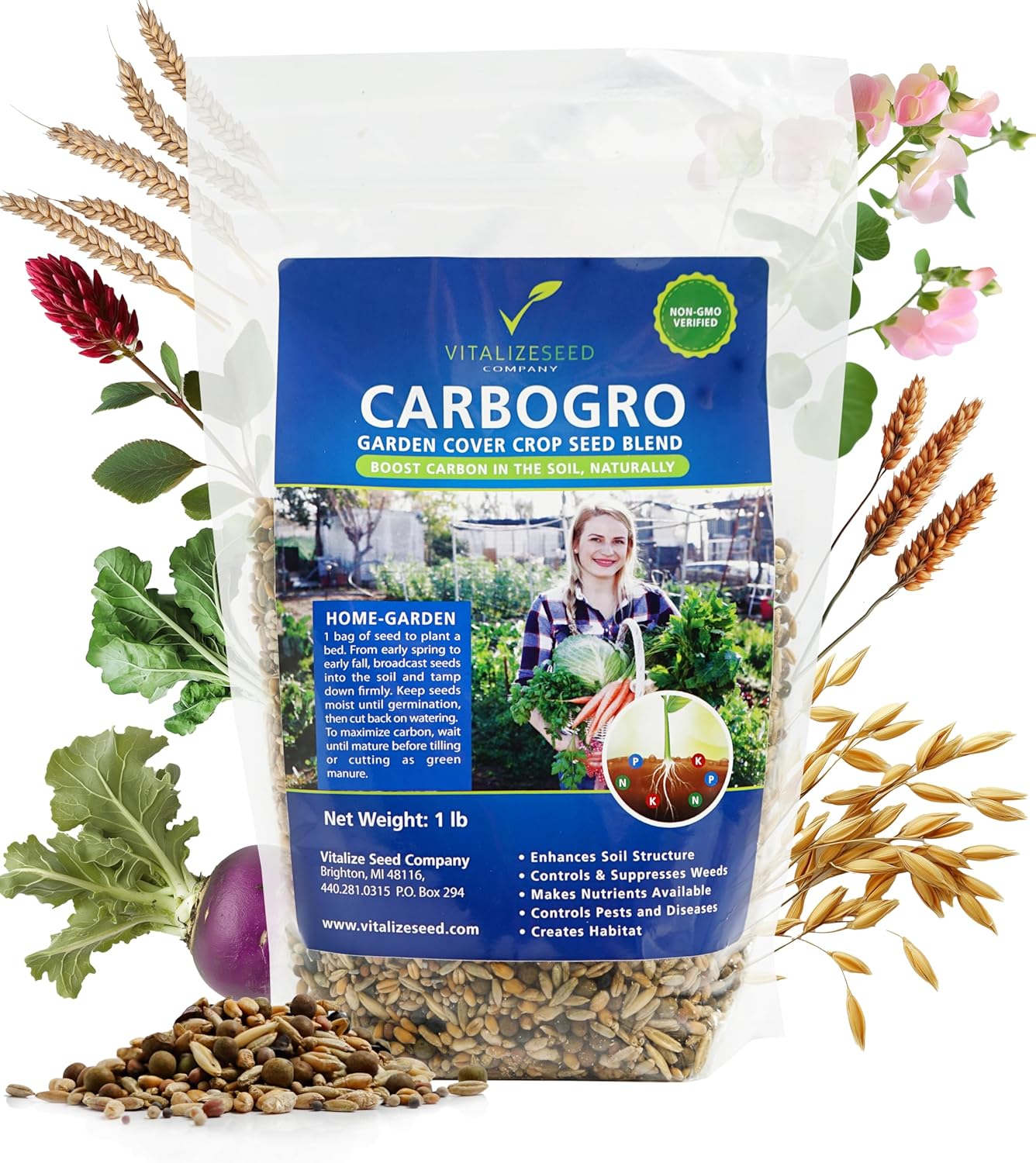
VitalizeSeed Carbogro Fall No-Till Cover Crop Seed Mix, 1 lb
| Sunlight Exposure | Full Sun |
|---|---|
| Unit Count | 16 Ounce |
| Brand Name | VitalizeSeed |
| Item Type Name | Seed |
Carbogro is a diverse 16-species cover crop blend intended for fall planting to protect soil over winter and deliver heavy spring biomass. Gardeners and small farmers use it as a no-till mulch to suppress erosion and weeds or as a green manure to till under and add organic matter before the next crop. The mix combines grains, brassicas, and clovers so different species establish at different rates and functions, which helps nutrient scavenging and promotes microbial activity in compacted or poor soils. In practice it establishes quickly in full sun, survives cold months, and produces abundant growth in spring that is easy to manage either by crimping or incorporation. Limitations are that performance depends on correct fall planting timing and adequate seed-to-soil contact, and a mixed-species blend means individual components cannot be managed separately if you need a single-species outcome. For clay soils seeking consistent winter survival and reliable biomass, Carbogro offers a robust, low-maintenance option.
Best for: Growers who prioritize a dependable, low-maintenance cover crop to reliably build organic matter and protect clay soils through winter so the ground is ready for spring planting.
Less Ideal for: People who need a single-species cover crop for a specific function or who plan to plant outside the recommended fall window.
- Broad 16-species blend combines grains, brassicas, and clovers for complementary functions
- Formulated for fall planting with good winter survival and strong spring biomass
- Works for both no-till thatch formation and as green manure when tilled under
- Supports soil biology and nutrient scavenging to improve soil structure over time
- Mixed-species seed means you cannot target or manage individual components separately
- Requires correct fall planting timing and good seed-to-soil contact for reliable establishment
Verdict: Choose Carbogro when you want a reliable, multi-species fall cover crop that builds biomass and improves soil health in clay soils with minimal fuss.
No-Till Solutions 13-Seed Cover Crop Mix (1 lb)

| Sunlight Exposure | Full Sun, Partial Sun |
|---|---|
| Soil Type | No-Till |
| Moisture Needs | Moderate Watering |
| Unit Count | 13 Count |
| Plant or Animal Product Type | peas |
This 13-seed No-Till Solutions mix is designed as a biodiverse cover crop blend for quick ground cover and soil improvement in no-till and raised-bed settings. The bag combines clovers (about half the mix) with vetch, peas, cowpeas, buckwheat, millet, lentils, flax and fenugreek to provide both rapid surface canopy (buckwheat, millet) and nitrogen-fixing roots (clovers, vetch, peas). It is inoculated with Rhizobium and marketed as GMO-free, which supports nitrogen fixation and a boost to beneficial soil fungi over time. Typical use is broadcasting or shallowly sowing in early spring or late summer, then mowing or cutting before seed set to leave a mulch layer that protects soil and suppresses weeds. Practical benefits include faster visual cover, improved soil structure and increased biodiversity of beneficial insects. Limitations are that performance depends on timing and moisture—some species need moderate watering and full to partial sun—and that a mixed blend can produce uneven dominance from the faster growers, so you may need to adjust seeding rate or management for a specific result.
Best for: Gardeners seeking a single, balanced cover-crop blend to establish quick ground cover while building soil biology in no-till beds and raised beds.
Less Ideal for: Growers who need a single-species lawn alternative or an exact crop composition for forage or seed production should look for a dedicated monoculture mix instead.
- Wide species diversity combines fast-covering plants and nitrogen fixers for both quick canopy and soil building
- Inoculated with Rhizobium to aid legume nitrogen fixation
- Suitable for no-till, raised beds, and container gardening so it fits small-scale and larger plots
- Non-GMO, nitro-coated seed from U.S. sources supports organic-friendly use
- Mixed blends can lead to some fast species dominating and reduce evenness of the stand
- Requires correct sowing time and consistent moisture to establish all included species
Verdict: Choose this mix when you want one balanced bag that establishes fast ground cover and builds soil fertility in no-till and raised-bed gardens.
Mountain Valley Seed Co Winter Rye Cover Crop Seeds, 5 lb

| Plant or Animal Product Type | Cover Crop |
|---|---|
| Sunlight Exposure | Full Sun |
| Expected Planting Period | Winter |
| Moisture Needs | Moderate Watering |
| Material Features | GMO Free |
Mountain Valley Seed Co Winter Rye is a no-fuss cover crop intended to protect and improve soil over the winter months. Broadcast in late fall or early winter, rye germinates quickly and produces a dense, fibrous root system that holds soil in place, reduces erosion, and helps break up compacted clay when tilled or left as a no-till stand. The seed is non-GMO and marketed for high germination, which makes establishment more reliable for gardeners who prefer lower-risk options. Use it in garden beds, raised beds, or larger plots to suppress weeds through rapid ground cover and allelopathic effects, then either mow, till in as green manure, or cut for mulch in spring. Practical limitations are that rye can be vigorous and may need timely termination before it sets seed, and it is not a legume so it does not fix atmospheric nitrogen like clovers or vetch. For clay soils the deep roots and dense cover provide tangible tilth and erosion control benefits, but expect to manage its regrowth if you plan an early spring planting.
Best for: Gardeners who prioritize a reliable, low-risk winter cover to stabilize clay soils and improve structure with minimal fuss.
Less Ideal for: Growers who specifically need a nitrogen-fixing cover or who cannot commit to terminating a fast-growing cereal cover before it sets seed.
- Fast germination and quick ground cover reduces winter erosion
- Deep, fibrous roots help break up compacted clay and improve soil tilth
- Packaged as non-GMO seed with a large 5 lb quantity suitable for substantial coverage
- Useful for no-till systems or as green manure when tilled in spring
- Does not fix nitrogen because it is not a legume
- Can be vigorous and requires timely termination to prevent reseeding
Verdict: Choose this winter rye if you want a dependable, fast-establishing cover crop to protect and improve heavy clay soil over winter.
Choosing the Right Green Manure for Clay Soil: Key Factors to Consider
Biomass and Ground Cover
High biomass matters because bulky tops and dense stems protect the soil surface from raindrop compaction, suppress weeds, and supply a large volume of organic matter when turned in. In clay soil, you want species that produce substantial aboveground growth without relying on deep dryness to thrive.
Timing is important: a quick-establishing cover will outcompete weeds and provide protection during wet periods. Consider how many weeks the cover crop will remain before you need to incorporate it, because biomass accumulates over time and later incorporation usually means more organic matter but a longer wait before planting cash crops.
Root System Type and Soil Penetration
Roots are the primary way a green manure changes clay structure. Fibrous roots create a dense network that helps bind newly formed aggregates and increases surface porosity. Deep taproots or stout pivot roots can break pans and create channels that improve drainage and root depth for following crops.
Choose species with roots suited to your specific clay problem. If you have a compacted layer or hardpan, look for taproots that can penetrate and fracture that layer. If the issue is surface crusting and poor aeration, fibrous-rooted covers that build a sponge-like layer near the topsoil are better.
Decomposition Rate and Timing
How quickly a green manure breaks down affects planting windows and nutrient release. Fast-decomposing covers let you incorporate green matter and plant again within weeks, while slow-decomposing stems can tie up nitrogen and delay planting unless properly managed.
Decomposition depends on tissue quality, C:N ratio, and soil biology activity. In cool, wet clay, decomposition is slower, so favor covers that either decompose rapidly or plan for earlier incorporation and composting of bulky residues when the soil is workable.
Nitrogen Fixation and Nutrient Value
Leguminous green manures fix atmospheric nitrogen and can reduce the need for supplemental fertilization for subsequent crops. For clay soils that are often low in microbial activity, adding legumes introduces both nitrogen and root exudates that feed soil life.
Non-legumes supply carbon and help with structure but may temporarily immobilize nitrogen as microbes break down high-carbon tissues. Consider mixing legumes and non-legumes to balance structure building with nutrient contribution.
Establishment Ease and Seedling Vigor
Compacted, poorly drained clay can be hard for small seeds to emerge through. Species with vigorous seedlings will establish ground cover faster and better compete with weeds and grasses. Larger-seeded covers are generally easier to establish in heavy soils because they have more energy reserves for pushing through dense surface layers.
Also factor in seeding depth tolerance and whether you can prepare a shallow seedbed. In wet seasons, choose covers that can handle standing soil moisture during germination without rotting off.
Management and Incorporation Practicalities
How you manage a green manure matters as much as which species you choose. Consider whether you will mow, flail, or till the crop in and how heavy residues will be to incorporate in wet clay. Some covers produce woody stems that are hard to break down without composting or a longer wait.
Plan incorporation around soil moisture; working clay when too wet causes compaction. Choose covers that match your available tools and the calendar you have for turning them under before the next crop.
Timing and Seasonality for Clay Beds
Planting time affects establishment and the eventual benefit to clay soil. In cool, wet springs you may prefer fast-germinating covers planted as soon as the soil can be worked; in late summer, quick-growing late-season covers can protect and build soil before winter. Some species tolerate waterlogged windows better than others and can be used as winter covers to prevent puddling and erosion.
Match the cover crop's growth cycle to your garden calendar. If you need to plant vegetables early in spring, select covers that can be terminated and decomposed quickly the previous fall or early spring so you do not delay your main crops.
- Start covers after harvest to prevent bare soil through wet months
- Use winter-hardy covers to protect against erosion and compaction
- Consider a killing date that allows at least two to four weeks of residue breakdown
Mixes Versus Single-Species Sowing
Mixing legumes and fibrous-rooted non-legumes gives complementary benefits: legumes add nitrogen, while grasses and brassicas provide structure and rapid biomass. In clay, mixes can combine taprooted plants that fracture compacted layers with fibrous species that protect the surface and build humus.
Single-species sowing is simpler to manage and makes timing decomposition more predictable. Use mixes when you want multiple benefits and are prepared to manage a slightly more complex residue profile at incorporation.
- Legume plus grass mixes balance nitrogen and carbon
- Brassicas can add deep rooting but may leave tougher stems
- Adjust seeding rates so dominant species do not outcompete companions
Establishing Covers in Wet, Compact Clay
Prepare the seedbed lightly; heavy cultivation can worsen compaction in clay. Often a shallow rake or broadcast seeding with light pressing is enough for larger-seeded covers. Avoid deep tillage when the soil is wet because that makes clods and re-compaction problems.
If the surface crusts after sowing, use a light mulch of straw or compost to protect seedlings, or choose larger-seeded species that can emerge through dense surfaces. Aim to seed when a few consecutive dry days are forecast, if possible, to improve germination success.
- Broadcast seed then roll or press for better contact
- Avoid working the soil when it sticks to tools
- Use cover mixes with at least one hardy, fast-establishing component
Incorporation Techniques for Clay Soils
Timing incorporation to when clay is moist but not wet prevents smearing and new compaction. Mechanical mowing followed by shallow rototilling or hand-digging works for small plots. For heavy residues, consider cutting and composting before incorporating to speed decomposition.
If you must work clay while still sticky, wait until the surface firms slightly. Using organic matter produced by the cover itself helps long term, but short-term management – like leaving residues on the surface as mulch rather than digging in immediately – can protect structure until the soil is ready.
- Mow high and let residues wilt a week before incorporation
- Shallow incorporation is usually better than deep in wet clay
- Compost woody residues separately for faster breakdown
Integrating Green Manure with Vegetable Rotations
Consider how long the green manure will occupy the bed relative to your main crops. Short-term covers that decompose quickly are suited to tight vegetable rotations, while longer-season covers are useful in offseason periods. Plan nitrogen-demanding crops to follow legumes for the best nutrient match.
Also think about disease and pest cycles. Some covers can host pests or share pathogens with subsequent crops, so rotate plant families and avoid back-to-back brassicas when possible. Green manures are a tool to improve soil health, but they should be woven into a broader rotation strategy.
- Terminate legumes a few weeks before planting heavy feeders
- Avoid replanting the same family after a large brassica cover
- Use green manures to rest beds after intensive cropping
How We Chose the Best Green Manure for Clay Soil
We selected green manures based on traits that directly affect clay soil improvement and usable garden outcomes. Primary evaluation criteria included biomass production, root structure and soil-penetration ability, decomposition speed and ease of incorporation, and nitrogen contribution or organic matter value for subsequent crops. We also considered winter hardiness and timing flexibility because clay beds often need cover through wet seasons, plus seed availability and ease of establishment in compacted ground. Exclusions were crops that require highly specialized equipment to incorporate or that perform poorly in heavy, poorly drained sites. The goal was to highlight cover crops that actually change clay structure through fibrous or taproot systems, deliver measurable organic matter within a season or two, and integrate practically with common backyard garden schedules. These filters kept options relevant for gardeners working with dense, slow-draining soils and looking for manageable, effective green manures.
FAQ
How long does it take for green manure to improve clay soil?
Often you will see measurable changes in surface structure within a season as roots and biomass add organic matter, but deeper improvements to compacted layers may take several seasons of repeated cover cropping and incorporation.
Can I plant green manure in waterlogged clay?
Some species tolerate temporary waterlogging better than others, but persistent standing water limits root growth and decomposition. Choose tolerant covers and plant when a dry window is forecast if you need reliable establishment.
When should I incorporate green manure before planting vegetables?
Terminate most covers at least two to four weeks before planting to allow residues to break down and nitrogen to become available. Faster-decomposing species need less lead time, while woody or high-carbon residues require longer or composting.
Will green manure make my clay soil drain better quickly?
Green manures improve surface structure and create root channels that aid drainage, but significant change in overall drainage can take multiple seasons. Expect progressive improvement rather than overnight fixes.
Is it better to mow or till green manure in clay?
Mowing followed by shallow incorporation usually minimizes re-compaction in clay. Deep tilling when wet can make compaction worse, so match your method to soil moisture and residue type.
Final Verdict
Green manures are a practical way to restore structure, increase organic matter, and slowly improve drainage in clay soils. Prioritize covers that combine strong biomass, complementary root types, and manageable residues for your schedule and tools. Expect incremental gains over multiple cover-cropping cycles and balance nitrogen-fixing legumes with carbon-rich species to avoid temporary nutrient lockup. With the right timing and termination strategy, you can turn heavy clay into a more workable, productive bed.
