

Note: This article contains affiliate links. If you click on these links and make a purchase, I may earn a small commission at no extra cost to you. This helps support my research and content. Read my full affiliate disclosure here.
Spring is when many plants shift from slow winter maintenance into active growth, and the right fertilizer in spring sets the tone for the season. Choosing a fertilizer that delivers the right nutrients at the right rate helps seedlings, bulbs, perennials, shrubs, and lawns push new growth without forcing weak, leggy shoots. This guide shortlists the top options for spring use and explains practical tradeoffs like nutrient ratios, release type, and application method. We tested entries against ease of use, nutrient balance, and suitability for common spring tasks to help you pick the best fit for your garden layout and maintenance style.
Top Picks at a Glance
| Best Overall The best all-around choice for most situations | Scotts Turf Builder Lawn Food, 12.5 lb |  |
| Best Quality Built to a higher standard if you want something more solid | Espoma Organic Spring Lawn Booster 8-0-0, 30 lb |  |
| Best Value The sweet spot between price and what you get | Scotts Turf Builder Lawn Food, 37.5 lb. |  |
| Best Budget The cheapest option that still gets the job done reliably | Miracle-Gro Water Soluble All Purpose Plant Food, 1.5 lb |  |
| Highest Rated A top-rated pick with lots of positive feedback | Down To Earth All Natural Vegetable Garden Fertilizer, 25 lb (4-4-4) |  |
| Most Popular A crowd favorite that many people choose with confidence | Miracle-Gro Water Soluble All Purpose Plant Food, 6.25 lb |  |
| Best Seller A high-volume bestseller chosen again and again | TPS NUTRIENTS Indoor Plant Food Liquid Fertilizer, 8 fl oz |  |
Scotts Turf Builder Lawn Food, 12.5 lb

| Item Form | Powder |
|---|---|
| Specific Uses For Product | Lawn |
| Coverage | 5,000 sq. ft. |
| Mixing Ratio | 32:0:4 |
Scotts Turf Builder Lawn Food is a general-purpose granular fertilizer formulated for use on any grass type to thicken turf and improve root strength. You spread it with a broadcast or drop spreader (Scotts provides recommended settings) and can apply it to wet or dry lawns in spring, summer, or fall. The formula is pesticide-free and emphasizes building deeper roots so the lawn better absorbs water and nutrients, which helps turf resist stress over the season. One 12.5 lb bag covers about 5,000 sq. ft., making it a simple option for small to medium yards or spot treatments. Practical benefits include clear application guidance, compatibility with common spreaders, and the option to water in for faster greening. Limitations are that this single bag covers a modest area compared with larger homeowner bags and it does not include weed control or insect protection, so you may need additional products for comprehensive lawn care.
Best for: Buyers who want a reliable, easy-to-apply granular fertilizer to strengthen and green a small to medium lawn and prefer products with widespread user approval and clear instructions.
Less Ideal for: Homeowners needing one-step weed or pest control, or those with large properties who want a single bag to cover many thousands of square feet.
- Works on all common grass types so one product fits mixed lawns
- Builds stronger, deeper roots to improve water and nutrient uptake
- Clear spreader settings and can be applied to wet or dry turf for flexibility
- Pesticide-free formula suitable when you only want fertilization
- Covers only about 5,000 sq. ft. per bag, requiring multiple bags for larger yards
- Does not include weed or insect control so additional products may be needed
Verdict: A reliable, easy-to-use granular lawn food that builds stronger roots and is a solid choice for feeding small to medium lawns.
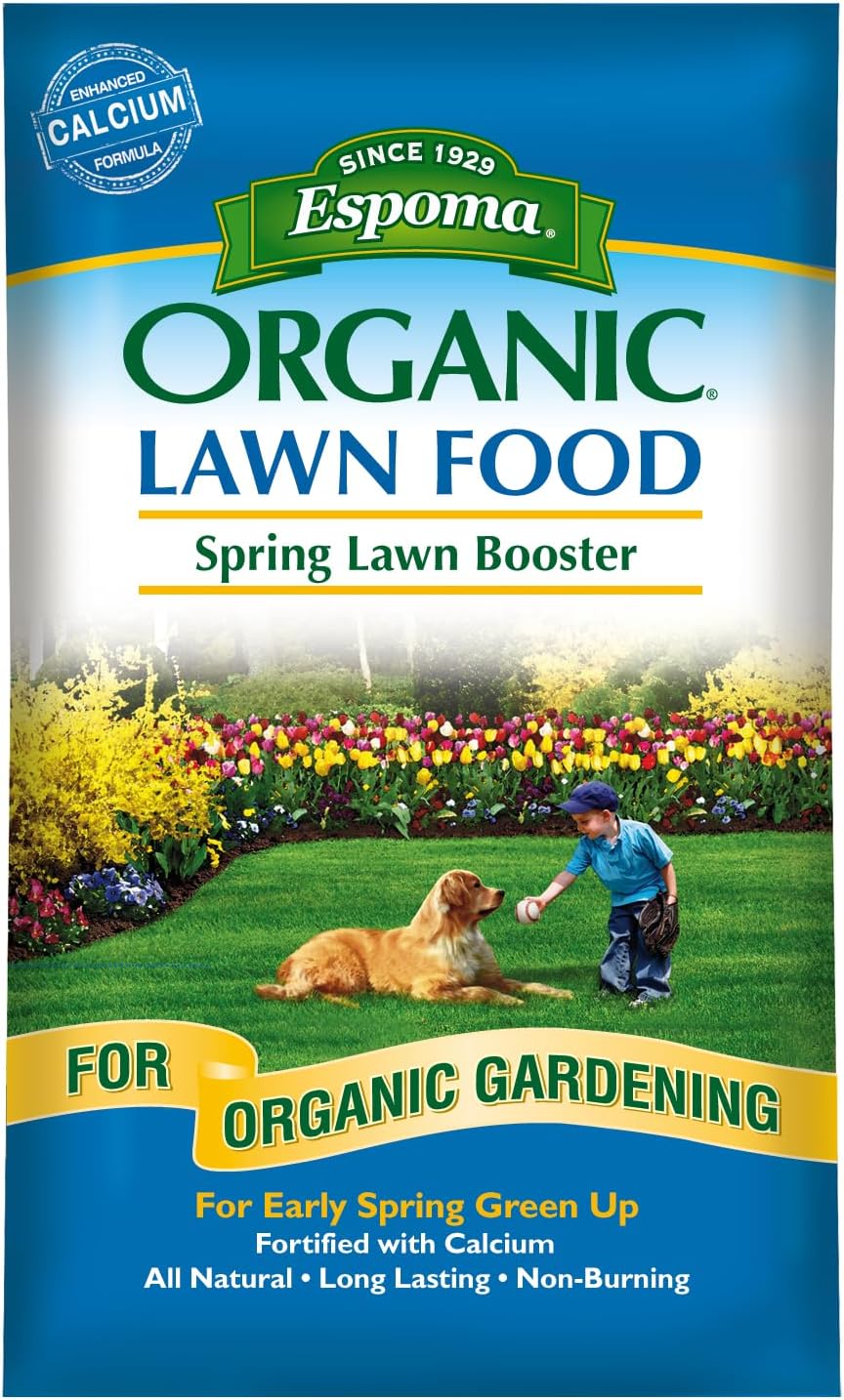
Espoma Organic Spring Lawn Booster 8-0-0, 30 lb
| Item Form | Granules |
|---|---|
| Application Method | broadcast spreader |
| Coverage | up to 5,000 sq ft |
| Mixing Ratio | 8-0-0 |
| Specific Uses For Product | Lawn,Organic |
Espoma Organic Spring Lawn Booster is a granular, organic fertilizer designed for spring application to turf grasses, including tall fescue. Applied with a broadcast or drop spreader, it supplies slow-release nitrogen (8-0-0) and added calcium to promote deep green color and steady early-season growth without burning. Its slow-release formula means you get longer-lasting feeding compared with quick-release synthetics, so lawns develop gradually rather than surging and then fading. Because it is OMRI-listed for organic gardening, it fits into organic lawn programs and is suitable for yards where pet and child safety is a priority. The bag covers up to 5,000 square feet, which makes it practical for typical suburban lawns but may be bulky for very small yards or hard-to-store for those with limited space. Users should plan application timing in early spring and have a spreader capable of handling granular fertilizers to get even coverage. For tall fescue, the steady nitrogen and calcium support early green-up and stronger blades without the risk of scorch from high salt fertilizers.
Best for: Homeowners who want an organic, low-risk spring feed for cool-season grasses like tall fescue and prioritize steady early-season green-up and safety around family and pets.
Less Ideal for: Gardeners who need a quick green-up from fast-release fertilizers or who prefer liquid or foliar feeds for spot treatments should look elsewhere.
- Slow-release nitrogen provides steady, long-lasting feeding for early-season growth
- Organic formulation approved for organic gardening and safer for kids and pets
- Contains added calcium to support turf color and plant health
- Covers up to 5,000 sq ft per 30 lb bag, suitable for typical lawns
- Granular format requires a spreader for even application
- Large 30 lb bag can be cumbersome to store or handle for small yards
Verdict: A reliable organic spring fertilizer that steadily greens and strengthens tall fescue without the burn risk of conventional quick-release products.
Scotts Turf Builder Lawn Food, 37.5 lb.

| Item Form | Granules |
|---|---|
| Specific Uses For Product | Lawn |
| Coverage | 15000 |
| Mixing Ratio | 32:0:4 |
Scotts Turf Builder Lawn Food is a granular, all-purpose lawn fertilizer formulated to thicken and green lawns while building deeper roots. It is used by broadcasting with a spreader or dropping with a drop spreader; Scotts gives specific spreader settings for easy, repeatable application. The bag covers a large area so it is convenient for whole-yard spring feeding routines. Practical benefits include improved root strength and better nutrient and water uptake compared with unfed turf, plus flexible timing since it can be applied to wet or dry grass and lightly watered in for faster greening. The product is pesticide-free and intended for any grass type, so it can fit into a seasonal program for warm-season grasses like Zoysia. Limitations are that it is a straight lawn food without weed control or insect ingredients, so you will need separate products for weeds or pests, and handling a 37.5 lb bag can be bulky for small yards or single-application needs.
Best for: Homeowners who want a straightforward, high-coverage spring fertilizer to strengthen and green their Zoysia lawn as part of a planned feeding routine.
Less Ideal for: Gardners who need one-step weed and feed or combined pest control solutions or those with very small lawns who prefer smaller package sizes.
- Covers up to 15,000 sq. ft. from one 37.5 lb. bag
- Formulated to build stronger roots and improve nutrient uptake
- Can be applied to wet or dry lawns and used with common spreaders
- Pesticide-free lawn food suitable for any grass type
- Does not include weed or insect control so additional products may be required
- Large bag size may be awkward for small properties or single applications
Verdict: A simple, high-coverage lawn food that reliably builds root strength and greens Zoysia when used as part of a seasonal feeding plan.
Miracle-Gro Water Soluble All Purpose Plant Food, 1.5 lb

| Item Form | Powder |
|---|---|
| Application Method | Watering Can |
| Target Species | For all flowers, vegetables, trees, shrubs and houseplants |
| Mixing Ratio | 24-8-16 |
Miracle-Gro Water Soluble All Purpose Plant Food is a powdered, water-soluble fertilizer formulated to deliver fast nutrition to a broad mix of plants. You mix the powder into a watering can or a garden feeder and apply every 1 to 2 weeks depending on whether plants are indoors or out. The 24-8-16 NPK ratio supplies a strong nitrogen boost for leafy growth along with phosphorus and potassium to support flowering and fruit set. For pepper growers this means it can help produce vigorous plants and encourage fruit development when used at the recommended strengths. Notable features include clear mixing guidance for both indoor and outdoor use and compatibility with container and in-ground plantings. Practical benefits are quick uptake by roots and flexible application options. Important limitations are the high nitrogen proportion, which can favor foliage over fruit if overused, and the need to follow dilution instructions to avoid nutrient burn. This product is best used as a regular boost within a balanced feeding plan rather than the only fertility source for long-term soil health.
Best for: Home gardeners looking for an affordable, easy-to-use boost to support vigorous pepper plant growth and quick results in both containers and garden beds.
Less Ideal for: Growers who want a low-nitrogen or slow-release fertility plan for long-term soil building should consider specialized or organic alternatives.
- Water-soluble powder that feeds plants quickly through the roots
- Clear mixing instructions for indoor and outdoor applications
- Broadly labeled for use on flowers, vegetables, trees, shrubs and houseplants
- Feeds approximately 600 sq. ft. from the 1.5 lb container
- High nitrogen ratio may encourage foliage more than fruit if used too frequently
Verdict: A budget-friendly, fast-acting soluble fertilizer that gives bell pepper plants a regular nitrogen-rich boost to promote vigorous growth and quicker results.
Down To Earth All Natural Vegetable Garden Fertilizer, 25 lb (4-4-4)

| Item Form | Granules |
|---|---|
| Target Species | vegetables |
| Unit Count | 400 Ounce |
| Mixing Ratio | 4-4-4 |
This 25 lb Down To Earth Vegetable Garden fertilizer is a granular, OMRI-listed organic blend designed to feed vegetables, herbs and container-grown edibles throughout the spring and summer. Gardeners typically broadcast or side-dress it into beds and containers to support leafy growth early in the season and to boost fruit size and yield for crops like tomatoes. The formula combines fish bone meal, alfalfa, feather meal, langbeinite, basalt, potassium sulfate, dolomite and seaweed meal to provide nitrogen, phosphorus and potassium along with mineral trace elements. Being granular makes it easy to handle and apply without measuring liquid mixes, and the organic inputs help build soil biology over time. Important limitations are that results are slower than synthetic fertilizers and you will need to follow application timing for best effect; heavy-feeding vegetables may require repeat applications. For gardeners prioritizing natural ingredients and steady long-term soil health, this is a dependable baseline fertilizer.
Best for: Gardeners who want a straightforward, naturally derived all-purpose fertilizer to support vegetables, herbs and container crops while building soil health over time.
Less Ideal for: Growers who need rapid, immediate nutrient correction or who prefer small single-season quantities for tiny balcony gardens.
- OMRI-listed organic formulation safe for certified organic gardens
- Balanced 4-4-4 N-P-K suitable for general vegetable and herb feeding
- Granular form is easy to apply as broadcast or side-dress for beds and containers
- Contains a mix of natural nutrient sources and mineral amendments to feed plants and soil biology
- Slower nutrient release compared with synthetic fertilizers, so effects appear over weeks rather than days
- Large 25 lb bag may be more than casual or balcony gardeners need at once
Verdict: A reliable, OMRI-listed organic 4-4-4 granular fertilizer that provides balanced, long-term nutrition for vegetable and herb gardens.
Miracle-Gro Water Soluble All Purpose Plant Food, 6.25 lb

| Item Form | Powder |
|---|---|
| Application Method | watering can |
| Target Species | all plants, flowers, vegetables, trees, shrubs and houseplants |
| Mixing Ratio | 1/2 tsp per gallon indoor; 1.5 tbsp per 1.5 gallons outdoor |
Miracle-Gro Water Soluble All Purpose Plant Food is a powdered fertilizer you mix into a watering can to feed shrubs, flowers, vegetables and houseplants. It dissolves quickly and is applied every 7 to 14 days outdoors or every two weeks for indoor plants using the included scoop and the specified mix ratios. The formulation supplies the core macronutrients nitrogen, phosphorus and potassium and is safe to use on most species when used as directed, so it is practical for routine maintenance of flower beds and ornamental shrubs. A single 6.25 lb container claims coverage of about 2,500 sq. ft., which makes it convenient for medium garden areas or repeated container feedings. Limitations are that it is a general-purpose NPK powder so it will not address specialty needs like high-phosphorus bloom boosting or micronutrient deficiencies, and frequent reapplication is required compared with slow-release granular fertilizers. It works best as a regular feed in a balanced garden fertility plan rather than a one-time corrective treatment.
Best for: Buyers who want a reliable, easy-to-use weekly or biweekly feed for flower beds and ornamental shrubs and prefer predictable results backed by many users.
Less Ideal for: Gardeners seeking a single-application slow-release solution or a specialty formula tailored for heavy bloom production should consider alternative products.
- Water-soluble powder that mixes quickly for immediate feeding
- Works on a wide range of plants including shrubs and flowering plants
- Includes measuring scoop with clear indoor and outdoor mixing instructions
- Feeds repeatedly over a season and covers an estimated 2,500 sq. ft.
- Safe to use as directed and formulated to avoid burning plants
- General-purpose formula does not target bloom boosting or specific micronutrient needs
- Requires frequent reapplication compared with slow-release fertilizers
Verdict: A dependable, easy-to-mix all-purpose feed that delivers regular nutrition for shrubs and flowering plants when used as part of a recurring watering routine.
TPS NUTRIENTS Indoor Plant Food Liquid Fertilizer, 8 fl oz

| Item Form | Liquid |
|---|---|
| Specific Uses For Product | Plant Food |
| Application Method | Watering can |
| Mixing Ratio | 2:1 (oz/gallon) or 1:64 (tbsp/gallon) |
TPS NUTRIENTS Indoor Plant Food is a concentrated liquid fertilizer made for regular use with houseplants. You mix the measured dose into water and apply it with your usual watering can; the label gives an easy mixing ratio for household use. Its kelp-enriched formula is pitched at improving leaf color, encouraging steady new growth, and supporting root health, so expect glossier foliage and more frequent leaf production when plants are fed consistently. The 8 fl oz bottle is portable and fits on a plant shelf or utility area, and the liquid form dissolves readily for even application. It is intended for medium coverage and labeled as gentle for weekly feeding, which simplifies care for busy owners. Important limitations are that this is a small bottle meant for regular top-up feedings rather than long-term bulk use, and it assumes you will follow dilution directions to avoid overfeeding. Keep it away from children and pets and avoid skin or eye contact when handling.
Best for: Plant owners who want a simple, low-effort weekly fertilizer to keep indoor foliage vibrant and encourage steady new leaf growth. Good for people who prefer an easy liquid mix applied during regular watering routines.
Less Ideal for: Gardeners needing a bulk or multi-season fertilizer for outdoor beds or large collections should consider larger-capacity or specialized products instead.
- Liquid concentrate mixes easily for even application with a watering can
- Kelp-enriched formula aimed at improving foliage color and encouraging new growth
- Gentle enough for weekly feedings according to product guidance
- Clear mixing instructions for home use
- Small 8 fl oz volume limits how many plants you can feed before repurchasing
- Not formulated or labeled for outdoor or large-scale garden use
Verdict: A convenient kelp-enriched liquid concentrate that makes weekly feeding easy for anyone who wants healthier, more vibrant indoor foliage.
Choosing the Right Fertilizer in Spring: Key Factors to Consider
Nutrient Ratio and Timing
The balance of nitrogen, phosphorus, and potassium determines how a plant allocates spring energy. Higher nitrogen supports leafy and shoot growth, moderate phosphorus helps root development after transplanting, and potassium strengthens overall stress tolerance. Matching the N-P-K to what you want in spring-for example, steady vegetative push in lawns or root support for newly planted perennials-prevents excess top growth or nutrient lockout.
Timing matters because rapid-release nitrogen can green plants quickly but may also encourage tender, frost-sensitive growth if applied too early. Controlled-release or lower-rate formulas provide a steadier supply that fits variable spring temperatures and rainfall patterns.
Release Mechanism: Quick-Acting Vs Controlled-Release
Quick-acting fertilizers deliver nutrients immediately and are useful when plants show visible deficiency or when you need fast greening. They are ideal for foliar applications or a short-term boost but require careful dosing and can leach in heavy spring rains.
Controlled-release products release nutrients gradually over weeks to months, smoothing out supply and lowering burn risk. For many spring tasks, a slow-release formula reduces the need for repeated applications and works well where soil moisture is unpredictable. Consider how often you want to apply fertilizer and local rainfall when choosing a release type.
Application Method and Accuracy
Different products suit broadcast spreading, point applications at transplants, granular side-dressing, or liquid drenching. Granules are convenient for large beds and lawns, while liquids and water-soluble powders work well for container plants and quick corrections. Foliar sprays can correct micronutrient deficiencies rapidly.
Accuracy in dosing matters because over-application can burn roots or promote weak growth and under-application may produce no visible benefit. Look for products with clear dosing guidance and packaging that helps measure small quantities for containers or concentrated mixtures for larger areas.
Soil Type and Existing Nutrient Levels
Soil texture and organic matter content change how nutrients behave. Sandy soils drain quickly and lose soluble nutrients faster, so they benefit from split applications or slow-release formulations. Heavy clay holds nutrients but can tie up phosphorus or micronutrients; soil testing helps reveal what to correct.
A soil test taken before spring applications prevents unnecessary fertilizing and targets real deficiencies. Amending based on test results improves long-term soil health and helps choose a product whose mineral composition works with your soil rather than against it.
Plant Type and Lifecycle Stage
Different plants need different spring feeds. Lawns usually respond to nitrogen-focused formulas in spring, while bulbs and newly planted shrubs may need a balanced feed with emphasis on phosphorus for root establishment. Ornamental trees and established perennials often need lighter feeding until they leaf out fully.
Knowing whether you are encouraging leafy growth, root development, flowering later in the season, or recovery from transplanting will guide the product choice and the application rate.
Environmental and Safety Considerations
Fertilizer runoff can harm waterways, and concentrated products pose risks if handled carelessly. Look for formulations and application methods that minimize leaching, such as slow-release granules or localized banding. Use calibrated spreaders and avoid applying before heavy rain.
Consider gardener safety: some concentrated fertilizers irritate skin or respiratory systems. Proper protective equipment, safe storage, and following label instructions reduce risks for people, pets, and beneficial wildlife.
When to Apply Spring Fertilizer
Timing a spring application depends on soil temperature and plant development rather than the calendar alone. For many temperate gardens, a good rule is to wait until soil consistently reaches around 45 to 50 degrees Fahrenheit for most perennials and lawns to avoid stimulating growth before frost risk has passed.
For bulbs that initiate growth early, apply a lighter, root-supporting feed at planting or as shoots emerge. For newly planted shrubs or transplants, apply a starter-style feed with moderate phosphorus at planting, then follow up with a balanced approach as they establish.
- Check soil temperature with a probe for best timing
- Avoid heavy nitrogen applications if late frosts are possible
- Split applications can protect against nutrient loss in rainy springs
Spring Fertilizer for Lawns Vs Garden Beds
Lawns typically need a nitrogen-forward formula in spring to green up and support the first growth flush. Choose a release type that fits your maintenance schedule: a slow-release feed for sustained growth or a quick-acting application when you need rapid color recovery.
Garden beds and containers often do better with balanced or slightly phosphorus-enhanced formulas early on to support root growth, especially after transplanting. Containers need more frequent, lighter feedings because nutrients leach faster with regular watering.
- Use a spreader for even lawn coverage
- Side-dress perennials rather than broadcasting near stems
- Container plants benefit from water-soluble feeds matched to pot size
Organic Vs Synthetic Spring Options
Organic fertilizers release nutrients more slowly as microbes break down the material. They improve soil structure and feed the soil biology, which is helpful for long-term soil health. Expect a gentler, longer-term response rather than an instant green-up.
Synthetic feeds provide predictable nutrient content and faster availability. They are useful when addressing clear deficiencies or when quick action is needed. Choose formulations with lower burn risk or opt for split applications to reduce leaching.
- Organic products improve long-term soil fertility
- Synthetic options offer precise N-P-K ratios and rapid correction
- Combine organic soil-building practices with targeted synthetic feeds if needed
How to Apply Fertilizer Safely in Spring
Read and follow label directions for rates and timing. Calibrate spreaders or measure liquid concentrates carefully. Watering after application may be needed to move nutrients into the root zone, but heavy rain right after application can cause runoff.
Wear appropriate protection when handling concentrates and keep pets and children away from freshly applied areas until instructions allow reentry. Store products in a dry, locked place away from moisture and food items.
- Measure precisely to avoid over-application
- Irrigate lightly after granular application when recommended
- Avoid application before heavy rain to reduce runoff risk
Addressing Common Spring Nutrient Deficiencies
Yellowing between veins, stunted growth, or pale new leaves often signal specific nutrient shortages such as iron or nitrogen. Foliar sprays can correct micronutrient shortages quickly, while soil-applied nitrogen corrects broader chlorosis in many species.
A soil test helps differentiate soil pH problems from actual nutrient deficiency. Low pH can lock out nutrients even when they are present, so correcting pH is sometimes more effective than repeated fertilizer applications.
- Use foliar feeds for fast micronutrient correction
- Test soil before chasing nutrient deficiencies
- Adjust pH when necessary to improve nutrient availability
How We Chose the Best Fertilizer in Spring
We selected fertilizers that address the specific demands of early-season gardening. Our editorial filters prioritized nutrient formulation relevant to spring growth, release mechanism, application flexibility, soil compatibility, and gardener safety and handling. We favored products that offer clear N-P-K profiles and documented release behavior, because these directly affect early shoot development and root establishment. We excluded specialty formulas intended solely for bloom boosting midseason, heavy chemical formulations meant only for high-input commercial use, and any products without transparent labeling. Evaluation focused on measurable criteria: nutrient ratio suitability for spring growth, controlled-release versus quick-acting performance, ease and accuracy of application for home gardeners, soil and plant safety considerations, and packaging that supports correct dosing. These dimensions reflect what matters most when applying fertilizer in spring and align with the scoring metrics below.
FAQ
Can I apply fertilizer as soon as the soil thaws?
Often it depends on soil temperature and plant activity. Applying once soil is consistently damp and around 45 to 50 degrees Fahrenheit is usually safer than right after thaw when roots are still inactive. Early applications can risk stimulating tender growth before frost danger has passed.
Is a slow-release fertilizer better for spring than a quick-release product?
It depends on your goal. Slow-release products reduce reapplication and lower burn and leaching risk, which is useful in variable spring weather. Quick-release feeds produce faster visual results and are better for correcting visible deficiencies or giving a rapid green-up.
How often should I reapply fertilizer during spring?
Frequency depends on the product and plant type. Controlled-release formulas may only need one application, while quick-acting or water-soluble feeds might be applied every few weeks at lighter rates. Follow label guidance and adjust based on plant response.
Should I fertilize newly planted trees and shrubs in spring?
New plantings typically benefit from a gentle starter feed that supports root establishment rather than heavy doses of nitrogen. Many gardeners apply a balanced, low-rate fertilizer at planting and hold off on heavier feeding until the following season unless a soil test indicates a clear deficiency.
Will fertilizer runoff from spring rains harm my yard or nearby water?
Runoff risk increases with heavy rain following application. Using slow-release products, avoiding application before heavy storms, and applying at recommended rates reduces runoff. Local regulations and best-practice guidance often recommend buffer zones near water.
Final Verdict
Picking the right fertilizer in spring means balancing immediate plant needs with long-term soil health. Prioritize a nutrient ratio and release type that match whether you want rapid green-up, root establishment, or a steady feed throughout the season. Consider soil testing, plant stage, and application accuracy to avoid overfeeding and environmental impacts. Your final choice should reflect the specific tasks you have in spring: lawns tend toward nitrogen-first approaches, newly planted specimens benefit from root-focused formulas, and containers need frequent, measured feeds. Focus on matching product behavior to those needs for the best seasonal results.
