

Note: This article contains affiliate links. If you click on these links and make a purchase, I may earn a small commission at no extra cost to you. This helps support my research and content. Read my full affiliate disclosure here.
If you maintain an expansive turf area, the right fertilizer spreader saves time and protects the lawn from uneven feeding. For large lawns you need equipment that holds enough material, travels comfortably, and lays down granules or seed at an even rate so you avoid patchy growth and burn spots. This guide covers our top shortlisted fertilizer spreaders for large lawns and explains the practical tradeoffs gardeners face when choosing capacity, accuracy, and durability. We evaluate models by hopper size, distribution consistency, and ease of use so you can match a spreader to your yard size and routine.
Top Picks at a Glance
| Best Quality Built to a higher standard if you want something more solid | CHAPIN 8400C Professional 100‑Pound Turf Broadcast Spreader |  |
| Best Value The sweet spot between price and what you get | Agri-Fab 130-lb Walk-Behind Broadcast Spreader (Model 45-0462) |  |
| Best Budget The cheapest option that still gets the job done reliably | Garvee Tow-Behind Broadcast Spreader, 90 lb Capacity, 12" Tires |  |
| Highest Rated A top-rated pick with lots of positive feedback | John Deere 130 lb Push Broadcast Spreader |  |
| Most Popular A crowd favorite that many people choose with confidence | Scotts Turf Builder EdgeGuard DLX Broadcast Spreader |  |
CHAPIN 8400C Professional 100‑Pound Turf Broadcast Spreader

| Load Capacity | 100 pounds |
|---|---|
| Wheel Type | Rubber |
| Number of Wheels | 2 |
| Material Type | Polyethylene, Stainless Steel |
The CHAPIN 8400C is a workhorse broadcast spreader aimed at serious homeowners and pros who need consistent coverage across lawns or larger properties. It pushes like a traditional walk‑behind spreader and uses a 100‑pound poly hopper on a stainless steel frame, an enclosed gearbox and cast agitator to keep material flowing without frequent clogging. The adjustable rotary gate and steel linkage let you control application pattern and rate for fertilizers, seed, and weed control products, while the 14‑inch pneumatic tires provide stability on uneven turf and moderate slopes. Practical touches include a rain cover, hopper grate to stop clumping, molded grips and a T‑handle for easier pushing. The unit requires assembly and is not recommended for salt, sand, or lime powders, so it is best for granular lawn products. Size and 38‑pound weight make it substantial to maneuver in tight beds, but that robustness is exactly what delivers steady, professional spread performance over larger areas.
Best for: Buyers who prioritize reliable, even application and durability for frequent use across lawns, acreage, or professional jobs where uptime and consistent coverage matter.
Less Ideal for: If you only need an occasional small‑yard spreader or must regularly apply salt, sand, or fine lime powders, a lighter-duty or specialty spreader would be a better fit.
- Large 100‑pound hopper reduces refill frequency for big yards
- Stainless steel frame and enclosed gearbox improve durability and reduce weather exposure
- Adjustable rotary gate and directional control for accurate application with different granular products
- 14‑inch pneumatic tires provide traction and stability on uneven terrain
- Included rain cover and hopper grate help prevent clumping in damp conditions
- Not recommended for salt, sand, lime or powderized materials
- Relatively heavy and sizeable which can make storage and maneuvering in tight spaces harder
Verdict: Choose the CHAPIN 8400C when you need a durable, high‑capacity broadcast spreader that delivers consistent professional‑grade coverage across larger lawns and properties.
Agri-Fab 130-lb Walk-Behind Broadcast Spreader (Model 45-0462)
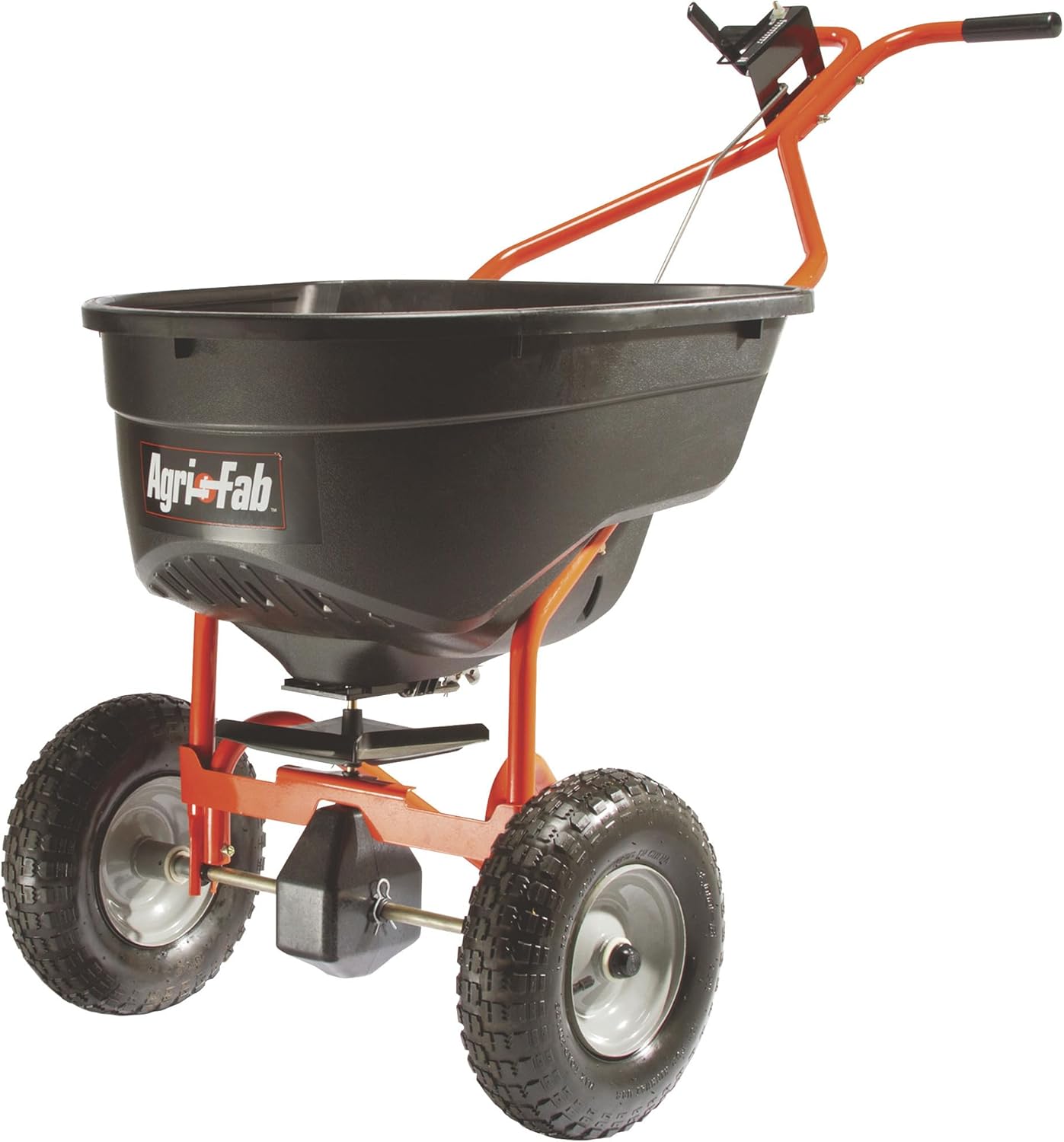
| Weight Capacity Maximum | 130 pounds |
|---|---|
| Number of Wheels | 2 |
| Tire Type | Tubeless |
| Material Type | Poly and steel |
The Agri-Fab 130-lb walk-behind broadcast spreader is a straightforward, high-capacity tool for spreading fertilizer, grass seed, or ice melt over lawns up to about half an acre. It uses a large polyethylene hopper and pneumatic tires to move smoothly over uneven turf, while a direct rod control makes adjusting and engaging the spread pattern simple during use. The wide broadcast pattern covers more ground per pass, reducing time spent spreading compared with lawn-size handheld options. Construction mixes poly and steel for a balance of durability and lighter weight, and the ergonomic handle improves comfort during longer passes. Expect reliable performance for routine residential lawn care, though assembly is required and the unit is a push-style spreader so it is physically demanding on larger sites. Controls are basic rather than precision-calibrated, so granular control for very small application rates may require extra care. For seasonal tasks from spring seeding to winter deicing, this model delivers consistent, no-frills coverage for homeowners focused on efficiency and capacity.
Best for: Homeowners who want a no-nonsense, high-capacity spreader to finish lawn tasks faster and who prioritize durability and ease of use over precision metering.
Less Ideal for: Owners of very large properties who prefer tow-behind or tractor-mounted spreaders and users who need highly precise, small-rate fertilizer application.
- Large 130 lb hopper reduces refills and speeds work on medium lawns
- Pneumatic tires and simple frame roll well over uneven yards
- Direct rod control is easy to use and intuitive while walking
- Polyethylene hopper and steel components provide a durable yet reasonably light build
- Push operation can be tiring on larger properties
- Controls are basic and may require testing to dial in precise spread rates
Verdict: A rugged, high-capacity push spreader that saves time on medium residential lawns by covering large areas with one hopper load.
Garvee Tow-Behind Broadcast Spreader, 90 lb Capacity, 12" Tires

| Capacity | 90 lb |
|---|---|
| Tire size | 12 in pneumatic |
| Frame material | Powder-coated steel |
| Hopper material | Rust-proof poly |
| Spread width | Up to 9.8 ft |
The Garvee tow-behind broadcast spreader is built to cover large lawns with fewer refills thanks to its 90 lb hopper and wide adjustable spread control. It attaches to most lawn tractors, ATVs, or UTVs with a universal hitch and offers up to 15 flow settings and a spreading width up to about 9.8 feet for precise, even application of fertilizer, seed, salt, or ice melt. The powder-coated steel frame and rust-proof poly hopper improve durability, while 12-inch pneumatic tires help the unit roll smoothly over grass, gravel, and uneven ground. Assembly is straightforward and operation is simple, making it practical for homeowners who want to finish large jobs quickly without specialized training. Limitations to note are the manual adjustment style rather than electronic metering and the need for a tow vehicle, which makes it less useful for very small lawns or users without compatible equipment.
Best for: Homeowners or small-farm owners with a tow vehicle who need to treat large lawns efficiently and prefer a straightforward, low-cost workhorse.
Less Ideal for: Those with very small yards or no compatible tow vehicle should consider a push spreader or handheld alternative instead.
- Large 90 lb hopper reduces how often you need to stop and refill
- Adjustable flow with up to 15 settings and near 9.8 ft spread for controlled coverage
- Durable powder-coated steel frame and rust-resistant poly hopper for year-round use
- 12-inch pneumatic tires provide good mobility over rough or uneven terrain
- Requires a tractor, ATV, or UTV to tow so not suited for walk-behind use
- Adjustments are manual which can be slower to fine-tune than calibrated electronic systems
Verdict: If you have a lawn tractor or ATV and want to cover large areas with fewer stops, this 90 lb tow-behind spreader is a practical, durable choice.
John Deere 130 lb Push Broadcast Spreader

| Capacity | 130 lbs. |
|---|---|
| Approximate coverage | Up to 25,000 sq ft |
| Spread width | 10 – 12 ft |
| Wheels | 13" x 4" pneumatic tires |
This John Deere push broadcast spreader is built for larger lawns and frequent use. The 130 lb rust-proof poly hopper lets you cover roughly half an acre between refills, while the broadcast plate delivers a 10 to 12 ft spread that speeds application and reduces passes. Control is simple: a direct rod gate and adjustable flow stop let you dial output for seed, fertilizer, weed control products, or ice melt so you get more even coverage and less waste. Durability is focused on practical longevity rather than lightweight portability — heat-treated steel gears are enclosed to resist corrosive materials and large turf-tread pneumatic tires make it easy to push across uneven turf. Assembly is required and the unit is substantial to maneuver compared with compact hand spreaders, but that heft contributes to stability and capacity. For performance-focused gardeners with mid-size to large lawns, it reduces refill frequency and produces consistent spreading; casual users with very small yards may find it larger than necessary.
Best for: Gardeners and property owners who prioritize efficient, consistent coverage across mid-size to large lawns and want a durable spreader that reduces refill interruptions.
Less Ideal for: People with very small yards, limited storage space, or who need a lightweight, highly portable seed spreader.
- Large 130 lb poly hopper reduces refills for up to 25,000 sq ft of coverage
- Wide 10–12 ft broadcast spread speeds application and improves uniformity
- Direct rod control and adjustable flow stop for precise output with different materials
- Enclosed heat-treated steel gears and turf-tread pneumatic tires improve durability and maneuverability
- Substantial size and weight make it less convenient for very small yards or frequent transport
- Some assembly required before first use
Verdict: Choose this spreader if you need high-capacity, consistent broadcast coverage for mid-size to large lawns without frequent refilling.
Scotts Turf Builder EdgeGuard DLX Broadcast Spreader

| Brand | Scotts |
|---|---|
| Item Type | EdgeGuard DLX Broadcast Spreader |
| Additional Features | EdgeGuard Technology, Pre-calibrated |
| Capacity Coverage | Up to 15,000 sq. ft. |
The Scotts Turf Builder EdgeGuard DLX is a straightforward broadcast spreader for homeowners who need even coverage across medium to large lawns. It arrives pre‑calibrated and uses a curved hopper with a dual‑bladed agitator to keep granular seed and fertilizer flowing smoothly while the EdgeGuard side shield blocks product from driveways, flower beds, and sidewalks. Settings are matched to Scotts product recommendations so setup is quick: pick the dial setting, pour in the product, and walk at a steady pace. The large capacity covers up to 15,000 sq. ft. per fill, and the robust hopper and agitator help prevent clumping with common lawn products. Downsides are that it is a broadcast spreader, so fine tuning application rate beyond the preset settings is limited and it requires steady walking speed for uniform results. It is also a single‑model design without specialty attachments for precision corridors or narrow strips. For routine seeding, fertilizing, or winter ice melt, it delivers consistent, reliable performance for the typical homeowner.
Best for: Homeowners who want a reliable, easy-to-use spreader for regular seeding, fertilizing, and winter salt tasks and who value convenience and consistent coverage across medium to large lawns.
Less Ideal for: Users who need highly precise application rates, professional landscapers, or those who work mainly in very tight or narrow planting areas.
- Pre-calibrated dial matched to Scotts product settings for quick setup
- EdgeGuard side shield prevents spread onto sidewalks, driveways, and beds
- Curved hopper and dual-bladed agitator reduce clumping and ensure smooth flow
- Large capacity covers up to 15,000 sq. ft. per fill for fewer refills
- Limited fine-tune control beyond preset calibration for precise application
- Not optimized for very narrow strips or beds where a drop spreader is better
Verdict: A user-friendly, pre-calibrated broadcast spreader that delivers consistent coverage and protects borders, making it a strong all-round choice for home lawn care.
Choosing the Right Fertilizer Spreader for Large Lawns: Key Factors to Consider
Hopper Capacity and Refill Frequency
On a large lawn, hopper capacity directly affects how often you must stop and refill. A larger hopper reduces downtime and makes it easier to complete application in one pass, which improves consistency across the whole yard. Consider the practical fill volume in gallons or pounds and remember that bulkier hoppers add weight when full, which affects towing and wear.
Also think about how easy it is to load and clean the hopper. Wide, low lips and smooth interiors make pouring fertilizer faster and reduce trapped material that can corrode over time. For very large properties, models that accept large bags or have funneling accessories will save repeated trips to storage.
Spread Pattern and Rate Control
Spread accuracy determines whether fertilizer is delivered evenly or in streaks that cause inconsistent growth. Look for adjustable gates and calibrated rate charts that match common lawn products. A consistent pattern reduces the need for overlapping passes and lowers the risk of overapplying in one area.
Flow control should be easy to change while you work so you can respond to product differences and ground speed. Consider whether the mechanism meters granules reliably across the entire width or if flow varies with hopper fill level, which is a common issue on larger machines.
Coverage Speed and Working Width
Working width and how fast you can push, tow, or drive the spreader determine how long a job will take. Wider spread patterns cover more ground per pass, but effective width depends on machine type, ground speed, and wind. For large lawns, balance a wider spread with the need for consistent coverage; excessively wide patterns can increase drift in breezy conditions.
Also evaluate how the spreader behaves at different speeds. Some meter systems assume a steady walking pace, while tow-behind units may be rated at a specific vehicle speed. Choose a spreader whose expected operating speed matches your equipment and typical work pace.
Durability and Corrosion Resistance
Fertilizers are chemically active and can accelerate wear and corrosion. Materials and protective finishes matter for long-term service on a large lawn where the spreader sees frequent use. Look for UV-stable plastics, powder-coated frames, stainless or galvanized fasteners, and seals in critical moving parts.
Consider how easy it is to do routine maintenance such as lubricating bearings and rinsing the hopper. Replaceable wear parts and straightforward service access extend a spreader's useful life and reduce downtime during peak seasons.
Towing, Traction, and Maneuverability
How a spreader moves across the lawn affects comfort and efficiency. For very large areas, tow-behind models pulled by a lawn tractor or ATV reduce physical exertion, while walk-behind or push units may be better for tighter spaces and precise control. Tire size, tread pattern, and wheel bearings influence traction and the machine's ability to handle slopes or uneven turf without bogging down.
Consider turning radius and hitch compatibility with your existing equipment. Ease of steering and stability when full are important for avoiding spills and keeping an even spread pattern on undulating ground.
Compatibility With Granular Products and Accessories
Different fertilizers, seed blends, and ice-melt products vary in granule size and flow characteristics. A spreader that accepts a range of particle sizes and includes or supports liners, baffles, or different metering plates will be more versatile across seasons. Check whether the manufacturer provides calibrated charts or settings for common products.
Accessory availability such as spreader covers, deflectors for sidewalks, or higher-capacity hoppers can change how practical a unit is for large properties. Accessories that simplify filling, transport, and cleaning reduce total work time across repeated treatments.
Choosing Between Tow-Behind and Walk-Behind Models
Tow-behind spreaders save effort and are usually the fastest way to treat acres because they can carry larger hoppers and maintain a steady speed when attached to a tractor or ATV. They are well suited to open turf with gentle terrain and when you have powered equipment available.
Walk-behind models offer greater control for edges, slopes, and narrow passes. They let you adjust your path precisely and are easier to store and maintain for gardeners who do not have a tow vehicle. For very large lawns, a walk-behind can still be practical when its hopper capacity and ergonomics are optimized for long sessions.
- Tow-behind: higher capacity, faster coverage, needs compatible vehicle
- Walk-behind: better maneuverability, finer control near beds and walkways
Operating Tips for Even Coverage
Maintain a steady speed and overlap passes slightly according to the spreader's recommendations. Speed changes are one of the main causes of striping or uneven application.
Avoid spreading on windy days to limit drift. When wind is present, shorten the spread width or apply in a different direction to compensate.
Calibrate your spreader before treating a large area. A quick test run over a measured distance with a known amount of product will tell you whether the settings match the rate on the fertilizer bag.
- Do a test calibration pass before treating the whole lawn
- Keep speed and gate setting consistent across passes
- Rinse the hopper after each use to prevent corrosion
Maintenance Practices That Extend Service Life
Rinse and dry the hopper and moving parts after each season to remove corrosive residues. Even a quick shake-out and brush can reduce buildup and preserve flow accuracy.
Inspect tires, bearings, and hitch points periodically for wear. Replacing cheap bearings or worn wheels is an inexpensive way to maintain smooth coverage over large areas.
- Lubricate moving parts annually or per manufacturer guidance
- Store under cover or indoors to protect finishes
- Replace worn metering plates or seals to retain accuracy
Adapting Techniques for Sloped or Wet Lawns
On slopes, control flow to prevent material rolling downhill and concentrate on shorter, more frequent passes. Tow-behind units may show different spread patterns uphill versus downhill, so test and adjust accordingly.
Avoid spreading on very wet turf, which reduces adhesion and can produce uneven distribution. If ground conditions force a delayed application, keep fertilizer dry and stored in sealed containers until you can apply safely.
- Use smaller passes on steep slopes to maintain control
- Wait for drier conditions when possible to reduce clumping
- Adjust flow settings when operating uphill or downhill
Seasonal Uses Beyond Fertilizer
Large-capacity spreaders are versatile tools. Outside of fertilizer application they can handle overseeding, distributing limestone, or spreading granular weed preventers. Choosing a spreader that accepts a range of particle sizes increases its year-round utility.
Be mindful of cross-contamination when switching between products. Clean the hopper thoroughly between different applications to avoid chemical reactions or unwanted nutrient mixes that could harm the lawn.
- Overseed with compatible seed sizes and adjust flow
- Use deflectors when applying near hardscapes
- Thoroughly clean between different chemical products
How We Chose the Best Fertilizer Spreader for Large Lawns
We focused on features that matter when treating large lawns and applied practical filters to narrow the field. First, capacity and hopper design were required to minimize refill stops on wide properties. Spread pattern consistency and adjustable flow control were included to reduce overlapping or missed strips that create uneven growth. Ease of towing or pushing was assessed because long sessions amplify ergonomic issues. Build materials and corrosion resistance were considered to ensure a spreader stands up to frequent exposure to fertilizer. Finally, accessory fit and compatibility with different granular products were evaluated so a spreader is useful year-round. We excluded small handheld and garden-scale push models that cannot maintain efficient coverage on acres and trimmed out equipment intended only for fertilizer types incompatible with common lawn products. Products that lacked clear flow adjustment or provided no meaningful capacity data were not considered. The criteria above guided selection and align with the scoring labels shown for each entry.
FAQ
How do I calibrate my spreader for the correct application rate?
Calibration usually involves measuring out product dispensed over a fixed distance at your typical operating speed and adjusting the gate until the output matches the recommended pounds per 1,000 square feet. Perform a small test run, collect the output, weigh it, and consult the fertilizer bag to compute the correct setting.
Can I use the same spreader for seed and fertilizer?
Often yes. Many spreaders handle both, but particle size and density differ. Clean the hopper between uses and adjust metering settings to match each product. Some materials may require different plates or baffles for reliable flow.
Is it better to spread on a calm day or after rain?
Calm, dry conditions are generally best. Wind increases drift and uneven distribution. Avoid spreading immediately after heavy rain because wet granules can clump and stick, causing inconsistent coverage; light moisture after application helps granules adhere and begin working.
How often should I replace parts on a high-use spreader?
Maintenance needs vary, but inspect high-wear items like bearings, tires, and metering components each season. Replace parts showing significant wear or corrosion promptly to maintain spread accuracy and avoid larger failures during peak use.
What speed should I use when towing a spreader with a tractor?
Follow the spreader's recommended operating speed, which is often specified for tow-behind units. If no guidance is provided, keep speeds moderate and steady to maintain consistent flow. Faster speeds can widen the effective spread but may increase drift and reduce accuracy.
Final Verdict
For large lawns prioritize hopper capacity, consistent spread control, and durable construction. Decide whether a tow-behind unit fits your equipment and acreage or whether a high-capacity walk-behind better matches your need for precise passes. Balance coverage speed with spread accuracy and maintenance practicality when choosing a tool. Focus on the factors that will reduce refill time and maintain even application across wide areas. That approach will help you pick a fertilizer spreader that saves time while protecting the health and appearance of your large lawn.
