

Note: This article contains affiliate links. If you click on these links and make a purchase, I may earn a small commission at no extra cost to you. This helps support my research and content. Read my full affiliate disclosure here.
Red clay changes how seeds behave in the garden. Dense, slow-draining soil can delay germination, stunt roots, and favor rot over growth. Choosing seeds bred for clay tolerance or those with quick-rooting habits makes the difference between a patchy bed and a thriving planting. This guide covers six top garden seed options suited for red clay soil. We shortlisted varieties that handle compaction, establish strong root systems, and tolerate wet periods. Below you will find practical notes on performance, seeding technique, and the evaluation factors we used to pick them.
Top Picks at a Glance
| Best Overall The best all-around choice for most situations | No-Till Solutions 13-Seed Cover Crop Mix (1 lb) |  |
| Best Quality Built to a higher standard if you want something more solid | BuildASoil No-Till 60% Clover Seed Mix — 12-Species Cover Crop Blend (1 lb) |  |
| Best Value The sweet spot between price and what you get | TIN SHED No-Till Cover Crop Mix Seed (Multi-Species Nitrogen-Fixing Blend) |  |
| Best Budget The cheapest option that still gets the job done reliably | SWEET YARDS Red Clover Seeds — 1 oz (approx. 15,000 seeds) |  |
| Highest Rated A top-rated pick with lots of positive feedback | Mountain Valley Seed Co No-Till Garden Cover Crop Mix |  |
| Most Popular A crowd favorite that many people choose with confidence | Groundio Crimson (Red) Clover Seeds, 5 lb |  |
No-Till Solutions 13-Seed Cover Crop Mix (1 lb)

| Sunlight Exposure | Full Sun, Partial Sun |
|---|---|
| Soil Type | No-Till |
| Moisture Needs | Moderate Watering |
| Material Features | GMO Free, Natural |
This 13-seed mix combines clovers, vetch, peas, buckwheat, millet, lentil, flax and other cover crops intended for no-till and raised-bed applications. It is typically broadcast over bare or prepared soil and allowed to establish as a living cover between planting seasons or as a seasonal green manure. Key features include a high clover proportion for nitrogen fixation, a mix of quick-establishing species like buckwheat for weed suppression, and inoculation with rhizobium to support legume nitrogen uptake. In practice the mix promotes soil structure and biodiversity by attracting pollinators and predators while increasing organic matter when cut and incorporated or terminated. Limitations are that the bag is a one-pound quantity suited to small plots or trialing rather than large acreage and the variety balance may favor clovers, so individual species dominance can occur depending on site conditions. Seed selection is natural and GMO-free, and the blend is aimed at building long-term soil health rather than providing an immediate cash crop.
Best for: Gardeners focused on improving soil structure and fertility in small plots or raised beds who want a low-effort, biodiversity-driven cover crop solution for seasonal management.
Less Ideal for: Farmers needing large-scale seed quantities or gardeners seeking a single-species cover crop for a specific immediate harvest purpose.
- Broad biodiversity with 13 complementary cover crop species for soil health
- Includes legumes and is inoculated with rhizobium to enhance nitrogen fixation
- Suitable for no-till, raised beds, and container gardening
- Non-GMO, natural seed mix sourced from USA
- Bag size (1 lb) is best for small gardens and not optimized for large acreage
- High clover proportion may outcompete some slower species in certain soils
Verdict: Choose this mix when you want an easy, biodiversity-rich no-till cover crop to rebuild clay soil structure and increase fertility in small gardens.
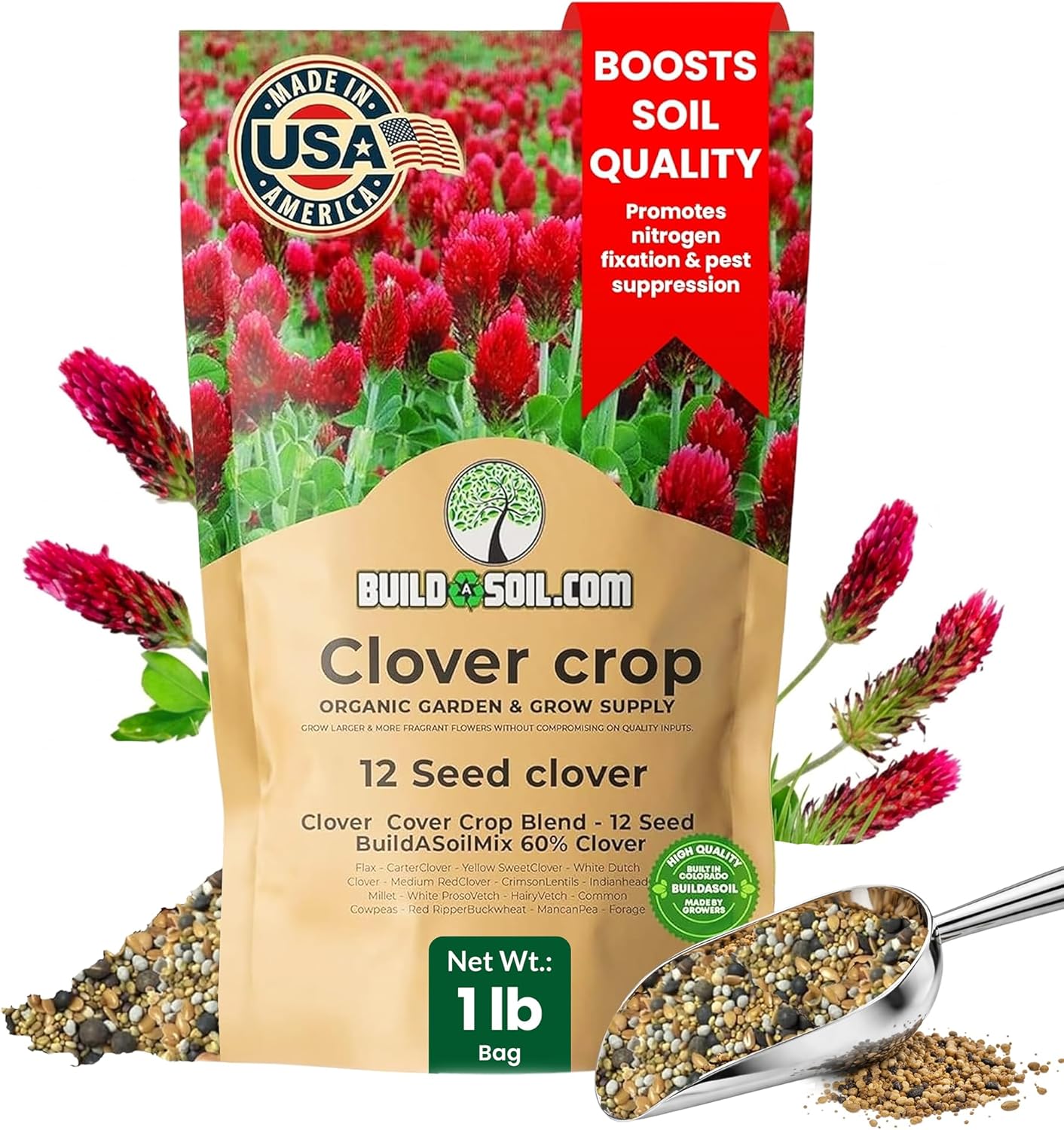
BuildASoil No-Till 60% Clover Seed Mix — 12-Species Cover Crop Blend (1 lb)
| Unit Count | 16 Ounce |
|---|---|
| Indoor Outdoor Usage | Outdoor |
| Brand Name | BUILD A SOIL |
This BuildASoil mix is designed as a high-clover, no-till cover crop for gardeners who want fast soil-improving performance without planting grasses or fillers. With 60% clover across multiple varieties plus 11 companion species, it establishes quickly to suppress weeds, fix nitrogen, and increase biological activity in compacted or poor soils. Typical use is broadcasting into beds, lawns, or large plots in spring, fall, or via frost seeding, then letting the clover act as a living mulch or mow-free lawn substitute. The mix is non-GMO and USA-made, and the concentrated clover content means more nitrogen contribution per pound and faster canopy closure than mixed grass blends. Limitations are that pure clover stands can be less wear-tolerant than turfgrass and may need reseeding in high-traffic areas, and the one-pound unit covers about 900 sq ft so larger areas require bigger bags. For clay soils the blend’s quick root growth and soil biology stimulation help improve structure over seasons, but results depend on correct seeding timing and site preparation.
Best for: Gardeners and small-scale farmers focused on fast soil improvement and low-maintenance ground cover who prioritize biological performance and nitrogen fixation over traditional turf aesthetics.
Less Ideal for: Property owners who need a durable, high-traffic lawn replacement or those seeking a traditional grass lawn look and feel should consider turfgrass mixes instead.
- High clover concentration (60%) delivers strong nitrogen fixation and rapid ground cover
- 12-species mix increases biodiversity to boost soil biology and resilience
- Formulated for no-till and no-mow use, reducing maintenance and irrigation needs
- Non-GMO and USA-made seed blend
- Clover-dominant stands are less tolerant of heavy foot traffic compared with traditional turf
- One-pound bag covers about 900 sq ft, requiring larger quantities for extensive areas
Verdict: Choose this concentrated clover mix if you want a low-maintenance, high-nitrogen cover crop that rapidly improves soil health in challenging garden soils.
TIN SHED No-Till Cover Crop Mix Seed (Multi-Species Nitrogen-Fixing Blend)

| Indoor Outdoor Usage | Outdoor |
|---|---|
| Sunlight Exposure | Full Sun |
| Expected Planting Period | Fall planting or between crop rotations |
| USDA Hardiness Zone | 3-8 |
| Material Features | Nitrogen-fixing blend |
This TIN SHED No-Till Cover Crop Mix is a versatile seed blend for gardeners who want to protect and improve soil without tilling. The mix combines grasses (triticale, rye), legumes (hairy vetch, peas, crimson and balansa clover), and deep-rooted brassicas (radish, rapeseed) so it establishes fast, creates a dense cover to shade out weeds, and adds nitrogen and organic matter when left to grow or terminated. Typical use is fall or between-crop planting after harvest in full sun to hold soil, reduce erosion, and loosen compacted layers with radish roots. Its no-till focus makes it easy to integrate into crop rotations or cover cropping plans and beneficial for building soil structure and water infiltration. Limitations are that success depends on proper timing and enough seedbed contact, and you will need to mow or terminate the stand before planting cash crops the next season. Pack sizing and seeding rate guidance are not detailed in the product notes so heavier or larger areas may require planning or multiple bags.
Best for: Gardeners who want a practical, low-disturbance cover crop to suppress weeds and build soil between growing seasons and who plan crop rotations around a fall or between-crop planting schedule.
Less Ideal for: Small pots, ornamental flower beds where intentional green manure is undesirable, or gardeners needing a single-species lawn repair seed rather than a multi-species soil-building blend.
- Diverse mix of grasses, legumes, and brassicas for complementary soil benefits
- Includes nitrogen-fixing legumes to naturally boost soil fertility
- Deep-rooted species help alleviate compaction and improve water movement
- Formulated for no-till systems so it fits into low-disturbance garden practices
- Seeding rate and bag coverage are not specified which complicates planning for larger areas
- Requires proper timing and a termination step before planting crops
Verdict: Choose this mix when you want a no-till, multi-species cover crop that suppresses weeds while building soil fertility and structure.
SWEET YARDS Red Clover Seeds — 1 oz (approx. 15,000 seeds)

| Unit Count | 1 Ounce |
|---|
This 1-ounce packet of red clover from SWEET YARDS supplies a high seed count suitable for seeding larger patches or using as a cover crop. Gardeners typically broadcast or shallowly sow the seeds in prepared soil where they germinate into low-growing clover with crimson flower heads that attract bees and other pollinators. Notable features include the large seed quantity that can cover about 100 sq ft, reusable zipper packaging with planting instructions, and a brand germination guarantee. In practice red clover works well to improve soil nitrogen and reduce erosion on open beds and slopes, so it is a practical choice for repairing or enriching heavy red clay when incorporated or mowed into the soil. Limitations are that clover prefers reasonably firm seed-to-soil contact and may need light raking and consistent moisture to establish on compacted clay, and it is not a quick substitute for heavy mechanical soil amendments when drainage and compaction are severe. For budget-focused gardeners this packet offers a generous amount of seed and clear instructions that make large-area planting straightforward.
Best for: Gardeners who want an inexpensive way to green and enrich bare or compacted beds, establish pollinator habitat, or seed large areas as a cover crop on a tight budget.
Less Ideal for: Gardeners seeking immediate erosion control on extremely compacted, poorly drained clay or those who need ornamental plants with precise spacing and uniform lawns.
- Very high seed count suitable for covering large areas or using as a cover crop
- Attracts pollinators and provides nitrogen fixation to improve soil fertility
- Reusable zipper packaging with planting instructions makes storage and sowing easier
- May struggle to establish on severely compacted or poorly drained red clay without prior soil preparation
Verdict: A cost-effective, high-count packet of red clover seeds that makes seeding large areas or adding a nitrogen-fixing cover crop simple and affordable.
Mountain Valley Seed Co No-Till Garden Cover Crop Mix

| Indoor Outdoor Usage | Outdoor |
|---|---|
| Other Special Features of the Product | High Germination Rate |
| Sunlight Exposure | Full Sun |
| Expected Planting Period | Fall |
| Moisture Needs | Moderate Watering |
This cover crop mix is designed as a performance-focused blend for gardeners who want rapid soil improvement with minimal tilling. It combines peas, winter wheat, triticale, radish, vetch, clovers, mustard, and collards so you get nitrogen-fixing legumes, deep-rooting radish for compaction relief, and quick-growing cereals for biomass and weed suppression. Typical use is broadcasting the seed over prepared soil in fall or spring, lightly raking, and watering; in 30 to 70 days the mix produces significant ground cover you can cut, mow, or mulch into the soil. Notable features include non-GMO seeds, some inoculated legumes to aid nodulation, and a formula suited for both small raised beds and larger no-till plots. Practical benefits are faster improvement of soil tilth, reduced erosion, and a supply of organic matter without intensive labor. Limitations are that a mixed-species cover can include plants that overwinter or reseed in milder climates and that performance on heavy clay will depend on initial drainage and planting timing rather than the seed mix alone.
Best for: Gardeners and small-scale growers who prioritize measurable soil improvement and want a no-till solution that adds nitrogen and organic matter with minimal labor.
Less Ideal for: Those seeking a single-species groundcover or an ornamental lawn substitute should look for specialized turf or monoculture options instead.
- Diverse nine-species blend delivers complementary functions: nitrogen fixation, deep rooting, and quick biomass.
- Includes deep-rooted daikon radish to help break up compacted soil.
- Some legume seeds are pre-inoculated to improve nitrogen fixation and germination.
- Suitable for no-till, raised beds, containers, and larger farm applications.
- May contain species that overwinter or self-seed in mild climates, requiring management.
- Effectiveness on very heavy clay depends on drainage and timing rather than the seed mix alone.
Verdict: Choose this diverse no-till cover crop mix when you want a performance-driven, low-labor way to rebuild soil structure and fertility.
Groundio Crimson (Red) Clover Seeds, 5 lb

| Sunlight Exposure | Full Sun |
|---|---|
| USDA Hardiness Zone | 2-10 |
| Expected Blooming Period | Summer |
| Material Features | Nitrocoated and inoculated |
| Moisture Needs | Drought tolerant |
Groundio Crimson Clover is sold as a large 5 lb packet for planting extensive areas as a lawn alternative, cover crop, or pasture. The seed is nitrocoated and inoculated to support strong germination and early root development; germination is expected in about 7–14 days at 65–70°F. It establishes into a low-maintenance mat that reaches roughly 12–20 inches tall, tolerates drought and a range of soils including clay, and performs best in full sun but will grow in partial shade. Practical benefits include nitrogen fixation to improve soil fertility, pollinator-attracting red blooms in summer, and a nutrient-rich forage for livestock. For red clay soil specifically, the product guidance on planting depth for heavier soils and the species’ adaptability make it a sensible choice. Limitations to note are that clover will not mimic a closely mown turf and requires seasonal management if you need a uniformly short surface; it also flowers at moderate height, which may not suit formal lawn aesthetics.
Best for: Gardeners or landowners who want an easy-to-establish, low-input groundcover or pasture that improves poor soils and supports pollinators in red clay and similar heavy soils.
Less Ideal for: Homeowners seeking a traditional short, manicured turf or those who need a permanent, non-flowering lawn surface.
- Large 5 lb quantity suitable for seeding large areas
- Nitrocoated and inoculated seed promotes reliable germination
- Adaptable to USDA zones 2–10 and tolerant of clay and sandy soils
- Fixes nitrogen and improves soil fertility while attracting pollinators
- Grows to 12–20 inches so it will not substitute for a low-cut formal lawn
Verdict: Choose this nitrocoated crimson clover when you need a large-quantity, soil-improving groundcover that establishes reliably in red clay and attracts pollinators.
Choosing the Right Garden Seed for Red Clay Soil: Key Factors to Consider
Soil Texture and Compaction
Red clay tends to form dense clods that limit air pockets and make it hard for young roots to penetrate. Understand the existing compaction level in your bed before choosing seed. Looser, friable clay amended with organic matter will let more seed types succeed, while highly compacted clay favors species with strong taproots or aggressive fibrous roots.
Seeding in compacted clay is different from sowing in looser soils. Small seeds that require light contact may fail if clods prevent consistent soil contact. Larger seeds or those that can be sown deeper often do better because they can reach moisture and avoid surface crusting.
Drainage and Water Management
Clay holds water longer than sandy soils. That can be beneficial during dry spells but also increases the risk of seed rot and fungal disease when the surface remains wet. Choose seeds with some tolerance for intermittent waterlogging or plan for raised beds, ridges, or rows to improve drainage where needed.
Irrigation strategy interacts with seed choice. Shallow, frequent watering can form a hard crust on clay; deeper, infrequent soakings encourage roots to move downward. Seeds that germinate quickly reduce the window of vulnerability to saturated conditions.
Root System Type
The architecture of a plant's roots determines how well it overcomes heavy clay. Taprooted species can push through dense layers and access deeper moisture, which is helpful where surface oxygen is low. Fibrous-rooted plants stabilize surface soil and can exploit thin pockets of loosened material when present.
When evaluating varieties, consider whether a strong primary root or an expansive fibrous system is more appropriate for your layout. For beds where you plan to amend the top several inches, fibrous-rooted plants may take advantage of improved upper layers, while taprooted species can perform better in minimally amended clay.
Seed Size and Planting Depth
Seed size affects how you plant in clay. Very small seeds need a fine, crumbly surface and good seed-to-soil contact to absorb moisture. In heavy clay, such a surface is hard to achieve without careful seedbed preparation or sowing into preparatory fine compost. Larger seeds tolerate slightly deeper planting and are less affected by surface crusting.
Adjust sowing depth to the seed. Planting too shallow risks desiccation or surface crusting; too deep and the seed may lack energy to reach the surface in compacted soil. Some gardeners use row covers or light mulches to moderate moisture and temperature for small-seeded crops in clay.
Disease and Pest Pressure
Wet, poorly drained soils increase the incidence of damping-off and root rots. Choose seeds of varieties with known resistance to common soil-borne pathogens when possible. Healthy, vigorous seedlings are better able to fend off disease, so seed quality and pre-treatment (when appropriate and safe) can matter.
Pest pressure can also shift in clay soils. Slower-draining beds may attract slugs or other soil-surface feeders. Consider this when planning seed placement and early protection strategies such as collars, barriers, or surface treatments compatible with seed safety.
Amendability and Cultural Fit
Some seeds perform well only after substantial soil improvement, while others are chosen specifically for low-intervention beds. Decide how much effort you will put into amending clay before sowing. If you plan extensive mixing of compost and grit, you can broaden your seed choices.
If you prefer minimal tilling, pick varieties that tolerate heavy soils and are known to establish without deep loosening. Also consider your long-term plan: will you grow cover crops, incorporate organic matter seasonally, or rely on raised beds? Seed choice should align with that culture.
Preparing Red Clay Beds Before Sowing
Work to create a seedbed that improves contact and reduces large clods. That often means breaking the surface into finer crumbs and incorporating organic matter into the top few inches. Aim for a firm yet friable surface rather than fluffy loose soil so seeds have consistent contact.
If full tilling is not desirable, focus on surface amendments: a top-dressing of finely screened compost, leaf mold, or well-rotted manure can improve moisture retention and microbial activity without heavy digging. For persistently heavy spots, consider narrow raised rows or beds to help roots avoid the worst-saturated layers.
Level beds to avoid puddles and let water flow rather than pool. A rake and a garden roller or tamping tool can help consolidate the surface slightly after sowing so seeds are firmly seated without being buried too deep.
- Screen compost to remove large pieces that prevent seed contact
- Use row covers to regulate moisture for tiny seeds
- Create shallow furrows for deeper-sowing larger seeds
Sowing Techniques That Improve Success
Match sowing depth to seed size and be prepared to protect the surface from crusting. Lightly firm the bed after broadcasting fine seeds so they touch the soil and can access moisture. For larger seeds, dig a shallow trench and backfill to ensure consistent depth.
Consider pre-germinating some seeds on a damp paper towel for particularly slow starters. Transplanting robust seedlings into prepared holes can be a good strategy when direct sowing in dense clay is unreliable.
Stagger sowing times to avoid losing an entire crop to a single wet period. If a patch is slow to emerge, thin and replant in adjacent rows rather than reworking the entire bed.
- Firm seedbed gently after sowing
- Pre-germinate or start indoors when necessary
- Stagger sowing to manage wet-season risk
Soil Amendments That Help Seeds Establish
Organic matter is the most widely useful amendment. Fine compost mixed into the top 3 to 6 inches improves drainage, increases microbial activity, and gives seedlings a better medium to root into. Avoid using very coarse materials at the surface as they can create uneven contact for small seeds.
Adding grit or sand can help break up clay, but it must be used in sufficient quantity and mixed thoroughly. Small additions of sharp sand combined with compost produce better results than sand alone.
Gypsum can sometimes improve structure in heavy clay with high sodium content, but its effects depend on soil chemistry. A soil test can help determine if gypsum will be beneficial for long-term structure rather than immediate sowing concerns.
- Top-dress with fine compost before sowing
- Mix sharp sand with compost for better structure
- Test soil chemistry before gypsum use
Post-Germination Care in Clay Conditions
Once seedlings emerge, encourage downward root growth with deeper, less frequent watering. Surface watering keeps roots shallow where compaction and fluctuating moisture present problems. Deep watering helps seedlings push roots into more stable moisture zones.
Mulching lightly with fine materials keeps surface moisture stable and reduces crusting without creating a barrier that prevents small seedlings from emerging. Avoid thick, heavy mulches until plants have robust stems and root systems.
Watch for common issues such as yellowing from poor oxygenation and treat early. Improving drainage locally, transplanting to amended spots, or providing mechanical aeration near plants can restore vigor for struggling seedlings.
- Use deep, infrequent waterings to encourage root depth
- Apply light mulch to reduce surface crusting
- Address signs of oxygen stress or rot promptly
Best Timing and Crop Rotation Considerations
Plant during windows when soil is workable. Avoid sowing immediately after heavy rain when clay is smoothed into a seal. Early spring sowings should wait until the top layer can be crumbled by hand. Late-summer sowings are often successful because the soil is warmer and microbial activity helps break down residues.
Rotate crops to avoid buildup of soil-borne diseases in poorly drained spots. Incorporate cover crops that improve structure; deep-rooted covers can help break compaction over time and create channels for subsequent crop roots.
Consider the season-long water budget of the bed. Mapping wetter and drier microzones in your garden helps you place seeds where they are most likely to thrive without intensive intervention.
- Avoid sowing in waterlogged soil
- Use deep-rooted cover crops to break compaction
- Map microzones to match crops to local drainage
How We Chose the Best Garden Seed for Red Clay Soil
We focused on traits that matter most when sowing in heavy red clay. Primary evaluation criteria included clay tolerance, germination speed in dense soil, root development vigor, and disease resistance in poorly drained conditions. We also looked at seed size and sowing depth flexibility because both affect how well seeds make contact with heavy soil and avoid smothering. Establishment speed and adaptability to amending techniques were considered to reflect real gardener practices. We excluded varieties that require highly sandy or extremely well-drained beds, strictly container-only cultivars, and seeds that need prolonged cold stratification not feasible for most clay gardens. Entries also had to have documented success in compact or high-iron soils or show traits-such as vigorous taproot formation or tolerance of intermittent wetness-that help plants overcome clay-specific challenges. The result is a list of seeds that balance quick, reliable germination in dense conditions with the root and disease traits needed for long-term success in red clay ground.
FAQ
Can I sow any vegetable seed directly into red clay?
Often it depends. Some vegetables with strong taproots or larger seeds do well direct-sown in clay, while tiny-seeded crops may struggle without soil improvement or starting indoors. Match seed size and root habit to your current soil conditions.
Will adding sand to clay instantly fix sowing problems?
Not usually. Small amounts of sand can make the mix worse unless it is added in large proportion and thoroughly mixed. Combining sand with ample organic matter gives better, longer-lasting structure for seed germination.
Are raised beds the best solution for heavy red clay?
Raised beds are an effective option when deep amendment is impractical. They allow you to build a well-draining mix for seeds to establish. However, improving in-ground soil with organic matter and targeted amendments can also support many seed types without full bed construction.
How deep should I plant seeds in compact clay?
Follow the standard guideline for each seed but err toward slightly shallower placements for very small seeds to keep them within reach of light and oxygen. Larger seeds can be planted deeper if you ensure the seedbed is firm enough for root contact.
Should I treat seeds before sowing in clay?
Seed treatment can help in some cases, such as using safe biological inoculants for legumes or fungicide treatments where damping-off is a persistent problem. Evaluate treatments carefully and prioritize high-quality seed and good cultural practices first.
Final Verdict
Prioritize seeds with traits that match the realities of red clay: strong rooting patterns, quick germination, and tolerance for intermittent wetness. Combine the right seed choice with modest soil preparation, correct sowing depth, and watering strategies to increase establishment success. Balance immediate needs with long-term soil improvement. If you plan to amend beds over time, you can expand your seed choices. If minimal disturbance is preferred, select varieties known to thrive in heavy soils and focus on cultural practices that reduce crusting and encourage deep roots.
