

Note: This article contains affiliate links. If you click on these links and make a purchase, I may earn a small commission at no extra cost to you. This helps support my research and content. Read my full affiliate disclosure here.
Finding the right compost garden spreader makes topping up beds, lawn feeding, or soil-building in larger veggie patches a lot less backbreaking. The right spreader controls how much compost you apply, how evenly it lands, and how long it takes to treat a given area. This guide covers seven shortlisted Compost Garden Spreaders suited to small patios, raised beds, and larger yards. We evaluated practical use factors like hopper size, spread pattern control, material durability, and ease of cleaning so you can pick the tool that fits how and where you garden. Read on for the evaluation criteria and quick notes to help you match a spreader to your routine.
Top Picks at a Glance
| Best Overall The best all-around choice for most situations | VEVOR 24 in Compost and Peat Moss Spreader with Push/Tow Handle |  |
| Best Quality Built to a higher standard if you want something more solid | Landzie 44-inch Compost Spreader Mesh Basket Roller |  |
| Best Value The sweet spot between price and what you get | Goplus 24" Compost Spreader with Height-Adjustable T-Handle and Metal Mesh Basket |  |
| Best Budget The cheapest option that still gets the job done reliably | 24" Compost Spreader Lawn Roller with Steel Mesh Basket |  |
| Highest Rated A top-rated pick with lots of positive feedback | HAPPYGRILL 24" Compost Spreader with Height-Adjustable T-Handle |  |
| Most Popular A crowd favorite that many people choose with confidence | Landzie 36-inch Mesh Compost and Topdressing Spreader |  |
| Best Seller A high-volume bestseller chosen again and again | Landzie 24" Compost & Peat Moss Spreader (Steel Mesh Roller) |  |
VEVOR 24 in Compost and Peat Moss Spreader with Push/Tow Handle

| Drum width | 24 in |
|---|---|
| Capacity | 2.66 cu ft |
| Handle heights | 4 adjustable positions |
| Mesh hole size | 12 × 20 mm |
The VEVOR 24-inch compost spreader is a versatile push-or-tow roller designed for topdressing lawns, spreading peat moss, seed, fertilizer, and light soil amendments. It combines a 24-inch drum that holds 2.66 cubic feet with a precision mesh to give consistent coverage across larger areas so you refill less often and finish jobs faster. The handle has four height positions and a push/tow configuration, letting one person work comfortably or hook the unit to a trailer for bigger plots. Construction uses stamped steel with a powder-coated finish and a 25 mm handle for corrosion resistance and durability in outdoor conditions. Assembly is required and two people make setup easier. Practical limitations include the need for manual pushing on uneven terrain and that very wet or chunky compost may clog the fine mesh, so materials should be screened or dried first. For everyday lawn and garden topdressing tasks this spreader balances capacity, even spread, and build quality without specialty features a professional might need.
Best for: Home gardeners and small acreage owners who want a durable, no-frills spreader that speeds up topdressing and seed/fertilizer application across medium to large lawns.
Less Ideal for: Landscape professionals needing motorized or tractor-powered spreaders for continuous heavy-duty commercial use.
- Large 24-inch drum holds 2.66 cu ft to reduce refills on medium to large lawns
- Four height settings and push/tow handle adapt to different users and tasks
- Fine mesh (12 × 20 mm) provides even distribution of seed and amendments
- Powder-coated stamped steel and a 25 mm handle improve durability and rust resistance
- Assembly is required and is easier with two people
- Fine mesh can clog with very wet or chunky compost
- Manual pushing may be tiring on rough or steep terrain
Verdict: A practical, durable 24-inch spreader that gives even coverage and big capacity for homeowners needing efficient topdressing and seed spreading.
Landzie 44-inch Compost Spreader Mesh Basket Roller

| Capacity | 7.25 cubic feet |
|---|---|
| Material Type | Steel |
The Landzie 44-inch compost spreader is a push-or-tow mesh-basket roller built to make topdressing large lawns faster and more consistent than shoveling. You fill the hinged steel drum, clip in the handle, and either push it by hand or tow it behind a mower or small tractor; as the drum turns the diamond-pattern mesh screens sift and evenly disperse fine compost, peat moss, topsoil, mulch or manure while holding back oversized clumps. The powder-coated steel construction and double locking clasps keep the load secure and resist corrosion in normal use. With a 7.25 cubic foot capacity the spreader covers wide swaths so you spend fewer passes per job, and the simple mechanical design is easy to clean and maintain. Limitations are that very large bark nuggets or oversized debris can clog or fail to pass through the mesh and that assembly and handling of a filled 44-inch drum requires some physical effort. For someone focused on speed and uniform results across medium to large lawns, this tool noticeably reduces time and wasted material compared with hand spreading.
Best for: Gardeners and landscapers who prioritize fast, uniform topdressing on medium to large lawns and want a durable tool that can be towed for efficiency.
Less Ideal for: Small urban yards, container gardens, or users who need to spread very coarse materials or unwilling to handle the weight of a full metal drum.
- Large 44-inch mesh drum gives wide coverage and fewer passes
- Mesh screen tumbles material to break clumps and deliver uniform distribution
- Can be pushed by hand or towed behind a mower for flexible use
- Powder-coated steel construction and locking clasps for durability and secure loads
- Mesh aperture limits use with very large wood chips or oversized debris which may clog the drum
- Filled drum and metal construction can be heavy to maneuver when loaded
Verdict: If you want faster, more uniform topdressing across medium to large lawns, this heavy-duty 44-inch mesh roller speeds the job and reduces wasted material.
Goplus 24" Compost Spreader with Height-Adjustable T-Handle and Metal Mesh Basket

| Capacity | 2.7 Cu.ft |
|---|---|
| Basket Material | Metal mesh |
| Handle | Height‑adjustable T‑handle |
| Frame Finish | Powder‑coated metal |
This Goplus compost spreader is built to move and distribute peat moss, compost, topsoil, sand, or fertilizer across lawns and garden beds. It holds a generous 2.7 cu ft in a wide‑opening metal mesh basket so you can fill and empty quickly, and the diamond mesh breaks up clumps for smoother coverage. The powder‑coated metal frame and reinforced side clasps give the unit a sturdy feel for repeated outdoor use, while the T‑shaped handle adjusts between two heights to reduce bending during longer jobs. Assembly is straightforward and the handle detaches for compact storage. Practical gardeners will appreciate the even spreading from the mesh and the large door that speeds refills, but note the capacity and metal construction make it a larger, heavier tool to maneuver than small handheld spreaders. It performs best on open turf, beds, and landscaping tasks where consistent, moderate coverage matters more than tabletop precision.
Best for: Gardeners and small‑scale landscapers who prioritize efficient coverage and durable construction for regular compost, peat moss, or topsoil spreading across lawns and beds.
Less Ideal for: People who need a lightweight, highly maneuverable spreader for very small containers, tight garden rows, or precision spot applications should consider a smaller handheld option.
- Large 2.7 cu ft metal mesh basket speeds filling and reduces refill trips
- Diamond mesh openings break up clumps for more even material distribution
- Powder‑coated metal frame and reinforced side clasps improve durability
- Height‑adjustable T‑handle reduces back strain and offers comfortable grip
- Detachable handle allows more compact storage
- Heavier and bulkier than handheld spreaders, making tight or uneven terrain harder to manage
- Metal construction can be cumbersome to lift when fully loaded
Verdict: Choose this spreader if you want a durable, high‑capacity tool that speeds filling and delivers consistent, clump‑free coverage for routine garden and lawn feeding.
24" Compost Spreader Lawn Roller with Steel Mesh Basket
| Capacity | 2.7 cubic feet |
|---|---|
| Basket Length | 24 in |
| Mesh Hole Size | 0.5 x 0.75 in |
| Frame Material | Powder-coated steel |
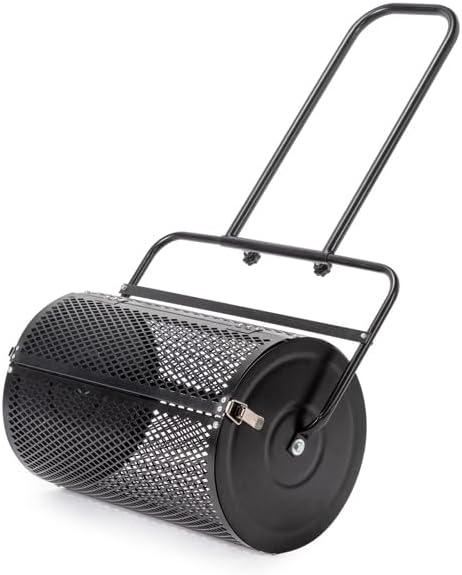
This 24-inch compost spreader is a simple, workmanlike tool for evenly distributing compost, peat moss, topsoil, seed, or similar materials across a lawn. You load the large diamond-mesh basket through a hinged filling door, then push it by hand for precise runs or hook it behind a small trailer to cover larger areas faster. The powder-coated steel frame and mesh are designed to resist rust and the side latches keep the basket closed during rolling so material does not spill on uneven ground. Assembly and takedown use basic knobs so storage is straightforward. Practical benefits include a roomy 2.7 cubic foot capacity that reduces refills, uniform release through 0.5 x 0.75 inch mesh for consistent topdressing, and an ergonomic U-shaped handle that eases pushing. The main limitations are that it is a manual/mechanically simple tool with no calibrated spread-rate control and heavier loads will require more effort to push or use with a tow vehicle for best results.
Best for: Gardeners who want a straightforward, lower-cost solution to evenly topdress lawns or spread compost over moderate to large areas and who value simplicity and durability over precision controls.
Less Ideal for: Users who need precise calibrated spreading for fertilizer or very fine granular products or those who prefer a motorized or fully tow-only commercial spreader.
- Large 2.7 cubic foot capacity reduces the need for frequent refills
- Powder-coated steel mesh and frame resist rust for outdoor durability
- Side latches and hinged filling door prevent spills and simplify loading
- Push or tow-behind design gives flexibility for small lawns or larger areas
- No adjustable spread-rate mechanism for fine control of application
- Requires physical effort to push when fully loaded unless towed
Verdict: A durable, no-frills 24-inch mesh compost spreader that gives budget-minded gardeners a large-capacity, easy-to-use way to topdress lawns and spread compost evenly.
HAPPYGRILL 24" Compost Spreader with Height-Adjustable T-Handle

| Capacity | 2.7 Cu.ft |
|---|---|
| Adjustable Heights | 41", 43.5", 46.5" |
| Material | Metal |
| Mesh Opening Size | 0.75" x 0.5" |
This HAPPYGRILL compost spreader is built for straightforward, reliable topdressing. The 2.7 cu ft mesh basket and wide loading door make filling with compost, peat moss, or topsoil fast and reduce trips back to the pile. As you roll, the fine metal mesh helps break up small clumps for more even coverage across lawns and garden beds. The sturdy metal frame, triangular supports, and reinforced side latches give it a durable feel suited to regular seasonal use, while the T-shaped handle adjusts to three heights for more comfortable pushing by different users. The handle is removable so it nests inside the basket for compact storage. Expect practical performance rather than lawn-care automation: assembly is required and the unit is manual so it works best on relatively even ground and for medium to large yards where you want control over spread rate. If you need powered spreading or very fine calibration for granular fertilizers, this manual mesh spreader will be less suitable.
Best for: Gardeners who prioritize a sturdy, no‑frills tool for reliable seasonal topdressing and want fewer refills and consistent spread without powered equipment.
Less Ideal for: Users who need motorized spreading, precision metering for granular fertilizers, or expect to work extensively on very rough or steep terrain.
- Large 2.7 cu ft capacity reduces refills during topdressing
- Fine metal mesh pattern helps break up clumps for more uniform coverage
- Heavy‑duty metal frame with triangular supports improves durability and stability
- Height‑adjustable T-handle provides ergonomic control for different users
- Removable handle allows compact storage in sheds or garages
- Manual operation best suited to even terrain and requires physical effort over longer areas
- No built‑in calibration for precise granular fertilizer application
Verdict: A robust, high‑capacity manual spreader built to deliver consistent, clump‑free topdressing for gardeners who value long‑lasting, dependable equipment.
Landzie 36-inch Mesh Compost and Topdressing Spreader

| Brand Name | Landzie |
|---|---|
| Item Highlight | Metal Mesh Basket Spreader for Manure Mulch Topdressing, Mid-Size – Push or Tow Lawn & Garden |
| Material Type | Steel |
| Model Number | Landzie |
| Item Dimensions L x W x H | 36"L x 36"W x 36"H |
The Landzie 36" mesh compost spreader is a walk-behind roller with a cylindrical diamond-mesh drum that sifts and distributes topdressing as you push or tow it behind a mower or tractor. Fill the hinged drum through the large opening, then roll across lawns or garden beds to lay down compost, peat moss, topsoil, manure or mulch in a consistent layer. The perforated mesh breaks up clumps and lets finer material fall through while retaining oversized pieces, which reduces clogging and gives a more even spread than shoveling by hand. Steel construction and a powder-coated finish help resist rust for season-to-season use, and the clip-in pole handle plus comfortable grips make solo use straightforward. Expect basic, no-frills assembly and manual control of spread rate and coverage; this is not a powered spreader so very fine control of application thickness takes practice and additional passes. The unit is best for mid-size yards and gardeners who want a robust mechanical alternative to hand spreading and broadcast spreaders for topdressing tasks.
Best for: Gardeners and homeowners who want a durable, mechanical solution to spread compost and topdressing across small to mid-size lawns and beds and who prioritize consistent results over a powered or precision applicator.
Less Ideal for: People who need highly precise, single-pass application rates for fertilizer or granular products or those with very small patios and container gardens where a compact hand tool would be better.
- 36-inch diamond-mesh drum that sifts and breaks up clumps for more even distribution
- Can be used as a walk-behind or towed behind a mower or tractor for faster coverage
- Steel construction with powder-coated finish for improved durability and corrosion resistance
- Hinged fill door and double locking clasps make loading and unloading straightforward
- Manual operation requires multiple passes to achieve very thin, uniform layers and takes physical effort
Verdict: Choose this spreader when you want a sturdy, mesh-drum roller that sifts and lays compost or topdressing evenly across lawns with push-or-tow convenience.
Landzie 24" Compost & Peat Moss Spreader (Steel Mesh Roller)

| Material Type | Steel |
|---|---|
| Item Highlight | Metal Mesh Basket Spreader for Manure Mulch Topdressing |
| Model Number | 779 |
| Product Coverage | Lifetime |
| Unit Count | 1 Count |
The Landzie 24" Compost & Peat Moss Spreader is a push-style mesh roller that makes topdressing smaller lawns and garden areas quicker and less messy. You fill the hinged steel barrel with compost, peat moss, topsoil or mulch, lock the chamber and either push it by hand or tow it with the clip-in handle for longer runs. The 24" metal mesh breaks up clumps and meters material evenly for a consistent layer, while powder-coated steel construction and upgraded side clasps aim to resist wear and rust. Its lightweight, ergonomic handle helps with maneuvering and the hatch opens for easy refilling and cleaning. Important limitations are that it is optimized for loose topdressing materials rather than heavy wet soil or very large properties and assembly and manual operation still require some physical effort. For gardens under regular maintenance it speeds topdressing chores and reduces waste compared with hand-spreading methods.
Best for: A homeowner who wants a reliable, low-complexity tool to topdress and maintain a residential lawn or garden with minimal fuss and long-term durability. Ideal for someone who prefers proven, straightforward equipment over experimental or high-maintenance solutions.
Less Ideal for: Not a good fit for large acreage or commercial contractors who need high-capacity motorized spreaders or for users who routinely spread very wet or chunky material that can clog a mesh roller.
- Large 24-inch steel mesh roller provides even, consistent distribution of peat moss and compost
- Hinged hatch and side clasps simplify filling and cleanup
- Powder-coated steel construction and upgraded clasps increase durability and rust resistance
- Lightweight design and ergonomic handle make it easy to push or tow for small to medium lawns
- Not intended for very heavy, wet soils or large commercial lawns where tow-behind motorized spreaders perform better
Verdict: A simple, durable steel-mesh roller that reliably evens peat moss and compost across small to medium lawns, perfect for buyers who prioritize low-risk dependable tools.
Choosing the Right Compost Garden Spreader: Key Factors to Consider
Hopper Capacity and Fill Frequency
Hopper capacity dictates how much compost you can carry between refills. Larger hoppers reduce the number of trips across a mid-sized lawn or multiple raised beds, but they also add weight when full and can be harder to push or tow on soft ground. Think about the scale of your tasks: a small vegetable plot benefits from a modest hopper you can easily handle, while a larger yard or community garden work session favors greater volume.
Material type and hopper shape influence bridging and flow. Wider, sloped hoppers tend to feed compost more reliably; narrow, tall hoppers may trap damp material and require more shaking or manual clearing. Choose a capacity that balances fewer refills with the physical effort you want to expend moving a full spreader.
Spread Pattern and Adjustability
Even, controllable spread is essential when applying compost around plants, on rows, or across turf. Look for spreaders with adjustable gates, variable-rate controls, and the ability to narrow or broaden the discharge. A uniform pattern reduces the need for hand raking and prevents piles that can smother seedlings or leave uneven nutrient patches.
Some spreaders offer directional deflectors or multiple gate positions to tailor lateral spread. For gardeners working in narrow beds or between plants, finer control at lower rates prevents waste. For broad turf applications, wider patterns speed coverage but may require calibration to avoid over-application.
Compatibility With Compost Texture
Compost can range from fine, screened material to coarse, chunky blends with wood chips or partially composted plant matter. Not every spreader handles the full spectrum. Check whether a design is intended for loose, screened compost or if it can tolerate coarser particles without clogging.
Open agitator systems or wider discharge openings work better with heterogeneous material but may sacrifice precision. If you use a variety of compost types seasonally, prioritize mechanisms that resist bridging and can be adjusted or cleared easily to maintain consistent flow.
Build Materials and Corrosion Resistance
Compost is moist and can accelerate corrosion or degrade weaker plastics. Steel frames with rust-resistant coatings or heavy-duty plastics designed for outdoor use last longer in this environment. Pay attention to axle quality, fasteners, and any exposed bearings; sealed bearings and stainless or zinc-coated hardware reduce maintenance needs.
Durable materials also affect stability and load capacity. A flimsy frame may twist under a heavy load, changing spread pattern and making the tool harder to control. Consider local climate and storage conditions when judging whether a spreader's materials will hold up over several seasons.
Ease of Cleaning and Maintenance
Leftover moist compost can cake and block chutes and gates. Designs that allow quick access to the hopper and discharge parts reduce downtime and frustration. Removable gates, wide-opening hoppers, and accessible agitators make rinsing and scraping simpler. Avoid tools with many small crevices that trap organic matter.
Also consider how easy it is to service moving parts. Grease fittings, replaceable wear plates, and simple hardware make routine upkeep quicker. Regular cleaning extends the life of the spreader and preserves consistent application rates.
Maneuverability and Terrain Handling
Garden terrain varies from level lawns to mulched beds and sloped plots. Wheel size, tire tread, and axle width influence how easily a spreader moves across different surfaces. Larger pneumatic tires roll more smoothly over rough ground and resist sinking in soft soil, while smaller solid wheels are lower maintenance but can be harder to push in uneven beds.
Consider steering or tow options if you will move heavy loads frequently. A spreader that tracks straight and responds predictably when turning reduces accidental spills and keeps applications neat around plants.
Preparing Compost for Best Results
Screening or sifting compost before spreading saves time and improves uniformity. Fine, screened compost flows more reliably and produces a consistent spread pattern, which is especially helpful when treating lawns or applying a thin topdressing to beds.
If your compost contains larger fragments, run it through a coarse sieve or break clumps by hand. Moisture content also affects flow. Compost that is too wet will bridge in the hopper and may require loosening or drying briefly before spreading.
- Aim for a crumbly texture for most spreaders
- Dry damp compost on a tarp for a day if it cakes
- Break large chunks to avoid hopper blockages
Using a Spreader Around Established Plants
When applying compost near established plants, use low-rate settings and narrow gates to avoid covering stems or smothering root collars. For delicate seedlings, consider hand application or a targeted tool, then finish broader areas with the spreader.
Rake lightly after application to distribute material into the soil surface. This helps prevent wind displacement and ensures the compost contacts soil where microbes and roots can access it.
- Start with a test pass to check coverage
- Use lower settings near plant bases
- Rake or gently water to settle compost
Topdressing Lawns With Compost
Compost topdressing improves soil structure and feeds turf when applied thinly and evenly. Use a narrow spread pattern with slower walking speed to build a light, even layer. Multiple light passes are better than one heavy pass to achieve a uniform finish without smothering grass.
After spreading, use a drag mat or light thatch rake to settle material into the canopy and to improve contact with the soil surface, which speeds microbial activity and nutrient release.
- Aim for 1/8 to 1/4 inch per pass for topdressing
- Make overlapping passes to avoid stripes
- Avoid heavy applications on compacted or poorly drained lawns
Storage and Off-Season Care
Store your spreader under cover and off damp ground to limit corrosion and pest intrusion. Clean all compost residue from the hopper, gates, and moving parts before storage, and apply light lubrication to exposed metal pivots to prevent seizure.
If you live in freezing climates, ensure no trapped moisture remains in cavities that could expand and crack components. Inspect tires and bearings in spring and replace any worn parts before heavy-use season to avoid breakdowns during busy times.
- Clean thoroughly before winter storage
- Lubricate pivots and check fasteners
- Protect from prolonged sun exposure to avoid plastic degradation
Adapting Spread Rates for Different Garden Tasks
Different tasks require different application rates. Seedbed preparation and vegetable beds often benefit from a heavier layer of compost worked into the soil, while lawn topdressing and mulching around ornamental plantings need lighter, more even coverage.
Calibrate your spreader by measuring how much material covers a known area at each setting. Keep notes on settings used for specific tasks so you can repeat successful applications and avoid over- or under-application.
- Use measured test areas to calculate volume per setting
- Record settings for repeatability
- Adjust walking speed as well as gate openings for fine control
How We Chose the Best Compost Garden Spreader
We focused on features that matter in real garden use and excluded specialty equipment intended only for bulk commercial operations. Our selection filtered for units designed to handle compost textures rather than only granular fertilizer. Key evaluation criteria included hopper capacity and discharge control because these determine how often you refill and how uniform the application is across beds and lawns. We checked spread pattern and adjustability to ensure gardeners can dial in coverage for narrow rows, raised beds, and open turf. Construction and corrosion resistance were considered to gauge how well a spreader holds up to moist, organic material. Ease of cleaning and maintenance mattered because compost can cake and clog if gear is hard to service. Finally, we looked at towability and maneuverability for different garden scales and terrain. We excluded lightweight broadcast gadgets that cannot cope with the variable particle size of finished compost and any tools meant only for seed or pelletized material.
FAQ
Can I use a compost spreader for coarse or woody compost?
Often it depends on the spreader design. Models with wider openings and agitators tolerate chunkier material better, while fine-gated broadcast spreaders may clog. Pre-screening or breaking up woody pieces improves reliability.
How do I calibrate spread rate for my garden area?
Measure a fixed area, run the spreader at a chosen setting and collect the compost applied. Weigh or measure the volume and calculate coverage per square foot. Adjust gate settings and repeat until you reach the desired rate.
Will compost damage spreader components over time?
Moist organic material can accelerate corrosion and wear, especially on unprotected metal parts. Regular cleaning, coating exposed metal, and servicing bearings reduces long-term damage and keeps the spreader functioning well.
Is it better to topdress with compost or mix it into soil?
It depends on the goal. Topdressing improves surface organic matter and slowly integrates via microbes and worms, ideal for lawns and established beds. Mixing compost into soil is better when preparing new beds or correcting poor subsoil structure.
How often should I clean the spreader after use?
Usually clean after every major application to prevent caked compost from hardening in the hopper or gate. For light, dry passes you can often brush residue out immediately, but moist material should be rinsed and dried before storage.
Final Verdict
Balance practical tradeoffs when choosing a compost garden spreader: larger hoppers and wider patterns speed work but increase weight and reduce fine control, while compact units give more precision for beds and tight spaces. Prioritize spread pattern control, material compatibility, and ease of maintenance for the tasks you do most often. With those priorities in mind you can match a spreader to your garden scale and compost types and get consistent, time-saving applications.
