

Note: This article contains affiliate links. If you click on these links and make a purchase, I may earn a small commission at no extra cost to you. This helps support my research and content. Read my full affiliate disclosure here.
A garden spreader that mounts to a zero turn mower changes how you seed, fertilize, and ice-manage large lawns. With the spreader riding behind the mower you cut steps, speed up applications, and get more consistent coverage across wide swaths. Choosing the right unit matters because hopper size, mounting method, and distribution controls all affect how evenly materials go down and how often you need to refill. This guide covers the top shortlisted garden spreaders for zero turn mower use and explains the practical differences that matter in a real yard. We evaluate capacity, stability, distribution control, and durability so you can pick the right spreader for your mowing routine and the materials you plan to apply.
Top Picks at a Glance
| Best Overall The best all-around choice for most situations | Agri-Fab Zero Turn Mower Electric Spreader, 125 lb Hopper, 12V Motor |  |
| Best Quality Built to a higher standard if you want something more solid | John Deere 130 lb Tow-Behind Lawn Spreader |  |
| Best Value The sweet spot between price and what you get | Yard Commander 125 lb Tow-Behind Broadcast Spreader |  |
| Best Budget The cheapest option that still gets the job done reliably | GarveeLife Tow-Behind Broadcast Spreader, 130 lb Capacity |  |
| Most Popular A crowd favorite that many people choose with confidence | Agri-Fab 130 lb Pull-Behind Broadcast Spreader (Model 45-0463) |  |
Agri-Fab Zero Turn Mower Electric Spreader, 125 lb Hopper, 12V Motor

| Hopper capacity | 125 lb |
|---|---|
| Spread width | Up to 12 ft |
| Coverage | Up to 25,000 sq ft |
| Motor | 12V sealed motor |
The Agri-Fab Zero Turn Mower Electric Spreader is built to attach to compatible zero-turn mowers and make seasonal seeding and fertilizing faster and more consistent. It uses a rustproof 125 lb poly hopper and a sealed 12V motor to deliver up to a 12 ft spread width and cover roughly 25,000 sq ft per use, which reduces the number of passes needed on larger lawns. Seat-side cable flow control lets you open and close the gate without dismounting, so adjustments are simple while mowing. The durable hopper and spreader plate resist corrosion from lawn materials, and the unit is aimed at maintaining even patterns at typical mower speeds. Limitations include the need for a compatible zero-turn mounting setup and a dependence on the mower for transport and power, so it is not a standalone tow-behind or handheld option. Assembly and proper calibration are required to get an even application, and the 12V motor is intended for routine seasonal jobs rather than industrial continuous use.
Best for: Homeowners or property managers with a zero-turn mower who want a single, higher-capacity spreader to speed seasonal seeding and fertilizing across medium-sized lawns.
Less Ideal for: People without a zero-turn mower, those who need a tow-behind or handheld spreader, or users who require industrial continuous-use equipment for very large commercial properties.
- Large 125 lb rustproof poly hopper reduces refill frequency for half-acre jobs
- Up to 12 ft spread width covers more ground per pass for efficient application
- 12V sealed motor designed for dependable seasonal operation
- Seat-side cable flow control allows gate adjustments from the mower seat
- Requires a compatible zero-turn mower for mounting and operation
- Not a standalone or tow-behind unit so it cannot be used without a mower
- May need careful calibration to achieve uniform spread patterns
Verdict: If you own a zero-turn mower and want to speed up seasonal seeding and fertilizing on medium-size lawns, this high-capacity electric spreader is a practical, mower-mounted solution.
John Deere 130 lb Tow-Behind Lawn Spreader

| Operation Mode | Manual |
|---|---|
| Number of Positions | 5 |
| Material Type | Polyethylene |
| Capacity | 130 lb |
This John Deere tow-behind spreader is built for moving larger quantities of fertilizer, seed, or ice melt across an acre or more without constant refilling. It mounts behind a mower or ATV and uses a manual drop system with five positions to change the flow rate. The polyethylene hopper resists corrosion and is lightweight to handle when empty, while the 130 lb capacity means fewer stops to refill on medium to large lawns. Setup and hookup are straightforward for riders with a standard hitch, and the simple controls make calibration quick in the field. Limitations are that the spreader is manual rather than broadcast or calibrated by ground speed, so fine-tuning application rate requires testing and attention to overlaps. It also lacks motorized agitation for stubborn mixes and does not include detailed spread-width specs, so expect some trial runs to dial in even coverage behind a zero turn. For someone who values capacity and durability over automated metering this is a practical, rider-friendly option.
Best for: Riders who need a rugged, high-capacity spreader to cover medium to large lawns quickly behind a zero turn and who prioritize fewer stops over automated metering.
Less Ideal for: People who want precise, speed-compensated broadcast spreading or automated agitation should consider calibrated or motorized spreaders instead.
- Large 130 lb hopper cuts refills for medium to large lawns
- Polyethylene construction resists rust and stands up to outdoor use
- Five-position manual flow control for quick adjustments while working
- Tow-behind design pairs easily with mowers or ATVs for efficient coverage
- Manual metering requires test passes to achieve accurate application rates
- No motorized agitation or powered distribution for cohesive or damp products
Verdict: Choose this spreader if you want a sturdy, high-capacity tow-behind that lets a zero turn cover large lawns with fewer refills.
Yard Commander 125 lb Tow-Behind Broadcast Spreader

| Capacity | 125 lb |
|---|---|
| Spread radius | 10–12 ft |
| Tire type | 12-inch pneumatic tires |
| Hopper | Corrosion-resistant composite with cover |
| Gears | Cast aluminum |
The Yard Commander 125 lb tow-behind broadcast spreader is built to handle large lawns and heavier materials like fertilizer, seed, and ice melt. It mounts to tractors, riding mowers, ATVs, or UTVs via a universal hitch and uses premium cast aluminum gears to deliver a steady 10–12 foot spread radius. The corrosion-resistant composite hopper and included weather cover keep materials dry and prevent clumping during light precipitation. Large 12-inch pneumatic tires improve flotation and traction across uneven or soft turf so you can tow it over rough ground without frequent stoppages. Flow is controlled with a simple gate lever for dosing adjustments so you can tune application rate for different materials. Expect basic assembly and occasional maintenance on moving parts, and note capacity varies by material so very dense mixes may not reach the full 125 lb in practice. The unit is practical for large properties where tow-behind performance, corrosion resistance, and a wide spread pattern matter most.
Best for: Gardeners and property owners who prioritize performance and efficiency on large lawns and need a tow-behind spreader that handles varied terrain and heavier materials.
Less Ideal for: Small-lot homeowners who prefer a walk-behind unit or users who want a completely maintenance-free, plug-and-play spreader.
- Large 125 lb composite hopper resists corrosion and holds enough material to cover up to 25,000 sq ft in one fill
- Premium cast aluminum gear drive provides smoother, durable spreading and supports a 10–12 ft broadcast width
- Universal hitch fits most lawn tractors, riding mowers, ATVs, and UTVs for versatile tow-behind use
- 12-inch pneumatic tires improve flotation and traction on rough or soft terrain
- Included hopper cover reduces clumping and allows light-rain operation
- Requires assembly and periodic maintenance of moving parts
- Actual capacity and coverage depend on material density and may be less than rated with heavy mixes
Verdict: Choose this spreader if you need a durable, tow-behind broadcast unit that covers large lawns efficiently while handling rough terrain and damp conditions.
GarveeLife Tow-Behind Broadcast Spreader, 130 lb Capacity

| Capacity | 130 lbs |
|---|---|
| Tire type | 10" pneumatic tires |
| Frame | Powder-coated steel |
The GarveeLife tow-behind broadcast spreader is a straightforward, utilitarian option for treating medium to large lawns from a zero turn or other tow vehicle. It mounts via a long tow bar and rolls on 10 inch pneumatic tires that handle uneven turf and driveways with minimal bouncing. The rust-resistant poly hopper holds up to 130 pounds and the powder-coated steel frame adds durability for seasonal use. An adjustable flow control lets you change spread width and material output so you can apply grass seed, fertilizer, ice melt, or sand with reasonable consistency across a 0 to 10 foot swath. The included waterproof cover and sieve help keep materials dry and reduce clumping. Expect simple mechanical parts rather than high-end seals or electronics, so assembly and maintenance are basic and approachable. If you need a heavy-duty commercial spreader or precise calibration for small lawns, this model may feel a bit bulky, but for routine homeowner tasks it delivers practical performance at an economy-oriented level.
Best for: Budget-minded homeowners who need a simple tow-behind spreader for a zero turn mower or small tractor to cover medium to large yards without fussing over advanced features.
Less Ideal for: People who want commercial-grade durability or very precise application rates for small lawns should look at heavier-duty or finely calibrated spreaders instead.
- 130 lb rust-resistant poly hopper suitable for long passes without frequent refills
- 10 inch pneumatic tires provide stable rolling over uneven lawns and driveways
- Adjustable flow control for tuning spread width and application rate
- Powder-coated steel frame improves corrosion resistance for seasonal outdoor use
- No precise calibration system for very accurate small-dose applications
- Relatively large and heavy compared with handheld or walk-behind spreaders
Verdict: A practical, no-frills tow-behind spreader that gives homeowners reliable coverage and easy towing behind a zero turn at an economical value.
Agri-Fab 130 lb Pull-Behind Broadcast Spreader (Model 45-0463)
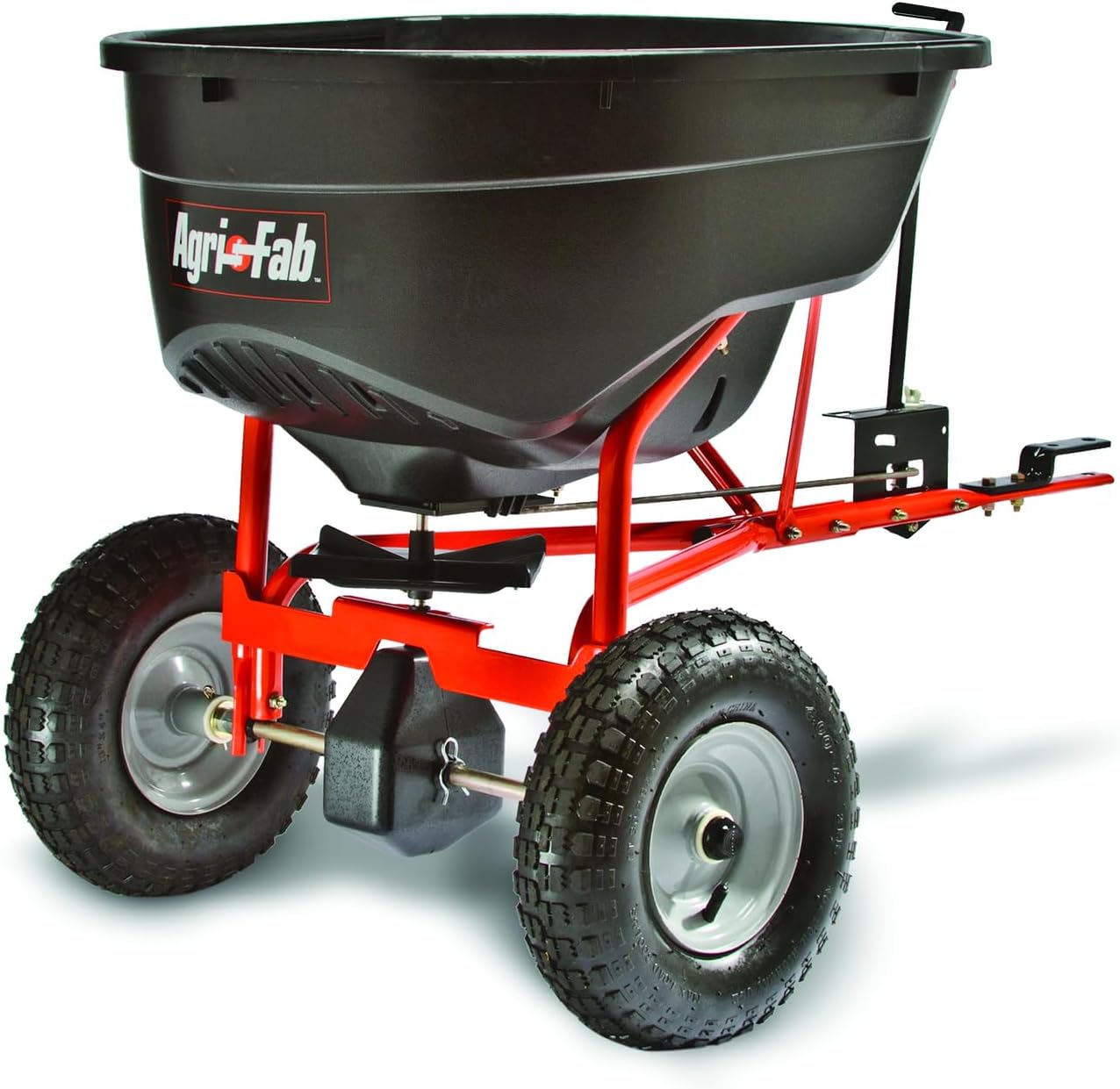
| Weight Capacity Maximum | 130 pounds |
|---|---|
| Spread Width | 10-12 ft |
| Tire Type | Pneumatic |
| Material Type | Alloy Steel, Polypropylene (PP), Rubber |
The Agri-Fab 130 lb pull-behind broadcast spreader is built for straightforward, dependable lawn care on larger yards. It mounts to most riding mowers with a universal hitch and holds up to 130 pounds, letting you cover roughly half an acre per fill to reduce interruptions. The wide 10 to 12 foot spread pattern and enclosed gear box promote more even dispersal and protect internal parts from dirt and moisture. A simple steel-rod flow control is reachable from the tractor seat so you can change application rates without stopping. The construction combines a poly hopper with alloy steel frame tubing and pneumatic tires for durability and smoother towing over uneven ground. Expect easy seasonal use for grass seed, fertilizer, granular lawn treatments, and salt. The main limitations are that it is a basic broadcast design, so very precise banding or ultra-fine calibration for specialty seed mixes may require additional passes or a different spreader type, and some assembly is required before first use.
Best for: Homeowners or property managers who want a reliable, no-nonsense tow-behind spreader to cover medium to large lawns efficiently and with minimal fuss.
Less Ideal for: Gardeners who need highly precise application patterns or small-plot users who prefer a handheld or walk-behind drop spreader for tight spaces.
- Large 130 lb hopper covers up to about 25,000 sq ft per fill to reduce refills on bigger lawns
- Universal hitch fits most riding mowers and lawn tractors for quick hookup
- Wide 10–12 ft spread width delivers even coverage with fewer passes
- Enclosed gear housing and steel frame improve durability and protect moving parts
- Seat-accessible steel-rod flow control lets you change settings without dismounting
- Broadcast design is less suited to precision banding or very narrow applications
- Requires assembly before first use
Verdict: A durable, easy-to-use tow-behind spreader that reliably covers larger lawns with fewer refills and minimal operator adjustments.
Choosing the Right Garden Spreader for Zero Turn Mower: Key Factors to Consider
Hopper Capacity and Access
Hopper size determines how often you must stop and refill during a job. A larger hopper reduces trips back to the shed when treating acres, but it also increases weight and can affect mower handling when full. Consider how many pounds of the specific material you typically apply per acre and choose capacity that matches your normal route.
Equally important is hopper access. A wide, low lip or a tapered funnel speeds pouring and reduces spills when you load fertilizer or seed. An easy-access lid helps keep moisture out during longer jobs and makes it simpler to switch materials between passes without leaving a mess.
Mounting Method and Stability
How the spreader attaches to the zero turn mower will determine stability and vibration transfer. Bolt-on mounts that tie into the mower frame or dedicated hitch points give a secure connection and reduce bouncing that can affect distribution patterns. Quick-release or bracket systems add convenience but must clamp tightly to avoid shifting under load.
Weight distribution matters for safe handling. A rear-mounted hopper places a load behind the mower center of gravity; confirm the mower can accept the added weight without compromising steering or lift. Look for spreaders with adjustable mounting hardware or stabilizing straps to keep the unit steady over rough ground.
Distribution Control and Accuracy
Even spread patterns are the primary job of any spreader. Look for units with adjustable gate settings and clear calibration charts so you can match the output to the product and application rate. A well-designed agitator and uniform feeder mechanism reduce bridging of damp or irregular materials and help maintain a steady flow.
Also consider adjustable deflectors or shielded spread plates for edge control. Accurate distribution reduces overapplication and gaps, which saves material and protects turf health. If you will work at variable mowing speeds, ensure the spreader's feed rate is predictable across that speed range.
Material Compatibility
Not all spreaders handle every material equally. Large seed, pelletized lime, rock salt, and specialty blends differ in particle size and flow properties. A spreader with an aggressive agitator or flexible feed options will tolerate coarser, irregular materials better and minimize clogging.
If you plan to alternate between fertilizer and salt, check component corrosion resistance and whether the hopper surface is easy to rinse. Some spreaders are better suited to dry, free-flowing fertilizers, while others include features that help with damp or sticky mixes.
Durability of Frame and Hardware
Regular exposure to grit, moisture, and mechanical vibration demands robust frames and corrosion-resistant hardware. Steel frames with protective coatings or thick-gauge aluminum constructions stand up to impacts and repeated mounting cycles. Fasteners, hinges, and mounting points should be plated or stainless to prevent seizing from rust.
Durability also influences resale life and whether the unit will creak or wobble after a few seasons. Consider how easily worn parts can be replaced and whether manufacturers use common fastener sizes to simplify field repairs.
Ease of Hookup and Storage
A spreader that is difficult to mount or remove will be used less often. Quick-connect brackets, lightweight components, and simple leveling adjustments reduce setup time between mowing and spreading tasks. Think through how you will store the spreader when not in use; folding brackets or removable hoppers can save space in a small shop.
Also evaluate whether the spreader can be secured on the mower for transport without interfering with attachments like baggers or aerators. Practical handling features make seasonal use less of a chore.
Preparing Your Zero Turn for Spreader Use
Before mounting a spreader, inspect the rear frame and any mounting points for corrosion, bent tabs, or weak welds. Reinforcing common hitch points or fitting a crossbar can improve stability for heavier hoppers. Confirm the mower's lift and weight limits in the operator manual so you do not overload the chassis.
Balance and clearance are important. Check that the spreader does not contact tires, deck components, or steering linkages at full articulation. Make any necessary adjustments while the spreader is empty to avoid surprises once loaded.
- Clean and grease mounting points to prevent wear
- Test mounting with a light load before a full job
- Verify electrical or PTO connections if using powered agitators
Material Calibration and Best Practices
Calibrating the spreader for the exact material you plan to apply will save time and prevent overapplication. Use the manufacturer's chart as a starting point, then perform a small field test: measure output over a fixed pass width and adjust settings incrementally until coverage is uniform.
Work at consistent ground speed and overlap slightly on each pass. Keep a log of settings and speeds for common materials so you can reproduce results on future jobs. Rinse the hopper after applying corrosive materials and let it dry before storing to avoid clumping.
- Measure a known area and collect output to calculate actual application rate
- Document speed and gate settings for repeatable results
- Keep a brush or scraper in the toolkit for stubborn residues
Handling Different Lawn Materials
Seed, fertilizer, and salt each have handling quirks. Fine seed requires gentler agitation and lower feed settings to avoid scatter and waste. Coarser materials may need a wider gate and more aggressive agitator to prevent bridging. Adjust the spread pattern and apply multiple light passes when precision matters, such as overseeding high-value turf.
When using corrosive materials like salt, protect metal parts and rinse the system immediately after use. For materials that cake in humid conditions, consider using anti-caking additives or work in the cooler parts of the day to reduce moisture pickup.
- Use lower feed settings for fine seed
- Increase agitation for coarse or pelletized materials
- Rinse after salt applications to protect hardware
Maintenance Tips for Long Service Life
Regular maintenance keeps a spreader accurate and reliable. Inspect moving parts for wear, tighten fasteners periodically, and lubricate pivot points according to the manufacturer guidance. Replace worn agitator paddles and check that calibration markings remain legible.
Store the unit indoors or under cover when not in use to prevent UV degradation of plastic hoppers and corrosion of metal parts. Before winter storage, clean thoroughly and apply a light protective coating to exposed metal to prevent rust.
- Inspect and tighten mounting hardware after initial runs
- Keep spare fasteners and a basic toolkit with the mower
- Schedule a quick calibration check at the start of each season
How We Chose the Best Garden Spreader for Zero Turn Mower
We prioritized features that actually affect day-to-day use when a garden spreader is mounted to a zero turn mower. Key evaluation criteria included hopper capacity and fill design for fewer stops, mounting compatibility and stability under vibration, distribution system accuracy for even application, and material compatibility across fertilizers, seed, and salt. We also assessed frame and hardware durability against road and brush contact, plus ease of hookup and removal so a spreader does not become a seasonal burden. We excluded walk-behind or handheld spreaders and any units intended only for pull-behind ATVs or utility trailers. We focused on units whose mounting solutions and weight distribution are appropriate for zero turn decks and frames. Items that required significant modification or custom fabrication were not considered. Our goal was to select spreaders that offer reliable operation across common lawn materials and typical mowing speeds.
FAQ
Will a rear-mounted spreader affect my zero turn steering or balance?
Adding significant rear weight can change steering feel and lifting dynamics. It depends on hopper weight and mounting location. Test with a partial load and adjust attachment points or add stabilizing straps to minimize handling changes.
Can I use the same spreader for seed and salt?
Often you can, but material compatibility matters. Salt can corrode metal parts and leave residues that affect seed flow. Rinse components after salt use and consider dedicated hoppers or liners if you switch materials frequently.
How do I calibrate a spreader for a specific fertilizer brand?
Start with the manufacturer's chart, then perform a field calibration by collecting output over a set distance and calculating pounds per area. Adjust the gate or feed setting until the measured rate matches the target for that fertilizer.
Is it better to apply in one pass or multiple light passes?
Multiple light passes usually yield more uniform coverage, especially for overseeding or precise fertilizer applications. Single heavy passes are faster but increase the risk of streaks and overapplication.
How often should I inspect mounting hardware?
Inspect mounting points and fasteners before each season and after the first few jobs with a new setup. Check again after any heavy impact, transport over rough ground, or if you notice vibration or movement during use.
Final Verdict
Choosing the right garden spreader for zero turn mower work is about matching capacity and mounting stability to the scale of your jobs and the materials you use. Prioritize a secure attachment system and a distribution mechanism that can be calibrated for the products you apply. Balance hopper size against handling and storage needs, and favor durable hardware that tolerates vibration and exposure. With those tradeoffs understood, pick a spreader that fits your typical route length and material types. A well-chosen unit will reduce downtime, improve application accuracy, and make large-area lawn care far more efficient.
