

Note: This article contains affiliate links. If you click on these links and make a purchase, I may earn a small commission at no extra cost to you. This helps support my research and content. Read my full affiliate disclosure here.
If you grow carnivorous plants indoors or in a protected sunroom, the right grow light changes how well those sensitive species develop traps, color, and flowering. Carnivores often need steady, species-specific light without excess heat or harsh spectra that cause stress. This guide shortlists the top grow light options built for carnivorous plants and explains why each type works in a real growing situation. We evaluated options on practical criteria gardeners care about: usable spectrum, intensity control, heat output, and durability under humid or wet conditions. Read on to match light features to the species you grow and the space you have.
Top Picks at a Glance
| Best Overall The best all-around choice for most situations | Raygrov Self-Watering Smart Planter with 5W Full-Spectrum USB Grow Light |  |
| Best Quality Built to a higher standard if you want something more solid | FECiDA 2-Head Adjustable Floor Grow Light with Stable Base |  |
| Best Value The sweet spot between price and what you get | SANSI 5W Clip-On LED Grow Light, 2-Pack |  |
| Best Budget The cheapest option that still gets the job done reliably | Kullsinss Halo 48-LED Full Spectrum Small Grow Light with Detachable Base |  |
| Highest Rated A top-rated pick with lots of positive feedback | Juhefa Super Bright 6000K Full-Spectrum Tabletop Grow Light |  |
| Most Popular A crowd favorite that many people choose with confidence | GooingTop HY-021 6000K Full-Spectrum Clip Grow Light |  |
| Best Seller A high-volume bestseller chosen again and again | Aokrean Halo Full-Spectrum LED Grow Light with Base (2-Pack) |  |
Raygrov Self-Watering Smart Planter with 5W Full-Spectrum USB Grow Light

| Features | Self Watering |
|---|---|
| Mounting Type | Wall Mount |
| Material Type | Aluminum, Plastic |
| Included Components | Hydroponics cup, Led Light |
| Power | USB powered 5W |
This Raygrov smart planter combines a capillary self-watering reservoir with a 5W full-spectrum USB LED to keep small indoor plants healthy with minimal intervention. Typical use is simple: fill the reservoir, add soil and seeds or a small plant, hang it on the wall or place it on a desk, then plug the USB light into a laptop, power bank, or USB adapter. The self-wicking system maintains consistent moisture for about one to two weeks per fill, which is helpful for busy owners or those who have struggled with under- or over-watering. The LED mixes red, blue, and white wavelengths so plants receive usable light even in windowless rooms. Aluminum and plastic construction keeps the unit light and easy to mount. Limitations are its small footprint and modest light output, so it is best for tiny pots, seedlings, microgreens, and small carnivorous plants rather than larger specimens or multi-plant setups. Also the USB power approach adds flexibility but means you must provide a USB source and there is no integrated timer or advanced light controls.
Best for: Buyers who want a low-maintenance desktop or wall planter that keeps small carnivorous plants and herbs alive with minimal effort and limited space.
Less Ideal for: Growers planning to cultivate larger carnivorous specimens, multiple plants, or who need high-intensity, adjustable lighting for advanced propagation.
- Self-watering capillary wick keeps soil evenly moist for 1–2 weeks between refills
- Built-in 5W full-spectrum LED supplies usable red, blue, and white wavelengths for low-light rooms
- Dual mounting options let you hang it on a wall or use it on a desk or shelf
- USB power works with laptops, power banks, or existing USB adapters for flexible placement
- Small footprint and limited light output restrict use to seedlings and small plants
- No built-in timer or adjustable light intensity for more precise control
Verdict: If you want a compact, low-effort planter that provides consistent moisture and enough light to keep small carnivorous plants healthy in low-light rooms, this unit is a practical pick.
FECiDA 2-Head Adjustable Floor Grow Light with Stable Base

| Light Source Type | LED |
|---|---|
| Number of Light Sources | 204 |
| Additional Features | 4,8,12,16,20 Hr Timer |
| Mounting Type | Free Standing On Floor |
| Power Source | Corded Electric |
This FECiDA floor grow light is built for tall houseplants like a Monstera, offering a two-head lamp on a stable round base with a height range that suits large foliage. It uses LED light sources and a full spectrum that includes warm 3000K, cool 5000K, and 660nm plus UV-IR elements to encourage vegetative growth and fuller leaves. The touch control and 5-mode timer (4/8/12/16/20 hours) make it easy to set daily on/off cycles so you can maintain consistent light without monitoring. The unit is corded and plugs into a standard outlet and supports daisy-chaining up to three units from one socket for larger setups. Practical benefits include an elegant living-room friendly design that doubles as décor, a sturdy base that resists tipping, and adjustable height for different plant sizes. Important limitations are the modest 25 watt rating listed in specs despite marketing claims of high lumen output and that the lamp is meant for indoor use only, so it is not suited to outdoor or weather-exposed placements.
Best for: Plant owners who prioritize consistent, high-quality light for large indoor specimens and want a floor lamp that fits a living-room aesthetic while delivering full-spectrum output and timer automation.
Less Ideal for: Growers needing high-intensity, commercial-grade output for dense canopy flowering or large multi-shelf grow tents should consider higher-wattage fixtures instead.
- Full-spectrum LED array including 3000K, 5000K and 660nm plus UV-IR for balanced plant growth
- Adjustable height that accommodates tall plants and multiple link rods for different sizes
- Built-in 5-mode timer with daily auto on/off for consistent light cycles
- Stable base and decorative design suitable for living-room placement
- Daisy-chainable power allowing up to three units from one outlet for expanded coverage
- Wattage listed at 25 watts may be lower than buyers expect given some brightness claims
- Intended for indoor use only and not weatherproof for outdoor placement
Verdict: A stylish, full-spectrum floor lamp that gives Monstera and other tall houseplants reliable, timed indoor sunlight in a living-room friendly form.
SANSI 5W Clip-On LED Grow Light, 2-Pack

| Wattage | 5 watts |
|---|---|
| Number of Light Sources | 2 |
| Mounting Type | Pot Clip-on Installation |
| Light Source Type | LED |
| Additional Features | Dimmable, Timer, Touch control |
The SANSI 5W clip-on grow lights are compact LED lamps designed to provide supplemental light to small indoor pots. Each unit clips to a pot or stand and uses a flexible gooseneck so you can direct the beam exactly where a plant needs it. Key features include four dimming levels, a 3/6/12-hour auto timer, touch controls and a low-voltage 5V USB power option that can be run from a power bank or computer. The lights use a 4000K spectrum intended as a natural-looking balance between cool and warm tones and the manufacturer highlights ceramic optics for efficiency. For growers of small, light-needy plants like sundews or small pitcher plants, the clip design makes it easy to position light close to the canopy without permanent fixtures. Limitations are the modest 5W output and non-waterproof construction, so the lamps are best for individual pots or supplemental use rather than replacing a larger full-spectrum unit for multiple or larger carnivorous specimens.
Best for: For practical growers who want a simple, adjustable supplemental light for small potted carnivorous plants and prefer low-power, easy-to-deploy solutions that can be moved between pots.
Less Ideal for: Not a good fit for hobbyists needing high-intensity whole-shelf lighting or for outdoor/misting-heavy setups where water resistance is required.
- Flexible gooseneck and clip-on mount allow precise positioning over individual pots
- Built-in 3/6/12-hour timer and four dimming levels for hands-off daily cycles
- Low-voltage 5V USB power makes it easy to run from common USB sources
- Compact 2-pack covers multiple small plants or staggered placement
- 5W output is limited for larger collections or plants requiring intense light
- Not water resistant so it must be kept away from wet conditions or misting
Verdict: A compact, low-power clip-on solution that gives practical, adjustable supplemental light for small carnivorous plants without complex setup.
Kullsinss Halo 48-LED Full Spectrum Small Grow Light with Detachable Base

| Number of Light Sources | 48 |
|---|---|
| Wattage | 2.5 watts |
| Voltage | 5 volts |
| Control Method | Remote |
| Mounting Type | Tabletop |
The Kullsinss Halo is a small, budget-friendly full-spectrum LED grow light made for single pots and tabletop displays. It uses 48 high-efficiency LEDs to cover wavelengths from roughly 380 to 760 nm, and offers three color modes plus 10 dimming levels so you can tune light intensity for succulents at different stages. The lamp can be used perched on its detachable base or with a stake inserted into soil, and the telescoping pole adjusts from about 6.5 to 26 inches to change coverage area and distance from plant crowns. A built-in timer with 3, 9, and 12 hour cycles and remote or touch controls make hands-off scheduling easy. Practical benefits include low power draw, good heat dissipation from the aluminum body, and a compact head that fits small pots or crowded shelves. Limitations are that the base is lightweight and may need the pot to stabilize it, the unit is not waterproof so it must stay dry, and it is best suited for single small succulents rather than large groupings or tall specimens.
Best for: Succulent owners seeking an inexpensive, compact lamp to boost light for single small pots on a desk or shelf who prioritize simple controls and energy efficiency.
Less Ideal for: Growers who need to light multiple plants, large rosettes, or tall specimens; users who require weatherproof or outdoor-rated fixtures.
- Full-spectrum LED array suitable for all growth stages of small plants
- Height-adjustable pole (6.5"–26") and 90° adjustable head for flexible positioning
- 10 brightness levels plus 3 color modes and auto timers (3H/9H/12H) for easy control
- Low wattage (2.5W) with aluminum body for efficient operation and heat dissipation
- Lightweight base may not reliably support the unit without placing the pot on it
- Not water resistant so it cannot be used in humid or outdoor environments
Verdict: A low-cost, compact full-spectrum grow light that gives small succulents customizable light and timers without raising energy use.
Juhefa Super Bright 6000K Full-Spectrum Tabletop Grow Light

| Light Source Type | LED |
|---|---|
| Number of Light Sources | 108 |
| Wattage | 80 watts |
| Voltage | 12 volts_of_alternating_current |
| Additional Features | Adjustable Arm, Adjustable Height, Dimmable, Timer |
This Juhefa tabletop grow light is built for steady, performance-focused indoor growing. It uses 108 LEDs (white, red and blue) tuned to a full-spectrum 6000K output and runs from a 12V/3A adapter for stable illumination that the manufacturer equates to a high-wattage halogen equivalent. The lamp mounts to a weighted base and has an extendable pole and flexible gooseneck so you can position the light over multiple pots or individual succulents. Controls include five dim levels and a 4/8/12 hour timer operated by a remote, which makes it convenient to automate photoperiods for seedlings and mature plants. Practical benefits include energy-efficient LED output, a stable tabletop footprint that avoids disturbing pots, and a lighting range intended to cover small racks or desktop groupings. Limitations are typical of desk-style units: it is intended for indoor, near-source lighting rather than large grow tents and it is not water resistant so it needs careful placement around watering. For growers focused on reliable light intensity and flexible placement for small collections, it delivers solid, controlled performance.
Best for: Growers who prioritize steady, controllable light output for small indoor collections and want a compact lamp that can be aimed precisely at succulents, seedlings, or desktop plants.
Less Ideal for: People needing a waterproof fixture or those looking to light a large canopy of plants or a full-size grow tent should consider larger, purpose-built fixtures instead.
- Full-spectrum LED array with white, red and blue chips to support photosynthesis across growth stages
- 12V/3A power input for steady, brighter illumination compared with typical low-watt desktop lamps
- Adjustable gooseneck and telescopic pole let you aim light precisely over succulents and seedlings
- Remote-controlled dimming (five levels) and 4/8/12 hour timer for easy automation
- Weighted tabletop base provides stable placement without inserting stakes into pots
- Not water resistant so it must be kept away from wet areas or overhead watering
- Designed for small-area coverage and not suitable as the sole light for large grow tents or many plants
Verdict: Choose this lamp if you need a compact, stable, full-spectrum LED fixture that gives controlled, automated light for succulents and other small indoor plants.
GooingTop HY-021 6000K Full-Spectrum Clip Grow Light
| Power Source | Corded Electric |
|---|---|
| Color Temperature | 6000 Kelvin |
| Light Output Maximum | 2500 lumens |
| Light Source Special Features | Dimmable |
| Number of Light Sources | 84 |
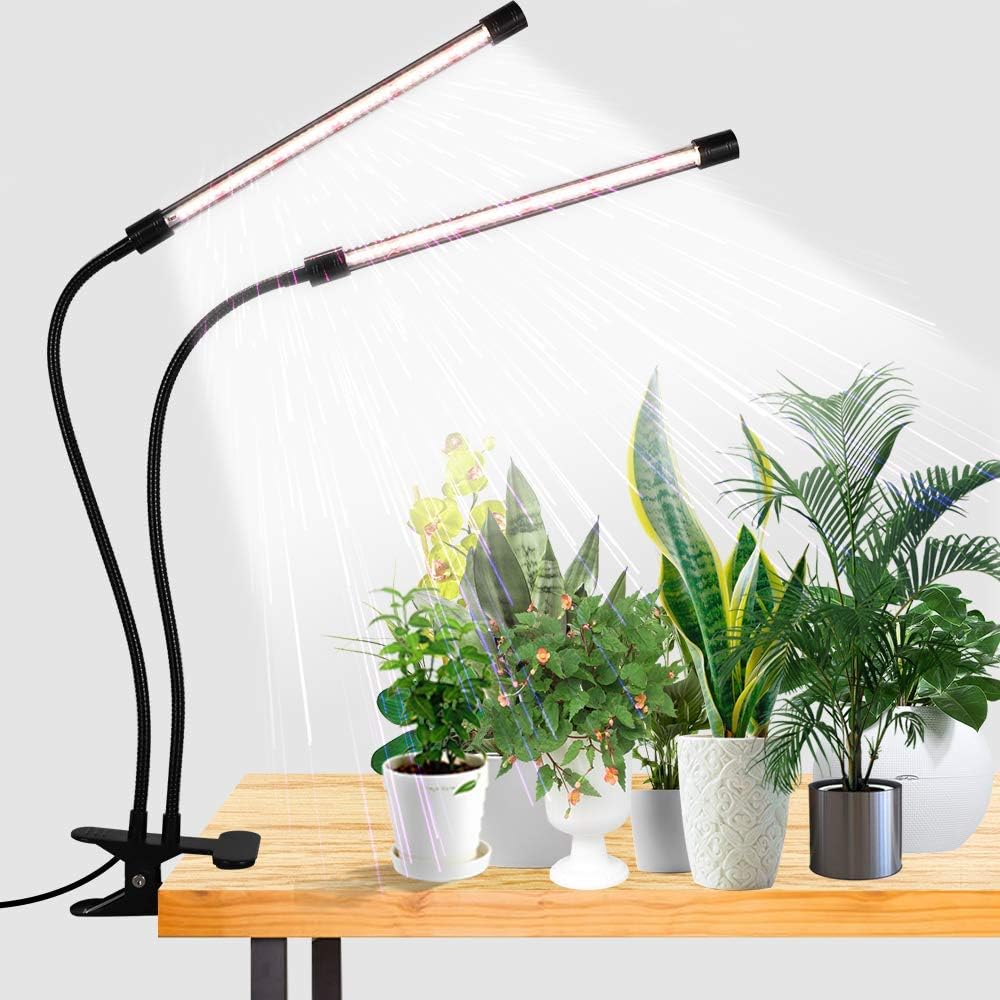
This GooingTop HY-021 is a compact clip-on grow light built for small houseplants, seedlings and shelf gardens. It uses 84 LEDs (white plus deep red) to deliver a 6000K full-spectrum output intended to mimic midday sun, with a high color-rendering output that also makes it pleasant as a reading lamp. Two flexible gooseneck heads and a strong clamp let you aim light precisely over pots and seed trays, while the attached remote provides 50%/100% dim levels and repeating timers at 4, 8 or 12 hours for hands-off scheduling. Practical benefits include low power draw (listed as roughly 10 W LED draw), a claimed 1 to 2 square meter coverage for seedlings, and an included timer that simplifies day/night cycles. Limitations are its design for small setups rather than large grow racks and the clip mounting limits placement compared with freestanding fixtures. The unit also relies on the corded remote instead of a smartphone app and the lifespan claim is typical of LEDs but not independently verifiable from the listing.
Best for: Buyers who want a simple, low-power, plug-and-play grow light to boost seedlings and a few houseplants on a desk or shelf and who value an easy-to-use timer and adjustable brightness.
Less Ideal for: Growers planning multi-shelf installations, larger vegetable grows, or who need networked or app-based control should consider larger bar lights or fixtures designed for commercial racks.
- Full-spectrum 6000K output with added 660 nm red LEDs to support vegetative growth and flowering
- Attached remote with dimming (50%/100%) and repeat timer settings (4/8/12 hours) for easy scheduling
- Flexible dual goosenecks and strong clamp enable precise positioning over small pots and seed trays
- High reported color rendering for comfortable viewing and accurate plant color assessment
- Low electrical draw around 10 W while covering small growing areas
- Clip-mount design and stated 1–2 m² coverage make it better suited to individual plants or small trays rather than large multi-shelf setups
- No smart app or wireless control option; remote is cord-attached which limits placement flexibility
Verdict: A compact, easy-to-use clip grow light that delivers full-spectrum light and convenient timer/dim controls for small indoor plant setups.
Aokrean Halo Full-Spectrum LED Grow Light with Base (2-Pack)

| Bulb Base | E26 |
|---|---|
| Number of Light Sources | 48 |
| Wattage | 10 watts |
| Power Source | Corded Electric |
| Timer | 3/9/12H |
The Aokrean Halo grow light is a compact LED lamp designed for indoor plant growth and decorative display. It ships as a two-pack and can be used either by inserting the stake into potting soil or by placing the pot on the supplied ABS base for a freestanding lamp. The unit uses 48 LEDs per light and offers three spectrum modes (white, warm white plus red, and mixed) plus ten brightness levels controlled by a touch/push button and a built-in timer with 3/9/12 hour cycling. The telescoping pole extends to cover taller small-to-medium pots and the 5V USB power and low 10W draw make it energy efficient and safe for continuous use. Practical benefits include flexible placement, multiple spectrum settings for seedlings through vegetative growth, and a small footprint that doubles as home decor. Limitations are its non-waterproof construction and modest light output suited to single pots or small clusters rather than a full grow shelf, and the base relies on pot weight for stability.
Best for: Buyers who want a simple, low-risk grow light for a few houseplants or seedlings and prefer plug-and-play controls, automatic timers, and a neat decorative look that fits on a windowsill or tabletop.
Less Ideal for: Gardeners who need high-intensity lighting for multiple larger plants, full shelves, or humid greenhouse conditions should choose a more powerful, waterproof fixture.
- Dual installation: stake into soil or place on included base for freestanding use
- Full-spectrum LEDs with three spectrum modes and 10 brightness levels for different growth stages
- Built-in timer with 3/9/12 hour cycles for automated daily light scheduling
- Low power draw (10 watts) and USB/5V power for efficient, low-heat operation
- Not water resistant so it must be kept away from wet environments
- Light output is modest and best for single small-to-medium pots rather than larger setups
Verdict: Aokrean Halo is a compact, easy-to-use full-spectrum grow light best suited to low-risk buyers who want a plug-and-play solution for a few indoor pots or seedlings.
Choosing the Right Grow Light for Carnivorous Plants: Key Factors to Consider
Spectrum and Color Output
Carnivorous plants respond to specific light wavelengths in ways that affect leaf color, trap development, and flowering. A full-spectrum LED that includes ample blue (for compact growth and chlorophyll production) and red (for flowering and energy capture) bands is usually preferable. Some species also show improved pigmentation with a touch of far-red or a broader spectral blend that mimics daylight. When choosing a light, look for spectral charts or labeled color temperatures, and avoid units that rely solely on narrow-band decorative LEDs that do not provide balanced photosynthetic light.
Consistent spectral quality matters more than exaggerated output numbers. Evenly distributed spectrum across the canopy helps traps form correctly and prevents stretched, weak growth in juveniles.
Intensity and Adjustability
Different carnivores have different intensity needs. Sundews and most tropical pitcher plants often tolerate moderate to bright indirect light, while some temperate species need a strong seasonal cycle with cooler, brighter conditions. A light with dimming capability or multiple power settings lets you tailor intensity as plants move from seedling to mature phases. Adjustable height or fixtures with focused lenses can also change the amount of usable light at pot level.
Using a light meter or smartphone PAR app can help set the right intensity for species. Avoid fixed, extremely high-intensity fixtures that force you to position plants far away, which can reduce useful spectrum and create uneven coverage.
Heat Output and Thermal Behavior
Excess heat is a common problem for carnivorous plants because traps and delicate leaves can dry out or curl under warm light. LEDs generally run cooler than older HID or incandescent options, but some high-power LEDs or densely packed arrays still emit noticeable radiant heat. Choose fixtures with good passive cooling, heat sinks, or low-profile designs to keep canopy temperatures stable. Also consider how heat affects humid growing setups; warm lights can drive more evaporation and require more frequent watering or tray refills.
Thermal performance also influences fixture longevity. A unit that runs hot may have shorter life or require active cooling that adds noise and complexity.
Moisture and Corrosion Resistance
Carnivorous plants are often grown in constantly moist media, trays of water, or enclosed terrariums. That environment exposes light fixtures to splashes, humidity, and mineral-laden vapor. Fixtures rated for humid environments, with sealed electronics or coated components, will last longer than standard indoor lights. Look for IP ratings or descriptions of water resistance when possible.
Mounting location matters too. Fixtures placed directly above open trays can collect splashes and should be either protected by a cover or specified as moisture-tolerant. Corrosion-resistant materials and connector types help prevent electrical issues in the long run.
Beam Spread and Coverage
How a light distributes photons across your planting area affects how many plants you can grow evenly under one fixture. Wide-angle panels provide uniform coverage for benches and multiple pots, while narrow-beam fixtures are useful for spotlighting individual specimens. Consider the footprint of your plants and the typical mounting height: a wider spread at a low mounting height is often better for dense collections, while focused beams are useful in displays or isolated specimens.
Measure the usable canopy area and match it to the fixture's recommended hanging height and coverage specs to avoid hotspots and shaded zones.
Ease of Installation and Control
Practical installation features save time and reduce mistakes. Chain or adjustable rope hangers, integrated timers, dimmers, and simple wiring make daily management easier. Built-in timers or compatibility with plug-in timers help recreate day-night cycles and seasonal changes without manual intervention. Units that include clear instructions for distance, mounting height, and recommended daily light hours are especially valuable for growers new to indoor carnivores.
Also consider access for maintenance. Fixtures that allow easy cleaning of covers or lenses reduce light loss from mineral deposits and help sustain spectral quality over months of humid use.
Matching Light to Carnivorous Plant Types
Different carnivorous plant groups have distinct light preferences. Tropical sundews and some Nepenthes appreciate bright, steady light but dislike direct, hot radiation, while Sarracenia and many temperate sundews require higher light intensity with cooler night cycles. Identify the species you grow and read culture notes about light hours and intensity before selecting a fixture.
For mixed collections, favor adjustable lights or a layered setup that lets you create bright zones and gentler areas. Using multiple smaller fixtures can be more flexible than one large panel when species needs diverge.
- Tropical species often need warm, steady light with moderate intensity.
- Temperate species may benefit from stronger day intensity and cooler night temperatures.
- Layered fixtures let you customize microclimates within a single bench.
Setting Light Schedules and Daily Hours
Carnivorous plants usually perform well with consistent day lengths. Most growers use 12 to 16 hours of light daily, adjusting seasonally for dormancy in temperate species. A programmable timer eliminates guesswork and helps mimic natural seasonal shifts that trigger dormancy and flowering.
When starting seedlings, longer daily hours at lower intensity can speed establishment without stressing young tissue. During flowering or active growth, shorter, brighter cycles often work better.
- Use timers for consistent daily schedules.
- Extend hours for seedlings at lower intensity.
- Reduce or change schedules to encourage dormancy when needed.
Placement Options: Terrarium, Bench, or Shelf
Where you place the fixture affects the type of light you need. Terrariums may require smaller, sealed or moisture-resistant lights mounted just above the glass, while benches and open shelves can use larger panels with wider spread. Think about how easy it is to adjust height and angle around watering and maintenance chores.
Shelves and narrow benches benefit from slim, low-profile panels that avoid blocking access. For tall pitcher plants, make sure a fixture can be mounted high enough while still providing useful intensity at the canopy level.
- Terrarium lighting should be moisture-resistant and compact.
- Benches benefit from wide-coverage panels or multiple fixtures.
- Adjustability is useful for tall-growth species.
Managing Heat and Humidity Together
Heat and humidity interact in ways that affect plant health. Higher temperatures increase water loss, so fixtures that add heat can force more frequent watering or lower tray levels. Conversely, low-heat LEDs help maintain humidity but might require stronger airflow to prevent stagnant, disease-prone conditions in terrariums.
Balance fixture heat with ventilation and monitor canopy temperature. Passive ventilation, small fans, or intermittent airing can prevent mold while keeping traps healthy.
- Monitor both air and canopy temperature when installing lights.
- Use low-heat fixtures in closed terrariums to preserve moisture.
- Add ventilation if humidity becomes too stagnant.
Maintenance and Longevity in Wet Environments
Regular cleaning and occasional inspection will keep lights delivering consistent output. Mineral deposits from trays and hard water can dim lenses, so choose fixtures that allow simple wiping or have removable covers. Check mounting hardware and connectors for corrosion, especially in long-term humid setups.
Plan for periodic replacement of filters, seals, or silicone gaskets if your fixture includes those components. A straightforward maintenance routine prevents sudden failures and preserves the spectral quality plants need.
- Wipe lenses and covers regularly to prevent light loss.
- Inspect fixtures for corrosion in humid setups.
- Keep spare mounting clips or hangers on hand.
How We Chose the Best Grow Light for Carnivorous Plants
We focused on real-world factors that matter to carnivorous plant growers rather than abstract ratings. We prioritized lights that offer a balanced spectrum with emphasis on blue and red bands important for photosynthesis and trap development, adjustable intensity to suit seedling, juvenile, and mature growth stages, and low radiant heat to avoid desiccating delicate traps. Moisture resistance and fixture durability were essential because carnivores are often grown in humid trays or terrariums. We also considered beam spread and mounting flexibility to ensure even coverage for common setups like shallow trays, small pots, or benches. Excluded from the list were lights designed only for decorative color or high-heat units intended for reptile husbandry, since those do not provide the control or spectrum carnivores need. We tested documentation, user-adjustable features, and real-world mounting options, and gave extra weight to units that simplify light schedules or pair with timers and dimmers. The final selections balance spectral quality, intensity control, thermal behavior, moisture resilience, and practical installation options.
FAQ
How many hours of light do carnivorous plants need daily?
Most growers provide 12 to 16 hours daily depending on species and growth stage. Seedlings often do well with longer, gentler light, while mature plants may prefer shorter, brighter cycles. Temperate species may need reduced hours to encourage dormancy.
Can I use a standard indoor LED panel for carnivorous plants?
A standard indoor LED may provide light but might lack the spectral balance carnivores prefer. Look for panels or bulbs with a full spectrum that emphasizes blue and red bands and confirm the fixture runs cool and has suitable coverage for your plants.
Will the light's heat harm my plants in a closed terrarium?
Excess heat can dry traps and stress plants in closed terrariums. Choose low-heat LEDs or place fixtures at a greater distance, and monitor humidity and canopy temperature to avoid overheating.
Is PAR or lumens more important when choosing a grow light?
PAR (photosynthetically active radiation) is more relevant because it measures the light plants actually use for photosynthesis. Lumens measure perceived brightness to the human eye and can be misleading for plant needs. If available, prioritize PAR or a provided PPFD value.
Do carnivorous plants need different light in winter?
Many temperate carnivores benefit from a cooler, dimmer winter period to induce dormancy. Tropical species may still need steady light but sometimes at slightly reduced hours. Adjust schedules seasonally to match the natural cycle for your species.
Final Verdict
Choosing the right grow light for carnivorous plants means balancing spectral quality, adjustable intensity, and low heat output to match species-specific needs. Prioritize units that offer a balanced spectrum with dimming or multiple settings, moisture-tolerant construction, and coverage that fits your bench or terrarium. Decide first on the species you plan to grow and the mounting environment, then weigh tradeoffs between wider coverage and focused intensity. A modestly powerful, adjustable, moisture-resistant fixture will serve most collections well and simplify care across seedlings, mature plants, and seasonal cycles.
