

Note: This article contains affiliate links. If you click on these links and make a purchase, I may earn a small commission at no extra cost to you. This helps support my research and content. Read my full affiliate disclosure here.
If Argentine ants have moved into your yard, patio, or the edges of your home, picking the right ant bait can make the difference between a temporary slowdown and long-term control. Ant baits work by luring worker ants to take poisoned food back to the colony, so you need formulations and delivery formats that match Argentine ant feeding preferences and foraging behavior. This guide covers seven top shortlisted ant baits for Argentine ants and explains the practical pros and cons gardeners and homeowners should expect. Below we summarize the key evaluation points used to narrow the list and then detail what to consider when choosing between bait types and placements.
Top Picks at a Glance
| Best Overall The best all-around choice for most situations | Syngenta Advion Ant Gel Bait, 4 x 30 g Tubes with Plungers and Tips |  |
| Best Quality Built to a higher standard if you want something more solid | Syngenta Advion Ant Gel (4 Tubes, 30 g each) |  |
| Best Value The sweet spot between price and what you get | Combat Max Ant Killing Bait Stations, 6 Count |  |
| Best Budget The cheapest option that still gets the job done reliably | Combat Max Ant Killing Gel, 27 g Syringe |  |
| Highest Rated A top-rated pick with lots of positive feedback | BASF Advance 360A Dual Choice Ant Bait Stations, 72 Pack (18 packs of 4) |  |
| Most Popular A crowd favorite that many people choose with confidence | Amdro Ant Killer for Outdoor Home Perimeter, 12 oz |  |
| Best Seller A high-volume bestseller chosen again and again | Amdro Ant Killer for Outdoor Home Perimeter, 24 oz |  |
Syngenta Advion Ant Gel Bait, 4 x 30 g Tubes with Plungers and Tips

| Item Form | Gel |
|---|---|
| Target Species | ant |
| Active Ingredients | Indoxacarb |
| Specification Met | EPA |
Advion Ant Gel is a concentrated, non-repellent gel bait intended for targeted ant control. It is applied in small spots or lines along active trails, in cracks and crevices, and beneath appliances where foragers feed and carry the bait back to the nest. The 0.05% indoxacarb formulation is designed to be highly attractive to sugar-seeking ants and to pass through worker-to-worker and worker-to-queen transfer for broader colony suppression. Syringes include plungers and tips for precise placement, making it easy to reach concealed areas without excess mess. Practical benefits include suitability for indoor and outdoor use and a bait matrix that encourages feeding rather than repelling ants, which speeds up colony-level control when ants accept it. Limitations are that it targets foraging ants specifically so success depends on correct placement and continued monitoring, and it is not a residual spray substitute for broad perimeter treatments.
Best for: Buyers who prioritize fast, colony-level control and will place bait strategically and monitor results; good for homeowners or pros focused on targeted treatments rather than broad sprays.
Less Ideal for: People wanting a one-time broad residual treatment or those unwilling to inspect and reapply bait as needed should consider other treatment formats.
- Non-repellent indoxacarb formula encourages foragers to feed and transfer bait into the colony
- Includes plungers and application tips for precise, low-mess placement
- Suitable for both indoor and outdoor use so you can treat trails and nests in multiple locations
- Gel form lets you place small doses in cracks, crevices, and other hidden spots
- Effectiveness depends on correct placement and ant species feeding preferences
- Requires monitoring and reapplication for complete control of large or multiple nests
Verdict: Choose Advion Ant Gel when you want a professional-strength, non-repellent bait that encourages worker feeding to eliminate entire ant colonies.
Syngenta Advion Ant Gel (4 Tubes, 30 g each)

| Unit Count | 4.23 Ounce |
|---|---|
| Included Components | 4 Tubes x 30-Grams, 1 Plunger and 2 Tips |
| Item Form | Gel |
| Active Ingredients | 0.05% indoxacarb |
| Target Species | Insects |
Advion Ant Gel is a user-friendly gel bait intended to control common household and structural ant species by exploiting worker foraging behavior. You apply small spots or short lines of the odorless gel along active trails, in cracks and crevices, and near entry points; foraging workers consume the bait and carry it back to the nest where it is shared, helping to eliminate the queen and other nestmates. The kit ships with four 30 g tubes plus an applicator plunger and tips for precise placement, which makes targeting tight spaces straightforward. Its non-repellent formula with 0.05% indoxacarb is formulated to be attractive to a range of species including Argentine and carpenter ants, and it is labeled for both indoor and outdoor use. Limitations to note are that it is a chemical bait so safety precautions are needed around children and pets and efficacy depends on ants accepting the bait matrix versus other available food sources.
Best for: Homeowners and renters who want a targeted, easy-to-apply solution to eliminate established ant infestations and prefer a bait that works via worker-mediated transfer to treat whole colonies.
Less Ideal for: People seeking non-chemical or immediate-contact kill methods or those who need a one-time spray rather than ongoing baiting strategies should consider other options.
- Non-repellent gel formulation designed for worker ants to feed and transfer bait to the colony
- Includes four 30 g tubes plus a plunger and application tips for precise placement
- Labelled for both indoor and outdoor use, suitable for common pest species
- Odorless formula that is easy to place along trails, cracks, and crevices
- Contains a chemical active ingredient so it must be kept away from children and pets
- Effectiveness depends on ants preferring the bait over other available food sources
Verdict: Choose Advion Ant Gel when you want a precise, bait-based solution that encourages workers to carry poison back to the nest for colony-level control.
Combat Max Ant Killing Bait Stations, 6 Count

| Active ingredient | Fipronil 0.01% |
|---|---|
| Units included | 6 bait stations |
| Intended use | Indoor and outdoor |
| Protection duration | Up to 3 months per station |
Combat Max Ant Killing Bait Stations are compact, child-resistant plastic stations prefilled with a Fipronil-based bait intended for indoor and outdoor use. You place the stations along ant trails or near entry points and foraging ants enter, feed, and carry the bait back to the nest where it works to eliminate the queen and other colony members. The package includes six stations, each designed to provide up to three months of protection, and the odorless, fuss-free formula means they can sit in kitchens, bathrooms, and living areas without noticeable fumes. Practical benefits include no-mess setup, a discreet low-profile housing that fits under sinks and behind appliances, and a bait attractive to multiple common ant species. Limitations are that results depend on ants finding and accepting the bait and that replacement every three months is recommended to maintain effectiveness. As with any insecticide, keep stations out of reach of children and pets and follow label directions for safe placement and disposal.
Best for: Buyers who want a practical, low-effort indoor ant solution they can place and forget for weeks at a time; good for homeowners prioritizing convenience and discreet placement.
Less Ideal for: People who need immediate knockdown of visible ants by contact spray or who prefer non-chemical control methods; not suitable where children or pets may repeatedly access bait despite child-resistant design.
- Ready-to-use, no activation or messy application required
- Child-resistant, low-profile plastic housing suitable for tight spaces
- Uses Fipronil for fast-acting control that targets the colony via forager transfer
- Odorless and vapor-free formula safe for use in living areas when used as directed
- Effectiveness depends on ants locating and accepting the bait so placement matters
- Requires replacing stations approximately every three months to maintain control
Verdict: A convenient, ready-to-use bait station pack that reliably targets entire ant colonies with minimal setup for buyers who prioritize low-effort indoor control.
Combat Max Ant Killing Gel, 27 g Syringe

| Active ingredient | Fipronil 0.001% |
|---|---|
| Net weight | 27 gram (0.95 oz) |
| Application | Indoor and outdoor use |
| Form | Ready-to-use gel in syringe |
Combat Max Ant Killing Gel is a syringe-applied bait that targets foraging ants and carries a fipronil-based formulation back to the nest to eliminate the queen, larvae, and workers. It is used by placing small dots of gel where ants travel or enter structures—along trails, in cracks, and near suspected nests—so foragers feed and transfer the bait to the colony. Notable features include a precise syringe applicator for tight spaces, an odorless, vapor-free gel suitable for kitchens and living areas, and a high water-content formula that encourages quick feeding and colony impact within three to five days. The product is effective on a range of common species including little black ants and odorous house ants. Important limitations are the small 27 gram syringe size, which may require reapplication or multiple tubes for larger infestations, and the need to avoid placement on areas that are routinely washed or where food contact can occur. Follow label directions to prevent contamination and do not use on electrical equipment.
Best for: Buyers who want a targeted, low-odor solution to control small black ants and other common household species by placing bait directly on trails and entry points and who prefer precise, spot treatments over broad sprays.
Less Ideal for: People facing large outdoor mound infestations or who need long-lasting perimeter protection should consider larger-capacity baits or complementary control methods.
- Syringe applicator allows precise placement in cracks, crevices, and other hard-to-reach ant pathways
- Fipronil-based formula begins working within hours and is designed to eliminate entire colonies via forager transfer
- Odorless and vapor-free gel suitable for use in kitchens, bedrooms, and living areas
- High water content encourages faster feeding by ants, speeding colony control
- Small 27 gram (0.95 oz) syringe may be insufficient for large or widespread infestations
- Must avoid areas that are routinely washed or where food is prepared, limiting placement options
Verdict: A precise, low-odor gel bait that quickly attracts and kills foraging small black ants and their colonies when applied directly to trails and entry points.
BASF Advance 360A Dual Choice Ant Bait Stations, 72 Pack (18 packs of 4)
| Included Components | 18 packs (4 ant bait station per pack) |
|---|---|
| Item Form | Granules |
| Target Species | Ants |
| Active Ingredients | Abamectin 0.011% |
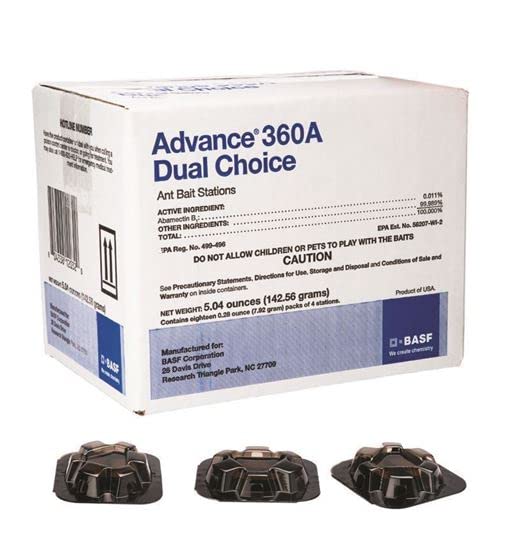
This BASF Advance 360A pack contains prefilled bait stations that present ants with two separate attractants—a protein blend and a carbohydrate/oil blend—so picky species like Pharaoh ants will feed and take bait back to the colony. Each station uses granules with 0.011% abamectin, an active ingredient that disrupts insect nervous systems and helps reduce entire colonies including queens when placed correctly. The kit is intended for indoor and outdoor use in places where ants are a problem and comes in a multi-pack for treating multiple rooms or repeat placements. Practical benefits include the dual-choice formulation for better uptake by mixed ant populations and a tamper-resistant station design that reduces accidental access by children and pets. Limitations are that the product requires following label directions closely because it is a pesticide and that multiple stations and repeat monitoring are usually necessary for heavy infestations to ensure colony elimination.
Best for: Buyers who want a professional-style bait that targets colonies rather than just killing foraging workers and who are prepared to place multiple stations and follow safety directions.
Less Ideal for: People looking for an immediate spray-style knockdown or those unwilling to use a chemical pesticide in or around living spaces.
- Dual-compartment stations provide both protein and carbohydrate/oil attractants to appeal to different ant preferences
- Contains abamectin 0.011%, a slow-acting active ingredient effective at reaching and affecting colony members
- Designed for indoor or outdoor placement with a tamper-resistant station to limit accidental access
- Sold in a large multi-pack suitable for treating multiple rooms or repeated placements
- Contains a pesticide that requires careful handling and strict adherence to label safety instructions
- Will typically need multiple stations and follow-up monitoring for heavy or established infestations
Verdict: Choose this dual-choice, professional-style bait if you need a colony-targeting solution that increases uptake by picky species like Pharaoh ants.
Amdro Ant Killer for Outdoor Home Perimeter, 12 oz

| Unit Count | 12 Ounce |
|---|---|
| Item Form | Granules |
| Target Species | Ant |
| Special Features | Ant Killer for Outdoor Home Perimeter |
Amdro Ant Killer for Outdoor Home Perimeter is a granular bait you shake around a building to create a 1-foot protective band that attracts worker ants and carries the poison back to the colony. It is typically used on lawns, around foundations and in landscaped beds during the spring and summer when ants are active. The formulation claims to work on 25 common ant species and continues to be effective for up to three months, which reduces how often you need to reapply. Practical benefits include easy application with no equipment, visible reduction in ant activity within a week, and suitability for broad perimeter treatment of larger yards. Limitations are that it must be applied to dry ground and not before rain or freezing temperatures, and it targets outdoor activity only so indoor infestations may require separate treatment. This product is best treated as a preventive or colony-control solution for routine lawn maintenance rather than a rapid indoor knockdown.
Best for: Homeowners who want an affordable, low-effort way to reduce ant pressure around lawns and landscaped perimeters and prefer a preventive, long-lasting perimeter treatment.
Less Ideal for: People needing immediate indoor ant control, emergency knockdown, or solutions for wet or shaded yards where repeated wetting makes granular application impractical.
- Granular bait that workers carry back to the colony to target queens and nests
- Claims control of up to 25 ant species common in lawns and landscapes
- Long residual action up to three months reduces reapplication frequency
- Simple shake-on application requires no special tools
- Must be applied to dry ground and avoided before rain or when temperatures are below 50°F
- Designed for outdoor perimeter use only and will not treat interior infestations directly
Verdict: Amdro provides a budget-friendly, long-lasting granular perimeter bait that makes routine lawn and foundation ant control simple and low maintenance.
Amdro Ant Killer for Outdoor Home Perimeter, 24 oz

| Item Form | Granules |
|---|---|
| Target Species | Insects |
| Special Features | Ant Killer for Outdoor Home Perimeter |
| Active Ingredients | Hydramethylnon |
This granular ant bait is formulated for outdoor perimeter control around foundations, lawns, and landscaped areas. You apply a 12-inch band around the house or sprinkle directly on visible trails and mounds; worker ants take the granules back to the colony so the active ingredient, hydramethylnon, can reach the queen and reduce the nest. The label claims protection up to three months and treatment coverage measured in linear feet, which makes it suitable for ongoing seasonal control rather than spot fixes. It works best when applied in cool morning or evening hours on dry ground and should not be used before rain or when temperatures are below 50°F. Practical benefits include simple shake-on application, broad efficacy against many common ant species, and residual activity that lowers repeat treatments. Important limitations are that it is a chemical bait requiring careful handling and adherence to safety directions and that results depend on ant foraging behavior so very large or established colonies may need follow-up treatments or combined tactics.
Best for: Buyers who prioritize strong, season-long perimeter control and want a targeted bait solution for lawns and landscaped areas rather than temporary surface sprays.
Less Ideal for: Those seeking non-chemical or immediate-kill surface treatments, or people who need a one-time indoor solution should consider other products or integrated approaches.
- Designed for outdoor perimeter use with instructions for 12-inch band application around the home
- Granular bait formulation is carried by foragers to the colony to target the queen
- Label lists effectiveness against a wide range of common ant species
- Offers residual control claimed up to three months reducing application frequency
- Contains hydramethylnon and requires careful handling and adherence to safety directions
- Performance depends on ants discovering and collecting the bait so results can vary by species and activity levels
Verdict: Choose this product if you want a proven granular perimeter bait that targets colonies to deliver longer-lasting outdoor ant control.
Choosing the Right Ant Bait for Argentine Ants: Key Factors to Consider
Bait Type and Food Preference
Argentine ants switch feeding preferences with season and resource availability. In warm months they often favor sugary liquids and carbohydrate sources; at other times they may take protein or lipid baits. Choosing a bait formulation that matches local foraging behavior increases the chance that workers will carry toxicant back to the nest.
Consider whether a gel, granular, or liquid bait is best for your situation. Liquids and gels mimic nectar or honeydew and work well near flowers, fruit trees, or where honeydew-producing insects are present. Granules or solid baits can be better around soil edges or in drier microclimates.
Placement and Station Design
How and where you place bait matters as much as the formulation. Stations protect bait from rain and curious non-target animals while focusing ant traffic. Place stations along trailways, near foraging sites, and close to structure perimeters where Argentine ants travel. Avoid putting bait directly on open soil or near pollinator-rich flowers.
Station design affects maintenance and safety. Look for stations with entry tunnels that accommodate many workers but block larger animals. Clear or see-through lids let you monitor bait consumption without disturbing ants, which helps you know when to replace or refill bait.
Resistance to Weather and Outdoor Conditions
Outdoor settings expose baits to sun, rain, and temperature swings that can reduce attractiveness or dissolve the active ingredient. Baits that dry out too fast or become diluted after rain stop being effective and may attract other pests.
Choose formulations or stations engineered to shed light rain and retain moisture, or plan regular checks after storms. When deploying liquid baits in hot climates, pick products with thicker gels or those formulated to resist rapid evaporation.
Risk to Non-Target Animals and Pollinators
Reducing accidental exposure to pets, birds, and beneficial insects is a major practical concern in gardens. Baits placed in open trays or spread across soil increase the chance that a curious pet will access the toxicant, and sugar-based baits can attract bees and wasps if placed near flowers.
Use tamper-resistant stations and place them low to the ground in sheltered locations away from flowering plants. Read label guidance for restrictions around pollinator habitats and choose baits with targeted delivery when non-target risk is a priority.
Speed of Action Versus Colony Impact
Some baits kill workers quickly, which can give the impression of rapid success but may not eliminate the colony if foragers die before returning the bait. Slower-acting toxicants allow more bait to be transported back to the nest, increasing the chance of colony-level reduction.
Balance the desire for visible, fast worker kills with the need for delayed-action modes that enable secondary transfer. For tough infestations, prioritize baits designed for colony suppression rather than immediate knockdown.
Maintenance and Monitoring Needs
Even the best bait requires routine checks. Outdoor stations need periodic inspection for consumption, contamination, and moisture loss. Long-term control can require rotating bait types if ants change feeding habits or if other pests begin using the bait.
Factor in how often you can inspect stations and whether the product is easy to refill or replace. Products that allow quick visual checks and simple servicing make sustained control more practical for busy gardeners.
Understanding Argentine Ant Behavior in Gardens
Argentine ants form large, cooperative colonies and often forage widely along property edges, mulch beds, and irrigation lines. They follow scent trails and recruit nestmates to reliable food sources, so a single well-placed bait can attract many workers if it matches their food preference. Observing peak foraging times and trail routes before placing bait improves success.
Avoid placing baits in direct sunlight or on flowering ornamentals. Instead, target shaded trail intersections, under pavers, or along foundation seams where ants consistently travel.
- Watch trails for several days to find consistent paths
- Place baits near known food sources like pet feeding stations, compost edges, or fruit drops
- Check stations in the morning and evening when ants are most active
Timing Baiting with Season and Weather
Seasonality affects what Argentine ants prefer to eat and how actively they forage. In the heat of summer they may seek liquids, while in cooler or wetter periods they might accept solids or protein-rich baits. Also avoid baiting right before heavy rain which can wash away or dilute baits.
If you expect several days of rain, either postpone deployment or use stations designed to keep bait dry. Recheck bait after storms and replace if it has been contaminated or dissolved.
- Switch bait type seasonally if consumption stalls
- Deploy baits during stable weather windows for best uptake
- Monitor after irrigation events that might alter trail patterns
Safe Placement Around Pets and Pollinators
Protecting pets and pollinators is a practical concern. Use tamper-resistant stations and site them out of reach of dogs and cats. Keep bait stations away from flowering plants, vegetable beds, and beehives to reduce attraction for beneficial insects.
If you have outdoor cats or free-roaming dogs, place stations in narrow crevices or under ledges where only ants can enter, and check stations frequently to ensure they remain secured.
- Prefer enclosed stations over open dishes near gardens
- Move pet feeding areas away from treated zones while baiting
- Label or mark baited zones to remind household members of placement
When to Call in Additional Control Measures
Baiting is most effective when it interrupts colony food flow, but severe infestations or nests inside structures may need complementary steps. If activity remains high after consistent baiting, additional perimeter barriers, habitat modification, or professional assistance focused on nest access may be necessary.
Addressing attractants such as exposed food, moisture sources, and dense mulch improves baiting outcomes. Reducing those food sources lowers worker traffic and increases the relative attractiveness of deployed baits.
- Eliminate accessible food and standing water near foundations
- Thin dense groundcover or mulch that provides nesting habitat
- Consider targeted nest inspections if trails lead to wall voids or structural entry points
How We Chose the Best Ant Bait for Argentine Ants
We evaluated candidate ant baits for Argentine ants using criteria that reflect real-world garden and outdoor use. First, bait attractiveness under warm, humid conditions was a primary filter, because Argentine ants prefer sweet or protein-rich baits depending on season and available food. Second, residual effectiveness at the colony level was assessed to prioritize baits likely to reduce foraging long term rather than only kill on-contact workers. Third, bait delivery and placement options were considered, including station design and how well a formulation resists rain or UV exposure. Fourth, safety and non-target risk were evaluated to favor products that reduce access by pets, pollinators, or birds. Finally, ease of use in outdoor and edge-of-structure settings was judged: how simple the product is to deploy, refill, or remove. We excluded contact-only insecticides, broadcast sprays, and devices that do not provide worker-to-colony transfer of active ingredient. We also filtered out formulations that are unsuitable for outdoor edge placements or that lack clear instructions for protecting beneficial insects. The results focus on baits and stations that balance attractant strength, bait longevity in outdoor conditions, and practical safety for gardens and patios.
FAQ
How quickly will ants find bait once I place it?
Often worker ants find a new, attractive bait within hours if placed along active trails, but it can take longer if foraging patterns vary. Check stations the first day and again within 48 hours to confirm uptake.
Can I use baits near vegetable gardens and flower beds?
You can use baits near these areas if you place them in enclosed, tamper-resistant stations away from flowers. Avoid open bait placements that pollinators or crop pests might access.
What if ants ignore the bait I choose?
Ants may ignore a bait if it does not match their current food preference or if competing food is available. Try a different bait type or move the station closer to active trails after removing competing food sources.
Should I remove mulch or debris before baiting?
Reducing excessive mulch or debris can help by exposing trails and making stations more accessible to workers. You do not need to remove all mulch, but thinning it near foundations and bait locations improves results.
How long should I leave bait stations in place?
Keep stations in place until consumption drops and foraging activity decreases, which can take several days to weeks depending on colony size. Continue monitoring and replace bait if it becomes contaminated or depleted.
Final Verdict
Focus first on matching bait type to what Argentine ants are actively foraging for and on placing stations where workers naturally travel. Prioritize bait formulations and station designs that resist weather, reduce non-target access, and allow colony-level transfer rather than immediate knockdown of foragers. Plan to monitor and maintain stations regularly and adjust bait type or placement if uptake slows. Ultimately choose a solution that balances attractant strength, safety around pets and pollinators, and practical maintenance needs for your outdoor setting. That approach gives the best chance of reducing Argentine ant activity over time.
