

Note: This article contains affiliate links. If you click on these links and make a purchase, I may earn a small commission at no extra cost to you. This helps support my research and content. Read my full affiliate disclosure here.
Starting tomato seedlings indoors is a seasonal necessity for many gardeners who want an earlier, more controlled start to the season. Choosing the right grow light for tomato seedlings affects germination rates, stem thickness, and overall transplant readiness because light intensity, spectrum, and coverage all influence how seedlings develop. This guide presents seven shortlisted grow lights that fit common seed-starting setups, from small windowsill trays to multi-flat racks. We evaluated each option against practical seed-starting needs such as spectral balance, usable coverage, heat management, and ease of setup to help you pick a fitter option for your space and workflow.
Top Picks at a Glance
| Best Overall The best all-around choice for most situations | Barrina T5 1 ft LED Grow Light, 5000K Full Spectrum (4-pack) |  |
| Best Quality Built to a higher standard if you want something more solid | Barrina 4ft T8 Full Spectrum LED Grow Light, 6-Pack |  |
| Best Value The sweet spot between price and what you get | FECiDA Flat Panel LED Grow Lights, 4-Pack | 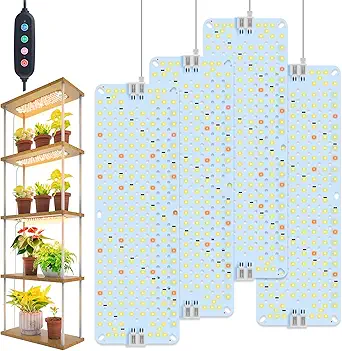 |
| Best Budget The cheapest option that still gets the job done reliably | RWNTAO 2-Head Full Spectrum Clip LED Grow Light (84 LEDs) |  |
| Highest Rated A top-rated pick with lots of positive feedback | VIPARSPECTRA P700 70W Dimmable LED Grow Light |  |
| Most Popular A crowd favorite that many people choose with confidence | GooingTop HY-021 Clip-on Full Spectrum LED Grow Light (6000K, Dimmable) |  |
| Best Seller A high-volume bestseller chosen again and again | Briignite A19 Full Spectrum LED Grow Light Bulbs (2-Pack) |  |
Barrina T5 1 ft LED Grow Light, 5000K Full Spectrum (4-pack)

| Wattage | 5W per fixture |
|---|---|
| Color temperature | 5000K Full Spectrum |
| Linkable | Link up to 16 lights |
| Control | Separate on/off switch per fixture |
| Included accessories | Power cords, connecting cords, clips, double-sided tape |
The Barrina T5 1 ft LED grow light kit supplies full-spectrum 5000K light in a compact, linkable T5 form that is useful for starting and growing tomato seedlings under artificial light. Each 1 ft fixture draws 5W and has its own on/off switch so you can run a single tube or multiple fixtures to match light needs. The set includes power cords, connecting cords, clips, double-sided tape and cable ties for quick plug-and-play installation and you can chain up to 16 lights in series to light multiple trays or shelf levels. Practical benefits for seedlings are even, high-PPFD output from an efficient LED array and the ability to tailor coverage by switching fixtures on or off. Limitations are that the small 1 ft form gives narrow coverage per tube so larger seed flats or full-width racks will need many fixtures, and the product is non-magnetic so mounting options depend on the included clips or your own hardware. Overall this kit is a straightforward, budget-friendly choice for growers who want controllable, linkable light for early-stage tomato plants.
Best for: Growers who want a compact, energy-efficient, controllable lighting solution for starting and growing tomato seedlings on shelves or seed trays.
Less Ideal for: People needing single wide-coverage fixtures for large benches or commercial-scale propagation should consider longer tubes or high-output panels instead.
- Full-spectrum 5000K output suitable for seedlings and vegetative growth
- Separately controllable fixtures let you run only the number of tubes needed
- Linkable design supports chaining up to 16 lights for multi-shelf setups
- Includes mounting clips, power and connecting cords for quick plug-and-play setup
- Small 1 ft length provides limited coverage per fixture so more units are needed for larger trays
Verdict: A compact, linkable full-spectrum T5 kit that gives efficient, controllable light ideal for raising healthy tomato seedlings on shelves and seed trays.
Barrina 4ft T8 Full Spectrum LED Grow Light, 6-Pack

| Wattage | 42 watts |
|---|---|
| Brightness | 2100 lumen |
| Color Temperature | 5000 Kelvin |
| Number of Light Sources | 6 |
| Mounting Type | Ceiling Mount |
The Barrina 4ft T8 full‑spectrum LED set is a plug‑and‑play solution for indoor seedling and vegetative stages. Each 42W fixture delivers about 2100 lumens at 5000K, and the included V‑shaped reflector plus aluminum shell improve light throw and heat dissipation for steady performance. Installation is straightforward with mounting clips, tape and connecting cables and you can link multiple fixtures in series to cover a long seedling bench or a small grow tent. Practical benefits for tomato seedlings include even white-spectrum light that encourages compact, balanced early growth and the ability to run an array without complex wiring. Limits to consider are that these are ceiling/indoor fixtures only and not water resistant, and the units use a fixed push‑button on/off control rather than dimming or spectrum adjustment, so you will need a separate timer or controller for precise photoperiods and intensity tuning.
Best for: Growers who prioritize steady, high‑output lighting arrays for fast, uniform seedling growth and want a straightforward, scalable installation for benches or small grow tents.
Less Ideal for: Home gardeners wanting adjustable spectrum or integrated dimming control, or setups where fixtures may be exposed to moisture or occasional splashing.
- Full spectrum 5000K output suited to seedling and vegetative growth
- Linkable design lets you daisy‑chain multiple fixtures to cover benches or tents
- V‑shaped reflector and aluminum body improve light distribution and heat dissipation
- No built‑in dimming or spectrum control so intensity and photoperiod need external timers or controllers
- Not water resistant, so it must be kept away from humidity and overhead watering
Verdict: A reliable, linkable full‑spectrum T8 array that delivers consistent light intensity for vigorous tomato seedlings when you need scalable, performance‑focused coverage.
FECiDA Flat Panel LED Grow Lights, 4-Pack

| Light Source Type | LED |
|---|---|
| Power Source | Corded Electric |
| Light Source Special Features | Natural Sunlight Full Spectrum |
| Number of Light Sources | 4 |
| Wattage | 48 watts |
These FECiDA flat-panel lights are a compact, practical solution for seed starting and shelf-based indoor gardening. Each panel uses a full-spectrum LED array (listed as 3000K, 5000K and 660nm components) with roughly 12W actual draw per panel and simple series/parallel connections so you can daisy-chain multiple units cleanly on a shelf. Typical use is under shelving, in small greenhouses, or above seed trays and young seedlings where space is limited. Built-in timers offer preset run times (4/8/12/16/20 hours) so you can set daily schedules and avoid manual on/off. The aluminum body and included driver keep installation straightforward, and the set of four covers multiple small trays or tiers. Limitations to note are the modest per-panel wattage if you plan to scale to larger areas and the fixed mounting style which is best suited to flat under-shelf attachment rather than adjustable-height stands. For tomato seedlings on a dedicated seed-starting shelf these panels provide even, plant-friendly light and hands-off scheduling, but larger or more light-hungry setups will need higher-output fixtures.
Best for: Plant parents who want a compact, easy-to-install lighting solution for seed trays and multi-tier shelves and who prioritize tidy wiring and scheduled runtimes for reliable seedling growth.
Less Ideal for: Growers planning to cultivate many tomato plants to larger vegetative or flowering stages in a single area should choose higher-output fixtures or adjustable-height systems instead.
- Full spectrum LED blend including 660nm red to support vegetative and early flowering stages
- Modular series/parallel connections allow tidy daisy-chaining across multiple panels
- Built-in 5-mode timer simplifies daily scheduling for seed starting
- Slim aluminum panels mount cleanly under shelves to save space
- Per-panel actual power (about 12W) is modest and may be low for larger or late-stage plants
- Fixed under-shelf mounting limits use where adjustable distance to seedlings is needed
Verdict: A space-saving, daisy-chainable full-spectrum panel set that makes scheduled seed starting on shelves simple and tidy.
RWNTAO 2-Head Full Spectrum Clip LED Grow Light (84 LEDs)
| Light Source Type | LED |
|---|---|
| Number of Light Sources | 84 |
| Control Method | App |
| Power Source | Corded Electric |
| Additional Features | Dimmable, Timer |
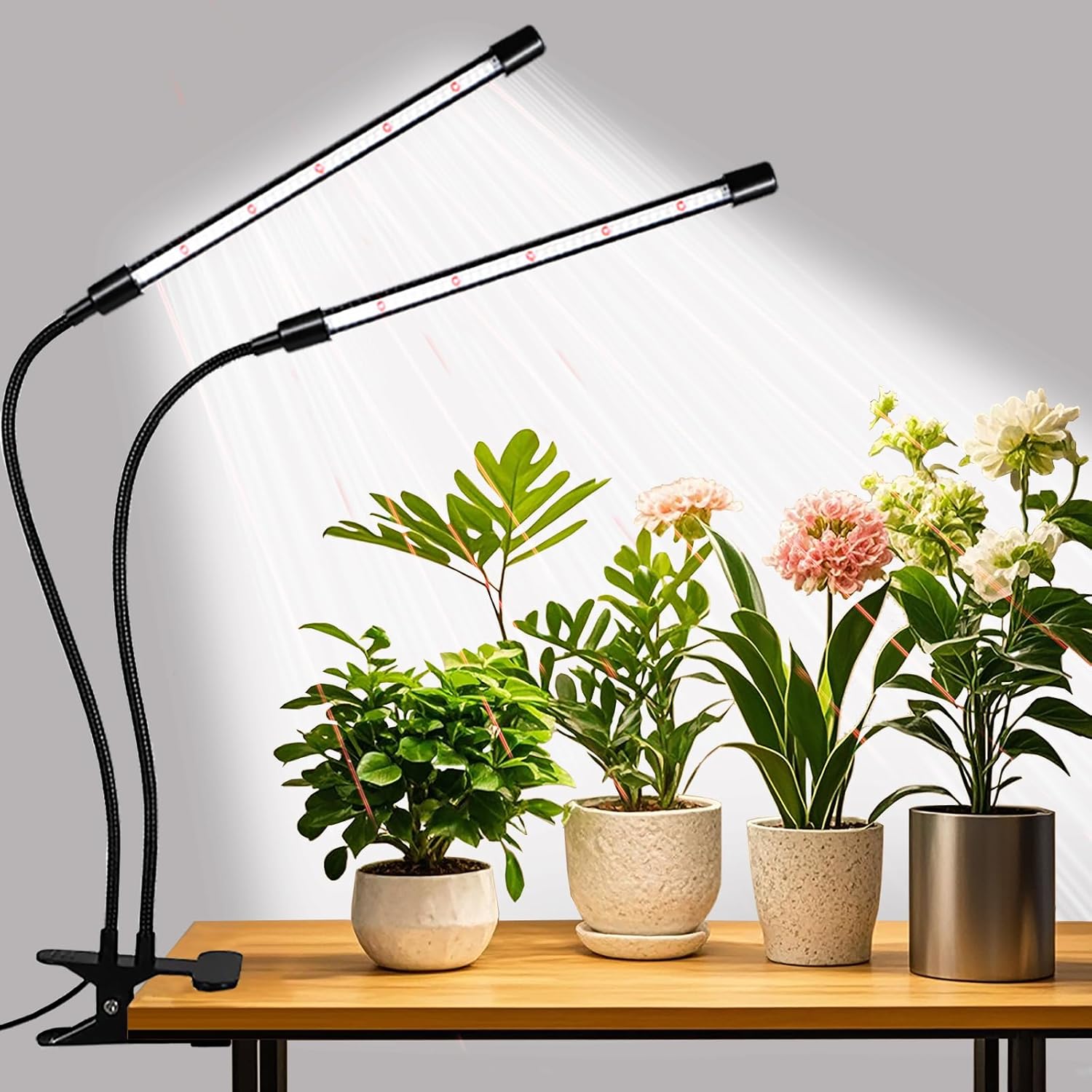
This RWNTAO two-head clip grow light supplies a full spectrum (white plus red) using 84 LEDs across two adjustable bars and is aimed at small-scale indoor growing like seedlings and potted plants. You clamp the unit to a shelf or table and position the flexible gooseneck heads to target young tomato seedlings or multiple small pots. Useful controls include 10 dimmable levels, three color modes (white, red, red+white) and a cycle memory timer with 3/9/12-hour presets so lights can run on a repeat schedule while you are away. The clamp and 360 degree goosenecks make it easy to get even coverage for a few seedlings without rigging a fixture. Practical limits are its modest LED count and single USB/5V power arrangement, which mean it is best for a small tray of seedlings rather than an entire grow rack; distance and coverage recommendations in the description should be followed for good results. Build is mainly aluminum or plastic and the clip supports thicker surfaces for stable placement.
Best for: A cost-conscious grower who needs an easy-to-use light for a few tomato seedlings or small trays and values simple timers and adjustable brightness over high-end output.
Less Ideal for: Growers planning to light large seedling batches, multiple racks, or full canopy coverage should choose a higher-output panel sized for their space.
- Full-spectrum white plus red LEDs suitable for vegetative and flowering stages
- 10 dimmable levels and 3 timer presets for hands-off, repeatable schedules
- Flexible 360° goosenecks and a strong clamp for accurate placement and stable mounting
- Designed for small setups so it will not provide sufficient coverage or intensity for large seedling flats or multiple tiers
Verdict: A budget-friendly, clamp-mounted full-spectrum LED grow light that gives tomato seedling growers simple timer and dimming controls for reliable small-scale starts.
VIPARSPECTRA P700 70W Dimmable LED Grow Light

| Light Output Maximum | 11000 lumens |
|---|---|
| Wattage | 70 watts |
| Light Source Type | Light Emitting Diode |
| Mounting Type | Hanging Mount |
| Light Source Special Features | Dimmable |
The VIPARSPECTRA P700 is a compact, energy-efficient LED grow light made for seed starting and vegetative stages. It delivers up to 11,000 lumens from 216 diodes across a balanced full spectrum that includes red 660nm and warm/cool white (3000K and 5000K), and the built-in 4-level dimmer makes it easy to tune intensity for delicate tomato seedlings or denser vegetative growth. Its fanless, large-aluminum heat sink design keeps operating temperatures low while extending component life, and the hanging-mount form factor with included stainless hooks makes installation in a small tent or shelving unit straightforward. At 70 watts it claims PAR comparable to much higher-wattage HPS/MH fixtures while using less energy, so it can run continuously during early seedling phases without large electricity costs. Limitations to note are the light footprint: the manufacturer recommends it for roughly a 2×2 ft vegetative area, so you may need multiple units for larger flats, and the P700 is a focused fixture rather than a wide-coverage panel which affects spacing and placement for even canopy light distribution.
Best for: Growers who prioritize dependable, low-heat lighting for tomato seedlings and want a simple, durable fixture that reliably supports early vegetative stages.
Less Ideal for: People needing to light large flats, full benches, or entire multi-tier setups with a single fixture should consider larger panels or multiple units instead.
- Full spectrum tuned for seedlings and vegetative growth including 660nm red and 3000K/5000K white.
- Dimmable 4-level control to match intensity for seedlings through veg stages.
- Energy efficient 70W output with high lumen and claimed high PAR for a small footprint.
- Fanless aluminum heat sink lowers operational noise and helps longevity.
- Includes hanging hardware for quick setup in tents, shelves, or cabinets.
- Recommended effective coverage is modest (about 2×2 ft) so larger seed trays need additional fixtures.
- No built-in timer or wireless control, requiring external timer or manual adjustment.
Verdict: A compact, reliable full-spectrum LED that gives tomato seedlings the controlled, low-heat light they need in small tents or trays.
GooingTop HY-021 Clip-on Full Spectrum LED Grow Light (6000K, Dimmable)

| Power Source | Corded Electric |
|---|---|
| Color Temperature | 6000 Kelvin |
| Light Source Special Features | Dimmable |
| Number of Light Sources | 84 |
| Mounting Type | Clip Mount |
This GooingTop clip-on grow light delivers a compact, flexible solution for starting tomato seedlings under artificial light. It uses 84 LEDs (10 red, 74 white) tuned around 6000K plus a deep 660nm red band to support vegetative growth and later flowering, and the attached remote provides two brightness levels and repeatable 4/8/12 hour timer cycles so you can set daily photoperiods without constant attention. The clamp and dual goosenecks make it easy to position over seed trays or single pots on a desk or shelf, and the maker reports a low power draw roughly equal to 10 W LED that is energy efficient for continuous seedling use. Practical limits are its intended coverage area of about 1 to 2 square meters and modest output compared with larger panel fixtures, so you may need multiple units or close mounting for thicker seed flats or larger batches of tomato starts. The light is best when used close to young seedlings and paired with regular height adjustments as plants grow.
Best for: Home gardeners starting small batches of tomato seedlings who want a plug-and-play lamp they can position precisely and schedule without complex setup.
Less Ideal for: Growers who need high-intensity lighting for large or densely sown seed trays or who prefer broad multi-shelf commercial fixtures.
- Full-spectrum output with targeted 660 nm red plus 6000K white for seedling growth and flowering support
- Attached remote offers dimming and repeatable 4/8/12 hour timer for easy photoperiod control
- Flexible dual goosenecks and strong clamp allow precise placement over trays or individual pots
- Low power consumption (about 10 W) suitable for running daily without high electricity cost
- Coverage and overall light intensity are limited, so multiple units may be needed for larger seedling batches
Verdict: A compact, energy-efficient clip-on grow light that makes scheduling and positioning tomato seedlings simple and low-effort.
Briignite A19 Full Spectrum LED Grow Light Bulbs (2-Pack)

| Light Type | LED |
|---|---|
| Additional Features | Full Spectrum |
| Bulb Base | E26 |
| Light Output Maximum | 1000 lumens |
| Light Source Operating Life | 30000 hours |
These Briignite A19 grow light bulbs are full-spectrum LED replacements that screw into any standard E26 fixture to provide plant-friendly light without the purple hue of many grow bulbs. Each bulb produces about 1000 lumens at roughly 11 to 12 watts, mimicking daylight at 3500 K and delivering even 180 degree coverage for seedlings and small pots. The bulbs are marketed with a high color rendering index and a long rated life around 25,000 to 30,000 hours, and the aluminum and plastic body helps dissipate heat so they run cool near delicate tomato seedlings. They are simple to use: plug into a lamp or fixture, set schedules with the app or push-button controls, and position 12 to 18 inches above trays for best results. Limitations are that they are single-bulb outputs meant for hobby setups rather than large flats, and the listed PPF is modest so multiple bulbs or closer placement will be needed for denser seedling racks. For a risk-averse gardener this is an easy, low-maintenance way to add natural-looking light for tomato seedlings without complicated fixtures.
Best for: Home gardeners who want a low-risk, easy-to-install grow light to start and maintain tomato seedlings in small trays or pots and who prioritize natural-looking light and simple controls.
Less Ideal for: Growers needing high-intensity lighting for large numbers of seedlings or for flowering/fruiting at scale should choose purpose-built high-PPF fixtures instead.
- Full-spectrum output (3500 K) that appears natural and shows true plant colors
- Standard E26 base fits common fixtures for simple installation
- Low power draw (11–12 watts) with about 1000 lumens for energy-efficient operation
- App and push-button controls allow scheduling and basic automation
- Aluminum and plastic construction with passive cooling reduces heat near seedlings
- Modest overall light output per bulb, so multiple units are needed for larger seedling trays
- Designed for indoor use only and not intended for commercial-scale growing
Verdict: A simple, low-maintenance full-spectrum A19 bulb solution that makes it easy to give tomato seedlings natural-looking light using standard E26 fixtures.
Choosing the Right Grow Light for Tomato Seedlings: Key Factors to Consider
Light Spectrum and Balance
Tomato seedlings respond to both blue and red wavelengths: blue light promotes shorter, sturdier stems and compact leaf growth while red light supports photosynthesis and early leaf expansion. A balanced full-spectrum or dedicated grow spectrum that includes both bands helps seedlings develop without becoming leggy. For seed starting, avoid lamps that are heavy on green wavelengths or purely decorative colors that do not deliver usable photosynthetic photons.
Spectrum labeling matters because some fixtures list color temperature in kelvins, which is an imperfect proxy for plant-useful light. Look for fixtures that provide a manufacturer PPFD curve or indicate a full-spectrum output that includes blue and red peaks suitable for the seedling growth stage.
Light Intensity and PPFD
Seedlings need moderate intensity. Too little light causes stretching and weak stems; too much near a concentrated source can scorch delicate cotyledons. Photosynthetic photon flux density is the best measure of usable plant light and some fixtures publish output at common hanging heights. For tomato seedlings, aim for steady, even PPFD across the tray rather than a high peak in the center.
Consider fixtures with dimming or multiple power modes so you can fine-tune intensity as seedlings move from germination to true-leaf stages. Also factor in the number of trays and their distance from the light when estimating whether a fixture provides adequate intensity.
Coverage and Fixture Size
Coverage determines how many cells or how large a tray a single fixture can light effectively. A fixture that only lights a small center spot forces you to rotate trays or use multiple lamps, which increases complexity. Measure your typical tray or flat size and choose a fixture whose even-light footprint matches or slightly exceeds that area.
Adjustable hangers or multi-light configurations let you scale coverage as your indoor nursery grows. For narrow windowsills, compact fixtures with reflective designs work better; for bench setups, choose wider panels that distribute light evenly across the whole surface.
Heat Output and Thermal Management
Young tomato seedlings tolerate only modest heat; excessive fixture heat can dry out trays, stress seedlings, or create hotspots that restrict growth. LED fixtures generally run cooler than older HID or fluorescent options, but high-output LEDs still produce heat that needs to be dissipated.
Good thermal design with heat sinks or passive cooling keeps fixture temperature stable and allows you to place lights closer to seedlings without risk. Also consider whether the fixture's heat will alter your room temperature or humidity and plan spacing and ventilation accordingly.
Mounting, Adjustability, and Controls
A practical grow light for seedlings should be easy to hang, lower, and control. Simple ratchet hangers, adjustable chains, or telescoping stands let you maintain the ideal distance as seedlings grow. Built-in timers or dimming presets reduce daily management work and help standardize light cycles.
Durability of cords, switches, and hanging hardware matters when you run multiple cycles each season. Ease of cleaning is also important because seed-starting areas can be messy; fixtures that tolerate occasional wiping and resist moisture intrusion will last longer in a damp nursery environment.
Energy Use and Runtime Costs
Energy efficiency affects long-term running costs when lights are on 12 to 16 hours a day for weeks at a time. Look for fixtures that deliver higher photon output per watt so you get adequate PPFD without excessive electricity draw. Timers and dimming can reduce runtime when full output is not necessary.
Also consider seasonal usage patterns. If you only start tomatoes for a few months, prioritizing lower upfront cost and modularity may make sense. For year-round use or larger volumes, energy-efficient panels with reliable drivers become more cost-effective over time.
Setting Up a Seedling Light Station
Pick a location with stable room temperature and access to power. A bench near a window can work, but supplemental light remains the primary source for most indoor starts, so ensure the fixture is centered over the tray and hung at an adjustable height. Use a waterproof mat or tray liner to protect surfaces from spills and errant water.
- Mount lights so they are horizontal and centered over flats to avoid edge shading.
- Use a dolly or movable bench if you need to shift trays outside for hardening off.
- Label hang heights and power settings for each stage so you can repeat a successful setup next season.
How Much Light Do Tomato Seedlings Actually Need
Tomato seedlings need enough photon flux to fill their daily light integral without stretching. In practice that means consistent, moderate intensity delivered for 12 to 16 hours during early growth. Monitor seedlings daily and lower the fixture if stems start to elongate; conversely raise or dim the fixture if leaves show signs of light stress or bleaching.
- Start with the fixture at the manufacturer recommended height for seedlings and adjust within the first week based on stem thickness.
- Use a simple handheld light meter or smartphone accessory if available to measure PPFD; otherwise use plant response as a reliable guide.
Common Mounting and Power Configurations
Home growers often choose between compact single bars, multi-bar racks, and flat panels. Single bars work well for small flats and windowsills; multi-bar systems scale across bench racks and provide more even coverage. Flat panels offer a balance of coverage and thin profile that fits under shelving. Consider power arrangements if you plan to run several fixtures. Daisy-chaining units with built-in connectors reduces cord clutter but check total draw for your circuit. Timers simplify daily cycles and reduce human error.
- For small setups, a single adjustable bar over a 1020 tray is usually enough.
- For multiple trays, staggered bars or a wider panel prevent shadows between flats.
Transitioning Seedlings to Strong Transplants
As seedlings develop true leaves and grow sturdier stems, continue the same light schedule but gradually raise the fixture to encourage sturdiness and avoid overheating. Harden seedlings by introducing outdoor light and wind exposure over a week before transplanting. Watch for color and growth changes: short, dark green stems with full leaves indicate adequate light, while pale leaves or long internodes suggest you need higher intensity or a closer fixture.
- Introduce a few hours of outdoor light and breeze in the final week before transplanting.
- Reduce daily light by a couple of hours during hardening to cue natural rhythms.
How We Chose the Best Grow Light for Tomato Seedlings
We focused on real-world seed-starting performance and practicality for tomato seedlings. Selection began with models suited to common indoor seed trays and flats rather than full-scale greenhouse fixtures. We excluded heavy commercial fixtures and single-purpose decorative lamps that lack the output or spectrum balance needed for healthy seedling development. Key evaluation criteria included light spectrum and photosynthetic photon flux density because young tomatoes need a balance of blue and red light for compact growth and robust leaf development. Coverage and adjustable height were assessed to ensure a fixture can uniformly light a typical seed tray and allow lowering as seedlings grow. Heat management and energy efficiency were considered to avoid scorched young plants and excessive running costs. Ease of use factors such as mounting options, dimming or timers, and durability completed the editorial filters. The final shortlist emphasizes fixtures that combine the right spectrum, steady output, simple control, and practical coverage for most home tomato seed-starting setups.
FAQ
How far should a grow light be from tomato seedlings?
Distance depends on fixture output. Many LED seedling fixtures start 6 to 12 inches above the cotyledons. Lower the light slowly if seedlings stretch, and raise it if leaves show bleaching or heat stress.
When should I switch seedlings to stronger light?
Increase intensity once seedlings develop true leaves and a defined stem, typically 1 to 3 weeks after germination. Use dimming or raise the fixture gradually to avoid shock.
Are full-spectrum lights necessary for tomatoes?
Full-spectrum lights that include blue and red wavelengths are helpful because they support compact growth and photosynthesis. Strictly speaking, seedlings can grow under many lamps, but a plant-focused spectrum reduces leggy growth and improves leaf development.
Can I use fluorescent lights for tomato seedlings?
Fluorescents can work for small batches and low-height setups, especially modern T5 fixtures that provide adequate blue output. LEDs usually give better efficiency and longevity, but fluorescents remain a viable low-cost option for beginners.
How many hours of light do tomato seedlings need per day?
Seedlings typically do best with 12 to 16 hours of light daily. Consistent daily cycles and a short dark period help hormone balance and prevent excessive stretching.
Will a single light work for multiple trays?
It can if the fixture's coverage area matches the combined tray footprint and light is evenly distributed. Otherwise you may need multiple fixtures or rotate trays to avoid uneven growth.
Final Verdict
Choose a grow light that matches your physical setup, the number of trays you plan to run, and how much hands-on adjustment you want to do. Prioritize correct spectrum and even coverage first, then look at intensity controls, mounting flexibility, and heat management. Tradeoffs are common: compact bars suit small windowsills, while wider panels reduce management for bench systems. Start with a fixture that offers adjustable output and a spectrum tuned for seedling growth. That approach keeps stems compact, speeds leaf development, and reduces time spent babysitting starts so you can move seedlings to the garden at peak transplant readiness.
