

Note: This article contains affiliate links. If you click on these links and make a purchase, I may earn a small commission at no extra cost to you. This helps support my research and content. Read my full affiliate disclosure here.
Starting seeds indoors needs steady, close light without excess heat or wasted energy. The right budget grow light for seedlings will give seedlings enough blue and red spectrum to form short, stocky stems while staying cool above the soil so delicate cotyledons do not scorch. In this guide we shortlisted five dependable options that suit small trays, individual pots, and compact windowsill setups. We evaluated each on light spectrum quality, usable coverage, heat management, and operating cost so you can pick the fixture that fits your tray size and setup. Read on for practical notes that help you match a light to your seed-starting routine.
Top Picks at a Glance
| Best Value The sweet spot between price and what you get | GooingTop HY-021 6000K Full-Spectrum Clip Grow Light |  |
| Best Budget The cheapest option that still gets the job done reliably | DOMMIA Under-Shelf USB LED Grow Light Panel, 2-Pack |  |
| Highest Rated A top-rated pick with lots of positive feedback | Sonamindary GL05 336-LED Desktop Grow Light (Full Spectrum) |  |
| Most Popular A crowd favorite that many people choose with confidence | LEOTER 4-Head LED Grow Light with Full Spectrum, Timer and 10-Level Dimming |  |
| Best Seller A high-volume bestseller chosen again and again | Barrina T5 1ft LED Grow Lights, 5000K Full Spectrum — 4-Pack |  |
GooingTop HY-021 6000K Full-Spectrum Clip Grow Light
| Power Source | Corded Electric |
|---|---|
| Color Temperature | 6000 Kelvin |
| Light Output Maximum | 2500 lumens |
| Light Source Special Features | Dimmable |
| Number of Light Sources | 84 |
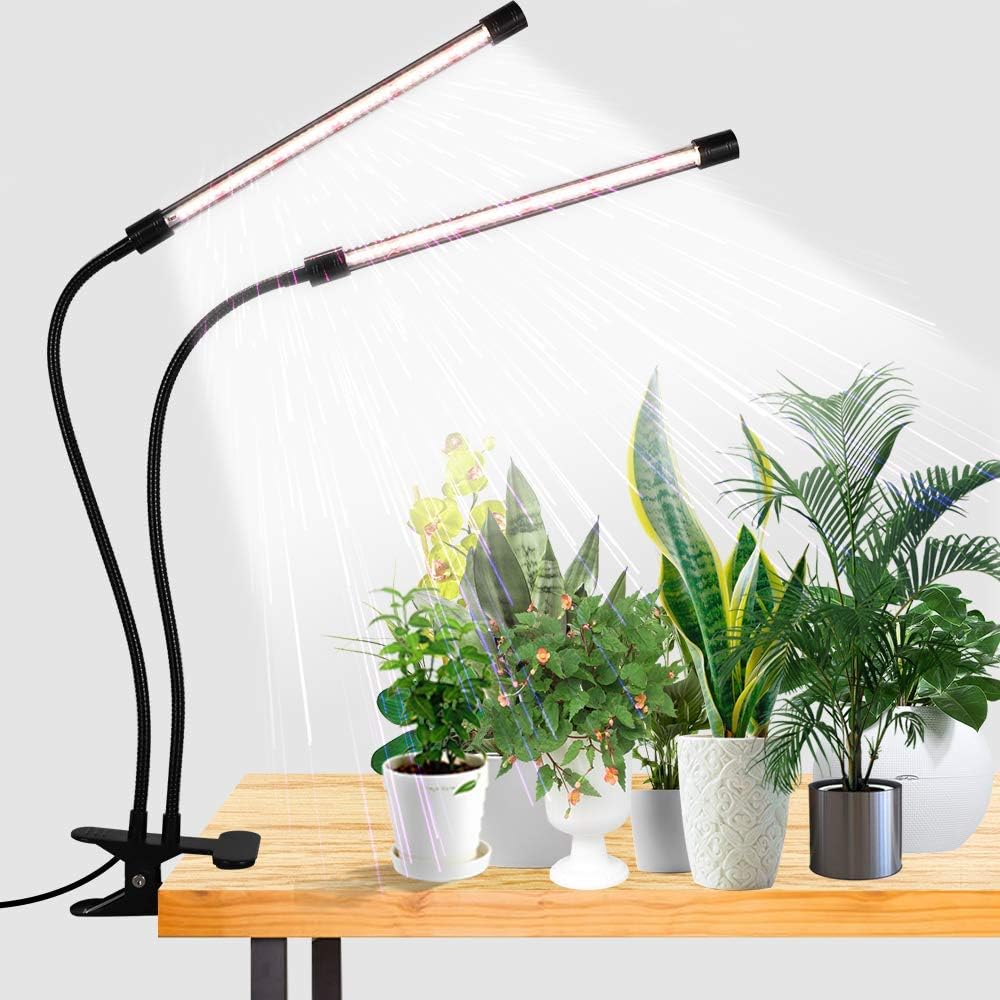
This GooingTop HY-021 is a compact clip-on grow light built for small houseplants, seedlings and shelf gardens. It uses 84 LEDs (white plus deep red) to deliver a 6000K full-spectrum output intended to mimic midday sun, with a high color-rendering output that also makes it pleasant as a reading lamp. Two flexible gooseneck heads and a strong clamp let you aim light precisely over pots and seed trays, while the attached remote provides 50%/100% dim levels and repeating timers at 4, 8 or 12 hours for hands-off scheduling. Practical benefits include low power draw (listed as roughly 10 W LED draw), a claimed 1 to 2 square meter coverage for seedlings, and an included timer that simplifies day/night cycles. Limitations are its design for small setups rather than large grow racks and the clip mounting limits placement compared with freestanding fixtures. The unit also relies on the corded remote instead of a smartphone app and the lifespan claim is typical of LEDs but not independently verifiable from the listing.
Best for: Buyers who want a simple, low-power, plug-and-play grow light to boost seedlings and a few houseplants on a desk or shelf and who value an easy-to-use timer and adjustable brightness.
Less Ideal for: Growers planning multi-shelf installations, larger vegetable grows, or who need networked or app-based control should consider larger bar lights or fixtures designed for commercial racks.
- Full-spectrum 6000K output with added 660 nm red LEDs to support vegetative growth and flowering
- Attached remote with dimming (50%/100%) and repeat timer settings (4/8/12 hours) for easy scheduling
- Flexible dual goosenecks and strong clamp enable precise positioning over small pots and seed trays
- High reported color rendering for comfortable viewing and accurate plant color assessment
- Low electrical draw around 10 W while covering small growing areas
- Clip-mount design and stated 1–2 m² coverage make it better suited to individual plants or small trays rather than large multi-shelf setups
- No smart app or wireless control option; remote is cord-attached which limits placement flexibility
Verdict: A compact, easy-to-use clip grow light that delivers full-spectrum light and convenient timer/dim controls for small indoor plant setups.
DOMMIA Under-Shelf USB LED Grow Light Panel, 2-Pack

| Wattage | 10 watts |
|---|---|
| Light Source Type | LED |
| Power Source | Corded Electric (USB 5V 2A) |
| Mounting Type | Under Cabinet Mount |
| Number of Light Sources | 2 |
The DOMMIA two-panel grow light is a compact LED solution made for cramped shelves, plant cabinets, and seedling trays. Each 4" square panel is ultra-thin and mounts with adhesive or magnets so you can position light directly over small pots or seedling flats. The panels provide a full 380–780nm spectrum with built-in optical lenses that concentrate light downward; the listing reports about 260 µmol/m²/s PPFD at 4 inches, which is well suited to germination and early vegetative growth. Controls live on a USB-powered smart controller with a 6/12/16 hour auto timer and four brightness levels, plus memory to restore settings after power loss. USB power and a 6 ft cord make it easy to use with a power bank or USB adapter, and the low-voltage design is safer around humid setups. Expect good coverage for a few seed trays or multiple small pots, but larger flats or multiple shelving tiers will need additional panels for even light. The construction is lightweight aluminum and plastic which keeps cost and bulk down but may be less robust than heavier fixtures.
Best for: Ideal for home gardeners starting seeds or growing a few small seedlings on a tight budget who need a low-profile, easy-to-install light for shelves and cabinets.
Less Ideal for: Not a good fit for growers who need high output over large trays, full shelving racks, or consistent commercial-scale lighting across many plants.
- Ultra-slim 4"x4" panels mount easily under shelves or inside cabinets.
- Full 380–780nm spectrum with optical lenses for focused light on seedlings.
- Built-in 6/12/16H auto timer and 4 brightness levels for set-and-forget use.
- USB 5V power and 6 ft cord work with adapters, power banks, and USB hubs.
- Small panel size limits effective coverage per unit, so multiple panels are needed for larger seedling batches.
- Lightweight plastic/aluminum build may feel less durable than heavier fixtures.
Verdict: A very affordable, ultra-slim USB LED panel set that gives seedlings focused full-spectrum light and automatic timers for small-scale indoor starts.
Sonamindary GL05 336-LED Desktop Grow Light (Full Spectrum)

| Number of Light Sources | 336 |
|---|---|
| Wattage | 15 watts |
| Voltage | 12 volts_of_direct_current |
| Mounting Type | Desktop |
| Power Source | Corded Electric |
The Sonamindary GL05 is a small, purpose-built desktop grow light that delivers even supplemental light for seedlings and small houseplants. Its 336-LED panel combines white and red diodes to provide a 6000K full spectrum and CRI 90+ color rendering, which helps seedlings develop without odd color shifts in your living space. The telescoping pole and silicone-sleeved metal arm let you position the 5.9 x 5.9 inch panel at heights suited to young plants, while a sturdy metal base keeps the lamp stable on desks or shelves. Practical controls include five brightness levels and a 4/8/12 hour daily timer that repeats every 24 hours, so you can set consistent light cycles. At 15 watts the lamp is energy efficient for continuous seedling use, and the tool-free setup makes it straightforward to install. Limitations to note are the desktop mounting only and the relatively small coverage area, so it is best for single pots or small trays rather than larger seedling flats.
Best for: Gardeners who need a reliable, easy-to-use supplemental light for starting individual seedlings or keeping a few small houseplants healthy under consistent daily cycles.
Less Ideal for: Growers who need wide coverage for multiple seedling flats or a fixture for a full greenhouse setup should choose a larger, higher-output panel instead.
- Full-spectrum LED array (252 white + 84 red) suited to multiple seedling growth stages
- Adjustable telescopic pole and flexible silicone-sleeved arm for precise positioning
- Built-in 4/8/12 hour timer and five dimming levels for consistent light schedules
- Compact metal base and tool-free assembly make it easy to set up on desks or shelves
- Desktop mounting and small panel limit coverage to a few seedlings rather than larger trays
- Not waterproof and not intended for greenhouse or outdoor use
Verdict: A compact, dependable full-spectrum desktop grow light that gives seedlings consistent, energy-efficient light and easy timer control for worry-free daily use.
LEOTER 4-Head LED Grow Light with Full Spectrum, Timer and 10-Level Dimming

| Light Source Type | LED |
|---|---|
| Number of Light Sources | 80 |
| Wattage | 80 watts |
| Control Method | Remote |
| Mounting Type | Clip On |
The LEOTER 4-head grow light is a USB-powered, clip-on lamp built for indoor plant care that combines full-spectrum and targeted red/blue diodes to support seedlings, vegetative growth and flowering. It uses 80 LEDs arranged across four adjustable heads on flexible goosenecks so you can position light over individual large plants or groupings. Notable features are three spectral modes (red+blue, warm/full spectrum, and combined), a circular memory timer with 3/9/12-hour presets, and ten brightness levels for fine control over intensity. The strong metal clip and flexible necks make it simple to aim light at tall foliage without permanent installation. Practical benefits include reduced need for supplemental natural light, convenient daily scheduling for busy users, and a compact footprint that suits shelves or plant stands. Important limitations are that the unit is described as a clip/desk lamp rather than a wide-panel fixture, so coverage for very large single specimens may require placing heads close to foliage or using multiple units, and the timer resets if unplugged so it needs occasional reprogramming after power loss.
Best for: Buyers who want a controllable, space-efficient grow light to supplement indoor sun for larger houseplants and prefer a proven, feature-rich unit with preset timers and adjustable heads.
Less Ideal for: Growers who need single-fixture coverage for floor-to-ceiling specimens or large multi-plant setups should consider full-size panel fixtures or multiple units instead.
- Full spectrum plus red and blue LEDs (80 total) to support all growth stages
- Ten dimming levels for precise intensity control
- Three timer presets with memory function for hands-off daily scheduling
- Adjustable 4-head design and flexible goosenecks for targeted placement
- Strong metal clip allows mounting on shelves, desks, or plant stands
- Designed as a clip-on lamp so single-unit coverage is limited for very large plants
- Timer settings must be reset after the light is unplugged
Verdict: A versatile, adjustable clip-on grow light that gives busy indoor gardeners precise control over spectrum, intensity and scheduling to boost large plant growth in compact spaces.
Barrina T5 1ft LED Grow Lights, 5000K Full Spectrum — 4-Pack

| Wattage | 5W |
|---|---|
| Color temperature | 5000K |
| Linkable | Link up to 16 lights |
| Control | Separate on/off switches |
The Barrina T5 1ft grow light 4-pack provides straightforward, energy-efficient supplemental lighting for seedlings, vegetative plants, and flowering houseplants. Each slim fixture produces a 5000K full spectrum output at 5W and includes an on/off switch so you can control lights individually or run them together. The lights are plug-and-play and come with power cords, connector cables, clips, double-sided tape, and cable ties for quick installation on shelves, racks, or small indoor shelving units. Because fixtures link up to 16 units, you can scale a multi-shelf setup without extra wiring. Practical benefits include low power draw, compact footprint that fits tight spaces, and a high PPFD-focused output that supports photosynthesis. Limitations are that these are short 1-foot fixtures intended for close-proximity use rather than lighting large rooms, the mounting relies on adhesive and clips rather than a heavy-duty mounting system, and they are not magnetic, which reduces some placement options. For growers who want an easy, modular lighting solution for small indoor setups, these deliver reliable light for everyday use.
Best for: Buyers who want a compact, energy-efficient grow-light system to brighten shelves or small indoor racks and who value easy installation and scalable setups.
Less Ideal for: Growers who need to light large rooms, tall plants, or wide benches should choose longer or higher-output fixtures instead.
- Full-spectrum 5000K output suitable for seedlings through flowering
- Individual on/off switches for each fixture allow flexible light scheduling
- Linkable design supports up to 16 lights for easy expansion
- Low power consumption (5W per 1ft fixture) reduces energy use
- Includes basic installation kit (power cords, connectors, clips, tape, cable ties)
- Short 1ft length limits coverage area per fixture
- Mounting depends on adhesive and clips rather than more secure hardware
- Not magnetic, reducing placement options on metal surfaces
Verdict: A compact, low-energy, and linkable 1ft grow light kit ideal for efficiently lighting shelves and small indoor plant setups.
Choosing the Right Budget Grow Light for Seedlings: Key Factors to Consider
Light Spectrum and Seedling Development
Seedlings respond differently to blue and red light. A higher proportion of blue light encourages compact, strong stems and broad cotyledons, while some red light supports early leaf formation and chlorophyll development.
On budget fixtures, look for a broad-spectrum white LED or a specified mix with emphasis on blue wavelengths rather than a high-intensity red-only array. Fixtures that list a color temperature in the 4000K to 6500K range or provide spectrum charts are easier to use for seedlings because they approximate natural daylight and reduce the risk of stretchy growth.
Light Intensity and Coverage Area
Intensity matters because seedlings must be kept within a specific distance to receive enough light without burning. Budget lights vary in usable footprint; a compact unit may be perfect for a single 1020 flat but inadequate for multiple flats side by side.
Check how manufacturers state coverage at typical seedling heights (4 to 12 inches). A fixture that advertises a wider footprint may still have hotspots. For even germination, prefer fixtures with diffuse lenses or multiple diodes spaced to reduce falloff so you do not have to move trays constantly.
Heat Output and Mounting Flexibility
Seedlings are sensitive to heat. Even modest heat build-up under a small fixture can dry the topsoil or damage tender cotyledons. Budget LED fixtures usually run cool, but metal housings, poor ventilation, or high current can raise temperature.
Choose lights that allow close mounting and provide clear guidance on minimum distance. Look for fixtures with passive cooling fins or low-profile designs that let you hang or clamp them at adjustable heights. Mounting options such as hangers, clamps, or adjustable goosenecks increase the chances you can position the light exactly where seedlings need it.
Controls, Dimming, and Timers
Good light control helps you replicate consistent day length and moderate intensity as seedlings grow. Built-in dimming or simple timer functions let you increase hours gradually or reduce intensity without moving the fixture closer.
On a budget, a straightforward mechanical timer or a light with built-in presets often gives the best mix of reliability and simplicity. Avoid lights that require complex apps if you prefer a plug-and-play approach, but consider digital controls if you want fine control over intensity and scheduling for different species.
Power Draw and Operating Cost
Even inexpensive LEDs consume electricity across long seed-starting seasons. Energy-efficient drivers and realistic wattage reporting help predict operating cost. Small increases in draw add up when you run lights 12 to 16 hours daily for weeks.
Compare stated wattage and luminous output, and favor fixtures with efficient drivers and passive cooling which tend to convert more power into usable light rather than heat. Calculating daily runtime and seasonal hours gives a clearer picture of ongoing cost than purchase price alone.
Size, Mounting Footprint, and Workspace Fit
Where you start seeds is often limited to a windowsill, shelf, or small table. The fixture must physically fit and allow you to access trays for watering and thinning without disturbing light position.
Measure the space you plan to use and consider a light that can be mounted above or clamped to a shelf. Compact form factors with adjustable height are usually more versatile for tight spaces. If you plan to scale up, choose a fixture or combination of fixtures that can be arranged modularly.
How Much Light Do Seedlings Actually Need
Seedlings need bright but gentle light. Most species do well with 200 to 400 foot-candles at cotyledon height, which for many LED fixtures means positioning the light within a few inches of the plants and dimming if necessary. Keep lights on for 12 to 16 hours daily rather than running them continuously.
Watch seedlings daily during the first two weeks. Signs of insufficient light include long thin stems and pale green leaves. Signs of too much light or heat include leaf curling, bleaching, or soil surface drying out unusually fast.
- Use a consistent schedule with a timer to avoid sudden shock.
- Adjust height rather than increasing time when seedlings look leggy.
Mounting Options for Small Grow Spaces
Clamp, hang, and freestanding fixtures each have tradeoffs. Clamps and goosenecks are great for windowsills and shelves because they let you aim the light precisely. Hanging fixtures with adjustable cords suit taller setups and multi-layer shelving.
Consider ease of access. A fixture that requires disassembling to water or move trays becomes a nuisance quickly. Look for designs that lift or tilt so you can tend seedlings without changing the light position every time.
- Clamps offer flexibility for narrow spaces.
- Hanging setups scale better for multiple shelves.
Setting Light Height and Schedule
Start with the manufacturer's recommended height for seedlings and reduce distance if seedlings appear to stretch. Monitor leaf temperature and soil moisture after lowering the light; move it up a few inches if you notice stress.
Set a consistent daily schedule that mimics natural daylight. A 14-hour photoperiod is a good starting point for many vegetables and flowers; adjust shorter or longer by species. Use dimming to reduce intensity rather than drastically changing distance.
- Begin with 12 to 14 hours light per day.
- Keep fixtures 4 to 12 inches above seedlings depending on intensity and design.
Common Setup Mistakes and How to Avoid Them
The most common mistakes are placing lights too high and overwatering to compensate for low light, and placing lights too close causing heat stress. Both cause weak starts that take longer to transplant.
Avoid overreliance on wattage alone. Check stated spectrum and real-world coverage, and use seedling response as the final guide. Invest time in proper mounting and a reliable timer and you will reduce day-to-day fuss.
- Do not assume higher wattage equals better seedling growth.
- Use plant response as your guide to tweak distance and schedule.
Scaling From Seedling Stage to First True Leaves
As seedlings develop true leaves, increase light gradually or raise the fixture to maintain a healthy shape. Many budget fixtures with dimming allow you to raise light output rather than repositioning frequently.
When seedlings are ready for transplanting, harden them off by introducing them to natural light gradually. A good seedling-stage fixture should support sturdy development that tolerates this transition with minimal shock.
- Increase light intensity in small increments over several days.
- Combine shorter outdoor exposures with indoor lighting during hardening off.
How We Chose the Best Budget Grow Light for Seedlings
We focused on entry-level fixtures that work for the delicate stage between germination and first true leaves. Key evaluation criteria were spectral balance, usable coverage at seedling height, heat and mounting options, energy efficiency and runtime cost, and user-friendly controls for dimming or scheduling. Spectral balance matters because seedlings need a higher ratio of blue light to prevent leggy growth while still getting some red for early leaf development. Usable coverage was judged by how many standard 1020 flats or small pots a single unit can reliably illuminate without extreme light falloff. Heat and mounting options determine how close you can position the fixture to seedlings without burning them and affect what setups are possible in small spaces. Energy efficiency and runtime cost reflect both LED driver quality and claimed wattage versus delivered output, important for regular daily use. Controls and ease of setup include dimming, timers, and simple mounting that reduce the chance of user error. Exclusions: we left out high-wattage, professional greenhouse fixtures, single-spectrum specialty lamps, and fixtures designed only for flowering stages because they are not optimized for seedling development. The list favors reliable physical construction and clear manufacturer specifications for spectrum and coverage so gardeners can set lights with confidence.
FAQ
How close should a budget grow light be to seedlings?
It usually depends on the fixture intensity, but many budget LEDs work best 4 to 12 inches above seedlings. Start higher and move the light closer over several days while watching for signs of heat stress or bleaching.
Can I use a regular desk lamp for seed starting?
A desk lamp can work if it holds an appropriate full-spectrum or cool white LED bulb and can be positioned close without overheating the plants. However, dedicated grow fixtures typically provide a better spectral balance and more even coverage.
How many hours of light do seedlings need each day?
Most seedlings thrive on 12 to 16 hours of light daily. Duration depends on species; some long-day crops benefit from the higher end of that range while others need slightly less. Use a timer to maintain consistency.
Will a budget grow light increase my electricity bill a lot?
Budget LED fixtures are generally energy-efficient, but cumulative hours matter. Running a small light 12 to 16 hours per day for several weeks will add some cost. Check wattage and estimate seasonal runtime to predict operating expense.
Should I dim my grow light as seedlings grow?
Dimming can help control intensity without changing fixture height and is useful when seedlings are at mixed stages under the same light. Gradually increasing intensity is often less stressful than frequent repositioning.
Final Verdict
Focus on spectrum, usable coverage, and heat control when choosing a budget grow light for seedlings. Prioritize fixtures that let you position light close without burning plants, provide a balanced spectrum toward the blue range, and offer simple controls or dimming. Remember that operating cost and physical fit in your starting space are practical constraints that often matter more than a lower purchase price. Choose the option that matches your tray size and schedule, and you will give seedlings the steady, cool light they need to develop into strong transplants.
