

Note: This article contains affiliate links. If you click on these links and make a purchase, I may earn a small commission at no extra cost to you. This helps support my research and content. Read my full affiliate disclosure here.
A push lawn aerator changes how your grass breathes and uses water. If you have compacted soil, a small lawn, or want to reduce thatch and improve fertilizer uptake, the right push aerator can make the difference between thin, stressed turf and a fuller, more resilient lawn. This guide focuses on the top shortlisted push models that suit typical home‑lawn conditions. We evaluated each option for how deeply it penetrates, how easy it is to push and maneuver, and how well it holds up over repeated seasonal use. Below you will find practical notes on what matters in the garden and a clear set of criteria we used to pick these seven top choices.
Top Picks at a Glance
| Best Overall The best all-around choice for most situations | Lawnira Heavy-Duty Push Roller Lawn Aerator with Steel Spikes |  |
| Best Quality Built to a higher standard if you want something more solid | K.D Stonedge Rolling Manual Lawn Aerator — Coring Tool for Compacted Soil |  |
| Best Value The sweet spot between price and what you get | VEVOR 15 in Rolling Manual Lawn Aerator with 42 Spikes and Fillable Drum |  |
| Best Budget The cheapest option that still gets the job done reliably | SUNSHNO 16-Inch Heavy Duty Rolling Lawn Aerator (Manual) |  |
| Highest Rated A top-rated pick with lots of positive feedback | LawnVigor Rolling Lawn Aerator with Hollow Tines |  |
| Most Popular A crowd favorite that many people choose with confidence | LawnVigor Manual Core Aerator with 3 Hollow Non‑Clogging Tines |  |
| Best Seller A high-volume bestseller chosen again and again | Walensee 15-Spike Manual Lawn Aerator Tool |  |
Lawnira Heavy-Duty Push Roller Lawn Aerator with Steel Spikes

| Tine count | 30 |
|---|---|
| Tine penetration | 2.2 inches |
| Tine width | 1.2 inches |
| Handle reach | 59 inches |
| Material | Powder-coated steel |
This Lawnira push roller aerator is a walk-behind tool that uses a 30-tine steel drum to perforate compacted turf while you push it across the lawn. It arrives mostly preassembled and the long cushioned T-handle gives mower-like control so you can aerate without bending or heavy lifting. The heat-treated 2.2-inch tines are stamped for strength and are sized to reach typical compaction depths; the unit weighs enough for effective penetration in normal lawns and can be ballast-filled with sand for firmer soil. Dual swivel wheels make turning and transport easy and included hardware plus a sand funnel simplify setup. Practical limits: very hard, dry soil will need watering before use to get full tine depth, and this manual roller is slower than powered aerators on large properties. The steel construction and powder coat finish should resist rust with seasonal storage, but the tool is intended for routine maintenance rather than commercial high-frequency use.
Best for: Gardeners who want a reliable, low-effort tool for routine aeration on average-sized lawns and value durable construction and easy setup.
Less Ideal for: Homeowners with very large properties or commercial crews who need rapid, high-volume aeration should consider gas or powered aerators instead.
- 30 heat-treated steel tines penetrate compacted soil to typical aeration depths
- Mostly preassembled with included hardware and sand-filling funnel for quick setup
- Cushioned T-handle and swivel wheels provide comfortable, mower-like control and easy turns
- Ballast option (add sand) lets you increase rolling weight for tougher compaction
- Powder-coated steel construction improves durability and outdoor corrosion resistance
- Manual push operation is slower than powered aerators on very large lawns
- Tines perform poorly in very hard, bone-dry soil without prior watering
Verdict: A sturdy, easy-to-use push roller aerator that delivers effective routine aeration for average lawns with minimal setup and effort.
K.D Stonedge Rolling Manual Lawn Aerator — Coring Tool for Compacted Soil

| Manufacturer | AVVA VISION INC |
|---|---|
| Item model number | KD-0003 |
| Item Weight | 43.7 pounds |
This rolling coring aerator uses a patented rotary design to punch and extract soil plugs as you push it across the lawn, improving air, water, and nutrient movement to grassroots. It is intended for manual push operation on small to medium lawns where a homeowner wants a physical, tool-driven solution rather than a powered machine. Notable features include heavy duty construction and a balanced weight that helps pull plugs effectively without complex assembly. In practice it delivers thorough aeration in a single pass where ground is moderately compacted, and the extracted cores are left on the surface for easy cleanup or natural breakdown. Expect a decent workout while using it since it is fully manual, and performance will be limited on extremely rocky or very hard clay soils where mechanical or powered aerators perform better. The unit is straightforward to store and durable enough for regular seasonal use, making it a practical choice for gardeners who want reliable coring performance without renting equipment.
Best for: Homeowners with small to medium lawns who want a reliable, manual coring solution to reduce soil compaction and improve turf health without renting powered equipment.
Less Ideal for: People with large acreage lawns or gardeners who need a machine for extremely hard or rocky soil should consider powered or tow‑behind aerators instead.
- Patented rotary coring design that pulls soil plugs for effective aeration
- Heavy duty construction built to withstand regular seasonal use
- Balanced weight and rolling action reduce effort compared with spike tools
- Leaves extracted cores on the surface for easy cleanup or natural decomposition
- Manual operation requires physical effort and can be tiring on larger lawns
- May struggle to penetrate very hard, rocky, or heavily compacted clay soils
Verdict: A durable, patent‑driven rolling coring aerator that gives balanced, effective manual aeration for small to medium lawns without renting powered equipment.
VEVOR 15 in Rolling Manual Lawn Aerator with 42 Spikes and Fillable Drum
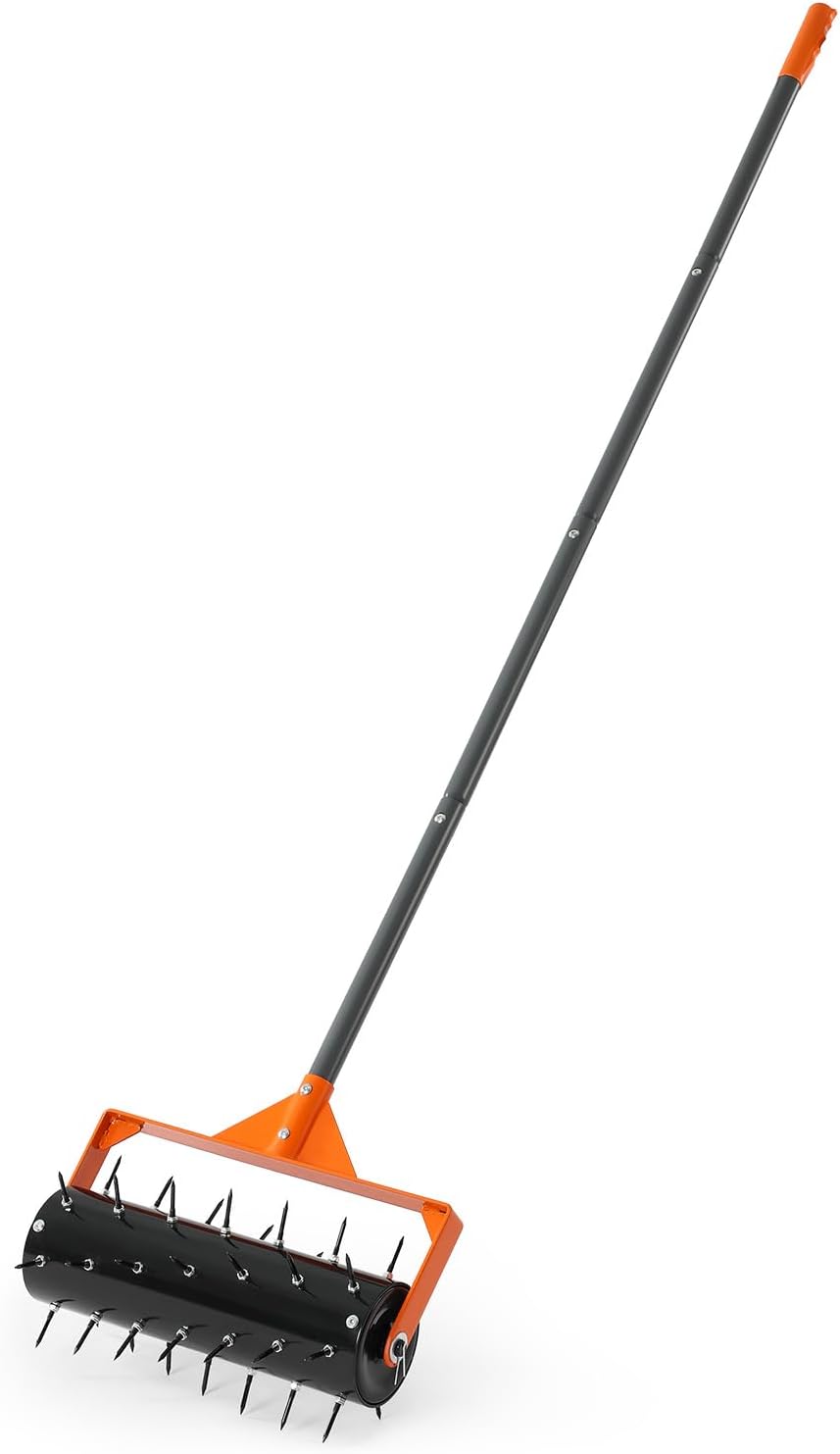
| Spikes | 42 solid steel spikes |
|---|---|
| Spike penetration | Up to 2 in |
| Frame material | Welded steel with rust-resistant coating |
| Handle length | 70 in overall height |
| Fillable drum | Yes, accepts sand or stones |
This VEVOR rolling aerator is a push-pull tool that creates many small holes quickly by rolling 42 solid spikes through the soil, helping air, water, and nutrients reach grassroots. It is typically used by pushing or pulling across a lawn in an upright position; the drum accepts sand or stones so you can add weight for improved penetration on compacted or dry ground. The unit’s welded steel frame and rust-resistant coating give it a durable feel for seasonal use, and the angled spike layout is designed to increase coverage with each pass. Assembly is straightforward because the spikes come mostly preinstalled, and the long handle reduces bending and back strain during use. Important limitations are that it is a manual tool so it requires physical effort over larger areas and it is most effective on soil that is slightly moist; very heavy clay or extremely large lawns may still require a powered aerator for best results.
Best for: Best for homeowners who want an efficient, low-tech way to improve lawn health on small to medium yards and who prioritize durability and the ability to tune performance by adding weight.
Less Ideal for: Not a great fit for landscapers or anyone who needs to aerate very large properties quickly or for those who prefer a powered solution that requires less physical effort.
- 42 solid steel spikes provide consistent penetration without clogging
- Fillable drum lets you add weight for deeper aeration on compacted soil
- Welded steel frame and rust-resistant coating improve durability for outdoor use
- Long handle and rolling design reduce bending and let you work forward and backward efficiently
- Manual operation can be tiring over large lawns compared with motorized aerators
- May struggle to penetrate extremely dense clay without substantial added weight or prewatering
Verdict: A durable, adjustable manual aerator that lets practical gardeners add weight for deeper penetration and efficient aeration on small to medium lawns.
SUNSHNO 16-Inch Heavy Duty Rolling Lawn Aerator (Manual)

| Material Type | Metal |
|---|---|
| Item Type Name | Heavy Duty Rolling Lawn Aerator |
| Model Number | S002 |
| Unit Count | 1 Count |
This SUNSHNO rolling aerator is a simple, budget-friendly manual tool for relieving soil compaction on small to medium yards. You push the 16-inch drum across your lawn and the multiple sharp tines puncture the soil to allow better air, water, and nutrient penetration. The roller opens so you can add sand or stones to increase weight and deepen penetration, and the metal frame is powder-coated to resist rust while the triangular support keeps the unit stable during use. Setup is straightforward: connect the handle sections and attach to the roller, and the comfortable grip helps reduce hand fatigue during longer passes. Expect steady performance on looser or moderately compacted soils; on very hard clay or large turf areas you may need multiple passes or a powered aerator for faster results. Construction is basic but functional, so this model is best if you want a no-frills, lower-cost option rather than commercial-grade durability or heavy-duty penetration on extremely compacted lawns.
Best for: Buyers who need an inexpensive, straightforward aerator for occasional lawn maintenance and who prefer a manual tool they can operate themselves.
Less Ideal for: Not a good fit for large properties, commercial use, or anyone who needs rapid aeration of heavily compacted turf where a powered machine would be more efficient.
- Fillable roller lets you add sand or stones to increase penetration depth
- Multiple sharp tine spikes effectively puncture typical garden soils
- Powder-coated metal frame resists rust and provides a stable triangular structure
- Manual push design requires physical effort and is slower than motorized aerators
- May struggle to penetrate very hard or heavily compacted clay without added weight
Verdict: A low-cost, no-frills rolling aerator that lets you add weight for deeper penetration, making it a practical choice for budget-minded homeowners with small to medium lawns.
LawnVigor Rolling Lawn Aerator with Hollow Tines

| Item Weight | 30 pounds |
|---|---|
| Manufacturer | LawnVigor |
| ASIN | B0HM7TJSVC |
| Item model number | LV-RLA-Orange-Z1 |
This LawnVigor rolling aerator is a manual core aerator designed to pull soil plugs and relieve compacted turf with six non-clogging hollow tines and two spare tines. You push the roller across the lawn and the hollow tines extract cores so air, water, and nutrients can reach grassroots; the drum can be filled with dry sand to add weight for deeper penetration. Built from powder-coated steel, it feels solid and resists bending when used on compacted soil, and the integrated wheels make it easier to push and maneuver across small to medium yards. Setup is straightforward and replacement tines are available, which keeps maintenance simple and extends the tool's useful life. The main limitations are that it is a manual tool so it still requires physical effort and it is best suited to lawns rather than very rocky or extremely large commercial areas where a powered aerator would be faster.
Best for: Homeowners who prioritize a durable, long-lasting tool for regular DIY lawn aeration and want to avoid rental equipment while maintaining a healthy yard.
Less Ideal for: Landscapers, commercial properties, or anyone needing to aerate very large areas quickly or work frequently in rocky terrain should consider a powered or heavier-duty solution.
- Sturdy powder-coated steel construction resists bending for reliable, season-to-season use
- Six non-clogging hollow tines with two spares allow consistent core removal and easy replacement
- Drum can be filled with sand to increase weight and achieve deeper aeration
- Integrated wheels provide smoother pushing and better maneuverability across lawns
- Manual push design requires physical effort and is slower than powered aerators
- Not intended for very rocky soil or large commercial lawns where mechanized equipment is preferable
Verdict: A robust, user-serviceable manual aerator built to give homeowners reliable core aeration without renting heavy equipment.
LawnVigor Manual Core Aerator with 3 Hollow Non‑Clogging Tines

| Manufacturer | LawnVigor |
|---|---|
| Item model number | LV-ALT4-ORANGE-Z0 |
| Tine type | Hollow tines |
| Number of tines | 3 |
The LawnVigor Manual Core Aerator is a simple, walk‑behind hand tool that pulls plugs of compacted soil to help water, air, and nutrients reach grassroots. It uses three heat‑treated hollow tines that resist clogging and pull out cores for effective aeration; the tines are replaceable which keeps the tool serviceable over multiple seasons. An ergonomic, non‑slip handle and a moderate height aim to reduce strain during use, and the unit assembles quickly with the included hardware. In practice it is best for routine spot aeration and small to medium yards where a full plug aerator machine would be overkill. Limitations are its manual nature, which makes aerating large lawns time consuming, and it relies on good technique and moist soil to extract plugs cleanly. The tool is sturdy for home use but not intended as a heavy commercial option.
Best for: Homeowners who want a low‑cost, durable tool for periodic spot aeration and improving turf health without renting or operating powered equipment.
Less Ideal for: Those with large acreage or professional landscapers who need fast coverage and a machine‑powered core aerator should look at motorized or tow‑behind options.
- Heat‑treated hollow tines that pull soil plugs and resist clogging
- Replaceable tines for easy maintenance and longer service life
- Ergonomic non‑slip handle reduces back strain during use
- Quick, tool‑included assembly gets the aerator ready in minutes
- Manual operation is slow on large lawns compared with powered aerators
- Performs best in moist soil and can struggle in very dry, compacted ground
Verdict: A sturdy, easy‑to‑use manual core aerator that reliably improves lawn health for homeowners doing routine spot aeration.
Walensee 15-Spike Manual Lawn Aerator Tool

| Spikes | 15 iron spikes |
|---|---|
| Spike length | about 2.8 inches |
| Handle length | 34.6 inches |
| Material | powder-coated iron/steel |
The Walensee 15-spike manual lawn aerator is a walk-on tool that opens small channels in turf so air, water, and nutrients reach grass roots more easily. You use it by stepping on the foot pedal and levering the 15 iron spikes into the ground, making it suitable for spot aeration, lawn edges, bare patches, and routine small-area maintenance. Notable features include a three-row spike layout for wider coverage per step, a cushioned T-handle and foot pedal for leverage, a 34.6-inch handle to reduce bending, and a detachable design for easier assembly and storage. In practice it moves faster than single-row spike tools on soft or recently watered lawns and avoids the balancing issues of strap-on aerator shoes. Important limitations are that it is intended for light to moderately compacted soils only and is not recommended for heavy clay, rocky ground, or large lawns where a powered or rolling aerator would be far more efficient. For best results on firmer ground water the lawn before aerating.
Best for: Homeowners who prioritize easy, low-cost lawn upkeep and want a simple, stable tool for spot aeration, edges, and small lawns backed by solid user feedback.
Less Ideal for: People with large properties, very compacted clay soil, or frequent large-scale aeration needs should consider a rolling or powered aerator instead.
- 15 sturdy iron spikes provide broader coverage per step than single-row spike tools
- Three-row layout and foot pedal speed up spot aeration and edge work
- Cushioned T-handle and 34.6-inch handle reduce bending and improve leverage
- Detachable, powder-coated steel construction is durable and easy to store
- Not suited for heavy clay, rocky, or very compacted soils where a powered aerator is needed
- Small-area tool only, so it is inefficient for large lawns
Verdict: A practical, durable manual aerator that makes spot and small-area aeration faster and more reliable than strap-on shoes for homeowners who need occasional turf maintenance.
Choosing the Right Push Lawn Aerator: Key Factors to Consider
Aeration Method and Soil Impact
Different push aerators either remove plugs of soil or simply punch holes. Core removal opens room for roots and increases oxygenation more effectively in heavy clay and compacted soils. Solid‑tine models can be lighter and easier to push but may not relieve compaction as deeply. Match the method to your soil type and desired outcome.
The depth a machine reaches determines how much root zone is affected. Deeper penetration helps in compacted subsoils but requires more effort and sturdier construction. Consider seasonal soil moisture too. Most aeration is most effective when soil is slightly moist but not waterlogged.
Tine Length, Diameter, and Density
Longer, narrower tines penetrate farther with less surface disruption, while thicker tines and wider spacing remove larger plugs. Tine spacing controls how much of the lawn is treated per pass: closer spacing gives denser coverage but increases push resistance.
Think about the balance between coverage and effort. If you have small, localized compaction, fewer passess with higher penetration may be fine. For whole‑yard maintenance, a higher tine density reduces the number of passes needed and evens out results across the turf.
Wheel Design and Traction
Wheel diameter, tread, and whether the wheels drive the tines or simply roll behind them affect how the tool moves over grass. Larger wheels track more easily over bumps and help maintain consistent tine depth; aggressive tread helps on slopes or damp grass.
If you have uneven ground or a sloped yard, choose a design that promotes stable contact and prevents the aerator from skipping or digging in. Smooth, narrow wheels may be lighter but will be harder to control in tougher conditions.
Weight, Balance, and User Effort
A push aerator needs to be heavy enough to drive tines without constant extra pressure, but not so heavy that pushing becomes a workout. Weight distribution matters: a well-balanced frame concentrates force on the tines and reduces steering effort.
Also consider handle reach and whether the unit allows multiple hand positions. Taller users need different handle heights than shorter users. Some push aerators incorporate a lever or folding handle for storage; evaluate whether adjustments feel secure during use.
Materials, Maintenance, and Replaceability
Tines and axles take most of the wear. Hardened steel tines and corrosion‑resistant finishes extend service life in wet outdoor equipment. Check how easily tines or spikes can be removed and replaced, and whether bearings or bushings are user‑serviceable.
Storage conditions in a typical backyard shed or garage can accelerate rust and wear. A design that allows partial disassembly for cleaning and replacement parts will perform better over multiple seasons.
Lawn Size and Intended Frequency of Use
Choose based on the scale of the job. Small city lots can be handled with a lighter, narrower aerator that is easy to store. Larger suburban lawns benefit from wider heads or higher tine density to reduce the number of laps.
Frequency matters too. If you plan on annual or biennial aeration, a simpler, lower‑maintenance tool can suffice. For heavy use or for gardens with persistent compaction, prioritize sturdier construction and easier parts replacement.
When to Aerate Your Lawn
Aim to aerate during the active growing season for your grass type. Cool‑season grasses respond best when aerated in early fall or spring, while warm‑season lawns take best advantage of late spring to early summer aeration once growth is underway. Aerating during peak dormancy stresses turf and delays recovery.
- Aerate when soil is moist but not saturated.
- Avoid aerating immediately after drought; water a day or two beforehand if soil is dry.
- If you overseed, aerate shortly before seeding to improve seed‑to‑soil contact.
Preparing Your Lawn for Aeration
Mow the lawn to a normal cutting height and remove debris like sticks and stones that can clog tines. Mark and avoid sprinkler heads, shallow cables, or buried utilities. Identify heavily compacted zones such as play areas or paths to give those extra attention during passes.
- Rake up excess thatch if it exceeds half an inch.
- Water lightly 24 to 48 hours prior if soil is very dry to ease penetration.
- Outline any obstacles so you can safely maneuver the aerator.
Techniques for Effective Coverage
Overlap passes slightly to ensure even coverage and vary your mowing pattern to avoid compacting the same lines repeatedly. For dense compaction, run perpendicular passes on the second pass to break deeper pans. Keep a steady walking pace to promote uniform tine depth and plug extraction.
- Work in straight, controlled lines for consistent results.
- Use perpendicular follow‑up passes when dealing with severe compaction.
- Collect plugs if you prefer a tidier finish, or leave them to break down naturally.
Post‑Aeration Care and Follow‑Up
After aeration, remove plugs if desired or leave them to decompose and return organic matter to the soil. Follow with overseeding in bare or thin areas and apply a light topdressing if your lawn needs additional organic matter. Water gently after overseeding to settle seed into the holes.
- Avoid heavy foot traffic on the lawn until it recovers.
- Fertilize according to your normal seasonal plan after aerating to maximize nutrient uptake.
- Keep newly seeded areas consistently moist until seedlings establish.
Storage and Winter Care
Clean soil from tines and components before storing to reduce corrosion. Lubricate moving parts and, if possible, remove tines for winter storage in damp climates. Store the aerator in a dry place and keep any spare parts together to simplify spring startup.
- Inspect tines for bending or wear before storage.
- Apply a light coat of oil to metal surfaces to prevent rust.
- Keep a record of replacement parts used so you can order matching sizes later.
How We Chose the Best Push Lawn Aerator
We narrowed the field to tools designed for manual, walk‑behind aeration intended for home lawns and small properties. Primary evaluation centered on physical aeration performance and gardener ergonomics: spike or plug depth, spike or tine density, and whether the head design produces core removal or solid-tine punctures. Durability under real outdoor conditions was judged by construction materials, axle and bearing design, and ease of replacing wear parts. We also weighed handling and user effort: wheel design and tread pattern that affect traction on wet or dry grass, handle height and grip comfort for sustained pushing, and overall unit weight and balance to avoid excessive user fatigue. Maintenance and storage were considered, including how easily tines can be cleaned or swapped and whether the tool breaks down for compact storage. Exclusions included motorized and tow‑behind machines, spike shoes, and soil testers; we focused strictly on manually pushed aerators suited to homeowner lawns. The final shortlist reflects tools that strike a realistic balance between effective soil penetration, manageable effort, and build longevity for seasonal aeration.
FAQ
How often should I aerate my lawn with a push aerator?
Often annual or biennial aeration is sufficient for most home lawns. High‑traffic or compacted lawns may benefit from aeration once a year, while low‑traffic, well‑maintained turf can often be aerated every two to three years.
Will a push aerator work on clay soil?
Push aerators can help clay soils by relieving surface compaction, but effectiveness depends on tine length and soil moisture. For deep clay pans you may need longer tines and slightly wetter soil to get meaningful penetration.
Can I aerate a wet lawn after heavy rain?
Usually you should avoid aerating immediately after heavy rain because saturated soil can smear and compaction may worsen. Wait until the soil is only slightly moist so tines remove cores cleanly rather than compressing the soil.
Should I overseed right after aeration?
Often overseeding right after aeration is beneficial because seed can settle into the holes and establish better soil contact. Lightly rake seed into holes and keep the area consistently moist until seedlings are established.
Do solid tines or coring tines give better results?
Coring tines that remove plugs usually provide better long‑term relief for compaction because they remove soil and allow room for root expansion. Solid tines are lighter and easier to push but may not be as effective in heavily compacted soils.
How can I reduce the effort required to push an aerator?
Choose a model with larger wheels, balanced weight distribution, and ergonomic handles. Aerate when the soil is slightly moist and use proper body mechanics to reduce strain during longer sessions.
Final Verdict
A push lawn aerator is a straightforward way to improve turf health by increasing oxygen and water movement to the root zone. Prioritize the aeration method and tine depth that match your soil type, then balance tine density, wheel design, and handle ergonomics to keep the job efficient and repeatable. Durable materials and easy maintenance matter if you plan to use the tool regularly. Focus on the handful of features that affect garden performance most: penetration depth, coverage per pass, and how easy the unit is to push across your specific yard. With those priorities in mind, you can confidently pick a push aerator that delivers clearer results with reasonable effort.
