

Note: This article contains affiliate links. If you click on these links and make a purchase, I may earn a small commission at no extra cost to you. This helps support my research and content. Read my full affiliate disclosure here.
If you grow annuals, herbs, or mixed container arrangements, a drip irrigation kit for containers can cut daily chores and protect root health during heat spells. The right kit keeps soil evenly moist without overwatering or wet foliage, which helps potted plants thrive whether on a balcony, patio, or greenhouse bench. This guide covers seven top-rated kits shortlisted for container use and walks through the setup, flow control, and compatibility features that matter to container gardeners. Below we explain how we evaluated each option and what to watch for when fitting a system to your pots.
Top Picks at a Glance


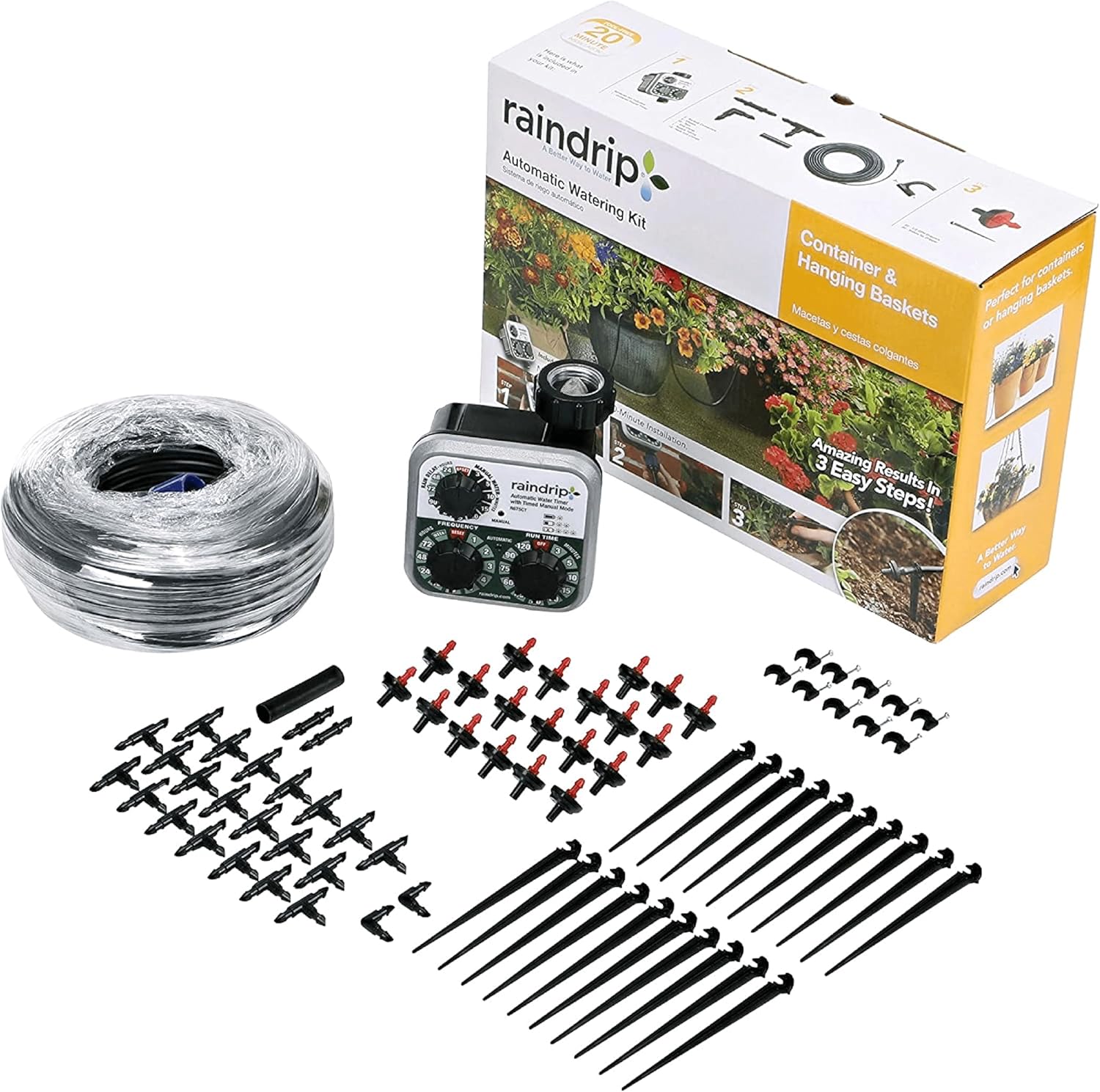
Raindrip R560DP Automatic Drip Irrigation Kit with Timer for Containers and Hanging Baskets
| Hose Length | 75 feet |
|---|---|
| Number of Pieces | 20 |
| Power Source | Battery Powered |
| Control Type | Button Control |
| Included Components | Timer, Tubing, 20 Drippers, Stakes, Tees, Clamps, Couplings & Elbows, Plug |
The Raindrip R560DP is a complete drip-watering kit built to automate watering for up to twenty container or hanging plants. The kit includes a battery-powered timer, 75 feet of 1/4 in. tubing, 20 drippers, clamps, stakes and basic fittings so you can connect to a faucet, lay out supply tubing and plug in emitters without buying extra parts. In use it provides slow, even delivery to individual pots and hanging baskets, which helps keep soil moisture consistent and reduces waste compared with hand watering. The kit is straightforward to install for gardeners who follow basic instructions and want a low-maintenance solution. Important limitations are the basic plastic components and the fixed number of included emitters, so larger or more complex layouts will need additional tubing and drippers. The timer is battery powered and button controlled, which is convenient but not as flexible as smart-phone timers or multi-zone controllers. For routine container irrigation where simplicity and reliability matter, this kit covers the essentials well.
Best for: Gardeners who want a straightforward, proven kit to automate watering for multiple pots or hanging baskets and prefer a complete, ready-to-install solution with minimal setup.
Less Ideal for: People needing multi-zone control, smartphone integration, heavy-duty materials, or large landscapes beyond container clusters should consider more advanced or expandable systems.
- Complete starter kit: includes timer, 75 ft tubing, 20 drippers and common fittings for one purchase setup
- Automatic battery-powered timer makes scheduled watering hands-free
- Designed for containers and hanging baskets so emitters deliver water directly to individual plants
- Simple threaded and barbed connections allow quick assembly without specialized tools
- Basic plastic parts may wear faster than higher-end materials
- Limited to the 20 included drippers and 75 ft of tubing unless you buy add-ons
- Timer is a simple button-control unit rather than a smart or multi-zone controller
Verdict: A reliable, all-in-one drip kit that quickly automates watering for up to twenty container or hanging plants with minimal fuss.
Orbit Planter Drip Irrigation Kit — 30 ft Complete Watering System with Adjustable Micro-Bubblers

| Hose Length | 30 feet |
|---|---|
| Maximum Pressure | 25 psi |
| Power Source | Water |
| Included Components | Drip Tubing, Filter, micro-bubbler on stake, T fitting, faucet adapter |
| Material | Plastic |
The Orbit Planter Drip Irrigation Kit is built to give predictable, low‑pressure micro-watering for container gardens. It includes 30 feet of 1/4" distribution tubing, two adjustable micro-bubblers on 6" stakes, a tee, a filter washer, a faucet adapter and a 25 psi pressure reducer so the emitters deliver even flow without puddling. Typical use is simple: attach the adapter to a hose or timer, run the tubing into your planter(s), stake the micro-bubblers near roots and fine-tune the emitter flow. The included pressure reducer and filter protect the system from high faucet pressure and debris, and the barbed fittings make expansion with other Orbit or standard drip parts straightforward. Because it is aimed at container setups, the kit is quick to install and easy to winterize or store. Limitations are its focused capacity — it is sized for a single large box or two small pots — and the plastic components are standard consumer grade rather than heavy commercial materials, so frequent seasonal disassembly will extend longevity.
Best for: Gardeners who need a reliable, easy-to-install micro-watering solution for a performance-focused container setup and who prioritize consistent emitter flow and simple expandability.
Less Ideal for: Those planning to irrigate multiple large raised beds or whole garden zones should choose a larger, higher-capacity drip system instead.
- Adjustable micro-bubbler emitters let you control flow to avoid puddling in pots
- Includes 25 psi pressure reducer and filter to protect emitters and prevent clogs
- 30 feet of 1/4" distribution tubing is easy to route and expand with standard fittings
- Compact kit designed for quick install and seasonal storage
- Designed only for one large planter or two small containers, not for larger beds
- Plastic fittings are consumer-grade and may wear faster under heavy seasonal use
Verdict: A compact, performance-minded drip kit that reliably delivers adjustable micro-watering to one large planter or two small containers with built-in pressure and filtration protection.
MIXC 1/4" 100ft Drip Irrigation Kit with 16 Adjustable Brass Nozzles and Connectors

| Fit Type | 1/4" |
|---|---|
| Hose Length | 100 feet |
| Maximum Pressure | 60 psi |
| Power Source | Water Pressure-driven |
| Special Features | Programmable |
This MIXC kit supplies a complete 100 ft run of 1/4" tubing plus connectors, bendable emitter rods and 16 adjustable metal nozzles so you can build a simple raised bed irrigation layout without specialty tools. Typical use is laying the 1/4" line along beds, adding three-way or Y connectors where you need branches, inserting the aluminum-core emitter rods and pointing the copper nozzles to target plant roots or foliage. Notable features include the US-focused 1/4" fit type to match common drip lines, quick-connect fittings for fast assembly and 360° adjustable copper nozzles that let you change spray patterns from mist to directed drip. Practical benefits are straightforward installation, flexibility to position emitters precisely and more durable metal nozzles compared with all-plastic kits. Important limitations are that the system is pressure-driven with a recommended limit of about eight emitters per 50 ft of tubing, so larger raised bed systems usually need a larger main line or additional loops to maintain pressure; the kit also does not include a timer so scheduling requires an external controller.
Best for: Gardeners who want a practical, no-frills drip solution for raised beds and container rows and who prioritize reliable fit and easy reconfiguration over automated scheduling.
Less Ideal for: Large or high-flow irrigation projects that require many emitters per run or integrated automation without adding a separate timer or higher-capacity main tubing.
- Complete 100 ft 1/4" tubing and comprehensive connector set for end-to-end installs
- 360° adjustable copper nozzles for precise watering patterns
- Bendable aluminum-core emitter rods let you aim water exactly where plants need it
- Quick-connect fittings speed up assembly and make reconfiguration easier
- Designed for 1/4" lateral lines so flow drops if you exceed recommended emitter count without a larger main supply
- No built-in timer or controller included
Verdict: A practical, easy-to-install 1/4" drip kit that gives precise, durable emitter placement for raised beds when you want a configurable manual system.
PESIODU 50 ft Drip Irrigation Kit with 11 Emitters and Quick-Connect Tubing

| Hose Length | 50 feet |
|---|---|
| Number of Pieces | 11 |
| Power Source | Water Pressure-driven |
| Fit Type | Quick Connect |
| Material | Plastic |
This PESIODU kit is a compact starter drip irrigation system aimed at small gardens and raised beds. It supplies 50 feet of 1/4" PE tubing plus a Y quick-connect splitter and a mix of 11 emitters: adjustable vortex drippers, steady stream drippers and bendable 360° misting nozzles. You install the tubing from a faucet or supply line, use the push-fit connectors and stakes to route lines through raised beds or containers, and position the emitters near roots or seedlings for targeted watering. Practical benefits include water-efficient delivery to plant roots, flexible layout for rows or individual pots and effortless quick-connect assembly for DIY setups. The plastic components keep cost down but mean fittings and emitters are less rugged than professional kits, and the 50 ft length limits coverage to a single small bed or a few containers unless extended with extra tubing. Expect decent performance for seasonal vegetable beds, starter gardens and greenhouse benches where affordability and simplicity matter.
Best for: Gardeners on a tight budget who need a simple, no-frills irrigation solution for one raised bed, a few containers, or a small greenhouse area and value easy DIY setup.
Less Ideal for: Large vegetable plots, multi-bed systems, or users who want heavy-duty, long-lasting commercial fittings should consider more robust or expandable kits.
- Includes 50 ft of 1/4" tubing and a Y quick-connect splitter for easy DIY routing
- Mix of adjustable emitters (vortex, stream, mist) for different plant needs
- Quick-connect push-fit parts simplify installation without tools
- Water pressure-driven automatic watering reduces waste compared with overhead watering
- Plastic fittings and emitters may wear faster than metal or commercial-grade parts
- 50 ft tubing may be insufficient for larger raised bed layouts without buying extensions
Verdict: A low-cost, easy-to-install starter kit that delivers targeted watering for a single raised bed or a few containers.
Rain Bird Drip Irrigation Repair & Expansion Kit (102-Piece, 100 ft.)

| Number of Pieces | 102 |
|---|---|
| Hose Length | 100 feet |
| Included Components | 100’ 1/4" tubing, tool, emitters, stakes, couplers, tees, plugs, guide |
| Material | Polyethylene |
The Rain Bird DRIPKITBAG is a compact repair and expansion kit designed to keep a 1/4" drip irrigation system running and to extend coverage to adjacent beds. It includes a self-dispensing 100 ft. roll of 1/4" tubing, an emitter installation/removal tool, 40 spot-watering emitters in three flow rates (0.5, 1.0, 2.0 GPH), barbed couplers and tees, tubing plugs, and stakes with insect-proof bug caps. Typical use is on small-to-medium garden plots, raised beds, or groups of potted plants where you need precise, low-volume watering directly at the root zone. The kit’s variety of emitter flow rates and abundant fittings makes it easy to tailor output per plant and to repair common issues like tubing breaks or clogged emitters. The polyethylene components and pressure-compensating emitters are built for outdoor use, and the pouch keeps parts organized for quick maintenance visits. Limitations are that the kit focuses on the 1/4" distribution side of a system and does not include pressure regulators, filters, or faucet adapters, so you may need additional parts to connect to a mainline or to protect against high pressure and debris.
Best for: Gardeners who prioritize reliable, precise watering and want a performance-focused kit to repair or expand small to mid-sized drip systems quickly and keep zones tuned to plant needs.
Less Ideal for: People starting a whole-house or large landscape irrigation system that requires mainline fittings, pressure regulation, or larger-diameter tubing should choose a more complete starter kit or add the missing components separately.
- Complete set of 102 pieces including 100 ft. of 1/4" tubing and a dedicated emitter install/removal tool
- Emitters in three flow rates (0.5, 1.0, 2.0 GPH) let you customize watering per plant
- Includes many couplers, tees, plugs, and stakes so you can repair breaks and expand circuits without extra trips
- Polyethylene parts and pressure-compensating emitters designed for outdoor durability
- Does not include pressure regulator, filter, or faucet/hose adapter needed to connect and protect a full system
Verdict: Buy this kit if you want a performance-minded, all-in-one parts pack to repair and fine-tune a 1/4" drip system for precise root-zone watering.
MIXC Drip Irrigation System Kit, 230 ft with Quick-Connect Tubing and Adjustable Emitters

| Hose Length | 230 feet |
|---|---|
| Size | 33FT main + 197FT 1/4" tube |
| Control Type | Automatic |
| Power Source | Water Pressure-driven |
| Special Features | Quick Connector Technology |
The MIXC 230 ft drip irrigation kit supplies a full DIY system for watering beds, containers, and small lawns by turning a garden faucet into a pressure-driven, automatic micro-irrigation network. It includes a 33 ft 1/2" mainline, 197 ft of 1/4" branch tubing, multiple emitter types, tees, barbed fittings and a faucet adapter so you can lay out a main hose and branch off to up to 32 emitters. The quick-connect technology and push-fit barbed parts make assembly straightforward and reduce leak points, and adjustable emitters let you change flow patterns from drips to sprays for different plants. Practical benefits include time savings versus hand-watering, flexible layouts for raised beds or potted plants, and the ability to fine-tune delivery to individual plants. Limitations to expect are the plastic construction, which will wear faster than premium materials in harsh sun or freezing conditions, and the need to plan pressure and emitter placement for even coverage rather than relying on a single layout to work everywhere.
Best for: Gardeners who want a practical, ready-to-install drip system to replace frequent hand-watering and who value components that make fast, adjustable layouts for beds and containers.
Less Ideal for: People seeking heavy-duty, long-lasting commercial-grade materials or systems sized for very large agricultural acreage.
- Complete kit that includes both 1/2" mainline and 1/4" distribution tubing plus fittings for a full layout
- Quick-connect fittings simplify assembly and reduce common leak points
- Adjustable emitters and three emitter styles let you tailor flow and spray pattern to different plants
- Designed to run automatically using water pressure so it eliminates frequent manual watering
- Plastic tubing and fittings may degrade faster under prolonged sun exposure or freezing temperatures
- Performance depends on correct pressure and layout planning to avoid uneven watering
Verdict: A practical, all-in-one drip kit that gets a small garden or group of planters on automatic watering quickly with easy-to-connect parts and adjustable emitters.
Rain Bird POTTEDKIT Drip Irrigation Potted Plant Watering Kit (1/4" tubing)

| Hose Length | 50 feet |
|---|---|
| Fit Type | 1/4" Barbed Fittings |
| Maximum Pressure | 25 psi |
| Included Components | 50’ Tubing, 3 Bubblers, Faucet Adapter, 25 psi Regulator, 10 Tees |
The Rain Bird POTTEDKIT is a compact, ready-to-install drip kit made for container gardening and small balcony setups. It includes a 50 ft roll of 1/4" distribution tubing, three adjustable 360-degree micro bubblers, a faucet/hose adapter and a 25 psi pressure regulator plus tees for a simple layout. Typical use is straightforward: attach the adapter to an outdoor faucet, run the tubing to each pot, cut and connect with the tees, and position the bubblers at the root zone. The adjustable bubblers let you control spray distance and flow by twisting the cap, so you can fine-tune watering for different pot sizes. Practical benefits are quick installation with no tools, reduced water use compared with hand-watering, and components made from UV-resistant plastic for outdoor durability. Limitations are that the kit is sized for only three containers and supports a maximum tubing run of 30 ft and 30 GPH, so larger container setups will require additional kits or parts; also emitters and tubing are plastic so occasional clogging or wear is possible with hard water or heavy use.
Best for: Gardeners who want a low-effort, reliable way to automate watering for a few containers or a small balcony garden and prefer a proven, easy-to-install system.
Less Ideal for: Those planning to irrigate many containers, large raised beds, or long tubing runs without expanding the system should choose a larger kit or a modular system designed for higher flow and more emitters.
- Complete kit with tubing, faucet adapter and 25 psi regulator for quick setup
- Adjustable 360° micro bubblers let you change flow and spray distance for each pot
- 50 ft of 1/4" tubing and multiple T-fittings allow flexible layouts for small groups of containers
- Compact resealable pouch stores parts neatly when not in use
- UV-resistant plastic construction intended for outdoor use
- Intended to water up to three potted plants only so it is not sufficient for larger container collections
- Plastic components and small emitter openings can require occasional cleaning with hard water
Verdict: A simple, dependable kit for automating watering of up to three container plants that gets you running quickly with adjustable bubblers and a built-in pressure regulator.
Choosing the Right Drip Irrigation Kit for Containers: Key Factors to Consider
Emitter Flow Rate and Adjustability
Emitter flow rate determines how much water each container receives over time, which directly affects watering frequency and runoff risk. Containers come in many sizes and soil mixes drain at different rates, so adjustable emitters or a mix of fixed flow rates let you tailor output to each pot. For shallow containers or succulents you will want low flow settings to avoid saturated soil. For large mixed planters or vegetable pots with higher water demand, higher flow or multiple emitters per container may be necessary.
Check whether a kit lists precise flow rates in liters or gallons per hour. Adjustable emitters give the most flexibility as plantings change through the season. If you expect to winterize or rearrange pots frequently, choose emitters that are easy to remove and reinstall.
Tubing Size and Flexibility
Mainline tubing diameter affects pressure and the number of emitters you can run before flow drops. For container systems, smaller flexible tubing often works well because runs are short and low pressure. However, very thin tubing can kink or split when moved, so durability matters. Flexible tubing that resists kinking helps when routing lines under railings, around furniture, or through dense foliage.
Also consider whether the tubing is UV-stabilized if systems will remain outdoors all season. Stiffer tube is easier to poke into connectors cleanly but can be less forgiving during layout changes. Look for kits that include spare lengths and couplers so you can adapt routing without cutting new lines.
Connector and Fitting Quality
Connectors and fittings are the mechanical weak points in any small irrigation system. Poorly fitting barbed connectors or brittle push-fit parts lead to leaks, lost pressure, and the need for frequent repairs. For container kits that are set up and taken down, connectors that hold securely under repeated use save time and frustration.
Check for keyed fittings or threaded couplers for source attachments, and test whether included stakes or clamps keep tubing where you place it. Kits that provide a variety of tees, elbows, and end caps make future expansions easier without having to buy separate parts.
Compatibility With Timers and Water Sources
A useful container drip system runs from a faucet, rain barrel, or inline reservoir and often benefits from automated scheduling. Ensure the kit includes or fits common timer threads and that pressure regulators are available or built in. High household pressure can blow out emitters or push too much water through small pots, while very low pressure will reduce output and unevenly water containers.
If you plan to use a gravity-fed barrel or a pump, verify the minimum and maximum pressure ranges for the kit and whether adapters are supplied. Simple battery timers work well for seasonal container gardening and reduce daily maintenance.
Ease of Winterizing and Storage
Container systems are often temporary and must be removed or winterized in cold climates. Tubing that can be drained easily and connectors that disassemble without damage make end-of-season storage simpler. Lightweight components are easier to handle when you are moving dozens of pots indoors or into a protected area.
Also consider whether replacement parts are common sizes so you can repair leaks quickly. Kits that require special proprietary fittings increase the risk of downtime if a part fails and cannot be replaced quickly.
Scalability for Different Container Layouts
Container gardens grow and change. Look for systems that scale from a single balcony rail to dozens of patio pots. Scalability depends on available spare tubing, modular connectors, and the ability to branch lines without losing consistent flow to farthest pots.
Consider how easy it is to add emitters or split a run to a new cluster of pots. Systems that work well with short runs and include variety packs of emitter types make seasonal reconfiguration fast and predictable.
Planning the Layout for a Container System
Start by mapping your containers and grouping pots with similar water needs together. Short, direct runs to grouped pots simplify emitter balancing and reduce the number of connectors required. Measure the distance from your water source to the farthest container to ensure tubing length and pressure meet demands.
Decide whether you want a single mainline with short feeder lines to each pot or a looped layout. Looping a run can help maintain more even pressure across multiple emitters in longer balconies, while single short runs minimize fittings and potential leak points.
- Group pots by water needs to simplify emitter choices
- Keep runs as short as practical to preserve flow
- Place emitters near the root zone, not on foliage
Installing Emitters and Stakes for Stable Placement
Position emitters so water goes into the soil surface near the primary root ball. In mixed containers place emitters between stems rather than on the rim to reduce splash and runoff. Use stakes or clips to keep tubing layed flat against the pot or saucer edge to avoid accidental dislodging.
For plants in hanging baskets or elevated planters, secure tubing along the hanger or rail with cable clips, and avoid placing emitters where water will drip onto wooden structures.
- Use multiple low-flow emitters for deep, large pots
- Secure tubing with stakes to prevent movement
- Avoid emitter placement that wets foliage
Adjusting Run Times and Scheduling
Set run times based on container volume, soil mix, and plant type rather than fixed daily times. Sandy mixes drain faster and usually need shorter, more frequent cycles, while dense mixes retain moisture and need less frequent watering. Consider running short pulses twice daily in hot weather rather than a single long session to keep soil from becoming waterlogged.
When first commissioning a system, run a manual test and check soil moisture after 10 to 30 minutes depending on emitter flow. Use that test data to dial in duration and frequency on your timer.
- Test soil moisture after initial runs to tune schedule
- Use shorter, more frequent cycles in heat
- Adjust schedules seasonally as plant demand changes
Maintaining and Troubleshooting Common Issues
Clogs, leaks, and pressure drops are the most common issues with container drip systems. Flush mainlines periodically, especially after long idle periods. If you notice dry pots at the end of a run, check for kinks, loose fittings, or clogged emitters and clean or replace parts as needed.
Keep a small spare parts kit with extra emitters, connectors, and end caps. For clog-prone water sources consider adding a simple inline filter and a pressure regulator if flows seem too forceful for small containers.
- Flush lines before reconnecting after storage
- Carry spare emitters and connectors for quick repairs
- Install a small filter if water quality is variable
Adapting Systems for Different Pot Types and Plants
Shallow saucers, deep planters, hanging baskets, and window boxes each present distinct watering challenges. Use lower flow or single emitters in shallow containers to avoid overflow, and multiple emitters spaced around the root zone in deeper planters to encourage even root distribution.
For edible container gardens, position lines to avoid wetting edible foliage and consider periodic hand-watering to flush salts from the soil profile if using drip exclusively.
- Use emitter number, not just flow, to match larger root volumes
- Avoid wetting edible surfaces where possible
- Adjust placement seasonally as plants grow
How We Chose the Best Drip Irrigation Kit for Containers
We focused on features that matter specifically to container gardening rather than large-scale drip systems. Key evaluation criteria included ease of setup, meaning how quickly a gardener can route lines and install emitters in multiple pots; emitter adjustability to match different pot sizes and plant water needs; tubing and connector durability for repeated seasonal handling; compatibility with common water sources and timers; and emission uniformity so all containers receive predictable flow rates. We excluded products designed solely for in-ground beds or complex agricultural arrays because those systems assume buried tubing and different emitter spacing. We also filtered out kits with flimsy connectors or undocumented flow rates. The final shortlist includes kits that scored well across the practical dimensions above, plus clarity of instructions and readily available replacement parts.
FAQ
Can I run a container drip system from a rain barrel?
Often yes. Gravity-fed barrels provide lower pressure than tap water so you will need emitters that operate at low pressure or a small pump. Check the kit's minimum pressure requirements and use adapters if the kit was designed for faucet threads.
How often should I check emitters for clogs?
Check emitters every few weeks during the growing season and after any heavy rain or sediment-rich fills. More frequent checks are wise if your water source has visible particulates or if you notice uneven wetting across containers.
Is a pressure regulator needed for balcony containers?
It depends on your water pressure. Urban tap pressure can be high enough to over-deliver through small emitters. A pressure regulator protects emitters and helps maintain consistent flow, especially on longer runs or when many emitters are connected.
Can I use a timer with battery power for container systems?
Yes. Battery-operated timers are common for container irrigation because they are easy to install and do not require wiring. Choose a timer rated for your water source and consider one with multiple daily programs if you need split watering cycles.
How do I winterize a container drip system?
Disconnect and drain tubing, remove emitters that could trap water, and store components indoors if freezing temperatures are expected. Flushing the mainline before disassembly helps prevent sediment settling and simplifies spring recommissioning.
Final Verdict
For container gardeners the best drip irrigation solution balances emitter control, durable small-diameter tubing, and easy scheduling. Prioritize kits that let you tune flow by pot size and that include robust connectors so systems survive seasonal handling. Be prepared to test and adjust run times after installation and to keep a small parts kit on hand for quick fixes. Choose a system that matches your layout and water source, and focus on emitter adjustability and compatibility with timers or low-pressure setups. That approach delivers consistent moisture, reduces daily work, and helps your container plantings thrive with minimal fuss.
