

Note: This article contains affiliate links. If you click on these links and make a purchase, I may earn a small commission at no extra cost to you. This helps support my research and content. Read my full affiliate disclosure here.
If you want stronger root development and fuller blooms in beds, containers, or new transplants, the right bone meal fertilizer can make a noticeable difference. Gardeners use bone meal primarily for its phosphorus and calcium, which help seedlings establish and flowering plants set more buds. Choosing well matters because bone meal behaves differently in heavy clay, raised beds, and containers, and because application timing and particle size change how quickly plants access nutrients. This guide covers the top shortlisted bone meal fertilizers for Best Bone Meal Fertilizer across common garden situations. We evaluate each option for nutrient content, how easy it is to apply, and how well it works in different soil types and planting scenarios. Read on for practical guidance to match the right formulation and application method to your garden needs.
Top Picks at a Glance
| Best Overall The best all-around choice for most situations | True Organic Bone Meal Organic Fertilizer, 3 lb |  |
| Best Quality Built to a higher standard if you want something more solid | Espoma Organic Bone Meal Fertilizer 4-12-0, 24 lb bag |  |
| Best Value The sweet spot between price and what you get | Down To Earth Organic Bone Meal Fertilizer 3-15-0, 25 lb |  |
| Best Budget The cheapest option that still gets the job done reliably | Whitney Farms Organic Bone Meal 6-8-0, 3 lb. |  |
| Highest Rated A top-rated pick with lots of positive feedback | Down To Earth Organic Bone Meal 3-15-0, 5 lb |  |
| Most Popular A crowd favorite that many people choose with confidence | Burpee Bone Meal Fertilizer, 3 lb |  |
| Best Seller A high-volume bestseller chosen again and again | Back to the Roots 100% Organic Bone Meal |  |
True Organic Bone Meal Organic Fertilizer, 3 lb

| Item Form | Granules |
|---|---|
| Unit Count | 48 Ounce |
| Mixing Ratio | 7:7:0 |
| Coverage | Medium |
| Included Components | 100% Made in the USA with Organic Inputs |
True Organic Bone Meal is a simple, low-risk granular fertilizer aimed at improving flowering and fruit set by supplying nitrogen, phosphate, and calcium in an organic form. You apply it to bulbs, beds, or containers—work a light dressing into soil around plants or mix into potting mix; the manufacturer recommends twice-yearly use in spring and fall. The formula lists 7% nitrogen (about 5.25% slow-release), 7% phosphate, and 7% calcium, so it steadily feeds bulbs and helps strengthen cell walls for better blooms. Practical benefits include organic inputs that support soil microbial activity and reduce reliance on synthetic chemicals, plus coverage suitable for small to medium areas from a 3 lb bag. Limitations are that bone meal releases nutrients slowly, so it is not a quick fix for severely deficient soils, and it must be applied responsibly around pets and children since it is not for ingestion. For gardeners who prefer straightforward, organic feeding for spring bulbs like tulips, this product is easy to use and fits into an annual maintenance routine.
Best for: Gardeners who prioritize safe, organic feeding for spring-flowering bulbs and want a low-maintenance, seasonal fertilizer to encourage stronger blooms without synthetic inputs.
Less Ideal for: Gardeners needing a fast-acting phosphorus boost or corrective fertilizer for severely depleted soils should consider a soluble or formulated quick-release product instead.
- 100% organic bone meal supports soil microbial activity and long-term soil health
- Balanced nutrient profile (7% N, 7% P, 7% Ca) tailored to support flowering and bulb development
- Granular form is easy to apply around bulbs and in containers
- Recommended twice-yearly application simplifies seasonal maintenance
- Slow nutrient release makes it unsuitable as an immediate correction for nutrient-deficient soil
- Not safe for ingestion so it requires cautious storage away from pets and children
Verdict: A dependable organic bone meal that provides steady nutrients to boost tulip flowering and overall bulb health with minimal fuss.
Espoma Organic Bone Meal Fertilizer 4-12-0, 24 lb bag

| N‑P‑K | 4-12-0 |
|---|---|
| Item Form | Powder |
| Specific Uses For Product | Gardening, Organic, Plant Food |
| Application Method | Sprinkle on the soil and lightly work in |
Espoma Organic Bone Meal is a powdered, slow-release source of phosphorus with secondary nitrogen and calcium aimed at improving root and bloom development. It is typically used at planting or worked lightly into soil around established bulbs, annuals, and perennials; application instructions recommend sprinkling and mixing into the planting hole or topsoil. The product is 100 percent bone meal with no fillers and is certified for organic gardening, so it fits into organic fertility plans and minimal-input beds. In practice it helps encourage root establishment and stronger flowering when used where phosphorus is needed, and its powder form makes it easy to distribute across planting rows or in seed trenches. Important limitations are that it supplies limited immediate nitrogen and does not address broader macro- and micronutrient needs by itself, so plan a complementary fertility program for leafy growth and long-term soil balance. It also releases nutrients slowly and depends on soil biology and moisture to become available, so results are not instantaneous.
Best for: Gardeners who prioritize reliable, organic nutrient sources and want a dependable phosphorus boost for root and bloom development in potato plantings and other root crops.
Less Ideal for: Growers seeking an all‑in‑one feed or immediate greening should look for a balanced or fast‑acting fertilizer instead.
- 100% natural bone meal with no fillers, suitable for certified organic gardens
- High phosphorus content (4-12-0) supports root development and flowering
- Powder form is easy to spread and incorporate at planting
- Long‑lasting, slow‑release nutrient supply that reduces frequent reapplication
- Provides little immediate nitrogen and does not supply a full NPK balance
- Effectiveness depends on soil biology and moisture so uptake can be slow
Verdict: Choose this bone meal when you want a proven, organic phosphorus boost to support strong roots and better tuber set in potato plantings.
Down To Earth Organic Bone Meal Fertilizer 3-15-0, 25 lb

| Item Form | Granules |
|---|---|
| Specific Uses For Product | Organic,Potting,Root |
| Coverage | Medium |
| Target Species | flowering plants, trees, ornamentals, bulbs |
| Mixing Ratio | 3:15:0 |
This 25 lb bag of Down To Earth organic bone meal is a straightforward, single-ingredient source of phosphorus and calcium for planting bulbs and strengthening early root growth. Gardeners typically sprinkle or mix the granules into planting holes or around established bulbs, garlic, and onions to encourage strong root establishment and better bloom and bulb formation. The 3-15-0 analysis means it delivers a strong phosphorus boost with negligible nitrogen, so it is best used at planting or when you want to promote roots and flowers rather than leafy growth. Being OMRI-listed makes it suitable for organic gardens, and the granular form is easy to handle and apply with a scoop. Important limitations are that it does not feed for nitrogen or potassium needs, so you will need a complementary fertilizer for balanced nutrition, and phosphorus-containing fertilizers are restricted in some areas because of runoff concerns, so check local guidance before use.
Best for: Gardeners focused on establishing strong roots and improving bulb and bloom set for crops like garlic and onions who prioritize organic, single-ingredient amendments.
Less Ideal for: Gardeners seeking an all-in-one fertilizer or those who need to correct nitrogen or potassium deficiencies without combining products.
- High phosphorus to promote root development and bulb formation
- OMRI-listed for organic production
- Granular form is easy to apply at planting or around established plants
- Includes calcium which supports bulb and flower quality
- Provides little to no nitrogen so it does not support leafy growth
- Not a complete fertilizer so another product is needed for balanced feeding
Verdict: A reliable organic phosphorus and calcium boost to establish strong roots and improve bulb and bloom development for garlic, onions, and other bulbs.
Whitney Farms Organic Bone Meal 6-8-0, 3 lb.

| Item Form | Granules |
|---|---|
| Specific Uses For Product | Plant Growth, Root Development, Soil Conditioning |
| Coverage | Medium |
| Item Weight | 3 pounds |
This 3 lb. bag of Whitney Farms Organic Bone Meal is a simple, ready-to-use phosphorus supplement you spread into planting holes or work into the top 1 to 3 inches of soil at planting time. It is OMRI listed and formulated as a 6-8-0 NPK granule, so it supplies phosphorus and calcium that encourage stronger root systems and better flower set in bulbs such as tulips. Typical use is one application in spring, or spring and fall for bulbs, applying about 1 cup per 30 sq. ft. or 1 tablespoon per 2 sq. ft. The granular form is easy to measure and mixes into backfill or around established plants, and the slow-release nature reduces the need for frequent reapplications. Important limitations are that bone meal works slowly and depends on soil biology to release nutrients, so it is not a fast corrective for severely deficient soils; also it should be kept away from pets and stored dry. For gardeners looking for an organic, targeted phosphorus boost for tulip planting, this is a practical, no-frills option.
Best for: Gardeners planting tulip bulbs who want an inexpensive, organic phosphorus boost applied at planting time and prefer a simple, measured granular amendment.
Less Ideal for: People who need a rapid corrective fertilizer for severely phosphorus-deficient soil or who avoid animal-based amendments should consider alternative products.
- OMRI listed organic bone meal suitable for organic gardens
- 6-8-0 NPK formulation supplies phosphorus and calcium for root and flower development
- Granular form is easy to measure and work into planting holes or soil
- Recommended application rates and seasonal timing provided for bulbs
- Slow-release action requires soil microbes to convert nutrients so results are not immediate
- Contains animal-derived material so it must be stored away from pets and some gardeners may avoid it
Verdict: A budget-friendly, OMRI-listed bone meal that provides a straightforward, slow-release phosphorus boost ideal for improving tulip bulb root and flower development at planting time.
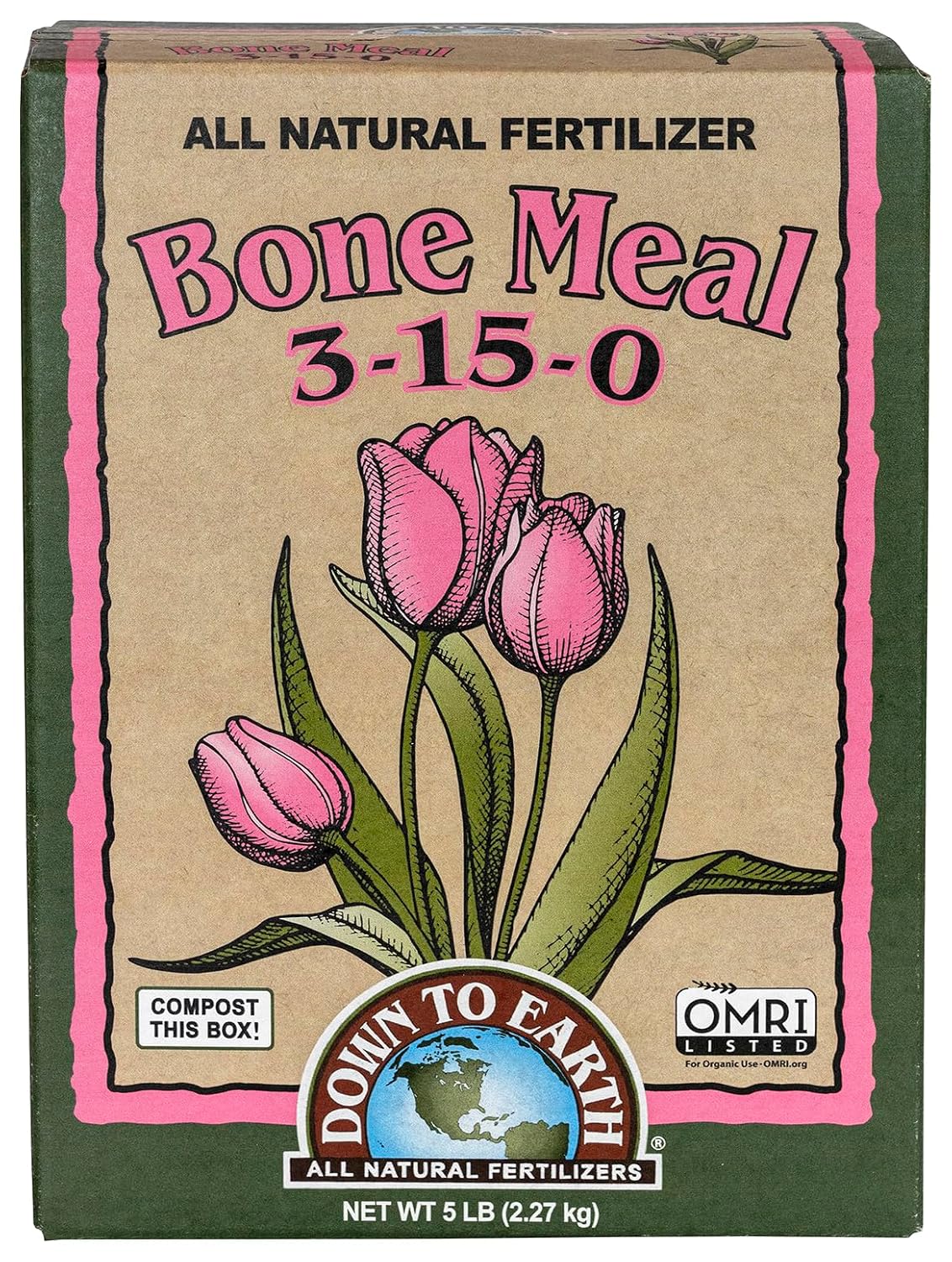
Down To Earth Organic Bone Meal 3-15-0, 5 lb
| Item Form | Granules |
|---|---|
| Specific Uses For Product | Plant Growth, Soil Conditioning |
| Coverage | Medium |
| Target Species | flowering plants, trees, ornamentals, bulbs |
| Mixing Ratio | 3:15:0 |
This Down To Earth bone meal is a straightforward organic phosphorus and calcium source designed to encourage root and bloom development in bulbs, flowering plants, trees, and ornamentals. Supplied as granules with a 3-15-0 N-P-K ratio and OMRI listing, it is typically worked into soil before planting or applied as a side dressing every 4 to 6 weeks. The product is easy to handle and stores well in its box when kept dry, making it convenient for routine seasonal use. Practical benefits include stronger early-season root establishment, improved flowering and fruit quality where phosphorus is limiting, and compatibility with organic growing systems. Important limitations are that bone meal supplies little nitrogen and is slow-release compared with synthetic options, so it should be used as part of a balanced feeding program and not relied on for fast corrective treatment of severe deficiencies. Protective handling is recommended to avoid inhalation or contact during application.
Best for: Gardeners who prioritize reliable, organic fertility for bulbs, ornamentals, and trees and want a proven phosphorus boost that integrates into routine seasonal care.
Less Ideal for: Growers seeking a fast-acting synthetic fertilizer or an all-in-one feed that supplies significant nitrogen and immediate correction of deficiencies.
- High phosphorus concentration (3-15-0) effective for root and bloom development
- OMRI-listed and made from natural bone meal suitable for organic gardens
- Granular form that is easy to work into soil or apply as a side dressing
- Recognized source of calcium which can aid plant health and soil structure
- Slow-release material that works gradually and will not correct acute phosphorus shortages quickly
- Provides minimal nitrogen so additional feeding may be needed for balanced nutrition
Verdict: A dependable OMRI-listed bone meal that delivers a concentrated organic phosphorus boost to improve root and bloom development in bulbs and flowering plants.
Burpee Bone Meal Fertilizer, 3 lb

| Item Form | Powder |
|---|---|
| Specific Uses For Product | Plant Growth, Root Development |
| Coverage | 240 Sqaure Feet |
| Target Species | tomatoes, peppers, and bulbs |
Burpee Bone Meal is a slow-release granular fertilizer designed to boost early root development and flowering in root and bulb crops. Gardeners typically work it into planting holes for bulbs or mix it into soil and potting media when starting seeds or transplanting vegetables like carrots, beets, and onions. The product is OMRI listed for organic gardening and provides phosphorus and calcium that support stronger root systems and better early-season growth. Its fine granular texture makes it easy to apply evenly, and because it breaks down slowly it feeds plants over the season without burning them. Practical benefits include targeted support for root vegetables and an easy application method for beds and containers. Limitations are that it supplies mainly phosphorus and calcium rather than a balanced NPK profile, so it is best used alongside a nitrogen source if foliage development is needed, and results are gradual rather than immediate because of the slow-release nature.
Best for: Gardeners focused on improving root development and bulb planting who prefer organic inputs and want a simple amendment to add at planting or during bed preparation.
Less Ideal for: Growers seeking an all-in-one balanced fertilizer for both foliage and root development or those who need fast-acting, soluble nutrients for immediate correction.
- OMRI listed for organic gardening, suitable for certified organic beds
- Fine granular form that is easy to spread and incorporate
- Provides phosphorus and calcium to encourage strong root and bulb development
- Slow-release action reduces risk of burning plants and supplies season-long support
- Not a complete fertilizer profile so additional nitrogen may be needed for leafy growth
Verdict: A reliable organic bone meal to strengthen roots and jump-start bulbs and root vegetables when added at planting.
Back to the Roots 100% Organic Bone Meal

| Item Form | Powder |
|---|---|
| Coverage | 3000 sq ft. |
| Target Species | Flowers, Vegetables, Houseplants |
| Mixing Ratio | 1:0:0 |
This bone meal is a powdered, organic fertilizer intended to strengthen roots and promote larger blooms in both indoor and outdoor plants. You apply it by working the powder into potting mix or garden soil where it slowly releases phosphorus and calcium to support root growth and flowering over time. Notable features include a coverage claim suitable for large areas and a formulation aimed at flowers, vegetables, and houseplants, which makes it versatile for mixed garden beds and containers. Practical benefits are steady nutrient release that reduces the need for frequent feeding and an ingredient profile focused on plant-available phosphorus and calcium that is helpful during establishment and bloom set. Limitations to note are that bone meal works slowly and depends on soil biology and pH to become available to plants, so it is not a quick corrective for severe deficiencies, and it may be less effective in very acidic or anaerobic soils. For cautious gardeners who prefer organic inputs, this product provides a predictable, low-maintenance source of bloom- and root-supporting nutrients.
Best for: Gardeners who prefer organic, low-maintenance fertilizers and want a steady, plant-focused boost for roots and blooms in mixed beds and containers.
Less Ideal for: Growers who need rapid correction of nutrient deficiencies or who garden in very acidic or waterlogged soils where bone meal availability is limited.
- Organic bone meal delivers slow-release phosphorus and calcium to support root and flower development
- Powder form is easy to mix into potting soil or broadcast in garden beds
- Formulated for flowers, vegetables, and houseplants, making it versatile across planting situations
- Claims coverage suitable for treating large areas which is useful for garden beds
- Nutrients release slowly and require active soil biology and appropriate pH to be effective
- Not a quick fix for acute nutrient deficiencies
Verdict: A dependable organic bone meal powder for gardeners who want slow-release phosphorus and calcium to strengthen roots and improve blooms.
Choosing the Right Bone Meal Fertilizer: Key Factors to Consider
Nutrient Analysis
Knowing the phosphorus percentage and calcium level matters because bone meal is used primarily as a source of phosphorus for root and flower development. The guaranteed analysis tells you how much phosphorus the product adds per application, which helps prevent underfeeding or overapplying in small beds and containers.
Phosphorus does not move much in soil, so placement and quantity are more important than frequency. For bulbs, transplants, and flowering shrubs, follow label rates tied to nutrient analysis rather than applying a fixed spoonful. If the product lacks a clear analysis, you cannot predict how many square feet a bag will treat safely.
Particle Texture and Release Rate
Bone meal comes in coarse granules, fine powders, or pelletized forms, and texture strongly influences how fast microbes mineralize the phosphorus. Finer powders release nutrients more quickly because they present more surface area to soil organisms, while coarse granules act as a slower, longer-lasting source.
Choose a finer particle for quick transplant boosts or container mixes where faster availability is useful. Pick coarser bone meal when you want a longer-term supply in beds and borders. Also consider how easy the texture is to incorporate into existing soil without damaging roots.
Application Method and Ease
Application ease affects whether you get precise placement and consistent dosing. Some bone meal products are simple powders you mix into potting mixes or soil pockets. Others are pelletized or blended into granular blends that can be broadcast by hand or with a spreader.
For seed-starting and delicate seedlings, a finely measured, easily mixed product reduces the risk of localized nutrient burn. For larger beds and landscapes, a product that spreads evenly and resists wind loss saves time. Also check whether labeled instructions include depth and timing guidance for common garden uses.
Soil Type and pH Considerations
Soil texture and pH affect phosphorus availability. In very alkaline or very acidic soils, phosphorus can become tied up and unavailable to plants. Bone meal adds phosphorus and calcium but will not correct severe pH issues, so test soil before large applications.
In heavy clay soils, phosphorus tends to bind near the point of contact, so mixing bone meal into the root zone is important. In sandy soils the nutrient can be less retained, so you may need to plan repeat, measured applications. Containers and raised beds often need more careful dosing because of the limited soil volume.
Timing and Plant Type
Different plants need phosphorus at different stages. Use bone meal at planting to support root formation for bulbs, transplants, and new shrubs. For flowering perennials and annuals, application in early growth stages supports bud formation.
Avoid heavy applications to newly germinated seedlings that can be sensitive to salts and concentrated nutrients. Plan timing around planting, transplanting, and pre-bloom stages rather than frequent top-dressing unless you are monitoring soil nutrient levels.
Source and Sustainability
Bone meal is an organic byproduct, and sourcing varies. Products with transparent sourcing and humane processing information tend to be more consistent in nutrient content. Some bone meals are rendered and sterilized differently, which affects microbial safety and odor.
If sustainability or traceability matters, look for documentation on origin and processing. This also can indicate how uniformly the product was milled, which affects texture and performance in the garden.
How to Apply Bone Meal in Different Garden Settings
Application method changes with context. For planting bulbs and transplants, sprinkle bone meal into the planting hole and mix with native soil so nutrients are placed near developing roots. For raised beds and containers, blend bone meal into the potting mix before filling containers to avoid pockets of concentrated nutrients.
For established perennials and shrubs, lightly fork bone meal into the top few inches of soil in a band under the dripline. Avoid surface-only applications in heavy clay where phosphorus will not move down to the roots unless mixed in.
When using finer powder in seed trays, use small amounts and dilute with potting mix to prevent harm to delicate radicles. Pelletized forms can be easier to dose for larger landscapes but may take longer to act.
- Planting holes: mix with backfill for direct root access
- Containers: pre-mix into potting media for even distribution
- Established plants: incorporate shallowly under the dripline
Working Bone Meal Into Organic Fertility Plans
Bone meal complements nitrogen-rich amendments such as compost and blood meal. Use compost for steady nutrient and organic matter supply, then add bone meal at planting to target phosphorus without creating an excess of nitrogen that could favor foliage over flowers.
Balance timing so that fast-release nitrogen sources are available during leaf-out while bone meal provides longer-term phosphorus for root and bloom development. Rotate or stagger organic inputs to maintain active soil biology that helps mineralize bone meal.
- Combine with compost for general fertility
- Pair with slow nitrogen sources to avoid flushes of leafy growth
- Top-dress annually at planting zones for sustained supply
Interpreting Soil Test Results Before Using Bone Meal
Always check soil phosphorus levels before adding bone meal. If soil tests show adequate or high phosphorus, extra applications are unnecessary and can be wasteful. Low phosphorus results indicate where bone meal can be most effective.
Soil pH and calcium levels influence whether added phosphorus will be available. Adjust pH as needed based on a test rather than relying on bone meal to correct underlying issues.
- Use soil tests to target applications
- Avoid adding bone meal to soils already high in phosphorus
- Adjust pH based on test recommendations for best nutrient uptake
Safe Use Around Seedlings and Young Roots
Young seedlings can be sensitive to concentrated nutrients. When starting seeds, mix very small amounts of bone meal into the seedling mix or apply only at potting-up stages. If you must add phosphorus at germination, choose a finely milled product and dilute thoroughly.
For transplant shock prevention, place bone meal in the planting pocket away from direct seed contact so roots access nutrients as they grow without burn risk.
- Dilute bone meal in seed mixes
- Place in planting pockets rather than touching seeds
- Use gentler, finer products around young roots
Storage and Handling Best Practices
Keep bone meal dry and sealed to prevent clumping and loss of potency. Store off the ground in a cool, dry place away from pets and children because it is an animal-derived product.
Label original packaging with purchase or open date if you transfer to another container. Old, wet, or rancid-feeling bone meal may have diminished effectiveness and should not be used.
- Store in airtight containers
- Keep in a dry, cool spot away from animals
- Discard clumped or foul-smelling material
How We Chose the Best Bone Meal Fertilizer
We prioritized criteria that reflect how bone meal performs in real gardens rather than abstract ratings. Nutrient analysis was a primary filter: products had to list phosphorus and calcium content so gardeners can match supply to plant needs. Particle texture and granule size were evaluated because they affect how quickly soil microbes break down the material and release nutrients. Application convenience and product form were considered to reflect whether a product is easy to spread, incorporate, or apply to containers. Soil compatibility and salt risk were included to avoid options that can cause nutrient lock or harm seedlings in light potting mixes. Finally, sustainability and source transparency were considered when available, since origin and processing affect consistency and environmental impact. We excluded any fertilizers that lacked clear nutrient labeling, had inconsistent particle descriptions, or were intended primarily as blended complete fertilizers. For the remaining products we compared the same functional dimensions: guaranteed analysis, granule or powdered texture, suitability for seed-starting versus established plants, ease of use, and likely release timing under typical garden soil conditions. Those evaluation dimensions align with the scoring metrics used for each product entry.
FAQ
Can I use bone meal when starting seeds?
Often you can, but use it sparingly. Seedlings are sensitive to concentrated nutrient pockets, so mix a very small amount into seed-starting mix or apply bone meal only at potting-up rather than directly in seed trays.
How soon will plants respond after applying bone meal?
It depends on soil biology and texture. In warm, biologically active soils a fine bone meal can become available within weeks, while coarser forms in cool soils may take months to release detectable benefits.
Is bone meal safe for vegetable gardens?
Bone meal is commonly used in vegetable gardens to support root crops and transplants. Apply according to soil test recommendations and avoid overapplication; follow label guidance for root crops to prevent uneven nutrient distribution in edible produce.
Can bone meal change soil pH?
Bone meal contributes some calcium but is not a reliable method for correcting pH. Significant pH adjustments should be done with materials specifically recommended from a soil test, such as lime for raising pH or sulfur for lowering pH.
How often should I reapply bone meal?
Reapplication depends on soil tests and plant response. Because bone meal releases slowly, many gardeners apply it at planting and then retest soil or reapply every one to three years based on crop needs and test results.
Are there alternatives to animal-derived bone meal?
Yes. Rock phosphate and some synthetic phosphorus fertilizers provide other phosphorus sources. Organic gardeners may choose plant-based amendments or mineral phosphates depending on their preferences and soil test recommendations.
Final Verdict
Choose a bone meal product that matches the soil conditions, plant type, and timing needs of your garden. Prioritize clear nutrient analysis and a particle texture suited to whether you want faster availability or a longer-term supply. Consider soil tests and placement to ensure phosphorus reaches the root zone without causing localized concentration. Balancing bone meal with compost and thoughtful timing reduces the chance of overapplication and supports steady root and bloom development. Use the scoring criteria above to weigh phosphorus content, texture, application ease, and source transparency when making your selection so you can pick the best option for your bed, container, or landscape.
