

Note: This article contains affiliate links. If you click on these links and make a purchase, I may earn a small commission at no extra cost to you. This helps support my research and content. Read my full affiliate disclosure here.
If you spend time in a garden where children, pets, or people with sensitivities are present, choosing a weed control option that reduces risk to humans matters. The wrong product can leave residues, irritate skin or lungs, or restrict how you use treated areas. This guide focuses on safe weed killer options for humans and explains practical differences in exposure, persistence, and effectiveness you will notice in a real yard, patio, or planting bed. We shortlisted five top-rated safe weed killer types and materials based on human toxicity, residual activity, and usable application methods. Below we summarize how each approach behaves in the garden and the evaluation factors we used to narrow the list before the product reviews.
Top Picks at a Glance
| Best Overall The best all-around choice for most situations | ECO Garden PRO Organic Vinegar Ready-to-Use Weed Killer (1 Gallon) |  |
| Best Quality Built to a higher standard if you want something more solid | BioSafe Systems Weed & Grass Killer Concentrate, 1 Gallon |  |
| Best Value The sweet spot between price and what you get | Spruce Weed & Grass Killer Refill, Ready-to-Use 64 fl oz |  |
| Best Budget The cheapest option that still gets the job done reliably | Pulverize Weed & Grass Killer, Ready-to-Use 1 Gallon (Messinas) |  |
| Most Popular A crowd favorite that many people choose with confidence | Spruce Weed & Grass Killer Power Wand Kit with 64 oz Refill |  |
ECO Garden PRO Organic Vinegar Ready-to-Use Weed Killer (1 Gallon)

| Unit Count | 128 Fluid Ounces |
|---|---|
| Coverage | 1000 square_feet |
| Item Form | Liquid |
| Active Ingredients | Sodium Chloride |
ECO Garden PRO is a one-gallon ready-to-use herbicide that uses organic vinegar, rock salt (sodium chloride), and biodegradable additives to burn back weeds and grasses on contact. It is applied with a sprayer directly to foliage on sunny days above 70°F and typically shows visible results within 24 to 48 hours. The product is designed for spot treatments on driveways, sidewalks, mulch beds and around hardscapes where root control is less critical. Notable features include a no-dilution RTU formula, instructions for fine-mist application, and claimed safety for pets, children, and beneficial wildlife when used as directed. Practical benefits are fast visible knockdown of broadleaf weeds, suitability for repeated use in sensitive areas, and an organic ingredient profile that avoids glyphosate. Important limitations are that it works primarily on foliage so deep or perennial-rooted weeds may regrow from roots, it requires warm, dry weather for best effect, and repeated applications may be necessary for heavy infestations or turf replacement planning.
Best for: Buyers who want a quick, low-toxicity, no-mix solution to control visible weeds on driveways, paths, and beds and who prefer organic ingredients over synthetic herbicides.
Less Ideal for: Gardeners seeking a systemic, long-term root kill for large turf areas or for persistent perennial weeds should consider a different approach or follow-up mechanical control.
- Ready-to-use spray eliminates the need to mix or measure
- Visible results in 24–48 hours for annual and surface weeds
- Formulated without glyphosate and with biodegradable ingredients
- Suitable for spot treatment on hard surfaces, sidewalks, and mulch beds
- Does not reliably kill deep roots or established perennial weeds
- Requires warm, dry, sunny conditions for best performance
Verdict: A fast, ready-to-use non-glyphosate spray that delivers quick visible weed knockdown for spot treatments where low-toxicity ingredients are a priority.
BioSafe Systems Weed & Grass Killer Concentrate, 1 Gallon

| Unit Count | 128 Ounce |
|---|---|
| Item Form | Spray |
| Coverage | 200 square_feet |
| Active Ingredients | Herbicide |
This one-gallon concentrate is a non-selective, organic herbicidal soap designed to burn down broadleaf weeds and many grasses on contact. You mix the water-soluble concentrate and spray directly onto unwanted plants on patios, walkways, vegetable garden paths, and edges; the product starts destroying plant cells within hours and gives visible results fast. Notable features include OMRI listing and EPA registration, a concentrated formula that treats up to 200 ft2 from a small amount, and a claim that soil migration is minimal so you can replant after four days. In practice it is best used for spot treatments and areas where you want quick results without persistent soil residue. Limitations are that it is non-selective so it will damage desirable plants if contacted and it requires thorough, uniform coverage for reliable control; perennial root systems may need repeat applications. Follow safety directions to avoid skin and eye contact and keep children and pets away during application.
Best for: Buyers who prioritize effective, fast-acting weed control but want an organic-certified product they can use around people and pets when applied carefully.
Less Ideal for: Gardeners seeking a systemic herbicide for deep-rooted perennial eradication or those who need a selective product to preserve surrounding plants.
- OMRI-listed and EPA-registered formulation suitable for organic gardening
- Concentrated formula covers up to 200 sq ft from small measured doses
- Works on contact with visible burn down within hours
- Non-volatile and water-soluble so it does not leave long-lasting residue
- Non-selective action will damage any desirable plants it contacts
- Requires thorough, uniform spray coverage for effective control
Verdict: Choose this concentrated, OMRI-listed spray if you want a fast-acting, organic-certified contact herbicide that delivers visible results while minimizing persistent soil residue.
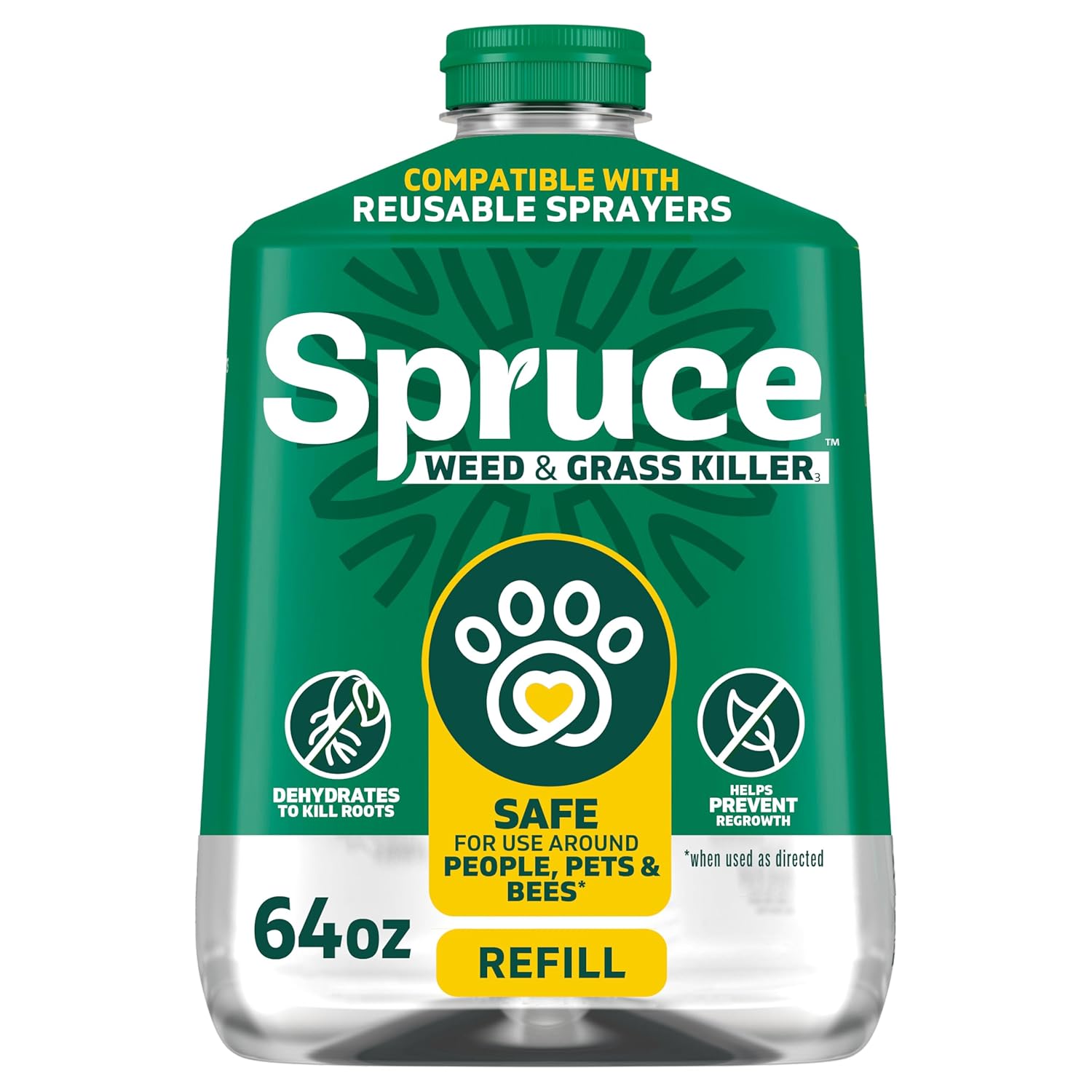
Spruce Weed & Grass Killer Refill, Ready-to-Use 64 fl oz
| Unit Count | 64 Fluid Ounces |
|---|---|
| Item Form | Spray |
| Coverage | 1 bottle treats up to 400 weeds |
| Active Ingredients | Sodium Lauryl Sulfate, Geraniol, Cornmint Oil |
This 64 fl oz Spruce refill is a no-mix replacement for the brand's Snap & Spray system that provides a convenient, ready-to-use weed and grass killer for spot treatments. It works on contact, dehydrating foliage with visible leaf darkening or wilting within an hour and complete plant death often by 24 hours. The formula relies on water, essential oils and sodium lauryl sulfate rather than synthetic herbicides, which makes it suitable for use around people and pets when directions are followed. One bottle is rated to treat up to about 400 weeds and is designed for hard surfaces, mulch beds, driveways and pavers rather than broadcast lawn application. Practical features include a snap-on refill top for the existing spray handle and a fast rainproof window of roughly 10 minutes. Be aware it is non-selective and must be applied carefully to avoid desirable plants, and it is most effective on young or small weeds rather than deep perennial roots where reapplication may be needed.
Best for: Buyers who want a low-fuss, pet-conscious spot weed killer for driveways, pavers and mulch beds and who prioritize convenience and visible speed of action.
Less Ideal for: Homeowners seeking a selective lawn treatment or long-term control of deeply rooted perennials should consider different systemic or professional options.
- Ready-to-use refill eliminates mixing and pouring
- Visible results in about one hour with full effect by 24 hours
- Formulated with water and essential oils for pet- and people-friendly use when directed
- Covers a high estimated count — one bottle treats up to 400 weeds
- Snap-on refill design fits the Spruce Snap & Spray handle for quick replacement
- Non-selective formula will damage desirable plants if oversprayed
- Less effective on large established perennial roots compared with systemic herbicides
Verdict: Choose this refill if you want a fast, ready-to-use, pet-conscious spot treatment that snaps into the Spruce spray handle for effortless weed control on hardscapes and beds.
Pulverize Weed & Grass Killer, Ready-to-Use 1 Gallon (Messinas)

| Unit Count | 128 Fluid Ounces |
|---|---|
| Item Form | Spray |
| Liquid Volume | 1 gallons |
| Active Ingredients | Maleic hydrazide |
| Coverage | Up to 250 sq.ft. (Gallon Ready to Use) |
This ready-to-use Pulverize Weed & Grass Killer is designed for homeowners who need a fast, no-mix solution for weeds on patios, driveways, and garden edges. You spray directly onto foliage and the formula begins drying weeds within hours, making it useful for spot treatments and clearing hardscape cracks. The product is non-selective so it will kill any plant it contacts, and the label highlights control of common annual weeds, moss, algae, and lichens. The formula is described as made from naturally derived ingredients and approved for organic gardening, which reduces concerns about heavy synthetic chemicals and makes it easier to use around family areas once treated surfaces have dried. Important trade-offs are that it will damage desirable plants if oversprayed and that repeat applications every 2 to 3 weeks are recommended for new growth; rain within a few hours can require reapplication. For small to medium problem areas this gallon size gives broad coverage without mixing, but users should follow safety directions to avoid skin or eye contact.
Best for: Homeowners who need an affordable, easy-to-use herbicide for spot-treating driveways, patios, and edges and who prioritize friendlier, naturally derived ingredients around pets.
Less Ideal for: Gardeners wanting a selective lawn-safe product to preserve turf or those who need a systemic, long-term single-application control for deep perennial roots.
- Ready-to-use spray requires no measuring or mixing
- Fast-acting formula shows visible weed dieback within hours
- Naturally derived active ingredient intended for pet- and family-friendlier use once dry
- Effective on a broad range of annual weeds plus moss, algae, and lichens
- Non-selective formula will kill desirable plants if contacted
- May require repeat applications every 2–3 weeks for new growth
Verdict: A convenient, pet-friendlier ready-to-use herbicide for quickly clearing weeds and hardscape growth without mixing.
Spruce Weed & Grass Killer Power Wand Kit with 64 oz Refill

| Unit Count | 64 Fluid Ounces |
|---|---|
| Coverage | 1 bottle treats up to 400 weeds |
| Item Form | Multiple |
| Liquid Volume | 64 fluid ounces |
This kit combines a 64 oz ready-to-use herbicide with a battery-powered Power Wand for fast, targeted spot treatments. The formula is non-mixing and designed to work on contact, dehydrating leaves so you can see darkening or wilting within an hour and complete die-off by about 24 hours when used as directed. The wand is reusable and comes with two AA batteries so you can spray cracks, edges, mulch beds, driveways, and walkways without pouring or measuring. Practical benefits include ease of use, rainproofing within 10 minutes, and a formula advertised as safe around people, pets, and bees when directions are followed. Limitations are that it is non-selective so it must be applied carefully to avoid desirable plants and grass, it is intended for spot treatment rather than broadcast lawn application, and best results require spraying in dry, warm conditions above 60°F with no immediate rain forecast.
Best for: Buyers who want a fast, easy-to-use spot weed killer for driveways, cracks, mulch beds, and edges and who prioritize quick visible results and minimal setup.
Less Ideal for: Those needing large-area lawn herbicide or selective weed control within turf should look for products made for broadcast lawn treatments or selective formulas.
- Ready-to-use 64 oz refill eliminates measuring or mixing
- Visible results in about one hour and full effect around 24 hours
- Includes battery-powered reusable wand for precision spot treatments
- Rainproof within 10 minutes so light showers are less likely to wash it off
- Formulated for use around people, pets, and bees when directions are followed
- Non-selective formula can damage desirable plants if oversprayed
- Designed for spot treatments not for broadcasting over large lawns
- Performance depends on spraying in recommended weather conditions
Verdict: A convenient, no-mix spot-treatment kit that delivers fast visible weed kill with a reusable powered wand for precise, low-fuss applications.
Choosing the Right Safe Weed Killer for Humans: Key Factors to Consider
Toxicity Profile And Exposure Routes
Understanding the toxicity profile is central to picking a weed control option that is safer for people. Look at both acute effects – like skin or eye irritation and inhalation danger – and any longer-term concerns reported in safety summaries.
Consider how people are likely to be exposed in your setting: direct skin contact during application, inhalation of spray droplets, or incidental contact by children and pets after treatment. Products with lower volatility and low dermal absorption reduce immediate exposure risk, which matters in family gardens and high-traffic outdoor spaces.
Residual Activity And Soil Persistence
Residual activity determines how long a treated area might affect people and future plantings. Some herbicides break down quickly, letting people re-enter treated areas and allowing quick replanting. Others bind in soil or leave residues that can be absorbed by newly planted crops or create a risk if children dig in treated beds.
Evaluate degradation timeframes and whether the active agents degrade into less harmful components. Shorter persistence is generally better for human safety, especially where edible plants, play areas, or barefoot traffic are common.
Application Method And Control
How a weed killer is applied affects both safety and effectiveness. Ready-to-use spot sprays, gel applicators, or granular products allow more targeted placement and reduce the chance of drift or accidental contact, while concentrated sprays or broadcast applications increase exposure risk.
Also consider the physical ease of applying the product at ground level without kneeling into wet spray, and whether the label requires special protective equipment. Products that allow targeted application reduce the area people are exposed to and are preferable in mixed-use landscapes.
Efficacy Against Target Weeds
Human-safe options vary widely in how well they control different weed types. Some are excellent on annual broadleaves but weak on stubborn perennials with deep roots. If your garden has persistent grasses or deep-rooted perennials, choose an approach that offers the needed control without forcing repeated heavy applications.
Balance safety and performance: an option that is very safe but ineffective will lead to repeated treatments and more overall exposure. Assess whether a product controls the specific weeds you face and how many applications are typically required.
Replanting Window And Usability After Treatment
The time you must wait before people can safely use the treated area or before planting new crops affects its practicality. Faster re-entry and shorter replanting windows are important for vegetable beds, high-traffic yards, and spaces used by children.
Look for products with clear label guidance on re-entry intervals and recommended waiting periods before sowing or transplanting. A product that allows quick re-use of the area reduces disruption to garden activities and lowers long-term exposure risk.
Environmental Behavior And Runoff Risk
Consider how the active ingredient behaves in rain and irrigation. Some substances are prone to moving with runoff or leaching, which can spread residues to play areas or water features. For gardens near ponds, streams, or swimming pools, choose options with low mobility and clear guidance on watering after application.
Think about landscape slope, soil type, and typical rainfall patterns in your area. Products that bind quickly to soil and break down naturally reduce the risk that residues will travel offsite and create unintended exposure for people.
When To Choose Nonchemical Methods First
Nonchemical approaches should be your first line of defense in areas with high human activity. Hand pulling, hoeing, mulching, flame weeding with safe technique, and covering small patches with landscape fabric all eliminate chemical exposure entirely when practical. These methods are especially appropriate around play areas, patios, and edible gardens where you want to minimize any residue risk.
- Hand pulling for small infestations preserves soil and is immediate and safe for people when done with gloves.
- Mulch and dense groundcovers prevent weed emergence with no human-toxic residues.
- Flame weeding works on annual weeds when done carefully, but it requires attention to fire safety and should not be used near people during application.
Spot Treatment Versus Broad Application
Targeted spot treatments reduce the area where people might encounter residues and limit airborne drift. Use a narrow-spray nozzle, gel applicator, or brush-on formula to treat individual plants while leaving surrounding soil and desirable plants untouched. For large, dense infestations in non-traffic zones, a broader approach may be simpler but increases re-entry considerations.
- Spot treatments limit exposure and are better near play areas or garden beds.
- Broad applications may save time in driveways or along fence lines where human contact is minimal.
- Follow label directions closely to restrict where the product lands and avoid overspray.
Protective Measures During Application
Even products marketed as low-toxicity benefit from basic protective practices. Wear gloves, avoid spraying on windy days, and keep bystanders and pets away until sprays have dried. Use an applicator that minimizes spray drift and consider a mask if you are sensitive to odors or fine droplets.
- Time applications for calm weather to reduce drift.
- Keep children and pets inside until treated surfaces are dry or the label says it is safe to return.
- Store products safely out of reach and follow disposal guidance to prevent accidental exposure.
Managing Tough Perennials Safely
If your yard has persistent perennials with deep roots, a single gentle treatment may not be enough. Combine mechanical removal of the root mass with a targeted application to the regrowing foliage when safe. This reduces the need for repeated, broad chemical use and shortens the time people are exposed to treated areas.
- Dig out roots where practical to minimize chemical needs.
- Use precisely timed spot applications on regrowth rather than repeated broadcasting.
- Monitor treated patches and remove dead material to allow quicker replanting or reuse of the area.
How We Chose the Best Safe Weed Killer for Humans
We focused on options that reduce direct human exposure while still controlling common weeds in yards, beds, and near patios. Evaluation prioritized measurable safety and practical performance relevant to everyday gardeners. Core criteria included toxicity profile – reviewing acute and chronic hazard data and typical exposure routes; residual soil impact – how long active ingredients persist and whether they affect follow-up planting; application method safety – ease of targeted application and need for protective equipment; efficacy on common perennial and annual weeds under normal garden conditions; and environmental behavior – degradation pathways and potential to drift or run off. We also considered usability factors like required reapplication frequency and whether treated areas remain usable by people soon after treatment. We excluded products with unclear safety data or those requiring industrial protective gear for normal use. We did not include broad claims without evidence of human-safety advantages. The final picks balance reduced human risk with realistic weed control performance based on the above dimensions.
FAQ
Are there weed killers that are completely safe for humans?
No weed control method is entirely without risk, but many options have very low human toxicity when used according to label directions. Nonchemical methods eliminate chemical exposure, while selected low-toxicity formulations minimize risk for people when applied properly.
How soon can people re-enter an area after using a human-safe weed killer?
Re-entry times vary by product and formulation. Some low-residue options allow re-entry once the spray has dried, while others require a wait time before children or barefoot adults use the area. Always follow the specific re-entry guidance on the product label.
Is natural or organic always safer for humans?
Not always. 'Natural' ingredients can still irritate skin or eyes and may be hazardous if misused. Safety depends on formulation, application method, and persistence. Evaluate the toxicity profile and follow label precautions regardless of whether an ingredient is natural.
Can I use safe weed killers around edible gardens?
Some low-residue, low-toxicity options are formulated for use near edibles, but timing and placement matter. Avoid direct contact with edible plants, follow replanting intervals, and rinse produce if there is any chance of drift. When in doubt, use nonchemical control in vegetable beds.
What if a child or pet gets into a treated area?
If contact occurs, follow the product label's first-aid instructions. For low-toxicity products, simply washing skin with soap and water is often sufficient. If ingestion or concerning symptoms occur, seek medical or veterinary advice promptly and bring the product label information.
Final Verdict
Prioritize methods that reduce direct human exposure while still addressing the specific weeds in your space. Start with nonchemical controls where feasible, use targeted application methods to limit treated area, and favor products with short soil persistence and low toxicity. Weigh the tradeoff between control strength and human-safety attributes: stronger residual chemistries may offer longer control but increase re-entry and replanting constraints. Choose the approach that matches how people use the area and the types of weeds you must manage to balance safety and effectiveness confidently.
