

Note: This article contains affiliate links. If you click on these links and make a purchase, I may earn a small commission at no extra cost to you. This helps support my research and content. Read my full affiliate disclosure here.
Ant control matters more when you share living space with pets. You want treatments that stop infestations without exposing dogs, cats, or small mammals to dangerous chemicals or tempting pellets. This guide narrows the field to five top pet-focused ant control options, each chosen for how it behaves in real homes and around animals. We evaluated candidates for how they reduce active ant trails, how they keep pets safe through formulation and placement, and how practical they are for routine use. Read on to see the shortlist and the criteria we used to select them before you inspect product details.
Top Picks at a Glance
| Best Quality Built to a higher standard if you want something more solid | EcoVenger Ant Killer & Nest Treatment, 32 oz |  |
| Best Value The sweet spot between price and what you get | EcoLogic Ant & Roach Killer Aerosol 14 oz |  |
| Highest Rated A top-rated pick with lots of positive feedback | NCSIFDD Ant Away Ant Repellent Gel, 6-Pack |  |
| Most Popular A crowd favorite that many people choose with confidence | STEM Plant-Based Bug Spray for Ants, Roaches and Flies, 12 fl oz |  |
| Best Seller A high-volume bestseller chosen again and again | Wondercide Indoor Pest Control Spray, Lemongrass, 32 oz |  |
EcoVenger Ant Killer & Nest Treatment, 32 oz

| Unit Count | 32 Fluid Ounces |
|---|---|
| Item Form | Spray |
| Target Species | Odorous House Ants, Fire Ants, Roaches, Fleas, Spiders |
| Active Ingredients | Citronella Oil, Geraniol, Cedarwood oil, Sodium Lauryl Sulfate |
EcoVenger Ant Killer is a plant-extract spray formulated to kill house ants on contact, treat fire ant mounds, and leave a residual barrier that deters re-entry for up to four weeks. You use it like a standard ready-to-use spray: spot-treat visible trails, spray around entry points and saturate mound tops or nest openings to reach the colony. Notable features include a citronella/cedarwood/geraniol active blend, a user-friendly trigger sprayer and claims of university testing and professional use. In practice the product offers fast knockdown for foraging ants and the ability to deliver treatment down tunnels using the spray wand, which helps target queens in mounds. The botanical formulation is marketed as non-staining and safe to use around pets and children when directions are followed, and the light citrus scent dissipates quickly. Limitations are that efficacy details beyond labeled target species rely on manufacturer testing and heavier infestations may need repeated treatments or perimeter work; the nozzle has delicate parts so care is needed when handling.
Best for: Homeowners who prioritize effective, fast-acting ant control but want a pet- and child-friendly botanical option for indoor and outdoor use.
Less Ideal for: People needing an industrial-strength chemical treatment for very large or persistent infestations or those who prefer products supported by multiple independent field trials.
- Kills odorous house ants on contact and eradicates fire ant mounds when applied to the colony
- Botanical active ingredients (citronella, geraniol, cedarwood) offer a lower-toxicity alternative to conventional pesticides
- Provides residual repellency for up to four weeks to help prevent re-entry
- Suitable for indoor and outdoor use and formulated to be non-staining on carpets and fabrics
- Nozzle contains delicate parts that can be damaged and may require careful handling
- Manufacturer efficacy claims are based on internal or cited studies rather than independent third-party field trials
Verdict: A fast-acting, plant-powered ant spray that balances quick colony knockdown with a formulation designed for use around pets and children.
EcoLogic Ant & Roach Killer Aerosol 14 oz
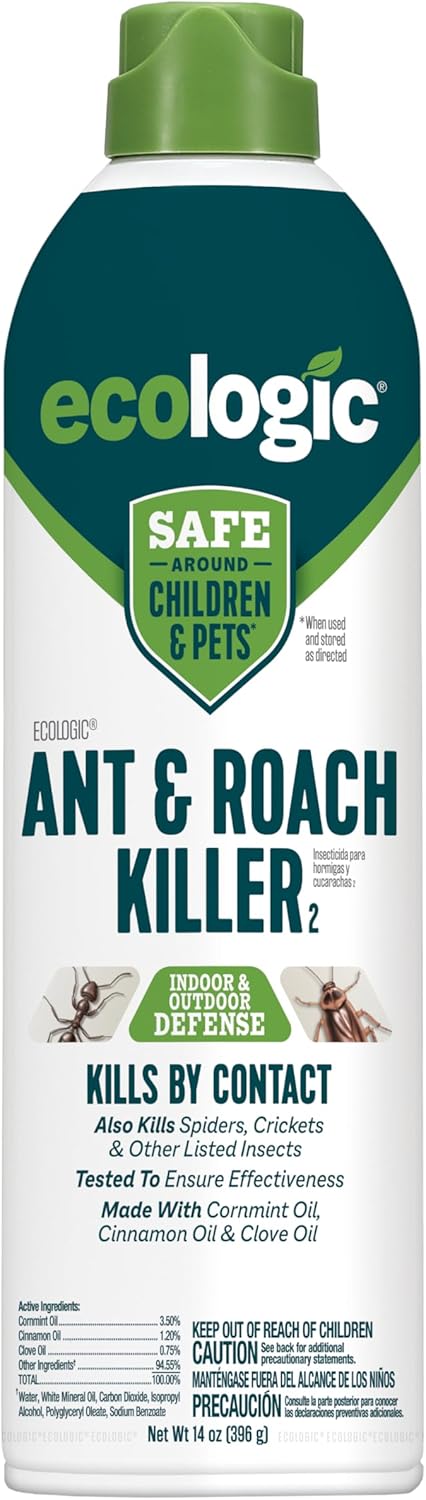
| Unit Count | 14 Ounce |
|---|---|
| Item Form | Spray |
| Target Species | Insects |
| Liquid Volume | 14 fluid ounces |
| Active Ingredients | carbon,sodium benzoate |
EcoLogic Ant & Roach Killer is an aerosol contact spray that uses cornmint, cinnamon and clove oils to kill ants, cockroaches, spiders and other listed insects. It is used like a conventional spray: direct into cracks, crevices and entry points until surfaces are visibly wet, repeating treatments as needed. The formula is positioned as a mindful, plant-oil alternative and is labeled safe around children and pets when used and stored according to directions. Practical benefits include fast knockdown on contact and flexibility for indoor or outdoor spot treatments around baseboards, sinks, doorways and patios. Because it is an aerosol, application is quick and reaches hard-to-access hiding spots. Important limitations are that it is a contact-only killer so it will not control hidden nests or provide long-term residual control, and users should avoid spraying food-preparation surfaces and test outdoor finishes for discoloration before use. For routine, targeted control where you prefer a plant-oil formulation, this works well; for heavy infestations a bait or professional treatment will be more effective.
Best for: Buyers who want a low-cost, plant-oil alternative for quick, targeted control of visible ants and roaches around the home and yard.
Less Ideal for: Those facing large or hidden infestations, or people who need long-lasting residual control should consider baits or professional services instead.
- Uses plant-derived oils (cornmint, cinnamon, clove) as active ingredients
- Designed for both indoor and outdoor spot treatments
- Aerosol format reaches cracks and crevices for quick contact kill
- Contact-only action provides little residual protection or colony control
- May discolor some outdoor surfaces if not tested first
Verdict: A budget-friendly, plant-oil aerosol that delivers fast contact kills for spot treatment of ants and roaches around home and outdoor entry points.
NCSIFDD Ant Away Ant Repellent Gel, 6-Pack

| Unit Count | 12 Count |
|---|---|
| Number of Pieces | 1 |
This ant repellent gel is a concentrated applicator product intended for targeted spot treatments around entry points, baseboards, window frames, and known ant trails. You remove the cap, attach the precision tip, and apply pea‑sized drops into crevices or along trails; the manufacturer notes it can take 3–5 days to work through a colony and helps keep ants away for up to 60 days in treated areas. Practical benefits include the narrow applicator for neat placement in tight gaps, suitability for both indoor and outdoor problem spots, and a formulation presented as family and pet safe when used as directed. Important limitations are that results are not instantaneous and multiple applications or placements may be needed to control larger or multiple colonies, and effectiveness depends on correctly locating trails and nest access points. For someone who wants a low‑mess, targeted solution rather than broad broadcast treatments, this gel is a convenient option.
Best for: Buyers who prioritize dependable, low‑mess spot treatment for recurring ant sightings and prefer a product they can place precisely where ants travel.
Less Ideal for: People needing rapid elimination of very large or widespread infestations or those who prefer broadcast sprays or professional colony eradication services.
- Precision applicator allows neat, pea‑sized placements in tight crevices and along ant trails
- Labeled for both indoor and outdoor use so the same product can treat kitchens, baseboards, and patios
- Formulation described as family and pet safe when used according to directions
- Single placements can provide protection in treated areas for up to 60 days
- Not an immediate knockdown—can take 3–5 days to affect a colony
- May require several placements and correct trail identification to fully control larger infestations
Verdict: Use this precision gel when you want a neat, family‑safe spot treatment that targets ant trails and entry points rather than a broad spray solution.
STEM Plant-Based Bug Spray for Ants, Roaches and Flies, 12 fl oz

| Active ingredients | Geraniol 6.2%, Lemongrass Oil 0.5% |
|---|---|
| Other ingredients | White Mineral Oil, Isopropyl Myristate, (+)-Ethyl Lactate 93.9% |
| Form | Trigger spray |
| Use | Indoor and outdoor spot treatments |
This STEM bug spray is a trigger-spray insecticide formulated with plant-derived actives such as geraniol and lemongrass oil to kill ants, roaches and flies on contact. It is intended for targeted indoor and outdoor spot treatments: shake, hold about a foot from the insect and spray directly on or where insects congregate. The product’s botanical formula and absence of added dyes or strong chemical fragrances make it a reasonable choice for homes where users prefer less synthetic-smelling options. The trigger bottle gives control for spot application and repeated short bursts, and the directions note it is oil-based so spills should be cleaned promptly. Important limitations are that it is not for spraying on people, pets or plants and requires direct hits for best effect rather than long-range fogging. For persistent infestations you may need supplemental measures because this is designed for surface and contact kills rather than residual baiting or area-wide control.
Best for: Buyers who want an affordable, low-odor botanical spray for quick spot control of common household pests and who prioritize a simple, easy-to-use trigger bottle for targeted treatments.
Less Ideal for: People facing large or hidden infestations who need long-lasting residual control or bait-style solutions should consider professional products or integrated pest control approaches.
- Plant-based active ingredients (geraniol and lemongrass oil) that reduce strong chemical odor
- Trigger-spray bottle for controlled, targeted application
- Labeled for both indoor and outdoor spot treatments when used as directed
- No added dye or fragrance listed, which minimizes residue and scent
- Oil-based formula can leave slippery residue if spilled
- Requires direct spraying of insects for effectiveness and offers limited residual control
- Not safe to spray on people, pets or plants
Verdict: A budget-friendly, low-odor plant-based trigger spray that provides quick, targeted kills of ants, roaches and flies for everyday spot treatments.
Wondercide Indoor Pest Control Spray, Lemongrass, 32 oz

| Unit Count | 32 Fluid Ounces |
|---|---|
| Item Form | Spray |
| Target Species | Ants, Roaches, Spiders, Flies, Fleas, Ticks, Mosquitoes, Silverfish, Moths, Gnats |
| Active Ingredients | 4.2% Cedar Oil; 1.5% Lemongrass Oil; 2.2% Sodium Lauryl Sulfate; 0.1% Sesame Oil |
Wondercide Indoor Pest Control is a ready-to-use, plant-powered spray intended for indoor use against ants, roaches, spiders, flies, fleas, ticks, mosquitoes, and other common household pests. It is typically used by spraying around entry points, baseboards, under sinks, inside cabinets, and on visible pests from about 8 to 12 inches. The formula relies on essential oils such as cedarwood and lemongrass plus a small amount of surfactant, so it doubles as a repellent and contact killer without relying on synthetic pesticides. Practical benefits include a pleasant lemongrass scent, multi-surface application, and labeling that says it is safe to use around pets and family when directions are followed. The spray also works as an indoor flea treatment for carpet and furniture and is convenient for routine preventive use. Important limitations are that it requires direct contact to kill flying insects and may need frequent reapplication for persistent infestations. The label warns it can irritate eyes and skin and that lemongrass may temporarily tint very light fabrics, so spot-testing sensitive surfaces is recommended.
Best for: Buyers who want an indoor pest treatment that leans on plant-based ingredients and family-safe labeling and who prefer a product backed by broad user adoption and clear usage instructions.
Less Ideal for: People facing a heavy or cryptic infestation who need long-lasting residual chemical control or professional-grade extermination methods should consider stronger targeted treatments.
- Plant-based active ingredients (cedarwood and lemongrass oils) that both repel and kill many common indoor pests
- Labeled as safe for use around people and pets when directions are followed
- Ready-to-use spray with adjustable nozzle for targeted or mist applications
- Works on multiple surfaces including carpet, furniture, and baseboards and is marketed as effective against fleas including eggs and larvae
- Requires direct spray contact to kill flying insects rather than providing a residual knockdown
- May cause eye or skin irritation in some users and can temporarily tint very light fabrics
Verdict: A pet-friendly, plant-powered indoor spray that repels and kills common household ants and other pests for everyday preventive use.
Choosing the Right Safe Ant Killer for Pets: Key Factors to Consider
Ingredient Toxicity Profile
Knowing the toxicity profile of active ingredients is central when pets live in the same space. Some insecticides are highly toxic to cats or dogs even at low doses, while others are designed to target insect physiology with lower mammalian risk. Read labels and safety data for acute oral and dermal toxicity and look for ingredients that have lower reported harm to common companion animals.
Lower-toxicity active ingredients often reduce risk from incidental contact or ingestion, but no product is entirely risk-free. Consider whether the formulation relies on granular baits, contained stations, or liquid sprays, because delivery form changes exposure likelihood. When in doubt, favor contained baits and products with clear, pet-focused usage instructions.
Delivery Form and Accessibility
How a product is presented affects how easily a pet can access it. Open granules, loose powders, and broadcast sprays create more opportunities for curious animals to sniff, paw, or eat treated material. Bait stations, enclosures, and tamper-resistant gels reduce direct access and are usually safer choices for homes with free-roaming pets.
Also consider where you will place treatments. Baits tucked into cracks, behind appliances, or inside mounted stations are harder for pets to reach than items left on countertops or floors. If you need to treat outdoor perimeters, look for applications that limit drift and avoid areas where pets play or forage.
Bait Attractiveness and Colony Control
A product that is highly attractive to foraging ants but not to pets is ideal. Effective baits must be palatable to the target ant species so workers carry the poison back to the nest. Some baits target sugar-feeding species, others protein-feeding species, and seasonal ant behavior changes can alter bait acceptance.
Choosing a bait with proven acceptance by local ant types speeds colony reduction and reduces the need for repeated treatments. Faster colony elimination also lowers the overall period during which pets might encounter treated zones, which improves safety in practice.
Placement Strategy and Routine
How you place and maintain ant control products determines real-world exposure risk. Even low-toxicity baits can be problematic if left in plain sight or not routinely checked. Establish a placement routine that keeps treatments in secure stations, checks for chew or tampering, and removes spent baits promptly.
Consider seasonal changes in ant activity and clean up food sources that draw ants in the first place. Good sanitation and thoughtful placement reduce the need for frequent product reapplication and keep pets away from treated spots.
Residual Hazard and Surface Persistence
Some insecticides leave residues on treated surfaces that persist for days or weeks, potentially exposing pets through paw contact or grooming. Products with short surface persistence or those designed for contained use limit residual exposure. Evaluate how long a product remains active on floors, baseboards, or outdoor patios and whether treated areas can be re-accessed by pets during that window.
If long-residual options are considered for heavy infestations, balance the control benefit against where pets spend time. Use physical barriers or temporary exclusion to keep animals away until residues diminish when necessary.
Labeling, Instructions, and Emergency Guidance
Clear labeling and explicit pet-safety instructions make a product more practical for animal households. Good instructions will explain placement, how to secure baits, required waiting times before allowing pet access, and what to do if a pet ingests the product. They may also include veterinarian-relevant first-aid steps.
Products without helpful instructions increase the chance of misuse and accidental exposure. Favor options with straightforward, readable directions and accessible emergency guidance so you can act quickly if an incident occurs.
How Pet Behavior Changes Pest Control Choices
Pets are active participants in the home environment and their curiosity determines many practical constraints on ant control. A dog that noses under furniture or a cat that jumps onto counters changes which placements are reasonable and which are risky. When choosing treatments, think about the typical movements and habits of your animals.
Adjusting application tactics to match pet behavior often reduces reliance on restrictive chemical choices. For example, using bait stations placed behind appliances or inside wall voids minimizes direct contact for ground-level pets, while outdoor perimeter baiting higher on foundations can keep materials out of reach for small animals that prefer ground-level play.
- Keep baits away from pet feeding and sleeping areas
- Use elevated or enclosed bait placements if pets jump on surfaces
- Inspect stations frequently for signs of tampering
Nonchemical and Exclusion Techniques to Reduce Pesticide Reliance
Physical exclusion and sanitation are often the first and safest steps in a pet household. Sealing entry points, repairing screen damage, and storing pet food in sealed containers reduce the pressure that draws ants indoors. These steps can reduce the total amount of pesticide you need to use.
Traps that do not use chemical insecticides, such as physical sticky traps placed outside pet reach, can also monitor activity and reduce population pressure when combined with habitat modification.
- Seal cracks and gaps around doors and windows
- Keep pet food in airtight containers and clean up spills immediately
- Trim vegetation away from the house foundation to reduce trails
Setting Up Bait Stations Safely
Bait stations are a widely used approach because they combine targeted delivery with containment. Choose stations designed so ants can enter but pets cannot. Place stations in hidden locations along ant trails, behind appliances, or in wall void access points when possible.
Regular monitoring is essential. Check stations for spent bait or signs of pet interference and replace or remove them once activity declines to avoid creating long-term temptations.
- Place stations out of reach and camouflaged to reduce pet interest
- Rotate station locations if ants ignore initial placements
- Remove stations once activity ceases to limit residual access
Outdoor Perimeter Tactics Near Pet Play Areas
Treating around foundations and doorways can reduce ant ingress, but keep in mind where pets play and rest outdoors. Use perimeter baits or bait stations installed above the ground on foundation ledges rather than scatter granules across lawns or patios. This reduces the chance that a roaming pet will come into direct contact with treated material.
When treating outdoor borders, schedule applications when pets are supervised or temporarily kept inside until baits are secured. Also, avoid treatments on grassy or soil play zones where digging or rolling could expose animals to residues.
- Mount outdoor stations on vertical surfaces where pets cannot reach
- Avoid broadcast granules in yards where pets dig
- Check treated areas after rain or irrigation to ensure baits remain contained
When to Consult a Professional
Large or persistent infestations may require professional intervention. If ants return repeatedly despite careful baiting and exclusion, a licensed pest control professional can evaluate nesting locations and recommend targeted treatments that reduce overall chemical use.
Ask any professional about pet-safe options and exclusion tactics first. Good practitioners can apply treatments in ways that limit pet exposure, such as treating voids, applying targeted dusts in inaccessible areas, or using contained bait regimens.
- Request pet-safety-focused application methods
- Ensure professionals explain re-entry intervals for treated areas
- Have emergency contact steps outlined if accidental exposure occurs
How We Chose the Best Safe Ant Killer for Pets
We prioritized solutions that balance ant control effectiveness with demonstrable measures to reduce risk to pets. Evaluation focused on four to six concrete dimensions: ingredient toxicity profile, bait attractiveness to target ants, bait station or placement safety for pets, residual surface hazard, and ease of use in a household with animals. We reviewed manufacturer safety sheets and typical usage instructions to assess how formulations are likely to be handled in practice. Products were excluded if they required unrestricted indoor broadcast sprays with high acute toxicity or if instructions relied on constant human supervision to keep pets away. We also filtered out options that deliver only repellent action without colony control, because short-term repellents tend to leave colonies intact and prompt repeat treatments that increase exposure risk. The final list favors low-toxicity active ingredients or contained-bait approaches, practical delivery forms that limit pet access, and clear labeling for pet households.
FAQ
Are any ant baits completely safe for pets?
No product is entirely risk-free, but contained baits and low-toxicity formulations greatly reduce exposure likelihood. Proper placement and routine checks further minimize risk, and following label instructions is essential.
Can I use natural remedies like borax or baking soda around pets?
Some household items can be toxic if ingested by pets, and effectiveness against ants varies. Borax is effective in baits but is not harmless to animals. Use contained baits rather than leaving DIY mixtures exposed where pets might consume them.
How long should I keep pets away from treated areas?
This depends on the product and its residual profile. Many contained baits can remain accessible sooner than sprayed residues. Follow label guidance for re-entry times and keep pets away from newly treated spots until the material is secured or any specified waiting period has passed.
What should I do if my pet eats an ant bait?
If ingestion is suspected, remove any remaining material and contact a veterinarian or emergency animal clinic immediately. Bring the product label or ingredient information if possible. The veterinarian can advise whether observation or active treatment is needed.
Are granular perimeter treatments unsafe for pets?
Broadcast granules increase the chance of direct pet contact, especially for animals that roam on lawns or like to dig. Granules are generally less desirable for homes with unsupervised pets unless they are placed in tamper-resistant stations or applied in inaccessible zones.
Do bait stations work on all ant species?
Bait stations work best when the bait matches the feeding preference of the local ant species. Some species prefer sweets, others proteins. If a bait type is ignored, switching bait chemistry or station placement usually improves acceptance.
Final Verdict
When you live with pets, prioritize treatments that limit direct access and use lower-toxicity active ingredients. Focus on containment, appropriate placement, and sanitation steps that reduce the need for repeated applications. Balance fast colony control against residual exposure risks and keep stations monitored and removed once activity drops. A careful, site-specific approach gives you the best outcomes: reduce ant numbers while keeping animals safe by matching bait type to ant behavior, securing treatments out of reach, and using nonchemical exclusion wherever possible.
