

Note: This article contains affiliate links. If you click on these links and make a purchase, I may earn a small commission at no extra cost to you. This helps support my research and content. Read my full affiliate disclosure here.
If you grow Bermuda grass, choosing the right weed-and-feed matters because it combines fertilization with selective herbicide action to restore color and suppress common grassy and broadleaf weeds. The wrong formula can burn stressed turf or leave stubborn weeds untreated, while the right one supports recovery, steady growth, and reduced hand-weeding. This guide shortlists seven top options suited for Bermuda lawns and explains the attributes that make each one practical for home gardeners. We evaluate nutrient formulation, herbicide spectrum, application flexibility, and turf safety to help you pick a product that fits your lawn schedule and maintenance style.
Top Picks at a Glance
| Best Overall The best all-around choice for most situations | Scotts Liquid Turf Builder Plus 2 Weed Control, 32 fl. oz. |  |
| Best Quality Built to a higher standard if you want something more solid | The Andersons Surge Weed and Feed 16-0-9 (40 lb) |  |
| Best Value The sweet spot between price and what you get | GreenView Weed & Feed Lawn Fertilizer, 13 lb (covers 5,000 sq. ft.) |  |
| Best Budget The cheapest option that still gets the job done reliably | BioAdvanced 5-in-1 Weed and Feed Granules, 9.6 lb |  |
| Highest Rated A top-rated pick with lots of positive feedback | BioAdvanced 3-in-1 Weed and Feed Granules for Southern Lawns, 10 lb |  |
| Most Popular A crowd favorite that many people choose with confidence | Scotts Turf Builder Weed & Feed3 Granular Lawn Fertilizer, 42.87 lb |  |
| Best Seller A high-volume bestseller chosen again and again | Scotts Turf Builder Weed & Feed (14.29 lb) |  |
Scotts Liquid Turf Builder Plus 2 Weed Control, 32 fl. oz.

| Item Form | Spray |
|---|---|
| Coverage | 6000 square_feet |
| Liquid Volume | 32 fluid ounces |
| Active Ingredients | Nitrogen |
This ready-to-spray Scotts liquid lawn food combines a fast-acting nitrogen feed with broadleaf weed control in a convenient hose-end applicator. You connect the bottle to a garden hose and spray when weeds are actively growing; the formula targets common lawn weeds such as dandelions, clover, chickweed and ground ivy while feeding grass. One 32 fl. oz. bottle covers up to 6,000 sq ft on warm-season lawns (and 4,000 sq ft on cool-season lawns), and weeds typically begin to curl within a few days. The hose-on design makes application quick for homeowners who want a simple, single-step product rather than separate fertilizer and spot treatments. Important limitations are that it is labeled only for listed grass types and listed weeds, may cause temporary injury on some bermudagrass varieties, and you must avoid watering for 48 hours after application. Stubborn weeds can require a repeat treatment in 3 to 4 weeks and applications should not be made in temperatures above 85°F.
Best for: Homeowners who want a simple, time-saving solution to feed their lawn and knock back common broadleaf weeds on Bermuda and other listed turf types without separate products.
Less Ideal for: Gardeners who need selective spot treatments for non-lawn plants or who grow grass types not listed on the label should look for alternatives.
- Ready-to-spray hose-end applicator for fast, low-effort application
- Combines nitrogen fertilizer with broadleaf weed control in one product
- Large coverage per bottle: up to 6,000 sq ft on warm-season lawns
- Works on both warm- and cool-season turf types listed on the label
- Weeds begin to show effects within a few days
- Not labeled for use on gardens, flower beds, or vegetables and may harm non-listed plants
- May cause temporary injury on some bermudagrass varieties
- Requires no watering for 48 hours after application which can be inconvenient in dry spells
Verdict: If you want quick, one-step feeding and broadleaf weed control for listed Bermuda and other common lawn grasses, this ready-to-spray bottle makes it fast and easy.
The Andersons Surge Weed and Feed 16-0-9 (40 lb)

| Item Form | Granule |
|---|---|
| Coverage | 16000 square_feet |
| Unit Count | 640 Ounce |
| Active Ingredients | Herbicide |
The Andersons Surge Weed and Feed combines a four-way herbicide with a 16-0-9 fertilizer in granular form to control broadleaf weeds and feed established lawns. It is typically applied with a broadcast spreader to dew‑covered or lightly watered turf and should be left dry for at least 24 hours after application so granules stick to weed foliage. The formula targets over 250 common weeds including dandelion and clover while the small particle size increases coverage per square inch. For Bermuda grass specifically, timing matters: use on established Bermuda following the manufacturer’s guidance for warm‑season turf and avoid newly seeded or freshly sodded areas. Practical benefits include season‑long performance in cooler spring and fall conditions and the convenience of a combined weed control plus fertilization step. Important limitations are that it is not labeled for some turf types such as Floratam St. Augustine, dichondra, carpetgrass, or creeping bentgrass and it requires careful watering and timing to avoid reduced effectiveness or turf injury.
Best for: Buyers who prioritize strong, single‑step weed control plus fertilization for established warm‑season lawns and want reliable season‑long performance.
Less Ideal for: Those establishing new turf, growing unsupported grass varieties listed as incompatible, or who need a product safe for mixed ornamental groundcovers should choose a different treatment.
- Professional four-way herbicide controls a wide range of broadleaf weeds
- Combined fertilizer (16-0-9) builds greener, thicker turf while treating weeds
- Small granules increase coverage and adherence to foliage for better contact
- Covers up to 16,000 square feet from a single 40 lb bag
- Not safe for use on several turf types including Floratam St. Augustine and creeping bentgrass
- Effectiveness depends on correct timing, prewatering, and keeping lawn dry after application
Verdict: Pick this product if you want a professional-strength weed-and-feed that delivers broadleaf control and fertilizer in one application for established Bermuda and other compatible warm-season lawns.
GreenView Weed & Feed Lawn Fertilizer, 13 lb (covers 5,000 sq. ft.)

| NPK | 27-0-4 |
|---|---|
| Form | Granule |
| Coverage | 5000 square_feet |
| Feeds up to | 8 weeks |
GreenView Weed & Feed is a one-step granular product designed to both nourish established turf and control broadleaf weeds. You spread it over a dry lawn when weeds are actively growing, then water to activate the herbicide and the controlled-release nitrogen. Its MESA/GreenSmart controlled-release nitrogen provides steady feeding for up to eight weeks, which helps green-up without a surge in top growth and supports deeper roots for heat and drought resistance. The selective herbicide targets more than 250 common weeds such as dandelion and clover, removing the need for a separate weed treatment. Practical directions and a 5,000 sq. ft. coverage per 13 lb bag make it a straightforward choice for medium lawns. Important limitations: it is for established turf only and is not safe for several turf types including St. Augustine in Florida, dichondra, carpetgrass, bentgrass, and young buffalograss seedlings, so you must confirm grass compatibility before applying.
Best for: Homeowners who want a low-effort, combined fertilizer and broadleaf weed control for established bermudagrass and other compatible warm- and cool-season lawns and prefer straightforward, time-saving treatments.
Less Ideal for: Gardens with sensitive or incompatible turf species, newly seeded or sodded lawns, or users who need a product for spot treating individual problem areas rather than whole-lawn applications.
- Combined fertilizer and herbicide saves time by treating nutrition and broadleaf weeds in one application
- Controlled-release nitrogen feeds up to eight weeks for steady green-up and reduced burn risk
- Covers up to 5,000 sq. ft. per bag, suitable for medium-sized lawns
- Targets over 250 common broadleaf weeds, reducing need for spot treatments
- Not safe for certain turf types including St. Augustine in Florida, dichondra, carpetgrass, bentgrass, and seedling buffalograss
- Requires application to established lawns only and correct timing when weeds are actively growing
Verdict: A practical, time-saving weed-and-feed that delivers steady eight-week nutrition while controlling broadleaf weeds across a 5,000 sq. ft. established Bermuda or compatible lawn.
BioAdvanced 5-in-1 Weed and Feed Granules, 9.6 lb

| Item Form | Granule |
|---|---|
| Coverage | 4000 square_feet |
| Active Ingredients | Dicamba, Quinclorac |
BioAdvanced 5-in-1 Weed and Feed is a granular lawn treatment that combines several herbicides with fertilizer so you can kill existing weeds and feed your Bermuda lawn in a single application. Apply with a broadcast or drop spreader to established, actively growing turf in spring or early summer; the formula claims to kill common broadleaf weeds and large crabgrass down to the root and to form a soil barrier that helps prevent new listed weeds for up to six months. The fertilizer component greens turf and supports thicker growth for up to three months, which helps fill in thin spots after weeds are removed. Practical benefits include one-step convenience and wide coverage up to 4,000 sq ft per bag, reducing the number of separate products you need to buy and apply. Important limitations are that it is a chemical treatment requiring careful handling and timing, it is not labeled for sale in some states, and treated areas should stay dry until granules dissolve and you should protect children and pets until the lawn is dry.
Best for: Homeowners with Bermuda lawns who want a single product to both reduce weeds and fertilize without buying separate treatments and who prioritize straightforward, low-effort lawn care.
Less Ideal for: People managing very small ornamental lawns or those who prefer organic or non-chemical weed control methods should consider alternative approaches.
- Combines weed control and fertilizer in one application for convenience
- Claims to control over 200 broadleaf weeds and large crabgrass to the root
- Provides feeding and greening effect for up to three months
- Covers up to 4,000 square feet per bag for broad lawns
- Contains herbicides that require careful handling and application timing
- Not available for sale in certain states and territories
- May require a spreader for even application and best results
Verdict: A convenient one-step granular treatment that kills a wide range of weeds and feeds Bermuda turf, making it a time-saving choice for budget-minded lawn owners.
BioAdvanced 3-in-1 Weed and Feed Granules for Southern Lawns, 10 lb

| Item Form | Granule |
|---|---|
| Coverage | 4,000 square feet |
| Active Ingredients | Dicamba acid, Indaziflam, Penoxsulam |
This 3-in-1 granule treatment is designed specifically for southern warm-season lawns such as bermudagrass, St. Augustine, centipede, and zoysia. Applied with a broadcast or drop spreader at the recommended rate, it combines selective herbicides with a slow-release fertilizer to kill established broadleaf weeds like dandelion and dollarweed, feed and green turf for several months, and provide up to six months of prevention against listed grassy and broadleaf weeds. Practical strengths include easy application as granules, single-season protection that reduces repeat treatments, and compatibility with common southern turf types when used as directed. Important limitations are its regional scope and turf restrictions—do not use on northern grasses or food crops—and the need to apply only when weeds are actively growing and temperatures are within the recommended range. Also, it is restricted from sale in many states, so check local availability and follow all safety directions during handling and application.
Best for: Homeowners with established southern warm-season lawns who prioritize a reliable, low-effort program to kill listed broadleaf weeds while feeding and preventing new weeds through the season.
Less Ideal for: Gardeners with cool-season or mixed turf, vegetable gardens, or those who need an all-purpose product for multiple grass types should choose a different product.
- Formulated for southern warm-season turfs and targets common southern broadleaf weeds
- Combines weed control with a slow-release fertilizer to feed and green lawns
- Provides up to six months of prevention against listed weeds with a single application
- Easy-to-apply granule form compatible with broadcast or drop spreaders
- Not suitable for northern turf types or food crops
- Sale and use are restricted in many states
- Requires application only when weeds are actively growing and within a 50 to 90°F range
Verdict: Choose this if you want a single, reliable granule treatment that kills listed weeds, feeds southern warm-season turf, and helps prevent new weeds for up to six months.
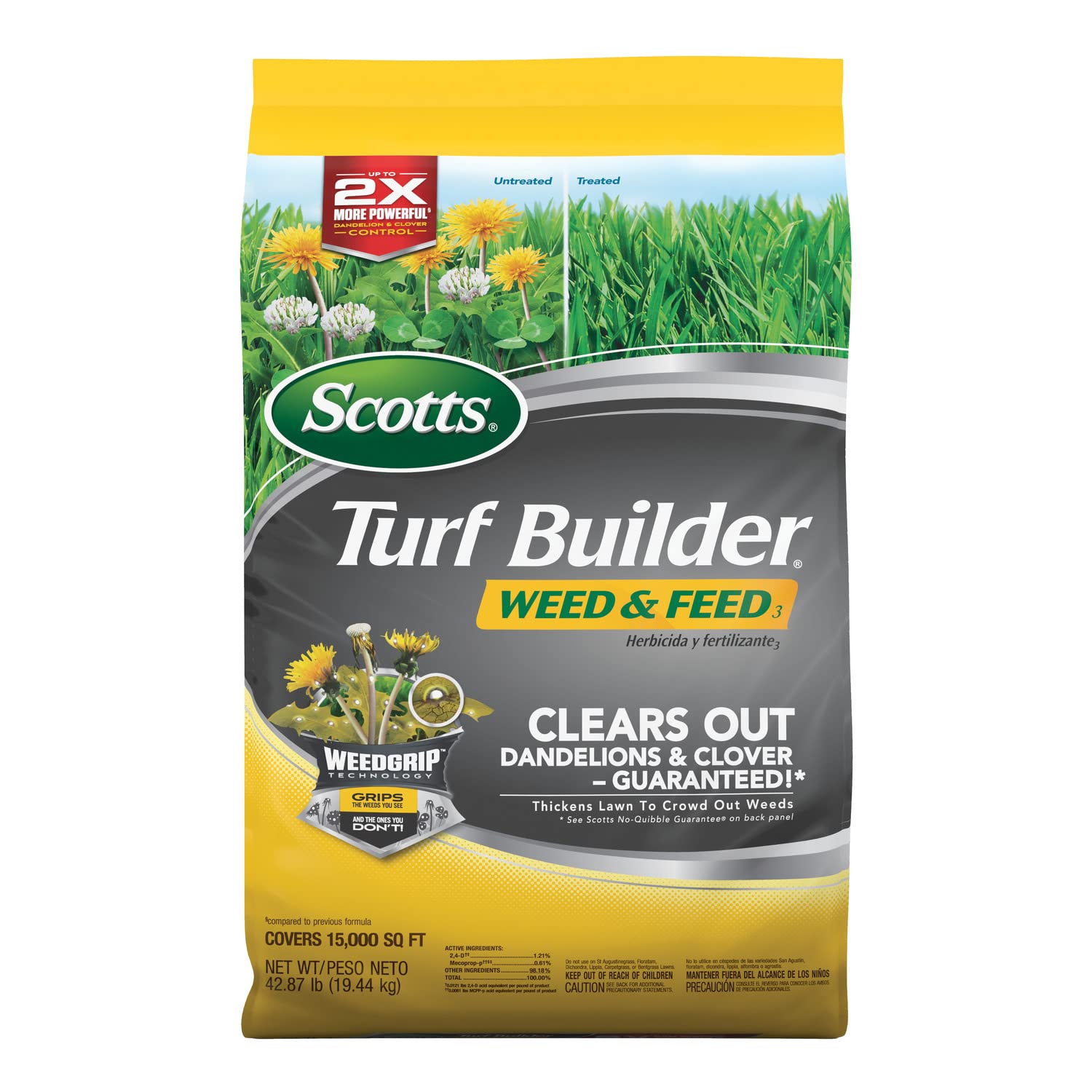
Scotts Turf Builder Weed & Feed3 Granular Lawn Fertilizer, 42.87 lb
| Item Form | Granule |
|---|---|
| Coverage | 15000 square_feet |
| Active Ingredients | 24-D Mecoprop-p |
Scotts Turf Builder Weed & Feed3 combines a broadleaf weed killer with granular fertilizer so you treat weeds and feed the lawn in a single application. It is applied with a broadcast or drop spreader when weeds are actively growing and temperatures are between 60 and 90°F; the product recommends applying to a wet lawn and avoiding watering for 24 hours afterward so the granules stick to weed leaves. The formula claims to control more than 50 weeds including dandelion and clover and to thicken turf by strengthening grass. Practical benefits include wide coverage from one 42.87 lb bag and clear application guidance for homeowners, including recommended spreader settings. Important limitations: it is not safe for several turf types (including St. Augustine and bentgrass), it requires specific weather and lawn moisture conditions for best effect, and it contains active herbicide ingredients that require keeping people and pets off treated areas until dust settles. For Bermuda grass specifically, check compatibility and follow label directions before applying.
Best for: Homeowners who want a straightforward, single-step product to reduce broadleaf weeds while feeding established warm-season lawns and who follow label directions carefully.
Less Ideal for: Do not choose this if you manage sensitive turf varieties, need a product that can be applied in wet or rainy conditions, or prefer non-chemical weed control methods.
- Combines weed control and fertilizer so you can treat and feed in one pass
- Large coverage up to 15,000 sq ft from a single bag
- WeedGrip technology formulated to stick to weed leaves for better control
- Clear application instructions and recommended spreader settings for consistent results
- Not labeled for use on several turf types including St. Augustine and bentgrass
- Requires specific temperature and moisture conditions and no rain for 24 hours after application
Verdict: Use this if you want a single granular product that treats common broadleaf weeds and feeds large lawns in one application.
Scotts Turf Builder Weed & Feed (14.29 lb)

| Item Form | Granule |
|---|---|
| Coverage | 5000 square_feet |
| Active Ingredients | 2,4-D 1.220%, Mecoprop 0.081% |
Scotts Turf Builder Weed & Feed is a granular lawn product that combines broadleaf weed control with lawn fertilizer so you can treat weeds and feed grass in a single application. It is applied with a broadcast or drop spreader to a wet lawn when daytime temperatures are between about 60°F and 90°F; particles stick to weed leaves to deliver active ingredients that target dandelion, clover and many other listed weeds while the fertilizer promotes thicker turf. The bag uses WeedGrip Technology for improved leaf contact and Scotts provides spreader settings for easier, repeatable application. Practical benefits include simplified seasonal maintenance and visible weed reduction within a few weeks, plus thicker grass that helps crowd out future weeds. Important limitations: do not use on several warm-season species such as St. Augustine and bentgrass, avoid application if rain is expected within 24 hours and restrict foot and pet traffic until dust settles. This product is formulated for homeowners who want a combined weed control and feeding step rather than separate treatments.
Best for: Homeowners who prefer a straightforward, single-step seasonal treatment to reduce broadleaf weeds and thicken warm-season turf and who value predictable, manufacturer-guided application.
Less Ideal for: Do not choose this if you maintain excluded grass species, need an all-season herbicide for every weed type, or prefer organic or non-chemical lawn care methods.
- Dual-action formula treats broadleaf weeds while fertilizing the lawn
- WeedGrip Technology helps granules adhere to weed leaves for effective control
- Covers about 5,000 sq. ft. per 14.29 lb. bag, suitable for small to medium yards
- Manufacturer-provided spreader settings simplify correct application
- Not safe for use on several turf types including St. Augustine and bentgrass
- Requires specific weather conditions and a 24-hour no-water waiting period after application
Verdict: A convenient single-bag solution for homeowners seeking reliable broadleaf weed control plus feeding to thicken lawns in a single application.
Choosing the Right Bermuda Weed and Feed: Key Factors to Consider
Herbicide Spectrum and Selectivity
Different weed-and-feed products contain herbicides that target either broadleaf weeds, grassy weeds, or both. For Bermuda lawns, selectivity matters because some herbicides that kill grassy weeds can also harm Bermuda if applied at the wrong rate or at sensitive growth stages. Understand which weeds are your primary problem. If broadleaf weeds dominate, a formula focused on broadleaf control with low turf stress is preferable. If grassy weeds like crabgrass are the issue, choose a product explicitly labeled for grassy-weed control on Bermuda turf.
Matching the herbicide spectrum to your weed profile reduces the need for repeat applications and minimizes collateral damage to desirable grass.
Fertilizer Analysis and Release Pattern
Fertilizer labels list the blend of nutrients and the percentage of slow- versus quick-release nitrogen. Bermuda responds well to steady feeding that supports dense, vigorous growth without sudden surges that increase mowing and disease risk. Slow-release nitrogen helps maintain color over several weeks and reduces the chance of burning when temperatures climb. High phosphorus content is usually unnecessary for established Bermuda and can be avoided unless a soil test shows deficiency.
Choose a formulation that fits your maintenance rhythm: quick-release for rapid green-up after dormancy or mechanical damage, slow-release for long-term maintenance and reduced application frequency.
Turf Safety and Timing
Bermuda grass has high heat tolerance but is susceptible to herbicide injury during active green-up or extreme heat stress. Pay attention to label guidance on optimum temperature windows for application and recommended wait times after aeration or irrigation. Applying weed-and-feed when the grass is stressed by drought, excessive heat, or recent herbicide exposure increases the risk of scorch or stunting.
Follow timing recommendations closely and avoid applications before predicted heat waves or heavy rainfall that could either burn turf or wash herbicide off target.
Application Equipment and Coverage
Even spread and correct calibration of broadcast spreaders or drop spreaders are essential to avoid streaking, missed areas, or overapplication. The product should include clear spreader settings and coverage estimates so you can match the bag rate to your equipment. Granular sizes and flow characteristics affect how evenly the product dispenses; some formulations flow reliably while others bridge in hoppers.
Invest time in calibrating your spreader on a flat surface and test on a small area if you are unsure. Proper application reduces risk of localized burning and ensures consistent turf response across the lawn.
Watering, Rainfastness, and Reseeding Considerations
Most weed-and-feed products require specific watering or irrigation windows after application to activate the herbicide and begin nutrient uptake. Labels vary on how long after application you must wait before irrigating and how long to avoid heavy rain to prevent runoff. If you plan to overseed or repair patches, check label restrictions for reseeding windows; some herbicides prevent safe seeding for weeks or months.
Coordinate feeding and weed control with your irrigation schedule and any planned turf renovations to avoid delaying repairs or causing seedling injury.
Storage Stability and Packaging
Granular products should store well in a dry, cool place because moisture can cause caking and uneven flow. Packaging that reseals or has a moisture barrier preserves product performance season to season. Consider how much lawn you have; buying a larger bag can be economical but only if you can store it properly.
Good storage practices maintain spreader flow characteristics and ensure the fertilizer component remains effective when you need it next season.
When to Apply Weed and Feed on Bermuda Lawns
Timing depends on your climate and the weeds you want to control. For spring grassy weed control, apply after the soil consistently reaches the warm temperatures that trigger Bermuda green-up but before crabgrass flushes. For broadleaf weed control, late spring to early summer when weeds are actively growing often gives the best results.
Avoid applying during heatwaves or drought stress. A light irrigation the day before application can help the turf recover and reduce scorch risk, but follow label watering instructions after applying to activate herbicides without causing runoff.
- Apply in early active growth phases rather than dormancy.
- Avoid application when temperatures exceed label-recommended limits.
- Coordinate with irrigation to meet rainfastness windows.
Preparing Your Lawn Before Application
Mow to the recommended height and remove debris so granules reach the canopy and soil surface evenly. Mark sprinkler heads and areas that need different rates, and repair bare spots before applying to avoid unnecessary herbicide contact with exposed soil.
Calibrate your spreader with the specific bag settings. Walk a small test strip to check for even distribution before treating the entire lawn.
- Mow slightly shorter than normal but avoid scalping.
- Clear fallen leaves and thatch buildup where granules might sit.
- Use a spreader test to confirm coverage rates.
Safety and Environmental Best Practices
Follow label directions for protective gear, and avoid applying near water features, storm drains, or on steep slopes where runoff risk is high. Keep children and pets off treated areas until the product is dry or past the re-entry interval stated on the label.
Consider integrated practices like spot-treating high weed pressure areas and using mechanical control for small infestations to reduce overall chemical use. Proper application and timing reduce the chance of off-target effects and protect pollinators when they are active.
- Do not apply before heavy rain to prevent runoff.
- Store leftover product in a dry, secure place away from pets and livestock.
- Wear gloves and avoid inhaling dust when loading spreaders.
Managing Expectations After Application
Weed decline is not always immediate. Broadleaf weeds often show yellowing within days and substantial dieback in one to three weeks, while tough perennial weeds may require multiple seasons of management. Turf response to fertilizer can be seen within a week but full recovery of thin areas may take several watering and mowing cycles.
If weeds persist, reassess timing and consider whether the herbicide spectrum matched the species present. Avoid repeated full-lawn applications in a single season unless the label permits and conditions warrant it.
- Expect gradual improvement over weeks rather than overnight eradication.
- Recheck treated sites before considering additional applications.
- Combine proper mowing and watering to support treated turf.
How We Chose the Best Bermuda Weed and Feed
We prioritized products that balance safe, effective weed control with turf nutrition tailored to Bermuda grass. Evaluation focused on herbicide spectrum, fertilizer formula and release type, turf safety and burn risk under heat, and ease of use at typical homeowner application rates. We also considered formulation durability in storage and labeling clarity that helps gardeners apply the product correctly. Exclusions included products not labeled specifically for Bermuda grass or those intended only for professional use. The final list emphasizes options that limit nonselective herbicides, offer measured nitrogen release patterns, and provide clear timing windows for seeding or overseeding. Practical handling and clear coverage estimates were also part of the selection filters to reflect common backyard application conditions.
FAQ
Can I apply weed and feed while overseeding Bermuda?
Usually you should avoid applying weed-and-feed during overseeding because many herbicides prevent seed germination. Check the product label for specific wait periods before seeding; some require several weeks to months. If you need to seed, plan feeding and weed control as separate steps.
Will weed and feed burn my Bermuda lawn?
It can if applied during heat stress, at rates above label recommendations, or on recently aerated or damaged turf. Use the correct spreader setting, follow timing guidance, and avoid use during drought or extreme heat to minimize burn risk.
How often can I apply weed and feed to Bermuda?
Frequency depends on the product formulation and label limits. Many homeowner products are intended for one to three applications per year. Repeated applications beyond label directions increase the risk of turf damage and environmental runoff, so follow label intervals.
Is spot treatment better than full-lawn applications?
Spot treating dense patches of weeds reduces chemical use and limits turf exposure. For scattered infestations, spot treatment with a targeted herbicide or manual removal combined with localized fertilization can be as effective as full-lawn treatment and is often more environmentally cautious.
What should I do if it rains immediately after application?
If heavy rain occurs shortly after application it can wash product away, reducing effectiveness and potentially causing runoff. Check label rainfast guidance; if the product was washed off, you may need to reapply at the recommended interval, keeping environmental precautions in mind.
Can I use weed and feed on newly installed Bermuda sod?
New sod is sensitive; most labels advise waiting until the turf is well rooted and has been mowed several times before applying weed-and-feed. Follow the establishment care guidance to avoid stressing the new sod with herbicides or high fertilizer rates.
Final Verdict
Choose a Bermuda weed-and-feed that matches your weed problems, fits your seasonal timing, and uses a fertilizer release pattern that aligns with your maintenance routine. Prioritize products labeled safe for Bermuda, with clear spreader settings and watering instructions. Balance the desire for quick green-up against the risk of turf stress by favoring slow-release nitrogen for regular maintenance and reserving quick-release formulas for targeted recovery. With correct timing, careful application, and reasonable expectations about how quickly weeds decline, you can improve turf density while keeping Bermuda healthy.
