

Note: This article contains affiliate links. If you click on these links and make a purchase, I may earn a small commission at no extra cost to you. This helps support my research and content. Read my full affiliate disclosure here.
Horse flies are persistent pests that stress animals, spread disease, and make turnout time miserable. Picking the right bug spray matters because effectiveness, safety around animals, and how long protection lasts directly affect horse comfort and health. This guide brings together seven top bug spray options for horse flies suitable for barn, pasture, and trail use. We shortlisted products that show reliable repellency, are practical to apply, and fit common stable routines. Below you will find the selection rationale and the decision criteria used to evaluate each option, followed by practical advice for applying sprays and keeping flies down across seasons.
Top Picks at a Glance
| Best Overall The best all-around choice for most situations | Farnam Tri-Tec 14 Fly Repellent for Horses, 32 oz |  |
| Best Quality Built to a higher standard if you want something more solid | Farnam Endure Gold Fly Spray for Horses, 32 oz |  |
| Best Value The sweet spot between price and what you get | Farnam Repel-X pe Concentrated Fly Spray for Horses & Dogs, 16 oz |  |
| Best Budget The cheapest option that still gets the job done reliably | Farnam Roll-On Fly Repellent for Horses, Ponies and Dogs, 2 oz |  |
| Highest Rated A top-rated pick with lots of positive feedback | Tack Shack of Ocala Pyranha Wipe N' Spray Fly Spray for Horses, Gallon |  |
| Most Popular A crowd favorite that many people choose with confidence | Farnam Repel-X Ready-to-Use Fly Spray for Horses, 32 fl oz |  |
| Best Seller A high-volume bestseller chosen again and again | Absorbine UltraShield EX Insecticide & Repellent, 32 fl oz Sprayer |  |
Farnam Tri-Tec 14 Fly Repellent for Horses, 32 oz

| Unit Count | 32 Fluid Ounces |
|---|---|
| Item Form | Liquid |
| Scent Name | Pleasant |
| Target Species | Equine |
| Active Ingredients | Permethrin/Cypermethrin, Pyrethrins, Piperonyl Butoxide |
Farnam Tri-Tec 14 is a concentrated, water-based fly repellent formulated to control horse flies, stable and house flies, gnats, mosquitoes, lice and deer ticks. It is applied by spray or wipe over a clean, dry coat and is designed for liberal coverage so the active ingredients can build residual protection. Notable features include multiple active insecticides for quick knockdown, conditioners that leave a non-greasy shine, and guidance to reapply every 5 to 7 days initially and every 10 to 14 days once protection builds. In practice this makes Tri-Tec 14 a solid choice for busy horse owners who need longer-lasting control between treatments and who want a product that holds up through sweat and light moisture. Limitations to expect are that it contains synthetic insecticides and requires careful application around the face and sensitive areas, plus reapplication after heavy rain or washing. Follow label directions closely for safe and effective use.
Best for: Horse owners who want dependable, longer-lasting fly control between grooming sessions and value a product that combines knockdown with residual protection.
Less Ideal for: Owners looking for an all-natural or pesticide-free fly control should consider non-chemical alternatives or spot treatments instead.
- Multiple active ingredients provide fast knockdown and multi-species control
- Residual protection that can last up to 14 days as directed
- Water-based, non-greasy formula with coat conditioners for a healthy shine
- Can be applied as a spray or wiped on for sensitive areas like the face
- Contains synthetic insecticides so must be applied according to label and handled carefully
- Requires reapplication after heavy rain, washing, or as protection diminishes
Verdict: Choose Tri-Tec 14 when you need fast knockdown plus multi-week residual protection to keep flies off working horses.
Farnam Endure Gold Fly Spray for Horses, 32 oz

| Unit Count | 32 Fluid Ounces |
|---|---|
| Item Form | Liquid |
| Scent Name | Citronella |
| Active Ingredients | Etofenprox (plus acetamiprid, pyrethrins) |
Farnam Endure Gold is formulated for horse owners who need fast, long-lasting insect control. It is a liquid spray powered by multiple actives including acetamiprid and etofenprox to kill and repel horn, face, stable, house and black flies as well as midges, mosquitoes and ticks. In practice you brush a clean, dry coat and spray the horse, where the formula is designed to deliver knockdown within minutes and carry residual protection for days so it stands up to heat, sweat, and turnout. Notable features are the multi-ingredient blend aimed at resistant flies, the non-oily finish, and labeled protection claims up to 14 days with hours of active repellency after application. That performance focus makes it suited to stables, show barns, and working animals that need reliable coverage between treatments. Important limitations are the safety precautions: avoid use on very young foals, keep away from eyes and open flame, and follow ventilation and handling directions because it contains concentrated insecticides that require careful application.
Best for: Buyers who prioritize professional-grade, long-duration fly control for stabled or working horses and need a spray that maintains performance through heat and turnout.
Less Ideal for: Owners who prefer all-natural or non-chemical repellents or who only need occasional, light protection for pastured hobby horses.
- Multi-ingredient formula targets a broad spectrum of biting flies and ticks
- Fast knockdown with claimed residual control up to 14 days
- Non-oily finish that performs through heat, sweat, and turnout
- Contains multiple insecticides and requires careful handling and ventilation due to irritation and flammability risk
- Not suitable for foals under 12 weeks and requires avoiding contact with eyes and mucous membranes
Verdict: Choose this spray when you need fast-acting, professional-strength fly and tick control with long-lasting residual protection.
Farnam Repel-X pe Concentrated Fly Spray for Horses & Dogs, 16 oz

| Package size | 16 fl oz |
|---|---|
| Active ingredients | Prallethrin 0.27%, Piperonyl Butoxide 1% |
| Intended uses | Horses, dogs, stalls, barns, pastures |
| Dilution guidance | 1:7 for general pests; 1:4 for horse flies and ticks |
Farnam Repel-X pe is a liquid concentrate designed for barn and pasture insect control that you dilute with water to make a ready-to-use spray for animals and surroundings. Typical use is mixing the recommended dilution in a pressure sprayer or hand sprayer, then applying to the animal's coat or using it around stalls and corrals; it can also be sponged on for targeted coverage. The product's active ingredients include prallethrin and piperonyl butoxide and the formula contains permethrin-class chemistry that kills on contact and helps repel horn flies, house flies, stable flies, gnats, mosquitoes, ticks, and lice. Practical benefits are concentrated dosing that yields multiple quarts of finished spray from a single bottle, versatile application options for animals and barn areas, and straightforward reapplication every 3 to 4 days for ongoing control. Important limitations are the need to mix fresh solution before each use, care required to avoid eye or mucous membrane contact for people and animals, and contraindications for very young foals without veterinary approval.
Best for: Buyers who want a cost-effective, concentrate-based fly control solution to manage insects on multiple horses and around a barn and who are comfortable mixing and applying a diluted spray regularly.
Less Ideal for: People who prefer ready-to-use aerosols or who need an insect product for very young foals without veterinary guidance should consider alternatives.
- Concentrated formula lets you make multiple quarts of ready-to-use spray from one bottle
- Effective broad-spectrum activity against flies, mosquitoes, ticks, gnats, and lice
- Can be applied to animals or used as a perimeter/stall spray for flexible barn use
- Works with pressure sprayers or can be sponged on for full-body coverage
- Requires correct dilution and fresh mixing before each use
- Contains insecticidal ingredients that can irritate eyes and mucous membranes
Verdict: If you want a flexible, concentrated barn and horse fly control you can mix to cover multiple animals and areas, this concentrate delivers broad-spectrum knockdown and repellent action.
Farnam Roll-On Fly Repellent for Horses, Ponies and Dogs, 2 oz

| Unit Count | 2 Fluid Ounces |
|---|---|
| Item Form | Liquid |
| Pet Type | Horse |
| Active Ingredients | N-Octyl Bicycloheptene Dicarboximide |
The Farnam Roll-On Fly Repellent is a small, targeted applicator designed to keep house, stable, face and horn flies off sensitive areas like the nose, eyes, ears and wounds. The roller-ball makes spot treatment easy and relatively mess-free compared with sprays, so you can apply it precisely where animals need protection without saturating their coat. It is useful for quick touch-ups in the barn, stall or on the trail and is labeled for both equine and canine use with specific reapplication guidance for dogs. The formula contains common insecticidal actives and must be used per directions to avoid eyes, mouth and open wounds and to respect the maximum daily and per-application limits. Practical benefits include portability, controlled dosing and suitability for targeted protection around faces where sprays are awkward. Limitations are its small 2 fl oz size which means frequent repurchase for multi-animal use and the need to avoid broad coverage since it is intended for spot treatment rather than whole-body protection.
Best for: Buyers who want an inexpensive, easy-to-use spot repellent for protecting faces and small areas on dogs or horses and prefer controlled application over broad sprays.
Less Ideal for: Owners seeking full-body or long-duration protection for many animals or wide pasture use should consider sprays, feed-through products, or larger-volume solutions instead.
- Roller-ball applicator allows precise, mess-free spot treatment around sensitive areas
- Labeled for use on both horses and dogs for face and wound protection
- Small, portable 2 fl oz bottle is convenient for barn, stall or trail use
- Small bottle size means it will need frequent replacement for multiple animals
- Not intended for whole-body application so it does not replace spray or systemic controls
Verdict: A compact, budget-friendly roll-on that gives precise fly protection for faces and small trouble spots on dogs and horses.
Tack Shack of Ocala Pyranha Wipe N' Spray Fly Spray for Horses, Gallon

| Unit Count | 32 Fluid Ounces |
|---|---|
| Item Form | Liquid |
| Scent Name | unscented |
| Active Ingredients | Geraniol, Clove Oil, Peppermint Oil |
Tack Shack of Ocala Pyranha Wipe N' Spray is a gallon-sized, ready-to-use fly spray designed for routine stable use and show prep. It is applied directly to a clean, groomed coat and can be used with a wipe or sprayer; the manufacturer notes effective protection from roughly 2 ounces per head for typical coverage. The formula combines pyrethrum with citronella and lanolin, which both repels insects and helps leave a glossy finish when the coat is brushed out. Practical benefits include broad-spectrum control of biting flies, mosquitoes, and gnats and a conditioner effect that improves appearance for turnout or shows. Users should shake well before use because the product contains oils that can separate, and the pyrethrum base means it is an insecticidal formulation rather than a purely natural repellent. For routine daily applications it is convenient and concentrated in a gallon size, but handlers should follow label directions and avoid use on animals with known sensitivity to pyrethrins or essential oils.
Best for: Buyers who prioritize dependable, barn-ready pest control and want a product that also improves coat appearance for regular turnout or show preparation.
Less Ideal for: Owners seeking an all-natural non-insecticidal repellent or those with horses known to react to pyrethrins or concentrated essential oil blends should consider gentler alternatives.
- Ready-to-use pyrethrum-based formula that kills and repels common biting pests
- Contains lanolin to condition coat and leave a visible shine
- Large gallon size suitable for regular barn use or multiple horses
- Effective at low per-horse usage (about 2 ounces) for routine protection
- Contains pyrethrum and essential oils which can cause sensitivity in some horses
- Oils in the formula may separate and require vigorous shaking before use
Verdict: Choose this gallon-ready Pyranha spray when you need a reliably effective, coat-conditioning fly control for regular barn use.
Farnam Repel-X Ready-to-Use Fly Spray for Horses, 32 fl oz

| Item Volume | 32 fluid ounces |
|---|---|
| Item Form | Liquid |
| Target Species | Equine |
| Scent Name | Pleasant |
Farnam Repel-X Ready-to-Use Fly Spray is a full-body equine insect spray designed for everyday use in stalls, pastures and before rides. The trigger-spray bottle delivers a non-oily liquid you can mist over the coat or apply with a sponge to legs, belly, neck and other problem areas; the label recommends reapplying every three to four days during peak season or as needed. Its formula contains pyrethrins, piperonyl butoxide and permethrin, so the product both kills flies on contact and helps repel biting insects for short-term protection. Practical benefits include a convenient ready-to-use format with clear directions for spray or wipe-on application and suitability for use around horses, dogs and barn areas. Important limitations are that it is an insecticide with active chemicals, so label precautions must be followed and it should not be used on foals under three months; some users may prefer pump-free or purely natural alternatives. For consistent fly control combine with barn management measures for best results.
Best for: Buyers who want a dependable, easy-to-apply chemical fly control for horses and barn areas and who prioritize proven effectiveness backed by widespread user adoption.
Less Ideal for: Owners seeking an all-natural or scent-free solution or those who prefer to avoid synthetic insecticides should consider alternative products.
- Ready-to-use spray bottle is convenient for quick application before turnout or riding
- Formula both kills on contact and helps repel flies, mosquitoes, gnats and ticks
- Directions support spray or wipe-on use for targeted application to legs, belly and face areas
- Suitable for use on horses, dogs and around stalls, barns and corrals
- Contains insecticidal actives so careful handling and label compliance are required
- Not suitable for foals under three months of age
Verdict: A convenient ready-to-use spray that reliably kills and repels flies and other biting pests for everyday equine fly control.
Absorbine UltraShield EX Insecticide & Repellent, 32 fl oz Sprayer
| Unit Count | 32 Fluid Ounces |
|---|---|
| Item Form | Liquid |
| Scent Name | Unscented |
| Active Ingredients | Pyrethrins |
| Recommended Uses For Product | Fly Control |
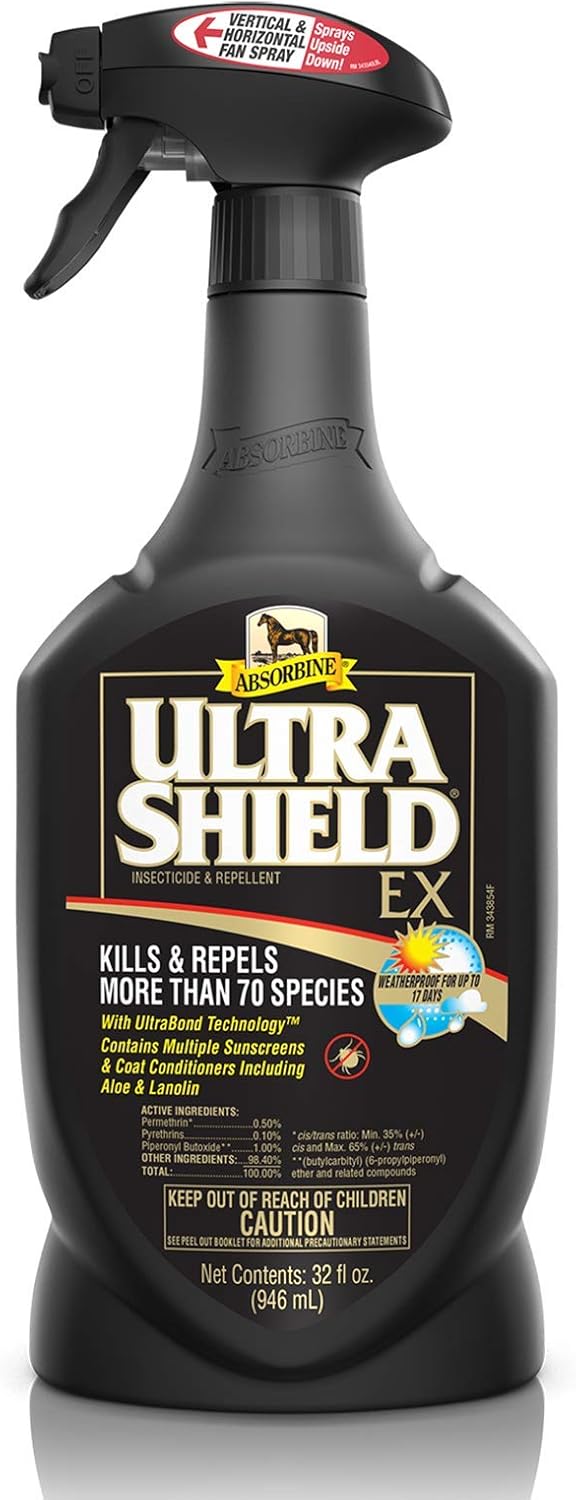
Absorbine UltraShield EX is a 32-ounce, ready-to-use spray designed for broad insect control around horses, barns, and outdoor areas. The water-based formula combines pyrethrins, piperonyl butoxide, and permethrin to kill and repel more than 70 species of pests while leaving no greasy residue. It is applied directly to animal coats or used as a premise spray and is intended to stick to hair and surfaces when applied to a clean coat. Notable features include weatherproof UltraBond Technology that can extend protection up to 17 days in some conditions and added sunscreens and coat conditioners for UV and coat care. Practical benefits are straightforward: no mixing, multi-species control including ticks, and suitability for spot-treating stalls, doorways, and tack areas as well as animals. Important limitations are that the product label emphasizes use on horses and premises and that some ingredients are insecticides requiring careful adherence to safety directions; it is not universally approved for all species and users should follow label precautions for application frequency and treated animals.
Best for: Buyers who prioritize robust, long-lasting insect control for horses, stalls, and outdoor areas and want a ready-to-use spray that reduces reapplication frequency.
Less Ideal for: Owners exclusively seeking a dog-specific repellent or those who prefer natural, non-pyrethroid formulations should consider alternatives tailored to dogs or gentler ingredient lists.
- Ready-to-use water-based formula requires no mixing and leaves little to no greasy residue
- EPA-approved actives that kill and repel over 70 insect species including ticks
- UltraBond Technology offers weatherproof protection that can last up to 17 days in some conditions
- Contains sunscreens and coat conditioners to help protect and maintain animal coats
- Label and ingredient profile require careful reading and safety precautions during application
- Primary registration and marketing focus is on horses and premises which limits direct claims for other pets
Verdict: Choose UltraShield EX if you need a ready-to-use, performance-oriented spray that kills and repels a wide range of pests and provides long-lasting protection for horses and outdoor areas.
Choosing the Right Bug Spray for Horse Flies: Key Factors to Consider
Repellency Active Ingredients
What the spray contains determines how well horse flies are deterred. Some ingredients provide quick knockdown but short-lived protection while others give steady repellency over hours. Understand whether the active components are contact insecticides that kill on touch, repellents that discourage landing, or formulations that combine both.
Knowing the active ingredient also helps match a product to seasonal pressure. High fly-density days may call for stronger, longer-lasting actives, while low-pressure times might be managed with gentler options. Look for clear labeling about target species and expected efficacy window so you can plan reapplication intervals.
Duration Between Applications
Duration governs how often you need to reapply spray during turnout or riding. Some sprays claim multiple hours of protection; others require reapplication after sweating, rain, or several hours of exposure. Longer duration reduces labor and disturbance to animals, but may come from stronger chemistries that need extra safety consideration.
Evaluate the typical conditions where you ride and turnout. If horses sweat heavily or you frequently ride in humid conditions, choose sprays with adherence or formulations designed to resist quick loss. Always follow label instructions for how environmental factors affect longevity.
Safety For Horses And People
Safety includes skin irritation potential, respiratory effects for handlers, and whether the product is safe around wounds, eyes, and muzzles. Some effective actives can be harsh on sensitive skin or cause allergic reactions in certain animals. Consider whether the product is labeled for use on foals, lactating mares, or animals with compromised skin.
Application method influences exposure too; aerosols can disperse into handlers' lungs, whereas targeted pump sprays or wipes reduce airborne exposure. Read safety notes about ventilation, protective gear for handlers, and withholding times before riding or turnout when the spray is wet.
Compatibility With Tack And Coats
Sprays can leave residues that stain or stiffen leather, discolor show coats, or attract dust. If you treat saddles, bridles, or blankets inadvertently, you risk damaging expensive equipment. Synthetic tack may react differently than leather, and white or light coats show stains more readily.
Test sprays on a small area of tack or an inconspicuous patch of hair before broad application. Look for formulations advertised as non-staining or tack-safe if you need to apply near gear. Consider wipe-on options for precision application around contact points.
Ease Of Application And Coverage
How you apply spray affects coverage and convenience in a barn. Aerosols offer fast broad coverage but can be wasteful and aerosolize particles into the air. Pump sprayers give control and conserve product but may require more time. Wipes and gels allow targeted application to faces, ears, and other sensitive areas without overspray.
Think about whether you usually treat multiple horses in sequence or only a single mount. For many horses, faster delivery methods save time, while for sensitive or skittish animals, quieter and more controlled application reduces stress.
Environmental Persistence And Non-Target Effects
Some active ingredients persist in the environment and can affect beneficial insects like pollinators or aquatic life if runoff reaches ponds. While reducing horse fly numbers is the goal, consider how the spray behaves in pasture settings and whether it should be kept away from flowering plants or water sources.
Choose products with clear guidance on environmental precautions. For paddocks near streams or with heavy flowering plants, opt for targeted application and avoid broad spraying of forage areas to minimize non-target impact.
Application Tips For Sensitive Areas
The face, around the eyes, ears, and muzzle are both high-target areas for horse flies and high-risk for irritation. Use a low-pressure pump sprayer or wipe-on format for these zones to avoid aerosol drift into eyes and nostrils.
Apply sparingly and rub in gently with a soft cloth when label instructions allow. For particularly sensitive horses, apply to a cloth first and then dab the skin rather than spraying directly. Allow treated areas to dry before turnout to minimize ingestion from grooming.
- Avoid direct sprays into eyes, nose, or mouth.
- Use a cloth barrier for delicate skin and muzzles.
- Reapply after heavy sweating or rain as directed.
Managing Fly Pressure In Pastures
Controlling horse flies in turnout areas requires an integrated approach. Sprays are one tool among others like manure management, fans in stabling areas, and targeted removal of standing water where flies breed.
Rotate where you apply sprays in the pasture and limit broad spraying of forage to protect pollinators. Consider treating horses before turnout rather than spraying large pasture areas for a more focused and environmentally conscious strategy.
- Keep manure cleaned and composted away from turnout.
- Use physical barriers such as fly sheets and masks during peak hours.
- Schedule treatments for early morning or evening when horse flies are most active.
How Weather Affects Protection
Heat, humidity, rain, and sweating all reduce how long a spray remains effective. Heavy rain can wash off topical products, and sweaty animals lose protection faster. Choose formulations designed to resist loss from moisture if you expect wet conditions.
On very hot days expect faster evaporation and reduced residence time on hair and skin. Plan reapplication intervals around weather forecasts and stable routines to maintain protection during peak fly activity periods.
- Reapply after rain or vigorous exercise.
- Store products as directed to preserve active ingredient stability.
- Avoid applying in direct midday sun if label warns of photoreactivity.
Integrating Sprays With Physical Barriers
Bug sprays work best when paired with fly sheets, masks, and stable fans. Physical barriers reduce landing rates and the need for frequent reapplication. Use sprays to protect exposed areas while relying on sheets for broader coverage.
Match spray type to barrier use. For example, avoid sprays that leave sticky residues under sheets that could trap dirt and irritate skin. When using both, allow sprays to dry fully before placing sheets or blankets.
- Coordinate timing so sprays dry before applying fly gear.
- Choose non-staining, non-sticky formulations when using cloth barriers.
- Check under sheets daily for trapped moisture or residue buildup.
Treating Multiple Horses Efficiently
If you manage several horses, choose an application method that balances speed and control. A large pump sprayer or a battery-powered sprayer can speed treatment but watch for overapplication. Allocate two people for nervous horses to reduce stress and speed the process.
Label and store applicators separately for medicated versus cosmetic use to avoid cross-contamination. Keep a rinse bucket handy for accidental eye exposure or skin splashes and follow label first-aid guidance.
- Work from calm to nervous horses to keep the group relaxed.
- Use color-coded cloths or applicators to prevent mixing products.
- Maintain an application log for reapplication schedules during peak season.
How We Chose the Best Bug Spray for Horse Flies
We focused on factors that matter to people managing horses in barns, pastures, and during turnout. Editorial filters prioritized repellency against horse flies specifically, duration of protection between applications, and safety for skin, mucous membranes, and common tack materials. Ease of application in a stable setting, whether a pump sprayer, aerosol, or sponge-on format, was included to reflect busy routines. Residue and material-compatibility tests were considered to avoid damage to leather and synthetic tack. We excluded products formulated only for indoor household pests or those lacking clear animal-safety labeling. We also filtered out options with impractical application methods for equine use, such as tiny personal-size sprays that do not cover a riding horse. Final inclusion required clear labeling for use on or around horses and evidence-manufacturer claims or lab summaries-of repellency or insecticidal action against blood-feeding flies. The criteria we used are reflected in the scorecard metrics: repellency strength, duration of protection, animal safety, ease of application, and tack/material compatibility. Together these filters identify sprays that perform in real stable and turnout situations without introducing avoidable risks.
FAQ
How often should I reapply bug spray for horse flies?
Reapplication depends on the product and conditions. Many sprays need reapplication every few hours under heavy fly pressure or after rain and heavy sweating. Follow label directions and reapply more frequently when horses are wet or when fly activity is high.
Are there sprays safe for foals and pregnant mares?
Some formulations are labeled safe for foals and breeding animals, but safety varies. Always check the product label for age and reproductive warnings. When in doubt, choose products with explicit foal and pregnant-mare approvals or consult a veterinarian.
Can I use human insect repellent on horses?
Human repellents are generally not formulated for animals and can pose risks. They may contain concentrations or solvents unsuitable for horses. Use products specifically labeled for equine use to ensure proper safety and effectiveness.
Will bug spray stain my horse's coat or tack?
Some sprays can leave visible residue that attracts dust or alters coat sheen, and others may affect leather or synthetic tack. Test a small area of coat and a hidden piece of tack first. Choose non-staining formulations when treating near show coats or light-colored gear.
Can sprays harm beneficial insects or the environment?
Yes. Broad spraying of pastures can affect pollinators and aquatic life if runoff occurs. Use targeted application on animals rather than forage, avoid spraying flowering plants, and follow environmental precautions on the label to minimize non-target impacts.
What's the best way to apply spray around the head and ears?
Use a wipe-on product or apply spray to a cloth before dabbing sensitive areas around the eyes, ears, and muzzle. This reduces the risk of inhalation or splashing into eyes. Work calmly and allow treated areas to dry before turnout.
Final Verdict
Prioritize sprays that balance proven repellency against horse flies with practical safety and material compatibility for barn life. Decide which tradeoffs matter most to you: longer protection reduces reapplication but may require stricter safety handling, while gentler formulations need more frequent use but lower irritation risk. Match application method to your routine and tack setup, and combine sprays with physical barriers and good pasture management for the best results. Choose a product with clear labeling for equine use and follow instructions to keep horses comfortable and protected.
