

Note: This article contains affiliate links. If you click on these links and make a purchase, I may earn a small commission at no extra cost to you. This helps support my research and content. Read my full affiliate disclosure here.
Paw paw trees have specific nutrient needs during establishment and fruiting seasons, and the wrong fertilizer can slow growth or reduce fruit quality. In this guide you will find six carefully shortlisted fertilizer options chosen for paw paw trees, with attention to how each product behaves in soil, how it affects roots and canopy, and the timing gardeners should follow. We evaluate candidates on concrete gardener-focused criteria such as nutrient balance and soil impact, plus ease of application and long-term effects. Read on to see which types of fertilizers suit young transplants, established specimens, or container-grown paw paws before the product list below.
Top Picks at a Glance
| Best Overall The best all-around choice for most situations | Dr. Earth Natural Wonder Fruit Tree Fertilizer, 4 lb |  |
| Best Quality Built to a higher standard if you want something more solid | Espoma Organic Tree-Tone 6-3-2 Organic Tree Fertilizer, 36 lb bag |  |
| Best Value The sweet spot between price and what you get | Southern Ag All Purpose Granular Fertilizer 10-10-10 (5 lb) |  |
| Best Budget The cheapest option that still gets the job done reliably | Jobe's Organics Granular Fruit & Citrus Fertilizer, 4 lb |  |
| Highest Rated A top-rated pick with lots of positive feedback | Pro Trust Products Plant, Tree & Shrub Fertilizer 21-5-12 (Granules) |  |
| Most Popular A crowd favorite that many people choose with confidence | Miracle-Gro Shake 'N Feed Flowering Trees & Shrubs Plant Food, 8 lb. |  |
Dr. Earth Natural Wonder Fruit Tree Fertilizer, 4 lb

| Item Form | Powder |
|---|---|
| Specific Uses For Product | Organic |
| Target Species | fruit trees & berries |
| Mixing Ratio | 2 tablespoons per gallon or 1/2 cup per cubic foot |
Dr. Earth Natural Wonder is an organic powdered fertilizer designed to feed fruit trees, berries, and fruiting vines both in the ground and in containers. It supplies a balanced 5-5-2 NPK and is intended for use at planting or as a regular feed during the growing season, with directions for 1 lb per 10 square feet or periodic container applications every six weeks. The formula is certified organic and non-GMO, so it suits gardeners who prefer sustainable inputs and want a product labeled safe around people and pets when used as directed. Practical benefits include easy spreading or mixing into potting soil, the ability to make compost tea for a soil drench or foliar spray, and a coverage claim that a 4 lb bag will feed multiple containers or a modest planting area. Limitations are typical of dry organic fertilizers: nutrient release is slower than synthetic feeds and you may need repeat applications for heavy-feeding or large trees, and precise results depend on timing, soil biology, and correct application rates.
Best for: Gardeners looking for an all-purpose, organic feed for fig trees who prioritize balanced nutrition and sustainable inputs over rapid synthetic gains.
Less Ideal for: Growers who need very fast, targeted nutrient correction or those managing large mature trees that require high-dose applications may prefer a concentrated synthetic or professional program.
- Balanced 5-5-2 NPK suitable for general fruit tree nutrition
- Certified organic and non-GMO for sustainable gardening
- Versatile use in-ground, in containers, or as compost tea
- Clear application guidance for planting area and containers
- Slower nutrient release compared with synthetic fertilizers, so more frequent applications may be needed for quick growth
Verdict: A balanced organic fertilizer that makes a reliable, sustainable baseline feed for fig trees in pots or backyard beds.
Espoma Organic Tree-Tone 6-3-2 Organic Tree Fertilizer, 36 lb bag

| Item Form | Granules |
|---|---|
| Application Method | Granular spreading |
| Target Species | trees |
| Mixing Ratio | 1:0 |
Espoma Tree-Tone is a granular, ready-to-use organic fertilizer designed specifically for trees. You apply it by spreading around the root zone in spring and fall; because it is granular and contains natural ingredients plus a Bio-tone formula, it feeds gradually and improves soil biology rather than giving a sharp quick flush. The 6-3-2 NPK with 5% calcium suits long-term health for woody trees, helping root development and reducing nutrient shocks common with high-nitrogen synthetics. It is labeled for use on shade, fruit, and ornamental trees and is approved for organic gardening, which matters if you want to avoid synthetic inputs. Limitations are that the feed is medium coverage and slower acting, so it is not the best choice when a quick green-up is needed, and a 36 lb bag is comparatively heavy to handle for a single-use application. For performance-minded tree care, it favors steady, soil-building results over instant growth spurts.
Best for: Buyers who prioritize long-term tree health and soil-building for live oaks and other shade trees and who prefer organic, steady-release nutrition over fast-acting synthetics.
Less Ideal for: Gardeners who need a rapid foliage green-up or smaller-quantity, lightweight packaging for spot treatments should consider faster-acting or smaller-format products.
- Organic, natural ingredients that support soil biology and are approved for organic gardening
- Balanced 6-3-2 NPK with added calcium to support woody tree health and root development
- Ready-to-use granular form requires no mixing and is simple to apply around the root zone
- Medium coverage and slow-release action mean results appear gradually rather than immediately
- Large 36 lb bag can be cumbersome for single-person application
Verdict: Choose Espoma Tree-Tone when you want an organic, steady-release fertilizer that builds soil health and supports long-term vigor in live oak and other shade trees.
Southern Ag All Purpose Granular Fertilizer 10-10-10 (5 lb)
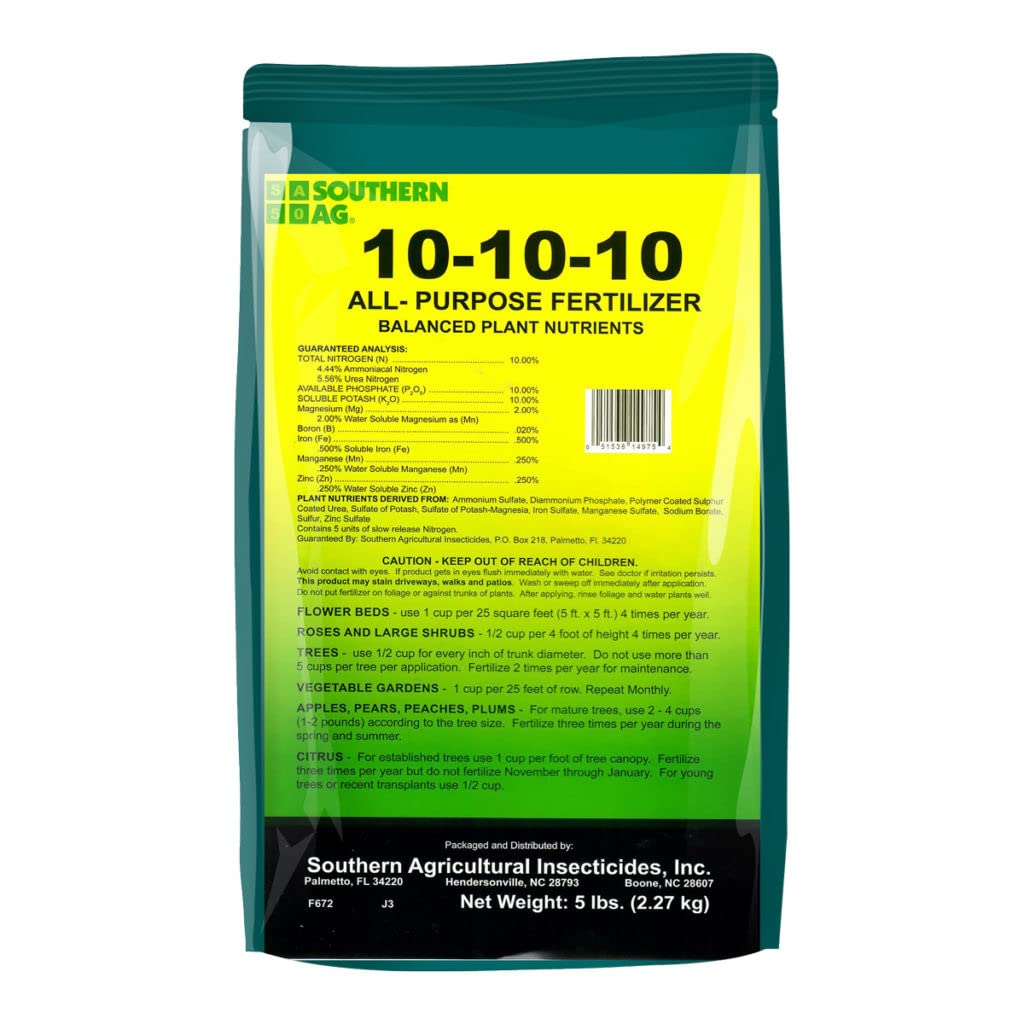
| Item Form | Granules |
|---|---|
| Specific Uses For Product | Citrus and Fruit Trees, Flowerbeds, Roses, and Large Shrubs, Vegetable Gardens |
| Application Method | Broadcast evenly over area and water in. |
| Mixing Ratio | 10:10:10 |
This 5 lb bag of Southern Ag 10-10-10 granular fertilizer is a straightforward, balanced all-purpose feed for vegetable beds, fruit trees, roses, and shrubs. You spread the granules uniformly over soil or beds and water them in; directions and recommended cup measurements are printed for common uses so dosing is easy. The formula supplies equal parts nitrogen, phosphorus, and potassium plus trace minerals like magnesium, iron, manganese, zinc, and boron, which supports steady vegetative growth and overall plant health. For asparagus specifically it can be used as a periodic maintenance feed during the growing season to support fern growth and energy storage in crowns. The product is simple to store and apply, and the small bag size is convenient for trialing on a single bed or patch. Limitations are that it is a general blend rather than a tailored asparagus formula, so heavy feeders or soils needing specific nutrient correction may require additional amendments, and granular broadcast feedings require careful placement to avoid contact with foliage or runoff risks described on the label.
Best for: Gardeners on a budget who want a simple, balanced fertilizer to maintain small asparagus patches and other mixed beds without buying specialty formulas.
Less Ideal for: Growers managing large asparagus plantings, or who need a targeted high-potassium or soil-specific amendment, should choose a crop-specific or soil-test-driven fertilizer.
- Balanced 10-10-10 N-P-K supports general growth and root development.
- Includes micronutrients (iron, manganese, zinc, boron) for broader plant nutrition.
- Clear application instructions and coverage rates for common garden uses.
- Small 5 lb size is convenient for testing on a single asparagus bed or small garden.
- Not formulated specifically for asparagus so may lack the higher potassium or phosphorus some heavy beds benefit from.
- Granular broadcast application can stain hard surfaces and requires watering after application to activate nutrients.
Verdict: A low-cost, easy-to-use balanced granular fertilizer that is a practical maintenance feed for small asparagus beds and mixed gardens.
Jobe's Organics Granular Fruit & Citrus Fertilizer, 4 lb

| Item Form | Granules |
|---|---|
| Specific Uses For Product | Plant Growth, Root Development, Seed Development, Soil Conditioning |
| Application Method | Spread evenly around base |
| NPK | 3-5-5 |
| OMRI Listed | Yes |
This granular Jobe's Organics fertilizer is designed to feed fruit and citrus trees with a slow-release, root-targeted NPK of 3-5-5. It is typically applied by measuring and spreading the granules evenly around the base of the tree, then watering in; applications are recommended every 4 to 8 weeks during the growing season. Notable features include OMRI listing for organic gardening, a blend of feather meal, bone meal and processed poultry manure for organic nutrient sources, and a resealable bag for convenient storage. In practice the formula supports root development and fruit set without synthetic chemicals, and the slow-release nature reduces the need for very frequent feeding. Limitations are that the lower nitrogen level makes it better suited for fruiting and flowering stage nutrition rather than rapid leafy growth, and larger trees will require repeated applications or larger quantities. For gardeners aiming for an organic, low-fuss feed for citrus, this provides predictable, targeted nutrition, but it is not a quick-fix soluble feed for immediate green-up.
Best for: Gardeners who prefer organic, low-maintenance feeding for citrus and fruit trees and want a slow-release product that focuses on fruit and root health.
Less Ideal for: Growers needing fast, high-nitrogen correction or a soluble foliar feed; landscapers managing many mature trees who need bulk quantities more often.
- OMRI listed organic formula suitable for certified organic gardens
- Balanced 3-5-5 NPK aimed at improving flowering and fruit production
- Slow-release granules that feed roots over time and reduce application frequency
- Resealable packaging keeps product fresh between uses
- Lower nitrogen content means it will not rapidly promote leafy growth
- 4 lb bag may be insufficient for mature trees or larger plantings
Verdict: A reliable OMRI-listed granular fertilizer that delivers slow-release, fruit-focused nutrition for organic citrus gardeners.
Pro Trust Products Plant, Tree & Shrub Fertilizer 21-5-12 (Granules)

| Item Form | Granules |
|---|---|
| Target Species | trees, shrubs, flowers |
| Mixing Ratio | 21:5:12 |
| Unit Count | 249.6 Ounce |
This granular 21-5-12 fertilizer is designed as a general-purpose feed for trees, shrubs, and flowers and is typically applied around the root zone and lightly worked into the soil or broadcast under the drip line. It supplies a high proportion of nitrogen for leafy growth while providing phosphorus and potassium to support root and overall plant health, and the formulation is intended to feed plants for roughly 12 to 16 weeks so you do not need to reapply frequently. The product is simple to use for routine seasonal maintenance of fruit trees like paw paws where steady nitrogen early in the season encourages vigorous leaf and canopy development. Practical benefits include broad suitability across species, granule form that is easy to measure and spread, and a straightforward mixing ratio listed for those who prefer to dissolve or side-dress. Limitations are that it is a generic blend rather than a paw paw–specific formula and it does not list micronutrients or organic certification, so gardeners seeking tailored nutrient balances or organic options should consider specialized alternatives.
Best for: Gardeners who prioritize a reliable, easy-to-apply, season-long granular fertilizer for routine feeding of trees and shrubs and who want predictable nitrogen-driven growth.
Less Ideal for: Growers seeking a paw paw–specific nutrient program, a micronutrient-rich formulation, or certified organic fertilizers should look at specialized products instead.
- High nitrogen ratio (21-5-12) supports strong leafy growth in young and fruiting trees
- Granular form is easy to spread and measure for spot or whole-canopy applications
- Feeds for approximately 12 to 16 weeks, reducing application frequency
- Labeled for use on trees, shrubs, and flowers so it fits a wide range of landscape needs
- Not formulated specifically for paw paw nutrient needs and lacks listed micronutrients
- Contains no organic certification for gardeners seeking organic inputs
Verdict: A dependable, long-feeding granular 21-5-12 fertilizer that simplifies routine feeding for trees and shrubs.
Miracle-Gro Shake 'N Feed Flowering Trees & Shrubs Plant Food, 8 lb.

| Item Form | Granules |
|---|---|
| Application Method | shake evenly onto the soil |
| Target Species | flowering trees, shrubs and other acid-loving plants |
| Mixing Ratio | 18:6:12 |
| Unit Count | 128 Ounce |
Miracle-Gro Shake 'N Feed Flowering Trees & Shrubs is a granular, slow-release fertilizer designed to support flowering shrubs and acid-loving plants over an extended period. You apply it by shaking the granules evenly onto the soil under the branch spread or working it into potting mix for containers, then watering to activate the nutrients. The formula lists an 18-6-12 N-P-K ratio and includes organic-derived inputs such as kelp, feather meal, bone meal and earthworm castings to help feed soil microbes and support root development. Practically, that means less frequent feeding and improved foliage and bloom quality across a season—Miracle-Gro recommends reapplying every three months. It works for both in-ground and container plantings and covers a medium area per bag. Limitations are that it is a general-purpose shrub formula tuned for acid-loving species so it is not a precision fertilizer for nutrient-deficient soils and you still need to avoid contact with trunks and foliage when applying. For best results monitor soil pH and follow labeled application rates for newly planted versus established shrubs.
Best for: Gardeners who want a low-effort, season-long feed for flowering shrubs like forsythia and prefer a product that supports soil health without frequent reapplication.
Less Ideal for: Growers who need a precise corrective fertilizer for diagnosed nutrient deficiencies or who maintain shrubs that prefer neutral to alkaline soils.
- Continuous-release granules feed plants for up to three months reducing application frequency
- Contains organic inputs like kelp and earthworm castings to support soil microbes and root health
- Clear application method for both in-ground and container plants makes it easy to use
- Higher nitrogen ratio (18-6-12) promotes lush foliage and supports flowering season-long
- Not a targeted corrective fertilizer for specific mineral deficiencies
- Designed for acid-loving plants so less suitable for neutral or alkaline-preferring shrubs
Verdict: Use this to give forsythia and other acid-loving shrubs an easy, three-month continuous feeding that boosts foliage and blooms with minimal effort.
Choosing the Right Fertilizer for Paw Paw Trees: Key Factors to Consider
Nutrient Balance and Ratios
Paw paw trees typically need a fertilizer that favors steady nitrogen for leafy growth early on and balanced phosphorus and potassium during fruit set. A clear label showing N-P-K ratios helps you match feeding to the tree's stage: higher nitrogen for young transplants, moderate nitrogen and higher P and K when flowers and fruit form.
Micronutrients like iron, manganese, and zinc matter because paw paw trees often grow in woodland soils where micronutrient availability varies. Deficiencies can show as chlorosis or poor fruit development, so choose a feed that either contains micronutrients or pair it with targeted amendments when soil tests indicate gaps.
Release Profile and Timing
How quickly nutrients become available determines how and when you apply fertilizer. Fast-release, water-soluble feeds give an immediate boost and are useful for correcting visible deficiencies or jump-starting growth in spring. Slow-release granular or coated fertilizers supply nutrients over months and reduce the need for repeated feedings, which is helpful for established trees.
Consider the paw paw growth cycle when planning application timing. Feed lightly at transplanting and again in early spring as new growth begins. Shift to lower nitrogen and more phosphorus/potassium when flowers emerge to support fruit development without excessive vegetative growth.
Soil pH and Biological Effects
Paw paw trees prefer slightly acidic to neutral soils. Fertilizers that significantly alter pH or contain high salts can stress roots and reduce beneficial microbial activity. Organic or biologically friendly formulations tend to support soil life and gradually improve structure, while some synthetic salts can temporarily suppress soil organisms.
If your soil test shows pH or biological imbalances, pair any fertilizer choice with corrections such as elemental sulfur, lime, or organic matter to restore optimal conditions. Avoid feeds that repeatedly acidify or alkalize soil without addressing the underlying cause.
Root Safety and Salt Index
Young paw paw roots are shallow and sensitive to high salt concentrations. Fertilizers with a high salt index or concentrated liquid feeds applied too near roots can cause burn and stunt establishment. Always follow label dilution and placement guidance and prefer lower-salt or coated slow-release forms for new transplants.
When applying granular fertilizer, keep material a few inches away from the trunk and water in thoroughly to move nutrients into the rootzone. For container trees, frequent flushing and cautious dosing prevent salt build-up in potting mixes.
Application Method and Practicality
Consider how you actually garden. If you prefer low-maintenance care, a single spring application of a slow-release granular fertilizer fits well. If you monitor trees closely and correct deficiencies, water-soluble feeds allow precise dosing but require more frequent applications.
Application tools and safety matter. Granules can be broadcast by hand or drop spreader, whereas liquid concentrates need measuring and proper dilution. For small gardens or container-grown paw paws, small-volume syringes or watering-can mixing is often most practical.
Source and Long-Term Soil Health
Organic fertilizers and amenders build soil structure and microbial life over time, which benefits paw paw trees that rely on healthy, well-drained woodland-style soils. Synthetic fertilizers can deliver nutrients efficiently but do not add organic matter.
Think about long-term goals: if you want to improve garden soil and slow nutrient release, choose organic or mixed strategies. If quick correction is needed for a specific deficiency, a targeted soluble feed may be appropriate for short-term use.
Feeding Schedule for Different Life Stages
Paw paw nutrient demands change with age. For newly planted trees, focus on gentle, frequent feedings that support root establishment rather than pushing top growth. Use a lower-strength soluble feed or a light application of balanced granular fertilizer during the first growing season.
Established trees benefit from a single measured feeding in early spring and a light follow-up after bloom if fruit set is poor. Heavy late-summer nitrogen can encourage soft new growth that is vulnerable in cooler weather, so avoid high-nitrogen late applications.
Container-grown paw paws need more frequent, light feedings because potting mixes release nutrients quickly. Monitor growth and flush containers periodically to prevent salt accumulation.
- Apply fertilizer in early spring before bud break for best nutrient uptake.
- Avoid heavy nitrogen applications after midsummer to prevent late soft growth.
- For containers, feed at lower strength every 4 to 6 weeks during active growth.
Interpreting Soil Tests and Adjusting Feed
A basic soil test informs whether your garden lacks macro or micronutrients and whether pH correction is necessary. Many nutrient issues mimic each other visually, so testing removes guesswork.
If tests show low phosphorus or potassium, shift to a feed higher in those elements during the fruiting period. If iron or manganese are low, use chelated or organically sourced micronutrient supplements rather than blanket high-nitrogen feeds.
- Test soil before planting and every 2 to 3 years afterward.
- Adjust fertilizer type and rate based on test results rather than routine heavy feeding.
Organic Versus Synthetic Approaches
Organic fertilizers release nutrients more slowly and contribute to soil organic matter and microbial life. They are forgiving for young roots and improve long-term soil structure.
Synthetic fertilizers deliver precise nutrient doses and quicker correction for deficiencies. They are useful when you need a targeted response but require careful dosing to prevent burn and soil salt buildup.
Choosing between them depends on whether you prioritize immediate correction or long-term soil improvement. Many gardeners use a combined approach: organic base applications with occasional soluble supplements for shortfalls.
- Use compost and well-rotted amendments as a foundation for organic feeding.
- Reserve synthetic soluble feeds for acute deficiencies or when a rapid response is needed.
Common Mistakes to Avoid
Applying fertilizer too close to the trunk or in concentrated pellets can damage shallow paw paw roots. Always spread material outward toward the dripline and water in after applying to distribute nutrients into the root zone.
Overfeeding in the name of faster fruiting often leads to vigorous vegetative growth at the expense of flower and fruit production. Follow label rates and reduce nitrogen during the flowering period.
Neglecting to monitor soil salt levels in containers causes buildup that harms roots. Periodic leaching and reduced application strengths prevent this problem.
- Do not mound granular fertilizer against the trunk.
- Avoid high-nitrogen late-season applications.
- Flush containers every few months to prevent salt accumulation.
How We Chose the Best Fertilizer for Paw Paw Trees
We selected fertilizers that match practical paw paw culture in home gardens and small orchards. Our editorial filters prioritized products and formulations that supply the nutrients paw paw trees most commonly require at vulnerable stages: establishment and the fruiting window. We included granular, water-soluble, and slow-release formats so gardeners working in-ground and in containers are represented. Evaluation criteria focused on measurable, gardener-relevant dimensions: complete nutrient ratios and the presence of micronutrients, how the formulation affects soil biology and pH, release profile and timing relative to paw paw growth stages, ease and safety of application for backyard use, and observed residual salt or burn risk. We excluded mixes aimed only at turf or general lawn care and any fertilizer with formulations unsuitable for acid-sensitive woodland fruit trees. Products were filtered for clear label information and realistic home-gardener use cases. We did not consider commercial orchard-only inputs or untested experimental blends. The shortlisted items are ones that meet these performance and usability thresholds for paw paw trees.
FAQ
How often should I fertilize a newly planted paw paw tree?
Usually light, low-strength feedings are best: apply a balanced, low-rate fertilizer at planting and repeat with gentle applications once or twice during the first growing season. Avoid heavy doses that encourage top growth before roots establish.
Can I use general fruit-tree fertilizer on paw paw trees?
Often yes if the product provides appropriate nutrient ratios and low salt risk. Check that the formulation suits shallow-rooted, woodland-loving trees and adjust timing so phosphorus and potassium are emphasized during fruiting rather than excessive nitrogen.
Is organic fertilizer better for paw paw trees?
Organic options support soil biology and improve structure over time, which benefits paw paws. They release nutrients more slowly, making them safer for young roots. However, quick-correcting synthetic feeds can be helpful for specific deficiencies.
How do I avoid fertilizer burn on paw paw roots?
Use lower-strength applications, keep fertilizer away from the trunk flare, and water in after applying. Prefer slow-release or lower-salt formulations for young or container-grown trees to reduce burn risk.
When should I stop fertilizing for the season?
Generally stop or sharply reduce nitrogen applications by mid to late summer to avoid soft new growth that will not harden before cold weather. A final light feeding of low-nitrogen or slow-release material can be applied early in fall in mild climates if needed.
Final Verdict
Prioritize nutrient balance, root safety, and the fertilizer release profile when choosing a feed for paw paw trees. Young transplants need gentle, low-salt options to support root establishment while mature trees benefit from timing that shifts nutrients toward fruit development. Balance immediate needs with long-term soil health to avoid common tradeoffs between quick growth and soil condition. Follow label directions, adjust based on soil tests, and pick the application method that fits your garden routine so you can confidently support healthy paw paw growth and fruiting.
