

Note: This article contains affiliate links. If you click on these links and make a purchase, I may earn a small commission at no extra cost to you. This helps support my research and content. Read my full affiliate disclosure here.
If you manage a large lawn, driveway, or landscaped estate you know smaller handheld blowers can leave jobs unfinished and require constant refills or recharges. Choosing the right backpack leaf blower for large yards matters because these machines put the engine and fuel on your back, delivering steadier airflow, longer runtime, and better balance for long sessions. This guide covers six shortlisted backpack blowers suited to sizable properties. We focus on practical performance metrics gardeners care about: raw airflow and velocity, continuous runtime and fuel or battery logistics, operator comfort for extended use, and durability in outdoor conditions. Read on to see how each model stacks up against those criteria and which features fit your yard and work style best.
Top Picks at a Glance
| Best Overall The best all-around choice for most situations | PRORUN PBB2884 75.6cc 1020 CFM 240 MPH Gas Backpack Leaf Blower |  |
| Best Quality Built to a higher standard if you want something more solid | Husqvarna 580BTS III 75.6cc Gas Backpack Leaf Blower |  |
| Best Value The sweet spot between price and what you get | NEO-TEC EPA03 79.4CC Gas Backpack Leaf Blower |  |
| Best Budget The cheapest option that still gets the job done reliably | HASANEN 850CFM Backpack Gas-Powered Leaf Blower (63CC, 2-Stroke) |  |
| Highest Rated A top-rated pick with lots of positive feedback | ECHO PB-9010T X Series 79.9cc Backpack Gas Blower |  |
| Most Popular A crowd favorite that many people choose with confidence | Husqvarna 150BT 51cc Gas Backpack Leaf Blower |  |
PRORUN PBB2884 75.6cc 1020 CFM 240 MPH Gas Backpack Leaf Blower

| Power Source | Gas Powered |
|---|---|
| Form Factor | Backpack |
| Additional Features | Anti-Vibration, Instant Start, Throttle Lock |
| Maximum Speed | 240 miles_per_hour |
The PRORUN PBB2884 is a gas‑powered backpack leaf blower built around a 75.6cc two‑cycle engine that produces up to 1020 CFM and 240 MPH for fast debris clearing in large yards. It is used like most backpack blowers: you strap the padded harness on, use the adjustable throttle handle and tube strap to aim the airflow, and engage cruise control for sustained speed. Notable features include anti‑vibration suspension to reduce operator fatigue, an extra‑large 71 fl. oz. fuel tank for long run times, tool‑free air cover access for easier maintenance, and an adjustable throttle position for comfort. In practice this blower moves heavy, wet leaves and grass clippings quickly and is suited to multi‑acre lawns, driveways, and commercial cleanups where runtime and power matter. The unit is heavier than handheld models and requires regular fuel mixing and maintenance typical of two‑cycle engines, so it is best for buyers who need sustained power rather than occasional light yard work.
Best for: Buyers who maintain large yards or small commercial properties and prioritize sustained blowing power and long run time over light‑duty convenience.
Less Ideal for: People with small yards, infrequent blower needs, or those who want a quiet, low‑maintenance cordless option should consider lighter handheld or battery models.
- High airflow (1020 CFM) and 240 MPH speed clears large debris quickly
- Large 71 fl. oz. fuel tank supports long continuous runtime
- Anti‑vibration harness and adjustable throttle reduce operator fatigue
- Tool‑free air cover and cruise control simplify maintenance and extended use
- Backpack form and engine weight make it heavier and less maneuverable than handheld blowers
- Requires regular two‑cycle fuel mixing and typical gas engine maintenance
Verdict: A powerful, long‑run backpack blower designed for large yards and professional cleanup where sustained high airflow matters.
Husqvarna 580BTS III 75.6cc Gas Backpack Leaf Blower

| Max air flow at nozzle | 1000 CFM |
|---|---|
| Max air speed | 220 MPH |
| Max blow force | 47 N |
| Engine displacement | 75.6 CC |
| Engine cycle | 2-Cycle |
The Husqvarna 580BTS III is a commercial-style backpack blower built to move large volumes of debris quickly. It pairs a 75.6 cc two-stroke X-TORQ engine with an efficient fan to produce up to 1000 CFM and 47 N of blow force, making it well suited to clearing heavy leaves, grass clippings, and wet debris across large properties. The ventilated, load-reducing harness and padded hip belt improve weight distribution so operators can work longer with less fatigue, and the tube-mounted throttle gives straightforward control while walking. A larger fuel tank reduces refueling stops during long shifts and the two-stage commercial air filter helps protect the engine in dusty conditions. Expect loud operation typical of powerful gas blowers and plan for regular 2-stroke maintenance and fuel mixing. This unit favors contractors or experienced homeowners who need sustained power and durability rather than occasional light-use tasks.
Best for: Buyers who need a rugged, high-output blower for frequent or large-area clearing—commercial landscapers and homeowners with extensive properties who prioritize performance and uptime.
Less Ideal for: Those with small yards, infrequent need for a blower, or who prefer quieter, low-maintenance electric models should consider smaller or battery-powered alternatives.
- Very high airflow and blow force suitable for commercial clearing (1000 CFM, 47 N)
- Ergonomic ventilated backpack harness and padded hip belt reduce operator fatigue
- Large fuel tank supports longer run times between refuels
- Tube-mounted throttle and adjustable speed give straightforward control during use
- Commercial two-stage air filter for better engine protection in dusty conditions
- High noise and typical 2-stroke maintenance requirements
- Backpack format and power are oversized for small yards or occasional light use
Verdict: Choose the 580BTS III when you need professional-level blowing power and endurance for large or frequent cleanup jobs.
NEO-TEC EPA03 79.4CC Gas Backpack Leaf Blower

| Power Source | Gas Powered |
|---|---|
| Form Factor | Backpack |
| Additional Features | Portable |
This NEO-TEC EPA03 is a commercial-style gas backpack leaf blower built for large yards and professional cleanup. It pairs a 79.4CC two-stroke engine with a backpack form factor to deliver high airflow and 194 MPH airspeed, which makes short work of wet leaves, matted needles, and storm debris across acre-plus properties. The unit is intended to be used for long sessions: a ventilated padded harness and anti-vibe shock springs reduce operator fatigue, while cruise control holds a set throttle so you do not need to squeeze continuously. Practical extras include a large fuel tank for longer runtime and a design that can be adapted for blowing light snow or clearing sawdust. Important trade-offs are the usual ones for gas equipment: it requires fuel mixing and routine engine maintenance and is heavier and louder than battery alternatives. For someone who needs sustained, fade-free power over large areas, this blower offers strong performance and durability; for short suburban jobs a lighter electric model may be easier to handle.
Best for: Practical owners who need sustained, commercial-grade blowing power to clear large yards, farms, or contract sites efficiently and prefer uninterrupted runtime over lightweight portability.
Less Ideal for: Casual homeowners with small yards, noise-restricted neighborhoods, or those who prioritize low maintenance and lighter, battery-powered tools.
- High airflow and airspeed suitable for heavy, wet leaves and large properties
- Backpack design with ventilated padded harness reduces shoulder and back strain during long runs
- Anti-vibe shock springs and cruise control minimize fatigue for extended use
- Large fuel tank enables long continuous operation without frequent refueling
- Multi-use capability for snow, sawdust, and year-round cleanup tasks
- Requires 2-stroke fuel mixing and regular engine maintenance
- Heavier and louder than battery-powered blowers, which may limit use in noise-sensitive areas
Verdict: Choose this blower if you need durable, fade-free gas power and a harnessed design to clear large properties quickly and comfortably.
HASANEN 850CFM Backpack Gas-Powered Leaf Blower (63CC, 2-Stroke)

| Power Source | Gas Powered |
|---|---|
| Form Factor | Backpack |
| Additional Features | Adjustable Speed |
| Noise Level | 101 db |
| Maximum Speed | 6800 rpm |
This HASANEN backpack leaf blower pairs a 63CC two-stroke engine with a backpack harness to deliver strong, continuous airflow for heavy clearing tasks. It is typically used for blowing leaves, grass clippings, light gravel, and even light snow across yards, driveways, and commercial grounds. Notable features include an adjustable nozzle angle for wider coverage, a large 0.47 gallon fuel tank for longer run times between refills, an adjustable throttle with a cruise/constant-speed switch, and breathable padded straps and backrest to reduce operator fatigue. Practical benefits are high clearing power and the ability to work longer stretches without frequent refueling, plus one-hand control that makes directional adjustments easier. Important limitations are the two-stroke gasoline engine that requires fuel mixing and produces noise around 101 dB, and a backpack form factor that is heavier to carry than handheld models and requires basic maintenance. For buyers focused on raw clearing performance on a budget, this unit gives strong power and useful features but comes with the usual maintenance and noise of gas engines.
Best for: Buyers who need a high-power, budget-friendly backpack blower for frequent heavy clearing on yards or commercial grounds and who are willing to handle basic gas-engine maintenance.
Less Ideal for: Those who prioritize quiet operation, zero-emissions use, or minimal maintenance should look at electric or battery models instead.
- High power 63CC two-stroke engine rated 2.7 kW for fast clearing of leaves and light debris
- Large 0.47 gallon fuel tank supports longer run time between refills
- Adjustable nozzle angle and hose make it easier to reach wider or awkward areas
- Backpack harness with padded straps and ventilated backrest reduces operator fatigue
- One-hand control with constant-speed switch simplifies sustained use
- Two-stroke gas engine requires fuel/oil mixing and routine maintenance
- Loud operation at about 101 dB makes hearing protection necessary
Verdict: If you want maximum clearing power on a budget, this backpack gas blower delivers strong airflow and long run time for heavy yard and commercial work.
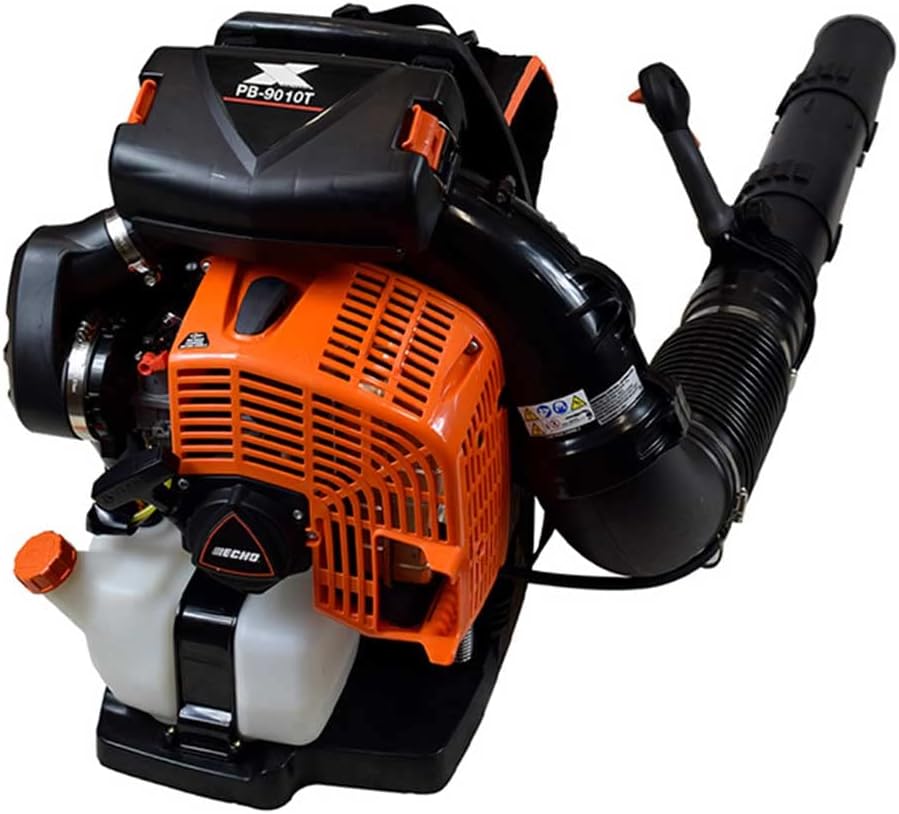
ECHO PB-9010T X Series 79.9cc Backpack Gas Blower
| Power Source | gasoline-powered |
|---|---|
| Form Factor | Backpack |
| Additional Features | Throttle Lock |
| Noise Level | 48 db |
| Maximum Speed | 220 miles_per_hour |
The ECHO PB-9010T X Series is a professional-style backpack blower built for heavy yard work and extended runs. Its 79.9 cc two-stroke engine produces up to 220 mph airspeed and a high airflow so you can move large piles of leaves, debris, and grass clippings quickly. The backpack form factor distributes the engine weight across the shoulders and hips for longer use than handheld units, and the tube-mounted throttle plus throttle lock help maintain a steady output during repetitive jobs. Practical benefits include strong clearing power for lawns, driveways, and beds and a design aimed at home users who need commercial-level performance. Limitations are the usual ones for gas backpack blowers: it requires fuel mixing and periodic engine maintenance, it is heavier and louder than electric alternatives, and it may be overkill for very small yards or infrequent light tasks.
Best for: Homeowners who need a reliable, high-power blower for frequent or large-area cleanup and who prioritize continuous performance over minimal maintenance.
Less Ideal for: Casual users with small yards, those who prefer low-maintenance electric equipment, or anyone seeking the quietest option for noise-sensitive neighborhoods.
- High reported maximum speed of 220 mph for strong clearing power
- Backpack form factor for longer, more comfortable operation than handheld blowers
- Tube-mounted throttle with throttle lock for steady speed control during extended use
- Gasoline power allows untethered operation and sustained output for large properties
- Requires fuel mixing and routine engine maintenance inherent to two-stroke gas engines
- Heavier and louder than electric or battery backpack models
- Likely more power than needed for very small yards or occasional use
Verdict: Buy this if you want a dependable, high-speed gas backpack blower that handles large yards and frequent heavy-duty cleanup.
Husqvarna 150BT 51cc Gas Backpack Leaf Blower

| Power Source | Gas Powered |
|---|---|
| Form Factor | Backpack |
| Air Flow Capacity | 765 cfm |
| Maximum Speed | 270 miles_per_hour |
| Additional Features | Adjustable Speed |
The Husqvarna 150BT is a gas-powered backpack leaf blower built for large yards and frequent clearing jobs. Its 51 cc 2-cycle engine produces up to 765 CFM and 270 MPH, which moves heavy or wet leaves quickly while the padded harness, hip belt, and weight-leveling system help distribute load for longer use. Variable speed throttle with cruise control lets you hold a steady speed without constant throttle input, and the air purge feature makes starting easier after refueling. In practice this blower is best for contractors or homeowners with many trees or large properties who need sustained blowing power and durability. Expect steady high performance and fewer passes on dense debris, but plan for routine maintenance typical of gas engines such as fuel mixing, spark plug checks, and quieter alternatives if noise or emissions are a concern. It comes with basic assembly items and a user manual so you can start using it right away.
Best for: Buyers who need sustained, professional-level blowing power for large yards or frequent heavy cleanups and who prioritize performance and durability over low-maintenance convenience.
Less Ideal for: Small-lot owners, noise-sensitive neighborhoods, or users who prefer low-emissions, low-maintenance electric or battery blowers.
- High clearing power: up to 765 CFM and 270 MPH for moving heavy or wet debris quickly.
- Ergonomic backpack harness with padded straps, hip belt, and weight-leveling for extended comfortable use.
- Variable speed throttle with cruise control for consistent operation without constant hand input.
- Air purge system to simplify starting after refueling and reduce pull-start issues.
- Gas engine requires regular fuel mixing and routine maintenance.
- Louder and higher-emission operation compared with electric or battery models.
Verdict: Choose the Husqvarna 150BT when you need professional backpack blower power and an ergonomic harness to clear large properties quickly.
Choosing the Right Backpack Leaf Blower for Large Yards: Key Factors to Consider
Airflow and Airspeed
Airflow measured in cubic feet per minute determines how much volume of leaves and debris the blower can move per pass. Higher CFM is helpful for sweeping large flat areas quickly, moving light debris in fewer passes, and keeping dust clouds down on wide properties.
Airspeed, or MPH at the nozzle, affects how well the tool can dislodge packed wet leaves, pine needles, and small twigs. For large yards that include tree canopies or areas where leaves mat down, a balance of strong CFM and good airspeed reduces the effort needed to break material free and prevents you from having to make multiple overlapping passes.
Runtime and Fuel or Battery Management
On big properties runtime is a top practical concern. Gas backpack blowers offer long continuous operation between refills but require safe fuel handling and periodic carburetor or spark plug maintenance. Battery backpack blowers eliminate fuel mixing and reduce vibration, but you must account for battery capacity, the number of battery packs needed, and recharge logistics if you have many acres to cover.
Consider realistic runtime under load rather than quoted numbers achieved at low throttle. Also check how easy it is to swap or refill power sources mid-job. Fast refueling, clear fuel capacity markings, or quick-access battery mounts can change whether a blower feels suited to prolonged clearing sessions.
Operator Comfort and Harness Design
Backpack blowers spend long periods strapped to your body, so harness comfort affects how long you can work without fatigue. Look for padded shoulder straps, breathable back panels, and adjustable belts that distribute weight across the hips and shoulders rather than concentrating it on any single point.
Noise and vibration also impact comfort. Anti-vibration mounts, a well-balanced center of gravity, and controls that are easy to operate from the hand tube make long sessions less tiring. For gardeners with limited core strength or recurring jobs, harness adjustability and ergonomic tube controls are essential considerations.
Power-to-Weight Ratio
A blower that is powerful but excessively heavy will still create fatigue and slow you down. Assess the power-to-weight ratio to understand whether the engine or battery output justifies the mass you carry. Lightweight construction that sacrifices necessary airflow is a false economy; conversely, a heavier unit with substantially higher CFM may be worth the tradeoff if the harness and balance reduce perceived load.
Also think about how often you need to lift the blower into a vehicle or onto a trailer. If you routinely move the blower between sites, a manageable overall weight and convenient carry handles matter as much as raw power.
Durability and Maintenance
Large yards expose equipment to more hours of use and more varied conditions, from gravel driveways to wet lawns. Durable housings, accessible air filters, and serviceable carburetor or battery connections reduce downtime. Bolt-on replacement components and common fastener types are easier to service without specialist tools.
Routine maintenance items such as spark plug access, easy carburetor inspection, and clear routing for fuel lines or battery cables will lengthen the useful life of the blower. Consider how weather-resistant external components are and whether protective covers keep dirt out of moving parts.
Control Options and Accessories
How you control airflow and direct debris matters for efficiency on large properties. Variable throttle, cruise control, and multiple nozzle attachments let you optimize airflow for tight beds, wide lawns, or long-distance blowing. Straight tubes are good for hauling bulk material, while curved or tapered tubes can increase velocity for stubborn spots.
Also evaluate available accessories like shoulder pads, tube extensions, or vacuum kits if you expect to switch tasks seasonally. A blower that supports useful attachments increases versatility and can handle leaf collection, gutter clearing, or light debris mulching in addition to general sweeping.
Matching Blower Type to Yard Tasks
Different large-yard tasks demand different airflow characteristics. Open lawns and long driveways benefit most from high CFM that moves lots of material with each pass. Areas with compacted leaves, gravel, or matted debris need higher airspeed to break material free and avoid scattering small stones or mulch.
Think about how much time you spend on different chores. If your yard is mostly open turf, prioritize volume. If you work frequent cleanups around beds, patios, and under trees, choose a unit that balances airspeed and maneuverability.
- High CFM for broad, open areas
- Higher MPH for matted or wet debris
- Consider interchangeable nozzles for different tasks
Fuel Choices and On-Site Logistics
Selecting between gas and battery power comes down to runtime needs and your tolerance for fuel handling. Gas models generally give longer continuous run times and quicker refuels, while battery units reduce maintenance and emissions. For very large properties you may prefer gas or a hybrid approach where batteries cover shorter cleanups and gas handles lengthy sessions.
- Evaluate refuel or recharge turnaround time
- Plan for spare batteries or easy fuel access on large properties
- Consider storage and winterization needs
Noise, Local Regulations, and Scheduling
Large properties often sit near neighbors or in areas with local noise ordinances. Backpack blowers can be loud, and sustained use may require scheduling early morning or late afternoon work to respect local restrictions. Check local rules and weigh quieter battery options if noise is a significant concern.
Also factor in hearing protection and communication if you operate with helpers on big jobs.
- Check noise restrictions for your area
- Use quieter options where neighbor relations matter
- Wear hearing protection for long sessions
Transport, Storage, and Seasonal Care
Consider how you will move the blower between storage and the worksite. Sturdy carry handles, a compact footprint, and removable tubes help fit equipment into trucks or sheds. For winter storage clean fuel systems or remove batteries to prevent degradation.
Seasonal maintenance such as cleaning air intakes, inspecting spark arrestors, and replacing fuel lines before leaf season keeps the blower ready when needed.
- Secure storage away from moisture and extreme temperatures
- Follow manufacturer guidelines for winter fuel care
- Keep a basic tool kit for on-site adjustments
Safety Practices for Backpack Use
Backpack blowers put weight on the torso and can throw debris. Always use eye protection, hearing protection, and gloves. Secure loose clothing and tie back long hair to prevent contact with moving parts.
Be mindful of wind direction to avoid blowing debris toward people, pets, or fragile plants. When working on slopes or near drop-offs use lower airspeed settings and maintain stable footing.
- Wear eye and hearing protection
- Secure clothing and maintain stable footing
- Adjust airflow to avoid damaging plants or scattering debris onto neighbors
How We Chose the Best Backpack Leaf Blower for Large Yards
Our selection prioritized machines that handle sustained clearing tasks on properties described by the article scope. We evaluated candidates against concrete, gardener-centered criteria: peak airflow and airspeed, continuous runtime and fuel or battery capacity, operator comfort and harness ergonomics, and build quality for outdoor use. We also considered serviceability and availability of common replacement parts such as air filters and fuel lines. We excluded handheld blowers and lightweight consumer-focused models that lack the airflow or runtime needed for large yards, as well as units intended solely for commercial landscaping crews if their duty ratings or ergonomics significantly differ from homeowner-oriented backpack designs. Our picks emphasize sustained clearing power, manageable weight distribution, straightforward maintenance, and predictable runtime under real yard conditions.
FAQ
How much airflow do I need for a large yard?
It depends on the material you need to move. For open lawns greater CFM is useful to cover ground quickly, while areas with wet or matted leaves need higher airspeed. Expect to prioritize units with strong CFM and a nozzle shape that maintains velocity under load.
Are battery backpack blowers practical for several acres?
Battery models can be practical for several acres only if you plan for multiple battery packs and charging logistics. They offer quieter operation and low maintenance, but runtime under full throttle is the limiting factor compared with gas-powered units.
What maintenance should I expect with a gas backpack blower?
Routine tasks include checking and replacing the spark plug, cleaning or replacing the air filter, inspecting fuel lines, and winterizing the fuel system. More hours of use will also require carburetor adjustments and periodic replacement of wear parts.
Can a heavy backpack blower be easier to use than a lighter one?
Yes. A heavier blower with a superior harness and better balance can feel easier to use because weight is distributed across the hips and shoulders. Evaluate harness comfort and adjustability alongside raw weight.
What accessories improve efficiency on large jobs?
Useful accessories include extended tubes or tapered nozzles for increased velocity, padded harness upgrades, spare batteries or quick-connect fuel containers, and vacuum or mulching kits if you want to collect debris.
Final Verdict
For large yards the right backpack leaf blower balances raw clearing power with practical runtime and user comfort. Focus first on airflow and airspeed that match the kinds of debris and surfaces on your property, then confirm that runtime logistics and harness ergonomics support extended sessions. Expect tradeoffs between absolute power and weight or between long runtime and lower maintenance. Prioritize runtime and comfortable weight distribution if you regularly clear many acres, or choose quieter battery options for smaller large yards where noise and emissions matter more.
