

Note: This article contains affiliate links. If you click on these links and make a purchase, I may earn a small commission at no extra cost to you. This helps support my research and content. Read my full affiliate disclosure here.
Choosing the right grow light for herbs and vegetables matters because light quality directly controls germination, compactness, leaf color, and production in small indoor setups. The wrong lamp can produce leggy seedlings or wasted energy, while the right fixture gives consistent growth and predictable harvests. This guide covers seven shortlisted grow lights selected for small-scale herb and vegetable growing in kitchens, balconies, and compact indoor gardens. We evaluate each pick on spectrum, coverage, and energy use to help you match a fixture to your planting space and crop goals.
Top Picks at a Glance
| Best Overall The best all-around choice for most situations | VIVOSUN LumaLight 100W LED Full Spectrum Grow Light |  |
| Best Quality Built to a higher standard if you want something more solid | Barrina T5 1 ft LED Grow Light, 5000K Full Spectrum (4-pack) |  |
| Best Value The sweet spot between price and what you get | LEOTER 4-Head LED Grow Light with Full Spectrum, Timer and 10-Level Dimming |  |
| Best Budget The cheapest option that still gets the job done reliably | Nzkwrv 11W Full Spectrum LED Plant Grow Light Bulb (2-Pack) |  |
| Highest Rated A top-rated pick with lots of positive feedback | GLOWRIUM Full-Spectrum Smart LED Grow Light (Freestanding) |  |
| Most Popular A crowd favorite that many people choose with confidence | Briignite A19 Full Spectrum LED Grow Light Bulb (2-Pack) |  |
| Best Seller A high-volume bestseller chosen again and again | Aokrean Halo Plant Grow Light with Base, 3.5in Full Spectrum LED |  |
VIVOSUN LumaLight 100W LED Full Spectrum Grow Light

| Wattage | 100 watts |
|---|---|
| Light Source Type | LED |
| Number of Light Sources | 336 |
| Is Waterproof | True |
| Control Method | Remote |
The VIVOSUN LumaLight 100W is a compact full-spectrum LED grow light intended for indoor gardens and patios. It uses a mix of white, blue, red and far-red diodes to support all growth stages from seedlings through flowering, and the array is arranged to deliver uniform intensity across the canopy. Typical use is hanging above a small grow area with the included rope hangers and adjusting intensity via the four-level dimming knob or remote/mobile control when paired with VIVOSUN accessories. Notable features include IP65 water and dust resistance for high-humidity setups, a low-heat design for closer placement to plants, and Bluetooth/remote control compatibility for easier scheduling. Practical benefits are even coverage for several small plants, lower heat stress, and long expected LED life. Limitations are its 100W power level, which is best for small tents or a few plants rather than larger grow rooms, and some advanced scheduling requires the separate GrowHub controller for full smart automation.
Best for: A practical home grower who wants a reliable, compact full-spectrum light for seedlings through flowering and values even coverage and low heat in a small tent or patio setup.
Less Ideal for: Large-scale growers or those outfitting multi-shelf systems who need higher wattage fixtures or broader coverage should consider more powerful models.
- Full-spectrum diode mix (white, blue, red, far-red) suitable for all growth stages
- Dimmable four-level control plus Bluetooth/remote connectivity for convenient intensity adjustments
- IP65 waterproof and dustproof rating allows use in humid or misted environments
- Low-heat design with aluminum body for efficient thermal management and longer LED life
- At 100 watts it is intended for small tents or modest plant counts and not optimized for larger grows
- Advanced smart scheduling requires purchasing the GrowHub controller separately
Verdict: A dependable, compact full-spectrum LED grow light that delivers even coverage and low heat for small indoor grows.
Barrina T5 1 ft LED Grow Light, 5000K Full Spectrum (4-pack)

| Wattage | 5W per fixture |
|---|---|
| Color temperature | 5000K Full Spectrum |
| Linkable | Link up to 16 lights |
| Control | Separate on/off switch per fixture |
| Included accessories | Power cords, connecting cords, clips, double-sided tape |
The Barrina T5 1 ft LED grow light kit supplies full-spectrum 5000K light in a compact, linkable T5 form that is useful for starting and growing tomato seedlings under artificial light. Each 1 ft fixture draws 5W and has its own on/off switch so you can run a single tube or multiple fixtures to match light needs. The set includes power cords, connecting cords, clips, double-sided tape and cable ties for quick plug-and-play installation and you can chain up to 16 lights in series to light multiple trays or shelf levels. Practical benefits for seedlings are even, high-PPFD output from an efficient LED array and the ability to tailor coverage by switching fixtures on or off. Limitations are that the small 1 ft form gives narrow coverage per tube so larger seed flats or full-width racks will need many fixtures, and the product is non-magnetic so mounting options depend on the included clips or your own hardware. Overall this kit is a straightforward, budget-friendly choice for growers who want controllable, linkable light for early-stage tomato plants.
Best for: Growers who want a compact, energy-efficient, controllable lighting solution for starting and growing tomato seedlings on shelves or seed trays.
Less Ideal for: People needing single wide-coverage fixtures for large benches or commercial-scale propagation should consider longer tubes or high-output panels instead.
- Full-spectrum 5000K output suitable for seedlings and vegetative growth
- Separately controllable fixtures let you run only the number of tubes needed
- Linkable design supports chaining up to 16 lights for multi-shelf setups
- Includes mounting clips, power and connecting cords for quick plug-and-play setup
- Small 1 ft length provides limited coverage per fixture so more units are needed for larger trays
Verdict: A compact, linkable full-spectrum T5 kit that gives efficient, controllable light ideal for raising healthy tomato seedlings on shelves and seed trays.
LEOTER 4-Head LED Grow Light with Full Spectrum, Timer and 10-Level Dimming

| Light Source Type | LED |
|---|---|
| Number of Light Sources | 80 |
| Wattage | 80 watts |
| Control Method | Remote |
| Mounting Type | Clip On |
The LEOTER 4-head grow light is a USB-powered, clip-on lamp built for indoor plant care that combines full-spectrum and targeted red/blue diodes to support seedlings, vegetative growth and flowering. It uses 80 LEDs arranged across four adjustable heads on flexible goosenecks so you can position light over individual large plants or groupings. Notable features are three spectral modes (red+blue, warm/full spectrum, and combined), a circular memory timer with 3/9/12-hour presets, and ten brightness levels for fine control over intensity. The strong metal clip and flexible necks make it simple to aim light at tall foliage without permanent installation. Practical benefits include reduced need for supplemental natural light, convenient daily scheduling for busy users, and a compact footprint that suits shelves or plant stands. Important limitations are that the unit is described as a clip/desk lamp rather than a wide-panel fixture, so coverage for very large single specimens may require placing heads close to foliage or using multiple units, and the timer resets if unplugged so it needs occasional reprogramming after power loss.
Best for: Buyers who want a controllable, space-efficient grow light to supplement indoor sun for larger houseplants and prefer a proven, feature-rich unit with preset timers and adjustable heads.
Less Ideal for: Growers who need single-fixture coverage for floor-to-ceiling specimens or large multi-plant setups should consider full-size panel fixtures or multiple units instead.
- Full spectrum plus red and blue LEDs (80 total) to support all growth stages
- Ten dimming levels for precise intensity control
- Three timer presets with memory function for hands-off daily scheduling
- Adjustable 4-head design and flexible goosenecks for targeted placement
- Strong metal clip allows mounting on shelves, desks, or plant stands
- Designed as a clip-on lamp so single-unit coverage is limited for very large plants
- Timer settings must be reset after the light is unplugged
Verdict: A versatile, adjustable clip-on grow light that gives busy indoor gardeners precise control over spectrum, intensity and scheduling to boost large plant growth in compact spaces.
Nzkwrv 11W Full Spectrum LED Plant Grow Light Bulb (2-Pack)

| Wattage | 11 watts |
|---|---|
| Bulb Base | E26 Medium |
| Color Temperature | 4000 Kelvin |
| Light Output Maximum | 1000 lumens |
| Color Rendering Index | 85 |
These Nzkwrv bulbs are A19 LED grow lights designed to drop into standard E26 fixtures so you can add plant lighting without special hardware. Each 11 watt bulb produces roughly 1000 lumens at a 4000 K natural-white color temperature and is marketed as full spectrum to cover both vegetative and flowering needs for herbs, leafy greens, and common houseplants. The bulbs run cool and claim to be energy efficient and long lasting, so they can operate for many hours without the heat or high electricity use of older bulbs. Practical benefits include easy installation in desk or pendant lamps, eye-friendly light that is not the typical purple grow-light hue, and enough output for a small herb shelf or a few potted vegetables when placed close to plants. Limitations are inherent to single A19 bulbs: you may need multiple bulbs or closer placement for denser or taller crops, and these are point-source bulbs rather than wide-panel fixtures so coverage is limited. The product is best where low cost and simple setup matter more than professional canopy coverage.
Best for: Buyers setting up a small indoor herb or vegetable station who want a low-cost, energy-efficient option that works with standard household lamps and fixtures.
Less Ideal for: Growers planning a larger or multi-tier vegetable garden, or those who need measured PAR/PFD output and uniform canopy coverage should consider dedicated grow panels or higher-output fixtures instead.
- Full-spectrum output suitable for vegetative and flowering stages
- Fits standard E26 sockets for tool-free installation
- Low power draw of 11 watts with about 1000 lumens of light
- Natural-white light that is easier on the eyes than purple LED grow bulbs
- A19 form factor provides limited coverage so multiple bulbs are needed for larger setups
- No published lifespan or PAR/PFD values for precise plant-lighting performance
Verdict: A cheap, easy-to-install full-spectrum LED bulb ideal for small herb and vegetable stations that need low-power, natural-white light.
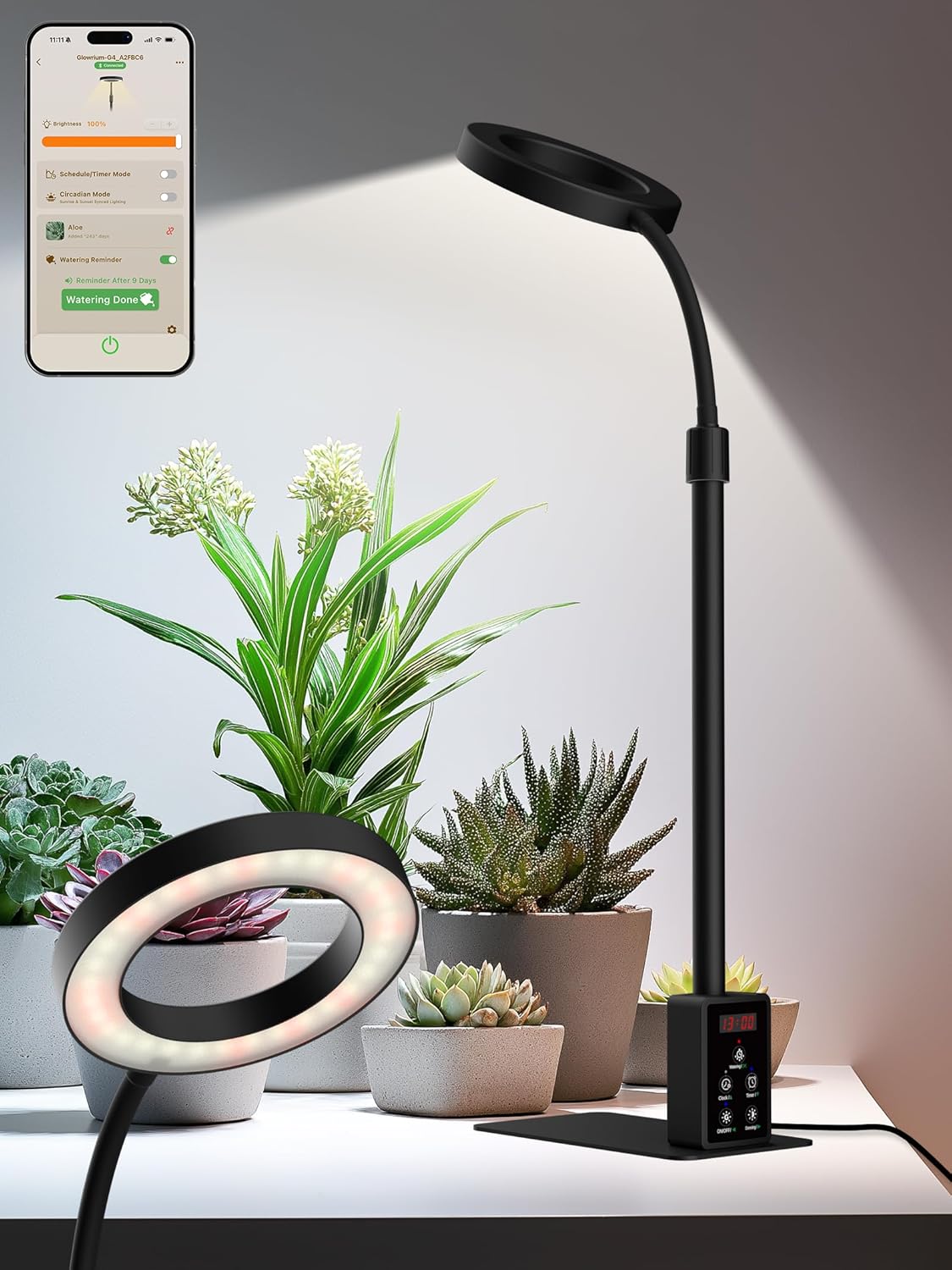
GLOWRIUM Full-Spectrum Smart LED Grow Light (Freestanding)
| Power Source | Corded Electric |
|---|---|
| Wattage | 12 watts |
| Control Method | App, Push Button |
| Connectivity Protocol | Bluetooth |
| Recommended Uses For Product | Plant Growth |
The GLOWRIUM grow light is a compact freestanding LED lamp designed to support seedlings through flowering with a full‑spectrum output and stepless dimming. It is typically placed next to herb trays, small vegetable seedlings, or potted kitchen plants where you can raise or lower the head to match plant height. Notable features include Bluetooth app control with timers and plant care reminders, a 360° flexible gooseneck for precise beam placement, and a frosted diffuser for softer, more even light. Practical benefits for herb and vegetable growers are easy scheduling, the ability to fine‑tune intensity for different growth stages, and a low‑voltage 24V system with long‑life LEDs that reduce maintenance. Limitations are its single light head and modest 12W power, which make it best for small setups or single shelves rather than larger multi‑tray germination systems, and it is not water resistant so it should be used away from wet work areas. The lamp’s aluminum construction and included adapter keep it stable and simple to set up for routine, reliable indoor vegetable and herb production.
Best for: Growers who prioritize a reliable, low‑maintenance lamp to run consistent light schedules for herbs and small vegetable seedlings, and who want app features to automate daily care.
Less Ideal for: People setting up larger multi‑tray propagation racks or full grow shelves who need higher wattage, wider coverage, or waterproof fixtures in wet spaces.
- Full‑spectrum output with stepless dimming for matching seedling and vegetative needs
- App control and programmable timers for consistent light schedules
- Adjustable height and 360° gooseneck for precise placement over small plants
- Low‑voltage 24V system and long‑life LEDs for safe, low‑maintenance operation
- 12W single head limits total coverage so multiple units may be required for larger setups
- Not water resistant so it must be kept away from watering areas
Verdict: A dependable, app‑controlled full‑spectrum desk/floor grow light that automates consistent lighting for herbs and small vegetable seedlings.
Briignite A19 Full Spectrum LED Grow Light Bulb (2-Pack)

| Light Type | LED |
|---|---|
| Additional Features | Full Spectrum |
| Bulb Base | E26 |
| Light Output Maximum | 1000 lumens |
| Light Source Operating Life | 30000 hours |
These Briignite A19 grow bulbs are full-spectrum LED replacements that screw into any standard E26 fixture to give indoor plants consistent, natural-looking light. Each bulb outputs about 1000 lumens at roughly 11 to 12 watts, so they act like a 60 to 100 watt incandescent while using far less energy, which is handy for running multiple bulbs on a budget. The 3500–4000K warm daylight color and high CRI make foliage colors appear normal rather than the purple hue of some grow lights, so they work well in living spaces and plant shelves. Built-in features include app control and push-button options and an advertised 25,000 to 30,000 hour operating life. Limitations to note are modest reported PPF compared with purpose-built high‑output grow fixtures and the 180 degree beam, which is better for general room lighting than targeted canopy penetration for dense or tall plants. For small collections, seed starting, or supplementing light in low-light rooms these bulbs are an economical, easy-to-install choice.
Best for: Houseplant owners who need an affordable, plug-and-play light to supplement natural light for a few pots, seedlings, or a small indoor garden while keeping energy costs low.
Less Ideal for: Growers aiming to flower large or dense canopy crops or outfitting multi-tiered grow racks will want higher‑PPF, purpose-built fixtures instead.
- Full spectrum output that looks like natural white light and preserves true foliage color
- Low power draw (around 11–12W) with 1000 lumens brightness for energy-efficient continuous use
- Standard E26 base fits common fixtures for tool-free installation
- High CRI of 90 helps accurate color rendering in living spaces
- Beam angle and lumen-focused design give less concentrated PAR/PPF than dedicated high‑output grow fixtures
- App and push-button controls are basic compared with advanced programmable controllers
Verdict: A low-cost, easy-to-install full-spectrum LED bulb that gives natural-looking light and energy savings for small indoor plant collections.
Aokrean Halo Plant Grow Light with Base, 3.5in Full Spectrum LED

| Wattage | 10 watts |
|---|---|
| Light Source Type | LED |
| Control Method | Touch |
| Power Source | Corded Electric |
| Connectivity Protocol | Bluetooth |
This Aokrean Halo grow light is designed for indoor herbs and small vegetables that need supplemental light. It offers three spectrum modes (white, warm white plus red, and mixed) and a 10-step dimmer so you can match light intensity to seedlings, leafy herbs, or vegetative growth. Two installation options make it flexible: push the stake into soil for targeted top-lighting or set the pole into the included base so a pot sits directly on the stand. The light is low-voltage (5V) and rated waterproof for occasional damp environments, and it includes a timer with 3/9/12 hour cycles for automated daily schedules. Practical benefits include an efficient 48-LED array in a compact halo shape, adjustable height up to about 26 inches to cover different plant sizes, and simple touch controls. Limitations are its small coverage area and modest 10-watt output, which mean you will need multiple units or closer placement for larger herb beds or multiple pots, and the base stabilizes best when a pot presses down on it.
Best for: A cautious home gardener growing a few potted herbs or small vegetable seedlings who prioritizes easy setup, automated timers, and adjustable light settings to protect plants without complex controls.
Less Ideal for: People planning to light larger beds, multiple pots, or mature fruiting vegetables should choose a higher-output fixture or multiple lights for adequate coverage.
- Full-spectrum LED with 48 lamp beads supports seedling and vegetative stages
- Two installation modes (soil stake or freestanding base) for flexible placement
- Adjustable height up to 26 inches and 10 brightness levels for fine-tuning light intensity
- Built-in timer with 3/9/12 hour cycles simplifies daily scheduling
- Small coverage and 10-watt output mean multiple units are needed for larger herb setups
- Base relies on the pot to press down for best stability
Verdict: Aokrean's Halo is a compact, easy-to-use full-spectrum grow light that is ideal for reliably keeping a few herb pots and seedlings healthy on an automated schedule.
Choosing the Right Grow Light for Herbs and Vegetables: Key Factors to Consider
Light Spectrum and Plant Needs
Spectrum determines how plants use the light you provide. Blue wavelengths keep seedlings compact and produce sturdy leaf growth, while red and far-red encourage flowering and fruiting in many edible crops. For herbs and leafy vegetables, a higher proportion of blue and full-spectrum white light helps maintain flavor, color, and compact form.
Look for fixtures that specify spectrum bands or provide full-spectrum output. Fixtures advertised only with "warm" or "cool" color temperature without actual spectral data can be hit-or-miss for edible production. A versatile fixture that supports both vegetative and bloom modes or offers a balanced white spectrum is often the most practical for mixed herb and vegetable trays.
Light Intensity and PAR/PPFD
The amount of usable light a plant receives, typically expressed as PAR or PPFD, affects growth rate and crop form. Seedlings and microgreens need much lower PPFD than mature fruiting plants. Herbs and leafy greens usually perform well at moderate PPFD values, while vegetables that set fruit may require higher consistent PPFD during the productive stage.
When choosing a grow light, consider the intended crop stage and distance from plants. Fixtures that publish PPFD maps or provide recommended hanging heights give you the data needed to estimate spacing and expected yields. Inadequate intensity results in slow growth and stretching; excessive intensity close to tender seedlings can cause photoinhibition or leaf stress.
Coverage Pattern and Uniformity
How evenly a light covers your bench, shelf, or tabletop determines how many plants thrive versus how many develop weakly under shaded spots. Fixtures with narrow beams concentrate light but leave hot and cold zones; wide-angle or multi-bar fixtures tend to give more uniform results for trays of herbs and small vegetable starts.
Match the fixture footprint to your growing area rather than trying to force a mismatched lamp to cover too large a surface. Overlapping multiple fixtures can improve uniformity, but that increases mounting complexity and energy draw. Check manufacturer coverage diagrams or user-shared PPFD grids when possible.
Energy Use and Runtime Costs
Grow lights often run 10 to 16 hours per day, so energy efficiency is a real operating cost in indoor edible production. LED fixtures are generally more efficient than legacy lamp types, but within LEDs there are differences in driver efficiency, diodes used, and control options that affect real-world power draw.
Factor expected daily runtime and the number of fixtures into your energy budget. Dimmable drivers or programmable schedules let you reduce output during nursery stages to save energy. Efficient fixtures also produce less waste heat, lowering ventilation needs and risk to temperature-sensitive herbs.
Thermal Design and Longevity
How a fixture handles heat impacts both the diodes and the driver electronics. Overheating accelerates lumen depreciation and can shorten expected life. Passive cooling with adequate surface area can be quiet and maintenance-free, while active cooling with fans can maintain output at higher power but adds mechanical failure points and possible noise.
Consider the ambient space: small enclosed cabinets trap heat and favor lower-power, well-dissipated fixtures. Outdoors or ventilated rooms can tolerate higher-output fixtures with active cooling. Long-term reliability is often as important as initial lumen output when planning a continuous herb and vegetable production schedule.
Mounting Options and Installation Flexibility
Practical mounting choices affect how easily you can position lights for changing crop heights and multiple shelves. Adjustable hangers, ratchet ropes, and integrated channels for under-shelf installation allow you to move fixtures as plants grow without rebuilding the setup.
Also consider cord length, plug type, and whether the fixture supports daisy-chaining. Fixtures designed for vertical grows should allow close placement over seedlings, while broad fixtures are better for flat trays. Easy-to-adjust mounting speeds up routine tasks like rotation, harvest, and hygiene checks.
Best Setup Practices for Seedlings and Microgreens
Start seedlings and microgreens with lights closer and slightly dimmed compared with mature crops. Seedlings benefit from a higher proportion of blue light and a hanging height that keeps them from stretching. A common approach is to position the fixture 6 to 12 inches above flats, then raise it as plants develop to maintain target PPFD without burning tender leaves.
- Use a timer to maintain consistent day length for uniform germination and early vigor.
- Rotate trays rather than moving lights for small setups to preserve uniform coverage.
- Reduce intensity for the first few days after germination, then increase gradually to encourage sturdiness.
Adapting Light Schedules by Crop Type
Different herbs and vegetables have distinct photoperiod and intensity preferences. Leafy herbs and salad greens usually do well with 12 to 16 hours of light and moderate intensity, while fruiting vegetables may need longer daily light and higher PPFD during the flowering and fruit set phases. Adjust schedules as plants transition from seedling to production stage.
- Short-duration crops like microgreens often use higher intensity for a short period and then are harvested quickly.
- For mixed plantings, set light duration for the most light-hungry crop and adjust intensity or distance for the more sensitive ones.
- Consider using separate fixtures or zones when growing very different crops together.
Managing Heat in Small Indoor Spaces
Heat buildup can stress herbs and reduce volatile oil concentration, which affects flavor. Monitor ambient temperature close to the canopy rather than room air. Good ventilation and choosing fixtures with appropriate thermal design will keep canopy temperatures in the optimal range for the species you grow.
- Place a small fan for gentle air movement to strengthen stems and disperse localized heat.
- Allow clearance above fixtures in cabinets to improve passive cooling.
- Avoid placing fixtures directly against combustibles or insulated surfaces that trap heat.
Scaling From Single Tray to Multi-Shelf Production
As your indoor garden expands, think in terms of modular lighting zones. Multiplying a proven fixture for one tray to fill additional shelves keeps light quality consistent across crops. For vertical racks, use fixtures built for narrow, deep coverage and ensure each shelf can be adjusted independently for height and runtime.
- Label circuits and use timers that support multiple zones for ease of management.
- Stacked systems benefit from thin-profile fixtures that fit inside shelf spacing without blocking access.
- Plan cord routing and service access before permanent mounting to simplify maintenance.
How We Chose the Best Grow Light for Herbs and Vegetables
We focused on criteria that reflect how a grow light performs in practical herb and vegetable production rather than flashy specs that do not translate to better harvests. Primary evaluation criteria included light spectrum suitability for both seedlings and leafy/fruiting stages, uniform coverage across a typical indoor planting area, and energy efficiency for long daily runtimes. We also weighed build quality and cooling because thermal design affects lifespan and consistent output, plus installation flexibility so fixtures integrate with shelves, racks, and hanging setups. Products were excluded if their output was only advertised for ornamental houseplants or if available documentation lacked usable PAR/PPFD guidance. We prioritized fixtures that supply useful technical details and real-world mounting options. Final selections balance usable spectrum, predictable coverage patterns, durable components, and reasonable power draw for hobbyist and small-scale edible production.
FAQ
How close should a grow light be to herb seedlings?
Distance depends on fixture intensity. For most LEDs start 6 to 12 inches above seedlings and watch for signs of stretching or leaf bleaching. If the manufacturer provides a PPFD chart, use that to set a height that matches the crop's recommended range.
Can one grow light cover both herbs and small vegetables?
Often yes if the fixture provides balanced spectrum and sufficient coverage for the area. For mixed plantings, you may need to raise or dim the light for delicate herbs while keeping higher PPFD nearer small vegetables, or use separate fixtures for distinct zones.
How many hours of light do herbs typically need?
Most leafy herbs do well with 12 to 16 hours of light per day. Some herbs tolerate slightly shorter photoperiods, but consistent daily hours encourage even growth and predictable harvest timing.
Will a higher wattage fixture always grow plants faster?
Not always. Wattage is an input measurement, not a direct indicator of usable plant light. PPFD and spectrum matter more. An efficient fixture with lower wattage but better diodes and optics can produce better plant growth than a higher-wattage, poorly designed lamp.
Do I need special ventilation with LED grow lights?
LEDs produce less radiant heat than many other lamp types, but they still generate heat at high output. Small enclosed spaces benefit from even modest ventilation to keep canopy temperature stable and to remove moisture.
Can I use a grow light on a timer overnight?
Yes. Timers are standard practice. Most edible crops respond to consistent day length, so automated schedules simplify management. Avoid irregular short cycles that confuse plants during sensitive developmental stages.
Final Verdict
Prioritize light spectrum and usable PPFD when choosing a grow light for herbs and vegetables, then match coverage footprint and mounting options to your planting area. Balance intensity needs against energy use and thermal constraints, especially in cabinets or small rooms. With those tradeoffs in mind, pick a fixture that offers the spectrum you need, clear PPFD guidance, and flexible installation so you can adapt as plants grow.
