

Note: This article contains affiliate links. If you click on these links and make a purchase, I may earn a small commission at no extra cost to you. This helps support my research and content. Read my full affiliate disclosure here.
Choosing the right mulch for newly planted trees matters because it directly affects how roots establish, how soil holds moisture, and how much early stress the tree experiences. The wrong material or depth can lead to rot, pests, or poor root spread, while the right mulch helps moderate temperature swings, conserve water, and reduce competing weeds during the critical first years. This guide covers seven shortlisted mulches suited for new trees and explains how we evaluated them on moisture management, nutrient contribution, longevity, and ease of use. Read on to understand which characteristics matter for your site and planting situation before you pick a product.
Top Picks at a Glance
| Best Overall The best all-around choice for most situations | USHIGHLIGHT 20 Gallon Slow-Release Tree Watering Bag with Coconut Mulch Ring (2-Pack) |  |
| Best Quality Built to a higher standard if you want something more solid | Fasmov Tree Protector Rubber Mulch Rings, 3-Pack, 24-inch |  |
| Best Value The sweet spot between price and what you get | PlantBest Coco Mulch Compressed Block (expands to 2.5 cu ft) |  |
| Best Budget The cheapest option that still gets the job done reliably | 2-Pack Non-Woven Tree Mulch Rings, 28-Inch Reusable Root Barrier |  |
| Highest Rated A top-rated pick with lots of positive feedback | Moicstiy Coconut Fiber Tree Mulch Rings, 10-Pack (11.8 inch) |  |
| Most Popular A crowd favorite that many people choose with confidence | Legigo Coconut Fiber Tree Mulch Ring, 24 inch (6 pack) |  |
| Best Seller A high-volume bestseller chosen again and again | ZeeDix 24" Coconut Fiber Tree Ring Mulch Mat (6-Pack) |  |
USHIGHLIGHT 20 Gallon Slow-Release Tree Watering Bag with Coconut Mulch Ring (2-Pack)

| Size | 20 Gallon |
|---|---|
| Number of Sets | 2 |
| Special Features | Automatic Watering |
| Included Components | 2 tree watering bag+ 2 coconut fiber tree mat |
This USHIGHLIGHT kit combines 20-gallon slow-release watering bags with coconut fiber mulch rings to give newly planted and young trees deep, low-effort irrigation. The bag wraps around the trunk, zips closed and fills through a wide opening; two small drip holes release water over roughly 5 to 9 hours so moisture soaks deeply rather than running off the surface. The included coconut mulch ring spreads the drips evenly, helps prevent the holes from clogging, suppresses weeds under the tree and helps retain soil temperature and moisture after watering. Installation is tool-free and quick, making the set practical for street trees, gardens and parks where frequent hand-watering is inconvenient. Limitations: the system requires periodic refilling (about 1 to 2 times per week in dry conditions) and is intended for establishing roots rather than replacing permanent irrigation; the fabric and zippers can wear over multiple seasons and the bag must be seated carefully while filling to avoid misplacement around the trunk.
Best for: Gardeners or landscapers who want a low-effort, deep-root watering solution for newly planted trees and who prioritize easy installation and water-efficient delivery.
Less Ideal for: People seeking a permanent hands-off irrigation system for mature trees or those who need automated timers and continuous flow without manual refilling.
- Slow, controlled release over 5 to 9 hours promotes deep root watering.
- Coconut fiber mulch ring distributes water evenly and reduces weed growth under the tree.
- Tool-free wrap-and-zip installation makes setup fast and easy.
- Two-bag kit covers multiple young trees or provides redundancy for larger root zones.
- Needs regular refilling during hot, dry periods and does not provide continuous unattended irrigation.
- Fabric and zipper components may degrade over multiple seasons with heavy use.
Verdict: Use this kit when you want a simple, water-efficient way to establish deep roots in new trees with minimal setup.
Fasmov Tree Protector Rubber Mulch Rings, 3-Pack, 24-inch

| Unit Count | 3 Ounce |
|---|---|
| Number of Pieces | 3 |
| Item Weight | 15 pounds |
| Material Features | Natural |
These rubber mulch rings create a simple, durable protective collar around young and established trees. Each 24-inch ring is half an inch thick with a center hole that can be opened or trimmed to fit trunks, so installation is a matter of laying the ring around the base and cutting to size if needed. Made from recycled heavy-duty rubber, the mats resist damage from string trimmers and lawnmowers and do not require landscape staples to stay in place. Their thickness blocks most weeds while remaining permeable so water and nutrients can reach the root zone. Practical benefits include low maintenance, longevity compared with organic mulch, and a neat, mower-friendly edge that reduces trunk injury. Limitations are that rubber does not break down to feed soil, rings must be sized for very large or grafted trunks, and the look is less natural than wood mulch for some landscapes.
Best for: Gardeners who prioritize long-lasting, low-maintenance trunk protection and want a mower-friendly solution that reduces mechanical damage to new trees.
Less Ideal for: People seeking organic, soil-building mulch or a natural bark appearance for ornamental landscapes should consider wood chips or compost instead.
- Durable recycled rubber construction withstands mower and string-trimmer contact
- Precut center that can be opened or trimmed for easy, tool-free installation
- Permeable 1/2-inch thickness lets water and nutrients reach roots while suppressing weeds
- No landscape staples required and can be mowed over for low maintenance
- Does not decompose to improve soil fertility like organic mulch
- Fixed 24-inch diameter may need cutting or multiple rings for very large root collars
Verdict: Choose these rubber rings when you want durable, low-maintenance protection that prevents mower and trimmer damage to new trees.
PlantBest Coco Mulch Compressed Block (expands to 2.5 cu ft)

| Item Form | Block |
|---|---|
| Coverage | 2.5 cubic feet |
| Specific Uses For Product | gardening and landscaping |
| Mixing Ratio | 6 fold in 5 minutes |
| Target Species | plants |
This compressed coco mulch block is designed to expand quickly with water into a lightweight, easy-to-spread mulch for flower beds and borders. One 9.1 lb block soaks up water and expands to roughly 2.5 cubic feet, making it simple to store and handle compared with bulky bags. The coconut fibers form a cohesive layer that helps retain soil moisture, reduce watering frequency, and suppress weed growth while resisting mild washout on slopes. It is peat-free and made from renewable coconut coir, so it avoids dyes and chemicals and can last through up to two seasons in typical garden use. Mixing and expansion are fast using the provided water ratio, and the material is useful around plants, trees, and walkways. Limitations are that coverage claims assume a 1.5-inch depth so you may need more than one block for larger beds, and it will gradually decompose over time so expect to top up after a season or two.
Best for: Gardeners who want an easy-to-store, peat-free mulch for flower beds and borders that conserves water and reduces weed pressure without heavy bags.
Less Ideal for: People needing permanent, decorative bark that lasts many years or those covering very large beds where buying in bulk loose mulch is more economical.
- Expands with water to a usable mulch, reducing storage bulk and handling weight
- Made from renewable coconut coir with no dyes or chemicals
- Helps retain soil moisture and can reduce how often you need to water
- Fibrous structure suppresses weeds and resists minor erosion on slopes
- Coverage is calculated at a 1.5-inch depth so larger beds may require multiple blocks
- Will break down over time and typically needs replenishing after one to two seasons
Verdict: A compact, peat-free coco mulch that expands with water to give flower beds moisture-retaining, weed-suppressing coverage with easy storage and handling.
2-Pack Non-Woven Tree Mulch Rings, 28-Inch Reusable Root Barrier

| Material | non-woven fabric |
|---|---|
| Package contents | tree mulch ring x2 |
| Available diameter | 28 inches |
These non-woven tree mulch rings are simple, low-cost ground covers meant to sit around young trees and keep grass and weeds away from the root zone. Each kit includes two pre-cut fabric rings with a center opening that slips around trunks to create a clean mulch-free circle. The non-woven fabric is permeable, so water and air reach roots while surface weeds are suppressed and moisture loss is reduced. Because the rings are lightweight and reusable they are easy to position and remove for seasonal maintenance. Practical benefits include less hand-weeding, tidier tree bases for lawn mowers, and better targeted watering that encourages deeper root growth. The product is a basic, utilitarian solution rather than a heavy-duty barrier, so it will not replace rigid root guards or long-term structural protection against persistent runners or burrowing pests. Expect gradual wear if left in place for many seasons in harsh sun or heavy foot traffic, but for establishing new trees on a budget these rings cover the core needs effectively.
Best for: Budget-minded homeowners who want an easy, low-maintenance way to protect newly planted trees and reduce hand-weeding without investing in heavier root-control systems.
Less Ideal for: People needing permanent, heavy-duty root barriers or protection from animals and deep-rooted invasive plants should consider sturdier solutions.
- Permeable non-woven fabric allows water and air to reach roots while suppressing surface weeds
- Pre-cut center hole makes installation quick and keeps a neat, mower-friendly edge
- Reusable and lightweight for easy seasonal repositioning or storage
- Made of fabric so it will degrade faster than rigid barriers when exposed to constant sun and abrasion
Verdict: A very affordable, easy-to-use fabric ring that keeps grass away and helps retain moisture around new trees, making it a strong budget pick for establishing young specimens.
Moicstiy Coconut Fiber Tree Mulch Rings, 10-Pack (11.8 inch)

| Package quantity | 10 pieces |
|---|---|
| Diameter | 11.8 inches |
| Material | Coconut fiber |
These coconut fiber mulch rings are thin, round mats meant to be placed around the base of newly planted trees or potted specimens to help retain soil moisture and limit weed growth. Made from natural coir, the rings are flexible and can be trimmed to fit different trunk sizes or container diameters, so they work well in garden beds, nurseries, balconies, or around young saplings. The product’s main benefit is moisture retention and temperature buffering for the root zone, which helps reduce watering frequency and supports establishment of new trees. Installation is simple — lay the mat around the stem and cut as needed. Because the mats are relatively thin, they will not create a deep mulch layer or substantially change soil structure, so they are best used as a top-covering aid rather than a replacement for thicker organic mulch or a weed barrier. Expect gradual breakdown over seasons since they are natural fiber, which is useful if you want a biodegradable option but will require occasional replacement for long-term use.
Best for: Buyers who prioritize dependable, low-maintenance moisture control for newly planted trees and want a natural, biodegradable top cover that is easy to install and replace.
Less Ideal for: Gardeners who need heavy-duty weed suppression or long-term insulation for large trees should consider thicker or longer-lasting mulch options.
- Natural coconut fiber retains moisture and helps keep roots hydrated
- Flexible, trim-to-fit design that adapts to different trunk sizes and pots
- Biodegradable material breaks down naturally over time
- Comes as a 10-piece set, suitable for multiple young trees or pots
- Thin profile provides limited insulation compared with thicker mulch layers
- Will decompose over seasons and needs periodic replacement
Verdict: A reliable, biodegradable moisture-retaining top cover that makes establishing new trees easier by conserving water and suppressing weeds with minimal fuss.
Legigo Coconut Fiber Tree Mulch Ring, 24 inch (6 pack)
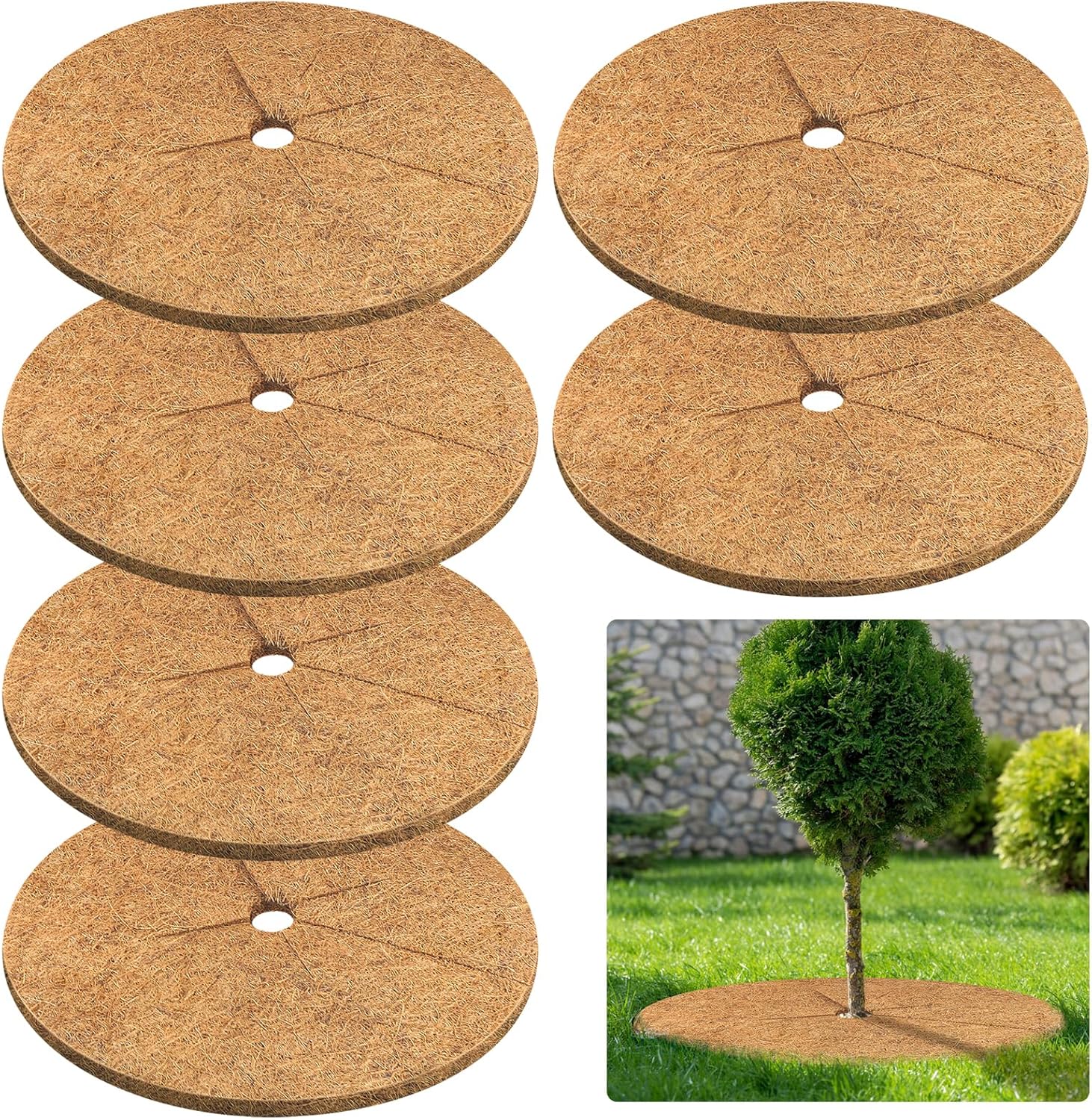
| Material | Coconut Fiber |
|---|---|
| Diameter | 24 inch |
| Thickness | 0.28 inches |
| Quantity | 6 pack |
These Legigo coconut fiber mulch rings are simple, no-frills tree protectors intended to sit around trunks or pot rims to conserve soil moisture and block weeds. Each 24-inch round mat is made from dense coconut fiber about 1/4 inch thick, so you lay a ring around the base of a tree or shrub and trim the center to fit the trunk. In practice they help reduce evaporative loss, keep soil looking tidy, and create a barrier that limits grass and weed encroachment and casual digging. The mats are lightweight and easy to position, making them practical for larger landscapes, nurseries, or container groupings. Because they are natural fiber they will slowly break down over time, which is helpful for adding organic matter but means you may need to replace them after a season or two in very wet climates. They do not anchor themselves, so on steep slopes or very windy sites you may need pins or extra finish mulch to hold them in place.
Best for: Gardeners who want a low-maintenance, natural-looking way to conserve soil moisture and keep the base of trees and large pots tidy, without using synthetic materials.
Less Ideal for: People looking for a permanent, heavy-duty mulch barrier or a product that stays fixed on steep or exposed slopes should consider alternatives with anchors or heavier construction.
- Natural coconut fiber retains moisture and slowly adds organic matter as it decomposes.
- 24-inch diameter covers a broad area around trunks or pots to suppress weeds and reduce grass encroachment.
- Lightweight and easy to trim so you can fit the ring neatly around different trunk sizes or container rims.
- Thin profile lies flat and keeps the planting area looking tidy without bulky buildup.
- Natural fiber will break down over time and may need periodic replacement in very wet conditions.
- No built-in anchoring; rings can shift on slopes or in high winds without additional pinning.
Verdict: A natural, easy-to-use coconut fiber ring that conserves moisture and tidies the area under trees, ideal for gardeners who want an eco-friendly seasonal ground cover.
ZeeDix 24" Coconut Fiber Tree Ring Mulch Mat (6-Pack)

| Package quantity | 6 pack |
|---|---|
| Material | Coconut coir |
| Diameter | 24 Inch |
| Hole diameter | 1.57 inches (4 cm) |
These ZeeDix coconut fiber tree rings are designed to sit around the base of young trees or large potted plants to block weeds, reduce soil splash when watering, and help retain moisture and warmth at the root zone. Made from natural coconut coir, the mats are breathable and have good water retention so they support steady root moisture without creating standing water. Each 24-inch ring has a pre-cut center hole and can be trimmed to fit trunks or pots, which makes installation straightforward for planting beds, patios, or balconies. The main practical benefits are reduced maintenance from fewer hand-weedings, cleaner trunks and mulch appearance, and modest insulation for roots in cooler seasons. Limitations to note are the fixed hole size for very large trunks, and natural coir will slowly break down over time so rings will need replacement every few seasons depending on climate and exposure. These are best used as a low-effort, eco-friendly ground cover rather than a permanent hard barrier around tree bases.
Best for: Homeowners and gardeners seeking a low-maintenance, natural mulch solution to protect and tidy newly planted trees and large container plants who prefer simple, ready-to-use products.
Less Ideal for: People who need a permanent, long-lasting barrier around mature trees or require exact-fit commercial-grade trunk collars should consider more durable synthetic or rigid options.
- Made from 100% natural coconut coir for breathability and good water retention
- Pre-cut center hole and trim-to-fit design makes installation quick and customizable
- Six mats in the pack cover multiple trees or allow rotation as mats degrade
- Helps suppress weeds and reduces soil splash when watering, keeping trunks cleaner
- Center hole diameter may be too small for established trees with large trunks
- Natural coir is biodegradable so mats will degrade and require replacement after some seasons
Verdict: A convenient, natural mulch ring pack that makes protecting and maintaining new trees easy with minimal effort.
Choosing the Right Mulch for New Trees: Key Factors to Consider
Moisture Retention and Drainage
New trees need consistent soil moisture without being waterlogged. Mulches that hold water near the root zone reduce irrigation frequency and buffer roots from short droughts. However, materials that compact or form a dense mat can prevent surface evaporation but also limit oxygen exchange and drainage, increasing risk of root rot.
Assess how the mulch behaves after repeated wet-dry cycles. Loose, chunky mulches tend to balance water retention and airflow better than fine, compacting materials. Consider your site's drainage: heavier-retaining mulches suit fast-draining sandy soils, while quicker-draining mulches fit poorly drained clay.
Nutrient Contribution and Soil Biology
Some mulches slowly release nutrients as they decompose and can nurture soil microorganisms that support root health. Organic options that integrate into soil over time will improve structure, increase cation exchange capacity, and feed beneficial microbes. Conversely, inert mulches add no nutrients and must be paired with other soil amendments if fertility is low.
If your planting hole was backfilled with native soil or amended minimally, choosing a mulch that builds organic matter can be beneficial. Be mindful that high-carbon materials may temporarily immobilize nitrogen as they decompose, so plan fertilization accordingly during the first season.
Breakdown Rate and Maintenance Needs
How quickly a mulch breaks down determines how often you will top it up and how it will influence the soil over time. Fast-breaking materials improve soil faster but require more frequent replenishment. Long-lasting mulches reduce maintenance but may not add organic matter as rapidly.
Consider the practical maintenance you are willing to perform. For public or low-maintenance landscapes, longer-lasting mulches reduce labor. In vegetable-adjacent or high-nutrient gardening contexts, faster-replenishing organic mulches can be an asset.
Installation Safety Around the Trunk
Mulch should be applied to keep the trunk base dry and free of prolonged contact. Mulch piled against bark holds moisture against the trunk, encouraging decay and pests. A safe mulch installation leaves a clear zone around the trunk flare while maintaining a broad donut of mulch over the root zone.
Look for mulches that are easy to spread to a uniform depth and that do not cake up against the trunk. The ability to form a stable ring without slumping into the trunk is particularly important on sloped sites or in high-traffic areas.
Pest Attraction and Rodent Risk
Certain mulches provide cover and nesting material for rodents, voles, and insects that can damage young trees by gnawing roots or girdling stems. Loose, fibrous materials may be more inviting to small mammals if placed right at the trunk. Materials that repel pests or are less hospitable reduce risk of animal damage.
Assess surrounding habitat and typical pest pressures in your area. In gardens with known vole or rodent activity, choose mulches and installation methods that minimize harboring spaces and avoid deep piles that provide shelter.
How Mulch Affects Early Root Development
Mulch moderates soil temperature swings that otherwise stress tender roots. By reducing diurnal temperature extremes, mulch encourages roots to expand earlier in the season and continue growing through hot periods. It also keeps the surface layer from crusting, making it easier for fine feeder roots to explore the topsoil.
Applied correctly, mulch concentrates moisture and organic inputs within the first few feet of the trunk where most young tree roots exist. Over time, decomposing mulch increases soil porosity and water-holding capacity, which benefits root architecture and long-term stability.
- Thicker mulch reduces temperature variation but should not touch the trunk.
- Shallow feeder roots form in the mulched zone, improving nutrient uptake.
Common Mulch Mistakes to Avoid
Mounding mulch against the trunk is a frequent error that invites rot and pest attack. Keep mulch pulled back several inches from the trunk flare to allow the bark to dry between wet periods.
Another mistake is applying mulch too deeply. For new trees, excessive depth can suffocate roots and prevent oxygen exchange. Aim for a moderate depth that conserves moisture without compacting into a dense layer.
- Do not create mulch volcanoes touching the bark.
- Avoid excessive depth that leads to matting and poor aeration.
Site-specific Guidance for Different Soils and Climates
On sandy, fast-draining soils choose mulches that retain moisture longer and add organic matter to improve water-holding. In heavy clay soils select materials that break down to improve structure without creating perched water layers.
In hot, dry climates prioritize mulches that reflect heat and reduce evaporation. In cool, wet climates select mulches that dry between rains and do not stay saturated against root collars.
- Sandy soil: use higher-retention organic mulches.
- Clay soil: use mulches that help improve structure and drainage.
- Arid climates: prioritize moisture-conserving materials and thicker coverage.
Application and Maintenance Tips for New Trees
Lay mulch in a donut shape extending to the tree's dripline when possible, leaving a few inches clear around the trunk. Keep depth generally between 2 and 4 inches depending on material to balance moisture conservation and aeration.
Inspect mulch annually and replenish thin areas. Fluff or break up compacted layers to restore airflow. Remove any mulch that has become waterlogged or that rests against the trunk, and replace with fresh material as needed.
- Maintain a mulch-free collar of several inches around the trunk base.
- Check for signs of pest activity and adjust material or depth accordingly.
Combining Mulch with Other Planting Practices
Mulch works best as part of an integrated planting approach. Improve the planting hole with appropriate backfill, avoid overfertilizing, and water deeply but infrequently to encourage deeper root growth. Mulch reduces surface evaporation so irrigation scheduling should be adjusted accordingly.
Avoid piling mulch over shallowly planted trees; correct planting depth is critical. Use stakes or supports only when needed and remove them once the tree can stand on its own to prevent bark abrasion beneath mulch.
- Coordinate mulch depth with irrigation frequency to prevent overwatering.
- Ensure the root collar is at the correct grade before applying mulch.
How We Chose the Best Mulch for New Trees
We focused on attributes that matter in the first three years after planting, when roots are establishing and trees are most vulnerable. Evaluation prioritized moisture retention and drainage to keep roots consistently damp but not waterlogged. We also assessed how each mulch contributes nutrients or improves soil biology over time, since that affects early growth and transplant recovery. Longevity and breakdown rate matter because a mulch that disappears too fast requires repeated application, while one that compacts or mats can suffocate roots. Ease of application and the tendency to attract pests or create rodent habitat were considered, along with how cleanly the material installs around the trunk without encouraging bark contact. We excluded options that require specialist installation or are known to leach harmful chemicals in typical landscapes. Our selection filters removed clearly inappropriate materials for new trees such as rock placed directly against the trunk and any mulch that forms an impermeable mat. The resulting list represents widely usable choices that balance moisture control, soil improvement, and low maintenance for newly planted trees.
FAQ
How deep should I mulch around a newly planted tree?
A 2 to 4 inch depth is usually appropriate depending on the material. Lighter, fluffier mulches can be used a bit deeper, while denser materials should be kept toward the shallower end to maintain oxygen flow.
Can I use rock or gravel as mulch around new trees?
Rock and gravel do not provide organic benefits and can concentrate heat near the root zone. They also do not improve soil structure, so they are generally not recommended for the critical establishment period of new trees.
Will mulch attract rodents that damage young trees?
Some mulches can create cover for rodents, especially when piled thickly against trunks. Using a moderate depth, keeping a clear collar around the trunk, and avoiding very loose, fibrous heaps reduces that risk.
How often should I replenish mulch for new trees?
Replenishment depends on the breakdown rate of the material and local climate. Many organic mulches need topping each one to three years, while longer-lasting materials may go several years before needing addition.
Is it okay for mulch to touch the trunk?
No. Mulch should be kept several inches away from the trunk flare to prevent moisture buildup against the bark and reduce the risk of decay and pest problems.
Final Verdict
Choose mulch that balances moisture retention with good air exchange and that suits your soil and climate. Prioritize materials that improve soil biology if you want long-term benefits, or longer-lasting options if you prefer low maintenance. Always install mulch in a wide, shallow ring that stays clear of the trunk to protect the root collar and reduce pest and rot risk. For newly planted trees, focus on correct application and ongoing maintenance rather than chasing a single ideal material. The right choice combined with proper installation will support steady root growth and reduce transplant stress.
