

Note: This article contains affiliate links. If you click on these links and make a purchase, I may earn a small commission at no extra cost to you. This helps support my research and content. Read my full affiliate disclosure here.
Choosing the right liquid pre-emergent herbicide matters because timing and even application change whether you stop weeds before they use resources in your lawn or garden. The wrong product or method can leave gaps in protection or harm desirable plants, so you want a solution that matches your site, timing window, and tolerance for maintenance. This guide covers six shortlisted liquid pre-emergent herbicides that suit common garden and turf scenarios. We evaluate each option on coverage, longevity, application ease, and plant safety to help you pick the approach that fits your lawn, vegetable bed, or ornamental planting schedule. Read on for practical deployment notes and how to match product traits to your yard.
Top Picks at a Glance
| Best Overall The best all-around choice for most situations | Dimension 2EW Specialty Herbicide, 64 oz |  |
| Best Quality Built to a higher standard if you want something more solid | BASF Pendulum Aqua Cap 2.5 gal Pre-Emergent Herbicide |  |
| Best Value The sweet spot between price and what you get | Barricade 4FL Herbicide Concentrate (4 fl oz) |  |
| Best Budget The cheapest option that still gets the job done reliably | Liquid Harvest Mesotrione Broadleaf Herbicide, 8 fl oz |  |
| Highest Rated A top-rated pick with lots of positive feedback | Sim-Trol 4L Flowable Simazine Pre‑Emergent Herbicide (2.5 Gallon) |  |
| Most Popular A crowd favorite that many people choose with confidence | Syngenta Tenacity Turf Herbicide, 8 oz |  |
Dimension 2EW Specialty Herbicide, 64 oz

| Unit Count | 64 Ounce |
|---|---|
| Item Form | Spray |
| Coverage | Annual |
| Active Ingredients | Herbicide |
Dimension 2EW is a concentrated liquid pre-emergent herbicide designed primarily to prevent crabgrass and control annual grassy and some broadleaf weeds in turf and ornamentals. It is applied as a spray at labeled rates and can be used as a single application or in sequential applications spaced several weeks apart, which gives flexibility for different germination windows. Notable features include its early post-emergence activity on crabgrass and broad turfgrass and ornamental safety across cool- and warm-season grasses and many ornamental species, so you do not usually need to switch products midseason. Practical benefits are extended protection through the germination period and the ability to treat larger areas from a single 64-ounce bottle. Important limitations are that it is a chemical herbicide requiring careful adherence to label safety and application rates, it is intended for pre-emergence use so it will not control established weeds, and state registrations and specific use directions should be followed for safe, legal application.
Best for: Homeowners and grounds managers who want reliable pre-emergent control of crabgrass and annual grassy weeds across both cool- and warm-season lawns and who value a product that can be applied early and optionally in sequences.
Less Ideal for: Gardeners seeking an organic or nonchemical solution or those needing a post-emergent product to remove already established weeds should look elsewhere.
- Formulated for pre-emergence control of crabgrass and annual grassy weeds
- Works on both cool- and warm-season turfgrasses with broad ornamental safety
- Concentrated 64 oz bottle covers large areas and supports sequential applications
- Allows early post-emergence activity on crabgrass so switching products is often unnecessary
- Not effective on established perennial weeds or large existing infestations
- Requires strict adherence to label directions and safety precautions
- Uses a chemical active ingredient, which some users may prefer to avoid
Verdict: Choose Dimension 2EW when you need a concentrated, turf-safe liquid pre-emergent that prevents crabgrass and covers large areas with flexible application timing.
BASF Pendulum Aqua Cap 2.5 gal Pre-Emergent Herbicide
| Liquid Volume | 2.5 gallons |
|---|---|
| Item Form | Liquid |
| Coverage | 4,114,968 sq. ft. |
| Active ingredient concentration | 38.7% Pendimethalin |
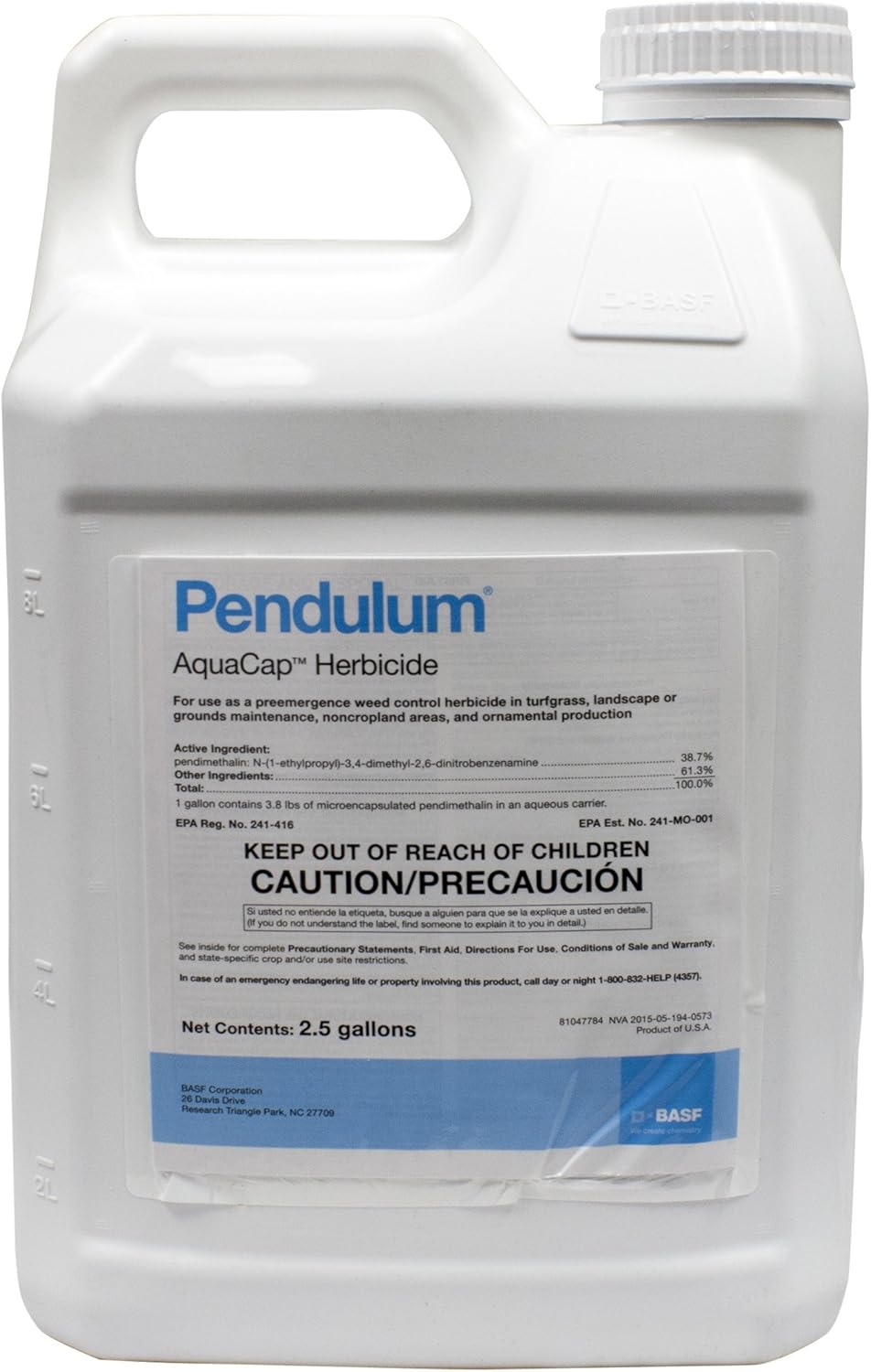
Pendulum Aqua Cap is a water-based, ultra-thin capsule formulation of pendimethalin designed to prevent grassy and broadleaf weeds before they emerge. It is mixed with water and applied evenly over turf or ornamental beds at labeled rates; the product's low odor and reduced staining make handling and cleanup easier than some solvent-based concentrates. The 2.5 gallon jug contains 38.7% active ingredient and claims coverage suitable for several acres when applied at recommended rates, which suits large lawns, commercial turf, or landscape managers who need long-lasting pre-emergent control. Practical benefits include flexible application rates for turf versus ornamentals, improved storage stability, and professional-level efficacy against a wide range of weeds. Important limitations are that it is a preventive product only so it will not control established weeds, and users must follow label directions carefully for application rates and timing to avoid crop injury to desirable ornamentals or newly seeded turf.
Best for: Buyers who prioritize strong, professional-level pre-emergent performance for large lawns, commercial turf, or landscape maintenance and who plan applications according to timing and label instructions.
Less Ideal for: Casual gardeners with only small beds or those needing a post-emergent weed control solution should consider simpler or different products.
- High active ingredient concentration (38.7% pendimethalin) for strong pre-emergent control
- Water-based ultra-thin capsule formulation for low odor and easier cleanup
- Large 2.5 gallon volume provides extensive coverage per container
- Separate recommended rates for turf and ornamentals allow flexible, targeted use
- Does not control established weeds since it is strictly a pre-emergent
- Requires careful timing and precise application rates to avoid harm to desirable plants
Verdict: Choose Pendulum Aqua Cap when you need a high-concentration, large-volume pre-emergent for reliable, professional-grade weed prevention over large turf or landscape areas.
Barricade 4FL Herbicide Concentrate (4 fl oz)

| Unit Count | 4 Ounce |
|---|---|
| Item Form | Spray |
| Coverage | Selective coverage for various grassy weeds |
| Active Ingredients | Prodiamine |
Barricade 4FL is a concentrated preemergent herbicide whose active ingredient, prodiamine, prevents weed seeds from germinating when applied as a diluted spray. It is used by mixing the concentrate per label directions and applying before target weeds emerge to protect lawns, turfgrass, ornamentals, container and field-grown plants. Notable features include long-lasting preemergent activity and selective control aimed at grassy weeds, so a single properly timed application can provide season-long suppression. Practical benefits for a lawn owner are reduced hand weeding and fewer visible grassy volunteers without directly harming established turf when labeled rates and timing are followed. Important limitations are that it does not control weeds that have already emerged and it requires careful timing, correct dilution and adherence to safety instructions to avoid non-target damage or environmental contamination.
Best for: A homeowner or groundskeeper who prioritizes consistent, season-long prevention of grassy weeds and prefers a product with established active ingredient and predictable performance.
Less Ideal for: Gardeners needing to kill already emerged weeds or those who want an immediate, post-emergent solution should choose a different product.
- Contains prodiamine for proven preemergent control of grassy weeds
- Concentrated formula lets users treat larger areas from a small bottle
- Labeled for use on lawns, turf, ornamentals, container and field-grown settings
- Long-lasting activity can reduce frequency of applications during a season
- No post-emergent activity so existing weeds must be removed separately
- Requires accurate dilution and correct timing to be effective
Verdict: Buy this if you want a reliable, long-lasting preemergent treatment to prevent grassy weeds from germinating in established lawns and ornamental areas.
Liquid Harvest Mesotrione Broadleaf Herbicide, 8 fl oz
| Liquid Volume | 8 fluid ounces |
|---|---|
| Item Form | Spray |
| Active Ingredients | Mesotrione |
| Coverage | 16 Fluid Ounces |
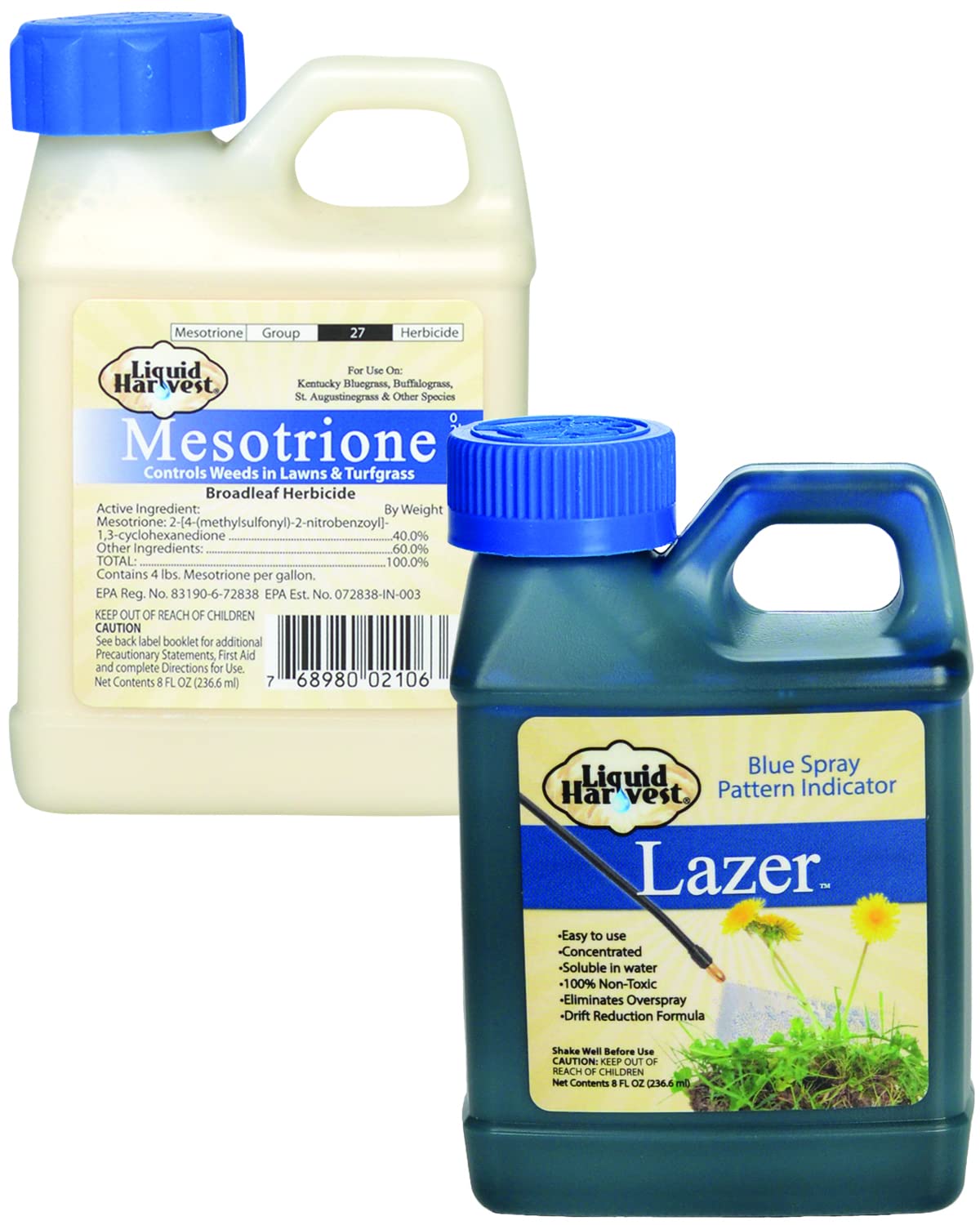
Liquid Harvest Mesotrione is a concentrated broadleaf herbicide designed for both pre-emergent and post-emergent use on lawns and turf. You mix small measured doses into water for spot treatments or larger tank mixes to cover more area, and the label lists recipes for spot applications and up to acre-scale treatments. The product contains mesotrione, which is systemic and inhibits photosynthesis in susceptible weeds, so you will often see visible decline within a few days and full control in two to three weeks after activation by rainfall or irrigation. It lists common targets such as dandelion, clover, crabgrass seedlings and chickweed, and is compatible with many cool-season grasses while advising against use on several warm-season species. The concentrate and clear dosing directions let a cost-conscious user treat multiple small patches or dilute for broader coverage, but careful reading of compatibility and watering instructions is required to avoid turf injury and ensure activation. Protective handling and equipment cleaning are necessary due to its potency.
Best for: Homeowners who want an economical, concentrated herbicide to treat persistent broadleaf weeds and seedlings across lawns and larger areas while controlling cost by diluting the product for multiple applications.
Less Ideal for: Gardeners with warm-season turf types listed as incompatible or those who prefer ready-to-use, non-concentrated products that require no measuring or mixing.
- Concentrated formula that can be diluted for spot or large-area treatments
- Active ingredient (mesotrione) works systemically for residual and contact control
- Label provides clear mixing rates for spot and acre applications
- Effective on a wide range of common lawn broadleaf weeds and some grass weeds
- Not safe for use on many warm-season turfgrasses so user must check compatibility before application
- Requires rainfall or irrigation to activate within 10 days or you must water to achieve control
Verdict: A cost-efficient mesotrione concentrate that gives budget-minded lawn owners flexible spot-to-large-area weed control when mixed and applied correctly.
Sim-Trol 4L Flowable Simazine Pre‑Emergent Herbicide (2.5 Gallon)

| Unit Count | 320 Fluid Ounces |
|---|---|
| Included Components | (1) 2.5 Gallon Jug of Simtrol 4L Herbicide |
| Item Form | Liquid |
| Active Ingredients | Simazine 42.8% |
| Coverage | Broad-spectrum coverage |
Sim-Trol 4L is a concentrated flowable formulation of simazine designed mainly for pre-emergent control of most annual grassy and broadleaf weeds. Applied in the fall or before weed germination, it creates a protective barrier in the soil and can also provide some post‑emergent activity against young seedlings. The product is tank‑mix compatible with many herbicides and liquid fertilizers, which makes it practical for integration into routine turf or nursery spray programs. It is labeled for use on golf course turf, sports turf, commercial and residential lawns, and Christmas tree plantings, so it suits large‑area applications where broad coverage is needed. The active ingredient concentration (simazine 42.8%) and the 2.5 gallon jug mean fewer refill trips and simpler mixing for repeat treatments. Users must follow label directions carefully for timing, rates, and safety precautions because simazine is persistent in soil and not suitable for all sites or sensitive ornamentals. Protective equipment and strict adherence to the label are important for safe, effective use.
Best for: Buyers who prioritize reliable, long‑lasting pre‑emergent control for large turf or commercial plantings and who follow label directions and safety protocols.
Less Ideal for: Homeowners with small lawns, mixed‑species ornamental beds, or those unwilling to follow specific application restrictions should consider more targeted or less persistent alternatives.
- High active ingredient concentration (Simazine 42.8%) for effective pre-emergent control
- Flowable formulation and 2.5 gallon jug reduce mixing frequency for large areas
- Tank‑mix compatible with many herbicides and liquid fertilizers for program flexibility
- Labeled for multiple turf and ornamental uses including golf courses and nurseries
- Persistent chemistry requires careful site selection and adherence to label restrictions
- Not appropriate for use around certain sensitive ornamentals and some turf types without checking label
Verdict: Choose Sim-Trol 4L when you need a concentrated, tank‑mixable pre‑emergent for reliable broad‑spectrum weed control across large turf and nursery areas.
Syngenta Tenacity Turf Herbicide, 8 oz
| Unit Count | 8 Fluid Ounces |
|---|---|
| Item Form | Liquid |
| Coverage | 2000 ft^2 per 1sp of product |
| Active Ingredients | Mesotrione |
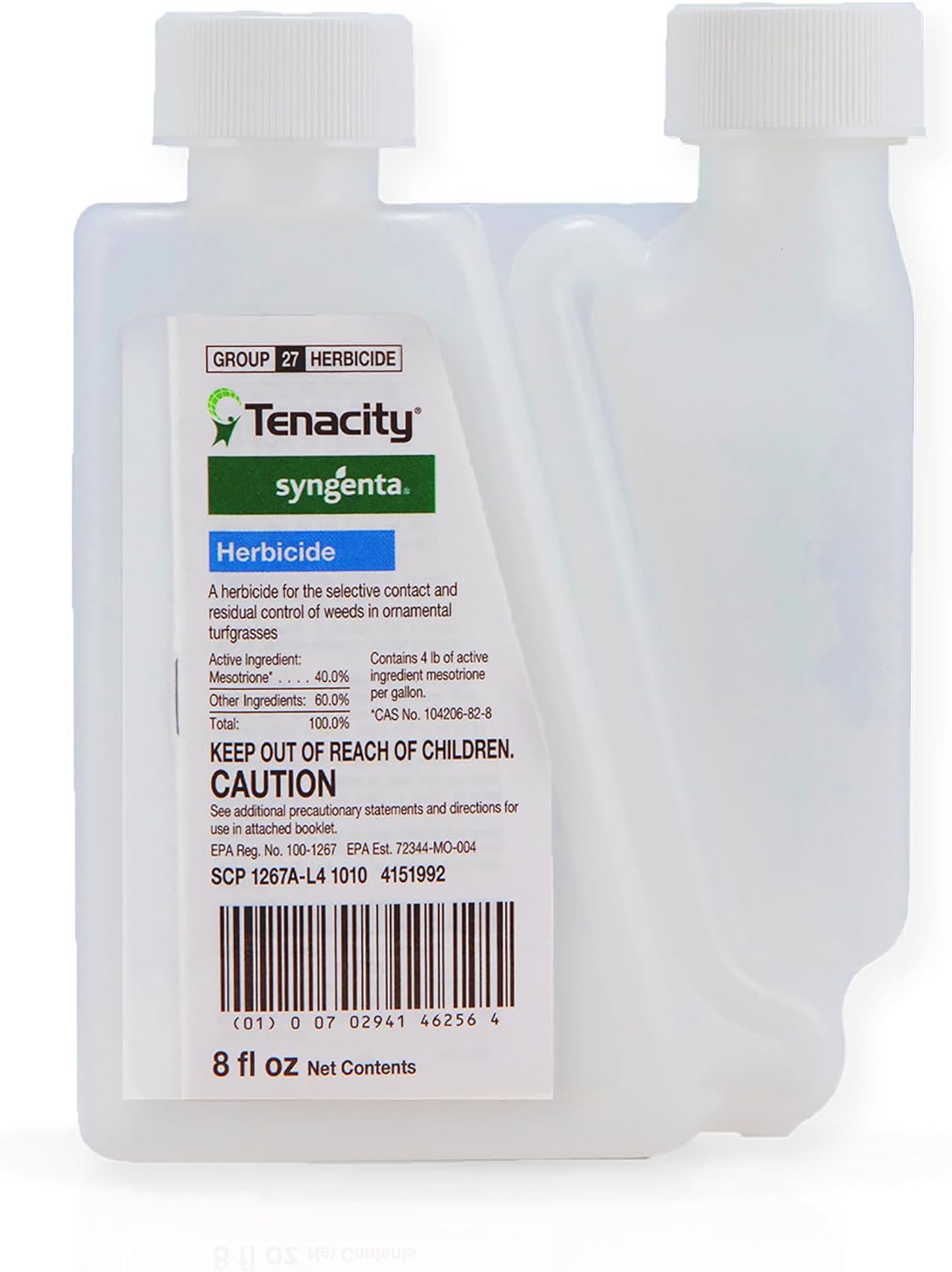
Tenacity Turf Herbicide is a concentrated mesotrione-based liquid designed for both pre-emergent and post-emergent control of common lawn weeds including crabgrass, clover, chickweed and dandelions. You apply it diluted according to label rates with a handheld or hose-end sprayer to target problem areas or broadcast across the lawn; when used as a pre-emergent it is taken up as weeds emerge and when applied post-emergent it acts systemically for selective control. The product covers a large area per bottle and the active ingredient provides residual control so you can expect longer suppression than a contact-only herbicide. Important practical points are that it is turf-selective so follow the label for grass species and mixing instructions to avoid turf injury, and results can take several days to appear. Also this is a concentrated chemical intended for careful, measured application rather than spot-use by people who prefer non-chemical methods.
Best for: Gardeners focused on strong, reliable crabgrass and broadleaf weed control who are comfortable using concentrated herbicides and following label directions for turf safety.
Less Ideal for: People seeking organic, mechanical, or spot-only solutions or those unwilling to follow detailed mixing and application instructions should consider other options.
- Systemic mesotrione active ingredient controls both pre- and post-emergent weeds
- Selective to turf when used per label, allowing treatment without killing desirable grass species
- Concentrated 8 oz liquid provides wide coverage per bottle
- Provides residual suppression, reducing frequency of repeat applications
- Requires careful mixing and adherence to label for turf safety
- Not a non-chemical or organic option for weed control
Verdict: Choose Tenacity when you want a concentrated, turf-selective herbicide that delivers pre- and post-emergent control of crabgrass and other common lawn weeds.
Choosing the Right Liquid Pre-Emergent Herbicide: Key Factors to Consider
Timing Window and Seasonal Targeting
When you apply a liquid pre-emergent herbicide determines whether it prevents germination of the weed species you care about. Many annual grassy weeds and broadleaf annuals germinate in narrow windows tied to soil temperature and seasonal cues. Applying too early wastes residual life before the germination flush; applying too late leaves seedlings unaffected.
Match the product label timing to local soil temperature or phenological signs, such as forsythia bloom or soil consistently reaching the recommended degrees. Some liquids have longer labeled residual windows and can tolerate earlier application; others work best just before the expected germination period.
Coverage Rate and Application Uniformity
Liquid products differ in labeled coverage per gallon and recommended spray volumes. Coverage affects how much product you need and how even the barrier will be over large lawns or irregular beds. Poor spray uniformity creates untreated gaps where weeds can establish.
Consider whether you will use a handheld pump sprayer, a tow-behind sprayer, or a backpack. Nozzle choice, spray pressure, and walking speed all change deposition. Products that work at lower spray volumes may be easier for small gardeners, while those needing higher carrier volumes can give more consistent coverage with adjustable nozzles.
Residual Longevity and Reapplication Needs
Residual longevity is how long the active ingredient continues to prevent seed germination after application. Shorter-residual products may require a follow-up application to cover long germination seasons, while longer-residual materials can protect through an entire flush.
Longer persistence can be convenient but may also extend the period during which newly seeded desirable plants are vulnerable. Understand the labeled reapplication interval and maximum annual application to plan around seeding schedules and to avoid overuse.
Plant Safety and Labeled Uses
Labels dictate where a liquid pre-emergent is safe to use. Some formulas are labeled for lawns and turf but not for vegetable gardens or around newly planted ornamentals. Others have restrictions on use near certain species or in newly seeded areas.
Always read the label for setbacks from desirable plants, maximum rates, and any crop rotation restrictions. Plant safety considerations determine whether a product is suitable for use in perennial beds, established turf, or transitional areas.
Mixing, Handling, and Application Ease
Ease of mixing influences whether you will apply the product correctly. Concentrated liquids need accurate measurement and thorough agitation to ensure the active ingredient stays in suspension. Some formulations settle or separate and require frequent agitation in the sprayer.
Also consider how tolerant the product is of common homeowner sprayers and whether the label specifies compatible adjuvants. Clear mixing directions and forgiving formulations reduce the risk of under- or over-application.
Environmental and Water Management Considerations
Liquid pre-emergents can be affected by rainfall, irrigation timing, and soil type. Heavy rain soon after application can dilute or move the active ingredient away from the intended zone, while dry conditions may limit incorporation into the germination zone.
Check the label for required irrigation timing after application and recommended soil incorporation methods. In sandy soils, movement may be greater than in loam or clay, so product selection and application timing should account for local soil texture and expected weather.
When To Apply in Different Climates
Regional climate dictates how you schedule a liquid pre-emergent herbicide. In cool-season turf regions, aim for the spring window tied to soil temperatures that signal crabgrass and other summer annuals are about to germinate. In warm-season turf areas, a late winter to very early spring application may be appropriate, with a second application in long warm seasons if the label allows.
- Use soil thermometers or local extension guidance to find the germination window.
- Observe plant cues like local tree or shrub bloom times to fine-tune timing.
Application Techniques for Even Barriers
Uniform coverage is the practical backbone of pre-emergent performance. Walk at a consistent pace, overlap spray swaths slightly, and choose nozzle types that match the recommended carrier volume. For narrow beds, a low-pressure fan nozzle can reduce drift and keep product on target.
- Maintain steady sprayer pressure and agitate the tank periodically for concentrates.
- Record spray width and pace to reproduce an even application next season.
Managing Treated Areas Around New Plantings
If you plan to seed a lawn or transplant seedlings, know the label's restrictions on seeding intervals after application. Many liquid pre-emergents will inhibit germination of desirable seed and some will require several months before you can safely seed. For transplants, some products have specific setbacks or require root-zone protection measures.
- Delay seeding until the label-allowed interval has passed.
- Consider spot-treating around transplants or using physical weed control near sensitive plants.
Integrating Pre-Emergents Into an Overall Weed Plan
A liquid pre-emergent is one tool among cultural practices. Combine proper mowing height, irrigation timing, and overseeding with pre-emergent use for the best long-term results. Address existing weeds with targeted post-emergent solutions before applying a pre-emergent so you are not masking established populations.
- Maintain dense, healthy turf to reduce space for weeds.
- Use post-emergents or mechanical removal for current weeds; pre-emergents stop new germination.
Safety and PPE Guidance for Gardeners
Even homeowner-labeled liquid products require thoughtful handling. Wear gloves, eye protection, and clothing that covers skin during mixing and spraying. Avoid drift onto edible crops and flowering plants visited by pollinators unless the label allows it.
- Mix and measure on a flat, stable surface to avoid spills.
- Follow label disposal instructions for leftover solution and rinsate.
How We Chose the Best Liquid Pre-Emergent Herbicide
We assembled the shortlist by prioritizing attributes that directly affect real-world weed prevention for gardeners and turf managers. Key evaluation criteria included coverage rate and spray pattern to assess how easily a product can protect large and irregular areas; labeled longevity and residual activity to determine how long the product prevents seed germination in one season; crop and turf safety to understand risks around ornamentals, vegetables, and recently seeded areas; ease of mixing and application to reflect typical homeowner sprayer setups; and weather and irrigation flexibility to gauge how soon rain or watering affects performance. We excluded granular-only formulations, products lacking clear labeled uses for home lawns or garden beds, and any materials without transparent active ingredient information. We also filtered out products whose labels restricted use in common residential settings. The final list focuses on liquid formulations with clear instructions for rates, timing windows, and labeled species control so gardeners can match a product to their planting calendar and watering routine.
FAQ
Can I use a liquid pre-emergent herbicide in vegetable beds?
It depends on the product label. Many pre-emergents are not labeled for use in vegetable gardens because they can inhibit seed germination for crops. Look for formulations explicitly labeled for ornamentals or vegetable-safe use, or use physical weed control and mulches in beds where you will seed or transplant.
How soon after application can I water or irrigate?
Label guidance varies. Some products require light irrigation to move the active ingredient into the germination zone, while others recommend waiting a specific number of hours to avoid runoff. Follow the product instructions for irrigation timing and amounts to ensure proper incorporation without washing the material away.
Will a liquid pre-emergent prevent weeds that are already growing?
No, pre-emergents prevent seed germination and are not effective on established plants. Use a targeted post-emergent or mechanical removal to eliminate existing weeds before applying a pre-emergent to reduce overall seed input.
Can I seed my lawn after using a liquid pre-emergent?
Often you must wait a label-specified interval before seeding; this can range from weeks to months depending on the active ingredient and rate. Some products are specifically labeled as safe for seeding after a short wait, but many will inhibit germination of desirable turf seed.
How does soil type affect product choice and performance?
Sandy soils can allow greater movement and potential leaching of some active ingredients, while heavier soils may retain the product nearer the surface where seeds germinate. Choose a product with labeled guidance for your soil type and follow irrigation instructions to limit unintended movement.
Is it safe to use a liquid pre-emergent near ornamentals and shrubs?
That depends on label restrictions. Some liquid pre-emergents are labeled for use in landscape beds and around certain ornamentals, while others are restricted. Check setback distances, root-zone warnings, and any species-specific cautions on the label before applying near desirable plants.
Final Verdict
Liquid pre-emergent herbicides are effective when matched to the right timing, application technique, and site conditions. Prioritize products with labeled uses that match your lawn or bed type, and balance residual longevity against plans to seed or transplant. Pay attention to coverage, mixing instructions, and weather windows to get an even protection barrier. When in doubt, follow label directions and coordinate pre-emergent use with cultural practices like proper mowing and irrigation. With the right timing and application, a liquid pre-emergent can significantly reduce annual weed pressure and ease seasonal maintenance.
