

Note: This article contains affiliate links. If you click on these links and make a purchase, I may earn a small commission at no extra cost to you. This helps support my research and content. Read my full affiliate disclosure here.
Dealing with a persistent mouse or rat problem changes how you plan baiting, placement, and household safety. The right lethal rodent poison will deliver reliable knockdown while letting you control exposure, odor, and where carcasses appear. This guide reviews a shortlist of top options suited to home and small-structure infestations, explaining the tradeoffs that matter in real gardens, garages, basements, and storage areas. We evaluated products on how well they attract target rodents, how controllable the application is, and what safety measures are practical for households and outdoor-adjacent spaces. Below are our top picks followed by the decision criteria and practical guidance to help you choose the best option for your situation.
Top Picks at a Glance
| Best Overall The best all-around choice for most situations | Tomcat Bromethalin Place Pacs Rodent Bait, 4.1 lb. |  |
| Best Quality Built to a higher standard if you want something more solid | Bell Laboratories Final Blocks Rodenticide 18 lb |  |
| Best Value The sweet spot between price and what you get | Ramik Bars Rodenticide, 4 lb (4 bars) |  |
| Best Budget The cheapest option that still gets the job done reliably | d-Con Corner Fit Mouse Poison Bait Station Refills, 10 Count |  |
| Highest Rated A top-rated pick with lots of positive feedback | Contrac All-Weather Blox Rodenticide (Bromadiolone) |  |
| Most Popular A crowd favorite that many people choose with confidence | Tomcat Bromethalin Bait Chunx Pail, 4.25 lb |  |
| Best Seller A high-volume bestseller chosen again and again | Tomcat Mouse Killer Disposable Child & Dog Resistant Bait Stations (2-Pack) |  |
Tomcat Bromethalin Place Pacs Rodent Bait, 4.1 lb.

| Unit Count | 1 Count |
|---|---|
| Item Type Name | Bait Pail |
| Target Species | Mouse |
| Manufacturer | The Scotts Company LLC |
Tomcat Bromethalin Place Pacs are a pre-portioned rodenticide intended to deliver a lethal dose to Norway rats, roof rats, and house mice. The product comes as individual 3-ounce place pacs inside a 4.1 pound pail, which makes distribution quick for both indoor and outdoor use around manmade structures when placed in tamper-resistant stations. Typical use is along walls, near gnawed openings, in corners, or inside bait stations; for rats the label recommends 1 to 2 pacs every 15 to 30 feet and for mice opening the pac and applying measured portions every 8 to 12 feet. The practical benefits are ease of placement, consistent dosing and efficacy against some anticoagulant-resistant rodents. Important limitations are safety requirements and restrictions: handlers must wear gloves and other protective gear, bait must be protected from children, pets and non-target wildlife with tamper-resistant stations for above-ground use, and the product has species-use restrictions in California. Expect to monitor and replenish bait sites for several days to achieve control.
Best for: Buyers who prioritize fast, dependable kill of rats and mice and want pre-measured bait for efficient placement around structures.
Less Ideal for: Households with young children, roaming pets, or frequent wildlife access where secure baiting cannot be guaranteed should consider non-toxic control methods or professional services.
- Pre-measured place pacs simplify consistent dosing and placement
- Contains bromethalin effective against some anticoagulant-resistant rats
- Formulated for both indoor and outdoor use when used in tamper-resistant stations
- Large 4.1 lb. pail supplies multiple placements for ongoing control
- Requires careful handling and protective gear to avoid exposure
- Must be used in tamper-resistant stations for above-ground application to protect children, pets, and non-target animals
- Not permitted for use against certain rodent species in California
Verdict: If you need a professional-strength, ready-to-place rodenticide that works on anticoagulant-resistant rats, these bromethalin place pacs deliver consistent, effective control when used safely.
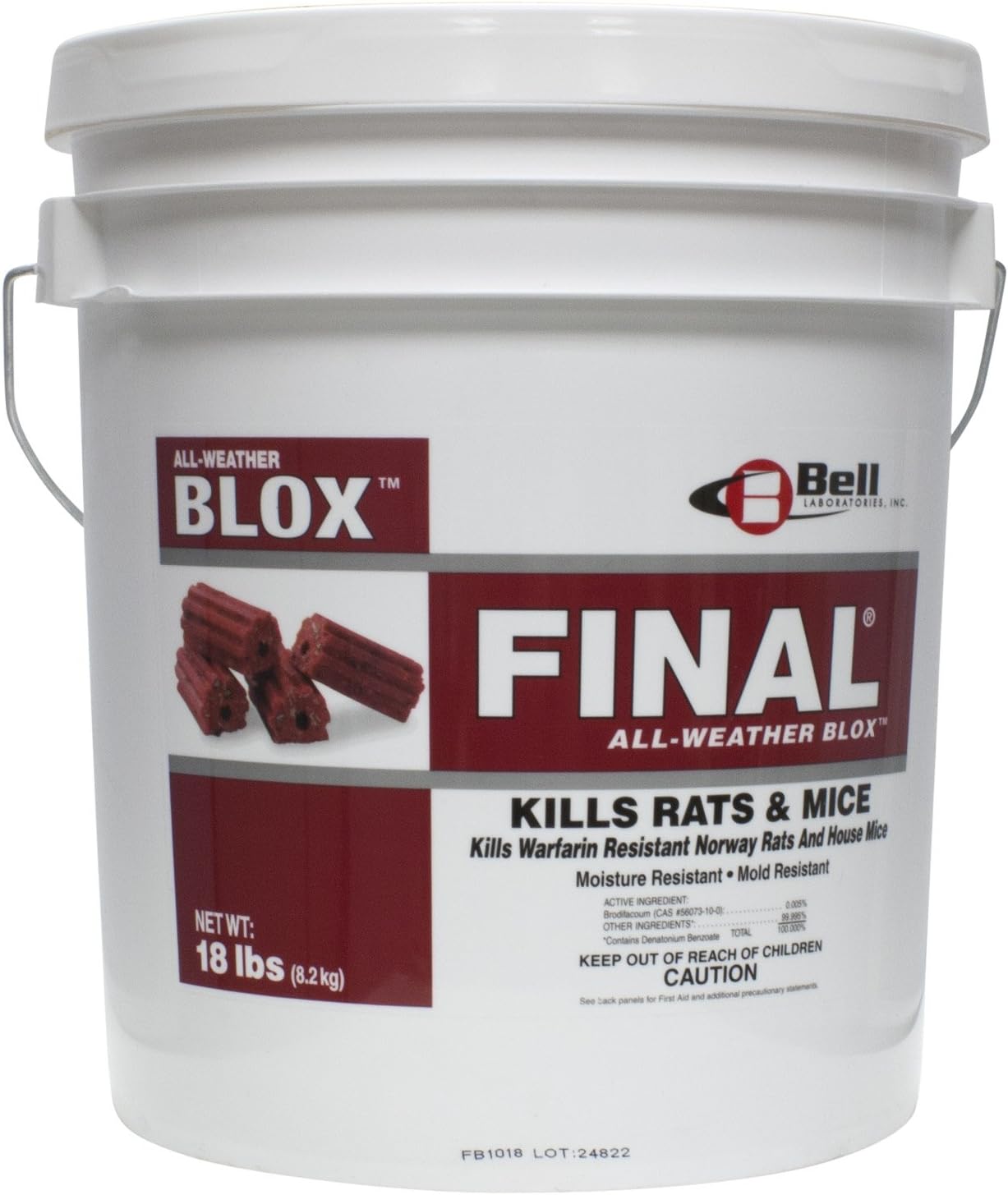
Bell Laboratories Final Blocks Rodenticide 18 lb
| Item Form | Spray |
|---|---|
| Target Species | Rodents |
| Item Weight | 19.9 pounds |
Final Blocks Rodenticide is a bulk block-style poison formulated for controlling rodents indoors and in outbuildings. It is presented as solid bait blocks designed to be placed in secure bait stations or locations rodents frequent; the block form helps keep bait in place and reduces scattering. Typical use is by distributing blocks around burrows, along runways, or inside tamper-resistant bait stations on a routine monitoring schedule. Practical benefits include a large 18 pound supply for sustained control programs and a concentrated formulation suited to professional or heavy residential infestations. Important limitations are that it is a toxic pesticide requiring careful placement in secured stations to keep pets and non-target wildlife away, and it assumes the user understands local regulations and safe handling. It does not include bait stations or measuring tools, so buyers should plan for storage and safe deployment accessories.
Best for: People managing moderate to heavy indoor or outbuilding rodent problems who prioritize an effective, long-lasting bait supply and will use tamper-resistant bait stations and proper safety practices.
Less Ideal for: Those with small, occasional mouse sightings, households with unsupervised pets or children, or anyone unwilling to follow pesticide safety rules should choose non-chemical or smaller packaged options.
- Large 18 lb supply suitable for multi-location or long-term control programs
- Block form resists scattering and stays in place along runways
- Designed for targeting rodents specifically, reducing wasted product
- Bulk pack is convenient for maintenance schedules without frequent repurchasing
- Contains toxic active ingredients and requires strict use in tamper-resistant bait stations
- No bait stations or placement accessories are included
- Not formulated or sold with child or pet-proof packaging integrated
Verdict: A bulk, block-style rodenticide that gives sustained, professional-strength bait supply for serious mouse control when used responsibly.
Ramik Bars Rodenticide, 4 lb (4 bars)

| Active ingredient | Diphacinone 0.005% |
|---|---|
| Item form | Bar |
| Unit count | 64 Ounce |
| Target species | Mouse, rat, meadow vole |
Ramik Bars deliver a food-quality, fish-flavored bait made with the active ingredient diphacinone for controlling house mice, Norway rats, roof rats and several other rodent species around buildings. The product comes as four 16-ounce scored bars that can be broken into one-ounce pieces and placed where rodents travel, in bait stations, or along rafters when using the mini bar style. It is formulated to resist moisture and wear, so it is usable in damp or wet areas and in both indoor and outdoor above-ground applications when used with tamper-resistant stations. Practical benefits include a palatable grain mix that encourages feeding and a low-concentration anticoagulant suitable for maintaining bait availability for the recommended 10 to 15 days until feeding stops. Limitations to keep in mind are legal use restrictions for certain species in some states and the requirement to use bait stations outdoors or where non-target access is possible, plus the need to follow label directions exactly because misuse is a legal violation.
Best for: Buyers who want a straightforward, measurable rodent control product to install in bait stations and maintain until activity stops; ideal for homeowners and facility managers focused on reliability and predictable bait usage.
Less Ideal for: People who need an instant-kill solution or those unwilling to follow label restrictions and use tamper-resistant bait stations; not a fit for open ground or non-bait-station outdoor deployments.
- Scored bars break into consistent one-ounce portions for easy placement and replenishing
- Fish-flavored, food-quality grain mix increases palatability to rodents
- Formulated to resist moisture and wear so it can be used in damp areas
- Suitable for indoor and outdoor above-ground use when used in tamper-resistant bait stations
- Contains a first-generation anticoagulant so it requires continuous fresh baiting for several days to be effective
- Not permitted for use against certain species in some states, so legal restrictions apply
Verdict: A practical, moisture-resistant bait bar system that provides reliable, easy-to-place anticoagulant bait for sustained control of mice and rats.
d-Con Corner Fit Mouse Poison Bait Station Refills, 10 Count

| Unit Count | 10 Count |
|---|---|
| Target Species | Mouse |
| Active Ingredients | Cholecalciferol |
This 10-count refill pack supplies the bait that fits d-Con corner-fit refillable stations and is formulated with cholecalciferol rather than traditional anticoagulants. You load the bait into the low-profile, tamper-resistant station and place it where you see mouse activity such as corners, behind appliances, attics or garages. The active ingredient is designed to be attractive to mice and can stop visible activity within a few days once mice consume the bait. The refillable format makes it easy to swap in fresh bait without replacing the entire station, and the manufacturer notes the station is weather-resistant for limited outdoor use. Important limitations are that this is a lethal control intended for rodents and contains a vitamin D derivative as the active ingredient, so users must follow label directions carefully to avoid accidental exposure to pets or children and to comply with local disposal rules. Also, bait effectiveness depends on proper placement and mice feeding on it, so monitoring and moving stations may be necessary.
Best for: Buyers who want a proven, replaceable bait option for established mouse activity and who prioritize products with social proof and a more familiar active ingredient profile.
Less Ideal for: People who need nonlethal or catch-and-release rodent solutions or who cannot guarantee secure placement away from children and pets.
- Contains cholecalciferol formulation instead of anticoagulant neurotoxins
- Refill pack fits d-Con corner-fit refillable stations for easy replacement
- Low-profile, tamper-resistant bait station design reduces access by children and pets
- Weather-resistant formulation and station suitable for indoor and limited outdoor placement
- Lethal to rodents so requires careful handling and strict adherence to label safety directions
- Effectiveness depends on mice actually feeding on the bait and correct placement of the station
Verdict: If you want a refillable, tamper-resistant bait option with cholecalciferol for quickly reducing house mouse activity, these 10-count refills are a practical choice.
Contrac All-Weather Blox Rodenticide (Bromadiolone)

| Active Ingredient | Bromadiolone |
|---|---|
| Form | 1-ounce center-hole blox |
| Manufacturer | Bell Labs |
Contrac All-Weather Blox is a maintenance and clean-out rodent bait sold as 1-ounce blocks designed for single-feed control of mice and rats, including some warfarin-resistant individuals. The blox formulation uses food-grade ingredients and low wax to make the bait highly attractive while holding up in damp or outdoor conditions, and the center-hole design fits standard tamper-resistant bait stations. It contains bromadiolone, a second-generation anticoagulant effective with fewer feedings compared with first-generation products. Practical benefits include strong palatability that encourages consumption and a bait form that is easy to place and inspect in stations. Important limitations are the toxic active ingredient, which requires strict use inside locked stations to protect pets and wildlife, and that it cannot be sold in California. There is also the need to plan for safe carcass disposal and to have vitamin K1 available as an antidote in case of accidental non-target exposure.
Best for: Buyers who prioritize reliable, single-feed rodent control and plan to use locked bait stations and safe handling practices to minimize non-target exposure.
Less Ideal for: Households with unsupervised pets or children, or users unwilling to follow strict containment and carcass disposal procedures should consider less hazardous control methods.
- Formulated for high palatability to encourage single-feed uptake
- Low-wax, weatherable blocks suitable for use in damp or outdoor bait stations
- Center-hole 1-ounce blox fit common tamper-resistant bait stations for safer deployment
- Contains bromadiolone for effective control of warfarin-resistant rodents
- Contains a potent anticoagulant that poses significant risk to pets and non-target wildlife
- Not available for sale in California
Verdict: Choose Contrac All-Weather Blox when you need a weatherable, highly palatable single-feed rodenticide for dependable control placed inside tamper-resistant stations.
Tomcat Bromethalin Bait Chunx Pail, 4.25 lb

| Item Form | Bar |
|---|---|
| Target Species | Rodents |
| Net Weight | 4.25 lb |
This Tomcat pail contains preformed 1 oz. bromethalin bait blocks intended for tackling mice, Norway rats, roof rats, and meadow voles in and around buildings. It is packaged for professional or agricultural use and is typically deployed inside tamper-resistant bait stations placed in basements, garages, crawl spaces, and around foundations within 100 feet of structures. The bait is fast-acting so rodents often consume a lethal dose in a single night and mortality can occur within a few days. The large 4.25 lb. pail supplies many placements and makes regular monitoring and replenishment simple. Important practical points are that outdoor placements must be in weather- and tamper-resistant stations and the label restricts use against certain species in California. Because this contains an acute pesticide, care is needed to keep it inaccessible to children, pets, and non-target wildlife and to follow local regulations and label directions.
Best for: Buyers who want a professional-strength, ready-to-use rodent bait for systematic control around buildings and who plan to use tamper-resistant stations and follow label directions.
Less Ideal for: Casual homeowners who cannot commit to secure bait station use or who need a rodent solution safe for free outdoor placement around pets and wildlife.
- Preformed 1 oz. blocks are easy to place and monitor in bait stations
- Contains bromethalin which is effective against anticoagulant-resistant rodents
- Large 4.25 lb. pail supplies many bait placements for ongoing control
- Suitable for indoor and outdoor use when placed in tamper-resistant stations
- Requires tamper- and weather-resistant bait stations for safe outdoor use and to protect non-targets
- Not permitted for use on several listed species in California and must be used according to label restrictions
Verdict: Choose this product when you need a professional-grade, preformed bromethalin bait supply for effective, managed rodent control around structures.
Tomcat Mouse Killer Disposable Child & Dog Resistant Bait Stations (2-Pack)

| Unit Count | 2 Count |
|---|---|
| Target Species | Mouse |
| Item Type Name | for Indoor/Outdoor Use |
| Included Components | Rodent Trap |
Tomcat Mouse Killer disposable stations come ready to use with a preloaded bait block inside a clear-lidded, tamper-resistant housing. You place the small stations where mice travel—along walls, in corners, behind appliances, or near burrows—and the bait attracts and kills mice that feed and leave the station. The clear lid makes it easy to check bait levels and the weather-resistant, child- and dog-resistant design lets you use them in garages, attics, and other semi-exposed spots without worrying about pets or kids accessing the poison. Because each unit is disposable and pre-baited there is no handling of loose bait, which simplifies setup and disposal. The package contains two stations, so this is best for spot treatment rather than an ongoing multi-station program. If you need broader or longer-term control you will want larger packs or a refillable system, but for quick targeted indoor use these stations are simple and effective.
Best for: Buyers who want a low-cost, low-effort spot treatment to quickly address a small indoor mouse problem and who prioritize safety and ease of use over long-term coverage.
Less Ideal for: Homes with heavy or widespread infestations or users who prefer reusable refillable systems for ongoing control should look at larger multi-station or refillable options.
- Ready-to-use pre-baited stations require no handling of loose poison
- Child- and dog-resistant housing reduces accidental access risk
- Clear lid lets you monitor bait without opening the station
- Weather-resistant design suitable for garage and attic placement
- Only two disposable stations in the box so coverage is limited for larger infestations
Verdict: A simple, safety-focused two-station kit that lets budget-minded buyers set and monitor pre-baited mouse poison with almost no setup.
Choosing the Right Lethal Rodent Poison: Key Factors to Consider
Bait Attractiveness and Formulation
Rodents will only consume what they find palatable. Formulation matters because different species prefer different textures and food bases. A granular or pellet bait may be suitable for some rat populations, while mice often prefer softer block baits. Weather exposure, humidity, and competing food sources in the area also change how attractive a bait remains over time.
Choosing a formulation that maintains scent and texture in the intended placement environment increases uptake and reduces the need for repeated applications. Consider how the bait will be secured or protected from the elements to preserve attractiveness.
Time-to-Action and Carcass Location
Lethal poisons vary in how long it takes for rodents to succumb after ingesting a lethal dose. Faster-acting formulations can reduce the chance of bait sharing and ongoing damage, but they may also cause rodents to die where they were feeding, which could be inside walls or hidden voids. Slower-acting products may allow rodents to return to exposed locations before dying, simplifying retrieval and reducing odor issues.
Think about where carcasses are likely to be found at your property and how easy it will be to access those locations. If retrieval is difficult, choose a formulation or placement method that encourages mortality in accessible areas.
Containment and Tamper-Resistant Placement
Limiting access to bait is essential for household safety and non-target protection. Bait stations, secured trays, and tamper-resistant packaging reduce accidental exposures for children, pets, and wildlife. The ability to lock or anchor bait containers is a major practical advantage, especially in busy yards or shared spaces.
Evaluate whether the product can be used inside approved bait stations or whether additional containment will be required. If you plan to place bait outdoors near gardens or compost areas, choose containment methods that prevent spill and scavenging by birds or small mammals.
Label Instructions and Safety Information
Clear, specific label directions are critical when working with lethal poisons. Good labeling explains target species, legal application sites, first-aid measures, and disposal instructions. It also specifies how to reduce risks to non-targets and when bait stations or other containment are required.
Prioritize products with straightforward, readable directions that match your intended use. Labels that list compatible bait stations, recommended placement distances from food areas, and carcass handling instructions make safe fieldwork easier.
Dose Control and Repeat Application Needs
Some formulations require multiple feedings to reach a lethal dose while others are single-dose. Multi-feed products can be less likely to produce immediate carcasses in hidden locations but may need longer monitoring and more bait. Single-dose baits tend to produce faster knockdown but require stricter control to avoid non-target exposures.
Plan for monitoring intervals and the amount of bait you will need. If your infestation is likely to be prolonged, consider whether the product allows phased or spot treatments to limit overall bait usage.
Disposal and Environmental Considerations
Handling and disposing of uneaten bait and rodent carcasses affects both safety and compliance. Some labels require specific disposal methods for contaminated containers, leftover bait, or carcasses found in the field. Environmental conditions also determine how long residues persist and whether scavengers might be secondarily exposed.
Ensure you can follow disposal instructions where you live and consider containment and placement strategies that minimize the chance of secondary poisoning of birds and mammals.
Safe Placement Strategies
Placement determines both effectiveness and safety. Place baits where rodents travel, such as along walls, near burrow openings, or in sheltered runways, rather than out in the open. For indoor use, place baits inside cabinets, basements, attics, or utility areas where pets and children cannot reach them.
Use approved tamper-resistant bait stations whenever possible. Anchor stations to the floor or ground to prevent tipping and check them regularly. When outdoors, place stations on level ground and out of direct sun or heavy rain to protect bait integrity.
- Target high-activity areas like along walls and near food sources
- Avoid open garden beds and areas accessible to wildlife
- Inspect stations and replace soaked or degraded bait promptly
Monitoring and Recording Results
Regular monitoring tells you whether the chosen strategy is working. Check stations at least every few days during active treatment to note bait uptake, refill needs, and any carcass locations. Keep a simple log of dates and observations so you can adjust placement and quantity over time.
If bait uptake is low, try moving stations closer to known activity or switching bait form. If carcasses are found in inaccessible voids, consider relocating baits to more open areas to improve recovery chances.
- Inspect stations 2 to 3 times per week initially
- Record bait weight or remaining pieces when possible
- Adjust placement based on observed feeding patterns
Protecting Non-Target Animals
Non-target protection starts with containment and ends with placement choice. Use locked bait stations and keep them off the ground where curious wildlife cannot access them. Avoid placing loose bait in areas frequented by birds, pets, or scavengers.
When working near gardens, keep bait stations away from compost piles, pet food, and bird feeders. If you have outdoor cats or free-roaming dogs, choose stations and placements that are inaccessible to those animals.
- Prefer enclosed bait stations over loose bait in open areas
- Move stations away from bird feeders and pet feeding zones
- Notify household members about active bait stations and safety precautions
Dealing With Odors and Hidden Carcasses
A common concern with lethal control is odor from carcasses found inside walls or other voids. To reduce the risk, consider baiting strategies that encourage rodents to return to more accessible locations before dying, such as placing fresh bait near exits or in sheltered external stations.
If you suspect carcasses in a void, increase ventilation where possible and monitor for pests that scavenge on carcasses. For persistent odor problems, consult local waste handling guidance for safe carcass disposal.
- Favor placements that keep dying animals in retrievable locations
- Ventilate enclosed areas after retrieval when safe
- Follow label guidance for carcass handling and disposal
Legal and Local Restrictions
Regulations for rodent poisons vary by location. Some formulations or active ingredients may be restricted for homeowner use in certain jurisdictions. Check local agricultural or environmental agency guidance to confirm permitted products and approved application sites.
If restrictions apply, consider alternative integrated pest management approaches such as trapping, exclusion, and sanitation to complement permitted chemical options.
- Confirm local rules before applying labeled poisons
- Document where and when you place baits in case of inspection
- Use non-chemical methods where legal restrictions limit options
How We Chose the Best Lethal Rodent Poison
We selected products that balance fast, reliable control with practical safety options for homes, garages, yards adjacent to structures, and small outbuildings. Our editorial filters focused on bait formulation and palatability to target species, dose and time-to-effect characteristics that influence where carcasses may be found, and packaging options that limit non-target access. We also prioritized products offering clear usage directions for bait station compatibility and child or pet protection measures. Criteria used in selection included bait acceptability to common commensal species, documented latency to mortality, containment or tamper-resistant packaging, and clarity of label instructions for safe placement and disposal. We excluded items marketed solely for professional pest controllers with no clear homeowner-use guidance, and formulations that require specialized licensing or equipment to apply. Overall, we favored options that let gardeners and homeowners manage where and how baits are placed, reduce the chance of accidental ingestion by non-target animals, and make carcass recovery predictable. The scorecard metrics reflect those priorities and guided which products were shortlisted for this roundup.
FAQ
How long after placing lethal bait will rodents die?
It depends on the formulation. Some products act within 24 to 72 hours while others require multiple feedings over several days. Time-to-death affects where carcasses are likely to be found and how often you should check bait stations.
Can children or pets be harmed by bait placed in stations?
With proper tamper-resistant stations and secure placement the risk is greatly reduced. However, loose bait or improperly secured stations can expose children and pets. Always follow label instructions and keep stations locked and out of reach.
What should I do if I find a rodent carcass in a wall?
If a carcass is in an inaccessible void, increase ventilation in the area and attempt to locate an access point for removal. Use gloves and follow label disposal instructions. If retrieval is impossible, consult local guidance for dealing with decomposing animals in structures.
Are there safer alternatives to lethal poisons?
Yes. Non-lethal approaches include live traps, exclusion work to seal entry points, improved sanitation, and habitat modification to make the area less attractive to rodents. These methods can be effective alone for small problems or used alongside lethal control when needed.
How should I dispose of unused bait and empty containers?
Follow label instructions precisely. Many labels require sealed disposal or returning empty containers to specified waste streams. Do not scatter unused bait or discard containers in open trash where wildlife can access them.
Will rain or humidity make bait less effective outdoors?
Yes. Exposure to moisture can reduce bait palatability and cause degradation. Use waterproof stations, place baits under cover, and inspect stations after heavy rain to replace spoiled bait.
Final Verdict
When choosing a lethal rodent poison, balance how quickly you need control with how and where you can safely place bait. Prioritize formulations and packaging that let you confine bait to tamper-resistant stations and that provide clear directions for placement and disposal. Expect tradeoffs between speed of action and carcass location: faster knockdown may increase the chance of hidden deaths while slower options require longer monitoring. Decide first on the containment and monitoring you can commit to, then select a formulation whose time-to-action and bait form match those constraints. That approach will give you predictable results while minimizing non-target risks and practical headaches.
