

Note: This article contains affiliate links. If you click on these links and make a purchase, I may earn a small commission at no extra cost to you. This helps support my research and content. Read my full affiliate disclosure here.
An automatic compost bin can turn kitchen scraps and yard trimmings into usable compost with less work and fewer odors than traditional piles. For gardeners who want steady, hands-off decomposition and predictable results, the right automatic unit makes a big difference in how quickly material breaks down and how often you need to empty or maintain the system. This guide covers six shortlisted automatic compost bins that represent the range of capacities, running styles, and maintenance demands you are likely to encounter. We evaluate them on practical gardener-focused criteria like decomposition speed, odor control, and ease of maintenance to help you pick the model that fits your space and composting rhythm.
Top Picks at a Glance
| Best Overall The best all-around choice for most situations | Reencle Gravity Electric Kitchen Composter (22L) |  |
| Best Quality Built to a higher standard if you want something more solid | GEME PRO 19L Electric Kitchen Composter |  |
| Best Value The sweet spot between price and what you get | iDOO 3L Electric Kitchen Composter |  |
| Best Budget The cheapest option that still gets the job done reliably | Home Zone Living Electric Pre-Composter (3 L) |  |
| Highest Rated A top-rated pick with lots of positive feedback | Saluna 4L Electric Kitchen Composter with LED Display and Visible Window |  |
| Most Popular A crowd favorite that many people choose with confidence | Reencle Prime Electric Composter, 14L |  |
Reencle Gravity Electric Kitchen Composter (22L)

| Capacity | 22 liters |
|---|---|
| Input Capacity (max daily) | 3.3 lbs |
| Material Type | Plastic |
| Model Number | RC-GT500 |
The Reencle Gravity is an electric kitchen composter designed to turn daily food scraps into usable compost quickly and with minimal fuss. It accepts typical household food waste and uses a microorganism-driven aerobic process to decompose up to about 3.3 pounds in a day, while the included starter and booster packs help jump-start cycles. Practical features include automatic lid functions, built-in weight and time tracking to monitor throughput, and a three-layer carbon filter system to keep odors contained. The unit is intended for countertop or utility-room use where quiet operation matters, since its advertised noise level is very low and it consumes modest power. Setup comes with filters and basic tools so you can start composting right away. Limitations to note are the unit size and weight, which make it less portable, and the dependence on consumables like filters and starter packs for optimal odor control and performance. Users should also expect some routine maintenance to remove processed material and replace filters over time.
Best for: Buyers who want a low-effort, indoor solution to reduce kitchen food waste and prefer a compact appliance that automates composting and provides measurable tracking.
Less Ideal for: People who need a large-capacity yard or municipal-scale composter or who prefer a purely passive bin with no consumable parts.
- Rapid decomposition using microbial/aerobic processing for small daily inputs
- Built-in weight and time tracking to monitor composting cycles
- Three-layer carbon filtration system aimed at controlling kitchen odors
- Includes starter pack, booster and basic tools so you can begin composting immediately
- Relatively heavy and bulky for frequent relocation or small counters
- Performance depends on consumable supplies like filters and starter packs
Verdict: A convenient countertop electric composter that automates fast, low-noise indoor composting for households wanting an easy, measurable way to cut food waste.
GEME PRO 19L Electric Kitchen Composter

| Capacity | 19 liters |
|---|---|
| Daily processing | Up to 11 lbs |
| Compost time | 6–8 hours |
The GEME PRO 19L electric composter is designed to convert everyday kitchen scraps into usable organic compost quickly using microbial degradation rather than dehydration. You load food waste directly into the 19-liter drum any time and the unit runs continuously, processing up to about 11 pounds per day and producing finished material in roughly 6 to 8 hours. Notable features include a permanent industrial-grade filter that the manufacturer says never needs replacing, an integrated deodorization system for low odor, and quiet operation for indoor use. The practical benefits are fast turnaround so you can harvest soil conditioner within hours, fewer trips to an outdoor bin, and reduced ongoing maintenance because the filter and routine cleaning requirements are minimal. Important limitations are its size and weight for placement in a small kitchen, and reliance on the included microbial starter supply to maintain breakdown performance over time. Also expect some electricity consumption compared with passive composting methods.
Best for: Buyers who prioritize fast, reliable on‑site composting and want a low-maintenance indoor unit that turns daily food waste into usable compost within hours.
Less Ideal for: People with very small kitchens or who prefer passive, electricity-free composting methods should consider other options.
- Fast processing: produces usable compost in about 6–8 hours using microbial degradation
- High daily capacity: can handle up to roughly 11 pounds of food waste per day
- Permanent built-in filter reduces ongoing maintenance and filter replacement costs
- Odor control and quiet operation make it suitable for indoor kitchen placement
- Relatively large and heavy for tight kitchens which can limit placement options
- Requires proprietary microbial starter (Kobold) to maintain optimal performance
Verdict: If you want rapid, low‑maintenance indoor composting that turns daily food waste into real compost in hours, this 19L GEME unit delivers performance-focused results.
iDOO 3L Electric Kitchen Composter

| Capacity | 3 liters |
|---|---|
| Material Type | Plastic |
The iDOO 3L electric composter is designed to turn daily kitchen scraps into pre-compost with minimal effort. You load food waste into the top chamber, choose a process or use automatic mode, and the unit uses high-temperature drying plus milling and a cooling phase to produce finished material in a few hours. Notable features include a removable inner bin for easy emptying, an activated-carbon odor filter with a multi-hour service life, an auto-clean option, and child-lock safety interlocks. In practical use it is well suited to singles or small households who want to reduce landfill waste and create a garden amendment without traditional backyard composting. Expect a small footprint that fits on a counter and straightforward controls, but be prepared to change filters periodically and follow the manual for items to exclude from the load. The machine can emit odors if protective stickers or filters are not installed correctly, and it is intended for food waste only rather than large-volume or very wet materials.
Best for: Buyers who want a low-effort, countertop solution to divert daily kitchen scraps into usable pre-compost and prioritize convenience over processing large volumes.
Less Ideal for: Households that produce large amounts of food waste, gardeners needing finished compost in bulk, or users who prefer traditional outdoor composting systems.
- Automatic drying, grinding, and cooling cycles convert scraps into pre-compost in hours
- Compact 3 liter capacity fits on a countertop for small households
- Removable inner bin and simple controls make emptying and maintenance straightforward
- Activated carbon filter and airtight design reduce kitchen odors during operation
- Limited 3L capacity is not suitable for larger households or heavy daily waste
- Requires periodic filter replacement and adherence to exclusion list to avoid odors or jams
Verdict: A compact, automated countertop composter that efficiently converts small amounts of kitchen scraps into pre-compost for gardeners who value convenience.
Home Zone Living Electric Pre-Composter (3 L)

| Capacity | 3 liters |
|---|---|
| Noise level | Under 45 dB |
| Item Type Name | Electric Composter |
| Material Type | Plastic |
This Home Zone Living electric pre-composter is designed to turn daily food scraps into pre-compost in a small kitchen-friendly footprint. You load up to the 3-liter drum with fruit and vegetable scraps, start the automated cycle and the unit grinds and dries the material while an activated carbon filter helps control odors. It runs quietly at under 45 dB and includes an auto-cleaning and automatic shutoff after cooling to conserve energy. Practical benefits include a compact size that fits on a counter or under a cabinet, straightforward operation for frequent small loads, and reduced odor compared with an uncontained bin. Limitations are the modest 3-liter capacity, which means more frequent emptying for larger households, and the plastic construction that may feel less durable than metal alternatives. It also produces pre-compost rather than finished compost, so outdoor composting or soil mixing is still needed to finish the process.
Best for: Best for budget-minded single occupants or couples who want a low-effort way to cut kitchen waste and produce pre-compost without a large appliance footprint.
Less Ideal for: Not a good fit for large households or users who need finished compost straight from the unit rather than pre-compost that needs outdoor finishing.
- Compact 3 liter capacity fits on counters and in small kitchens
- Activated carbon filter helps reduce cooking and food odors
- Quiet operation below 45 dB suitable for indoor use
- Auto-cleaning cycle and automatic power-off for low-maintenance use
- Small capacity requires frequent emptying for multi-person households
- Made of plastic which may be less robust than metal-bodied models
Verdict: A compact, energy-conscious electric pre-composter that offers quiet, low-maintenance odor control for budget-minded kitchens.
Saluna 4L Electric Kitchen Composter with LED Display and Visible Window
| Capacity | 4 liters |
|---|---|
| Material Type | Metal, Stainless Steel |
| Item Highlight | One-Touch Produces Dry Pre-Compost, LED Display, Odorless & Auto-Cleaning |
| Model Number | Fc-385w |
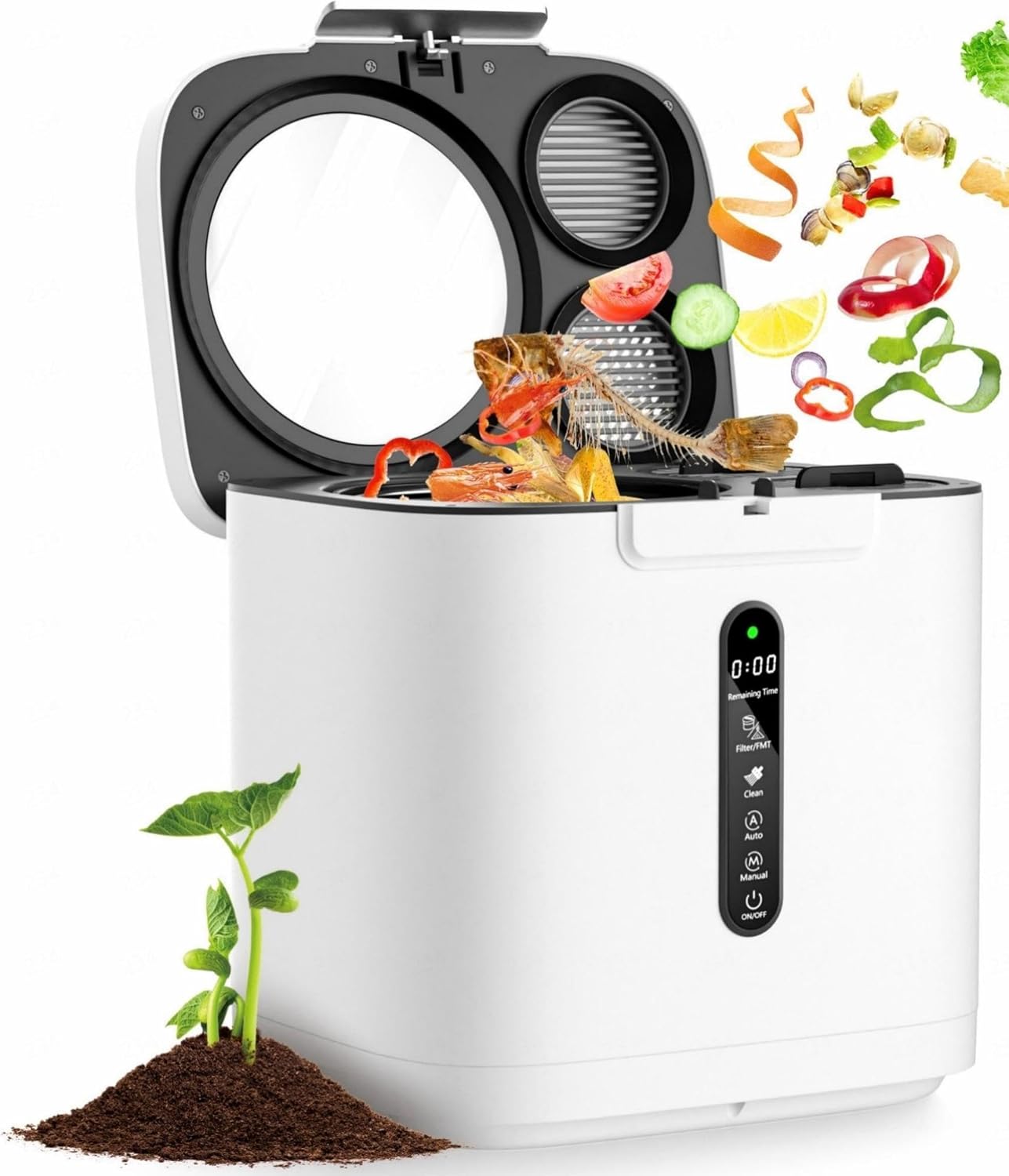
This Saluna 4L electric kitchen composter is designed for daily indoor use on a countertop to reduce food waste into a dry pre-compost product. It offers three programmable composting modes shown on an LED panel so you can set cycle time and monitor progress through the clear viewing lid without breaking the seal. Practical features include dual activated carbon filters for odor control, a removable stainless steel bucket that is dishwasher-safe, and a one-touch auto-cleaning rinse to simplify maintenance. The unit’s 4 liter capacity fits typical household scrap volumes for one to a few people but will require more frequent emptying in larger households. Because it concentrates material into a dry pre-compost rather than finished garden-ready compost, you will still need a backyard compost pile, worm bin, or municipal collection for final decomposition. The build appears aimed at durability with metal and stainless components, and the visible window and simple controls make it easy to integrate into a reliable kitchen routine.
Best for: A buyer who wants a dependable, low-fuss indoor system to reduce daily kitchen waste and prefers predictable, easy-to-use controls for routine composting.
Less Ideal for: Not well suited for households that need large-volume processing or gardeners who expect finished, soil-ready compost straight from the machine.
- Compact 4 L capacity suited to countertop placement and everyday kitchen scraps
- Three LED-controlled modes and visible lid let you monitor and customize cycles
- Dual activated carbon filters reduce kitchen odors during operation
- Removable stainless steel bucket is dishwasher-safe for easier cleaning
- One-touch auto-cleaning simplifies maintenance between uses
- 4 liter capacity requires frequent emptying for larger households or heavy cooking
- Produces dry pre-compost rather than finished compost, so further processing is needed
Verdict: Choose this compact electric composter if you want a reliable, low-maintenance countertop unit that turns daily scraps into dry pre-compost with straightforward controls and built-in odor control.
Reencle Prime Electric Composter, 14L

| Capacity | 14 liters |
|---|---|
| Material Type | Polypropylene (PP) |
| Item Type Name | Electric Composter |
The Reencle Prime is a countertop electric composter designed to turn everyday food scraps into finished compost quickly while keeping odors and noise to a minimum. You load mixed scraps (including meat, dairy, citrus and leftovers but not large bones or pits) into the 14 L chamber, the unit activates its aerobic microbe process and filtration system, and living microbes accelerate decomposition so you get usable material within weeks rather than months. Notable features are a three-layer carbon filter for low-odor operation, a hands-free lid, a whisper-quiet motor rated as low as 28 dB, and a starter pack plus shovel included so you can begin right away. The compact rectangular design fits on a kitchen counter and handles small household output — the manufacturer lists up to about 2.2 lb of daily waste processing. Trade-offs are capacity and throughput: the 14 L bin and the daily processing rate suit small households or couples but will require more frequent emptying for larger families, and the unit is a dedicated appliance that uses electricity and occasional filter replacements. For buyers wanting fast, low-odor indoor composting without outdoor bins, this is a practical, easy-to-use option.
Best for: Homeowners or renters who want a straightforward indoor solution to convert daily kitchen scraps into compost quickly and with minimal odor, and who prioritize ease of use and social reassurance from a well-reviewed device.
Less Ideal for: Large households that produce heavy daily food waste or gardeners who need high-volume outdoor composting should choose a larger or outdoor system instead.
- Rapid microbial decomposition that produces usable compost much faster than traditional methods
- Three-layer carbon filter and sealed design reduce kitchen odors
- Whisper-quiet operation (as low as 28 dB) suitable for indoor use
- Includes starter pack, shovel, and one carbon filter so you can begin immediately
- 14 L capacity and stated daily processing limit mean frequent emptying for larger households
- Requires electricity and periodic filter replacements
Verdict: A compact, low-odor electric composter that makes fast, hassle-free indoor composting practical for small households.
Choosing the Right Automatic Compost Bin: Key Factors to Consider
Decomposition Speed and Consistency
How quickly a unit converts scraps into usable compost determines how often you will harvest finished material and how much space you need for active material. Automated mixing, internal heat management, and aeration systems all affect breakdown rate. Faster decomposition is useful if you want steady supplies of compost through the season, while slower but steady systems may be simpler and use less power.
Consistency matters because partially finished or overly wet compost can harbor odors and pests. Look for designs that promote even mixing and airflow to avoid cold spots where materials sit unchanged.
Odor Control and Pest Resistance
Good odor control comes from balanced airflow, containment, and drainage. An automatic compost bin should ventilate odors away from the living area while keeping flies and rodents out. Sealed lids, internal filters, and active aeration all play roles in minimizing smell.
Pest resistance also depends on access points and how material is loaded and removed. Units that allow top or side loading without exposing the whole chamber reduce attraction. Consider ventilation pathways and whether the unit sits elevated or directly on soil, which affects rodent access.
Capacity and Physical Footprint
Capacity determines how much kitchen and yard waste you can store between empties. Larger households or gardeners generating lots of yard trimmings need larger tanks, while balcony gardeners or small families benefit from compact models. Footprint includes height and diameter as well as weight when full, and it determines whether a unit fits under an overhang, on a deck, or in a garage.
Also consider where you will place the bin in relation to water and power access for automated models. Size affects how easy it is to move the unit for winter storage or to position it for filling and removal.
Ease of Maintenance and Access
Automated systems can reduce manual work, but they still need periodic cleaning and emptying. Evaluate how the unit opens for adding material and removing finished compost, and whether internal components like paddles or filters are user-serviceable. Simpler access lowers the barrier to regular use.
Maintenance also covers filter replacement, drainage cleaning, and any recommended seasonal care. If internal parts require tools or professional service, that increases long-term effort and cost.
Energy Use and Electrical Safety
Automatic compost bins vary in power demand depending on motors, heating elements, or active aeration. Consider typical running power and whether continuous or intermittent operation is required. Low-power designs keep operating costs down and are easier to justify for small gardens.
Electrical safety is a real concern outdoors. Look for units with weather-resistant power connections, GFCI protection when used outside, and clear placement guidance from the manufacturer. For patios and garages, low-voltage or battery-assisted options reduce electrical risk.
Material Compatibility and Output Quality
Different bins handle a range of inputs from soft kitchen scraps to woody yard trimmings. Some automated units are best with food waste and soft garden clippings and struggle with large woody material. Knowing what you plan to compost helps match the bin to your feedstock.
Output quality matters because gardeners want stable, aerated compost that benefits soil. Assess whether the system produces finished compost that needs additional curing or if it returns compost that can be used immediately in beds or containers.
Where to Place an Automatic Compost Bin
Placement affects convenience, smell, and maintenance. Choose a level, well-drained spot close enough to the kitchen for frequent deposit but far enough from living areas to minimize any occasional odors. If the unit requires power, place it near a protected outlet or plan for safe extension arrangements rated for outdoor use.
- Avoid low spots that collect water; good drainage reduces anaerobic smells.
- Allow clearance for loading and emptying – check door swing and access height.
- If on a balcony or deck, verify weight capacity and protect the surface from moisture.
How Much Power Will Your Garden Need
Estimate running costs and practical wiring needs before buying. Automated mixing motors and heating elements differ greatly in consumption. For small-scale home use, prioritize units that run intermittently or at low wattage. If you plan to place the bin outdoors year-round, confirm that power connections and housing are rated for the elements.
- Look for units with sleep or adaptive cycles to minimize energy use.
- Consider solar-assisted or low-voltage models for remote locations.
- Verify that outdoor cord connections are weatherproof and that the unit has listed electrical safety features.
Managing Odors and Moisture in Daily Use
Even automatic systems need balanced feedstock and occasional moisture adjustments. Alternate green and brown inputs, chop large pieces, and monitor drainage to prevent soggy pockets. Use a kitchen caddy with a tight lid to minimize smell before transfer, and avoid adding large quantities of fatty or oily food scraps at once.
- Add dry carbon material if the bin smells sour.
- Empty liquid collection trays regularly when present.
- Chop or shred woody material to improve mixing and speed decomposition.
What to Expect From Finished Compost
Automatic units often produce partially stabilized compost that may need a short cure before use in sensitive seedlings or potting mixes. Finished material should be crumbly, dark, and have an earthy smell. Expect some variation in texture depending on input mix and the unit's mixing intensity.
- Sift or age very coarse output before using in fine container mixes.
- Use coarser fractions as mulch or soil conditioner.
- Blend with other amendments for potting media to improve structure.
Seasonal Care and Winter Considerations
Cold weather slows microbial activity, which affects automated units differently depending on whether they use heating. In colder climates, insulated models or ones with internal heaters maintain performance, but they draw more power. If you plan to leave the bin outdoors in winter, protect electrical components and follow manufacturer guidance for dormant-season care.
- Move the unit to a sheltered spot during storms or freeze-thaw cycles.
- Empty or reduce active volume before prolonged freezing to prevent damage.
- Inspect seals and vents after winter for debris or animal intrusion.
How We Chose the Best Automatic Compost Bin
We selected entries based on features and performance factors that directly affect gardening outcomes and user experience. Primary evaluation criteria included decomposition speed and consistency, because faster, predictable composting matters for gardeners who need finished compost on a schedule. Capacity and footprint were assessed to match different household and outdoor space needs. Odor control and pest resistance were judged by ventilation design and containment strategies to keep bins usable near patios or small yards. Energy use and electrical safety were considered for automated units to ensure reasonable running costs and safe backyard installation. Ease of maintenance, including how material is added, mixed, and removed, was weighed heavily since convenience determines how often gardeners will actually use the system. We excluded units that rely solely on manual tumbling or hand-turning without any automated mixing or controlled heating, and we filtered out designs unsuitable for typical home use due to extreme size or industrial requirements. Final selections balanced real-world usability, predictable decomposition, and manageable upkeep.
FAQ
Can an automatic compost bin handle meat and dairy?
Most automated home units recommend limiting or avoiding meat and dairy because those materials can attract pests and cause strong odors if not processed at high temperatures. Some advanced heated systems can handle small amounts, but it usually depends on the unit's heating and containment capabilities.
How often will I need to empty the bin?
Emptying frequency depends on capacity and household waste levels. Small units may need weekly attention for a family, while larger tanks can go several weeks. Faster decomposition reduces required batch time, but regular checks for drainage and odor help determine the right rhythm.
Do automatic bins require special maintenance tools?
Most routine tasks are simple and tool-free, such as emptying trays and replacing filters. Some models have removable mixing components that come out without tools, but check service instructions for any recommended deeper cleaning that could require basic tools.
Will an automatic compost bin eliminate all smells?
No system eliminates odor completely, but good ventilation, proper feedstock balance, and drainage greatly reduce smell. Strong odors usually indicate excess moisture or too many nitrogen-rich scraps and can be corrected with carbon additions and improved airflow.
Are automatic units suitable for apartment balconies?
Compact automatic bins can work on balconies if weight, footprint, and odor control are acceptable. Verify the balcony load capacity, ensure the unit is rated for that environment, and plan for convenient emptying and storage during extreme weather.
How long before I can use the compost in the garden?
Time to usable compost varies widely. Some automatic systems produce usable material in a few weeks; others require longer curing. Check the texture and smell – stable, earthy-smelling material is ready, while warm, wet, or sour-smelling output needs more time.
Final Verdict
Prioritize the features that match how you compost: fast decomposition if you need steady batches, compact footprint for small spaces, or strong sealing if you are close to living areas. Expect tradeoffs between power use and speed, and between capacity and ease of placement. Choosing a unit that fits your feedstock mix and maintenance preferences will make composting a reliable, low-fuss part of your garden routine. Focus on decomposition speed, odor control, and maintenance access as the primary decision points. Pick the balance of capacity and convenience that matches your household and you will get the most consistent results from an automatic compost bin.
