

Note: This article contains affiliate links. If you click on these links and make a purchase, I may earn a small commission at no extra cost to you. This helps support my research and content. Read my full affiliate disclosure here.
Blossom end rot is a common physiological disorder that shows up as sunken, dark spots on the blossom end of tomatoes, peppers, and squash. Choosing the right fertilizer for blossom end rot matters because the right formula and application method can improve calcium availability to developing fruit and prevent recurring damage. This guide covers seven top-rated fertilizers shortlisted for correcting or preventing blossom end rot in vegetable gardens and container setups. We evaluate each option on how effectively it supplies calcium, how easy it is to apply, and how it fits different garden situations from beds to pots. Read on to find the best fit for your plot and season.
Top Picks at a Glance
| Best Overall The best all-around choice for most situations | Botanicare Cal‑Mag Plus Plant Supplement (Quart) |  |
| Best Quality Built to a higher standard if you want something more solid | ENVY Solution Grade Calcium Nitrate (15-0-0) 1.5 lb |  |
| Best Value The sweet spot between price and what you get | Blue Planet Nutrients CalMag + Iron Plant Supplement, 32 oz |  |
| Best Budget The cheapest option that still gets the job done reliably | Bonide Rot-Stop Tomato Blossom End Rot Ready-to-Use Spray, 32 oz |  |
| Highest Rated A top-rated pick with lots of positive feedback | Hoss Pro-Cal Blossom End Rot Treatment — Root-Targeted Calcium Formula |  |
| Most Popular A crowd favorite that many people choose with confidence | Bloom City Professional Grade Cal‑Mag Liquid Fertilizer (32 fl oz) |  |
| Best Seller A high-volume bestseller chosen again and again | TPS Nutrients Cal‑Mag with Iron and Micronutrients, 8 oz Liquid |  |
Botanicare Cal‑Mag Plus Plant Supplement (Quart)

| NPK | 2-0-0 |
|---|---|
| Intended use | Soil, coco, containers, hydroponics |
| Active ingredients | Calcium nitrate, magnesium nitrate, ferric EDTA |
Botanicare Cal‑Mag Plus is a targeted supplement that supplies calcium, magnesium, and iron to plants that are showing deficiency symptoms or are being grown in media low in these elements. It is typically mixed into the watering solution or applied as a foliar spray and can be used in soil, coco coir, containers, and hydroponic systems. The formula is highly fortified and labeled for use with every watering as needed, so it works well as a regular corrective treatment during the growing season. Practical benefits include easier correction of blossom end rot and other calcium deficiency symptoms, support for steady cell wall development, and compatibility with existing nutrient programs. Important limitations are that it is a supplement rather than a complete fertilizer so it must be used alongside a balanced nutrient regimen, and care is needed to follow dosing and pH recommendations to avoid nutrient lockout or leaf burn.
Best for: Gardeners who prioritize preventing or correcting calcium-related disorders like blossom end rot and want a simple additive to integrate into their regular watering routine.
Less Ideal for: Beginners seeking an all-in-one fertilizer who do not want to manage separate supplements or monitor pH and dosing closely.
- Concentrated calcium, magnesium, and iron blend to correct common deficiencies.
- Can be mixed with every watering or applied as a foliar spray for flexible use.
- Suitable for soil, container, coco coir, and hydroponic systems.
- Formulation complements existing nutrient programs without replacing base fertilizers.
- Not a complete NPK fertilizer so additional nutrients are required for full feeding.
- Requires careful mixing and pH management to avoid interference with other nutrients.
Verdict: Use this concentrated Cal‑Mag supplement when you need a reliable, easy-to-add calcium and magnesium fix to prevent or correct blossom end rot.
ENVY Solution Grade Calcium Nitrate (15-0-0) 1.5 lb

| Item Form | Liquid |
|---|---|
| Specific Uses For Product | Hydroponic |
| Application Method | Dissolve in water |
| Mixing Ratio | 1:1 |
| Target Species | plants, tomatoes, peppers |
ENVY Solution Grade Calcium Nitrate is a water-soluble calcium and nitrogen source formulated to address calcium deficiency and help prevent blossom end rot on tomatoes and peppers. It dissolves in water for foliar feed or root drench and is intended for both soil and hydroponic use, with a simple 1:1 mixing ratio provided. Notable features include a high-calcium formula marketed as greenhouse professional grade, resealable packaging with a measuring scoop, and compatibility with ENVY hydroponic nutrient lines to avoid oily residues in recirculating systems. In practice this product gives a fast, soluble calcium boost that strengthens cell walls and supports fruit development when used alongside balanced base nutrients. Because it supplies nitrogen as well, users should account for overall N levels to avoid pushing excessive vegetative growth. The 1.5 pound pouch is convenient for small to medium plots or hobby hydroponic setups but may require frequent replenishment on larger acreage. Clear labeling and water solubility make it easy to integrate into feeding schedules, especially for growers focused on correcting blossom end rot quickly.
Best for: Growers who prioritize plant performance and need a reliable, fast-acting calcium supplement to correct deficiency and reduce blossom end rot in tomatoes and peppers, especially in greenhouse or hydroponic setups.
Less Ideal for: Gardeners looking for a large-volume or bulk calcium amendment for extensive acreage or those who want a calcium-only product without added nitrogen.
- Water soluble concentrate that provides a quick, usable source of calcium for preventing blossom end rot
- Suitable for both soil and hydroponic systems and compatible with ENVY hydroponic Part I to reduce residue
- Resealable pouch with measuring scoop simplifies dosing and storage
- Contains supplemental nitrogen which can support continued growth while correcting calcium deficiency
- Smaller 1.5 lb unit may be insufficient for large gardens or commercial use
- Contains nitrogen so it is not a pure calcium additive and can affect overall N balance
Verdict: A fast-dissolving, professional-grade calcium nitrate that delivers a targeted calcium boost to prevent blossom end rot in small to medium soil and hydroponic tomato and pepper crops.
Blue Planet Nutrients CalMag + Iron Plant Supplement, 32 oz

| Volume | 32 oz |
|---|
Blue Planet Nutrients CalMag + Iron is a concentrated liquid supplement designed to correct and prevent calcium, magnesium, and iron deficiencies that cause problems like blossom end rot and leaf curl. You mix a small amount into water and apply it as a regular feed, foliar spray, or as a pre-soak for coco coir, which makes it useful for soil, container, and hydroponic growers. The formula targets the specific elements plants need for healthy cell development and nutrient transport, so it is a practical add-on when your base fertilizer lacks sufficient calcium or magnesium. Because it is concentrated, a single 32 ounce bottle makes many gallons of solution, which lowers the cost per application for gardeners who monitor nutrient needs. It does not replace a complete fertilizer so you will still need a balanced feed for nitrogen, phosphorus, and potassium. Also, as a soluble supplement it requires careful measuring to avoid overapplication and should be used according to crop stage and local water chemistry.
Best for: Gardeners who track nutrient balance and want a targeted, economical supplement to prevent blossom end rot and other Ca/Mg/Fe deficiencies in vegetables and container plants.
Less Ideal for: Casual gardeners looking for an all-in-one fertilizer or those who prefer granular slow-release products instead of liquid supplements.
- Concentrated formula stretches a 32 oz bottle into many gallons of feed
- Supplies calcium, magnesium, and iron that specifically address blossom end rot and leaf curl
- Works in soil, containers, hydroponic, aeroponic, and soil-less media
- Can be applied as a foliar spray or used to pre-soak coco coir
- Not a complete fertilizer so additional NPK feeding is required
- Requires careful dilution and monitoring to match plant needs
Verdict: Use this concentrated CalMag + Iron supplement when you need a cost-effective, targeted fix for calcium and magnesium deficiencies that cause blossom end rot.
Bonide Rot-Stop Tomato Blossom End Rot Ready-to-Use Spray, 32 oz

| Item Form | Liquid |
|---|---|
| Specific Uses For Product | Plant Food |
| Application Method | Spray |
| Target Species | Vegetables |
| Mixing Ratio | 2 oz: 1 gallon |
Bonide Rot-Stop is a ready-to-use foliar spray designed to correct calcium deficiency that causes blossom end rot on tomatoes, peppers, cucumbers and melons. It is applied as a spray to foliage or fruit to deliver nutritional calcium (from calcium chloride) directly to the plant and can be used with a hose-end or tank sprayer. The 32 ounce ready-to-use bottle requires no measuring for immediate spot treatments, and the product mixes readily with water at the labeled ratio when dilution is needed. Practically, this makes it useful for quick corrective applications during a growing season when blossom end rot first appears or when plants are under stress. It is meant as a supplement to regular fertilization rather than a complete nutrient program, so gardeners should still maintain balanced soil fertility. Limitations include the need for repeated applications for ongoing prevention and that foliar calcium does not replace proper soil management or irrigation practices that also influence blossom end rot.
Best for: Gardners looking for an affordable, no-fuss foliar calcium treatment to correct or quickly address blossom end rot on vegetable plants during the growing season.
Less Ideal for: Those seeking a complete soil amendment program or a single permanent fix for chronic calcium-poor soils should look for broader soil management solutions instead.
- Ready-to-use formula allows immediate spot treatment without measuring
- Supplies botanical-grade calcium via foliar application to target blossom end rot
- Compatible with hose-end or tank sprayers for easy application
- Works on multiple vegetables including tomatoes, peppers, cucumbers and melons
- Intended as a supplement and will not replace soil fertility or irrigation fixes
- Requires repeat applications for ongoing prevention rather than a one-time cure
Verdict: A straightforward, budget-friendly foliar calcium spray for quickly addressing and preventing blossom end rot on common vegetable crops.
Hoss Pro-Cal Blossom End Rot Treatment — Root-Targeted Calcium Formula
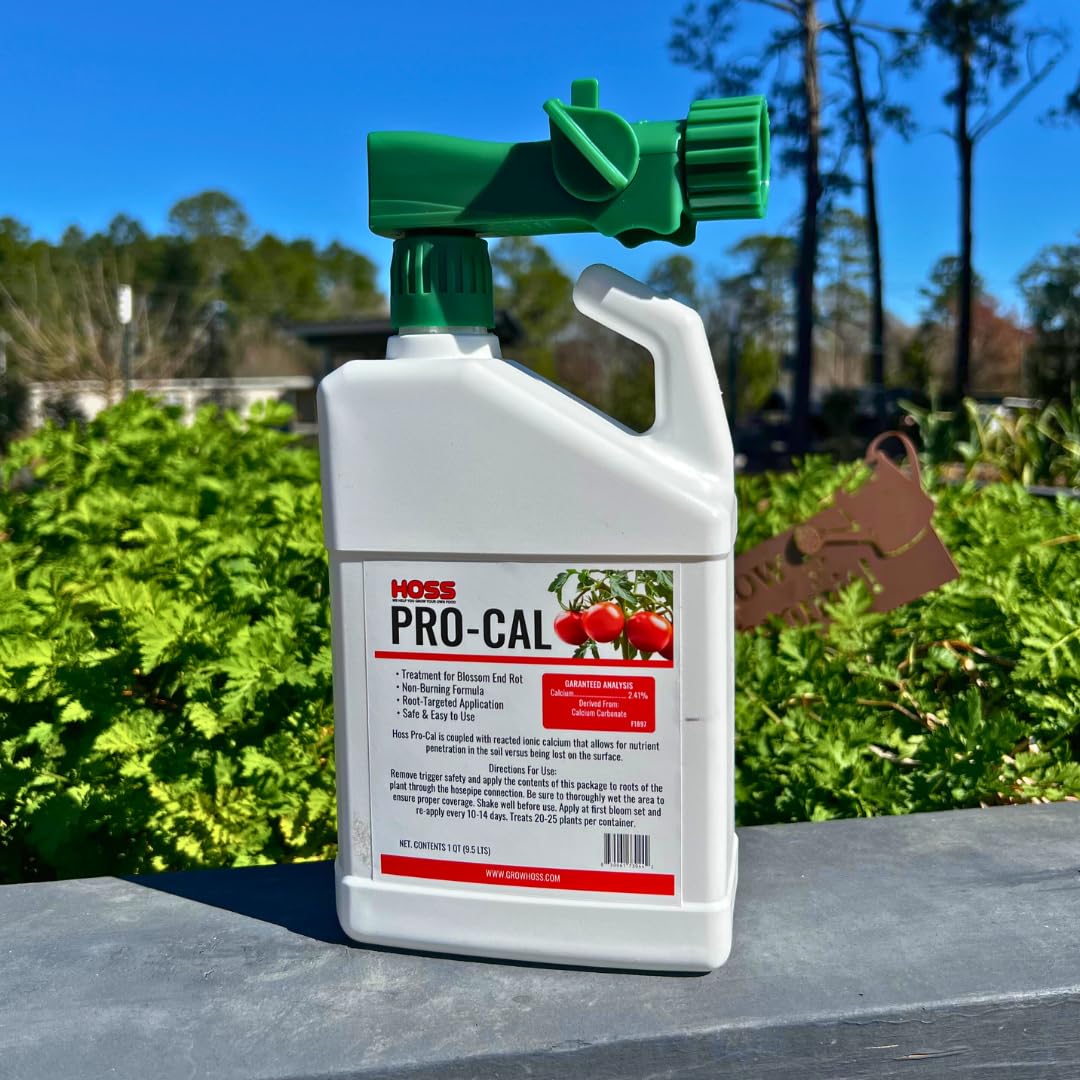
| Item Form | Liquid |
|---|---|
| Specific Uses For Product | Treatment for Blossom End Rot |
| Application Method | Connect to water hose |
| Coverage | 20-25 plants |
Hoss Pro-Cal is a root-targeted liquid calcium treatment designed specifically to prevent and correct blossom end rot on fruiting plants. It connects to a garden hose for direct application to the root zone and treats roughly 20 to 25 plants per quart. Typical use is to apply at first bloom and repeat every 10 to 14 days; the product's trigger system and hose connection make it fast to apply across multiple plants. The non-burning formula and root delivery reduce the risk of leaf scorch that can occur with foliar calcium sprays, and the manufacturer recommends shaking before use to maintain an even solution. Because it is a concentrated, plant-targeted supplement rather than a complete fertilizer, it is best used as a focused corrective measure alongside a regular feeding program. Practical limits include the stated coverage per container and the need to reapply during the season for continued protection, so gardeners with large plantings should plan supply accordingly.
Best for: Gardeners who prioritize consistent, dependable correction of blossom end rot and want a simple, low-risk method to deliver calcium directly to plant roots across a small to medium planting.
Less Ideal for: Large-scale growers or those seeking an all-in-one fertilizer solution should consider broader-coverage products or bulk treatments instead.
- Root-targeted application via hose connector delivers calcium directly to the zone plants absorb it
- Non-burning liquid formula is safe for use at the root without scorching foliage
- Simple trigger system makes treating multiple plants quick and repeatable
- Clear dosing guidance for timing and frequency (apply at first bloom and every 10–14 days)
- Covers only about 20–25 plants per quart, which may require multiple containers for larger gardens
- Not a complete fertilizer so additional nutrients must be provided separately
Verdict: Use Hoss Pro-Cal when you need a reliable, easy-to-apply calcium treatment that targets roots to prevent and correct blossom end rot.
Bloom City Professional Grade Cal‑Mag Liquid Fertilizer (32 fl oz)

| Item Form | Liquid |
|---|---|
| Specific Uses For Product | Organic |
| Application Method | Watered-in fertilizer and foliar spray |
| Liquid Volume | 32 fluid ounces |
Bloom City Cal‑Mag is a concentrated liquid supplement that supplies calcium and magnesium for plants, meant to be added to watering or used as a foliar spray. Typical use is simple: mix a small dose (the label suggests 2–5 mL per gallon for routine feeding or a stronger foliar mix) into a watering can, hose‑end sprayer, or hydro reservoir to correct or prevent deficiencies. Notable features include an organic‑focused formula, clear dosing guidance for grow and bloom phases, and suitability for pots, garden beds, houseplants and hydroponics. In practice this product helps reduce blossom end rot on tomatoes and supports stronger stems and greener foliage by improving Ca and Mg availability. It is easy to incorporate into weekly or every‑watering schedules and can be used as a quick foliar treatment for faster uptake. Important limitations are that it is a supplement rather than a complete fertilizer so it does not replace balanced NPK feeds, and correct dosing and pH management are still required to ensure plants can absorb the supplied nutrients.
Best for: Gardeners who want a targeted, easy way to prevent or correct calcium and magnesium deficiencies in tomatoes, peppers and other fruiting plants and prefer organic or plant‑friendly supplements.
Less Ideal for: Growers seeking an all‑in‑one base fertilizer or those unwilling to monitor feed schedules and pH should consider a full‑spectrum feed instead.
- Provides readily available calcium and magnesium to address deficiency symptoms linked to blossom end rot
- Liquid form mixes easily for watering cans, hose‑end sprayers or hydro reservoirs for fast application
- Clear dosing options for grow and bloom phases and instructions for foliar use
- Organic‑lean formulation suitable for growers wanting nonindustrial ingredient sources
- Not a complete NPK fertilizer so must be paired with regular balanced feeds
- Effectiveness depends on correct dosing and appropriate pH for nutrient uptake
Verdict: Use this concentrated Cal‑Mag liquid when you need a simple, plant‑friendly fix to prevent blossom end rot and strengthen stems.
TPS Nutrients Cal‑Mag with Iron and Micronutrients, 8 oz Liquid

| Item Form | Liquid |
|---|---|
| Specific Uses For Product | Plant Growth |
| Target Species | plants |
| Mixing Ratio | 1/2 to 1 tsp per gallon of feedwater |
| Unit Count | 8 Fluid Ounces |
This 8 oz Cal‑Mag concentrate is designed to correct and prevent calcium and magnesium deficiencies that cause leaf yellowing and blossom end rot in tomatoes and other fruiting plants. You dilute 1/2 to 1 teaspoon per gallon of feedwater and add it to your regular watering or feeding routine; it can be used in soil, containers, and hydroponic systems. Notable features include a liquid form for easy mixing, added iron and micronutrients to improve nutrient uptake, and a formulation aimed at strengthening plant structure. Practical benefits are faster correction of calcium-related disorders, fewer yellowing leaves, and improved fruit quality when used consistently. Limitations are that it is a concentrate so dosing must be measured carefully, and the 8 oz bottle treats limited volume of water which may require frequent repurchasing for larger gardens. Also follow safety directions closely since it should be diluted and kept away from children and pets.
Best for: Home gardeners who want a straightforward, proven supplement to prevent blossom end rot and correct calcium or magnesium deficiencies with minimal fuss.
Less Ideal for: Large-scale growers or those managing many beds who need bulk-volume treatments or an all‑in‑one complete fertilizer solution.
- Liquid concentrate mixes easily into feedwater for quick application
- Contains both calcium and magnesium plus iron and micronutrients to address multiple deficiencies
- Suitable for soil, container and hydroponic systems for flexible use
- Small 8 oz bottle treats a limited amount of water and may not last for larger vegetable gardens
- Requires precise measuring to avoid overapplication
Verdict: Use this concentrated Cal‑Mag to reliably correct calcium and magnesium deficiencies and reduce blossom end rot in home tomato and vegetable plantings.
Choosing the Right Fertilizer for Blossom End Rot: Key Factors to Consider
Calcium Form and Availability
Which chemical form calcium is supplied in matters because not all forms are equally available to plants. Soluble calcium salts dissolve in soil moisture and move to root zones more readily, while some mineral forms release slowly and may not correct an acute deficiency. Consider whether the fertilizer supplies calcium in a water-soluble form that matches your urgency: immediate corrections need fast-available forms, while maintenance programs can rely on slower-release sources.
Also think about interactions with other nutrients and soil chemistry. High soluble potassium or ammonium can interfere with calcium uptake, so a fertilizer that balances competing ions or recommends staggered application helps maintain availability to fruiting tissues.
Application Method and Flexibility
How you apply the fertilizer determines whether calcium actually reaches developing fruit. Root-applied soluble fertilizers and soil drenches make calcium available where roots can take it up, whereas foliar sprays can provide temporary surface support but often do not move into fruit quickly enough to prevent blossom end rot. Choose products that offer flexible application options – granular for side-dressing, soluble powders for soil drenches, or liquids compatible with drip systems.
Readability of instructions and whether a product can be safely used in containers or near sensitive plants also matters. A formulation that is too concentrated risks root burn in small pots, while one designed for in-ground use may be awkward for container gardeners.
Compatibility with Soil pH and Texture
Soil pH and texture influence calcium availability and how fertilizers behave after application. Acidic soils can bind calcium, while very alkaline soils can cause micronutrient imbalances that mimic deficiency symptoms. Sandy soils drain quickly and may need more frequent applications, while clay soils hold nutrients but can tie up calcium.
Look for fertilizers whose labels indicate effectiveness across a range of pH levels or that include guidance for adjusting pH. If your soil is extreme at either end of the pH scale, you may need separate amendment steps alongside calcium-focused fertilization.
Nutrient Balance and Crop Needs
Blossom end rot is often triggered by insufficient calcium reaching the fruit, but other factors like irregular watering, excessive nitrogen, or imbalanced potassium can worsen the problem. A good fertilizer for blossom end rot should provide calcium without creating a strong excess of competing nutrients. Some formulations offer a balanced N-P-K ratio with supplemental calcium, while others are calcium amendments meant to be used alongside a regular feeding plan.
Consider the specific crop you are growing. Heavy-feeding tomatoes have different needs than peppers or summer squash, and container-grown plants typically require more consistent feeding than in-ground crops.
Safety for Edible Crops and Application Timing
Anything applied to soil for edibles must be labeled safe for food-producing plants. Some calcium products are fine for ornamental use but lack guidance for harvest windows or residue. Choose fertilizers with clear edible-plant labeling and follow recommended wait times before harvest if applicable.
Timing is crucial: applying calcium at or just before fruit set is far more effective than attempting a late-season correction after fruit has developed. Plan applications around bloom and early fruit development to maximize calcium uptake during the critical period.
When Blossom End Rot Appears Midseason
If you spot blossom end rot after fruits start forming, immediate steps can reduce further losses. Focus on steady watering to keep soil moisture even; fluctuations make calcium uptake unpredictable. A targeted root drench with a water-soluble calcium source can supply quick-acting calcium to the root zone and help new fruits develop without spots.
- Increase consistent irrigation frequency rather than deep but infrequent soaking
- Apply a water-soluble calcium drench at the first sign of symptoms
- Avoid high-nitrogen side dressings that may worsen uptake competition
Preventive Feeding During Flowering and Fruit Set
To prevent blossom end rot before it starts, adjust feeding at bloom and early fruit set. Use fertilizers that include calcium in forms that are plant-available and schedule lighter, more frequent feeds for containers. Maintaining even soil moisture and avoiding sudden shifts in fertility helps plants transport calcium to developing tissues.
- Switch to calcium-inclusive feeds at bloom
- Reduce large nitrogen spikes that encourage rapid leafy growth
- Mulch to retain consistent soil moisture
Managing Containers and Raised Beds
Container and raised bed soils dry and warm more rapidly than in-ground beds, increasing the risk of blossom end rot. Use potting mixes with added calcium or plan a routine calcium supplement during the growing season. Choose fertilizers that are safe at container concentrations and can be applied as gentle, regular feeds to avoid root stress.
- Use mixes amended with lime or gypsum for baseline calcium in raised beds
- Apply dilute calcium drenches every 1 to 2 weeks for pots during fruit development
- Avoid over-concentrated applications that can burn roots
Soil Testing and pH Adjustment
A soil test is the definitive way to identify baseline calcium and pH conditions. If tests show low calcium or pH extremes, amend soils early in the season to set the stage for successful fruiting. Lime raises pH and supplies calcium, whereas gypsum supplies calcium without changing pH, which can be useful for certain soil types.
- Test for exchangeable calcium and pH before major amendments
- Use lime for acidic soils needing pH correction and calcium
- Use gypsum when calcium is low but pH should remain unchanged
Watering Practices That Improve Calcium Uptake
Consistent soil moisture is one of the most controllable factors to reduce blossom end rot. Water deeply but regularly to keep the root zone evenly moist, and use mulch to moderate evaporation. Inconsistent irrigation causes transient root stress and reduces calcium transport even when soil calcium is adequate.
- Install drip or soaker hoses to maintain steady moisture
- Avoid overhead irrigation during high heat which can cause stress
- Monitor soil moisture with a probe or finger test rather than guessing
How We Chose the Best Fertilizer for Blossom End Rot
We prioritized fertilizers that specifically address the physiological causes of blossom end rot rather than generic nutrient claims. Our selection process focused on formulations and application methods that influence calcium availability at the root and fruit level. Key evaluation criteria included nutrient form and calcium content, compatibility with common soil types, ease and flexibility of application, measured impact on plant health in real garden contexts, and safety for edible crops. We excluded products that only provide surface foliar effects without addressing root uptake, as well as experimental blends lacking clear nutrient analysis or usage instructions. Also omitted were fertilizers requiring specialized equipment not normally found in home gardens. The remaining picks are practical, labeled for edible plants, and usable across raised beds, in-ground rows, and containers. These filters reflect what gardeners can realistically apply to prevent or correct blossom end rot during a growing season.
FAQ
Can foliar calcium sprays stop blossom end rot instantly?
Foliar sprays can temporarily increase calcium on leaf surfaces and sometimes help developing fruit, but they usually do not move into fruit tissue fast enough to correct established blossom end rot. They are more useful as a short-term supplement combined with root-applied calcium and consistent watering.
How often should I apply a calcium drench to containers?
Containers often need more frequent applications because they dry faster. A diluted calcium drench every one to two weeks during fruit set is common, but follow label directions and adjust based on plant response and pot size.
Will adding lime fix blossom end rot quickly?
Lime increases soil calcium over time and adjusts pH, but it works slowly and is best applied before the growing season. For immediate correction of blossom end rot, use a soluble calcium source rather than relying solely on lime.
Can too much potassium cause blossom end rot?
High potassium can compete with calcium uptake in some soils, especially when applied in large, infrequent doses. Balanced fertilization and staged feeding reduce this risk; avoid large potassium-only applications during fruit set.
Is blossom end rot caused by a calcium deficiency in the soil?
Not always. Blossom end rot results from insufficient calcium in the fruit tissue, which can be due to low soil calcium, poor root uptake caused by inconsistent moisture, or nutrient competition. Identifying the underlying cause helps choose the right corrective measure.
Final Verdict
Preventing and correcting blossom end rot is mostly about ensuring consistent calcium access at the root and maintaining steady soil moisture. Prioritize the calcium form and application method that match your garden situation, whether containers, raised beds, or in-ground plots. Balance nutrient inputs to avoid creating uptake competition and time applications around bloom and early fruit set. Focus on predictable, repeatable practices: soil testing, even watering, and choosing calcium-friendly fertilizers that fit your irrigation method. That approach reduces the chance of recurring fruit damage and keeps harvests productive.
