

Note: This article contains affiliate links. If you click on these links and make a purchase, I may earn a small commission at no extra cost to you. This helps support my research and content. Read my full affiliate disclosure here.
If you grow calamansi, the right fertilizer makes a big difference in flowering, fruit set, and overall plant health. Calamansi respond best to balanced, consistent feeding that supports a healthy canopy early in the season and encourages flower and fruit production as trees mature. This guide covers six top options suited for potted and in-ground calamansi, shortlisted for common backyard and small-farm situations. We evaluated each product on nutrient formulation, ease of application, and suitability for container or ground planting so you can choose the feeding approach that fits your growing setup.
Top Picks at a Glance
| Best Overall The best all-around choice for most situations | Espoma Citrus-Tone Organic Fertilizer (4 lb) |  |
| Best Quality Built to a higher standard if you want something more solid | FoxFarm Happy Frog Citrus & Avocado Fertilizer (4 lb) |  |
| Best Value The sweet spot between price and what you get | Miracle-Gro Shake 'N Feed Citrus, Avocado, Mango Plant Food, 4.5 lb |  |
| Best Budget The cheapest option that still gets the job done reliably | RAINFLOW Slow-Release All-Purpose Fertilizer 14-13-13 (11.28 oz) |  |
| Most Popular A crowd favorite that many people choose with confidence | Jobe's Organics Granular Fruit & Citrus Fertilizer, 4 lb |  |
| Best Seller A high-volume bestseller chosen again and again | TPS Nutrients Lemon Tree Fertilizer Liquid, 8 fl oz |  |
Espoma Citrus-Tone Organic Fertilizer (4 lb)

| Item Form | Granules |
|---|---|
| Application Method | Apply to the soil around the drip line of the tree |
| Target Species | citrus, avocado, fruit and nut trees |
| Mixing Ratio | No mixing required |
Espoma Citrus-Tone is a ready-to-use granular organic fertilizer designed for citrus and similar fruit trees. You broadcast or sprinkle it around the tree drip line and water it in; no mixing is required. The 5-2-6 NPK balance with 5 percent calcium and organic feedstocks supports foliage growth, bloom set and fruit development, making it suitable for pre-bloom, post-bloom and fall feedings. Because it is an organic, slow-release formula it supplies nutrients steadily instead of a rapid spike, which helps avoid salt buildup and reduces risk of leaf burn when used as directed. It is registered for organic production and uses natural ingredients rather than synthetic fillers. The main limitations are that it is a medium-coverage, small 4 pound bag so it may require more frequent purchases for larger trees or orchards, and results develop over weeks rather than days which is typical for organic fertilizers.
Best for: Gardeners who prioritize steady, long-term performance for lemon and other citrus trees and prefer organic inputs that support bloom and fruit set.
Less Ideal for: People who need rapid greening or fast corrective feeding for nutrient-deficient trees or those managing large orchards where a bulk commercial fertilizer would be more practical.
- Formulated specifically for citrus and similar fruit and nut trees
- Organic, slow-release granular formula that reduces risk of burn
- Contains 5% calcium which supports fruit quality and reduces blossom drop
- Ready to use with no mixing required and simple drip-line application
- Small 4 lb bag provides only medium coverage and may not be economical for multiple large trees
- Slow-release action means visible results take weeks rather than days
Verdict: For lemon growers seeking an organic, calcium-containing slow-release fertilizer tuned to support bloom and fruit development, Citrus-Tone delivers reliable, tree-focused performance.
FoxFarm Happy Frog Citrus & Avocado Fertilizer (4 lb)

| Item Form | Granules |
|---|---|
| Specific Uses For Product | Organic |
| Target Species | Citrus, Avocado |
| Unit Count | 64 Ounce |
| Mixing Ratio | 7:3:3 |
This granular fertilizer is designed specifically for citrus and avocado trees and supplies slow-release nitrogen alongside calcium and sulfur to support steady vegetative growth. It is typically applied to the root zone a few times per year (manufacturer suggests 1/2 cup per foot of tree height for established trees, three times annually) and should be watered in after application. Notable features include an OMRI-listed organic formulation and a mycorrhizal fungi blend intended to improve root efficiency and nutrient uptake. In practice this product simplifies seasonal feeding for home orchardists who want a reliable, low-maintenance feed that promotes steady growth without frequent applications. Practical benefits are ease of use, organic certification, and the addition of microbes that can help marginal soils. Important limitations are that it is a single-purpose, granular formula so it does not replace targeted nutrient correction for specific deficiencies and it requires following the mixing/measurement guidance to avoid overapplication on small or container trees.
Best for: Home orchardists and gardeners who prioritize reliable, low-maintenance fertilization to support steady growth and want an organic, microbe-enhanced option for citrus and avocado trees.
Less Ideal for: Growers who need rapid correction of a diagnosed nutrient deficiency or who require a water-soluble feed for foliar or drip-irrigation applications should consider other products.
- Formulated specifically for citrus and avocado so nutrient balance matches common needs
- OMRI-listed organic formula suitable for organic gardeners
- Includes mycorrhizal fungi to aid root efficiency and nutrient uptake
- Slow-release granules reduce how often you need to feed trees
- Granular single-formula does not address specific micronutrient deficiencies
- Application amounts must be measured by tree height which may be awkward for mixed-size plantings
Verdict: A dependable organic slow-release fertilizer with beneficial microbes that makes seasonal feeding of citrus and avocados simple and low maintenance.
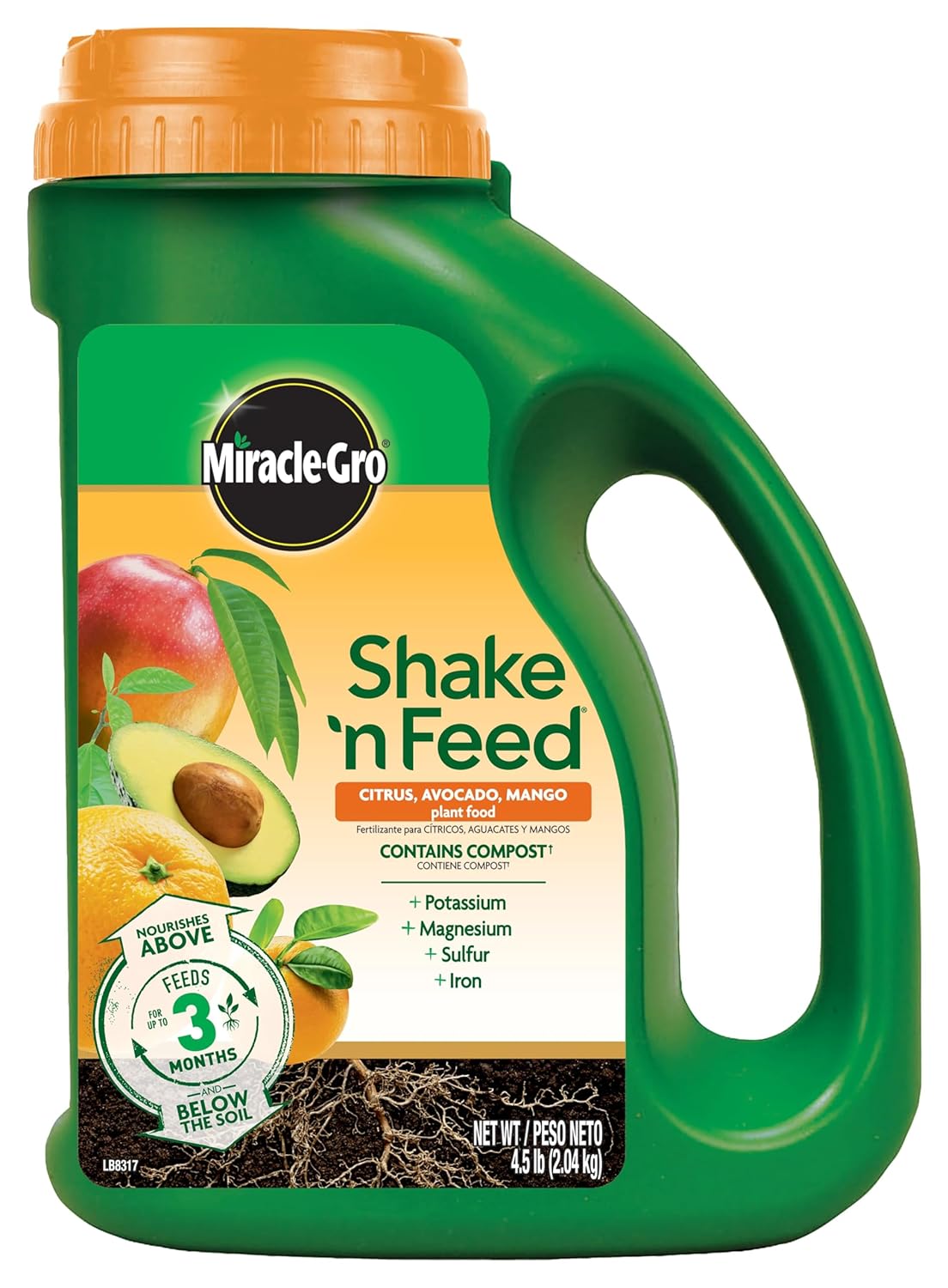
Miracle-Gro Shake 'N Feed Citrus, Avocado, Mango Plant Food, 4.5 lb
| Item Form | Granules |
|---|---|
| Application Method | Shake evenly onto soil |
| Target Species | citrus, avocado, mango |
| Mixing Ratio | 8-2-10 |
| Coverage | Medium |
This Shake 'N Feed formula is a granular, slow-release fertilizer made for citrus, avocado and mango trees in containers or in-ground. You shake the granules evenly onto the soil within the branch spread or mix into potting mix at planting, then water to start feeding; one application feeds plants for up to three months. The N-P-K listed (8-2-10) and added micronutrients such as potassium, magnesium, sulfur and iron help correct common deficiencies and support root development through microbes in the mix. It is practical for seasonal feeding and reduces the frequency of applications compared with quick-release fertilizers. Limitations include that it is a general fruit-tree feed rather than a lemon-specific formula and needs correct placement to avoid contact with trunks or foliage. For established trees you must follow label rates to avoid overfeeding and reapply every three months to maintain nutrition through the growing season.
Best for: Practical gardeners who want an easy, low-maintenance feeding schedule for lemon and other citrus trees and prefer a single product that works in pots and beds.
Less Ideal for: Growers who need a custom nutrient program based on soil tests or who want a fast-acting liquid feed for quick corrections should consider more targeted products.
- Slow-release formula provides up to 3 months of feeding per application
- Contains N-P-K 8-2-10 plus micronutrients to address common deficiencies
- Works for both container and in-ground citrus and other fruit trees
- Easy shake-and-feed application that reduces application frequency
- Not a lemon-specific formulation so may lack tailor-made ratios for particular soil tests
- Requires careful placement and incorporation to avoid trunk or foliage contact
Verdict: Use this to keep lemon trees consistently fed with a convenient, three-month slow-release granular fertilizer.
RAINFLOW Slow-Release All-Purpose Fertilizer 14-13-13 (11.28 oz)

| NPK ratio | 14-13-13 |
|---|---|
| Formulation | Slow release granular |
| Duration | Up to 180 days |
This compact granular fertilizer delivers a balanced 14-13-13 NPK formula in a slow-release form designed to feed plants for up to 180 days. It is intended to be sprinkled and lightly worked into potting mix or garden soil to support root development, flowering, and fruit set. Because it releases nutrients gradually, you can reduce the frequency of applications compared with quick-release feeds, which is useful for container citrus like calamansi that benefit from steady nutrition. The product claims broad compatibility, so it can be used on succulents, orchids, vegetables and fruiting trees when applied at appropriate rates. Practical benefits include easy application, fewer feedings over the season, and a balanced nutrient profile for fruit production. Limitations are the small 11.28 ounce size, which means frequent repurchase for larger trees or multiple pots, and the description does not list exact application rates per plant size so novices should follow conservative dosing and monitor plant response.
Best for: Home gardeners growing calamansi in pots or small yards who want a low-maintenance, steady feed and are shopping on a budget.
Less Ideal for: Large-scale growers or anyone managing many mature citrus trees who need bulk quantities and precise fertilization schedules.
- Balanced 14-13-13 NPK supports both vegetative growth and fruiting
- Slow-release formulation that can feed plants for up to 180 days reducing application frequency
- Granular form is easy to spread and mix into potting soil or garden beds
- Small 11.28 ounce package is not economical for multiple or mature fruit trees
- Product listing lacks detailed application rates for specific plant sizes
Verdict: A budget-friendly, easy-to-use slow-release fertilizer that gives steady, balanced nutrition ideal for potted calamansi and small backyard citrus.
Jobe's Organics Granular Fruit & Citrus Fertilizer, 4 lb

| Item Form | Granules |
|---|---|
| Specific Uses For Product | Plant Growth, Root Development, Seed Development, Soil Conditioning |
| Application Method | Spread evenly around base |
| NPK | 3-5-5 |
| OMRI Listed | Yes |
This granular Jobe's Organics fertilizer is designed to feed fruit and citrus trees with a slow-release, root-targeted NPK of 3-5-5. It is typically applied by measuring and spreading the granules evenly around the base of the tree, then watering in; applications are recommended every 4 to 8 weeks during the growing season. Notable features include OMRI listing for organic gardening, a blend of feather meal, bone meal and processed poultry manure for organic nutrient sources, and a resealable bag for convenient storage. In practice the formula supports root development and fruit set without synthetic chemicals, and the slow-release nature reduces the need for very frequent feeding. Limitations are that the lower nitrogen level makes it better suited for fruiting and flowering stage nutrition rather than rapid leafy growth, and larger trees will require repeated applications or larger quantities. For gardeners aiming for an organic, low-fuss feed for citrus, this provides predictable, targeted nutrition, but it is not a quick-fix soluble feed for immediate green-up.
Best for: Gardeners who prefer organic, low-maintenance feeding for citrus and fruit trees and want a slow-release product that focuses on fruit and root health.
Less Ideal for: Growers needing fast, high-nitrogen correction or a soluble foliar feed; landscapers managing many mature trees who need bulk quantities more often.
- OMRI listed organic formula suitable for certified organic gardens
- Balanced 3-5-5 NPK aimed at improving flowering and fruit production
- Slow-release granules that feed roots over time and reduce application frequency
- Resealable packaging keeps product fresh between uses
- Lower nitrogen content means it will not rapidly promote leafy growth
- 4 lb bag may be insufficient for mature trees or larger plantings
Verdict: A reliable OMRI-listed granular fertilizer that delivers slow-release, fruit-focused nutrition for organic citrus gardeners.
TPS Nutrients Lemon Tree Fertilizer Liquid, 8 fl oz

| Item Form | Liquid |
|---|---|
| Application Method | Watering can, hose end sprayer, or leaf misting |
| Target Species | Lemon Trees |
| Mixing Ratio | 1:200 |
| Liquid Volume | 8 fluid ounces |
This 8 fl oz liquid fertilizer from TPS Nutrients is made specifically for lemon and other citrus trees and is used by diluting at the recommended 1:200 ratio and applying with a watering can, hose‑end sprayer, or by leaf misting. It is designed to promote fruit production, support healthy leaves and shoots, and build stronger roots so trees absorb water and nutrients more effectively. The liquid form delivers nutrients quickly for potted trees on patios as well as in-ground specimens, and the medium coverage makes it suitable for individual trees or small groups. Practical benefits include fast absorption, simple dilution and multiple application methods that fit common garden routines. Limitations are the small 8 ounce bottle size, which means frequent repurchasing for larger citrus collections, and lack of detailed NPK values on the label for gardeners who prefer exact nutrient ratios. Overall this is a convenient, citrus-focused supplement for home growers seeking straightforward feeding for Meyer and dwarf varieties.
Best for: Home gardeners who want a ready-to-use, citrus-specific feed for one or a few lemon trees and prefer simple dilution and flexible application methods.
Less Ideal for: Growers managing larger orchards or multiple mature trees who need bulk quantities or exact NPK formulations should consider commercial‑scale fertilizers instead.
- Formulated specifically for lemon and citrus so nutrients suit citrus needs.
- Liquid concentrate with 1:200 mixing for quick uptake and flexible application.
- Multiple application methods: watering can, hose‑end sprayer, or foliar misting.
- Suitable for both potted and in‑ground citrus, useful for patios and small orchards.
- Small 8 fl oz bottle may not last for multiple trees or large plantings.
- Product listing does not provide explicit NPK numbers for precise nutrient planning.
Verdict: A convenient liquid concentrate tailored to lemon and citrus that makes regular feeding easy for home growers with one or a few trees.
Choosing the Right Fertilizer for Calamansi: Key Factors to Consider
Nutrient Balance and N-P-K Ratios
Calamansi need a balanced supply of nitrogen, phosphorus, and potassium at different stages. Higher nitrogen helps young trees build leafy growth and a strong root system, while increased phosphorus and potassium support flowering and fruit development. Look for labeled N-P-K ratios and consider a slightly higher nitrogen ratio during the first years, shifting to a more balanced or slightly potassium‑heavy mix as the tree begins to fruit.
Misreading the N-P-K can lead to too much vegetative growth at the expense of flowers, or weak fruit set from insufficient phosphorus and potassium. Also pay attention to the percent analysis so you can calculate how much to apply per pot or per tree.
Secondary Nutrients and Micronutrients
Calamansi benefit from calcium, magnesium, and trace elements like iron, zinc, and manganese. Calcium and magnesium help with fruit quality and reduce blossom-end issues, while iron and manganese prevent yellowing in acid-sensitive citrus. A fertilizer that lists these secondary nutrients or includes a compatible supplement can reduce common deficiencies, especially in container-grown trees where soil reserves are limited.
If your soil or potting mix is alkaline, choose formulations or supplements that address micronutrient availability. Foliar feeds can be a useful supplement for quick correction of visible leaf symptoms.
Formulation and Application Method
Fertilizers come as water-soluble powders, granular mixes, and slow-release prills. Water-soluble feeds allow precise control and fast uptake, which is helpful during active growth or to correct deficiencies. Granular blends are good for routine feeding in beds and larger pots, while slow-release products reduce how often you need to feed but can be slower to correct an existing problem.
Consider how you irrigate. If you use drip irrigation or frequent hand-watering, water-soluble or controlled-release fertilizers designed for irrigation can integrate easily. For foliar sprays, ensure the product is labeled safe for foliar application on edible citrus.
Suitability for Containers Vs In‑Ground
Containers dry out and lose nutrients faster than garden soil, so potted calamansi often need more frequent, low-dose feeding and attention to salt buildup. Look for fertilizers formulated for containers or with instructions for reduced-rate, regular applications. In-ground trees can access broader soil nutrient reserves, and slow-release options are often a low-maintenance choice for larger specimens.
Also consider pot size and substrate. Small pots require weaker, more frequent feeds, while larger containers can handle a standard schedule. Always flush pots occasionally to prevent salt accumulation from soluble feeds.
Timing and Frequency of Feeding
Calamansi have distinct growth phases: vegetative growth, flowering, and fruiting. Timing your fertilizer applications to these phases yields better results than a one-size-fits-all schedule. Frequent light feedings during active growth and a shift toward potassium-rich feeds during flowering and fruit set support yield and fruit quality.
Follow label guidance but adjust for local climate and growth habit. In cooler or dry spells, reduce frequency; in peak growth season, many growers increase regularity. Keep records of applications so you can tweak timing based on observed response.
Ease of Use and Safety for Edible Crops
Clear application instructions reduce the risk of overfertilizing, which can burn roots and reduce fruit quality. Products that provide specific rates for container sizes and recommend pre-harvest waiting periods are preferable for edible trees. Ease of measurement, compatibility with common watering systems, and clear guidance on environmental runoff are practical considerations for garden use.
Choose fertilizers with straightforward mixing ratios and avoid mixes that require complex pH adjustments unless you are experienced. For small-scale home growers, simpler is often safer for consistent results.
When to Start Feeding Young Calamansi
Begin feeding newly planted calamansi once the tree has established and shows new growth, usually a few weeks after transplanting. At this stage, favor a fertilizer slightly higher in nitrogen to encourage root and foliage development, but use reduced concentrations to avoid burning tender roots.
Young trees planted in fresh potting mix may benefit from light, frequent feedings rather than heavy single applications. Monitor new shoots and leaf color to gauge whether to increase or decrease concentration.
- Apply low-strength feeds every 2 to 4 weeks for containers.
- For in-ground young trees, consider a balanced granular application spaced per label instructions.
Adjusting Feed During Flowering and Fruit Set
As calamansi transition to flowering, reduce excessive nitrogen and move toward formulations with adequate phosphorus and potassium to support blossoms and fruit hold. Too much nitrogen at this stage can promote leafy growth at the expense of flowers.
Use water-soluble applications for quick adjustments if flowers drop or fruit set appears weak. A short foliar spray can also help if micronutrient deficiencies are evident.
- Shift to a balanced or slightly potassium-enhanced feed during bloom.
- Space feedings to avoid salt stress during heat waves.
Managing Fertilizer in Containers
Container calamansi need careful attention to avoid salt buildup and root burn. Use lower concentrations more often and flush the potting mix with clean water periodically to prevent excess salts. Slow-release fertilizers can work if you select a grade formulated for fruiting container plants, but expect to supplement with occasional soluble feeds for micronutrients.
Choose potting mixes with good drainage and organic matter to buffer nutrients. If leaf yellowing or stunted growth appears, a soluble feed or foliar micronutrient application can provide faster correction than granular products.
- Leach containers once or twice a year to remove accumulated salts.
- Record application amounts to avoid accidental overfeeding.
Organic Vs Synthetic Options
Organic fertilizers release nutrients more slowly and help build soil structure. They work well for gardeners who prefer gradual feeding and improved long-term soil health, but they can be slower to correct acute deficiencies. Synthetic feeds give predictable nutrient ratios and faster uptake, which is useful when you need quick corrective action.
Many gardeners use a combined approach: organic amendments in spring to build soil reserves and targeted soluble feeds during flowering and fruit set. Consider your maintenance preferences and how quickly you need results when choosing between these approaches.
- Organic matter improves water retention and nutrient-holding capacity.
- Synthetic solutions provide rapid correction and consistent N-P-K ratios.
Monitoring and Correcting Nutrient Deficiencies
Regularly inspect leaves and new growth. Yellowing between veins often indicates micronutrient deficiencies, while uniform yellowing suggests nitrogen shortage. Poor fruit set can signal low potassium or phosphorus. Corrective action should match the symptom: foliar sprays for rapid micronutrient delivery, soluble feeds for macronutrient correction.
Soil or substrate tests can pinpoint deficiencies and help refine your feeding schedule. Keep notes on symptoms and treatments to build a reliable care routine for future seasons.
- Use foliar sprays for quick iron or manganese fixes.
- Run a soil test if persistent problems appear across multiple seasons.
How We Chose the Best Fertilizer for Calamansi
We focused on fertilizers that match the nutritional needs of citrus and specifically the growth stages of calamansi. Our selection filters prioritized nutrient balance geared toward flowering and fruiting, clear N-P-K labeling and secondary nutrients, and formulations that work for both potted specimens and in-ground trees. Ease of use was important, so we included options that offer straightforward application rates and flexible methods such as granular broadcasting, water-soluble feeding, and slow-release prills. We also evaluated safety for edible crops by preferring products with clear instructions on pre-harvest intervals and recommended concentrations. Longevity and feeding frequency mattered for gardeners who prefer low-maintenance schedules, while solubility was a factor for those using drip irrigation or foliar sprays. We excluded general-purpose lawn feeds and products without explicit citrus or acid-loving plant guidance. The final picks balance immediate nutrient availability for flowering with steady supply for fruit development, and all would suit common container and backyard calamansi situations.
FAQ
How often should I fertilize potted calamansi?
Potted calamansi typically do best with lighter, more frequent feedings. A common approach is a half-strength soluble feed every 2 to 4 weeks during the growing season, with less frequent applications in cooler months. Adjust frequency based on growth and leaf color.
Can I use a general citrus fertilizer for calamansi?
Often yes. General citrus fertilizers usually match calamansi needs, but check the N-P-K ratio and micronutrient content. If the mix is high in nitrogen and your tree is in heavy fruit, consider supplementing with a potassium-rich feed during bloom and fruit set.
When should I stop fertilizing before harvest?
There is no universal rule, but many gardeners reduce or stop high-nitrogen feeds a few weeks before major harvests to encourage fruit maturation. Follow label guidance for edible crops and consider a lower-frequency maintenance feed if the tree still needs nutrients.
Are foliar sprays useful for calamansi?
Foliar sprays can be an effective way to quickly correct micronutrient deficiencies or give a short-term boost during flowering. They act faster than soil-applied amendments but do not replace soil fertility management for long-term health.
How do I avoid fertilizer burn in container trees?
Use lower concentrations and apply more frequently rather than heavy, infrequent doses. Flush pots with clear water occasionally to leach salts, and follow label rates for container sizes to reduce the risk of root burn.
Should I amend soil with organic matter before feeding?
Yes. Incorporating compost or well-rotted organic matter improves nutrient retention and root health. It reduces dependence on frequent soluble feeds and provides a buffer that helps sustain steady nutrient release for calamansi.
Final Verdict
Choose a fertilizer strategy that matches your planting situation and how hands-on you want to be. For containers, prioritize soluble, low-strength feeds and monitor salt buildup. For in-ground trees, slower-release blends paired with targeted soluble boosts during bloom often work best. Balance N-P-K with attention to secondary nutrients and adjust timing for flowering and fruit set. With a clear feeding plan and regular monitoring, you can reliably improve flower production and fruit quality in calamansi.
