

Note: This article contains affiliate links. If you click on these links and make a purchase, I may earn a small commission at no extra cost to you. This helps support my research and content. Read my full affiliate disclosure here.
Yucca plants are tough, architectural specimens, but fungal infections such as leaf spot and root rot can quickly undermine their appearance and vigor. Choosing the right fungicide for yucca plant matters because the wrong product or application method can scorch the swordlike leaves or fail to reach protected infection sites. This guide covers a short list of the seven best options for treating common fungal issues on yucca. We evaluate each choice on what gardeners care about: the active ingredient, contact versus systemic action, safety for foliage and surrounding plants, and ease of application. Read on to find a treatment approach that fits your gardening style and the specific disease signs on your yucca.
Top Picks at a Glance
| Best Overall The best all-around choice for most situations | Bonide Infuse Systemic Disease Control Concentrate, 16 oz |  |
| Best Quality Built to a higher standard if you want something more solid | Bonide Captain Jack Copper Fungicide 16 oz Concentrate |  |
| Best Value The sweet spot between price and what you get | BioAdvanced 3-in-1 Insect, Disease & Mite Control Spray, 32 fl oz |  |
| Best Budget The cheapest option that still gets the job done reliably | Bonide Fung-onil Multi-Purpose Fungicide, 32 oz Ready-to-Use Spray |  |
| Highest Rated A top-rated pick with lots of positive feedback | Monterey Fungi-Max Systemic Fungicide, 16 oz (with Measuring Spoon) |  |
| Most Popular A crowd favorite that many people choose with confidence | Bonide Captain Jack's Ready-to-Use Neem Oil Spray, 32 oz |  |
| Best Seller A high-volume bestseller chosen again and again | BioAdvanced 3-in-1 Insect, Disease & Mite Control Spray, 24 fl oz |  |
Bonide Infuse Systemic Disease Control Concentrate, 16 oz

| Item Form | Spray |
|---|---|
| Target Species | Disease |
| Liquid Volume | 16 fluid ounces |
| Unit Count | 16 Ounce |
Bonide Infuse is a concentrated systemic fungicide designed for turf and ornamentals that you mix with water and apply as a spray. The active ingredient propiconazole treats and prevents many common fungal diseases such as powdery mildew, rust, leaf spot and blight, and the label lists control for about 30 disease problems. It is used by diluting 1 to 2 tablespoons per gallon in a sprayer, coating affected foliage or mowing-height turf, and it creates a rainproof barrier that can protect plants for up to four weeks when applied as directed. Practical benefits include broad-spectrum control from a single product and economy of a concentrate that treats large areas. Limitations are that it is a chemical fungicide requiring careful adherence to label rates and safety precautions, and it is intended for listed diseases and plant types only, so you should confirm yucca-specific guidance before use on that species.
Best for: Gardeners who want a single, broad-spectrum chemical fungicide to manage common fungal problems across lawns and ornamental plants and who are comfortable following label safety and application instructions.
Less Ideal for: Growers seeking organic or non-chemical disease control methods or those who need a product explicitly labeled for every narrow ornamental species without checking compatibility.
- Systemic action with propiconazole for both prevention and treatment of many fungal diseases
- Concentrated formula treats large areas so one bottle covers a lot of turf or ornamentals
- Rainproof residual protection that can last up to four weeks when applied correctly
- Ready-to-mix concentrate that works with standard garden sprayers
- Requires careful mixing and strict adherence to label directions and safety precautions
Verdict: Choose Bonide Infuse when you need a concentrated, broad-spectrum systemic fungicide to prevent and treat common fungal diseases on lawns and ornamentals.
Bonide Captain Jack Copper Fungicide 16 oz Concentrate

| Unit Count | 16 Ounce |
|---|---|
| Item Form | Liquid |
| Target Species | Fungus |
| Active Ingredients | Copper Octanoate (Copper Soap) |
Bonide Captain Jack Copper Fungicide is a liquid concentrate designed to prevent and treat a broad range of fungal diseases on vegetables, fruits, ornamentals, and turf. Mixed with water per label directions, it is sprayed onto plant surfaces, including tops and undersides of leaves, and can be applied up to the day of harvest, which makes it practical for food crops like tomatoes. The active ingredient copper octanoate provides contact protection against powdery mildew, blight, black spot, rust, peach leaf curl and similar diseases. Application is straightforward and repeatable every 7 to 10 days as needed, and the product is cleared for use in organic gardening. Limitations to consider are that copper is a contact fungicide so it does not systemically move through the plant and works best as a preventative or early-treatment tool rather than curing severe systemic infections. Users should follow safety directions and avoid overuse to reduce copper buildup in soil.
Best for: Gardeners looking for a performance-focused, organic-approved fungicide to include in a preventative disease program for tomatoes and other edibles.
Less Ideal for: Growers seeking a systemic treatment for already advanced internal infections or those who prefer non-copper chemistries to avoid soil accumulation.
- Approved for organic gardening and can be used up to the day of harvest
- Controls a wide range of common diseases affecting tomatoes such as blight and powdery mildew
- Concentrated liquid formula mixes with water for spray application
- Repeatable 7–10 day application schedule makes preventative programs easy to maintain
- Acts as a contact fungicide and does not move systemically within the plant
- Repeated use can contribute to copper accumulation in soil if not managed
Verdict: Use this organic-approved copper concentrate when you want an effective, easy-to-apply preventative spray to protect tomatoes from common fungal diseases.
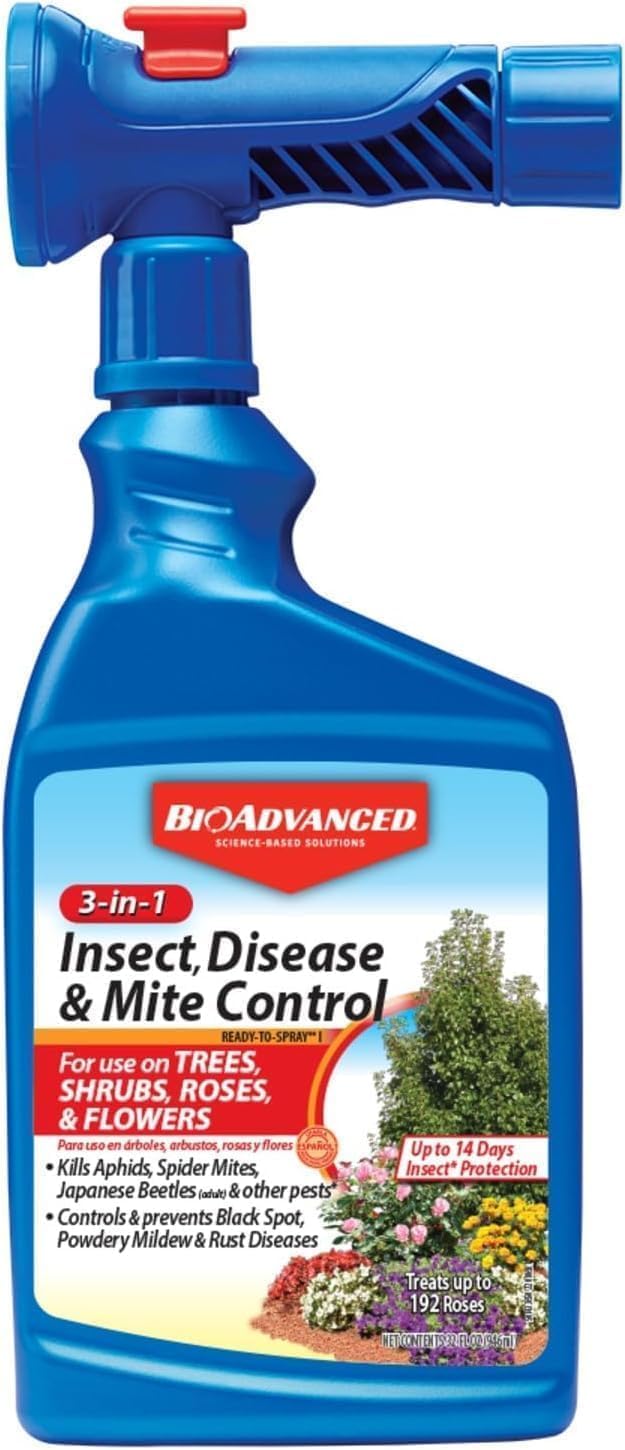
BioAdvanced 3-in-1 Insect, Disease & Mite Control Spray, 32 fl oz
| Unit Count | 32 Fluid Ounces |
|---|---|
| Item Form | Spray |
| Target Species | Aphids, caterpillars, leafminers, whiteflies and other listed pests |
| Active Ingredients | Tau-fluvalinate 0.61%, Tebuconazole 0.65% |
This BioAdvanced 3-in-1 spray is a performance-focused ready-to-use treatment that kills common pests on contact while also preventing and curing listed fungal diseases and controlling spider mites. It attaches to a garden hose for broad, even coverage and is labeled to treat up to 192 rose bushes, making it practical for medium to large beds and multiple shrubs. Key features include systemic ingredients plus contact control, rainproof protection lasting up to 14 to 30 days depending on labeled claims, and active ingredients targeting aphids, caterpillars, whiteflies, and mites. In use you spray foliage including undersides, and the product provides both immediate knockdown of insects and longer residual control so follow-up applications are less frequent. Limitations: it is a chemical treatment so users must follow safety directions and keep children and pets away until treated areas have dried, and it is not sold for use in New York. For someone prioritizing reliable, one-step control of aphids and associated fungal problems on roses and ornamentals, this bottle delivers convenient, broad-spectrum protection.
Best for: Gardeners who want a fast, high-performance one-step solution to control aphids and related pests while also preventing common fungal diseases on roses and ornamental plants.
Less Ideal for: Organic gardeners or those seeking nonchemical options should look for botanical or soap-based aphid controls instead.
- Combines insecticide, fungicide, and miticide in one ready-to-use formula for streamlined treatment
- Attaches to a garden hose for fast coverage of many plants including up to 192 roses
- Provides knockdown on contact and residual protection between labeled reapplications
- Controls a wide list of pests including aphids, spider mites, whiteflies, and caterpillars
- Contains chemical active ingredients that require careful handling and adherence to safety directions
- Not approved for sale in all states which limits availability for some users
Verdict: For gardeners focused on performance, this ready-to-spray 3-in-1 formula delivers fast aphid knockdown plus disease prevention in one convenient application.
Bonide Fung-onil Multi-Purpose Fungicide, 32 oz Ready-to-Use Spray

| Unit Count | 32 Ounce |
|---|---|
| Item Form | Spray |
| Target Species | Fungicide |
| Active Ingredients | Chlorothalonil |
Bonide Fung-onil is a 32-ounce ready-to-use spray that uses chlorothalonil to control and prevent common fungal problems such as leaf spot, blight, rust, and mildew. It comes in a trigger-sprayer bottle so you can shake and apply directly to affected lawns and plants without mixing concentrates. Typical use is to spray both tops and bottoms of leaves or turf blades until wet and repeat every 7 to 14 days when disease pressure appears. The practical benefits are broad-spectrum activity across vegetables, ornamentals, shrubs, trees, and grass, convenient spray delivery for small areas and quick application, and a trusted active ingredient for preventative protection. Important limitations are that it is a chemical fungicide so users must follow label safety directions and reapply on a schedule rather than rely on a single treatment, and it is not an organic option. For someone managing recurring fungal issues on turf like St. Augustine grass, this product provides an easy, affordable way to reduce disease spread when used as part of routine care and proper cultural practices.
Best for: Gardeners on a tight budget who need a straightforward, ready-to-use fungicide to manage recurring fungal problems on lawns and landscape plants and who prioritize convenience and proven chemistry over organic options.
Less Ideal for: Homeowners seeking certified organic treatments, those who prefer systemic or single-application alternatives, or users who do not want to follow safety precautions for chemical fungicides.
- Ready-to-use trigger bottle requires no mixing for quick spot treatments
- Chlorothalonil offers broad-spectrum control of leaf spot, blight, rust, mildew and other common fungal diseases
- Suitable for use on a wide range of plants including turf, ornamentals, vegetables and fruit
- Convenient 32 oz size covers multiple small-to-medium applications
- Chemical active ingredient limits use for organic or low-chemical gardening approaches
- Requires repeated applications on a 7 to 14 day schedule while disease pressure persists
Verdict: A low-cost, ready-to-use broad-spectrum fungicide that makes routine disease control on St. Augustine grass and other garden plants quick and simple.
Monterey Fungi-Max Systemic Fungicide, 16 oz (with Measuring Spoon)

| Item Form | Liquid |
|---|---|
| Application Method | Spray |
| Coverage | Wide range of plants and plant types |
| Target Species | Flowers, Vegetables, Trees, Lawn Grass |
| Liquid Volume | 16 fluid ounces |
Monterey Fungi-Max is a concentrated liquid fungicide that you dilute and apply with a sprayer to prevent and control many common plant diseases. It is used outdoors on flowers, shrubs, trees, lawns and edible plants including vegetables and fruiting trees; for tomato growers it is intended to control leaf spots, blights and powdery mildew when applied at the first sign of disease. The product’s systemic action means it is absorbed and provides residual protection for up to two weeks, which reduces how often you need to spray during an outbreak. A measuring spoon is included to help with mixing and the spray application method works with standard pump or backpack sprayers. Important limitations are that it must be mixed and applied correctly according to the label and it is not listed as organic, so it may not suit organic-certified operations; also coverage on large plantings requires multiple bottles. For gardeners who want a reliable, easy-to-use fungicide to protect tomatoes and other outdoor plants, Fungi-Max delivers predictable, short-term disease control when applied promptly.
Best for: Gardeners who prioritize reliable, fast-acting disease control for outdoor tomato beds and mixed orchards and who want a product that gives measurable residual protection between applications.
Less Ideal for: Growers who require organic-certified products or those managing very large commercial tomato plantings where bulk coverage and cost per acre are primary concerns.
- Systemic action provides plant uptake and up to two weeks of protection per application.
- Broad labeled coverage for many plant types including vegetables and fruit trees.
- Liquid concentrate mixes for use with standard spray equipment for even coverage.
- Includes a measuring spoon to simplify accurate dilution amounts.
- Not listed as organic so unsuitable for certified organic production.
- One bottle may not cover large tomato plantings without repeated purchases.
Verdict: For home tomato growers seeking dependable, systemic disease control that reduces spray frequency, Monterey Fungi-Max is a practical, easy-to-use choice.
Bonide Captain Jack's Ready-to-Use Neem Oil Spray, 32 oz

| Item Form | Liquid |
|---|---|
| Target Species | Insects |
| Liquid Volume | 32 fluid ounces |
| Active Ingredients | Clarified Hydrophobic Extract of Neem Oil |
This ready-to-use neem oil spray is a multipurpose garden treatment that kills insects at all life stages while also serving as a miticide and preventative fungicide. Packaged in a 32-ounce trigger bottle, it is applied by shaking and thoroughly spraying plant surfaces, including leaf undersides, at the first sign of pests or disease and reapplying every 7 to 14 days as needed. The active ingredient is a clarified hydrophobic extract of neem oil, which is approved for organic gardening and labeled safe to use on vegetables up to the day of harvest. Practical benefits include broad pest coverage (aphids, whiteflies, spider mites and others), disease suppression such as powdery mildew, and convenience from a ready-to-use sprayer. Important limitations are that results are slower than synthetic contact insecticides and application timing matters to avoid leaf burn in full sun; repeated applications may be needed for heavy infestations. Follow label safety directions and keep the product away from children and pets.
Best for: Gardeners who want a single, organic-approved product to manage common vegetable garden pests and fungal problems and who prefer products with strong user feedback.
Less Ideal for: Growers needing rapid knockdown of severe infestations or commercial producers who require fast-acting, high-throughput treatments.
- Kills multiple pest stages including eggs, larvae and adults for more complete control.
- Also acts as a fungicide and miticide so one product covers pests and common fungal issues.
- Ready-to-use trigger bottle requires no mixing and is easy to apply to leaves and undersides.
- Approved for organic gardening and can be used on vegetables up to day of harvest.
- Slower-acting than many synthetic contact insecticides, so it may take several applications to see control.
- Must avoid spraying in peak sunlight to reduce risk of leaf burn.
Verdict: A convenient, organic-approved all-in-one neem spray that controls common vegetable garden pests and fungal issues with minimal fuss.
BioAdvanced 3-in-1 Insect, Disease & Mite Control Spray, 24 fl oz

| Unit Count | 24 Fluid Ounces |
|---|---|
| Item Form | Spray |
| Liquid Volume | 24 fluid ounces |
| Active Ingredients | 0.012% Imidacloprid, 0.014% Tau-fluvalinate, 0.015% Tebuconazole |
| Specification Met | EPA |
This ready-to-use BioAdvanced 3-in-1 spray combines an insecticide, miticide, and fungicide for broad protection on ornamental plants, including orchids listed among similar use sites. It is applied with a trigger sprayer to foliage and blooms, killing aphids, caterpillars, Japanese beetles and controlling spider mites on contact while the systemic components provide rainproof protection for up to 30 days. The inclusion of a fungicide helps manage common diseases such as powdery mildew and black spot, which can benefit orchids prone to fungal problems in humid conditions. Practical benefits are ease of use, multi-target control in one bottle, and coverage for dozens of plants per container. Important limitations are that the formula contains systemic insecticides so it must be used according to label directions and is not allowed for sale in several states, and specific orchid suitability is not detailed on the label so spot-testing on a few plants is prudent before wide application. Expect good short-term control but follow safety and timing guidance for flowering plants.
Best for: Home gardeners who want a single, easy-to-use product to manage common insect pests, mites, and fungal issues on ornamental plants and potted specimens while minimizing application time.
Less Ideal for: Specialist growers who require orchid-specific products or organic/chemical-free controls should consider targeted or softer alternatives tailored to sensitive species.
- Combines insect, mite, and fungal control in one ready-to-use spray for simplified treatment.
- Trigger-spray applicator makes spot and foliar application easy for container and potted plants.
- Systemic, rainproof protection that can last up to 30 days reduces reapplication frequency.
- Covers many common pests on ornamentals including aphids, caterpillars, Japanese beetles, and spider mites.
- Label does not list detailed directions specific to orchids so compatibility with sensitive species is not guaranteed.
- Not available for sale in several states which limits access depending on location.
- Contains multiple active ingredients so users must follow safety precautions and withholding periods for bloom treatments.
Verdict: A convenient all-in-one ready-to-use spray for casual orchid and ornamental growers who want combined insect, mite, and disease control with minimal fuss.
Choosing the Right Fungicide for Yucca Plant: Key Factors to Consider
Active Ingredient and Spectrum
Knowing the active ingredient tells you what fungal organisms the product is likely to control. Broad-spectrum contact agents quickly kill spores on surfaces while systemic chemistries are absorbed and can protect new growth. For yucca, look for actives effective against leaf spot fungi and common soilborne pathogens that can cause root decline.
Different actives vary in speed of knockdown and length of protection. Rotating modes of action reduces resistance risk when multiple treatments are needed. Always match the active ingredient to the disease signs you observe and follow label directions for targeted timing.
Foliage Safety and Phytotoxicity
Yucca leaves are thick and often exposed to full sun, which raises the chance of phytotoxic reactions when sprays are applied. Some fungicides can scorch, discolor, or weaken leaves if used in hot, sunny conditions or at concentrations higher than recommended. Check label warnings for light sensitivity and recommended temperature ranges for application.
Application technique also affects safety: avoid spraying in midday sun, test a small area first on a single leaf if unsure, and rinse off accidental overspray on neighboring tender plants. Choosing formulations labeled for ornamentals and specifying yucca or similar succulents reduces the risk of damage.
Contact Versus Systemic Action
Contact fungicides remain on the surface and are useful for preventing spore germination and quickly reducing visible lesions. They typically require thorough coverage and may need more frequent reapplication after rain or irrigation. Systemic products move into the plant and can provide protection to new growth and treated tissues for longer periods, which is helpful for infections already established beneath the surface.
For many yucca problems, a combined strategy works best: use a contact product to reduce surface inoculum and a systemic product to protect regrowth. Read label directions about uptake time and restrictions before combining treatments.
Application Method and Ease
How you apply a fungicide affects coverage, waste, and safety. Ready-to-use sprays are convenient for spot treatments and small patios, while concentrates that dilute into a sprayer are more economical for large yards. Soil drenches target root and crown diseases, while foliar sprays are the right choice for leaf spots.
Consider what equipment you already have, whether you need a hose-end sprayer or pump sprayer, and whether the label permits tank mixes if you plan to combine treatments. Ease-of-use influences how likely you are to follow reapplication schedules correctly.
Environmental and Non-Target Safety
Fungicide choice should account for pollinators, beneficial soil life, and nearby water sources. Some fungicides have higher toxicity to bees or aquatic organisms and require precautions like avoiding flowering plants at the time of application or keeping products away from runoff pathways. For landscape yuccas near ponds or pollinator plantings, choose products with lower non-target impacts and follow buffer zone instructions.
Also consider residual activity in soil and the potential to harm mycorrhizal fungi that support long-term plant health. Shorter-residual contact products may be preferable where preserving soil biology is a priority.
Reapplication Interval and Resistance Management
Different products recommend different reapplication windows based on persistence and disease pressure. Short-interval sprays can control outbreaks quickly but increase labor and potential resistance selection. Products with longer residual activity reduce application frequency but may encourage resistance if used repeatedly without rotation.
Plan a treatment schedule that follows label intervals, rotate modes of action when treating recurrent disease, and combine cultural controls such as improving drainage and removing infected tissue to reduce reliance on chemical controls.
Identifying Common Yucca Fungal Problems
Before choosing a treatment, confirm the problem. Leaf spots show as brown or black flecks that may coalesce, while root and crown rot causes wilting, yellowing, and a soft or discolored crown at soil level. Some fungal issues begin after extended wet conditions or poor drainage.
Accurate identification matters because leaf-acting products will not cure established root rot, and soil-applied fungicides will not remove spores already on leaf surfaces. Observe where symptoms start and how they progress to select the right control strategy.
- Leaf spot: localized necrotic patches on leaves
- Rust and powdery mildew: raised pustules or white powdery coating
- Root or crown rot: soft, discolored base and overall decline
Safe Spray Practices for Sword-Shaped Leaves
Yucca leaves present a large surface area and pointed edges that can concentrate spray droplets. To reduce risk of phytotoxicity, apply sprays in the early morning or late afternoon when light intensity is lower and temperatures are cooler.
Use gentle spray settings to avoid forcing solution into leaf sheaths, and hold off on treatment if temperatures will exceed label-specified limits. If you must treat during warm periods, dilute at the lower recommended rate and test an inconspicuous area first.
- Avoid spraying in direct midday sun
- Apply with even, light coverage rather than heavy soaking
- Rinse any accidental overspray from nearby tender plants
Combining Cultural Controls With Chemical Treatment
Fungicides work best when paired with cultural improvements. Improving drainage, reducing overhead irrigation, and removing infected leaves lower disease pressure and reduce the number of treatments needed. For root issues, lifting plants from saturated soil and improving sanitary planting beds is critical.
Promote airflow around plants by spacing and pruning to keep lower leaves dry. Sanitation, such as cutting away and disposing of heavily infected tissue, reduces inoculum and makes chemical controls more effective.
- Remove and discard heavily infected foliage
- Avoid overhead watering; water at the soil level
- Correct drainage problems to limit root rot risk
Timing Treatments for Best Results
Start foliar applications as soon as you notice early signs of leaf infection or at the first sign of disease-favoring weather. For preventative control, apply contact protectants before extended wet weather or high humidity periods known to spur fungal activity.
Systemic products work better when applied to healthy, actively growing tissue so the plant can uptake the active ingredient. Follow label guidance about optimal timing relative to rainfall and irrigation.
- Begin treatment at first signs of disease or before wet weather
- Avoid applying before heavy rain unless product is rainfast
- Use systemic treatments earlier to allow plant uptake
When to Seek Professional Diagnosis
If symptoms progress despite reasonable treatment and cultural changes, or if you see symptoms that do not match common leaf spots or rot, consider a professional diagnosis. Extension services or plant clinics can identify less common pathogens and recommend targeted control strategies.
A correct diagnosis can prevent unnecessary spraying and point to cultural or environmental fixes that chemical treatments alone will not solve.
- Rapid decline despite treatment
- Unusual symptoms or spreading to many plants
- Need for laboratory confirmation for persistent issues
How We Chose the Best Fungicide for Yucca Plant
We shortlisted products that match the needs of yucca growers by applying practical, garden-centered filters. First, we prioritized active ingredients with documented efficacy against common yucca pathogens, including broad-spectrum contact agents and systemic chemistries that move into tissue. Second, we assessed foliage safety, preferring formulations and label directions that minimize leaf scorch risk for sword-shaped leaves and that allow safe use in bright light. Third, application flexibility was important: products that work as sprays, drenches, or spot treatments earn higher consideration because yucca care can require different approaches. Fourth, persistence and reapplication interval were evaluated to balance control with fewer treatments. We excluded products labeled only for edible crops, those with overly complex mixing requirements for casual gardeners, and formulations whose labels prohibit use on ornamental yucca. Final selections reflect a mix of contact and systemic options, simple application methods, and clear label guidance for ornamental use. The criteria used here align with the scoring metrics we applied to each product entry.
FAQ
Can I use a household fungicide on my yucca plant?
Often household fungicides formulated for ornamentals are acceptable, but you must follow the product label for application rates and plant types. Avoid products intended only for edible crops or those that explicitly list succulents as sensitive. Test a small area first to check for leaf reaction.
How often should I reapply a fungicide to treat leaf spot on yucca?
Reapplication intervals depend on the product's persistence and label directions. Contact products may require repeat applications every 7 to 14 days during active disease, while some systemics have longer intervals. Always follow the label and adjust timing for rainfall and disease severity.
Will a fungicide fix root rot on an overwatered yucca?
Fungicide drenches can help when root rot is caused by soilborne fungi, but correcting drainage and reducing moisture is crucial. In many cases improving cultural conditions and repotting or amending soil are needed in addition to chemical treatment for recovery.
Is it safe to use fungicides near pollinator plantings or water features?
Some fungicides pose risks to pollinators and aquatic life, so choose products with lower non-target toxicity and follow label buffer and timing instructions. Avoid spraying flowering plants while bees are active and prevent runoff into ponds or drains.
Can I rotate fungicide types on my yucca to prevent resistance?
Yes, rotating modes of action reduces resistance risk. Alternate between products with different active ingredient classes and combine chemical control with cultural measures to minimize repeated use of the same mode of action.
Final Verdict
Choose a fungicide for yucca plant by matching the active ingredient and application method to the type of infection you see. Prioritize products labeled for ornamentals and those that minimize leaf phytotoxicity while offering the right balance of contact or systemic action. Combine chemical treatment with cultural fixes such as better drainage, sanitation, and careful irrigation. Focus on timing and safety to protect foliage and nearby beneficials, and rotate modes of action when multiple applications are needed so you can manage disease effectively over the long term.
