

Note: This article contains affiliate links. If you click on these links and make a purchase, I may earn a small commission at no extra cost to you. This helps support my research and content. Read my full affiliate disclosure here.
Leaf spot diseases can quickly reduce vigour, defoliate ornamentals and crops, and spread across a garden when conditions are wet. Picking the right leaf spot fungicide matters because products differ in how fast they stop lesions, how safe they are for tender foliage, and how long protection lasts between applications. This guide covers seven top-rated leaf spot fungicides shortlisted for common garden and landscape uses, with clear notes on application timing, treated plant types, and safety considerations. Read on for evaluation criteria and practical tips to decide which option fits your planting situation.
Top Picks at a Glance
| Best Overall The best all-around choice for most situations | Gardentech Daconil Fungicide Concentrate, 16 fl oz |  |
| Best Quality Built to a higher standard if you want something more solid | Atticus Gunner 14.3 MEC Propiconazole Fungicide (32 oz) |  |
| Best Value The sweet spot between price and what you get | BioAdvanced 3-in-1 Insect, Disease & Mite Control Ready-to-Spray, 32 oz |  |
| Best Budget The cheapest option that still gets the job done reliably | Bonide Fung-onil Multi-Purpose Fungicide, 32 oz Ready-to-Use Spray |  |
| Highest Rated A top-rated pick with lots of positive feedback | Monterey Fungi-Max Systemic Fungicide, 16 oz (with Measuring Spoon) |  |
| Most Popular A crowd favorite that many people choose with confidence | Bonide Captain Jack's Ready-to-Use Neem Oil Spray, 32 oz |  |
| Best Seller A high-volume bestseller chosen again and again | Bonide Captain Jack's Liquid Copper Fungicide Ready-to-Use, 32 oz |  |
Gardentech Daconil Fungicide Concentrate, 16 fl oz

| Unit Count | 16 Fluid Ounces |
|---|---|
| Item Form | Liquid |
| Target Species | Insects |
| Active Ingredients | Chlorothalonil |
Daconil Fungicide Concentrate is a garden-focused broad-spectrum fungicide that treats and prevents many common foliar diseases including leaf spots, rusts, blights and powdery mildew when used as directed. You mix measured amounts into a hand-held, hose-end or tank sprayer and apply as a fine spray to thoroughly wet upper and lower leaf surfaces. The product’s active ingredient chlorothalonil offers rain-resistant protection and is labeled for use on vegetables, flowers, shrubs, fruit and shade trees, making it useful for both preventive programs and first-sign treatments. The built-in measuring cap simplifies dilution and the concentrate format lets you treat multiple plants or larger beds without frequent repurchasing. Important limitations are strict safety and site restrictions, the need for protective clothing during mixing and application, and specific pre-harvest intervals for edible plants, so follow the label carefully. Also avoid use on lawns and on plants under heat or water stress to prevent injury.
Best for: Gardeners focused on reliable, performance-oriented disease control who plan to run a preventive or curative spray program across vegetables, ornamentals and fruit trees and who are willing to follow label safety and timing requirements.
Less Ideal for: Casual gardeners who prefer pesticide-free or organic options, or those unwilling to use protective gear and follow pre-harvest intervals for edible crops.
- Broad-spectrum control covering more than 65 diseases including common powdery mildew and blights
- Concentrate format treats multiple plants and stretches a single purchase
- Rain-proof protection after application for dependable results in light weather
- Easy-to-use measuring cap and compatible with common sprayers
- Requires careful personal protective equipment and handling due to eye, skin and inhalation hazards
- Not labeled for use on lawns and has restrictions around certain public or high-traffic sites
Verdict: Choose this concentrate when you want a proven, rain-resistant broad-spectrum fungicide for preventive and corrective treatment of powdery mildew and other foliar diseases.
Atticus Gunner 14.3 MEC Propiconazole Fungicide (32 oz)

| Unit Count | 32 Fluid Ounces |
|---|---|
| Item Form | Liquid |
| Target Species | Fungus |
| Active Ingredients | Propiconazole |
| Specification Met | EPA |
Gunner 14.3 MEC is a concentrated, low-odor propiconazole fungicide designed for turf and landscape disease control. You mix small measured amounts into water and spray recommended rates over lawns or ornamentals to prevent and treat leaf spot, brown patch, dollar spot and other common fungal problems. The MEC formulation mixes easily and stays stable in the sprayer so you do not need to re-agitate constantly, and it moves into the plant through foliage and root uptake to deliver protection that can last up to 28 days. It is labeled for both residential and commercial use and is compatible with rotation partners to help manage resistance. Practical benefits include clear application guidance, short reapplication windows (14 to 28 days) for flexible scheduling, and the ability for pets to re-enter once sprays are dry. Important limitations are that mixed spray solution should be used the same day and not stored, and application timing matters for best preventive results because established severe infections are harder to cure.
Best for: Gardeners and turf managers who prioritize reliable, professional-level disease control and want a fungicide that mixes easily, fits into a rotation program, and delivers predictable multi-week protection.
Less Ideal for: Casual homeowners who prefer ready-to-use products or who will not follow label mixing and scheduling instructions should consider simpler formulations or professional application services.
- Contains 14.3% propiconazole, a proven active ingredient for broad-spectrum control
- Microemulsion concentrate (MEC) mixes easily and remains stable in the sprayer
- Provides up to 28 days of protection per application
- Low-odor formula and labeled safe for pet re-entry after sprays dry
- Mixed spray solution cannot be stored and must be used the same day
- Best results require preventive timing and repeat applications under high disease pressure
Verdict: Choose Gunner 14.3 MEC when you need a professional, easily mixed propiconazole fungicide that delivers fast, multi-week control of leaf spot and other turf diseases.
BioAdvanced 3-in-1 Insect, Disease & Mite Control Ready-to-Spray, 32 oz

| Item Form | Liquid |
|---|---|
| Target Species | Insect, Disease & Mite |
| Liquid Volume | 32 fluid ounces |
| Active Ingredients | Bifenthrin 0.57% Myclobutanil 0.53% |
This ready-to-spray 3-in-1 formula combines bifenthrin insecticide and myclobutanil fungicide to protect roses, flowers, shrubs, and trees from common pests and diseases. You connect the bottle to a garden hose and apply an even spray that kills listed insects on contact, controls diseases such as black spot and powdery mildew, and suppresses spider mites for up to about 14 days. The convenience of a hose-end applicator makes coverage fast on larger beds and established ornamentals, and the absorbed active ingredients provide a short-term protective barrier so you do not need to re-treat daily. Important limitations are that it is a broad synthetic pesticide formula, so users must follow label directions for safety, avoid using on edible food crops unless specified, and expect nonselective effects on beneficial insects if applied indiscriminately. For gardeners who want a single go-to product to handle insects, fungal problems, and mites on landscape ornamentals, this product simplifies care and reduces the number of separate treatments needed.
Best for: Gardeners who want a single, convenient product to manage common insect pests, fungal diseases, and mites on roses, flowers, shrubs, and landscape plants without mixing concentrates.
Less Ideal for: Growers who prioritize organic methods, home vegetable gardens, or highly targeted biological controls should consider specialized or organic alternatives.
- Combines insecticide, fungicide, and miticide in one ready-to-spray bottle
- Hose-end applicator provides fast, even coverage for shrubs and flower beds
- Active ingredients offer residual protection for up to about 14 days
- Effective against a wide range of listed pests including aphids, whiteflies, and Japanese beetles
- Contains synthetic pesticides that require careful handling and strict adherence to label safety instructions
- Not specified for use on edible food crops which limits use to ornamentals
Verdict: A convenient, ready-to-spray all-in-one solution for gardeners who want broad protection against insects, fungal diseases, and mites on landscape ornamentals.
Bonide Fung-onil Multi-Purpose Fungicide, 32 oz Ready-to-Use Spray

| Unit Count | 32 Ounce |
|---|---|
| Item Form | Spray |
| Target Species | Fungicide |
| Active Ingredients | Chlorothalonil |
Bonide Fung-onil is a 32-ounce ready-to-use spray that uses chlorothalonil to control and prevent common fungal problems such as leaf spot, blight, rust, and mildew. It comes in a trigger-sprayer bottle so you can shake and apply directly to affected lawns and plants without mixing concentrates. Typical use is to spray both tops and bottoms of leaves or turf blades until wet and repeat every 7 to 14 days when disease pressure appears. The practical benefits are broad-spectrum activity across vegetables, ornamentals, shrubs, trees, and grass, convenient spray delivery for small areas and quick application, and a trusted active ingredient for preventative protection. Important limitations are that it is a chemical fungicide so users must follow label safety directions and reapply on a schedule rather than rely on a single treatment, and it is not an organic option. For someone managing recurring fungal issues on turf like St. Augustine grass, this product provides an easy, affordable way to reduce disease spread when used as part of routine care and proper cultural practices.
Best for: Gardeners on a tight budget who need a straightforward, ready-to-use fungicide to manage recurring fungal problems on lawns and landscape plants and who prioritize convenience and proven chemistry over organic options.
Less Ideal for: Homeowners seeking certified organic treatments, those who prefer systemic or single-application alternatives, or users who do not want to follow safety precautions for chemical fungicides.
- Ready-to-use trigger bottle requires no mixing for quick spot treatments
- Chlorothalonil offers broad-spectrum control of leaf spot, blight, rust, mildew and other common fungal diseases
- Suitable for use on a wide range of plants including turf, ornamentals, vegetables and fruit
- Convenient 32 oz size covers multiple small-to-medium applications
- Chemical active ingredient limits use for organic or low-chemical gardening approaches
- Requires repeated applications on a 7 to 14 day schedule while disease pressure persists
Verdict: A low-cost, ready-to-use broad-spectrum fungicide that makes routine disease control on St. Augustine grass and other garden plants quick and simple.
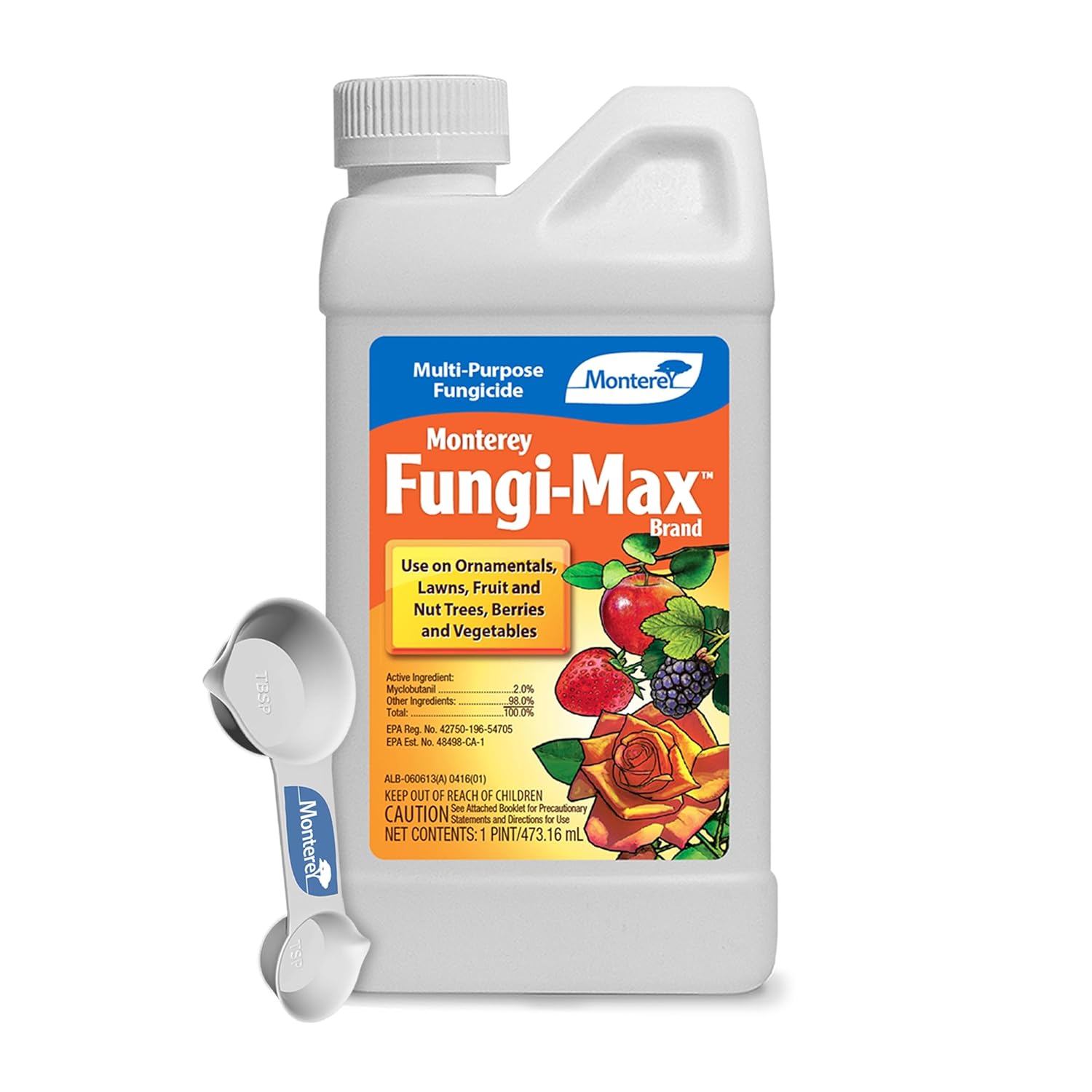
Monterey Fungi-Max Systemic Fungicide, 16 oz (with Measuring Spoon)
| Item Form | Liquid |
|---|---|
| Application Method | Spray |
| Coverage | Wide range of plants and plant types |
| Target Species | Flowers, Vegetables, Trees, Lawn Grass |
| Liquid Volume | 16 fluid ounces |
Monterey Fungi-Max is a concentrated liquid fungicide that you dilute and apply with a sprayer to prevent and control many common plant diseases. It is used outdoors on flowers, shrubs, trees, lawns and edible plants including vegetables and fruiting trees; for tomato growers it is intended to control leaf spots, blights and powdery mildew when applied at the first sign of disease. The product’s systemic action means it is absorbed and provides residual protection for up to two weeks, which reduces how often you need to spray during an outbreak. A measuring spoon is included to help with mixing and the spray application method works with standard pump or backpack sprayers. Important limitations are that it must be mixed and applied correctly according to the label and it is not listed as organic, so it may not suit organic-certified operations; also coverage on large plantings requires multiple bottles. For gardeners who want a reliable, easy-to-use fungicide to protect tomatoes and other outdoor plants, Fungi-Max delivers predictable, short-term disease control when applied promptly.
Best for: Gardeners who prioritize reliable, fast-acting disease control for outdoor tomato beds and mixed orchards and who want a product that gives measurable residual protection between applications.
Less Ideal for: Growers who require organic-certified products or those managing very large commercial tomato plantings where bulk coverage and cost per acre are primary concerns.
- Systemic action provides plant uptake and up to two weeks of protection per application.
- Broad labeled coverage for many plant types including vegetables and fruit trees.
- Liquid concentrate mixes for use with standard spray equipment for even coverage.
- Includes a measuring spoon to simplify accurate dilution amounts.
- Not listed as organic so unsuitable for certified organic production.
- One bottle may not cover large tomato plantings without repeated purchases.
Verdict: For home tomato growers seeking dependable, systemic disease control that reduces spray frequency, Monterey Fungi-Max is a practical, easy-to-use choice.
Bonide Captain Jack's Ready-to-Use Neem Oil Spray, 32 oz

| Item Form | Liquid |
|---|---|
| Target Species | Insects |
| Liquid Volume | 32 fluid ounces |
| Active Ingredients | Clarified Hydrophobic Extract of Neem Oil |
This ready-to-use neem oil spray is a multipurpose garden treatment that kills insects at all life stages while also serving as a miticide and preventative fungicide. Packaged in a 32-ounce trigger bottle, it is applied by shaking and thoroughly spraying plant surfaces, including leaf undersides, at the first sign of pests or disease and reapplying every 7 to 14 days as needed. The active ingredient is a clarified hydrophobic extract of neem oil, which is approved for organic gardening and labeled safe to use on vegetables up to the day of harvest. Practical benefits include broad pest coverage (aphids, whiteflies, spider mites and others), disease suppression such as powdery mildew, and convenience from a ready-to-use sprayer. Important limitations are that results are slower than synthetic contact insecticides and application timing matters to avoid leaf burn in full sun; repeated applications may be needed for heavy infestations. Follow label safety directions and keep the product away from children and pets.
Best for: Gardeners who want a single, organic-approved product to manage common vegetable garden pests and fungal problems and who prefer products with strong user feedback.
Less Ideal for: Growers needing rapid knockdown of severe infestations or commercial producers who require fast-acting, high-throughput treatments.
- Kills multiple pest stages including eggs, larvae and adults for more complete control.
- Also acts as a fungicide and miticide so one product covers pests and common fungal issues.
- Ready-to-use trigger bottle requires no mixing and is easy to apply to leaves and undersides.
- Approved for organic gardening and can be used on vegetables up to day of harvest.
- Slower-acting than many synthetic contact insecticides, so it may take several applications to see control.
- Must avoid spraying in peak sunlight to reduce risk of leaf burn.
Verdict: A convenient, organic-approved all-in-one neem spray that controls common vegetable garden pests and fungal issues with minimal fuss.
Bonide Captain Jack's Liquid Copper Fungicide Ready-to-Use, 32 oz

| Item Form | Spray |
|---|---|
| Unit Count | 32 Ounce |
| Active Ingredients | copper |
Bonide Captain Jack’s Liquid Copper Fungicide is a trigger-spray, ready-to-use copper treatment designed to control common fungal diseases such as black spot, powdery mildew, blight and peach leaf curl. It is applied by shaking and thoroughly spraying tops and undersides of leaves every 7 to 10 days or as needed, and the label allows application up to the day of harvest on listed edible plants. The product’s copper active ingredient makes it broadly effective against many foliar diseases and the convenient spray bottle removes the need to mix concentrates. Practical benefits include organic approval for many uses and clear directions for repeat treatments, which helps with consistent disease management. Important limitations are that it is a contact-style copper spray rather than a systemic cure, so thorough coverage and repeated applications are required for control, and care must be taken to follow label directions to avoid phytotoxicity on sensitive varieties.
Best for: Gardeners who prioritize established, proven solutions and want an organic-approved spray that controls common foliar diseases on roses and other plants with minimal setup.
Less Ideal for: Growers looking for a systemic fungicide or a single-application cure for long-term prevention should consider alternatives with systemic activity.
- Ready-to-use trigger spray for easy application without measuring or mixing
- Approved for organic gardening and label allows use up to day of harvest on listed edibles
- Effective copper active ingredient against a wide range of foliar fungal diseases including black spot
- Clear instructions for treatment interval make follow-up applications straightforward
- Contact-action copper requires thorough coverage and repeat sprays rather than a one-time systemic fix
- Potential for phytotoxicity on some sensitive plants if label directions are not followed
Verdict: A ready-to-use, organic-approved copper spray that provides reliable contact control of black spot and other foliar diseases when applied thoroughly and on schedule.
Choosing the Right Leaf Spot Fungicide: Key Factors to Consider
Mode of Action and Resistance Management
Understanding a fungicide's mode of action matters because repeated use of a single chemistry can select for resistant fungal strains. Alternating products with different modes of action or using multi-site materials when appropriate reduces selection pressure.
When planning treatments, check whether a product is contact-only or systemic. Contact materials protect new tissue only while residue remains on the leaf surface. Systemic or translaminar options move into the leaf and can suppress developing infections. For longer-term programs, rotation and integration with cultural controls help preserve effectiveness.
Speed of Activity and Visible Symptom Response
How quickly a product halts lesion expansion affects whether plants recover foliage and avoid defoliation. Fast-acting materials can limit further spread and reduce inoculum that would re-infect nearby plants.
Consider whether you need immediate curative action or primarily preventive protection. In many cases a combined approach-treating active outbreaks and following up with preventative intervals-gives the best control in a typical garden setting.
Plant Safety and Phytotoxicity Risk
Some formulations can stress sensitive plants, especially under hot, sunny conditions or when applied at too-strong concentrations. Label directions typically list tolerant and sensitive species and recommend avoiding applications during midday heat.
If you manage mixed plantings that include tender ornamentals, newly transplanted specimens, or young vegetable seedlings, favor products with low phytotoxicity records and follow label concentration and timing guidance closely.
Spectrum of Pathogen Control
Leaf spot is a symptom caused by different fungi and bacteria across species. A product's spectrum determines whether it will control the pathogens common on your target plants. Broad-spectrum fungicides cover many leaf spot fungi, while some act mainly against specific genera.
Match the expected pathogens in your garden to the treatment spectrum when possible, and pair chemical controls with sanitation and cultural practices to reduce overall disease pressure.
Application Method and Ease of Use
Ease of application influences how consistently you can follow recommended intervals. Ready-to-use sprays, hose-end applicators, and concentrated mixes each have tradeoffs in accuracy and coverage.
Think about spray coverage for dense canopies, required personal protective equipment, and whether you need tank-mix compatibility with other horticultural products. More user-friendly formats improve adherence to label intervals and reduce the chance of under- or overapplication.
Residual Protection and Reapplication Interval
Residual protection determines how often you must reapply to maintain control during high-risk periods such as extended wet weather. Products with longer residual activity reduce labor and cumulative exposure but may have constraints for edible crops.
Factor in rainfall, irrigation patterns, and plant growth rate when planning reapplication. Shorter intervals demand more monitoring but can limit resistance development when integrated thoughtfully into a rotation plan.
When to Treat: Timing and Disease Thresholds
Treating at the right time prevents minor infections from becoming widespread. For many leaf spot diseases, the ideal window is early in symptom development or as soon as weather conditions favor fungal growth-cool, wet, or humid periods. Waiting until extensive defoliation is visible makes recovery harder.
Use simple thresholds to guide action: spotty lesions on a few lower leaves often call for sanitation and monitoring rather than immediate chemical control. If lesions are increasing in number, appear on upper foliage, or if new infections appear after favorable weather, begin or resume fungicide applications according to label intervals.
- Start treatment at first sign of active lesion expansion on new growth.
- Prioritize plants that are high value or closely spaced, where disease spreads quickly.
- Combine spray programs with pruning out heavily infected foliage to reduce inoculum.
Application Best Practices for Effective Coverage
Good coverage matters more than frequent spraying. Apply sprays to thoroughly wet both upper and lower leaf surfaces when the label permits, since many pathogens colonize the underside of leaves. Use a spray nozzle suited to fine coverage for foliage, and plan applications during calm weather to limit drift.
Avoid applying during the heat of the day to reduce phytotoxic risk. Early morning or late afternoon applications often give the best balance of reduced sun stress and adequate drying time.
- Calibrate sprayers to ensure correct dilution and uniform coverage.
- Wear recommended protective gear and avoid spraying in windy conditions.
- Do not exceed label concentration; more is not always better and can damage plants.
Integrating Fungicides With Cultural Controls
Fungicides are most effective when used alongside cultural practices that reduce disease pressure. Improve air circulation by thinning crowded plantings, avoid overhead irrigation when possible, and remove fallen infected leaves promptly. These steps lower humidity around foliage and reduce the number of infectious spores.
Sanitation and selection of tolerant varieties cut down reliance on chemical measures over the season. When fungicide treatments are necessary, use them as part of a larger disease management plan rather than as a sole solution.
- Prune to open canopy and increase airflow.
- Water at the base of plants and time irrigation to allow foliage to dry quickly.
- Rake and dispose of infected leaf debris to limit overwintering inoculum.
Special Considerations for Edibles and Herb Gardens
If you treat vegetables, herbs, or fruiting plants, pay special attention to label instructions for edible crops, pre-harvest intervals, and wash-off risks. Some products allow use on ornamentals only, while others have explicit directions for certain fruits and vegetables.
When treating edible plants, prefer products with short pre-harvest intervals or those labeled safe for food crops, and always follow reentry and harvest timing to avoid residues above recommended limits.
- Check pre-harvest intervals and maximum applications per season on the label.
- Rinse harvested produce that may have been exposed to foliar sprays.
- Consider mechanical and cultural controls first for low-value or small-scale edible plantings.
Environmental and Pollinator Safety
Some fungicides can harm beneficial insects or aquatic life if misapplied. Avoid spraying during bloom when pollinators are active unless the product is explicitly labeled as safe for use during flowering. When treating near water features, take measures to prevent runoff and follow buffer zone recommendations.
Use targeted spot treatments when possible to reduce overall environmental load and protect beneficial predators that help suppress other pests.
- Avoid treating open flowers and time sprays for periods of low pollinator activity.
- Follow label guidance for buffer zones near ponds and streams.
- Prefer spot applications to whole-canopy sprays when disease is localized.
How We Chose the Best Leaf Spot Fungicide
We shortlisted products that demonstrably control common leaf spot pathogens in small-scale gardens and landscapes, then filtered for options that suit home gardeners and serious hobbyists. Selection criteria prioritized modes of action with documented efficacy against fungal leaf spot organisms, formulation types that are usable by homeowners, and label guidance appropriate for ornamentals, edibles, or turf. We also weighed speed of symptom suppression, residual protection between applications, and phytotoxicity risk to sensitive plants. Excluded items included products intended only for large-scale agricultural use or industrial formulations without homeowner labeling, as well as materials lacking clear application rates. Our practical filters emphasized clear instructions, reasonable reentry intervals, and compatibility with integrated disease management such as sanitation and cultural controls. The evaluation focused on measurable, garden-relevant dimensions: how quickly lesions stop spreading, how long foliage remains protected, how safe the product is across common ornamental and edible species, and how easy the product is to apply correctly.
FAQ
How soon after applying a fungicide will I see leaf spot stop spreading?
Often you will see reduced lesion expansion within a few days, but visible recovery of damaged tissue can take longer. Contact products can prevent new lesions quickly, while systemic materials may take a short period to translocate and show control.
Can I mix a leaf spot fungicide with other garden sprays?
It depends on label guidance. Many products allow tank mixes with certain insecticides or nutrients, but compatibility varies. Always test a small area and follow label directions for mixing and application rates.
Is it safe to use the same fungicide repeatedly all season?
Repeated use of one chemistry can encourage resistance in fungal populations. Rotate products with different modes of action and incorporate nonchemical practices to reduce the likelihood of resistance.
Will fungicides prevent leaf spot in wet seasons?
Fungicides can reduce infection risk but are not a guarantee, especially under prolonged wet conditions. More frequent applications and combining sprays with cultural controls improve success during high-pressure weather.
Are there any risks to beneficial insects when treating for leaf spot?
Some fungicides pose low acute risk to pollinators, while others can harm beneficials if applied to flowers or during active foraging. Avoid spraying during bloom and follow label precautions to minimize impacts.
How do I choose between a contact and a systemic product?
Choose contact materials for preventive coverage and when you need broad-spectrum surface protection. Systemic options can help suppress established infections and protect new growth, but both types have roles depending on disease stage and plant sensitivity.
Final Verdict
Select a leaf spot treatment based on the disease stage, the plants you need to protect, and the program you can maintain. Prioritize products that act quickly when lesions are spreading, but balance that with plant safety and resistance management by rotating modes of action. Combine any chemical control with sanitation, pruning, and irrigation adjustments to reduce disease pressure and get the most durable protection.
