

Note: This article contains affiliate links. If you click on these links and make a purchase, I may earn a small commission at no extra cost to you. This helps support my research and content. Read my full affiliate disclosure here.
If you need clean, repeatable holes for fence posts, deck footings, or garden trellises, the right auger post hole digger can save hours of backbreaking work. In gardens, yards, and small construction sites, power augers change how quickly you can plant posts while keeping hole diameter and depth consistent. This guide covers a shortlist of the top picks for the Best Auger Post Hole Digger and explains the practical tradeoffs you should weigh, including motor torque, bit size options, and ease of use. Each selection was evaluated against common gardener and installer needs, so you can match a tool to your site conditions and project scale.
Top Picks at a Glance
| Best Quality Built to a higher standard if you want something more solid | Earthquake E43 1‑Person Earth Auger Powerhead with 8" Auger Bit |  |
| Best Value The sweet spot between price and what you get | Prowoo 72CC Gas-Powered Post Hole Digger with 6" and 8" Auger Bits |  |
| Best Budget The cheapest option that still gets the job done reliably | Leriton 6" x 46" Hand Auger Post Hole Digger with Hardwood T-Handle |  |
| Highest Rated A top-rated pick with lots of positive feedback | Wild Badger Power 40V Cordless Electric Earth Auger Post Hole Digger Kit |  |
| Most Popular A crowd favorite that many people choose with confidence | VEVOR 43CC Gas-Powered Post Hole Digger with 8" Auger |  |
| Best Seller A high-volume bestseller chosen again and again | XtremepowerUS 1500W Electric Post Hole Digger with 6" Auger Bit |  |
Earthquake E43 1‑Person Earth Auger Powerhead with 8" Auger Bit

| Engine | 43cc 2-Cycle Viper Engine |
|---|---|
| Transmission Ratio | 30:1 |
| Included Auger | 8 inch steel auger with fishtail point |
| Handle Type | Steel handlebars with anti-vibration foam grips |
The Earthquake E43 is a gas-powered, one-person earth auger combo built for demanding digging tasks like fence posts, deck footings, and tree planting. Its 43cc two-cycle Viper engine and 30:1 transmission deliver strong torque so a single operator can bore through compacted soil quickly. The unit pairs a compact powerhead with an 8-inch steel auger that includes a fishtail point, flex-coil shock absorber and replaceable blades for longevity. Industrial-style air filtration and ball-bearing transmission gears improve reliability during repeated use, while anti-vibration foam-grip handles and fingertip throttle make control more comfortable. Because it is a gasoline machine, expect typical needs for fuel mixing, periodic spark plug and air filter service, and louder operation compared with electric models. The combo is aimed at performance and durability rather than ultra-lightweight portability, so it works best when you need consistent, powerful drilling for multiple holes across a property.
Best for: Buyers who prioritize drilling performance and durability for regular landscaping or farm tasks and want a one-person gas auger that handles compacted soil without assistance.
Less Ideal for: Casual gardeners with only a few shallow holes, or users who need a quieter, low-maintenance electric or battery-powered option.
- Powerful 43cc two-cycle Viper engine for strong torque in tough soil
- Includes durable 8-inch steel auger with fishtail point and replaceable blades
- Industrial air filtration and ball-bearing transmission for improved reliability
- Anti-vibration foam-grip handles and fingertip throttle for better operator comfort
- Requires gasoline maintenance and is louder than electric or battery options
Verdict: If you need a rugged, single-operator auger that delivers strong torque and durability for repeated posthole and planting work, the Earthquake E43 is a top performance choice.
Prowoo 72CC Gas-Powered Post Hole Digger with 6" and 8" Auger Bits

| Manufacturer | Prowoo |
|---|---|
| Item model number | 72 CC |
| Size | 72CC+2 auger(6"8")+1 Ext |
| Material | Metal, Plastic |
The Prowoo 72CC gas-powered post hole digger is a compact earth auger designed for routine fence, pole, and planting-hole work. It pairs a 72cc two-stroke engine with ergonomic handlebars, a finger throttle, and a manual recoil start so one person can quickly position and dig holes without electric cords. The kit includes 6" and 8" double-sheet auger bits, a 60cm extension rod, a fuel mixing bottle, and basic assembly tools, which makes it ready to use on arrival. In practice the heavier powerhead and metal augers cut through typical garden and farmland soils efficiently and the interchangeable blades let you sharpen or swap bits for different ground conditions. Expect vibration and noise typical of small gas engines and occasional maintenance such as spark plug, air filter, and fuel-mix care. The unit is well suited to repetitive post-hole jobs where mobility and continuous run time matter, though it requires safe handling and basic engine maintenance compared with electric alternatives.
Best for: Buyers who need a mobile, gas-powered auger for regular post-hole or planting tasks and who value quick setup and continuous run time over electric convenience.
Less Ideal for: People who want near-silent, low-maintenance operation or who prefer battery or electric tools for very small, infrequent jobs.
- Powerful 72cc gasoline engine for strong digging performance in compact package
- Includes 6" and 8" double-sheet auger bits plus a 60cm extension for versatility
- Ergonomic handlebars with finger throttle give good control during operation
- Comes as a complete kit with fuel-mixing bottle and basic assembly tools for quick start
- Requires routine two-stroke engine maintenance and correct fuel mixing
- Produces typical gas-engine noise and vibration during use
Verdict: A ready-to-use, petrol-powered auger kit that delivers strong, mobile digging performance for frequent post-hole and planting work.
Leriton 6" x 46" Hand Auger Post Hole Digger with Hardwood T-Handle
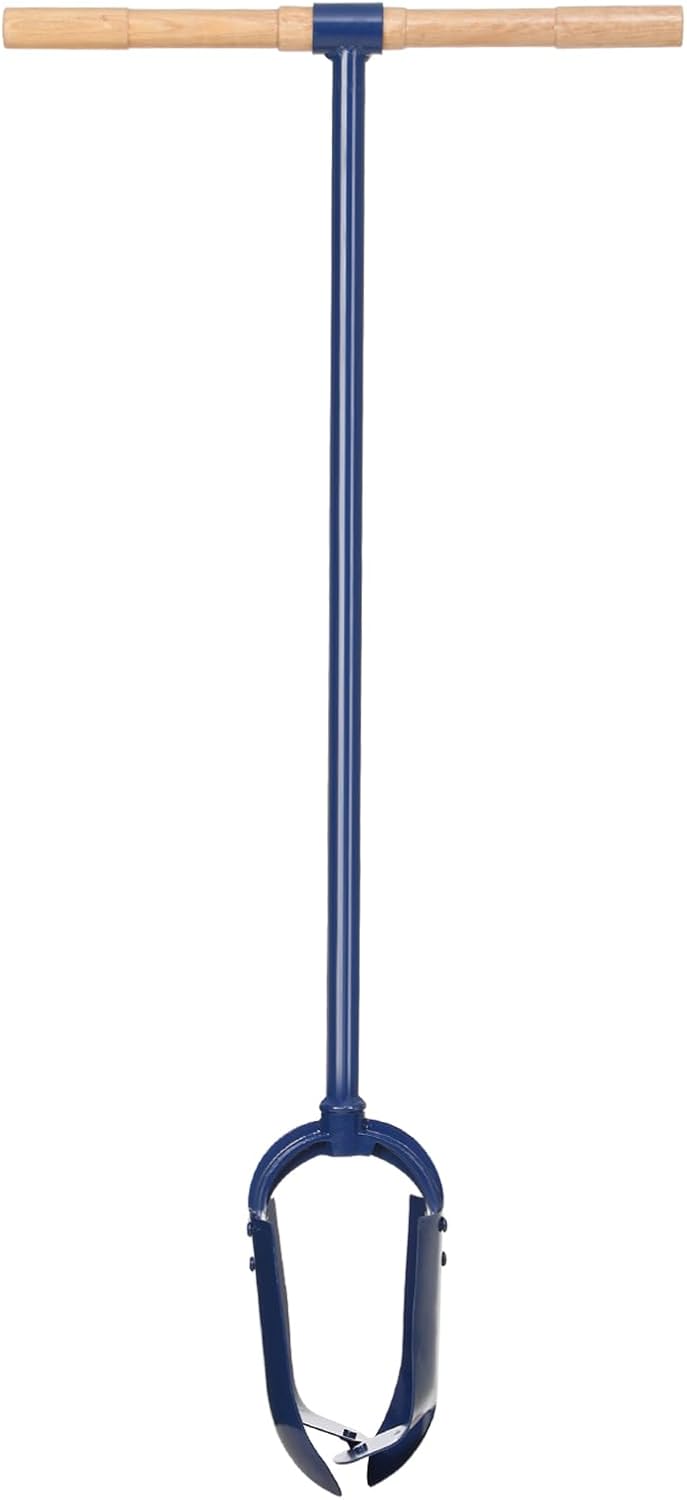
| Blade spread | 6 inches |
|---|---|
| Shaft length | 46 inches |
| Blade material | Hardened steel |
| Handle type | Hardwood T-handle |
The Leriton 6" x 46" hand auger is a straightforward manual post-hole digger built around a hardened steel blade and a long T-handle shaft. You use it by placing the blade on the soil, stepping and twisting to bore a cylindrical hole, which makes it practical for fence post installation, planting trees, and other garden holes where a power auger is unnecessary. The 46-inch shaft gives extra reach and leverage so you can keep your back straighter while turning, and the hardwood T-handle provides a comfortable grip for repeated rotations. Because it is a simple, one-piece tool it arrives ready to use with no assembly. Important limitations are that it is manual work so it is slow in compacted clay or rocky ground and not suitable for very deep or large-diameter holes without repeated passes. For light to medium garden tasks on softer soils this auger is an economical, durable option; for heavy professional digging a gas or cordless auger would be faster and less physically demanding.
Best for: Buyers looking for a low-cost, no-frills manual auger for occasional fence post installation, planting, and small garden holes who prioritize durability and simplicity over mechanized speed.
Less Ideal for: Professional contractors, frequent diggers, or anyone who regularly works in dense clay or rocky ground should consider a powered auger for faster, less strenuous digging.
- Hardened steel blade for durable cutting in typical garden soils
- Long 46-inch shaft provides leverage and reach to reduce bending
- Hardwood T-handle offers a comfortable, non-slip grip
- Ready to use out of the box with no assembly required
- Manual operation requires significant physical effort in heavy, compacted, or rocky soils
- Not ideal for very deep holes or large-diameter post holes without multiple passes
Verdict: A durable, budget-friendly manual auger that delivers reliable performance for occasional fence-post and planting holes without the cost of powered equipment.
Wild Badger Power 40V Cordless Electric Earth Auger Post Hole Digger Kit

| Motor power | 1,600W brushless |
|---|---|
| Torque | Up to 66 ft-lb |
| Auger bit | 8-inch by 31-inch cast-steel |
| Battery | 40V 4.0Ah lithium-ion (included) |
| Warranty | 3-year limited |
The Wild Badger 40V cordless earth auger is a compact, cordless post-hole digger kit built for residential fence, mailbox and planting work. It uses a 1,600W brushless motor delivering up to 66 ft-lb of torque and comes with an 8-inch by 31-inch cast-steel auger bit, a 40V 4.0Ah lithium battery and a fast charger, so you can dig multiple 8-inch holes on a single charge depending on soil conditions. Two-hand ergonomic controls, high and low speeds, reverse and an anti-kickback feature make it straightforward to operate and free a bound bit if it stalls. The cordless design removes fuel mixing and extension cords, and the brushless motor promises longer life and less maintenance than brushed alternatives. Limitations are typical for cordless augers: it is meant for loose-to-moderate soil and will struggle with large rocks, heavy clay, frozen ground or concrete. The unit is fairly heavy for handheld use, so longer jobs may be tiring despite the ergonomic grips. Overall it is a reliable, low-maintenance choice for homeowners and landscapers needing frequent post holes in suitable ground.
Best for: Buyers who prioritize a durable, low-maintenance tool for regular post and planting holes in yard or garden sites and who prefer cordless convenience over gas or corded machines.
Less Ideal for: People who need to dig in rock-filled, heavy clay, frozen ground or concrete, or those who expect to do very long continuous digging without breaks.
- Brushless 1,600W motor gives strong torque and lower maintenance than brushed motors
- Includes 40V 4.0Ah battery and fast charger for cordless, ready-to-use operation
- Cast-steel 8" x 31" auger bit produces consistent holes for posts and planting
- Two-speed control plus reverse and anti-kickback improve control and safety
- Not suitable for rocky, frozen, or concrete surfaces
- Relatively heavy handheld weight can cause fatigue during extended use
Verdict: A dependable cordless auger kit that delivers strong brushless power and practical controls for routine post and planting holes in loose to moderate soil.
VEVOR 43CC Gas-Powered Post Hole Digger with 8" Auger

| Maximum Power | 1250 watts |
|---|---|
| Maximum Rotational Speed | 9350 rpm |
| Drill Type | Earth Drill |
| Included Components | 8" Auger, Oil Mixing Bottle, Spark Plug, Tool Kit |
| Material Type | Aluminum |
The VEVOR 43CC post hole digger is a petrol-powered auger built to speed up fence posts, planting, and small farm digging tasks. It pairs a 43cc engine and ball-bearing gearbox with a 30-inch alloy steel auger so you can drill deeper holes without stooping. Typical use is straightforward: fill the 1.2L fuel tank with the recommended gas-oil mix, prime and pull the thicker 1.2m cord, then guide the unit by its foam-wrapped handles while the auger bores into soil. Notable features include a shock-absorbing handle, emergency stop switch on the grip, and a corrosion-resistant powder-coated drill bit. Practical benefits are faster hole completion versus manual digging and fewer interruptions thanks to the large fuel tank and included basic tool kit and spare spark plug. Important limitations are that it is a gas engine tool so it requires fuel mixing, periodic maintenance, and suitable outdoor ventilation; it will also be heavier and louder than electric alternatives and may struggle in extremely rocky ground. For routine post and planting jobs in typical garden and small-acreage soils it delivers solid, reliable performance.
Best for: Buyers who prioritize reliable, gas-powered digging for routine fence posts, planting, or small farm work and want a turnkey tool that handles common garden soils with minimal fuss.
Less Ideal for: People needing a low-noise, zero-emission tool for confined or city yards or those who prefer electric convenience and minimal maintenance.
- Powerful 43cc engine with ball-bearing gearbox for steady drilling in compact and loamy soils
- Includes 8" alloy steel auger (30-inch length) that allows deeper holes without bending
- 1.2L fuel tank and longer 1.2m pull cord reduce interruptions and make starting easier
- Safety and comfort features such as an emergency stop switch and foam anti-vibration handle
- Ships with a basic tool kit, spare spark plug, and oil mixing bottle for first-use readiness
- Gas engine requires fuel-oil mixing and routine maintenance
- Heavier and louder than electric or manual options, and not ideal for indoor or low-noise needs
Verdict: A robust gas-powered auger that reliably speeds up post and planting work for gardeners and small-acreage owners who want proven engine power and ready-to-use accessories.
XtremepowerUS 1500W Electric Post Hole Digger with 6" Auger Bit

| Rated Watt | 1500W |
|---|---|
| Max Torque | 90ft/lb |
| Horsepower | 1.6HP |
| No Load Speed | 200RPM |
| Auger Bit Diameter | 6" |
The XtremepowerUS electric post hole digger is a one-person powerhead kit built for digging consistent holes for fence posts, planting trees, and other yard projects. It pairs a 1500W motor rated at roughly 90 ft-lb of torque with a single 6-inch manganese steel auger that is meant to reach about 28 inches deep, letting you bore holes faster and with less physical strain than manual digging. The unit includes anti-vibration, anti-slip handles and a safety lock on the trigger to reduce accidental starts, which helps during repetitive work. Its spiral two-flute bit is designed to cut and eject soil effectively and the metal construction is treated to resist rust. Limitations are that it is an electric powerhead so it needs mains power and is best for moderate holes rather than heavy industrial use, and only one auger bit is included by default so wider or deeper holes require buying additional bits or extensions. For homeowners and landscapers wanting quicker, more consistent holes, it delivers solid, practical performance.
Best for: Buyers who want a faster, less physical way to dig consistent post or planting holes around the yard and who prioritize safety features and proven performance when choosing tools.
Less Ideal for: Users who need fully cordless mobility for remote jobs or who regularly need a wide range of bit diameters and depths without buying extras.
- Powerful 1500W motor delivering up to 90 ft-lb torque for efficient digging
- Includes a durable 6-inch manganese steel auger bit that reaches about 28 inches deep
- Anti-vibration, anti-slip handles and a safety lock reduce user fatigue and accidental engagement
- Spiral two-flute design helps cut soil cleanly and eject spoil while digging
- Requires mains power so not suitable for remote sites without an outlet
- Only the 6-inch auger bit is included, so different hole sizes need separate purchases
Verdict: A powerful, safety-minded electric post hole digger that speeds up fence and planting work for homeowners and landscapers who can use mains power.
Choosing the Right Auger Post Hole Digger: Key Factors to Consider
Power and Torque
Power and torque determine whether an auger can bite through compacted soil, clay, or gravel. Higher torque at low RPMs is usually more useful than high top speed because it prevents stalling when the bit meets resistance. For gardeners, matching motor output to site conditions means fewer interruptions and less strain on the gearbox.
Assess the typical ground you will be drilling into. Sandy loam needs much less torque than clay or rocky subsoil. If you expect to hit roots or hardpan, prioritize torque and a robust gearbox to avoid frequent stalls and overheating.
Auger Bit Size and Extension Options
Hole diameter and depth options are critical because posts, fence anchors, and footings have standard sizes. An auger that accepts a variety of bit diameters and extensions lets you adapt to different post sizes without buying a second machine.
Also check whether bits are standard-shank and easy to swap in the field. Removable extensions save time on deeper holes and reduce the need to overdrill multiple passes.
Durability and Corrosion Resistance
Outdoor tools face moisture, abrasive soils, and occasional impacts. Steel quality in the auger flighting, gearbox housing, and frame affects how long the machine holds up. Protective coatings and sealed bearings reduce corrosion and ingress of grit.
Durability matters for both resale value and downtime. A well-built auger will have replaceable wear parts like spiral tips and a serviceable gearbox, which is preferable to a sealed unit that must be discarded after failure.
Ergonomics and Vibration Control
Augering produces torque reactions and vibration that transmit to the operator. Handle design, grip placement, and vibration-dampening mounts reduce fatigue and improve control, especially during long runs of holes.
Consider weight distribution and whether the unit needs a second operator. Lighter units are easier to maneuver but can transfer more vibration; heavier models may be steadier but require more effort to position.
Portability and Setup
Portability influences whether you can move the auger around a yard, up stairs, or into a garden gate. Units that break down quickly or have carry handles save time. Setup features like quick-release couplings for bits and tool-free adjustments reduce the time between holes.
If you plan on using the auger across multiple properties or storage in a shed, factor in overall package size and how easily it disassembles for transport.
Maintenance and Serviceability
Routine maintenance keeps an auger reliable. Accessible grease points, a serviceable gearbox, and clear instructions for belt or engine upkeep make long-term ownership simpler. For gas units, carburetor access and an easy fuel-shutoff are useful in storage and winterization.
Availability of replaceable wear parts such as cutting edges and spiral tips reduces lifecycle cost. Consider whether you can perform basic repairs yourself or if professional servicing will be needed frequently.
Matching Auger Size to Common Post Types
Different posts require different hole diameters and depths. Residential fence posts commonly need 4 to 6 inch holes, while larger deck or structural posts may require 8 inches or more. Choose an auger that offers bits or adapters for the diameters you use most often.
Depth control is equally important. Many operators drill full length in stages, using extensions when necessary. For consistent depth across a run, use a physical stop or mark the bit with tape to avoid under- or over-digging.
- Match bit diameter to post socket or concrete tube size.
- Use extensions rather than overdriving a single pass for deeper holes.
- Consider using a depth stop for repeatable results.
Working in Tough Soil and Rooted Sites
Clay, compacted subsoil, and root networks are the most common reasons augers stall. For these conditions, a combination of aggressive cutting tips and slower, high-torque operation helps. Clearing the hole in stages prevents the auger from packing soil into the flighting.
If you frequently encounter roots, carry a spade or root saw to clear the immediate area before augering. That reduces strain on the gearbox and speeds up the process compared with forcing the bit through thick roots.
- Reduce RPM and apply steady pressure in clay.
- Clear surface roots first to protect the bit and gearbox.
- Pull the auger up regularly to remove packed soil from flights.
Gas Vs Electric Considerations
Gas-powered augers provide consistent torque and longer run times for large jobs, but they require fuel management and routine engine maintenance. Electric options are quieter, lighter, and lower maintenance, making them attractive for small to medium tasks in residential settings.
Battery-powered augers add portability without a tether, but battery life and replacement cost should be weighed if you plan long digging sessions. For intermittent yard work, electric models often offer a good balance of convenience and performance.
- Choose gas for extended jobs away from power or for heavier soils.
- Select corded electric for unlimited runtime where cord access is reliable.
- Prefer battery units for lighter jobs and minimal maintenance.
Safety and Best Practices
Safe operation starts with clearing the area of buried utilities and marking any known lines before drilling. Always use the correct personal protective equipment, including gloves, eye protection, and hearing protection for gas units.
Maintain a firm stance and use two hands on the handles. When the auger binds, stop the motor and clear the bit rather than forcing it. If torque reaction becomes severe, reposition, or use a second operator to control the tool.
- Call local utility locating services before digging.
- Wear appropriate PPE and keep bystanders clear.
- Stop and clear packed soil or roots before continuing.
Storage and Winterizing
Proper storage extends the life of an auger. Clean soil and moisture from the bit and frame after use. For gas models, run the engine dry or stabilize fuel and fog the carburetor for winter storage to prevent gumming.
Keep spare cutting tips and a small service kit with basic tools. Storing bits separately with a light coating of oil prevents corrosion and preserves sharpness for the next season.
- Remove moisture and pack from flights before storage.
- Stabilize or drain fuel in gas engines before long-term storage.
- Store spare tips and small parts in labeled containers.
How We Chose the Best Auger Post Hole Digger
We focused on attributes that affect real-world digging performance for gardeners and homeowners. Key evaluation criteria included engine or motor torque and RPM range for effective penetration in packed soils and clay, auger bit diameter options and extension compatibility for common post sizes, build durability and corrosion resistance for long-term outdoor use, user ergonomics including handle design and vibration control, and maintenance accessibility for routine service like belt, gearbox, or fuel system checks. We also considered portability and setup time for tasks across different parts of a property. Exclusions: heavy excavator-style equipment and purely commercial, high-tonnage rigs were left out because they are impractical for residential gardens and small acreage. The resulting selections prioritize machines that balance digging power with manageable weight, clear serviceability, and flexibility of bit sizing so gardeners get consistent holes without unnecessary complexity.
FAQ
What auger diameter do I need for typical fence posts?
For standard residential fence posts, 4 to 6 inch diameter bits are common. Larger structural posts for decks or heavy loads often need 8 inches or more. Match the diameter to the post and any concrete sleeve you plan to use.
Can I use a handheld auger in clay or rocky soil?
You can, but expect more stalls and wear. In clay, use lower RPM and higher torque settings where possible and clear the bit frequently. For consistently rocky or root-filled ground, a heavier unit or pre-clearing the hole with a digging bar is usually more effective.
How deep should I drill for fence posts in my yard?
Depth depends on local frost depth and post height, but a common rule is one third of the post length below grade. For frost-prone areas, follow local codes or extend beyond typical depths to reach stable subsoil.
Are electric augers powerful enough for most home projects?
Electric augers can handle many home projects, especially in softer soils and for moderate hole sizes. For long runs, deep holes, or very compacted ground, gas or higher-torque units may be more reliable.
How do I maintain cutting tips and flighting?
Keep tips sharp and replace worn edges when they no longer cut efficiently. Clean soil from the flighting after every use and inspect for bends or cracks. Lubricate bearings and check fasteners regularly to prevent damage from vibration.
Is it safe to operate an auger alone?
Many augers can be operated by a single person depending on size and torque reaction, but using a second operator for larger bits or heavy units improves control and safety. Always follow the manufacturer's safety recommendations for two-person operation if torque is high.
Final Verdict
Choosing the right auger post hole digger comes down to matching power, bit options, and durability to your typical soil conditions and project scale. Prioritize torque and compatible bit sizes if you work in clay or need larger holes, and favor ergonomics and vibration control if you will be drilling many holes in one session. Balance portability and maintenance needs against the workload to select a tool that lasts and makes the job significantly faster and less tiring.
