

Note: This article contains affiliate links. If you click on these links and make a purchase, I may earn a small commission at no extra cost to you. This helps support my research and content. Read my full affiliate disclosure here.
Choosing the right soil mix matters more than you might think for a money tree plant. The wrong blend holds too much water or sheds moisture too quickly, stressing roots and inviting rot or slow growth. Good mixes balance free drainage with enough water-holding capacity and stable nutrients so your plant can establish quickly and respond well to regular watering and feeding. This guide shortlists seven top soil mixes for money tree plants, each selected for practical performance in indoor and bright-window situations. We evaluate mixes for drainage, moisture balance, aeration, and nutrient retention so you can pick a blend that matches your watering style and potting setup.
Top Picks at a Glance
| Best Overall The best all-around choice for most situations | Leaves & Soul Money Tree Potting Soil Mix, 2.2 Quarts |  |
| Best Quality Built to a higher standard if you want something more solid | Duspro Money Tree Potting Mix — Pre‑Mixed Coco Coir, Perlite & Pine Bark, 6 Quarts |  |
| Best Value The sweet spot between price and what you get | Perfect Plants Money Tree Potting Soil, Indoor Coco Coir Mix, 2 qt |  |
| Best Budget The cheapest option that still gets the job done reliably | Kapecute Money Tree Potting Soil Mix, 2 QT (Compressed Sphagnum Moss + Perlite + NPK) |  |
| Highest Rated A top-rated pick with lots of positive feedback | Top Tier Genetics Premium Money Tree Potting Mix (Indoor) — 8 qt |  |
| Most Popular A crowd favorite that many people choose with confidence | Perfect Plants Money Tree Potting Soil (4 qt) — Coconut Coir-Based Indoor Tree Mix |  |
| Best Seller A high-volume bestseller chosen again and again | Gardenera Money Tree Potting Mix (1 Quart) |  |
Leaves & Soul Money Tree Potting Soil Mix, 2.2 Quarts

| Volume | 2.2 quarts |
|---|---|
| Made in | USA |
| Primary components | Peat moss, coco coir, perlite, dolomite |
This 2.2 quart Leaves & Soul Money Tree potting mix is a ready-to-use blend designed to repot and maintain Pachira aquatica and other indoor tropical plants. The mix combines peat moss and coco coir for moisture retention, perlite for drainage and aeration, and dolomite to buffer pH and add calcium and magnesium. In practice it gives a loose, well-aerated root zone that helps prevent overwatering problems common with Money Trees while still holding enough moisture between waterings. The resealable bag makes storage between small projects convenient. Because the package is small, it is best for single pots or topping up soil rather than large repots or multiple plants. Performance will still depend on container drainage, pot size and your watering habits, so you may need to supplement with extra perlite for very shallow or heavy pots. Safety notes advise avoiding inhalation and skin contact when handling dry mix.
Best for: Buyers who want a practical, ready-made soil specifically tuned for indoor Money Trees and similar tropical houseplants and who typically work on single pots or occasional repots.
Less Ideal for: Gardeners repotting multiple large plants or creating custom media blends should consider larger-volume mixes or base components they can adjust.
- Balanced formula of peat moss, coco coir and perlite for moisture retention plus drainage
- Dolomite included to help buffer pH and supply calcium and magnesium
- Resealable 2.2 quart bag is convenient for small repotting jobs and storage
- Ready-to-use mix requires no on-site blending or amendments
- Small 2.2 quart quantity limits use to one or a few small-to-medium pots
- No nutrient analysis or fertilizer schedule provided with the product
Verdict: A handy, ready-made potting mix that gives Money Trees a well-aerated, moisture-balanced root environment for single-pot repotting and maintenance.
Duspro Money Tree Potting Mix — Pre‑Mixed Coco Coir, Perlite & Pine Bark, 6 Quarts

| Brand | Duspro |
|---|---|
| Volume | 1 kg |
| Item Highlight | Coco Coir, Perlite & Pine Bark blend |
Duspro's Money Tree potting mix is a ready-to-use 3‑ingredient blend designed to give Pachira aquatica a lighter, faster-draining medium than standard potting soil. You use it straight from the bag for repotting or top-ups; the coco coir holds modest moisture while perlite and pine bark open the mix for better drainage and root aeration. In practice that means less risk of waterlogging and faster drying between waterings, which is helpful for growers who tend to overwater or use lower-porosity pots. The mix is especially convenient when you want predictable texture without measuring or sourcing components separately. Important limits to note are that it is a simple physical mix rather than a complete fertilized potting soil, so you should plan to feed plants on a regular schedule, and the formulation targets Money Trees and similar tropical houseplants so it may not suit species with very different moisture needs. For growers focused on performance, this mix delivers consistent drainage and repotting convenience, but you will still need to manage fertilization and watering to get the best results.
Best for: Houseplant owners who prioritize consistent drainage and straightforward repotting for Money Trees and similar tropical indoor plants and who prefer a ready-made mix to optimize root airflow.
Less Ideal for: Growers who want a complete, fertilized potting soil or who care for plants that need persistently moist or heavy organic mixes.
- Pre-mixed blend removes need to source and measure coco coir, perlite and pine bark
- Lightweight texture improves drainage and reduces water retention compared with standard potting soil
- Perlite and pine bark increase root airflow for healthier root development
- Convenient for quick repotting of multiple small Money Trees
- No indicated nutrient or fertilizer content so additional feeding is required
- Sold as a physical mix without variant nutrient profiles for different plant needs
Verdict: Choose this ready-made coco coir, perlite and pine bark mix when you want reliable drainage and root airflow for repotting Money Trees without mixing components yourself.
Perfect Plants Money Tree Potting Soil, Indoor Coco Coir Mix, 2 qt

| Net volume | 2 qt |
|---|---|
| Primary ingredients | Coco coir, pine bark, perlite, sand |
| Fertilizer | No pelletized fertilizer |
| Bag feature | Heavy duty resealable bag |
This 2 quart Perfect Plants potting mix is formulated to give indoor trees like money trees a well-draining, airy root medium. It combines shredded coir husk with pine bark, perlite and sand to speed drainage while retaining enough moisture for steady nutrient uptake, so it helps prevent root rot in potted specimens. The mix contains no pelletized fertilizer, which makes it suitable for growers who prefer to control feeding separately. The resealable heavy-duty bag is convenient for repeat use with small pots or repotting young trees, and being blended on a small family farm means batches are consistent. Because the bag is only 2 quarts, it is best for single repots, starter trees, or topping off soil rather than large specimens. If you need ready-to-feed, long-term nutrition or bulk volume for mature trees you will need to supplement with fertilizer or buy larger quantities, but for budget-conscious indoor gardeners looking to pot or refresh a small tree this mix is a practical, easy-to-use option.
Best for: Ideal for budget-minded indoor gardeners repotting small tropical trees or starter specimens who want a well-draining, easy-to-handle mix and prefer to manage fertilization themselves.
Less Ideal for: Not a good fit for growers who need a bulk supply for mature trees or a ready-to-feed mix that includes long-lasting nutrients.
- Coco coir and perlite blend provides good drainage while retaining moisture
- No pelletized fertilizer lets you control feeding separately
- Resealable heavy-duty bag keeps leftover mix fresh for future use
- Small 2 qt size is convenient for single repots or topping off pots
- Only 2 quarts per bag so multiple bags are required for larger trees
- No built-in fertilizer means extra feeding is needed after repotting
Verdict: A compact, well-draining coco coir mix that is a practical, low-cost choice for repotting small indoor trees when you want control over feeding.
Kapecute Money Tree Potting Soil Mix, 2 QT (Compressed Sphagnum Moss + Perlite + NPK)

| Brand Name | Kapecute |
|---|---|
| Unit Count | 3.5 Ounce |
| Item Type Name | potting soil |
| Volume | 2 quarts |
This Kapecute kit supplies a ready-made potting medium aimed at money trees by combining compressed sphagnum moss, perlite, and a small packet of balanced NPK fertilizer. You rehydrate the compressed moss, mix in the included perlite and fertilizer, squeeze out excess water, and use the resulting blend to pot or top-dress small indoor trees. The moss gives good water retention and a slightly acidic environment that favors root growth while perlite improves drainage and aeration. The individually wrapped components make measuring and mixing easy for a single pot or a few small repots. Limitations are the very small net volume—2 quarts is effectively a sample-sized bag once the moss expands—and the product is hand-packed so weights vary. Also this mix is simple and does not contain long-term slow-release amendments or significant organic matter beyond sphagnum, so users who need larger quantities or a more complete long-term potting soil will need to amend or purchase more material.
Best for: A budget-minded indoor gardener who needs an inexpensive, easy-to-use small batch mix for repotting or topping up money trees and similarly pH-sensitive houseplants.
Less Ideal for: Gardeners who need bulk potting soil for multiple large plants or a complete, long-term potting mix without additional amendments should look elsewhere.
- Compact, individually wrapped components simplify mixing for small repots
- Sphagnum moss provides strong water retention and mildly acidic conditions good for root development
- Perlite improves drainage and aeration to reduce compaction
- Includes a measured NPK granular fertilizer for an immediate nutrient boost
- Very small total volume suitable only for one or two small pots
- Contains minimal organic amendments beyond sphagnum so it is not a full long-term potting soil
Verdict: A low-cost, conveniently packaged small-batch potting mix that makes quick, single-pot repots of money trees simple and tidy.
Top Tier Genetics Premium Money Tree Potting Mix (Indoor) — 8 qt

| Brand Name | Top Tier Genetics |
|---|---|
| Style Name | Indoor Potting Mix |
| Unit Count | 128 Ounce |
| Volume | 8 quarts |
This potting mix is formulated specifically for Pachira aquatica and is intended for indoor container growing. It combines organic matter and a range of nutrients with a particle blend designed to keep soil airy while holding enough moisture for money tree roots. In practice the mix makes repotting straightforward: it drains well enough to reduce risk of waterlogging yet retains enough dampness to avoid daily watering for healthy foliage. The aeration properties help prevent compaction, which supports active root development in medium and larger containers. Because it is sold as a finished, nutrient-rich mix you can pot up newly purchased plants or refresh established specimens without adding an immediate fertilizer. Limitations are that the bag is a modest 8 quart volume so larger trees or repeated repots require multiple bags, and specific ingredient breakdown and NPK numbers are not provided for precise fertilization planning.
Best for: Buyers who prioritize a dependable, ready-to-use indoor potting mix tailored to money trees and want a low-effort way to repot or refresh houseplants.
Less Ideal for: Growers who manage large specimens, produce-heavy collections, or who need detailed fertilizer control should consider larger-volume or custom mixes instead.
- Formulated for money trees to balance drainage and moisture retention
- Contains organic matter and nutrients to support foliage and root growth
- Particle mix designed to promote aeration and resist compaction
- Small 8 quart volume may require multiple bags for larger plants or full repots
- No detailed NPK or ingredient percentages provided for precise feeding plans
Verdict: A convenient, money tree–specific potting mix that reliably balances drainage, aeration, and nutrients for healthy indoor growth.
Perfect Plants Money Tree Potting Soil (4 qt) — Coconut Coir-Based Indoor Tree Mix

| Unit Count | 128 Ounce |
|---|---|
| Item Type Name | Money Tree Potting Soil |
| Style Name | Coconut Coir-based, Nutrient-rich, Moisture-draining, Indoor Tree Soil |
| Volume | 4 quarts |
This potting mix is formulated specifically for money trees and other indoor potted tropicals. It combines shredded coconut coir, pine bark, perlite and sand to create a fast-draining yet moisture-retentive medium that encourages root development and helps prevent waterlogged roots. The absence of pelletized fertilizer makes it suitable for growers who prefer to control feeding separately. The resealable bag is convenient for storing leftover mix between repottings. In practice the blend will speed transplanting and reduce overwatering stress compared with heavy garden soils, and the added garden lime helps moderate pH for many indoor species. Limitations: it does not include slow-release nutrients so you will need to add fertilizer on a schedule, and the 4 quart size is best for small to medium pots rather than larger specimen trees.
Best for: Buyers who want a purpose-made indoor tree mix that reduces overwatering risk and supports healthy root development while controlling their own fertilization schedule.
Less Ideal for: Gardeners looking for an all-in-one fertilized mix or those who need bulk soil for large outdoor plantings should look elsewhere.
- Blend of coconut coir, pine bark, perlite and sand provides fast drainage with moisture retention
- Formulated for potted tropicals to promote root growth and leaf health
- Resealable heavy-duty bag keeps unused mix fresh between uses
- Blended in the USA on a small family farm
- No pelletized or built-in fertilizer so regular feeding is required
- 4 quart volume limits use to smaller pots or a few repottings
Verdict: Choose this mix if you want a purpose-built, fast-draining potting medium that helps money trees establish healthy roots while you manage fertilization yourself.
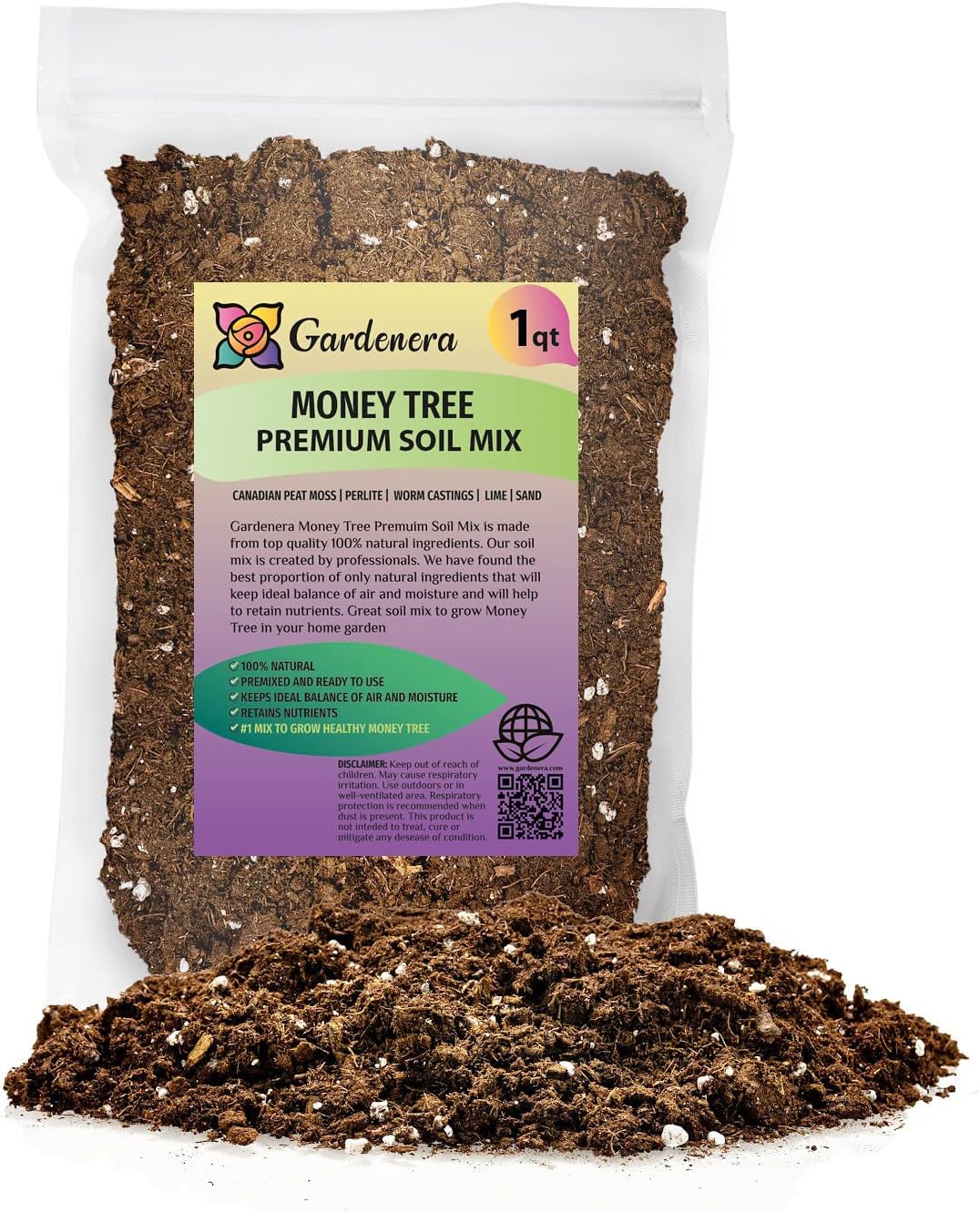
Gardenera Money Tree Potting Mix (1 Quart)
| Brand Name | Gardenera |
|---|---|
| Item Type Name | Money Tree Potting Mix |
| Unit Count | 2.39 Ounce |
| Volume | 1 quarts |
Gardenera Money Tree Potting Mix is a ready-to-use, small-batch soil blend designed specifically for growing or repotting Money Trees. It combines horticultural-grade components such as peat moss, perlite, sand, lime, and worm castings to create a light, airy medium that balances moisture retention and drainage. In practice the mix promotes root development and helps keep leaves healthy by retaining nutrients while preventing waterlogging. The one-quart bag is convenient for repotting small to medium indoor trees or refreshing the top layer of a container. Because it is premixed, you do not need to measure or amend components yourself, which saves time and reduces guesswork for gardeners focused on plant performance. Limitations include the small bag volume if you are repotting larger specimens and the need to handle the product carefully to avoid inhaling dust. For growers who prefer to tailor every ingredient, this premixed option offers less flexibility than building a custom mix from components.
Best for: Buyers who want a performance-focused, ready-made potting medium that promotes healthy roots and foliage for indoor Money Trees without mixing components themselves.
Less Ideal for: Gardeners repotting large specimens or those who prefer to custom-blend their own soils for exact ingredient ratios should look elsewhere.
- Formulated for Money Trees with a balance of drainage and moisture retention
- Made from 100% natural horticultural-grade ingredients like peat, perlite, sand, and worm castings
- Premixed and ready to use, saving time when repotting or refreshing containers
- Light, airy texture that supports root growth and reduces risk of waterlogging
- Small 1 quart volume may be insufficient for repotting larger trees
- Premixed formula offers less customization for growers who want to tweak proportions
Verdict: Choose this premixed, natural potting soil when you want a performance-oriented, ready-made medium that supports strong root growth and healthy foliage on indoor Money Trees.
Choosing the Right Money Tree Plant Soil Mix: Key Factors to Consider
Drainage and Percolation
Money tree plants need soil that drains well to prevent root rot. A mix with coarse components such as perlite, pumice, or coarse sand creates channels for excess water to move away from the root zone. Fast percolation reduces the time roots spend in saturated conditions after watering.
However, drainage should not mean that water disappears instantly. The right mix moves excess water efficiently while keeping enough moist pockets for roots to access between waterings. Avoid mixes that compact when wet, because compaction reduces pore space and undermines drainage over time.
Moisture Retention Balance
Indoor growers need a soil that holds moderate moisture without staying soggy. Organic components such as aged compost or coir provide water-holding capacity while still allowing oxygen to reach roots. Sphagnum peat can hold water but may compact or acidify over time unless balanced with coarse materials.
Think about your watering rhythm. If you water frequently and lightly, choose a mix with slightly higher retention. If you water deeply and infrequently, pick a mix with faster drying and more coarse aggregate so the root crown does not remain wet for long periods.
Aeration and Root Space
Root health depends on air in the soil as much as it does on water. Larger particles and a fluffy texture create stable air pockets and reduce compaction, helping roots expand and take up oxygen. Look for mixes that include components like pumice, bark chips, or coarse sand to keep the profile open.
Good aeration also makes repotting less stressful for plants. When you remove a root ball, a textured mix holds its shape without squeezing roots, making root inspection and trimming easier while minimizing damage.
Nutrient Content and Stability
Soil mixes should offer enough baseline nutrients to support new root growth without forcing immediate feeding. Stable organic matter such as well-aged compost or slow-release components provides a gentle nutrient supply. Avoid mixes overloaded with fresh, high-nitrogen amendments that can burn sensitive roots.
Also consider how long the mix will hold its structure and nutrients. Materials that break down rapidly can leach nutrients and change water-holding behavior, so mixes formulated for indoor container life tend to perform more predictably across potting cycles.
pH and Chemical Compatibility
Money tree plants prefer a slightly acidic to neutral pH range. The mix should not swing pH dramatically as it ages. Components like peat can acidify over time while lime or some composts can raise pH. Choosing a balanced mix helps ensure nutrient availability and prevents deficiencies caused by pH shifts.
Also factor in fertilizer compatibility. If you plan to use slow-release or liquid feeds, select a base mix whose chemistry won't bind or inactivate common nutrients. Moderately buffered mixes give you predictable feeding responses.
Texture, Weight, and Potting Practicalities
Indoor gardeners often care about how heavy a pot becomes after watering. Mixes with excessive fine silt or dense peat can make containers heavy and harder to move. Lightweight aggregates such as perlite and pumice reduce weight while improving structure.
Practicality also includes how easy the mix is to work with during repotting and top-dressing. A consistent particle size prevents dust and makes it easier to loosen the root ball and add soil without a lot of mess. Consider whether you want a ready-to-use potting blend or prefer to tweak it with extra aggregates at home.
Adjusting Mixes for Your Watering Style
Your watering routine should drive small tweaks to a base mix. If you tend to water lightly every few days, increase organic components slightly to hold moisture. If you water deeply and infrequently, add more coarse aggregate so the mix drains between waterings.
Simple adjustments can be made at potting time. Mix in extra perlite or pumice to speed drying, or add a little coir or aged compost to raise water-holding capacity without causing compaction.
- Light daily watering: add 10 to 20 percent extra organic matter
- Deep weekly watering: add 20 to 30 percent extra coarse aggregate
- Improve aeration: replace some fine peat with bark or pumice
How Pot Size and Container Material Affect Soil Choice
Smaller pots dry out faster and benefit from mixes that retain a bit more moisture. Larger containers buffer watering frequency but need excellent drainage to avoid pockets of stagnant water near the bottom.
Porous containers like unglazed terracotta wick moisture away; choose mixes with slightly higher retention. Nonporous containers keep moisture longer, so use mixes with increased drainage components to prevent soggy conditions.
- Small pots: increase water retention slightly
- Large pots: prioritize drainage and aeration
- Terracotta: reduce retention to avoid overdrying between waterings
Repotting Tips and When to Refresh Mix
Repot money tree plants every 12 to 24 months or when roots fill the pot. During repotting, inspect roots for circling, trim as needed, and backfill with fresh mix that matches the established blend. Fresh soil restores structure and nutrient balance.
For top-dressing, replace the top inch or two of soil annually to refresh surface-depleting nutrients. If the original mix shows compaction or poor drainage, consider a full repot and a slightly coarser blend.
- Full repot: every 1 to 2 years or when root-bound
- Top-dress: refresh top 1-2 inches annually
- Inspect roots: trim circling or damaged roots before repotting
Feeding and Long-Term Soil Health
Because container mixes have limited nutrient reserves, plan a feeding schedule suited to your chosen blend. Faster-draining mixes may require more frequent, lighter feedings while mixes with more organic matter can support longer intervals between fertilizer applications.
Incorporate occasional organic inputs such as compost tea or a light top-dress of compost to maintain microbial activity. Monitor plant vigor and adjust feeding so the soil remains productive without salt buildup.
- Fast-draining mixes: feed every 2 to 4 weeks during growth
- Higher organic mixes: feed monthly or follow slow-release schedule
- Flush pots occasionally to prevent salt accumulation
Indoor Light and Temperature Effects on Soil Moisture
Light and heat influence how quickly a mix dries. Bright, warm windowsills accelerate evaporation and root uptake, so mixes that retain a bit more moisture work better there. Cooler, low-light spots slow drying and need more drainage to avoid soggy soil.
Adjust the mix or your watering practice as seasons change. In winter, reduce watering frequency and choose mixes with slightly higher drainage to compensate for lower evaporation rates.
- Bright warm locations: increase moisture retention slightly
- Low light or cool spots: increase drainage to avoid wet soil
- Seasonal adjustments: reduce watering in winter regardless of mix
How We Chose the Best Money Tree Plant Soil Mix
We focused on real-world growing needs for money tree plants and selected mixes that match common indoor conditions. Our filters emphasized drainage structure, moisture-holding capacity, and root aeration because money tree roots need both access to oxygen and moisture without prolonged saturation. We also considered organic matter content and nutrient stability so the mix supports steady growth between feedings. Particle consistency and texture were reviewed to ensure mixes are easy to repot with and reduce compaction over time. Additional practical checks included compatibility with common pot sizes and suitability for top-up repotting or full root-ball replacement. We excluded mixes formulated exclusively for outdoor beds, succulents, or plants with very different moisture needs. Blends that rely on heavy peat only or that compact rapidly were filtered out. The criteria that mattered most were drainage performance, moisture retention balance, aeration and texture, nutrient content and stability, and ease of use for indoor repotting.
FAQ
Can I use standard indoor potting soil for a money tree plant?
Standard potting soil can work but often needs modification. Many commercial mixes retain too much moisture without added coarse materials. Improve standard potting soil by mixing in perlite, pumice, or coarse sand to enhance drainage and aeration.
How much perlite or pumice should I add to a potting mix?
A typical starting point is 20 to 30 percent by volume for money tree plants. Increase to 30 to 40 percent if you water heavily or use nonporous containers. Adjust gradually and observe drying times.
Is peat or coir better for moisture retention?
Both hold moisture, but coir is more sustainable and resists compaction better than peat. Peat can retain a lot of water initially but may compress over time. Use coir with coarse aggregates for a balanced mix.
When should I repot a money tree into fresh soil?
Repot when roots start circling the pot, growth slows, or every 12 to 24 months. Choose a fresh, well-structured mix during repotting and inspect roots, trimming any damaged or tightly bound sections before returning the plant to its container.
How does pot material affect soil choice for a money tree?
Porous materials like terracotta dry out faster and pair well with mixes that retain more moisture. Nonporous or decorative containers retain moisture longer and benefit from faster-draining mixes to prevent root saturation.
Final Verdict
Prioritize a soil mix that balances drainage, aeration, and moisture retention for dependable indoor performance. Your watering habits, pot size, and container material should guide small adjustments to a base blend so the root zone stays moist but never waterlogged. Focus on mixes with stable organic matter and coarse aggregates so the potting medium remains structured and responsive across repotting cycles. With these priorities in mind, you can confidently choose a money tree plant soil mix that supports steady root growth and resilient indoor health without overcomplicating the decision.
