

Note: This article contains affiliate links. If you click on these links and make a purchase, I may earn a small commission at no extra cost to you. This helps support my research and content. Read my full affiliate disclosure here.
Picking the right soil conditioner can change how your flower beds perform across a season. The right amendment improves soil structure, helps roots access air and water, and keeps nutrients available for blooms instead of washing away. This guide covers seven top soil conditioners suitable for flower beds and explains the practical differences you'll notice in a garden setting. We shortlisted options that gardeners use to correct heavy clay, soften compacted soil, or boost water retention in sandy beds. The picks are evaluated on material composition, impact on drainage and moisture, ease of application, and long-term soil health. Read on for straightforward guidance that leads into the selected conditioners.
Top Picks at a Glance
| Best Overall The best all-around choice for most situations | Live Earth Products Humate Soil Conditioner, 50 lb Bag |  |
| Best Quality Built to a higher standard if you want something more solid | FOOP Organic Inoculated Biochar Soil Amendment, 5 gal Pail |  |
| Best Value The sweet spot between price and what you get | Black Kow Composted Cow Manure Fertilizer, 8 qt |  |
| Best Budget The cheapest option that still gets the job done reliably | Live Earth Humate Soil Conditioner Granules, 3 × 5 lb Bags (15 lb) |  |
| Highest Rated A top-rated pick with lots of positive feedback | florasoul Soil Food Sand Humic Acid Soil Conditioner (6.6 lb) |  |
| Most Popular A crowd favorite that many people choose with confidence | Brut Organic Worm Castings, 5 lb |  |
| Best Seller A high-volume bestseller chosen again and again | Back to the Roots Organic Expanding Coco Coir Potting Soil Brick (10 lb) |  |
Live Earth Products Humate Soil Conditioner, 50 lb Bag

| Unit Count | 800 Ounce |
|---|---|
| Manufacturer | Live Earth Products, Inc. |
| Contains | Humic acid, fulvic acid, humin |
This humate soil conditioner supplies concentrated humic and fulvic acids plus trace minerals to help rebuild tired soils, increase organic matter, and improve water and nutrient holding capacity. Typically applied by spreading and raking or incorporating into the topsoil, it can be used on new or established turf, vegetable gardens, raised beds, trees, and shrubs; recommended rates are given for each use so you can dose by area. The product is OMRI-listed and marketed as safe for kids and pets, and because it is mined humic shale the material is stable and easy to handle. For clay soils specifically, the humates can help improve structure and microbial activity so clay becomes more friable and better at retaining available moisture. Limitations are that results build over time rather than instantly and you may need repeat applications once or twice a year to see durable change, and a 50 lb bag can be heavy to move around without assistance.
Best for: Home gardeners and lawn keepers who want a practical, long‑term soil improvement plan for compacted or low‑organic clay soils and prefer clear application guidance.
Less Ideal for: People seeking a fast, one‑time cure for drainage or compaction issues or gardeners who need a lightweight, small-quantity product for container plants.
- High humic and fulvic acid content to support soil biology and nutrient availability
- Clear application rates for lawns, gardens, raised beds, and trees that make dosing straightforward
- OMRI listed and described as safe for kids and pets
- Stable mined humic shale that is easy to spread and incorporate
- Effects accumulate over multiple applications rather than providing an immediate fix
- Large 50 lb bag can be awkward to handle for a single person
Verdict: A practical, OMRI‑listed humate conditioner that improves clay soil structure and nutrient retention when applied as part of a repeat maintenance plan.
FOOP Organic Inoculated Biochar Soil Amendment, 5 gal Pail

| Volume | 5 gallons |
|---|---|
| Item Weight | 15 pounds |
This FOOP inoculated biochar is a ready-to-use soil amendment designed to boost soil biology and make nutrients more available to flowers, shrubs, and container plants. It ships in a 5-gallon pail and is precharged with billions of microbes so you can mix it into planting beds or potting mixes without a separate inoculant. In practice you work it into the root zone or blend with topsoil at planting time; the porous biochar holds moisture and adsorbed nutrients, then gradually releases them as roots need them, which helps reduce leaching and supports steadier growth. Because it is labeled organic and sustainably sourced, it fits into low-input or ecological flower bed systems. The product is safe to handle with no dusty particles to worry about and the manufacturer gives a recommended mix range for backyard use. Expect benefits to develop over weeks as soil biology establishes; if you need immediate, high-soluble nutrient feeding you will still want to use a fertilizer alongside the biochar.
Best for: Gardeners focused on long-term bed performance who want to rebuild soil life and improve nutrient and moisture retention in flower beds and containers.
Less Ideal for: Gardeners seeking a quick, high-NPK boost for immediate greening or rapid bloom should pair this with a soluble fertilizer or choose a fast-acting amendment instead.
- Preinoculated with billions of soil-enriching microbes to jump-start soil biology
- Porous biochar structure improves moisture retention and nutrient buffering in the root zone
- Organic and sustainably sourced material suitable for ecological gardening
- Safe to handle with no dusty particles, reducing PPE or cleanup needs
- Benefits are gradual and rely on establishing soil biology rather than providing immediate soluble nutrients
Verdict: Choose this preinoculated organic biochar when you want to rebuild soil biology and improve moisture and nutrient retention for healthier, longer-lasting flower beds.
Black Kow Composted Cow Manure Fertilizer, 8 qt

| Item Form | Granules |
|---|---|
| Unit Count | 256 Fluid Ounces |
| Included Components | Cow Manure |
| Mixing Ratio | 1:1 |
Black Kow composted cow manure is a ready-to-use organic soil amendment formulated to improve moisture retention, aeration, and nutrient availability in planting areas. Gardeners typically mix it into raised bed soil before planting or use it as a top dressing and it can also be brewed into compost tea using the 1:1 mixing ratio supplied. The product is granular and contains beneficial microbes that help convert nitrogen into plant-available forms, so it feeds slowly without burning young roots. Practical benefits for raised vegetable beds include better water-holding in sandy mixes and improved crumb structure in heavier soils, which helps root development and reduces nutrient leaching. Important limitations are that nutrient content is not given as an N-P-K analysis and dosing is less precise than bagged balanced fertilizers, so heavy feeders may still need supplemental fertilizers. The safety notes mean you should handle with gloves and a mask and avoid direct contact with edible harvests immediately after fresh application.
Best for: Home gardeners building or refreshing raised vegetable beds who want an affordable, organic soil conditioner to improve texture, water retention, and microbial activity.
Less Ideal for: Gardeners who need a precise, high-analysis fertilizer program for heavy-feeding crops or who prefer fully screened, potting-grade composts for container vegetables.
- Organic composted manure improves soil structure and moisture retention
- Contains beneficial microbes that help make nutrients available to plants
- Versatile use as soil amendment, top dressing, or compost tea ingredient
- Granular form is easy to mix into raised bed mixes and garden soil
- No detailed N-P-K nutrient breakdown provided for precise feeding
- May require supplementary fertilizer for heavy-feeding vegetables
Verdict: A budget-friendly organic soil amendment that improves structure and moisture retention in raised vegetable beds while supplying slow-release nutrients.
Live Earth Humate Soil Conditioner Granules, 3 × 5 lb Bags (15 lb)

| Item Form | Granules |
|---|---|
| Specific Uses For Product | Soil Conditioning |
| Coverage | Full |
| Target Species | lawns, turf, vegetable gardens, flowers, trees, shrubs |
This humate soil conditioner supplies concentrated humic and fulvic acids in granular form to improve soil organic matter and nutrient retention. It is typically broadcast or raked into soil for lawns, raised beds, vegetable gardens, trees, and shrubs; the product page lists application rates for new and established turf, garden beds, and trees so you can match the dose to your soil type. Because it is OMRI-listed and made from mined humic shale, it functions as a gentle, low-risk soil amendment that can be applied before or after fertilization without burning plants. Practical benefits for heavy clay include improved structure, increased water infiltration and retention, and enhanced microbial activity that helps roots establish. The format of three 5 lb bags makes it easy to handle and apply in small yards or raised beds. Limitations are that humates work gradually and are not a quick fix for severely compacted clay where mechanical loosening or larger-volume organic amendments may be needed, and recommended application rates for large areas can require significant material to see major change.
Best for: Home gardeners looking for an affordable, low-risk organic amendment to improve clay soil structure and boost plant root development in small to medium beds and lawns.
Less Ideal for: Gardeners who need immediate structural correction of heavily compacted clay or who prefer a single high-volume compost or tillage solution for large acreage.
- Contains humic and fulvic acids that improve nutrient retention and soil biology
- OMRI-listed natural source suitable for organic gardens and safe around kids and pets
- Granular bags are easy to spread by hand or with a spreader and can be raked into beds
- Includes application guidance for turf, vegetables, trees, and shrubs
- Effects are gradual and require repeat applications to build measurable organic matter
- Not a substitute for mechanical tilling or large-volume compost when correcting severely compacted clay
Verdict: A budget-friendly organic humate conditioner that steadily improves clay soil structure and nutrient holding capacity for home gardens.
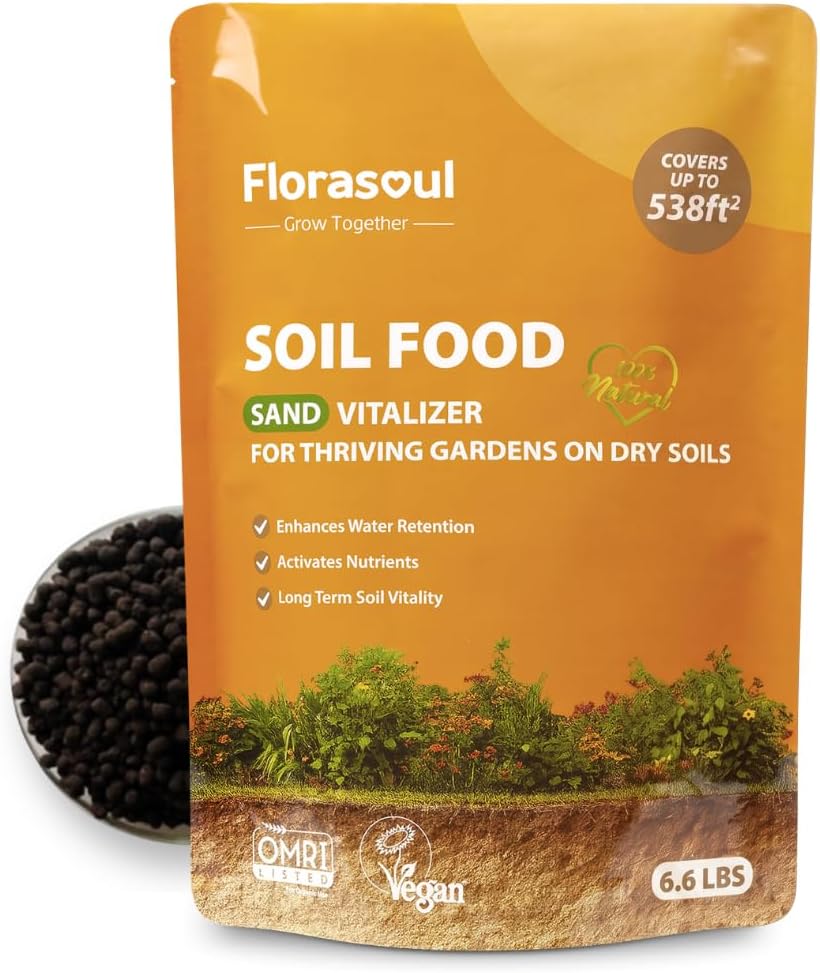
florasoul Soil Food Sand Humic Acid Soil Conditioner (6.6 lb)
| Brand Name | florasoul |
|---|---|
| Item Highlight | Organic Soil Amendment for Moisture Retention, Nutrient Retention & Root Growth |
| Unit Count | 105.6 Ounce |
| Number of Packs | 1 |
Florasoul Soil Food Sand is a granular humic-acid soil amendment made for sandy, fast-draining beds where moisture and nutrients are lost quickly. You spread the 2–4 mm black granules across lawns, flower beds, raised beds or mix into potting areas to add organic matter that helps soil hold water and retain fertilizer in the root zone. The product's humic acid and bioactive organic matter support microbial activity and deeper root development, which can result in greener, more resilient plants over time. The clean granule form is easy to apply by hand or with a spreader and creates less dust than powdered amendments. It is presented as safe for organic gardening and for households with pets and children. Expect incremental improvement rather than an instant miracle; repeated applications or incorporation into the root zone will produce the best, longer-lasting changes to sandy flower beds.
Best for: Gardeners who want a reliable, low-mess soil amendment to improve moisture and nutrient retention in sandy flower beds and who plan regular maintenance applications.
Less Ideal for: Those needing a one-time, large-volume soil rebuild for heavy clay or compacted soils or gardeners who prefer liquid soil conditioners for immediate absorption.
- Granular 2–4 mm form spreads cleanly by hand or with a spreader
- Contains humic acid and organic matter to improve moisture retention in sandy soils
- Helps bind nutrients to reduce leaching and improve fertilizer efficiency
- Supports microbial activity and deeper root growth for healthier plants
- Requires repeated or incorporated applications for noticeable, long-term soil change
- Sold in a relatively small 6.6 lb package for larger beds
Verdict: A dependable granular humic-acid amendment that strengthens sandy flower beds by improving moisture and nutrient retention with clean, easy application.
Brut Organic Worm Castings, 5 lb

| Item Form | Granules |
|---|---|
| Specific Uses For Product | Gardening,Organic |
| Target Species | All plants |
| Mixing Ratio | 1:5 |
Brut Organic Worm Castings function as a concentrated, natural soil amendment you mix into potting mixes or top-dress garden beds and raised beds. Typical use is mixing at the recommended 1:5 ratio for new indoor plants, sprinkling a cup around established houseplants, or working into outdoor planting holes and beds according to the brand directions. The product is OMRI/CDFA listed and produced in controlled conditions, which supports consistent nutrient content and beneficial microbial life that help roots establish, improve soil structure, and increase moisture retention without burning plants. Practical benefits for raised garden beds include improved aeration, slow-release nutrients, and a boost in microbial activity that supports long-term fertility. Limitations are that it is not a complete NPK fertilizer for immediate heavy feeding needs and larger beds require significant quantities to hit the suggested per-square-foot rates, so frequent applications or bulk purchases may be needed for big projects.
Best for: Gardeners who prioritize dependable, organic soil improvement for raised beds and container gardens and prefer predictable, low-risk amendments that support long-term soil health.
Less Ideal for: Those needing immediate, high-NPK feeding for heavy-feeding crops or gardeners who want to amend very large beds without buying supplemental bulk material.
- Certified organic and produced indoors for consistent purity
- Rich in beneficial microbes that improve soil structure and plant vigor
- Easy-to-use granular form suitable for mixing or top-dressing
- Not a standalone high-NPK fertilizer for rapid nutrient correction
- Five-pound bag may be small for large raised beds and repeated seasonal use
Verdict: Use this OMRI/CDFA-listed worm castings product to reliably build long-term fertility and microbial health in raised beds and containers.
Back to the Roots Organic Expanding Coco Coir Potting Soil Brick (10 lb)

| Item Highlight | 10 lb compressed coco coir brick; peat-free; OMRI Listed |
|---|---|
| Item Type Name | Coconut Coir |
| Volume | 2 cubic feet |
| Ingredients | Coconut Coir |
| Style Name | Expanding Potting Soil |
This compressed coco coir brick provides a lightweight, peat-free potting medium that expands when you add water to create loose, airy substrate for containers and seed flats. It is typically used by hydrating the 10 lb block to about 2 cubic feet of coir and then using it alone for potted plants, mixing it into garden soil to improve drainage and aeration, or blending with compost for starting seeds. Notable features include OMRI listing for organic use, a balanced pH suited to a wide range of plants, and compact storage before expansion which saves space. Practical benefits are improved root aeration and water retention compared with heavy garden loam, easier handling than bulky bags, and versatility across vegetables, herbs, and ornamentals. Important limitations are that coco coir is a soilless substrate and does not supply significant nutrients on its own so you will need to add fertilizer or compost for long-term potted herbs like rosemary, and the product requires time and a water source to expand before use.
Best for: Buyers who prioritize low-risk, easy-to-handle, organic potting media and want a versatile base for container herbs and seed starting without dealing with heavy bags.
Less Ideal for: Gardeners who want a ready-to-plant, nutrient-rich potting mix out of the box or those who prefer soil with built-in slow-release fertilizer.
- Peat-free OMRI listed organic coco coir suitable for organic growing
- Expands from a compact brick to about 2 cubic feet for easy storage and transport
- pH balanced and airy texture that improves drainage and root aeration
- Versatile use: can be used alone, for seed starting, or mixed into existing soil
- Provides little inherent fertility so supplemental feeding or compost is needed for nutrient-hungry plants
Verdict: A compact, peat-free coco coir brick that expands into an airy, pH-balanced base ideal for low-risk organic container gardening and seed starting when paired with fertilizer or compost.
Choosing the Right Soil Conditioner for Flower Beds: Key Factors to Consider
Material Composition and Texture
Different conditioners are made from composted yard waste, aged bark, coconut coir, peat alternatives, or mineral amendments. The physical texture and particle size determine whether the amendment breaks up clay, loosens compacted loam, or binds sandy soil. Coarser materials add long-lasting pore space and improve aeration, while finer, humus-rich composts increase water-holding capacity and nutrient exchange.
Knowing the base material also tells you about pH influences, potential weed seeds, and how quickly the amendment will integrate with native soil. For flower beds, choose a composition that complements the existing soil rather than completely replacing it.
Drainage and Aeration Effects
Improving drainage is a primary goal in heavy or compacted soils. Amendments that add stable particle size and structure create channels for excess water to move through the root zone, reducing root rot risk and allowing oxygen to reach roots. For beds that stay wet after rains, prioritize materials that resist compaction over time.
Aeration matters for root development and for the microbes that break down organic matter. Some conditioners deliver immediate improvements, while others require seasonal incorporation to reach full effect.
Moisture Retention Characteristics
In sandy or fast-draining beds, conditioners that increase the soil's ability to hold moisture can reduce watering frequency and help blooms persist during dry spells. Materials like well-aged compost and natural fibers hold moisture in micropores and slowly release it to roots.
However, too much retention in poorly drained soils causes oxygen deprivation. Match moisture-retaining conditioners to soils that need it, and avoid them where standing water or poor drainage is present.
Nutrient Contribution and Biological Activity
Some soil conditioners supply significant nutrients and a boost to microbial life, while others mainly change physical properties. Organic conditioners that are mature and well-composted feed soil life and gradually release nitrogen, phosphorus, and potassium. They also support beneficial fungi and bacteria that help plants access nutrients.
Avoid immature or 'hot' organic material that can tie up nitrogen or harm young roots. Understanding the biological profile helps you plan follow-up fertilization and planting timing.
Ease of Application and Incorporation
Practical gardeners need amendments that are straightforward to apply at bed scale. Lightweight, loose materials that can be spread by hand or with a shovel are easiest. Some conditioners require tilling or rototilling for effective incorporation, which may not be suitable in beds with existing plants or delicate root systems.
Consider whether you can feasibly mix the conditioner into the top 6 to 12 inches of bed soil or whether it must be used as a surface mulch. Application method affects how quickly you will see results.
Longevity and Maintenance Frequency
Different amendments persist for different lengths of time. Coarse woody materials and mineral conditioners can improve structure for multiple seasons, while fine compost and mulch may break down and need replenishing annually. Longevity affects maintenance planning and seasonal labor.
Choose a conditioner with a longevity profile that fits how often you want to amend beds. For perennial displays you may prefer longer-lasting structure; for seasonal beds, faster-acting organic matter can be acceptable.
Assessing Your Flower Bed Soil First
Start with a quick hands-on test and a simple drainage check. Dig a shovel-wide hole about 8 inches deep and feel the texture. If the soil forms a dense, sticky ball it leans toward clay; if it crumbles and drains fast it is sandy. Observe how quickly water drains after a heavy watering or rain to decide whether you need a drainage-focused or moisture-retaining conditioner.
Consider getting a basic lab or DIY pH test if you suspect extreme acidity or alkalinity. Many conditioners subtly change pH over time, so knowing your starting point helps you avoid compounding issues.
- Perform a ribbon and squeeze test to estimate clay content
- Do a 24-hour percolation test to check drainage
- Note existing plant health and any wet or dry microzones
How to Apply Soil Conditioner in Established Beds
For established flower beds, surface topdressing followed by light fork incorporation is less disruptive than deep tilling. Spread a 1 to 3 inch layer of conditioner, then use a digging fork to gently lift and mix the top few inches without damaging perennial roots. For new beds you can mix amendments into the full planting depth for best results.
Work on small sections at a time and water after incorporation to help settle the amendment into the soil profile. Avoid burying mulch-like materials too deeply; keep most organic mulches at the surface where they slowly break down.
- Topdress 1 to 3 inches for established beds
- Mix into top 6 to 12 inches for new beds
- Use fork or small tiller only where appropriate
Timing and Seasonal Considerations
Apply most soil conditioners in spring or fall when soil is easier to work and biological activity is moderate. Spring applications help beds recover before the growing season, while fall amendments can break down over winter and be ready for spring planting. Avoid heavy incorporation during hot, dry spells that stress plants.
For beds with heavy clay, multiple light applications over two seasons often deliver better long-term structure than one deep, aggressive amendment.
- Best times: early spring or autumn
- Staggered light applications for clay improvement
- Avoid major soil work during drought or heat waves
Combining Conditioners With Mulch and Fertilizer
Soil conditioners and mulches serve different roles. Use conditioners to change soil texture and long-term moisture dynamics, and mulches to reduce surface evaporation, suppress weeds, and moderate temperature. Apply mulch after conditioner incorporation to maximize benefits.
If a conditioner has substantial nutrient content, reduce immediate fertilizer inputs and monitor plant response. Conversely, inert mineral conditioners may require supplemental feeding to support vigorous blooms.
- Apply mulch after incorporating conditioner
- Adjust fertilization based on organic content
- Match mulch type to overall bed goals
Common Mistakes to Avoid
Avoid over-applying organic material in one go. Too much amendment at once can create layering that impedes root movement or causes uneven moisture zones. Excessive use of high-carbon wood chips mixed into root zones can temporarily tie up nitrogen.
Do not assume a single product solves all issues. If a bed has both compaction and poor fertility, pair a structural conditioner with targeted organic matter or fertilization rather than relying on one item to do everything.
- Do not bury fresh, uncomposted organic matter
- Avoid forming distinct layers of different textures
- Address multiple soil problems with a combined plan
How We Chose the Best Soil Conditioner for Flower Beds
We selected soil conditioners based on attributes that directly affect flower bed performance rather than marketing claims. Core evaluation criteria included material composition and particle size, because whether an amendment is coarse compost, fine peat substitute, or fibrous material determines how it changes soil porosity and drainage. We assessed moisture management by looking at how amendments retain or shed water, which matters for both drought-prone and waterlogged sites. Nutrient contribution and biological activity were evaluated to understand short-term feeding and longer-term soil life benefits. Ease of application and incorporation were considered, since heavy amendments or those requiring special equipment are less practical for typical beds. Longevity and persistence in the soil were reviewed to estimate how often repeat applications are needed. We excluded mixes intended primarily for lawn repair, vegetable production in intensive systems, and raw industrial aggregates that are not commonly used by home gardeners. Products that function mainly as topdressings without measurable soil-structure effects were also excluded. The final selection focuses on amendments that demonstrably alter soil texture, drainage, and fertility in flower bed contexts.
FAQ
How quickly will I see results after applying a soil conditioner?
You can notice improved drainage or easier root penetration within weeks when a conditioner changes pore structure. Biological improvements and nutrient release often take several months as microbes break down organic material. Expect the full benefit to develop over a season or two, depending on the amendment.
Can I use compost as my only soil conditioner in flower beds?
Compost is an excellent general conditioner because it adds nutrients and biology, but it may not solve severe compaction or large clay particle issues on its own. In those cases combine compost with coarse amendments that provide lasting structure.
Will a soil conditioner change bed pH?
Some conditioners affect pH mildly. Peat alternatives and certain composts can lower pH, while wood ash or lime-based mineral amendments raise it. Test your soil if pH-sensitive plants are present and select amendments that will not push pH outside the plants' preferred range.
How often should I reapply a soil conditioner?
Reapplication depends on the material. Fast-decomposing organic conditioners may need annual topdressing, while coarse woody or mineral conditioners can last several seasons. Monitor soil texture and plant performance and plan refreshes accordingly.
Is it safe to apply soil conditioners near established perennials?
Yes, if you use gentle incorporation methods. Spread the conditioner as a topdressing and work it lightly into the topsoil with a fork rather than deep tilling, which can damage perennial roots. Take care to avoid burying crown tissues.
Final Verdict
Choosing the right soil conditioner for flower beds is about matching the amendment to the soil problem you actually have. Prioritize material composition and how it will affect drainage or moisture holding, then balance nutrient and biological benefits with ease of application. Expect structural changes to build over time and plan seasonal maintenance accordingly. Focus on the primary constraint in your bed-compaction, clay, or sand-then pick a conditioner that addresses that issue while supporting soil life. That approach will give you healthier roots, better bloom performance, and more predictable maintenance needs.
