

Note: This article contains affiliate links. If you click on these links and make a purchase, I may earn a small commission at no extra cost to you. This helps support my research and content. Read my full affiliate disclosure here.
If you garden on light, gritty sand, choosing the right soil conditioner can make the difference between thirsty plants and a thriving bed. Sandy soil drains fast, holds little organic matter, and warms quickly, so amendments that boost moisture-holding capacity and add stable organic content are the most useful. This guide covers six shortlisted soil conditioners chosen for sandy soil conditions and explains practical differences gardeners should expect in the yard or raised bed. We evaluate options based on moisture retention, organic-matter contribution, how they affect soil structure, and ease of application to help you pick the best fit for your site.
Top Picks at a Glance
| Best Overall The best all-around choice for most situations | Farmer's Secret Soil Revitalizer Organic Liquid Compost (32 oz) |  |
| Best Quality Built to a higher standard if you want something more solid | Live Earth Products Humate Soil Conditioner, 50 lb Bag |  |
| Best Value The sweet spot between price and what you get | Stateside 20% Humic Acid Soil Amendment, 64 fl oz |  |
| Best Budget The cheapest option that still gets the job done reliably | Live Earth Humate Soil Conditioner Granules, 3 × 5 lb Bags (15 lb) |  |
| Highest Rated A top-rated pick with lots of positive feedback | florasoul Soil Food Sand Humic Acid Soil Conditioner for Sandy Soil |  |
| Most Popular A crowd favorite that many people choose with confidence | The Andersons HumiChar Organic Soil Amendment with Humic Acid and Biochar (12 lb) |  |
Farmer's Secret Soil Revitalizer Organic Liquid Compost (32 oz)

| Item Form | Liquid |
|---|---|
| Specific Uses For Product | Organic |
| Application Method | spray/pour |
| Coverage | 32,000 square feet |
| Mixing Ratio | 1:128 |
Farmer's Secret Soil Revitalizer is a concentrated liquid amendment that uses activated humics to improve soil structure, stimulate microbial activity, and make nutrients more available to plants. It is mixed at 1 ounce per gallon of water and can be applied with a watering can, sprayer, irrigation system, or as a foliar feed for houseplants. For clay soils the product's humic-rich formula helps loosen compacted particles over time and supports biological activity that improves drainage and root penetration. It is OMRI listed and made from organic sources, so it is suitable for edible gardens and safe around children and pets when used as directed. The effects are gradual rather than immediate because it works by rebuilding soil biology rather than supplying fast-release NPK, so gardeners should expect cumulative improvement after several applications every 2 to 4 weeks. Coverage claims are high for the bottle size, so plan dosing carefully if treating a large lawn or landscape.
Best for: Gardeners who want a low-risk, soil-first approach to improve compacted or nutrient-poor soils and are willing to use a repeat feeding schedule to build long-term soil health.
Less Ideal for: People seeking rapid green-up or instant high-amount nutrient feeds for heavy-feeding annuals or lawns should consider a supplemental synthetic fertilizer instead.
- OMRI listed organic formula safe for edible gardens when diluted as directed
- Activated humics increase microbial activity and long-term soil structure improvement
- Versatile application options: watering can, sprayer, hose-end or irrigation
- Concentrated mixing ratio (1:128) stretches one bottle over many applications
- Not a fast-acting synthetic fertilizer so visible results take multiple applications
- Coverage per bottle may be optimistic for large yards, requiring multiple bottles for whole-lawn use
Verdict: Use this organic, humic-rich liquid if you want to rebuild clay soil biology and structure over time rather than chase quick fertilizer results.
Live Earth Products Humate Soil Conditioner, 50 lb Bag

| Unit Count | 800 Ounce |
|---|---|
| Manufacturer | Live Earth Products, Inc. |
| Contains | Humic acid, fulvic acid, humin |
This humate soil conditioner supplies concentrated humic and fulvic acids plus trace minerals to help rebuild tired soils, increase organic matter, and improve water and nutrient holding capacity. Typically applied by spreading and raking or incorporating into the topsoil, it can be used on new or established turf, vegetable gardens, raised beds, trees, and shrubs; recommended rates are given for each use so you can dose by area. The product is OMRI-listed and marketed as safe for kids and pets, and because it is mined humic shale the material is stable and easy to handle. For clay soils specifically, the humates can help improve structure and microbial activity so clay becomes more friable and better at retaining available moisture. Limitations are that results build over time rather than instantly and you may need repeat applications once or twice a year to see durable change, and a 50 lb bag can be heavy to move around without assistance.
Best for: Home gardeners and lawn keepers who want a practical, long‑term soil improvement plan for compacted or low‑organic clay soils and prefer clear application guidance.
Less Ideal for: People seeking a fast, one‑time cure for drainage or compaction issues or gardeners who need a lightweight, small-quantity product for container plants.
- High humic and fulvic acid content to support soil biology and nutrient availability
- Clear application rates for lawns, gardens, raised beds, and trees that make dosing straightforward
- OMRI listed and described as safe for kids and pets
- Stable mined humic shale that is easy to spread and incorporate
- Effects accumulate over multiple applications rather than providing an immediate fix
- Large 50 lb bag can be awkward to handle for a single person
Verdict: A practical, OMRI‑listed humate conditioner that improves clay soil structure and nutrient retention when applied as part of a repeat maintenance plan.
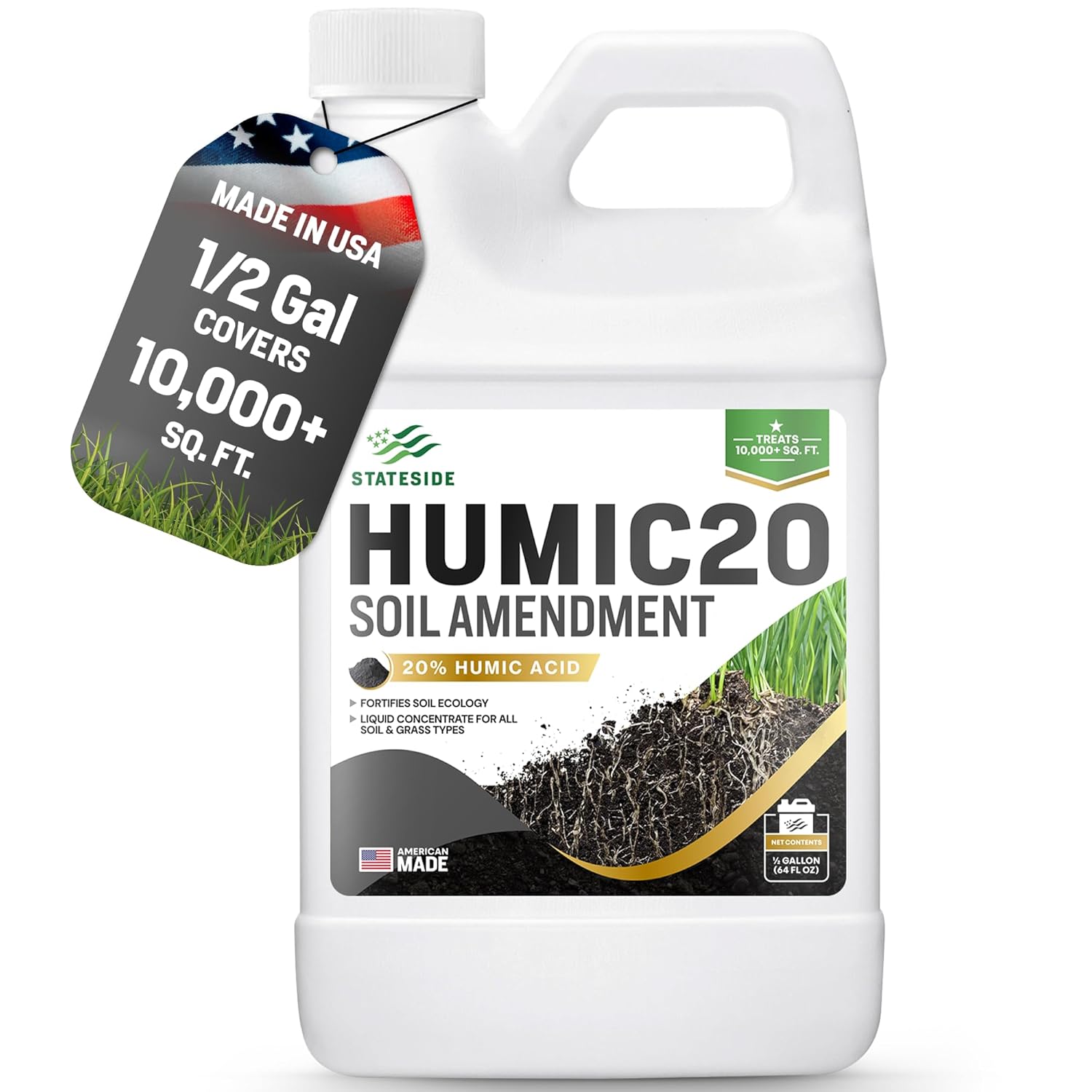
Stateside 20% Humic Acid Soil Amendment, 64 fl oz
| Unit Count | 64 Fluid Ounces |
|---|---|
| Ingredients | 20% Humic Acid |
| Included Components | Bottle |
| Manufacturer | Stateside |
This 64 fl oz bottle of Stateside 20% Humic Acid is a liquid soil amendment designed to improve soil structure and make sandy ground more hospitable to turf. You dilute and apply it across the lawn to increase aggregation of soil particles, which improves water retention, aeration, and microbial activity. The label claims coverage large enough for typical yard sizes when mixed as directed, and the 20% active humic acid concentration is high enough to expect noticeable effects on root development over a few applications. Practical benefits for sandy soil include better moisture-holding capacity, reduced leaching of nutrients, and an easier medium for new roots to establish. It is compatible with existing fertilizer programs so you can add it to regular lawn care routines. Limitations are that results take several weeks and repeated applications, and it does not supply macronutrients itself, so you will still need fertilizer for quick green-up and nitrogen-driven growth.
Best for: Gardeners and homeowners managing sandy or fast-draining lawns who prioritize improving soil structure and long-term root health through targeted soil amendments.
Less Ideal for: People seeking immediate green-up or quick nutrient fixes for lawns should choose a fertilizer or combined fertilizer-plus-conditioner product instead.
- High 20% humic acid concentration for effective soil conditioning
- Liquid form that mixes and spreads easily with standard sprayers
- Formulated to improve drainage and aeration while increasing microbial activity
- Covers a large area per bottle when diluted according to directions
- Does not provide plant nutrients like nitrogen or phosphorus
- Benefits develop over multiple applications rather than immediately
Verdict: Use this concentrated humic acid conditioner when you want to rebuild sandy soil structure and support stronger root development over time.
Live Earth Humate Soil Conditioner Granules, 3 × 5 lb Bags (15 lb)

| Item Form | Granules |
|---|---|
| Specific Uses For Product | Soil Conditioning |
| Coverage | Full |
| Target Species | lawns, turf, vegetable gardens, flowers, trees, shrubs |
This humate soil conditioner supplies concentrated humic and fulvic acids in granular form to improve soil organic matter and nutrient retention. It is typically broadcast or raked into soil for lawns, raised beds, vegetable gardens, trees, and shrubs; the product page lists application rates for new and established turf, garden beds, and trees so you can match the dose to your soil type. Because it is OMRI-listed and made from mined humic shale, it functions as a gentle, low-risk soil amendment that can be applied before or after fertilization without burning plants. Practical benefits for heavy clay include improved structure, increased water infiltration and retention, and enhanced microbial activity that helps roots establish. The format of three 5 lb bags makes it easy to handle and apply in small yards or raised beds. Limitations are that humates work gradually and are not a quick fix for severely compacted clay where mechanical loosening or larger-volume organic amendments may be needed, and recommended application rates for large areas can require significant material to see major change.
Best for: Home gardeners looking for an affordable, low-risk organic amendment to improve clay soil structure and boost plant root development in small to medium beds and lawns.
Less Ideal for: Gardeners who need immediate structural correction of heavily compacted clay or who prefer a single high-volume compost or tillage solution for large acreage.
- Contains humic and fulvic acids that improve nutrient retention and soil biology
- OMRI-listed natural source suitable for organic gardens and safe around kids and pets
- Granular bags are easy to spread by hand or with a spreader and can be raked into beds
- Includes application guidance for turf, vegetables, trees, and shrubs
- Effects are gradual and require repeat applications to build measurable organic matter
- Not a substitute for mechanical tilling or large-volume compost when correcting severely compacted clay
Verdict: A budget-friendly organic humate conditioner that steadily improves clay soil structure and nutrient holding capacity for home gardens.
florasoul Soil Food Sand Humic Acid Soil Conditioner for Sandy Soil

| Brand Name | florasoul |
|---|---|
| Item Highlight | Organic Soil Amendment for Moisture Retention, Nutrient Retention & Root Growth |
| Unit Count | 105.6 Ounce |
| Style Name | Sandy |
Florasoul Soil Food Sand is a granular soil amendment formulated to help sandy, fast-draining soils hold water and nutrients. It is applied by broadcasting or mixing into topsoil in lawns, garden beds, raised beds, or potted mixes to increase organic matter and introduce concentrated humic acid. The 2–4 mm black granules are low-dust and easy to spread by hand or with a spreader, which makes application tidy and simple. In use it should reduce water runoff and nutrient leaching by helping bind fertilizers and minerals in the root zone, and the added bioactive organic matter can encourage improved microbial activity and deeper root growth over time. Important limitations are that this product improves soil biology and retention gradually and is not an instant fertilizer replacement, so expect incremental benefits with repeated applications rather than immediate dramatic growth responses.
Best for: Gardeners who want a practical, low-mess amendment to make sandy lawns and beds hold water and fertilizer better and who plan to improve soil biology over several seasons.
Less Ideal for: People seeking a fast-acting, one-time fertilizer boost or those who need treatments for clay or heavy soils rather than sandy, free-draining sites.
- Granular 2–4 mm particles for low-dust, tidy spreading by hand or spreader
- Contains humic acid and organic matter to improve moisture retention in sandy soil
- Helps reduce nutrient leaching by binding fertilizer and minerals near roots
- Supports soil microbial activity and deeper root development with repeated use
- Not an immediate fertilizer substitute; benefits accumulate over multiple applications
- Only supplied in modest unit weight, so larger landscapes will require multiple bags
Verdict: Use this granular humic-acid conditioner if you want a low-mess, long-term solution to help sandy soil retain water and nutrients and encourage stronger root growth.
The Andersons HumiChar Organic Soil Amendment with Humic Acid and Biochar (12 lb)

| Unit Count | 192 Ounce |
|---|---|
| Volume | 12 liters |
| Ingredients | Humic Acid, Coconut Husk Biochar, Leonardite, Proprietary Binding Agent, Water |
| OMRI Listed | Environmentally friendly, OMRI listed |
HumiChar is a granular organic soil amendment designed to boost soil structure and long-term fertility by combining high-concentration humic acid with granulated biochar. It is applied to lawns and garden beds either alone or blended with fertilizer to increase nutrient availability, improve moisture retention, and build soil carbon over time. The product's dispersible granule technology reduces dust and helps the particles break down more predictably in the soil, making it easier to apply evenly with a spreader. Because it contains both quickly available humic acid and persistent biochar, you get both near-term benefits for turf vigor and a durable improvement in soil tilth that can reduce reliance on repeat fertilizer applications. Important limitations are its chemical-safety notes and handling precautions and that measurable soil changes require repeated or follow-up applications for larger areas; it is not a one-time quick fix for heavily depleted soils. Overall this is a practical option for homeowners and groundskeepers seeking a reliable, low-dust organic amendment to improve lawn soil health.
Best for: Homeowners or lawn caretakers who prioritize consistent, long-term soil improvement and want a low-dust, organic amendment that fits into a routine fertilizing program.
Less Ideal for: People needing an immediate, dramatic correction for compacted or nutrient-depleted turf who require fast-acting chemical treatments or structural soil replacement.
- Combines 30% humic acid with 43% granulated biochar for both immediate and long-term soil benefits
- Dispersible granule formulation reduces dust and spreads evenly with common spreaders
- OMRI-listed organic ingredient set suitable for organic lawn programs
- Can be blended with fertilizers or used alone for flexible application
- Not a one-time solution for severely degraded soils because measurable changes take time and repeat applications
Verdict: Choose HumiChar when you want a dependable organic amendment that delivers both quick humic benefits and long-term soil-building biochar for healthier lawns over time.
Choosing the Right Soil Conditioner for Sandy Soil: Key Factors to Consider
Moisture Retention
Sandy soil drains quickly and holds little plant-available water, so any conditioner you add should increase the soil's capacity to retain moisture between irrigations. Materials that bind water or increase micropore space, such as well-composted organic matter or water-absorbing organic particles, will reduce plant stress during dry spells.
Think about how often you can water and whether you want a short-term boost or a long-term improvement. Some amendments increase immediate water-holding but break down quickly, requiring more frequent reapplication, while others build stable humus that improves retention over seasons.
Organic Matter Contribution
Adding carbon-rich material changes sandy soil by increasing cation exchange capacity and providing a slow-release reservoir of nutrients. Choose conditioners that supply a balance of labile and stable organic compounds so the soil benefits both in the first season and over subsequent years.
High-quality compost, well-aged leaf mold, or finely ground woody compost will add different fractions of organic matter. Consider the starting nutrient content and decomposition rate because faster-rotting materials can temporarily immobilize nitrogen, affecting young plantings.
Soil Structure Improvement
Good conditioners promote aggregation so sand grains bind into crumbs that hold more water and resist crusting. Materials that increase microbial activity and root-derived mucilage help form stable aggregates; this improves aeration while slowing rapid percolation.
Evaluate whether the amendment integrates readily with existing soil or tends to stay as discrete particles. Materials that mix well when tilled or worked into the topsoil produce more uniform structural benefits than those that remain layered on top.
Nutrient Availability and Release
Sandy soil typically has low nutrient retention, so a conditioner that provides or helps retain nutrients will reduce leaching losses. Look at whether the amendment supplies macro and micronutrients or primarily acts as a physical improver that needs to be paired with fertilizers.
Consider the release pattern: fast-release materials feed plants quickly but may flush out with heavy rain, while slow-release organic inputs build a nutrient bank. Matching the release profile to your planting schedule prevents deficiencies or waste.
Salt Content and Contaminant Risk
Because sandy soils offer little buffering capacity, any salt or soluble contaminants in an amendment will move quickly through the root zone. Check for high-salt materials or biosolids with unknown heavy metal content; these can stress salt-sensitive plants or accumulate over time.
Prefer low-salt, well-tested amendments for vegetable and ornamental beds. If you must use a recycled material, test its salinity and, if possible, blend it with clean organic matter to dilute potential issues.
Application Practicality
How easy an amendment is to spread, incorporate, and reapply matters for most gardeners. Fine-textured amendments are simple to mix into the top few inches, while bulky materials may require more labor or equipment. Also consider how the material behaves in containers versus in-ground beds.
Timing and frequency of application affect workload. Some conditioners are effective with a single seasonal incorporation while others should be top-dressed annually. Choose options that fit your maintenance capacity and seasonality of plantings.
Amendment Types and How They Work in Sandy Soil
Different types of soil conditioners act through distinct mechanisms. Composts and well-rotted manures add organic matter and nutrients while promoting microbial activity that builds soil structure. Peat alternatives and leaf mold increase water-holding capacity by adding fine particulate matter that holds moisture in micropores. Mineral amendments such as biochar or clay concentrates change physical texture by providing surface area and adsorption sites that slow percolation.
Choosing between them depends on whether you need immediate water-holding help, a long-term structural change, or both. Many gardeners blend two or more amendment types to get complementary benefits.
- Compost improves both nutrients and structure but varies with source and maturity.
- Leaf-based materials and peat alternatives increase fine pore water capacity.
- Biochar and clay concentrates can adsorb nutrients and help retain moisture without adding quick-release nitrogen.
How to Apply Conditioners to Existing Beds and Lawns
For established beds, top-dressing with a thin layer of amendment and lightly forking or mulching in is often the least disruptive approach. For major renovations, work amendments into the top 6 to 12 inches to change root-zone properties more quickly. On lawns, incorporate light amounts evenly and overseed or rest one season if undertaking major texture changes.
Spread materials evenly and avoid thick layers that will create dry pockets or inhibit seed-soil contact. For containers, mix a higher proportion of fine, water-retentive amendment into potting mixes rather than using coarse bark or woody chips that can accelerate drainage.
- Top-dress and lightly work in for maintenance improvements.
- Deep incorporation speeds wide-area changes but requires more effort.
- Adjust application depth for root depth of the plants you grow.
Timing and Quantity Recommendations
Sandy soils benefit most from seasonal applications timed before active growth. Apply organic conditioners in late fall or early spring so microbial decomposition begins under cooler conditions and feeds plants as temperatures rise. For immediate planting, incorporate a single application into the planting hole or bed edge.
Quantities vary with amendment type. Aim to add enough material to noticeably change the topsoil texture without creating a distinct layer that separates from native sand. A common practice is to mix 2 to 4 inches of amendment into the top 6 to 8 inches of soil when renovating a bed; lighter maintenance top-dressings can be done at 0.5 to 1 inch.
- Renovation: mix 2 to 4 inches into top 6 to 8 inches.
- Maintenance: top-dress 0.5 to 1 inch annually.
- Modulate timing to match local frost and planting schedules.
Pairing Conditioners with Irrigation and Mulch
Conditioners work best when paired with sensible irrigation and surface mulch. Mulch reduces evaporation from the soil surface and keeps moisture inside the conditioned root zone. Drip irrigation and soaker hoses deliver water slowly so amended sand retains more of each irrigation than with overhead watering.
If you use a water-holding amendment, reduce daily irrigation frequency and favor longer, less frequent applications. Monitor soil moisture with a probe or by feel to adjust schedules as the conditioned soil's water-holding changes over time.
- Combine mulch with conditioners to reduce surface evaporation.
- Use slow, deep watering methods to maximize retained moisture.
- Re-evaluate irrigation frequency after amendment incorporation.
Environmental and Long-Term Soil Health Considerations
Building organic matter in sandy soil has cumulative benefits beyond immediate plant health. Over seasons, organic inputs increase biodiversity, cation exchange capacity, and the soil's ability to cycle nutrients. Avoid relying solely on synthetic polymers or materials that do not contribute carbon if your goal is sustained soil improvement.
Also plan for potential nitrogen drawdown when adding high-carbon materials. A balanced approach that pairs carbon-rich amendments with modest nutrient inputs prevents temporary deficits and supports microbial communities that create lasting soil structure.
- Prioritize carbon-adding materials for long-term improvement.
- Monitor for temporary nitrogen immobilization and adjust feeding.
- Aim to build steady organic matter rather than quick fixes.
How We Chose the Best Soil Conditioner for Sandy Soil
We prioritized products and amendment types that demonstrably change sand-dominated texture and plant-available water. Key evaluation criteria included moisture retention, measured by how much available water the amendment adds to a coarse-textured soil; organic matter contribution, focusing on long-term carbon input and nutrient release; structural improvement, meaning the amendment's ability to increase aggregation and reduce rapid percolation; and application practicality, including ease of spreading, incorporation, and suitability for beds, containers, or turf. We also considered salt content and potential for nitrogen tie-up, excluding any amendments prone to creating hydrophobic layers or that require specialist equipment to apply. Products were filtered to favor materials that are safe for vegetables, ornamentals, and native plantings and that do not rely on synthetic polymers as the primary mechanism. We excluded experimental treatments lacking field evidence and amendments intended only for erosion control rather than soil conditioning.
FAQ
How often should I reapply a soil conditioner to sandy beds?
It depends on the amendment. Fast-decomposing materials may need annual top-dressing, while more stable inputs like well-composted organics or biochar can provide benefits for several years. Check soil structure and moisture retention seasonally and plan reapplication when improvements decline.
Can I use compost alone to fix sandy soil?
Compost is a good starting point because it adds organic matter and nutrients, but its effectiveness depends on source and maturity. For some sandy soils, combining compost with finer materials or mineral conditioners yields faster gains in moisture retention and structure than compost alone.
Will adding organic matter cause nitrogen lock-up in my garden?
High-carbon, undecomposed materials can temporarily tie up nitrogen as microbes break them down. Use well-aged compost to minimize this risk, or supply a small nitrogen supplement at planting until the material stabilizes.
Is biochar useful for sandy soil?
Biochar can help by increasing surface area and nutrient adsorption, which slows leaching in sandy soils. It is most effective when charged with compost or fertilizer before application so it does not initially tie up nutrients.
How much amendment should I mix into a new raised bed built on sand?
For a new bed, blend enough conditioner to noticeably change texture. A common guideline is mixing 2 to 4 inches of amendment into the top 6 to 8 inches of soil. Adjust based on planting depth and the specific amendment's properties.
Final Verdict
Improving sandy soil is a multi-season project that balances immediate water-holding gains with building stable organic matter. Prioritize conditioners that increase moisture retention and encourage aggregation while having a predictable nutrient release. Consider labor and application method when choosing an amendment so you can maintain gains over time. Focus first on amendments that change the root-zone texture and then refine inputs like mulch and irrigation to lock in benefits. With consistent additions and appropriate watering, gardeners can transform sandy beds into more resilient, productive planting sites.
