

Note: This article contains affiliate links. If you click on these links and make a purchase, I may earn a small commission at no extra cost to you. This helps support my research and content. Read my full affiliate disclosure here.
Getting soil moisture right is one of the simplest ways to keep potted plants, containers, and patio beds healthy. A reliable plant soil moisture meter shows you when to water and when to hold off, preventing root rot from overwatering and drought stress from underwatering. This guide gathers seven top-rated plant soil moisture meters suitable for indoor and outdoor container gardening and explains the practical strengths gardeners should expect. The shortlisted meters were evaluated on real-use factors like how accurately they read different potting mixes and how well they hold up in humid conditions. Read on to understand the criteria behind our picks and which features matter for your setup.
Top Picks at a Glance
| Best Overall The best all-around choice for most situations | Dr.meter S10 Soil Moisture Meter |  |
| Best Quality Built to a higher standard if you want something more solid | SUStee Aquameter Soil Moisture Meter — Medium, Bundle of 12 |  |
| Best Value The sweet spot between price and what you get | XLUX Long Probe Soil Moisture Meter (T9178) |  |
| Best Budget The cheapest option that still gets the job done reliably | Censinda Soil Moisture Meter — Analog Probe Hygrometer (No Battery) |  |
| Highest Rated A top-rated pick with lots of positive feedback | HSLGOVE 2-in-1 Soil Moisture and pH Meter (Battery-Free) |  |
| Most Popular A crowd favorite that many people choose with confidence | XLUX T10 Plant Soil Moisture Meter (Battery-Free) |  |
| Best Seller A high-volume bestseller chosen again and again | XLUX T10 Soil Moisture Meter (2-Pack) |  |
Dr.meter S10 Soil Moisture Meter
| Battery Description | No batteries required |
|---|---|
| Mounting Type | Tabletop |
| Upper Temperature Range | 40 °C |
| Included Components | 1x Dr.meter Moisture Sensor Meter |
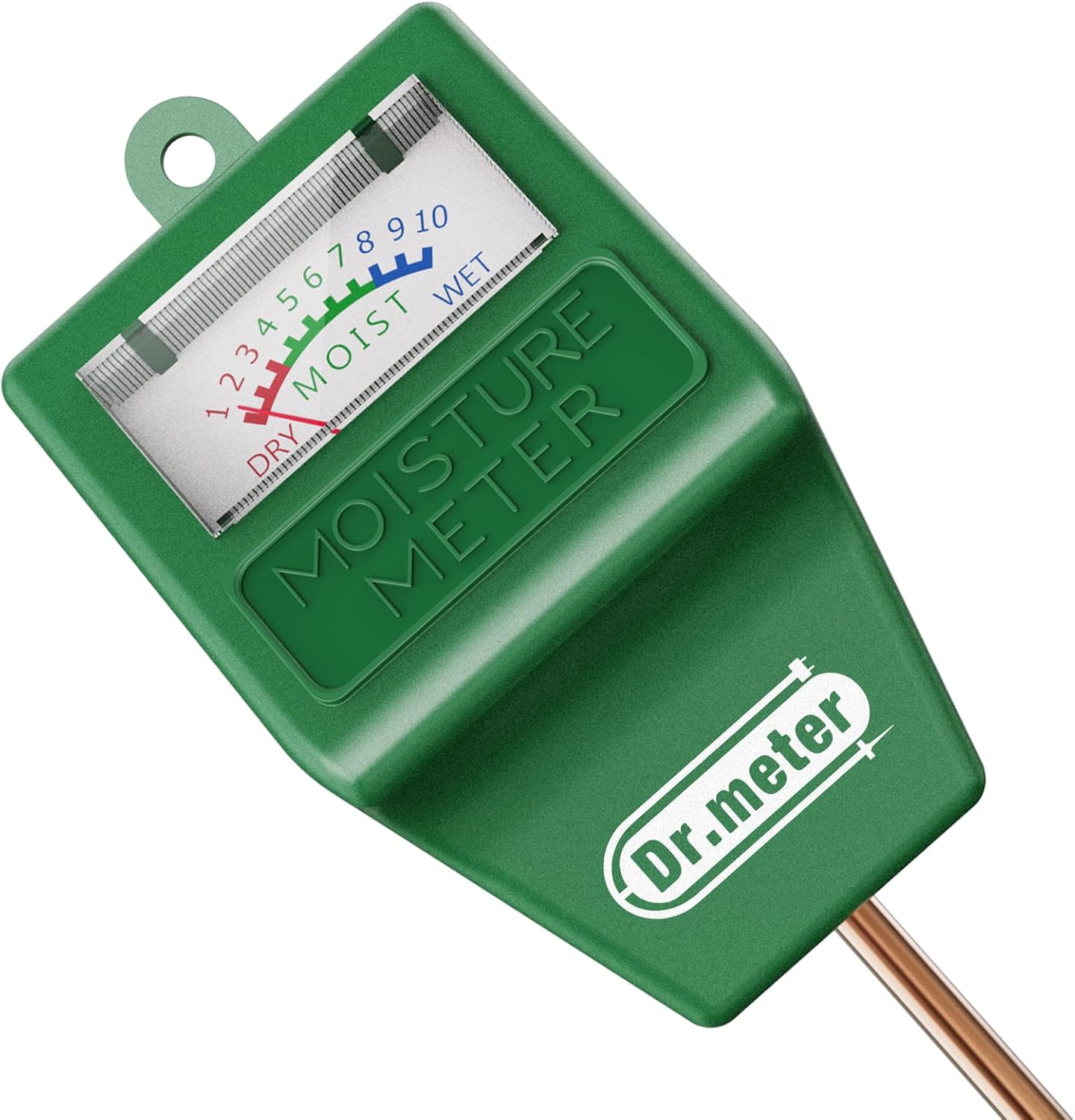
The Dr.meter S10 is a compact, analog moisture meter designed to remove guesswork from watering houseplants and garden beds. You insert the single probe into potting mix or garden soil and read a 1–10 scale with color cues (dry to wet) on an easy-to-read display. Because it needs no batteries and has a slim probe it is ready to use immediately and is gentle on roots, making spot checks around stems quick and low-impact. Practical benefits include portability for checking multiple pots, straightforward color guidance for beginners, and a no-maintenance design that requires only occasional cleaning of the probe. Limitations: it provides relative moisture levels rather than precise volumetric water content, so results are best used as a watering guide rather than a scientific measurement. Avoid pushing the probe into very rocky or compacted soil to prevent damage, and expect fewer features than digital multi-function meters that add pH or light readings.
Best for: Gardeners who want a low-effort, reliable way to stop over- or under-watering and prefer simple, visual guidance for everyday plant care.
Less Ideal for: Users who need laboratory-grade moisture data, multi-parameter soil analysis, or frequent use in very compacted or rocky ground should consider a more advanced meter.
- No batteries required so it is always ready to use
- Simple 1–10 scale with color coding makes readings easy for beginners
- Slim single probe design minimizes root disturbance during testing
- Compact and portable for quick spot checks across multiple pots or garden areas
- Provides relative moisture readings rather than precise volumetric measurements
- Probe can be damaged if used in very rocky or extremely hard soil
Verdict: A fuss-free, batteryless moisture meter that gives clear color-coded readings to help everyday gardeners water more confidently.
SUStee Aquameter Soil Moisture Meter — Medium, Bundle of 12

| Battery | No batteries required |
|---|---|
| Suitable for pot sizes | 3.5–6 inches (medium) |
| Units included | 12 sticks |
| Core replacement interval | 6–9 months |
The SUStee Aquameter is a simple leave-in moisture indicator designed for potted plants and continuous monitoring at root level. You insert the slim stick into potting mix and watch the refillable core change color from blue (sufficient water) to white (needs watering); the medium size is meant for 3.5–6 inch pots and the medium core typically responds in about 15 minutes after watering. Because it is battery-free and maintenance-light you can leave it in place without disturbing roots, and the replaceable core keeps the indicator useful for months. Practical strengths are its minimal profile that blends with plants, compatibility with a wide range of soil types, and the included 12 sticks which suit multiple pots or staggered replacements. Limitations are that response time varies by soil and it works best in media that retain moisture, so it is not an instant digital readout and occasional cleaning or core replacement (recommended every 6–9 months) is needed for reliable performance.
Best for: Serious plant caretakers who prioritize reliable, low-effort monitoring across several potted plants and want a simple, repeatable indicator rather than a technical readout.
Less Ideal for: People who need precise numerical moisture readings for scientific experiments or growers working in extremely fast-draining media should consider a digital probe or meter instead.
- Leave-in, battery-free operation for continuous root-level monitoring
- Color-changing refillable core gives an intuitive wet/dry indication
- Slim, unobtrusive design that suits decorative pots
- Includes 12 medium sticks so you can outfit multiple plants or keep spares
- Compatible with many common potting mixes and soil amendments
- Not a quantitative digital meter so it only gives a wet/need-water indication
- Response time depends on soil type and can take up to 15 minutes for medium size
- Requires core replacement every 6–9 months and occasional cleaning
Verdict: Choose SUStee when you want a low-maintenance, leave-in moisture indicator that reliably flags when potted plants need watering across multiple pots.
XLUX Long Probe Soil Moisture Meter (T9178)
| Brand | XLUX |
|---|---|
| Model | T9178 |
| Mounting Type | Tabletop |
| Upper Temperature Range | 50 °C |
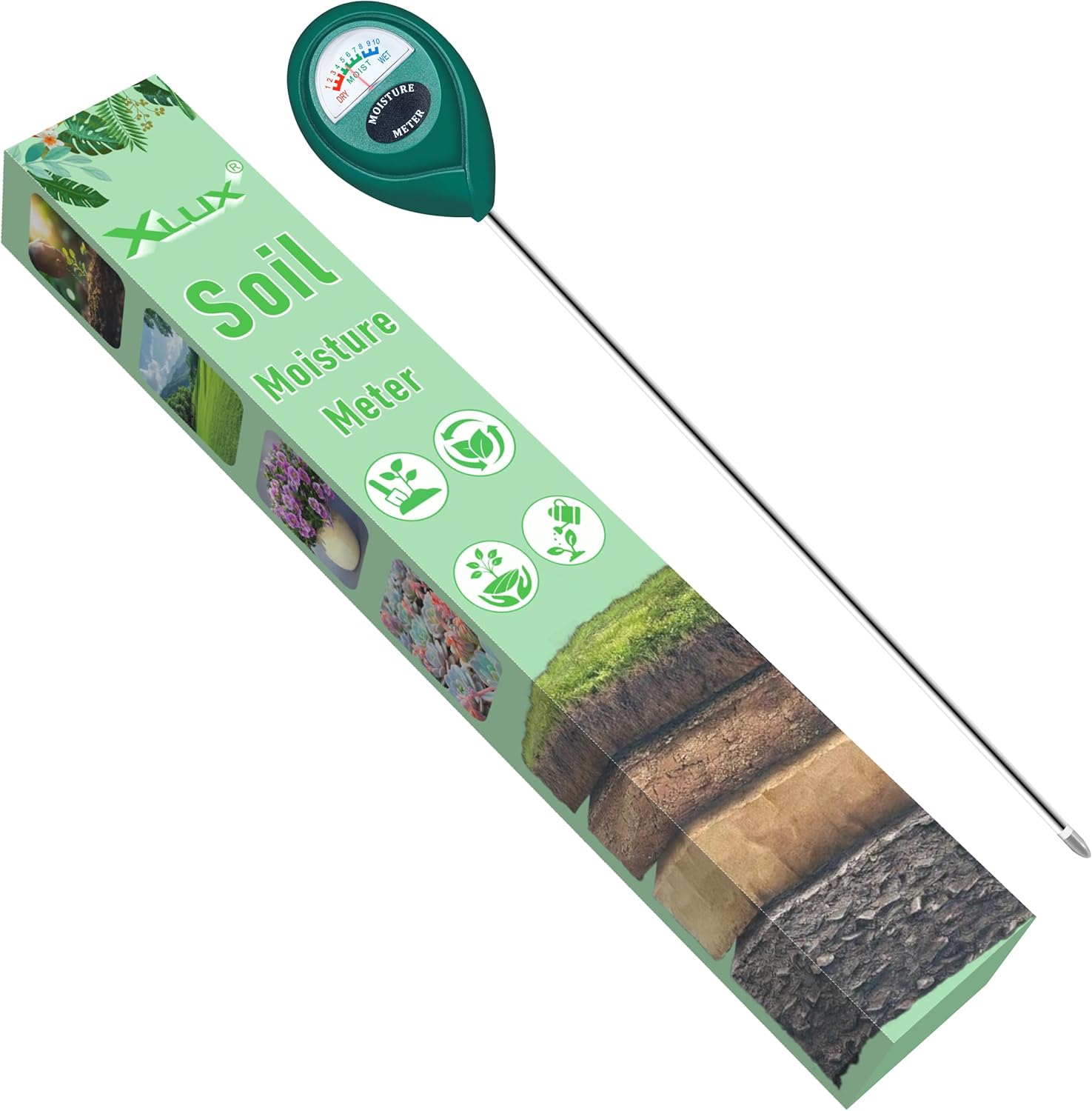
The XLUX long probe soil moisture meter is a no-frills analog hygrometer designed to read moisture deeper in larger pots and containers. It works by inserting the single metal probe into potting mix and reading an immediate moisture indication on a large dial divided into dry, moist, and wet zones. The extended probe length makes it convenient for tall planters and hanging baskets where surface checks are misleading. Its simplicity means no batteries or calibration routines and the single-probe design reduces root disturbance when testing. Important practical notes are that the probe is intended for typical potting mixes and can give inconsistent readings in very airy media unless that media is compacted around the sensor, and the metal tip should not be left in soil for more than a few minutes to avoid corrosion. For routine watering decisions this meter is fast, easy to use, and durable enough for casual gardeners, but it is not suited to continuous monitoring or precise scientific moisture profiling.
Best for: Gardening buyers who want a simple, low-maintenance tool to make faster watering decisions for larger pots and container plants without fussing over electronics.
Less Ideal for: Users who need continuous logging, highly precise moisture percentages, or a meter engineered for coarse soilless mixes like pure perlite or orchid bark.
- Long 5.5-inch probe reaches lower soil levels in large pots and deep planters
- Large, easy-to-read dial with dry, moist, and wet zones for quick decisions
- Single-probe design minimizes root disturbance during testing
- Mechanical operation requires no batteries or electronics to maintain
- Not reliable in very airy substrates unless the media is compacted around the probe
- Metal probe can corrode if left in soil for extended periods
Verdict: Choose this meter if you need a fast, battery-free way to check moisture deep in large pots and make practical watering decisions.
Censinda Soil Moisture Meter — Analog Probe Hygrometer (No Battery)

| Battery Description | No batteries needed |
|---|---|
| Probe Length | 6.7inch |
| Moisture Range | 1-10 (1-3 Dry, 4-7 Nor, 8-10 Wet) |
| Upper Temperature Range | 40 °C |
This inexpensive Censinda moisture meter is a no-frills analog probe that tells you if potting soil is dry, normal, or wet. You insert the long metal probe into the root zone and read a needle on a numbered scale; because it needs no battery it is ready to use and very low maintenance. The 6.7-inch probe makes it practical for potted plants, hanging baskets, and garden containers, and the printed on-device guidance helps beginners interpret the 1–10 scale. Practical benefits include fast instant readings, lightweight portability, and a low cost that lets you keep one in several pots. Important limitations are that the meter is designed for soil only, it can give inconsistent results in very rocky or compacted soils, and the probe should not be left permanently in the ground or immersed in water. For gardeners who want a cheap, easy way to stop overwatering and check moisture at the roots, this meter is an effective basic tool; users needing digital accuracy, long probes for deep beds, or soil nutrient and pH readings should look elsewhere.
Best for: Budget-minded plant owners who want a quick, practical way to avoid overwatering for potted plants, containers, and hanging baskets without learning digital tools.
Less Ideal for: Gardeners who need lab-grade moisture precision, continuous logging, deep bed/depth-specific probes, or soil nutrient and pH testing should consider more advanced meters.
- No batteries required so it is always ready to use
- 6.7-inch probe reaches typical potting soil root zones for containers and hanging baskets
- Fast, easy analogue readout gives instant dry/normal/wet guidance
- Very low cost and lightweight so you can keep multiple meters around the garden
- Not suitable for very rocky, compacted, or non-soil media where probes may be damaged
- Should not be left permanently in soil or submerged which limits continuous monitoring
- Provides qualitative moisture levels rather than precise digital measurements
Verdict: A very affordable, battery-free probe meter that gives fast, easy moisture checks for potted plants and container gardens.
HSLGOVE 2-in-1 Soil Moisture and pH Meter (Battery-Free)

| Manufacturer | HSLGOVE |
|---|---|
| Functions | Soil moisture and soil pH |
| Power | No batteries required |
| Probe material | Alloy soil sensing probe |
The HSLGOVE 2-in-1 soil meter combines a moisture probe and a pH dial in a compact, battery-free unit for routine garden checks. You insert the single alloy probe at least three inches into potting mix or garden soil to get a moisture level in seconds and a pH reading within about three minutes. The dual-dial layout shows both measurements simultaneously so you do not need to switch modes, which makes spot checks fast when watering or adjusting soil amendments. The device is simple to use and low maintenance: no batteries, a sturdy metal probe, and a wipe-clean sensor. Practical limits include unreliable results in very hard, extremely loose, or highly uniform single-material media and it should not be used to test liquids. Readings are directional rather than lab-accurate, so use them for routine care decisions instead of precise soil analysis. Follow the instructions about insertion depth and keeping the probe dry between uses to get consistent readings.
Best for: Gardeners who prioritize dependable, low-maintenance tools for routine watering and pH checks and want straightforward guidance for everyday plant care.
Less Ideal for: Users who need laboratory-grade pH or moisture analysis, professional soil labs, or who will test unusual substrates like pure sand, heavy clay blocks, or standing water.
- Two-in-one design gives simultaneous moisture and pH information without changing settings.
- Battery-free operation avoids downtime and ongoing battery costs.
- Simple plug-and-read use with wipe-clean probe makes routine checks fast.
- Sturdy alloy sensing probe is less likely to bend during normal use.
- Not suitable for testing liquids or extremely hard or very loose soils where readings may be unreliable.
- Provides approximate field readings rather than laboratory-accurate measurements.
Verdict: A no-fuss, battery-free field tester that gives quick, reliable moisture and pH guidance for everyday plant care.
XLUX T10 Plant Soil Moisture Meter (Battery-Free)

| Battery Description | No batteries required |
|---|---|
| Mounting Type | Tabletop |
| Upper Temperature Range | 45 °C |
| Temperature Reading Accuracy | ±0.5 °C |
The XLUX T10 is a straightforward analog soil moisture meter designed to give instant moisture readings without batteries. You use it by inserting the slim 304 stainless steel probe into the potting mix or garden bed down to the root zone, then read the large color-coded dial that marks Dry, Moist, and Wet. Its single narrow probe minimizes root disturbance compared with thicker dual-prong meters, making it useful for potted houseplants and smaller garden beds. The tabletop mounting and protective sleeve help preserve the probe between uses, and the unit requires minimal maintenance beyond wiping the probe clean after each short test. Limitations to note are that it provides a general moisture level rather than precise soil moisture percentage and is intended for temporary tests only, so it is not a continuous-monitoring solution; accuracy can also vary by soil type and insertion depth. For gardeners who want a low-cost, low-effort way to remove guesswork from watering, the T10 offers reliable, easy-to-read results for everyday use.
Best for: Buyers who want a simple, low-maintenance tool to quickly check whether potted plants or small garden beds need water and who value easy-to-read, proven devices backed by many users.
Less Ideal for: If you need digital precision, continuous logging, or professional soil-moisture profiling for large-scale landscapes, this basic analog tester will be insufficient.
- Battery-free operation for instant readings without maintenance
- Slim single 304 stainless steel probe reduces root damage
- Large color-coded dial that is easy to read at a glance
- Protective sleeve included to prevent probe abrasion during storage
- Provides qualitative moisture ranges rather than numeric moisture percentage
- Designed for short, temporary tests only and not for continuous monitoring
Verdict: A no-fuss, battery-free moisture meter that gives quick, readable root-zone moisture guidance for everyday indoor and small garden plant care.
XLUX T10 Soil Moisture Meter (2-Pack)

| Battery Description | No batteries required |
|---|---|
| Number of Items | 2 |
| Item Highlight | Anti-rust 304 SST probe, single-probe immediate read |
The XLUX T10 is a straightforward analog soil moisture meter sold as a two-pack for spot-checking moisture in pots and garden soil. It uses a single stainless steel probe and a large dial marked in three zones plus ten scales so you can instantly tell if soil is dry, moist, or wet. Because it is battery-free and mechanical, there is nothing to charge or replace and it is easy to hand to less experienced gardeners. Typical use is pushing the probe into the root zone for a few seconds, reading the dial, then wiping the probe clean. The single-probe design limits root disturbance and the 304 stainless probe resists rust better than untreated metal. Important limitations are that it is not designed for continuous in-ground monitoring, should not be left in soil for more than a few minutes, and is less effective in very compacted or rocky soils. It reports relative moisture rather than precise volumetric measurements, so use it as a quick, practical guide rather than a scientific moisture profile.
Best for: Buyers who want a low-maintenance, easy-to-use tool to confirm whether houseplants or garden pots need water and prefer a simple reliable indicator over technical precision.
Less Ideal for: People who need continuous logging, laboratory-level moisture accuracy, or reliable readings in very compacted or rocky soil should choose a different sensor type.
- Battery-free operation requires no maintenance or replacements
- Large, easy-to-read dial with clear dry/moist/wet zones
- Single stainless steel probe reduces root disturbance and resists rust
- Sold as a two-pack for checking multiple pots or locations
- Not intended for continuous monitoring and should not be left in soil
- Gives relative moisture levels rather than precise numeric measurements
Verdict: A no-fuss, battery-free moisture meter that delivers quick, easy dry/moist/wet readings for cautious gardeners who want straightforward guidance.
Choosing the Right Plant Soil Moisture Meter: Key Factors to Consider
Reading Accuracy and Calibration
A moisture meter is useful only if its readings reflect real moisture levels in your potting medium. Accuracy depends on sensor type and calibration. Some meters use resistive probes whose values vary with soil composition and salinity, while others use capacitance-based sensing that is less affected by fertilizer salts.
You should consider how a meter reports moisture – numerical values, color bands, or icons – and whether the scale matches your plants' watering needs. For example, succulents and orchids need a different interpretation than tropical houseplants. If you plan to rely on specific thresholds, look for meters with consistent, repeatable readings rather than ones that jump widely with small position changes.
Probe Length, Thickness, and Design
Probe length determines how deep into a pot or container you can measure. Shallow probes work for small pots and seed trays but will misrepresent moisture in deep-rooted houseplants or patio containers. Thicker probes can be sturdier but may compact root zones in small pots; thinner probes are gentler yet may bend or corrode faster.
Also consider split-probe versus single-rod designs. Split probes rely on the pair spacing for readings and can be less intrusive, while single long rods with internal sensors often penetrate deeper. Pick a probe profile that suits your typical pot sizes and that reaches the root zone you want to monitor.
Durability and Corrosion Resistance
Soil and potting mixes contain moisture, salts, and fertilizers that can corrode metal probes and degrade electronics. Meters built for garden use will specify corrosion-resistant materials or replaceable probes. Corrosion shortens a meter's useful life and gives inconsistent readings as metal surfaces change.
Check whether the meter's housing is robust enough for repeated use outdoors and whether electronics are sealed against humidity. For higher-use scenarios, look for meters with easily replaceable probes or robust metal treatments to extend service life.
Ease of Reading and Interpretation
Readability matters when you are checking many plants. Large analog dials, bright backlit displays, or clear color bands speed decisions during routine checks. Some meters provide raw numbers that require you to remember moisture thresholds, while others translate readings into dry, moist, and wet zones.
Also consider where you will use the meter. If you check moisture under grow lights or in dim indoor corners, a backlit or high-contrast display is helpful. Simple, unambiguous cues reduce mistakes and make it easier to train others who may water for you.
Water Resistance and Weather Tolerance
Meters used outdoors or in humid greenhouses need protection against water intrusion. Water-resistant housings and sealed electronics help prevent failures after repeated exposure to splashes or wet hands. Even meters primarily used indoors can be exposed to overspray from watering or humid microclimates.
Consider meters rated for outdoor use or with IP ratings if you plan to keep them near patio containers or use them in humid conditions. Proper drying and storage between uses also extend life if a meter is not fully waterproof.
Power Source and Maintenance
Some meters are passive analog devices that need no batteries, while others use batteries to power digital displays or additional sensors. Battery-powered meters can offer higher precision or extra features but require periodic battery changes and have potential failure points around battery compartments.
Maintenance considerations include cleaning probe shafts after each use to avoid cross-contamination between pots, inspecting seals or boots for cracks, and storing meters indoors during freezing weather. Choose a power approach that matches your willingness to perform small recurring maintenance.
How Different Meters Work in Potting Mixes
Resistive probes measure electrical resistance between contacts and are influenced by moisture, salts, and the mix texture. They are inexpensive and give straightforward guidance but can read higher in mixes with fertilizers or mineral-rich water.
Capacitive or dielectric sensors estimate water content by measuring changes in dielectric constant and are usually less affected by soluble salts. They tend to be more reliable across a range of soil-less mixes commonly used in containers and hanging baskets.
- Resistive meters are simple and affordable but may drift with salts
- Capacitive meters handle potting mixes and fertilizers better
- Probe placement affects both types, so consistency matters
Using a Moisture Meter with Different Plant Types
Different plants have different root depth and moisture needs. For shallow-rooted herbs, probe near the surface and aim for slightly drier reads between waterings. For deeper-rooted shrubs or large patio specimens, sample at multiple depths to check the root zone.
Adjust your target moisture thresholds by plant type. Succulents and cacti prefer lower sustained moisture, while ferns and moisture-loving tropicals need consistently higher readings to thrive.
- Sample multiple points in large containers to spot dry pockets
- Avoid probing too close to the stem to prevent injury
- Use longer probes for deep-rooted or large pots
Care and Cleaning for Long Meter Life
Clean probes after each use with a soft cloth and fresh water to remove soil and fertilizer residues. Dry thoroughly before storage to reduce corrosion risk. Avoid abrasive cleaning that removes protective coatings from probes.
Store meters indoors away from freezing temperatures and extended humidity to protect electronics and seals. If a meter has a battery compartment, check for corrosion periodically and replace batteries before they leak.
- Rinse and wipe probes after use
- Store in a dry, temperate spot
- Inspect seals and battery compartments regularly
Interpreting Readings to Avoid Over- and Underwatering
Treat a moisture meter as one tool in your watering kit. Cross-check readings with a finger test in unfamiliar pots or new mixes. If the meter reads unexpectedly wet or dry, take multiple readings at different depths to confirm.
Modify watering schedules based on seasonal shifts and plant behavior. Readings that were ideal in summer may be too wet in cool, low-light months when evaporation slows.
- Use multiple depth checks to confirm moisture status
- Combine meter data with plant signs like leaf wilt or firmness
- Reassess targets after changing potting mixes or fertilizers
When a Meter Might Not Be Necessary
Experienced gardeners often rely on soil feel and plant cues for mature outdoor beds and large landscaping where moisture varies across zones. In those cases, routine inspection and known watering patterns may suffice.
However, meters are particularly helpful for busy plant owners, indoor collections, or when you are learning the needs of new species. They are also valuable for diagnosing watering problems in mixed container plantings.
- Skip a meter if you routinely inspect soil and plants daily
- Use a meter when caring for finicky or high-value houseplants
- Apply meter readings as one piece of diagnostic information
How We Chose the Best Plant Soil Moisture Meter
We prioritized real-world performance and durability that matter to gardeners using moisture meters in pots, hanging baskets, and small beds. Primary evaluation criteria included reading accuracy across common potting mixes, probe and housing durability for repeated use in wet soil, and ease of reading and interpreting results in low-light indoor settings. We also assessed probe length and design for common container depths, waterproofing or corrosion resistance for humid environments, and battery life or power simplicity for meters with electronic displays. Practical ergonomics such as weight, probe thickness, and whether the meter can be used while plants remain in place were considered. Excluded items were purely decorative moisture indicators, single-use devices, and meters lacking measurable accuracy information or clear probe specifications. We focused on meters that gardeners can rely on season after season and that deliver consistent, actionable moisture information across typical container and patio mixes.
FAQ
How deep should I insert a moisture meter into a pot?
Insert the probe to the depth of the root ball or at least halfway into the pot for medium-sized plants. For tall pots, take readings at multiple depths to capture surface dry spots and deeper moisture levels.
Will fertilizer or salt buildup affect my meter readings?
Yes. Fertilizer salts can change electrical resistance and make resistive meters read wetter than the actual water content. If you use fertilizers regularly, consider a meter type less sensitive to salts or rinse the soil surface before testing.
Can I leave a moisture meter in the soil between checks?
It is generally not recommended to leave probes in the soil long-term. Continuous contact can accelerate corrosion and may stress roots. Remove the meter after each check and store it dry.
Do I need a battery-powered meter for accurate readings?
Not necessarily. Many passive analog meters give useful guidance without batteries. Electronic meters can offer finer resolution and backlit displays, but they add the need for battery maintenance.
How often should I clean the probe?
Clean the probe after each use to remove soil and fertilizer residue. Regular cleaning prevents cross-contamination between pots and reduces corrosion, helping maintain consistent readings.
Can a moisture meter prevent overwatering by itself?
A meter helps prevent overwatering by providing objective moisture data, but it should be used alongside plant observation and proper drainage practices. Rely on both the meter and visible plant cues for best results.
Final Verdict
Choose a plant soil moisture meter that matches your typical pots and plant types. Prioritize reading accuracy and a probe length that reaches the root zone you care about, while also considering durability and ease of reading for routine checks. Balance the benefits of digital features against the simple reliability of passive meters. By focusing on the factors that matter in your own containers and environment, you can pick a meter that reduces guesswork, saves water, and helps plants stay healthier with fewer watering mistakes.
