

Note: This article contains affiliate links. If you click on these links and make a purchase, I may earn a small commission at no extra cost to you. This helps support my research and content. Read my full affiliate disclosure here.
Installing synthetic grass changes how you manage soil, moisture, and unwanted plants. The right weed barrier for artificial turf keeps perennial roots from pushing through the material, maintains good drainage to avoid puddling, and reduces maintenance work over time. This guide covers the top shortlisted weed barriers suited to artificial turf installations, focusing on real-world garden performance rather than laboratory claims. We evaluate durability, water permeability, ease of installation, and long-term weed suppression to help you pick an option that fits your yard, patio, or rooftop turf project. Read on to compare the leading choices and learn what matters during installation.
Top Picks at a Glance
| Best Overall The best all-around choice for most situations | Sunocity 6 ft x 300 ft Heavy-Duty Woven Weed Barrier Fabric (Black) |  |
| Best Quality Built to a higher standard if you want something more solid | DeWitt Pro-5 Heavy-Duty Woven Weed Barrier Fabric, 4 x 250 ft |  |
| Best Value The sweet spot between price and what you get | FEED GARDEN Heavy Duty Landscape Fabric 4ft x 100ft (2 × 4×50 ft) with 30 U-Shaped Stakes |  |
| Best Budget The cheapest option that still gets the job done reliably | HANWRAPS 3.3 ft x 13 ft Heavy-Duty Weed Barrier Fabric (3.2 oz) |  |
| Highest Rated A top-rated pick with lots of positive feedback | EasyGrowth Weed Barrier Landscape Fabric, 4 ft x 100 ft, 3.2 oz with 30 Staples |  |
| Most Popular A crowd favorite that many people choose with confidence | LAVEVE Heavy Duty Weed Barrier Landscape Fabric, 4 ft x 100 ft (two 4×50 ft rolls) |  |
| Best Seller A high-volume bestseller chosen again and again | Happybuy 6 ft x 300 ft Heavy-Duty Weed Barrier Landscape Fabric |  |
Sunocity 6 ft x 300 ft Heavy-Duty Woven Weed Barrier Fabric (Black)

| Material | Woven polypropylene |
|---|---|
| Length | 300 ft |
| Width | 6 ft |
| Weight per unit | 3.5 oz (fabric weight listed) |
This Sunocity woven weed barrier is a long roll intended to sit between soil and surface coverings to suppress weeds while permitting water and air movement. For artificial turf projects it is laid out over the graded subbase, trimmed to fit, and secured with staples so turf seams and infill sit on a stable, low-weed layer. Notable features are the UV-resistant, cross-weave polypropylene construction and the 6 ft by 300 ft coverage that reduces seams on larger lawns. The fabric’s permeability helps drainage and reduces puddling under synthetic turf, and its heavier weight resists tearing during installation. Expect easier maintenance and less weed intrusion compared with bare soil, but you will need to cut and fasten the material around edges and fixtures and use enough staples to prevent shifting. It does not eliminate the need for a proper subbase or edging when installing artificial turf, and the large roll can be bulky to handle alone during placement.
Best for: Homeowners or landscapers installing artificial turf who want a robust, breathable underlayer that reduces weed growth and improves drainage for a neat finished surface.
Less Ideal for: People installing very small turf patches where a narrow pre-cut mat would be easier to handle or installers who expect the fabric alone to replace proper subbase preparation.
- Durable woven polypropylene resists UV and tearing for longer outdoor life
- High permeability allows water and air to pass through, aiding drainage under turf
- Large 6 ft x 300 ft roll minimizes seams on medium to large installations
- Heavy-weight construction holds up to foot traffic during installation and placement
- Roll is heavy and awkward to position alone for one person installations
- Requires mechanical fastening and careful trimming around edges and fixtures
Verdict: A heavy-duty, breathable woven fabric that provides wide coverage and reliable weed suppression for larger artificial turf installations.
DeWitt Pro-5 Heavy-Duty Woven Weed Barrier Fabric, 4 x 250 ft

| Material weight | 5 oz |
|---|---|
| Roll length | 250 ft |
| Manufacturer | Dewitt |
The DeWitt Pro-5 is a commercial-grade woven weed barrier made for long runs and high-traffic landscape installations. It is typically rolled out under mulch, gravel, or around long planting beds where durable, long-term weed suppression is needed. The fabric is strong and puncture-resistant, so it stands up to installation with staples, foot traffic, and edging work better than lightweight nonwoven covers. Gold alignment stripes every 12 inches make it easy to lay straight rows and space plants consistently in beds or garden rows. Because it is woven, the material permits water, air, and nutrients to pass through to the soil while still blocking sunlight that fuels weed growth. The main compromises are that heavy woven fabric is less flexible to conform to very irregular terrain and it requires cutting and careful anchoring at edges to prevent lifting. For large landscapes, commercial beds, and raised-row gardens where longevity and mechanical strength matter, this fabric performs reliably.
Best for: Gardeners and contractors who prioritize durable, long-lasting weed control for large beds, long rows, or commercial landscaping projects and need a fabric that stands up to heavy use.
Less Ideal for: Home gardeners with small, highly contoured planting areas or those who want a very flexible, lightweight fabric for tight curves should consider more pliable options.
- Commercial-grade woven construction resists tears and punctures during installation and use
- Allows air, water, and nutrients to reach soil while blocking weed growth
- Gold alignment stripes every 12 inches simplify straight-row layout and plant spacing
- Sized for long runs and large projects, suitable for pathways, borders, and raised beds
- Stiffer woven material is less conformable on very uneven or contoured ground
- Requires careful cutting and anchoring at edges to prevent lifting in windy areas
Verdict: Choose this heavy-duty woven fabric when you need long-lasting, tear-resistant weed control for large or commercial landscape projects.
FEED GARDEN Heavy Duty Landscape Fabric 4ft x 100ft (2 × 4×50 ft) with 30 U-Shaped Stakes

| Material | Woven polypropylene |
|---|---|
| Quantity | 2 pieces (4ft x 50ft each) |
| Included stakes | 30 U-shaped stakes |
| Permeability | Breathable, allows water and air |
This FEED GARDEN landscape fabric is a straightforward, no-frills weed barrier for garden beds, paths, and around shrubs. It comes as two folded 4ft x 50ft pieces (sold as 4ft x 100ft total) with printed guide lines that make layout and cutting easy, plus 30 U-shaped stakes to anchor the material. The woven polypropylene construction gives respectable tensile strength and durability for long-term ground cover, and the fabric is breathable enough to let water and air through so plants and soil do not stay waterlogged. In practice it works well under mulch, gravel, or decorative rock to reduce weed growth and simplify maintenance. The main limitations are that heavy-duty perennial weeds with deep roots may still find gaps and that the supplied stakes are basic U-pins, so very windy or uneven sites may need additional or heavier anchors. It is easy to trim to fit irregular beds and the guide lines speed installation for a neat layout, making it a practical choice for routine landscape and vegetable-plot weed control.
Best for: Buyers who want a practical, easy-to-install weed barrier to reduce routine weeding and tidy beds quickly, especially those who value straightforward setup and measurable coverage.
Less Ideal for: Gardeners needing a permanent solution for aggressive, deep-rooted weeds or those who require heavy-duty anchoring in exposed, high-wind sites.
- Woven polypropylene construction offers good tensile strength and durability for long-term ground coverage
- Permeable design allows water and air to pass through, protecting soil health
- Printed guide lines make measuring and cutting quick and accurate
- Includes 30 U-shaped stakes for immediate securement during installation
- Supplied U-shaped stakes are lightweight and may be insufficient on very windy or uneven ground
- Woven barrier will not permanently stop deep-rooted perennial weeds without additional maintenance
Verdict: A practical, easy-to-lay woven landscape fabric with guide lines and stakes that makes routine weed control and neat bed layout fast and reliable.
HANWRAPS 3.3 ft x 13 ft Heavy-Duty Weed Barrier Fabric (3.2 oz)

| Material | Polypropylene |
|---|---|
| Fabric weight | 3.2 oz |
| Size | 3.3 ft x 13 ft |
| Manufacturer | HANWRAPS |
HANWRAPS weed barrier fabric is a budget-friendly woven polypropylene cloth sold in a 3.3 ft by 13 ft roll intended for garden beds, pathways, and light landscaping. It is a 3.2 oz heavy-duty fabric with a high-density weave that resists tearing and holds up to sun and cold exposure, yet remains permeable so water and air reach the soil. Typical use is to lay the fabric over prepared soil, cut to shape, secure with pins, and cover with mulch or gravel to suppress weeds while retaining soil moisture. The material is easy to cut for custom beds and can be butted or overlapped to cover larger areas. Practical benefits include simple installation, decent durability for seasonal projects, and versatility for small home gardens or underlayment tasks. Limitations are the single-roll size that may require several pieces for larger beds and that woven polypropylene will eventually degrade under prolonged UV exposure, so it is better for medium-term rather than permanent installations.
Best for: A gardener on a budget who needs an affordable, easy-to-install weed barrier for small to medium beds, pathways, or under mulch and gravel.
Less Ideal for: People planning permanent, heavy-traffic installations or covering large areas who prefer industrial-grade geotextiles designed for long-term civil projects.
- High-density woven polypropylene offers good tear resistance for routine garden use
- Permeable weave lets water and air reach roots while reducing weed growth
- Easy to cut and splice for custom bed shapes and modular coverage
- Single 3.3 ft x 13 ft roll is small for larger landscapes so multiple rolls may be needed
- Woven polypropylene will slowly break down with long-term UV exposure and heavy wear
Verdict: A cost-conscious, easy-to-cut woven fabric that reliably suppresses weeds and retains soil moisture for small to medium garden projects.
EasyGrowth Weed Barrier Landscape Fabric, 4 ft x 100 ft, 3.2 oz with 30 Staples
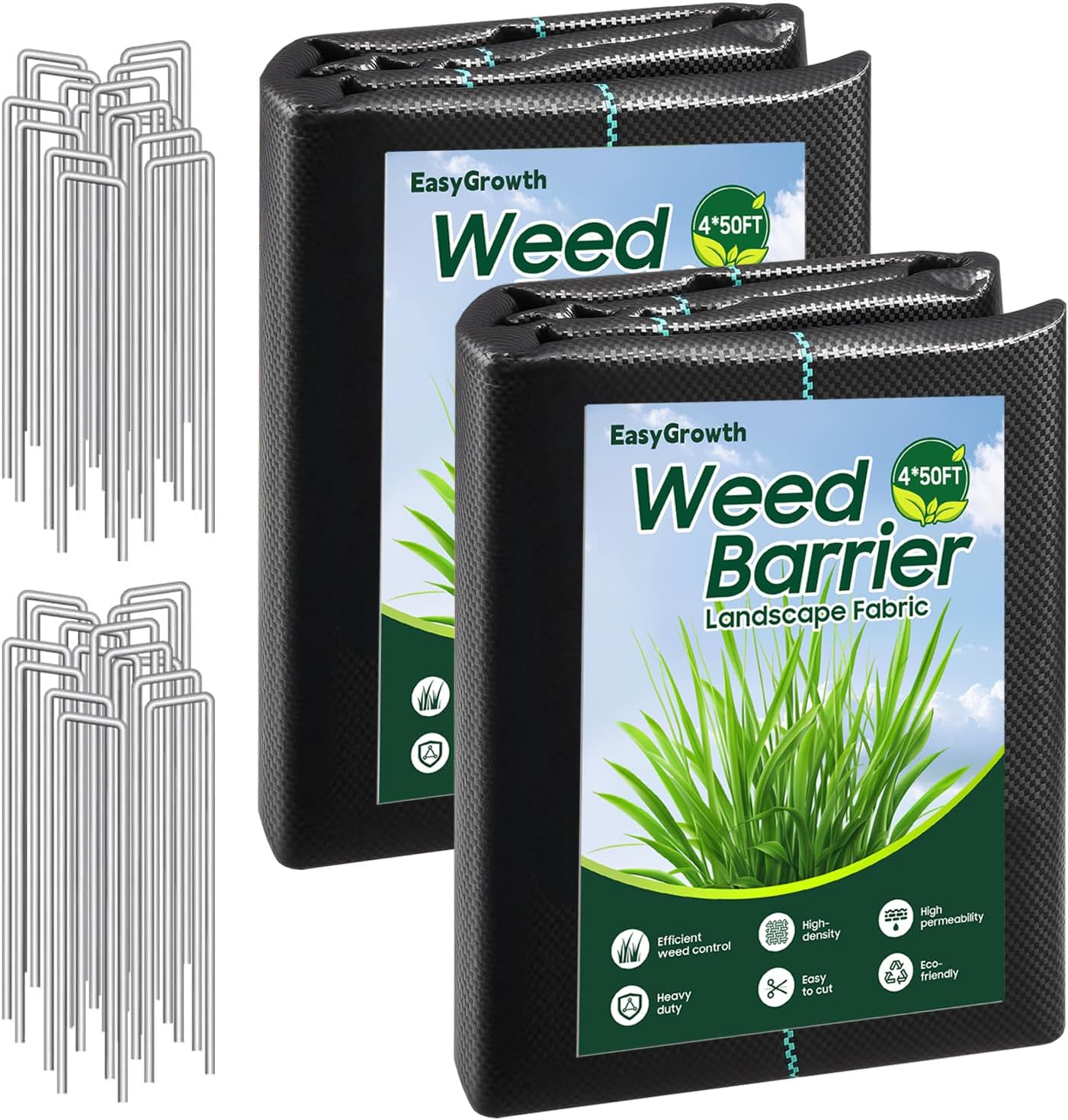
| Material | Polypropylene |
|---|---|
| Coverage | 4 ft x 100 ft (≈400 sq ft) |
| Fabric weight | 3.2 oz |
| Accessories included | 30 U-shaped staples |
This EasyGrowth woven polypropylene landscape fabric is a straightforward, reliability-focused option for long runs of artificial turf or underlayment beneath gravel and mulch. The 4 ft x 100 ft roll covers about 400 sq ft and the included 30 U-shaped staples make initial installation faster and neater. At 3.2 oz woven weight it is dense enough to reduce light at the soil surface and stop most perennial and annual weeds while still permitting water and air to reach the soil, which helps drainage under synthetic turf. Typical use is to roll it out over prepared ground, overlap seams, cut openings as needed, and pin the edges with staples; it trims cleanly with household scissors. Important limitations are that staples are limited for very large projects so additional pins are usually required and heavier foot traffic or sharp objects can eventually abrade woven fabric, so expect multi-year rather than permanent service. For artificial turf installations this product provides a dependable, easy-to-handle barrier that balances durability and permeability.
Best for: Buyers who prioritize a reliable, easy-to-install weed barrier under artificial turf or landscape coverings and want a proven woven fabric that balances durability with permeability.
Less Ideal for: Those seeking a permanent, impermeable membrane or a product designed specifically for heavy vehicular driveways should consider specialized geotextiles or heavier commercial underlayments instead.
- Woven polypropylene construction that blocks light while allowing water and air to pass
- Large 4 ft x 100 ft roll covers approximately 400 sq ft for fewer seams
- Includes 30 U-shaped staples to secure edges and overlaps during installation
- 3.2 oz weight offers a balance of durability and flexibility for easy handling and trimming
- Included 30 staples are insufficient for securing large installations without buying more fasteners
- Woven fabric can wear over time under heavy foot traffic or from sharp objects
Verdict: A dependable woven polypropylene barrier that gives artificial turf installations good weed suppression with easy handling and reliable drainage.
LAVEVE Heavy Duty Weed Barrier Landscape Fabric, 4 ft x 100 ft (two 4×50 ft rolls)

| Material | Polypropylene |
|---|---|
| Permeability | Breathable, allows water and air flow |
| UV resistance | Resistant to sun exposure |
| Package | Two rolls totaling 4 ft x 100 ft |
This LAVEVE landscape fabric is a heavy-duty woven polypropylene ground cover intended to suppress weeds while letting moisture and air reach the soil. It ships as two 4 ft x 50 ft rolls (total 4 ft x 100 ft) with printed guide lines that make cutting and alignment straightforward. In practice it is laid over prepared beds, cut for plantings, and secured with U-shaped pegs; the fabric’s permeability helps reduce erosion and allows irrigation to penetrate. The material is UV-resistant and built for typical garden uses such as flower beds, vegetable plots, gravel paths, and sidewalks. Because it is a woven polypropylene, it is sturdier than thin nonwoven mats and stands up to foot traffic when covered with mulch or gravel. Limitations to expect are that surface-seeded weeds or seeds blown onto mulch can still germinate on top, and long-term burial or heavy soil compaction can reduce effectiveness; occasional maintenance and proper installation around plants are required to keep beds weed-free.
Best for: Gardeners who want a durable, breathable ground cover to reduce routine weeding and tidy beds across medium-length runs of pathway or planting area, and who value a product with solid usage feedback.
Less Ideal for: People seeking a permanent, maintenance-free solution or those who prefer chemical weed control methods; also not the best choice for beds where frequent deep digging or planting changes are required.
- Woven polypropylene construction provides durable, tear-resistant coverage
- Permeable design allows water and air to reach soil, reducing erosion
- Printed guide lines make measuring and cutting easier during installation
- Suitable for multiple applications including beds, paths, and under gravel
- Comes as two rolls totaling 4 ft x 100 ft for extended coverage
- Does not prevent weeds that germinate in mulch or on top of the fabric
- Requires proper securing and occasional maintenance to stay effective
Verdict: A sturdy, breathable woven fabric that gives reliable, easy-to-install weed suppression for medium garden beds and paths backed by strong user approval.
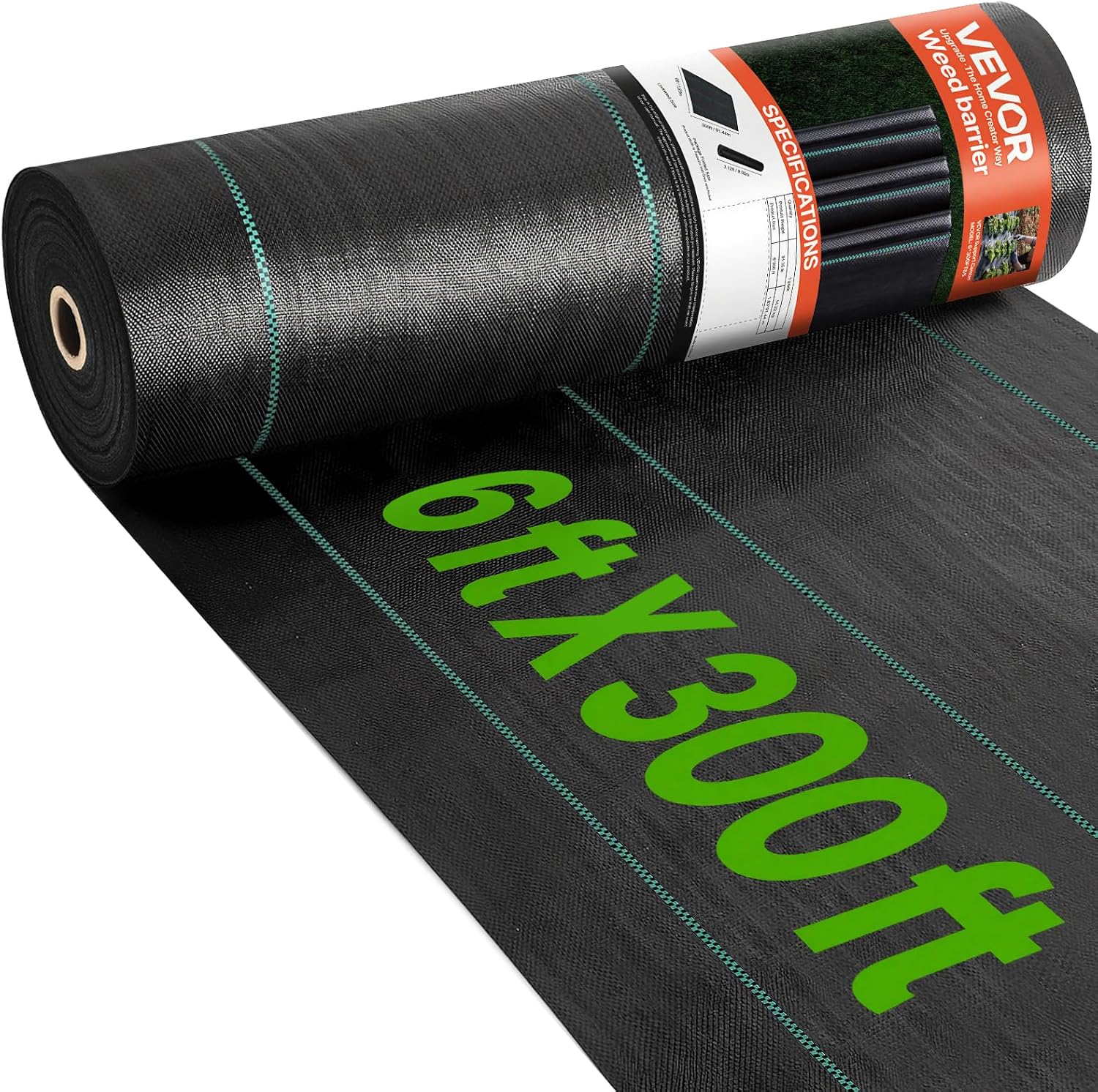
Happybuy 6 ft x 300 ft Heavy-Duty Weed Barrier Landscape Fabric
| Material | Polypropylene fabric |
|---|---|
| Size | 6 ft x 300 ft |
| Weight (fabric density) | 2.4 oz (density 12) |
This Happybuy landscape fabric is a heavy-duty woven polypropylene weed barrier sold as a 6 by 300 foot roll that covers roughly 1800 square feet when unrolled. It is used as an underlayer for beds, paths, driveways, and around plantings to suppress weeds while letting water and air reach the soil. Notable features include a tear-resistant woven construction, green guide lines for cutting and layout, and a breathable design that helps retain soil moisture without puddling. In practice the fabric is easy to cut and position and works well under mulch, gravel, or pavers; staples or landscape pins (not included) are recommended to keep edges secure. Limitations are that the black fabric will eventually show wear in high-traffic areas and persistent perennial weeds can grow through seams or holes, so occasional maintenance and careful overlap are needed. Also the roll is bulky to handle solo, so two people make installation faster on larger areas.
Best for: Gardeners or homeowners who want a practical, durable fabric to reduce routine weeding across medium to large beds and hardscape underlayers and who value easy installation and long coverage.
Less Ideal for: People needing a decorative surface finish as this is a functional underlayer rather than a visible landscape material and those with very small container or indoor plantings where a roll this large is impractical.
- Large coverage area reduces number of seams for medium to large beds
- Woven polypropylene construction offers tear resistance and weatherproofing
- Permeable design lets water and air through to protect soil health
- Printed guide lines make cutting and aligning plants easier
- Bulky roll can be awkward for one person to unroll and position
- Not a permanent barrier against aggressive perennial weeds that can exploit gaps or edges
Verdict: Choose this heavy-duty 6×300 ft woven polypropylene fabric when you need broad, breathable weed suppression that is easy to cut and lay for medium to large garden projects.
Choosing the Right Weed Barrier for Artificial Turf: Key Factors to Consider
Material and UV Resistance
The fabric composition determines how long a weed barrier will last under sun exposure and repeated foot traffic. Polypropylene and woven polyethylene blends generally provide good tensile strength and resist breaking under routine use. UV stabilizers in the weave slow degradation from sunlight so the barrier does not become brittle and tear.
A product that lacks adequate UV protection can fail within a few seasons, allowing weeds to penetrate at stress points. Consider how exposed your turf area is to direct sun and choose materials specified for outdoor landscape use rather than indoor or temporary fabrics.
Water Permeability and Drainage
Artificial turf relies on a permeable base to shed rainwater quickly. A weed barrier must allow rapid water passage so the turf surface does not puddle and the base course does not stay saturated. Look for specified flow rates or dense yet porous weaves that maintain permeability even after soil settles against the fabric.
Poor permeability can lead to trapped moisture that causes odor, weeds exploiting saturated seams, or shifting of infill and base materials. For areas with heavy rainfall or poor underlying soil, prioritize barriers engineered to keep high water throughput.
Root-Blocking Performance
Effective root blocking depends on weave tightness, fabric thickness, and overlap strategy at joints. Dense woven fabrics block root tips and rhizomes better than loosely woven or perforated sheets. Some barriers include an added nonwoven layer to stop tiny seedlings while still permitting drainage.
Think about the weed pressure in your location: lawns near beds, trees, or perennial borders face stronger root intrusion. In those contexts, choose a barrier with proven root-stopping properties and plan for generous overlaps and secure anchoring to prevent gaps where roots can find entry.
Installation Ease and Compatibility
A garden-friendly weed barrier should be simple to cut, lay flat, and fasten without specialized tools. Ease of trimming lets you fit around curves, planters, drainage outlets, and other landscape features. Compatibility with common turf installation methods-such as using landscape staples, adhesives, or mechanical edging-reduces installation time and risk of future failures.
If a barrier is hard to handle, installers may leave gaps, create wrinkles, or use excessive fasteners that damage the fabric. Evaluate roll widths, edge handling, and whether seams can be overlapped or taped cleanly to match your installation approach.
Edge Stability and Seam Integrity
Edges and seams are the most common failure points for weed barriers under artificial turf. Secure edges resist lifting from wind, foot traffic, or maintenance activities. Seam integrity is critical because even small openings let weeds establish and roots migrate under the turf.
Consider how a product is joined at seams: options include overlap with staples, seam tape, or mechanical connectors. Also assess whether the fabric frays when cut; materials that fray complicate achieving a snug seam and require extra steps to stabilize cut edges.
Longevity Versus Maintenance Tradeoffs
Heavier, tightly woven fabrics often offer longer service life and better root suppression but can be harder to work with and may cost more upfront. Lighter fabrics are easier to lay and cut but may require replacement sooner, especially in high-stress yards. Balance the expected lifespan against how often you are willing to inspect, re-anchor, or replace the barrier.
Also factor in maintenance access. If you plan to lift sections for irrigation or buried utilities, choose a product that tolerates repeated handling without rapid deterioration.
Preparing the Base for Artificial Turf
Proper base preparation starts with removing existing vegetation and loosening compacted soil so the weed barrier can lie flat. A compacted or uneven base creates valleys where water pools and where the fabric can pinch, creating weak spots for weed intrusion. Grade the area to promote runoff and install a suitable aggregate or sand layer specified for synthetic turf installations.
When placing the barrier, lay it on a clean, stable bed and overlap edges according to manufacturer guidance to prevent gaps. Secure the fabric with staples or anchors spaced to resist wind and traffic, and avoid stretching the fabric tight, which can create tension tears over time. If you have sprinkler heads or drains, cut precise openings and seal the edges to reduce fraying.
- Remove roots and large debris before laying fabric
- Compact and level the base aggregate for consistent support
- Overlap seams and secure with landscape staples or seam tape
Managing Drainage and Slope
Even with a permeable barrier, the slope and subbase determine how quickly water moves away from the turf. A shallow slope of a few degrees is usually enough to prevent standing water. In low spots, consider installing a French drain or adding a more permeable base material to enhance flow under the barrier.
At outlets and perimeter edges, ensure water can exit without undermining the edge anchoring. Where turf meets hardscape, design a channel or use porous edging that permits water passage while keeping the barrier secured.
- Use a uniform subbase depth to avoid low spots
- Add drainage channels in flat or poorly draining areas
- Check permeability after installation by testing with a garden hose
Handling High-Weed-Pressure Areas
Locations next to garden beds, trees, or perennial borders face constant root and seed pressure. In these cases, extend the barrier under adjacent beds or add a supplemental root barrier at the turf edge to block lateral root growth. Deep-rooted plants may require a physical root barrier installed vertically to the depth of known roots.
Also plan for ongoing maintenance: a few hand-weeding visits near edges and seams during the first season will prevent small outbreaks from establishing. Use overlaps and edge anchors that are easy to lift and reseat if you need to remove stubborn roots that find their way under the turf.
- Extend barrier beyond turf edges near heavy root zones
- Install vertical root barriers for aggressive shrubs and trees
- Inspect seams periodically during the first growing seasons
Cutting, Seaming, and Finishing Details
Accurate cutting and clean seams keep weeds from exploiting gaps. Use sharp utility knives and straightedges for clean cuts that minimize fraying. When joining two sheets, overlap according to product guidance and consider using seam tape or staples beneath turf seams for extra protection.
Finish perimeter edges with mechanical edging or landscape boards that clamp the turf and fabric in place. This prevents lifting and creates a clean aesthetic transition to garden beds, patios, or paths. Avoid burying fabric edges in unstable soil that can wash away and expose seams.
- Use sharp blades and measure twice before cutting
- Reinforce seams with tape or extra staples in high-traffic areas
- Secure perimeter edges with stable edging materials
Seasonal Care and Inspection
Plan to inspect the barrier and turf at least once a year to check for seam separation, edge lifting, or localized weed emergence. Small issues addressed early are easier to fix and prevent larger repairs. After heavy storms or freeze-thaw cycles, verify that anchors remain tight and that water is still draining as expected.
If you find weeds, pull them out by the root and investigate how they penetrated the barrier. Repair any tears or gaps by overlapping a patch and re-anchoring the edges rather than relying on surface trimming alone.
- Inspect seams and edges seasonally
- Patch small tears promptly with overlapping material
- Re-anchor any loose sections after extreme weather
How We Chose the Best Weed Barrier for Artificial Turf
We evaluated candidates based on how well they address the practical challenges of installing and maintaining artificial turf. Primary criteria were material durability under foot traffic and UV exposure, and water permeability to ensure proper drainage beneath synthetic grass. We also scored ease of installation for DIY and professional installers, measuring seam handling, anchoring options, and compatibility with infill systems. Weed suppression effectiveness was judged by fabric density and root-block features rather than short-term herbicide effects. Finally, we considered long-term stability including resistance to tearing, rot, and movement when exposed to freeze-thaw cycles or heavy use. Products that performed poorly in drainage testing, lacked clear installation compatibility with turf adhesives or staples, or used non-garden-safe materials were excluded. We prioritized products that balance robust root blocking with sufficient water flow and that are designed for landscape use rather than temporary or indoor fabrics. The criteria listed informed the scoring labels used across the product blocks and ensured each shortlisted item is practical for real garden and yard installations.
FAQ
Can I lay weed barrier directly on topsoil under artificial turf?
You can lay barrier on topsoil, but a prepared aggregate base is recommended for drainage and stability. A compacted base prevents settling that could create gaps and weak points in the fabric.
How much overlap do I need at seams to stop roots?
Overlap recommendations vary by product, but a common practice is 6 to 12 inches to reduce seam gaps. In high-pressure areas, use larger overlaps and secure them with staples or seam tape to prevent lateral root entry.
Will a barrier prevent all weeds forever?
No barrier is absolutely permanent. Properly installed, a good barrier greatly reduces weed ingress for many years, but edges, seams, and extreme root systems may require occasional attention and repairs.
Does a weed barrier affect turf drainage?
A correctly specified barrier is designed to be permeable and should not hinder drainage. Choose materials with proven water flow characteristics and confirm permeability during base preparation.
Can I reuse weed barrier if I remove artificial turf later?
Reusing fabric is possible if it is undamaged, but cutting and lifting often cause fraying and weakened seams. Inspect the material carefully and patch or replace sections that show wear before reinstallation.
Final Verdict
Prioritize a weed barrier that balances strong root-blocking characteristics with high water permeability and durable UV resistance. Focus on products that are easy to trim and secure, and plan for careful seam handling and stable edging so weak points do not allow weed ingress. For most synthetic turf projects, investing time in proper base prep and selecting a barrier rated for outdoor landscape use will reduce maintenance and prolong the installation's life. Choose based on your yard's weed pressure, drainage needs, and how often you want to perform upkeep.
