

Note: This article contains affiliate links. If you click on these links and make a purchase, I may earn a small commission at no extra cost to you. This helps support my research and content. Read my full affiliate disclosure here.
If you manage warm-season turf in the South, choosing the right granular weed killer matters for both weed control and turf health. Southern lawns face a specific mix of broadleaf weeds, grassy invaders, and seasonal pressures that can respond differently to granular herbicides. In this guide we shortlist the top options for southern lawn conditions and explain the performance and safety factors that matter in real yards. The selections that follow are the top-rated granular products suited to southern lawns, evaluated for kill rate on common weeds, turf safety, longevity, and ease of use. Read on for practical guidance that helps you match a product to your lawn type and maintenance plan before you head out to apply it.
Top Picks at a Glance
| Best Overall The best all-around choice for most situations | BioAdvanced 5-in-1 Weed and Feed Granules, Fertilizer and Crabgrass Killer, 24 lb |  |
| Best Quality Built to a higher standard if you want something more solid | The Andersons Barricade Granular Pre-Emergent Weed Control (18 lb, covers 5,800 sq ft) |  |
| Best Budget The cheapest option that still gets the job done reliably | BioAdvanced 3-in-1 Weed & Feed Granules for Southern Lawns, 10 lb |  |
| Highest Rated A top-rated pick with lots of positive feedback | Scotts Turf Builder Bonus S Southern Weed & Feed2, 13.79 lb |  |
| Most Popular A crowd favorite that many people choose with confidence | BioAdvanced Season Long Lawn Weed Killer + Preventer for Southern Lawns, 10 lb |  |
BioAdvanced 5-in-1 Weed and Feed Granules, Fertilizer and Crabgrass Killer, 24 lb

| Item Form | Granule |
|---|---|
| Coverage | 10000 square_feet |
| Unit Count | 384 Ounce |
BioAdvanced 5-in-1 Weed and Feed is a single-application granular product that combines fertilizer with herbicides to kill over 200 listed broadleaf weeds and large crabgrass while feeding turf for several months. You apply it with a broadcast or drop spreader across established lawns in spring or early summer; granules create a soil barrier that helps prevent listed weeds and crabgrass from emerging for up to six months while the fertilizer greens and thickens turf for about three months. Notable features include multi-target weed control (including dandelion and clover), crabgrass control to the root, and coverage rated for roughly 10,000 square feet from the 24 pound bag. The practical benefit is fewer follow-up treatments because the formula acts as both a killer and a preventer, and the granular form makes even application straightforward with a spreader. Important limitations are state sale restrictions and the need to follow label safety directions closely since it is a concentrated pesticide product that requires protective clothing and careful handling.
Best for: Homeowners who want a practical, once-or twice-a-season solution to both feed their lawn and reduce weed pressure without separate products, and who are comfortable using a granular pesticide with a spreader.
Less Ideal for: People with small lawn areas who prefer spot treatments, organic lawn stewards, or anyone in states where this product is restricted should look for alternatives.
- Controls over 200 listed broadleaf weeds plus large crabgrass
- Prevents listed weeds and crabgrass from emerging for up to six months
- Feeds and greens lawn for up to three months
- Granular formula works with broadcast or drop spreaders for even coverage
- Not available for sale in certain states
- Requires protective clothing and careful handling due to pesticide ingredients
Verdict: If you want a simple, single granular product that both kills a wide range of weeds and feeds your lawn for months, this 5-in-1 weed-and-feed is an efficient seasonal pick.
The Andersons Barricade Granular Pre-Emergent Weed Control (18 lb, covers 5,800 sq ft)
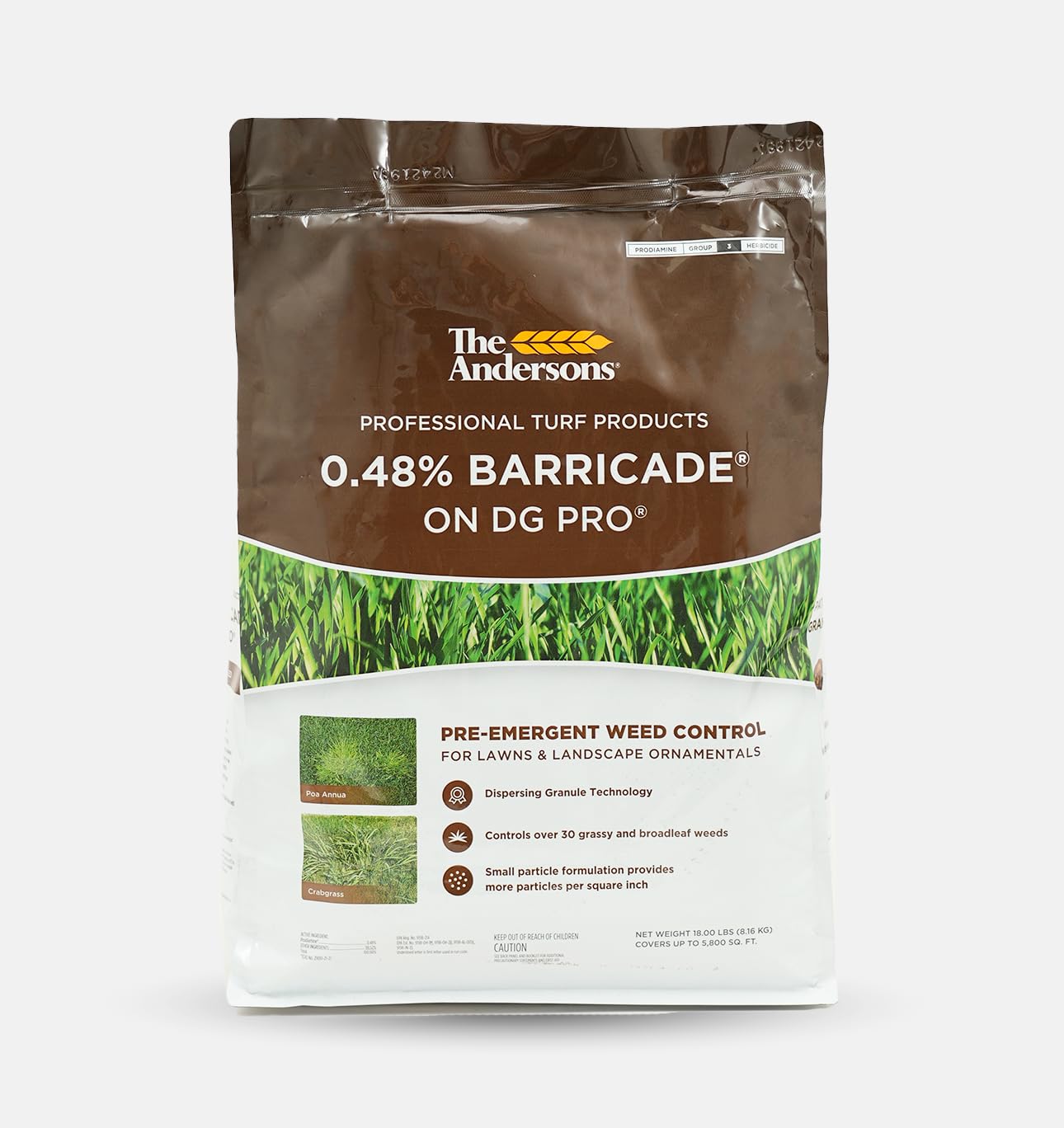
| Item Form | Granule |
|---|---|
| Coverage | 5800 square feet |
| Unit Count | 288 Ounce |
| Active Ingredients | Prodiamine 0.48% |
Barricade is a granular pre-emergent that stops common lawn weeds before they emerge, using 0.48% prodiamine in a dispersible granule formula. You apply it across the lawn in early spring or fall and water it in so the small DG Technology particles dissolve and move the active ingredient into the soil. That combination gives broader, more even coverage per square inch and is especially aimed at preventing crabgrass, poa annua and other annual grassy and broadleaf weeds across up to 5,800 square feet from a single 18 pound bag. The product is straightforward to use with a spreader and fits routine seasonal maintenance plans. Important limits are that it will not kill weeds already established and must be timed correctly for best effect. Also, because it is a professional-strength herbicide buyers should follow safety directions closely and keep pets and children off treated areas until safe.
Best for: Homeowners who plan seasonal lawn maintenance and want a single, high-coverage pre-emergent to prevent crabgrass and common annual weeds across medium to large yards.
Less Ideal for: People needing a post-emergent solution for existing weeds, or gardeners who prefer non-chemical weed control methods.
- Designed to prevent both grassy and broadleaf annual weeds including crabgrass and poa annua
- DG Technology dispersible granules dissolve quickly when watered for consistent soil incorporation
- Covers up to 5,800 square feet from a single 18 pound bag, suitable for typical residential lawns
- Contains professional-grade active ingredient prodiamine for season-long pre-emergent control
- Will not control weeds that are already established in the lawn
- Must be applied in the correct seasonal window (early spring or fall) to be effective
- Requires watering after application and careful safety handling around children and pets
Verdict: Pick Barricade when you want a professional-strength, high-coverage pre-emergent that reliably prevents crabgrass and other annual weeds across a typical residential lawn.
BioAdvanced 3-in-1 Weed & Feed Granules for Southern Lawns, 10 lb

| Item Form | Granule |
|---|---|
| Coverage | 4,000 square feet |
| Active Ingredients | Dicamba acid, Indaziflam, Penoxsulam |
| Unit Count | 160 Fluid Ounces |
This 3-in-1 granule combines selective herbicides with a slow-release fertilizer for one-step care of St. Augustine and other southern warm-season lawns. Use it with a broadcast or drop spreader when temperatures are 50 to 90 degrees and weeds are actively growing; a single 10 lb bag covers about 4,000 sq ft at the recommended rate. The product kills common southern broadleaf weeds such as dandelion, dollarweed, and clover while feeding and greening turf for roughly three months, and it claims up to six months of prevention against listed grassy and broadleaf weeds. Practical benefits include easy application, targeted chemistry for southern species, and reduced need for separate weed control and fertilizing products. Limitations: it is formulated only for southern turfs (not for northern lawns or edible plants), is restricted from sale in many states, and requires attention to temperature and spreader calibration to avoid damage to sensitive turf or non-target plants.
Best for: Homeowners with St. Augustine or other southern warm-season lawns who want a single-product solution to kill listed weeds, green the turf, and reduce repeat applications during the growing season.
Less Ideal for: Gardeners with cool-season or mixed turf, vegetable gardens, or who need a product approved for use in states where this formulation is restricted should look elsewhere.
- Combined weed control and slow-release fertilizer simplifies seasonal maintenance
- Formulated specifically for southern warm-season grasses including St. Augustine
- Granular form works with broadcast or drop spreaders for even coverage
- Provides up to six months prevention of listed weeds and feeds the lawn for up to three months
- Not intended for northern turf or edible plants and is restricted for sale in many states
- Requires correct application timing and spreader calibration to be safe and effective
Verdict: Choose this product if you want a convenient, single-step granular treatment to kill common southern lawn weeds and feed St. Augustine turf through the season.
Scotts Turf Builder Bonus S Southern Weed & Feed2, 13.79 lb

| Item Form | Granule |
|---|---|
| Coverage | 4000 square feet |
| Unit Count | 220.64 Ounce |
This Scotts Turf Builder Bonus S Southern Weed & Feed2 combines a broadleaf weed killer with a slow-release fertilizer made specifically for southern lawns. It is designed for spot-to-whole-lawn applications with a broadcast or drop spreader and must be applied to a dry, actively growing lawn and watered in immediately. Notable features include a formula that targets more than 25 southern weed species, including clover, and guidance for spreader settings to ensure even coverage. Practical benefits are twofold: it reduces existing broadleaf weeds while providing nutrients that encourage grass to fill in and compete with future weeds, helping create a denser turf. Important limitations are that it is labeled only for St. Augustine, Centipede, Zoysia, and Carpetgrass and should not be used during winter dormancy or on other grass types, and timing matters—apply after the third mowing when soil temperatures reach the recommended range. Coverage per 13.79 lb bag is 4,000 square feet, so larger yards will need multiple bags or a larger size option.
Best for: Homeowners with southern-style lawns who want a single product to control clover and other broadleaf weeds while feeding the turf, and who follow label timing and application guidance.
Less Ideal for: Those with cool-season lawns, mixed-grass yards, or users who prefer spot-treating weeds with herbicide-only products should look elsewhere.
- Kills a wide range of southern broadleaf weeds including clover
- Feeds grass while killing weeds to encourage thicker turf
- Formulated for common southern grasses so label directions are targeted
- Includes recommended spreader settings for even application
- Restricted to specific southern grass types and not safe for all lawns
- Must be applied when grass is actively growing and watered in immediately which requires correct timing
Verdict: Choose this if you have a southern grass lawn and want one granular product that kills clover and other broadleaf weeds while feeding the turf to promote a denser lawn.
BioAdvanced Season Long Lawn Weed Killer + Preventer for Southern Lawns, 10 lb

| Item Form | Granule |
|---|---|
| Coverage | 4000 square feet |
| Unit Count | 160 Ounce |
| Included Components | 10LB Season Long Weed Killer, Granules |
This 10 lb granular treatment is made for southern warm-season turf and combines immediate weed control with a residual herbicide to prevent listed broadleaf and grassy weeds for up to six months. You apply it with a rotary or drop spreader to an established southern lawn (St. Augustine, Bermudagrass, Centipede, Zoysia, and others listed on the label), water after application to activate it, and avoid mowing for two days. Notable features are its multi‑ingredient formula (including dicamba, penoxsulam, and indaziflam), coverage for about 4,000 sq ft, and clear directions for timing and activation. In practice it is convenient for homeowners who want a single granular pass that both kills existing weeds and provides long residual prevention, reducing repeat treatments through the season. Important limitations: it is labeled specifically for southern turfs only and is not legal for sale in several states, so check local restrictions and the product label; safety precautions matter because it can irritate skin and eyes and should be kept away from children and pets.
Best for: Homeowners with established southern warm-season lawns who want a season-long granular solution to reduce repeat spot treatments and simplify weed control.
Less Ideal for: Gardeners outside the specified southern turf types or people in states where the product is restricted should choose a different, labeled option.
- Designed for southern warm-season grasses and lists compatible turf types
- Provides both immediate knockdown and up to six months of residual weed prevention
- Covers roughly 4,000 square feet from one 10 lb bag when applied as directed
- Granular formula works with standard spreaders for straightforward application
- Not approved for sale or use in several states so availability and legality vary
- Contains herbicide active ingredients that require caution around people, pets, and desirable plants
Verdict: A single 10 lb granular application that kills listed weeds and provides up to six months of prevention makes this a convenient season‑long option for established southern lawns.
Choosing the Right Granular Weed Killer for Southern Lawn: Key Factors to Consider
Weed Spectrum and Target Species
Different granular weed killers vary in which weeds they control. Some are broadleaf-selective and will target dandelion, clover, chickweed, spurge, and plantain while leaving desirable turf intact. Others include ingredients that also affect certain grassy weeds. Knowing the specific weeds that trouble your southern lawn helps you choose a product formulated to suppress those targets.
Selecting a product with the correct spectrum reduces repeat applications and lowers the risk of unintentionally stressing turf with off-target activity. Always match the active ingredients listed on the label to the weeds you see, and remember that some weeds require multiple seasonal treatments for reliable control.
Turf Compatibility and Timing
Warm-season grasses such as bermudagrass, zoysia, centipede, and St. Augustine have different tolerance levels. Turf safety information on the label will indicate whether a granular weed killer is safe for your species and the recommended application windows. Applying at the wrong time of year or to a stressed lawn increases the chance of discoloration or injury.
Plan applications when turf is actively growing but not heat-stressed. Fertilization, recent herbicide use, insect damage, or drought can make turf more vulnerable. Read label cautions about overseeding and do not apply products that advise against use on your grass type.
Residual Activity and Reapplication Interval
Residual longevity determines how long the granules continue to control germinating weeds after application. Longer residual products reduce the need for frequent reapplications, which can be helpful in high-pressure southern yards, but they may also affect desirable seedlings and garden edges. Shorter-residual options give more flexibility for overseeding or establishing new plants nearby.
Consider your lawn calendar: if you expect to seed or plant within weeks, choose a low-residual formula. If you need season-long suppression, a product with extended residual activity can be more convenient, but follow label limits on yearly application rates.
Granule Quality and Spread Uniformity
Granule size, weight, and coating affect how evenly a product distributes from a spreader and how well it adheres to the turf surface. Fine, uniformly sized granules distribute more evenly, reducing streaks and hot spots. Coatings that improve flow can help prevent clogging in common spreaders.
Uneven application leaves untreated patches where weeds will reappear and can create concentrated areas that risk turf damage. Match granule characteristics to the spreader you use and calibrate the spreader before treating the whole lawn.
Label Instructions and Ease of Use
Clear label directions for spreader settings, application rate per square foot, timing, and safety precautions make proper use far more likely. Some products include simple homeowner instructions and spreader setting charts compatible with popular consumer spreaders, which reduces guesswork.
Also check for practical guidance on watering after application, when to mow relative to treatment, and any required personal protective equipment. Ease of measuring and handling affects how likely you are to apply the product accurately.
Environmental Considerations and Buffering
Consider runoff risk, proximity to flower beds, vegetable gardens, water features, and sidewalks. Some active ingredients are mobile and can affect nearby sensitive plants or contaminate water if overapplied or applied before heavy rain. Buffer the application area from garden beds and follow label guidance on leaving untreated strips near water.
Using targeted application techniques and avoiding applications before heavy rainfall greatly reduces off-site movement. If pollinator or aquatic concerns are high, choose products with label language that limits use near those areas and follow any recommended buffer zones.
Timing Treatments for Southern Climate Cycles
Southern lawns cycle through active growth, summer heat stress, and cooler transitional seasons, and the timing of granular treatments affects both efficacy and turf safety. Apply selective granular herbicides when weeds are actively growing and the turf is healthy enough to recover from minor stress.
Spring and early fall often yield the best control for many broadleaf weeds because plants are not heat-stressed and are translocating nutrients. Avoid applying during peak summer heat or when the lawn is drought-stressed. Check label guidance for precise seasonal recommendations for warm-season turf.
- Target young, actively growing weeds for faster knockdown.
- Avoid treatments immediately before or during extreme heat or drought.
- Follow label timing if overseeding or renovating the lawn.
Calibrating Your Spreader for Even Coverage
Proper spreader calibration is one of the simplest ways to get consistent results from granular weed killers. Calibration involves setting the machine to the label-recommended opening and then checking the material output over a measured area.
Test a small strip at the recommended setting and visually inspect for overlap or gaps. Walk at a steady pace and use an overlapping pattern to avoid missed areas. If the granules clump or bridge in the hopper, adjust agitation or try a different spreader type compatible with the product.
- Use the spreader chart on the product label when available.
- Walk at a consistent pace and use parallel passes with slight overlap.
- Clean spreader hopper after use to prevent cross-contamination.
Combining Cultural Practices with Granular Treatments
Granular weed control is more effective when combined with sound cultural practices. Proper mowing height, regular watering, and seasonal fertilization improve turf density and shade out weed seedlings. Dense, vigorous turf reduces the number of weeds that require chemical control.
Address underlying issues such as compaction and poor soil fertility to reduce recurring weed pressure. In many southern lawns, improving drainage and correcting pH can change the competitive balance in favor of desirable grass.
- Mow at the recommended height for your warm-season grass to suppress weeds.
- Fertilize according to a schedule appropriate for southern turf species.
- Consider aeration or topdressing to improve turf vigor and reduce weeds.
Spot-Treating Versus Whole-Lawn Applications
Decide whether to treat the entire lawn or only problem patches. Spot treatments use less product and reduce exposure of non-target areas, but they are only practical when weed pressure is limited and identifiable. Whole-lawn applications are efficient for diffuse weed problems or when establishing a preventative residual.
When spot treating, adjust the spreader or use a handheld applicator designed for precision. For whole-lawn preventive applications, ensure the product is labeled for that use and follow the maximum seasonal rates to avoid turf stress.
- Spot treat isolated weed clusters to minimize chemical use.
- Use whole-lawn applications for widespread or recurring invasion.
- Keep accurate records of application dates and rates for seasonal planning.
Watering and Mowing After Application
Label instructions vary on whether to water in granules after application. Some products require light watering to activate the herbicide, while others rely on rain or soil moisture. Follow the label for the correct water volume and timing to optimize efficacy and reduce runoff risk.
Mow timing also matters. Wait the interval recommended on the label before mowing to avoid removing granules or redistributing them unevenly. If heavy residue accumulates on the turf blades, a light raking or brief delay before mowing can help maintain even exposure.
- Follow label directions on post-application watering to activate or fix granules.
- Delay mowing for the recommended period to avoid displacing product.
- Avoid power-washing treated areas to reduce off-site movement.
How We Chose the Best Granular Weed Killer for Southern Lawn
We prioritized products that are formulated for warm-season turf and have proven activity on the common weeds that plague southern lawns. Key evaluation criteria included documented efficacy against broadleaf targets and grassy weed suppression where appropriate; turf safety ratings specific to warm-season species; and longevity of control to reduce the number of treatments needed. We also assessed granule size and distribution behavior, since even spread is critical for uniform results, plus application flexibility across spreader types and label guidance for timing. Ease of storage and clear, practical label instructions were included because homeowners often misapply products when directions are hard to follow. We excluded granular formulations labeled only for cool-season turf or for ornamentals and garden beds where turf safety data was absent. Final selections favor granular weed killers that balance consistent weed mortality with conservative turf impact under realistic southern lawn conditions. We did not include spot-applied liquid-only herbicides or products lacking clear warm-season turf guidance.
FAQ
Can I use a granular weed killer on newly planted warm-season grass?
It depends. Many granular products have specific waiting periods after seeding or sodding. New turf and seedlings are more vulnerable to herbicides, so follow the label; often you must wait several weeks or until the turf is well established before applying.
Will a granular weed killer harm flower beds or vegetable gardens nearby?
Granular herbicides can move off-target if they are overapplied or washed by heavy rain. Maintain buffers between lawn treatments and garden beds, avoid windblown spread, and do not apply before heavy rainfall to reduce risk to nearby plantings.
How soon will I see results after applying a granular treatment?
Results often appear within 7 to 21 days for many broadleaf weeds, but timing varies with the active ingredient, weed species, and growing conditions. Tough, established weeds may require repeat applications or an integrated control approach.
Can I overseed my southern lawn after using a granular weed killer?
Overseeding timelines vary by product. Some granular formulations have long residuals that inhibit seedling establishment, so check the label for the recommended wait time. If planning to overseed, choose a product labeled compatible with seeding or schedule treatments accordingly.
Is it safe to let pets and children on the lawn after treatment?
Safety guidance differs by product. Many labels permit re-entry once granules are watered in or dried, while others specify a set re-entry interval. Follow label directions on re-entry, and keep pets and children off treated areas until the product's recommended wait time has passed.
Should I apply granular weed killer before or after fertilizing?
Timing depends on the product and the lawn's condition. Some herbicides perform best on actively growing weeds, which can be promoted by light fertilization beforehand. However, avoid applying both simultaneously unless the label permits tank-mixing or combined application timing for granular products.
Final Verdict
For southern lawns, prioritize turf-specific safety, the weed spectrum you need to control, and practical spreading behavior when choosing a granular weed killer. Balance residual needs against plans for overseeding or nearby planting, and always follow label timing to protect warm-season grasses. By matching a product's active ingredients and application guidance to the weeds present and the condition of your lawn, you can achieve dependable control with minimal turf stress.
