

Note: This article contains affiliate links. If you click on these links and make a purchase, I may earn a small commission at no extra cost to you. This helps support my research and content. Read my full affiliate disclosure here.
Growing alocasia black velvet rewards you with dramatic foliage that needs steady, balanced nutrition. These plants have a compact root system and a naturally slow, showy leaf habit, so the wrong fertilizer or feeding rhythm can cause leaf burn, leggy growth, or reduced coloration. This guide shortlists six fertilizers that suit the species' needs and explains which formulas and application styles work best in different growing setups. The picks focus on nutrient ratios, micronutrient content, and ease of application for houseplants and terrarium-style conditions. Below you will find practical guidance on feeding frequency, dilution, and how to match a fertilizer to your potting mix and light level before the product list.
Top Picks at a Glance
| Best Overall The best all-around choice for most situations | Growth Technology GT Foliage Focus Liquid Plant Food (250 mL) |  |
| Best Quality Built to a higher standard if you want something more solid | Gardenera Plant Growth Superfood for Alocasia — Organic Liquid Plant Food, 8 oz |  |
| Best Value The sweet spot between price and what you get | Purived All-Purpose Liquid Houseplant Fertilizer, 16 fl oz (Makes 50 Gallons) |  |
| Best Budget The cheapest option that still gets the job done reliably | Miracle-Gro Pour & Feed Singles Ready-to-Use Plant Food |  |
| Most Popular A crowd favorite that many people choose with confidence | TPS NUTRIENTS Indoor Plant Food Liquid Fertilizer, 8 fl oz |  |
| Best Seller A high-volume bestseller chosen again and again | TPS NUTRIENTS Monstera Liquid Plant Food, 8 oz |  |
Growth Technology GT Foliage Focus Liquid Plant Food (250 mL)

| Item Form | Liquid |
|---|---|
| Specific Uses For Product | Soil / Hydroponics / Semi Hydro / Foliar Spray |
| Application Method | Foliar Spray |
| Target Species | Houseplants, Leafy Tropical |
| Liquid Volume | 250 ml |
Growth Technology GT Foliage Focus is a liquid concentrate designed to support leafy tropicals like monstera by supplying macronutrients and trace elements in an easy-to-use, pH‑buffered solution. It is mixed at low milliliter-per‑liter rates for routine feeding: lower dilutions for soil and potting mixes and slightly stronger mixes for hydroponic or semi‑hydro systems. Typical use is adding the recommended dose to your watering can and feeding with every watering or applying as a foliar spray for faster leaf uptake. The formula lists nitrate‑nitrogen, potassium, calcium, magnesium, and trace elements, so it supports steady chlorophyll production and robust foliage when used consistently. Practical benefits include clear dosing guidelines, compatibility across growing media, and a compact bottle that fits on a shelf or in a small greenhouse. Limitations are the small 250 mL size for growers who feed many plants frequently and the need to flush monthly to avoid salt buildup if used with each watering.
Best for: Buyers who prioritize consistent, reliable feeding routines for monstera and other leafy tropicals and want a single product that works across soil and hydro systems.
Less Ideal for: Large-scale growers or collectors who prefer bulk concentrates or an all-in-one slow-release option should consider larger-volume or alternative delivery formats.
- pH‑buffered, ready-to-dilute liquid formula for straightforward mixing
- Clear dosing guidance for soil, hydroponic, semi‑hydro and foliar use
- Contains macronutrients and trace elements targeted at leafy tropicals
- Small concentrated bottle is convenient for home and small greenhouse setups
- Only 250 mL volume may require frequent repurchasing for larger collections
- Requires monthly flushing to manage mineral salt buildup
Verdict: A reliable, pH‑buffered liquid feed that makes steady, cross‑media nourishment simple for monstera and other leafy indoor plants.
Gardenera Plant Growth Superfood for Alocasia — Organic Liquid Plant Food, 8 oz
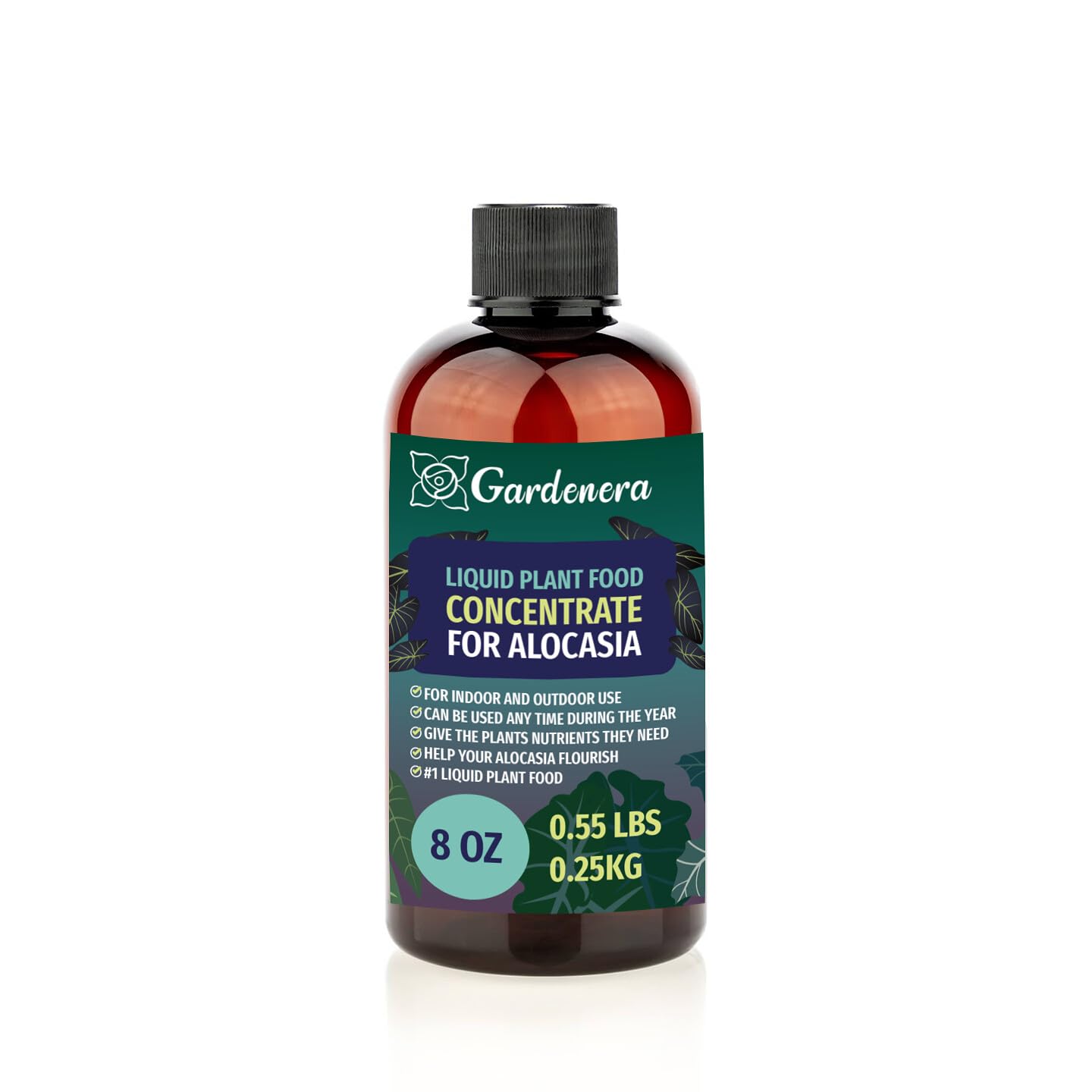
| Net volume | 8 oz |
|---|---|
| Nutrients included | 18 essential nutrients and microbial ingredients |
| Suitable for | Soil, hydroponics, vivariums, terrariums |
| Made in | USA |
This concentrated organic superfood is designed as an all-purpose liquid supplement to strengthen roots, foliage, and blooms on Alocasia and similar tropical houseplants. You dilute the 8 oz concentrate in water and apply it to soil or hydro setups to deliver a broad mix of nutrients and beneficial microbes, including kelp, worm castings, mycorrhizae, fulvic acid and several manures and mineral sources. For a performance-minded Alocasia grower the blend supports faster recovery after repotting, fuller leaves, and healthier, more resilient roots—especially in heavier feeders like Alocasia Black Velvet. The formula is ready-dissolving, claims long shelf stability, and is safe for mixed systems including vivariums and hydroponics. Be aware this is a broad-spectrum organic formulation rather than a tailored NPK fertilizer, so precise macronutrient control or aggressive foliage push may require complementary products or adjusted dosing. Also the ingredient list is complex and naturally variable, so expect batch-to-batch variation common with organic concentrates.
Best for: Growers focused on maximizing overall plant vigor and natural feeding for Alocasia who prefer a single concentrated organic supplement that supports roots, foliage, and blooms.
Less Ideal for: Strict nutrient managers who need exact NPK dosing or rapid high-nitrogen pushes for immediate foliage growth should consider a measured synthetic fertilizer or targeted nutrient program.
- Broad-spectrum organic blend with 18 nutrient and microbial inputs including mycorrhizae and fulvic acid
- Concentrated liquid that dissolves instantly for easy dosing in soil, hydro, or vivarium setups
- Formulated to support root development, foliage health, and bloom/flower enhancement
- Marketed as pet, fish, and reptile safe with no strong odors, suitable for mixed indoor systems
- Not formulated with explicit NPK ratios, so less precise for growers needing exact macronutrient targets
- Organic ingredient complexity can lead to variable results between batches
Verdict: A concentrated organic superfood that delivers broad-spectrum nutrients and microbes to boost Alocasia vigor and root health with minimal fuss.
Purived All-Purpose Liquid Houseplant Fertilizer, 16 fl oz (Makes 50 Gallons)

| Item Form | Liquid |
|---|---|
| Application Method | soil drench, foliar feed, full & semi hydroponics |
| Target Species | Houseplants |
| Mixing Ratio | 320:1 |
Purived All-Purpose Liquid Houseplant Fertilizer is a concentrated 16 fl oz bottle that mixes 1 cap per gallon to treat up to 50 gallons of water. It is formulated for indoor potted plants and supports multiple application methods including soil drench, foliar spray, and full or semi-hydroponics, so you can use the same product whether you water, mist, or run nutrient solutions. The formula lists primary macronutrients and a range of micronutrients, which helps correct common deficiencies and supports steady growth when used at the recommended dilution. Practical benefits include an easy-to-follow mixing ratio, an odorless solution that is simple to store, and broad compatibility with different feeding routines. Important limits are that the label gives no N-P-K percentages, so precise nutrient planning for sensitive seedlings or specialty plants is not possible, and safety precautions mean you must handle and store it carefully. For new plants, start at or below the recommended dilution and observe growth before increasing frequency.
Best for: Buyers who want a versatile, no-fuss fertilizer for establishing and maintaining new houseplants and who value a single product that works across watering, misting, and basic hydroponic setups.
Less Ideal for: Growers who need exact N-P-K formulations for seedlings, specialty plants, or strict hydroponic nutrient regimens should consider a product with full nutrient breakdown and concentration details.
- Very concentrated so one bottle treats up to 50 gallons, reducing repurchase frequency
- Suitable for multiple application methods: soil drench, foliar feed, and hydroponics
- Includes a range of micronutrients in addition to primary NPK components
- Simple, clear mixing ratio (320:1) that is easy to follow
- No N-P-K ratio listed on the product information, limiting precise nutrient management
- Requires careful handling and storage due to safety warnings
Verdict: A concentrated, easy-to-use all-purpose fertilizer that covers feeding, foliar, and basic hydroponic needs for new houseplants.
Miracle-Gro Pour & Feed Singles Ready-to-Use Plant Food

| Item Form | Liquid |
|---|---|
| Application Method | Pour |
| Coverage | Medium |
| Unit Count | 2 Ounce |
| Specific Uses For Product | Plant Food |
Miracle-Gro Pour & Feed Singles are single-use, pre-measured liquid doses that you snap open and pour onto the soil of container plants, so there is no mixing, measuring, or long-term storage. Each 2-ounce single is formulated for potted plants and is intended to feed 12 to 18-inch containers every 10 to 14 days, making it convenient for quick top-ups on vegetables grown in pots. The cap-measure instructions and pour application simplify regular feeding, and the ready-to-use format reduces the chance of over- or under-dosing. Practically, these work well for growers who rotate several small vegetable containers or need an easy solution when juggling many plants. Limitations are that the singles are sized for medium pots only, so very small or very large containers may need adjusted amounts or additional applications, and the format creates more single-use packaging than bulk concentrates. For gardeners prioritizing simplicity and predictable dosing, the product streamlines weekly feeding for container vegetables, but those managing large numbers of pots may prefer a concentrated liquid or granular option for lower per-application cost and less waste.
Best for: Ideal for hobby gardeners growing a few container vegetables who want a no-fuss, predictable feeding routine and value convenience over lowest cost.
Less Ideal for: Not the best choice for producers managing many pots or those focused on minimizing packaging waste or per-application cost.
- Ready-to-use pre-measured singles eliminate mixing and measuring
- Simple pour application designed for container plants
- Labels recommend a clear 10 to 14 day feeding schedule for consistency
- Portable single doses are convenient for spot feeding or travel
- Singles are sized for 12–18 inch pots and may not match very small or very large containers
- Single-use packaging generates more waste than concentrated formulas
Verdict: An easy, no-mix feeding solution that makes consistent fertilizing of medium container vegetables fast and foolproof.
TPS NUTRIENTS Indoor Plant Food Liquid Fertilizer, 8 fl oz

| Item Form | Liquid |
|---|---|
| Specific Uses For Product | Plant Food |
| Application Method | Watering can |
| Mixing Ratio | 2:1 (oz/gallon) or 1:64 (tbsp/gallon) |
TPS NUTRIENTS Indoor Plant Food is a concentrated liquid fertilizer made for regular use with houseplants. You mix the measured dose into water and apply it with your usual watering can; the label gives an easy mixing ratio for household use. Its kelp-enriched formula is pitched at improving leaf color, encouraging steady new growth, and supporting root health, so expect glossier foliage and more frequent leaf production when plants are fed consistently. The 8 fl oz bottle is portable and fits on a plant shelf or utility area, and the liquid form dissolves readily for even application. It is intended for medium coverage and labeled as gentle for weekly feeding, which simplifies care for busy owners. Important limitations are that this is a small bottle meant for regular top-up feedings rather than long-term bulk use, and it assumes you will follow dilution directions to avoid overfeeding. Keep it away from children and pets and avoid skin or eye contact when handling.
Best for: Plant owners who want a simple, low-effort weekly fertilizer to keep indoor foliage vibrant and encourage steady new leaf growth. Good for people who prefer an easy liquid mix applied during regular watering routines.
Less Ideal for: Gardeners needing a bulk or multi-season fertilizer for outdoor beds or large collections should consider larger-capacity or specialized products instead.
- Liquid concentrate mixes easily for even application with a watering can
- Kelp-enriched formula aimed at improving foliage color and encouraging new growth
- Gentle enough for weekly feedings according to product guidance
- Clear mixing instructions for home use
- Small 8 fl oz volume limits how many plants you can feed before repurchasing
- Not formulated or labeled for outdoor or large-scale garden use
Verdict: A convenient kelp-enriched liquid concentrate that makes weekly feeding easy for anyone who wants healthier, more vibrant indoor foliage.
TPS NUTRIENTS Monstera Liquid Plant Food, 8 oz
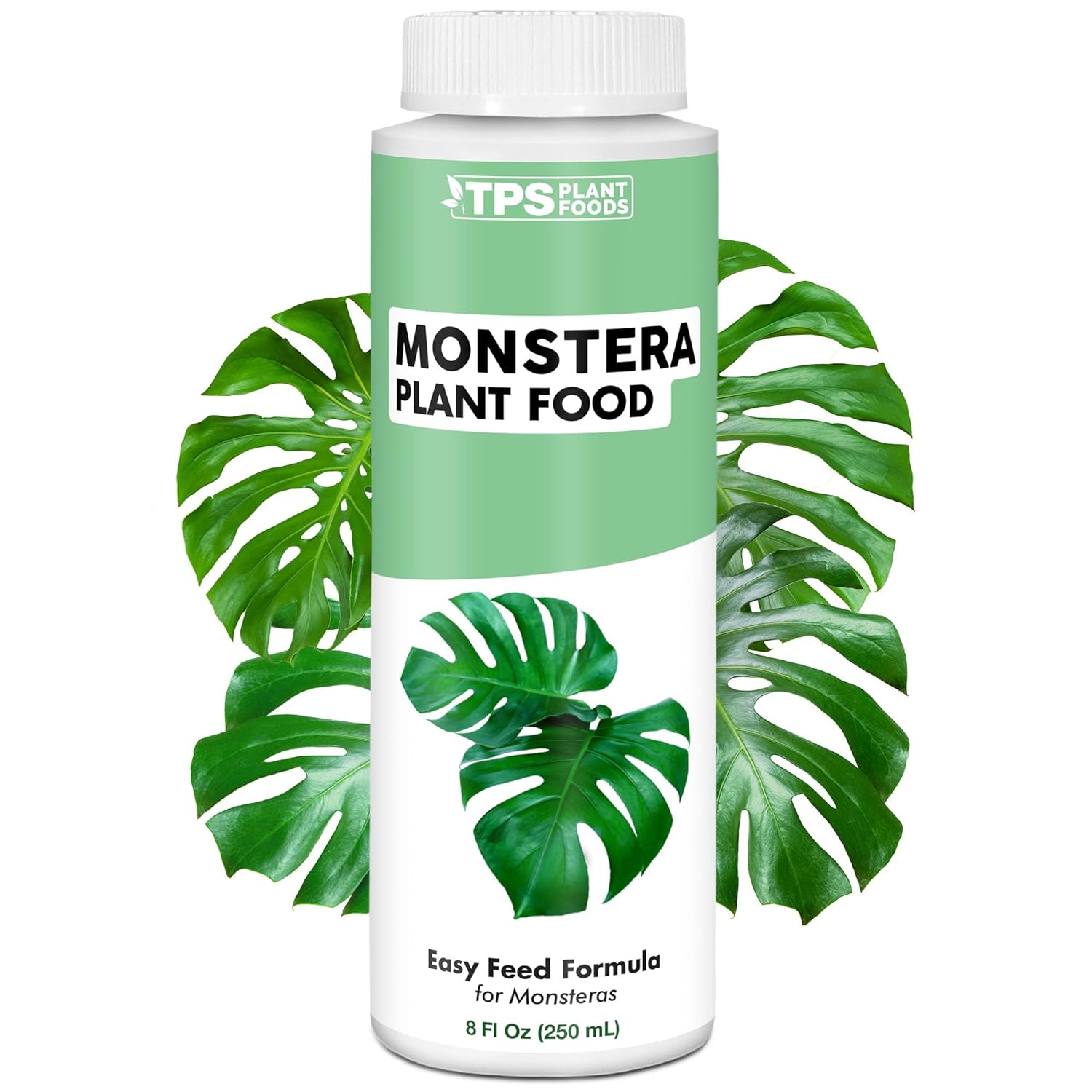
| Item Form | Liquid |
|---|---|
| Application Method | Mix with water and apply to plant |
| Target Species | Monstera |
| Mixing Ratio | 1:32 |
| Unit Count | 8 Fluid Ounces |
This liquid Monstera fertilizer is a concentrated, kelp-enriched formula designed to be mixed with water at a 1:32 ratio and applied to container-grown tropical houseplants. In everyday use you dilute the 8 ounce bottle to make multiple feedings, which makes it convenient for regular maintenance of foliage and root health. The label highlights faster absorption, support for new leaf and stem growth, and ingredients aimed at stronger roots and deeper leaf color. Practical benefits include targeted nutrition for Monstera varieties, easy mixing and application, and a small bottle that stores easily for apartment or desk plants. Limitations are its small unit size if you have many plants and the need to follow the mixing ratio precisely to avoid overfeeding. There is no detailed N-P-K breakdown visible, so buyers who want exact macronutrient numbers or a granular feeding schedule may need to contact the brand or compare products with full nutrient labels.
Best for: Buyers who prioritize reliable, plant-specific nutrition for indoor Monsteras and want an easy-to-mix liquid feed to support fuller foliage and healthier roots.
Less Ideal for: Growers who need detailed N-P-K analytics, professional growers with large numbers of plants, or those who prefer slow-release granular fertilizers.
- Formulated specifically for Monstera and tropical houseplants
- Kelp-enriched, fast-absorbing liquid that supports foliage and root development
- Concentrated 1:32 mixing ratio lets a small bottle treat multiple feedings
- Easy to store and apply for indoor pots and decorative planters
- No explicit N-P-K or full nutrient breakdown provided on the listing
- 8 fl oz size may require frequent repurchasing for larger collections
Verdict: A compact, easy-to-mix liquid fertilizer tailored for Monstera owners who want faster-absorbing, kelp-enriched nutrition for healthier leaves and roots.
Choosing the Right Fertilizer for Alocasia Black Velvet: Key Factors to Consider
Nutrient Ratio and Strength
Alocasia Black Velvet needs a balanced feeding approach rather than aggressive nitrogen-heavy formulas. Moderate nitrogen supports steady leaf production without producing weak, floppy growth. Potassium helps overall plant vigor and stress tolerance, while phosphorus supports root development after repotting or during re-establishment.
Pay attention to the recommended concentration on the label and plan to feed at lower than full strength for small pots. Using half to quarter doses more frequently often gives better control and reduces the risk of salt buildup and leaf-tip burn.
Micronutrients and Trace Elements
Micronutrients such as iron, magnesium, manganese, and zinc influence leaf color and the intensity of the velvety sheen. A formula that includes these elements or a separate chelated micronutrient supplement can correct or prevent subtle deficiencies that show as yellowing between veins or dulling of the leaf surface.
Chelated forms are generally more available to the plant in a range of pH conditions, which matters when you use different potting mixes or water sources. If you see persistent color loss, consider switching to a balanced fertilizer with a reliable micronutrient package.
Solubility, Residue, and Salt Build-Up
Alocasias are sensitive to salt accumulation because they are often grown in small pots with limited drainage volume. Soluble fertilizers that leave minimal residue reduce the risk of tip burn and brown edges. Products that dissolve completely and recommend regular leaching or flushing practices are preferable.
Look for guidance on how often to flush the potting mix and choose water-soluble or liquid fertilizers designed for houseplants. Avoid concentrated granular feeds unless you can control slow-release rates and monitor substrate conductivity.
Delivery Method and Application Flexibility
Liquid concentrates, water-soluble powders, and mild slow-release granules each have pros and cons for Alocasia Black Velvet. Liquids and soluble powders allow precise dilution and easy foliar or root feeding, which is useful for small pots and terrarium setups. Slow-release options reduce dosing frequency but can be harder to adjust quickly if you need to reduce feeding.
Choose a format that fits your routine and container size. If you repot frequently or keep many small pots, a dilute liquid feed is usually simpler to dose accurately.
pH Compatibility and Potting Mix Interaction
The availability of some nutrients depends on substrate pH. Alocasias grown in peat- or bark-based mixes may experience different nutrient availability than those in mineral-rich mixes. A fertilizer that maintains micronutrient availability across a range of pH values will reduce deficiency risks.
Test or estimate your potting mix pH and select a fertilizer that works well with that range. If you use hard water, consider formulas that account for calcium and magnesium interactions to avoid precipitates or imbalances.
Feeding Frequency and Seasonal Needs
Alocasia Black Velvet has a seasonal growth pattern and often needs more nutrients during active growth and much less during dormancy or slower months. A feeding schedule that scales back in low-light seasons prevents wasted fertilizer and reduces stress on the plant.
Pick a product that supports flexible schedules: dilute weekly or biweekly during active growth, and reduce or pause feeding during cooler or lower-light periods. Clear label guidance about seasonal adjustments is a strong plus.
Matching Fertilizer to Your Growing Setup
Small pots, terrariums, and standard containers each change how fertilizers behave. In a terrarium or closed container, humidity and low evaporation mean nutrients stay available longer and salts can build up more quickly. In small pots the same issue appears because there is less substrate volume to buffer concentration spikes.
For compact or enclosed setups, use diluted liquid feeds and schedule periodic flushing of the mix with plain water. For larger, open containers with active drainage, a balanced slow-release product can reduce maintenance while still providing steady nutrition.
- Terrariums: dilute liquid feeds, infrequent, very low concentration
- Small pots: dilute and feed more often rather than high-concentration infrequent doses
- Larger pots: slow-release or controlled liquid schedule is practical
Symptoms of Feeding Problems and How to Respond
Leaf-tip browning, crisp edges, or sudden yellowing between veins often point to overfeeding or salt accumulation. If these appear, stop fertilizing and flush the potting mix with plenty of water until runoff runs clear. Reduce future concentration and frequency.
Pale leaves that do not respond to light adjustment may indicate micronutrient deficiency. Try a chelated micronutrient supplement or switch to a fertilizer that explicitly lists iron and magnesium. Make changes gradually and monitor for improvement over several weeks.
- Overfeeding signs: brown tips, burnt margins, slowed new growth
- Underfeeding signs: slow growth, paler leaves, smaller new leaves
- Corrective action: flush, reduce dose, re-evaluate water quality and mix
Timing Feeding with Repotting and Growth Cycles
Repotting stresses roots and is a moment when phosphorus and gentle root-supporting nutrition help recovery. Use a milder feed after re-establishment rather than a high-strength application. Wait a couple of weeks after repotting for root damage to settle before resuming regular feeding.
During active spring and summer growth, increase frequency at a lower concentration. In autumn and winter, cut back or pause feeding depending on indoor light and temperature to avoid pushing soft growth that will not harden off.
- Post-repot: light feed after 2 weeks
- Active growth: dilute feeds more often
- Dormant periods: reduce or pause feeding
Foliar Feeding: When It Helps and When to Avoid It
Foliar feeding can correct minor deficiencies quickly because leaves absorb certain nutrients faster than roots. For Alocasia Black Velvet, occasional light foliar feeds with a very dilute solution can boost micronutrient uptake and reinvigorate leaf color.
Avoid foliar feeding in direct sun or with concentrated solutions as this can scorch the velvety leaf surface. Use it sparingly and only when root feeding is insufficient or when you need a quick corrective boost.
- Use very dilute solutions for foliar sprays
- Apply in morning or evening to avoid leaf scorch
- Not a substitute for balanced root feeding
Adjusting for Water Quality
Tap water hardness affects nutrient balance. Hard water contributes extra calcium and magnesium, which can change how fertilizers behave and alter pH over time. If your water is hard, consider using rainwater, filtered water, or adjusting fertilizer concentration to account for baseline minerals.
If you notice white crust on the pot rim or persistent tip burn despite careful feeding, test your water and adjust practices. Periodic flushing with soft water helps prevent mineral buildup.
- Hard water: consider filtered or rainwater for flushing
- Soft water: reduces risk of salt buildup but monitor electrolytes
- Regular flushing helps reset substrate balance
How We Chose the Best Fertilizer for Alocasia Black Velvet
We selected fertilizers according to criteria that matter for Alocasia Black Velvet's compact root systems and foliage color. First, nutrient balance was a key filter: formulas with moderate nitrogen, adequate potassium, and accessible phosphorus performed better in theory for healthy leaves and root support. Second, micronutrient content mattered because iron, magnesium, and trace elements help maintain the deep green-black leaf tone. Third, delivery method and dilution flexibility were evaluated so growers can match fertilizer to small pots, terrariums, or standard containers. Fourth, solubility and residue were considered to avoid salt buildup and leaf-tip burn in the small root volumes these plants prefer. Fifth, ease of use and clear dosing instructions were required so less-experienced growers can feed without overdoing it. We excluded fertilizers designed exclusively for heavy feeders, large outdoor landscaping, or ones that recommend extremely high-concentration applications unsuitable for compact indoor Alocasias. We also filtered out products lacking clear nutrient labeling or application guidance. The resulting list emphasizes formulas and formats that reliably support color, steady growth, and root health under typical indoor growing conditions.
FAQ
How often should I fertilize Alocasia Black Velvet during active growth?
Often a dilute liquid feed every 1 to 2 weeks during active spring and summer growth is effective. Use a lower-than-label concentration for small pots and monitor growth and leaf tips for signs of overfeeding.
Can I use a general houseplant fertilizer for Alocasia Black Velvet?
Yes, a balanced general houseplant fertilizer can work if it includes micronutrients and you dilute appropriately. Avoid high-nitrogen formulas designed for fast-growing foliage plants unless you reduce strength to prevent weak growth.
Is foliar feeding necessary for this species?
Foliar feeding is not usually necessary but can help correct micronutrient deficiencies quickly. Use it sparingly and with very dilute solution to avoid leaf scorch.
How do I tell if my plant has a micronutrient deficiency?
Look for interveinal chlorosis, loss of leaf sheen, or slow recovery after light adjustments. These signs, especially when general nutrition and watering are correct, can indicate missing trace elements like iron or magnesium.
What should I do if I suspect fertilizer burn?
Stop feeding, flush the potting mix with ample water until runoff is weak, and allow the soil to dry to the normal level for the plant before resuming a much weaker feeding schedule. Trim heavily damaged foliage to redirect energy to new growth.
Are slow-release pellets a good option for Alocasia Black Velvet?
Slow-release pellets can be convenient for larger pots but are less flexible for small containers and terrariums. They can work if you select low-release-rate formulas and monitor for salt buildup, but liquids give more precise control.
Final Verdict
Choose a fertilizer that matches the small-rooted, showy-leaf habit of Alocasia Black Velvet: moderate nutrient ratios, chelated micronutrients, and low-residue solubility should be priorities. Match the delivery format to your container size and routine, using dilute liquids for small or closed environments and cautious slow-release for larger pots. Prioritize flexible application, clear dosing, and attention to water quality to avoid salt build-up and leaf burn. With those tradeoffs in mind, you can feed confidently to keep the foliage dark, dense, and velvety while minimizing stress and maintenance overhead.
