

Note: This article contains affiliate links. If you click on these links and make a purchase, I may earn a small commission at no extra cost to you. This helps support my research and content. Read my full affiliate disclosure here.
Choosing the right fertilizer for a northern lawn matters because cool-season turf species respond to different nutrient balances and spring‑to‑fall timing than warm‑season grasses. The wrong formula or feeding schedule can leave you with thin growth, poor color, or extra mowing and clippings. This guide collects seven top fertilizer options for northern lawn conditions and explains why each type made the shortlist. We evaluate products by nutrient composition, release pattern, and application practicality so you can pick a feed strategy that matches your soil and lawn goals.
Top Picks at a Glance
| Best Overall The best all-around choice for most situations | The Andersons Professional PGF 16-0-8 Granular Lawn Fertilizer with Humic DG, 40 lb |  |
| Best Quality Built to a higher standard if you want something more solid | The Andersons Professional PGF Complete 16-4-8 Granular Lawn Fertilizer (covers 5,000 sq ft) |  |
| Best Value The sweet spot between price and what you get | GreenView Fairway Formula Fall Lawn Fertilizer, 22.5 lb |  |
| Best Budget The cheapest option that still gets the job done reliably | Greenview Starter Fertilizer 10-18-10, 8 lb (covers 2,500 sq. ft.) |  |
| Highest Rated A top-rated pick with lots of positive feedback | Scotts Lawn Pro Lawn Fertilizer, 43.56 lb |  |
| Most Popular A crowd favorite that many people choose with confidence | Scotts Turf Builder WinterGuard Fall Lawn Food, 10 lb. |  |
| Best Seller A high-volume bestseller chosen again and again | Scotts Turf Builder Lawn Food, 12.5 lb |  |
The Andersons Professional PGF 16-0-8 Granular Lawn Fertilizer with Humic DG, 40 lb
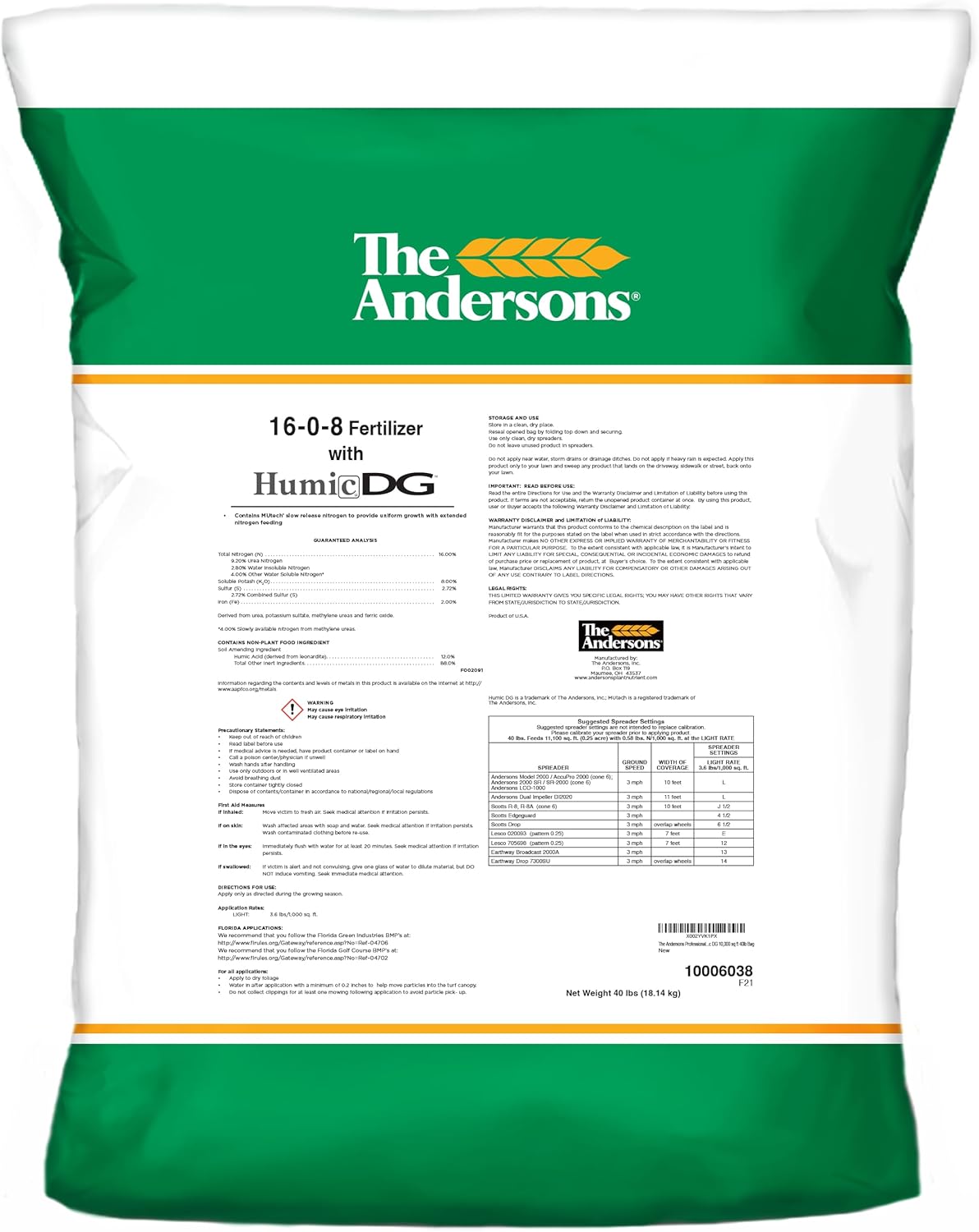
| Form | Granules |
|---|---|
| Specific Uses For Product | Lawns |
| Target Species | lawn grasses |
| Mixing Ratio | 1:4.5 |
The Andersons Professional PGF 16-0-8 is a granular lawn fertilizer designed to deliver both immediate and extended nitrogen feeding while adding humic DG and micronutrients. It is intended for broadcast spreader use on lawns and is applied at 3.6 pounds per 1,000 sq ft every 6 to 8 weeks. The super-fine granules promote even distribution, which helps avoid streaking and ensures more uniform green-up. Because the formula is phosphorus-free and includes iron and Humic DG, it supports turf color and soil health without adding phosphorus. Practical benefits include a mix of quick- and slow-release nitrogen for steady growth, clear directions for application rates, and a resealable bag for storage. Limitations to consider are that it is not labeled for use in some states and centipede lawns require a reduced rate, and like any granular fertilizer, correct spreader calibration and dry application conditions are important to avoid uneven results or runoff risk.
Best for: Buyers who want reliable, performance-focused feeding to green and maintain warm-season lawns like zoysia with predictable scheduling and steady growth.
Less Ideal for: Homeowners seeking a fertilizer to correct phosphorus deficiency or those who need a product approved for restricted states should look elsewhere.
- Blend of quick- and slow-release nitrogen for immediate color and up to eight weeks of feeding
- Super-fine granules for more even spread and reduced streaking
- Includes iron, micronutrients, and Humic DG to support turf color and soil biology
- Clear application rate and schedule guidance with a resealable bag for storage
- Phosphorus-free formula may not address phosphorus-deficient soils
- Not labeled for sale or use in certain states
Verdict: Choose this fertilizer when you want a performance-oriented, even-spreading granular feed that delivers immediate color and up to eight weeks of controlled nitrogen for warm-season lawns like zoysia.
The Andersons Professional PGF Complete 16-4-8 Granular Lawn Fertilizer (covers 5,000 sq ft)

| Item Form | Granules |
|---|---|
| Specific Uses For Product | Soil Conditioning |
| Target Species | lawn grasses |
| Unit Count | 288 Ounce |
| Mixing Ratio | 4-1-2 ratio |
This granular fertilizer is built to boost turf performance with a 16-4-8 N-P-K ratio that delivers both immediate and extended nitrogen release for up to eight weeks. It is typically applied with a broadcast spreader at the recommended rate on dry foliage, then lightly watered to activate the Humic DG technology that helps nutrients move into the root zone. Notable features include super-fine particles for even coverage, added iron and micronutrients for richer color, and a mix of quick and slow-release nitrogen for steady growth without frequent reapplication. Practical benefits for a performance-focused buyer are visibly greener turf, reduced application frequency, and improved soil conditioning from humic acids. Important limitations are that it is a granular product so precise spreader calibration and steady walking are required for uniform results, and it is not labeled for sale in California which restricts availability in that state.
Best for: Gardeners focused on high-performance, visibly greener lawns who want a single application product that delivers both immediate and extended feeding and supports soil health.
Less Ideal for: Small container gardeners or people who prefer liquid or organic-only fertilizer programs should consider other formats or formulations.
- Balanced 16-4-8 N-P-K with both quick- and slow-release nitrogen for immediate color and sustained feeding
- Super-fine particles designed for even distribution across the lawn
- Includes iron and multiple micronutrients to improve turf color and overall plant nutrition
- Humic DG additive to help move nutrients into the soil and support soil conditioning
- Requires correct spreader settings and consistent walking speed to avoid streaking
- Not available for sale in California
Verdict: Choose this fertilizer when you want a performance-focused granular formula that delivers quick color boost plus up to eight weeks of sustained feeding for greener grass.
GreenView Fairway Formula Fall Lawn Fertilizer, 22.5 lb

| Item Form | Granules |
|---|---|
| Application Method | broadcast spreader |
| Coverage | 7,500 sq. ft. |
| Specific Uses For Product | Plant Growth, Root Development, Seed Development, Soil Conditioning |
GreenView Fairway Formula Fall Lawn Fertilizer is a granular winterizer designed for homeowners preparing turf for winter and aiming for a healthier spring lawn. It is applied with a broadcast or drop spreader and supplies a mix of immediate and slow-release nitrogen so lawns green evenly without a surge of top growth while encouraging deeper root development. A single 22.5 lb bag covers about 7,500 square feet and the manufacturer claims feeding for up to 12 weeks, which makes scheduling a single late-season application simple. The formula contains 59% slow-release nitrogen and no phosphate to reduce runoff concerns. Practical benefits include easier application with standard spreaders, steady feeding that reduces mowing shock, and help repairing summer stress before dormancy. Limitations are that it is focused on nitrogen and root development only, so it will not address phosphorus or micronutrient deficiencies, and safety guidance means you should not hand spread and must store unused product securely.
Best for: Homeowners who want a straightforward late-season lawn treatment that focuses on root strengthening and steady greening with a single, easy spreader application.
Less Ideal for: Gardeners managing soils with known phosphorus or micronutrient deficiencies or those needing an all-in-one nutrient program should consider targeted soil tests and alternative blends.
- High proportion of slow-release nitrogen provides steady feeding for up to 12 weeks
- Formulated to promote deep root development and repair summer stress before winter
- Covers approximately 7,500 sq. ft. per bag for single-application convenience
- Designed for easy application with a broadcast or drop spreader
- No phosphate in the formulation to help reduce runoff concerns
- Does not supply phosphorus or specific micronutrients that some soils may need
- Not intended for hand spreading and requires safe storage away from children
Verdict: A reliable fall winterizer that delivers steady, slow-release nitrogen to strengthen roots and simplify late-season lawn care.
Greenview Starter Fertilizer 10-18-10, 8 lb (covers 2,500 sq. ft.)

| Item Form | Granules |
|---|---|
| Application Method | broadcast or drop spreader |
| Coverage | 2,500 sq. ft. |
| Specific Uses For Product | Plant Growth, Root Development, Seed Development, Soil Conditioning |
| Mixing Ratio | 10-18-10 |
Greenview Starter Fertilizer is formulated for establishing new lawns and repairing bare spots by supplying a high-phosphorus blend that encourages root development and seed germination. It is broadcast or drop-spreader friendly and intended to be applied just before or after seeding, then lightly raked into the topsoil so seed can make contact with nutrients. The mix delivers both immediate and time-released nitrogen for up to eight weeks of feeding, which helps young grass get through the critical first mows. Practical benefits include clear application guidance and coverage sized to treat roughly 2,500 square feet from an 8 pound bag, making it convenient for small yards and patch jobs. Limitations are that it is designed as a one-time starter application rather than an ongoing lawn program, and users must avoid hand spreading and follow safety storage recommendations. Also it does not replace post-establishment fertilization or weed control once the lawn is mature.
Best for: Budget-minded gardeners establishing a new lawn or repairing small bare spots who want a straightforward, single-application starter fertilizer that covers a modest area.
Less Ideal for: Homeowners managing large lawns who need multi-application programs or combined weed-and-feed products should consider larger-capacity or more comprehensive lawn fertilizers.
- High phosphorus ratio (10-18-10) to support seed germination and root development
- Includes both quick-release and time-release nitrogen for continuous feeding up to eight weeks
- Formulated for use with broadcast or drop spreaders for even application
- Covers about 2,500 sq. ft. from a single 8 lb bag, useful for small lawns and spot repairs
- Intended as a single starter application and not a complete ongoing fertilization program
- Not suitable for hand spreading and requires care in storage and handling
Verdict: A simple, budget-friendly starter fertilizer that delivers a high-phosphorus 10-18-10 formula and short-term feeding to help new grass seedlings establish quickly.
Scotts Lawn Pro Lawn Fertilizer, 43.56 lb

| Unit Count | 720 Ounce |
|---|---|
| Coverage | 15 |
| Specific Uses For Product | Lawn Fertilizer |
This Scotts Lawn Pro granular fertilizer is designed to cover large lawns with a single bag and deliver fast, deep greening while minimizing burn risk. You spread it with a broadcast or drop spreader according to the coverage guidance and then water it in or let normal irrigation activate it. The product emphasizes broad, season-round use and is promoted as safe to apply in spring, summer, or fall, which simplifies maintenance for homeowners who prefer a low-risk schedule. Its most practical benefits are the large coverage per bag and the promise of visible thickening and greening without the careful timing some fertilizers require. Important limitations are that nutrient analysis and exact N-P-K numbers are not provided on the listing and the bag is heavy to handle for one person, so plan for a helper or cart when moving and spreading. For northern lawns this works as a reliable, general-purpose granular feed when you want straightforward application and quick visual results.
Best for: Homeowners in northern lawns who prioritize a dependable, easy-to-apply granular fertilizer that delivers quick greening and reduces the need for precise timing.
Less Ideal for: Gardeners who require exact nutrient ratios for fertilization plans or who prefer lightweight, small-bag products for tight or containerized lawns.
- Large coverage: rated for 15,000 sq ft per bag which reduces how often you need to buy and apply
- Marketed as safe to apply any time with low risk of burning, which simplifies scheduling
- Granular form works with standard spreaders for even application across lawn areas
- Promotes fast, visible greening and thicker turf when used as directed
- Nutrient formula (N-P-K) is not specified in the listing so precise feeding needs cannot be assessed
- Heavy 43.56 lb bag can be awkward to lift and maneuver alone
Verdict: Choose this for a large northern lawn when you want a straightforward, low-risk granular fertilizer that quickly greens turf and covers a lot of ground per bag.
Scotts Turf Builder WinterGuard Fall Lawn Food, 10 lb.

| Item Form | Granules |
|---|---|
| Specific Uses For Product | Lawn Fertilizer |
| Application Method | spread |
| Coverage | 4000 |
| Target Species | lawn grasses |
Scotts Turf Builder WinterGuard is a granular fall lawn food designed to build strong, deep roots and help turf recover from summer heat, drought, and regular wear. It is applied with a broadcast or drop spreader over a lawn in autumn and can be used on any grass type. The bag covers about 4,000 sq. ft., and the package directions include recommended spreader settings and note that watering-in is optional for fast results. In practice this product provides a straightforward, DIY-friendly way to add nutrients before winter; the granules are easy to spread and work with standard spreaders. Notable features are its all-grass compatibility and clear application guidance. Limitations are that it is a single-season bag sized for small to medium yards and it does not include weed or insect control functions found in some other Scotts formulas, so you may need additional products if those issues are a concern. For homeowners wanting a simple autumn boost to root strength, this is an effective, no-frills option.
Best for: Homeowners who want a simple, reliable fall fertilizer to strengthen roots and help lawns recover from summer stress without complicated application steps.
Less Ideal for: People managing large lawns who need wide-coverage bulk fertilizer or those who want combined weed or insect control in the same product.
- Formulated specifically for fall to build deep, winter-ready roots
- Works on all grass types so it fits mixed lawns
- Clear application instructions and spreader settings for easy DIY use
- Covers 4,000 sq. ft. from a single 10 lb. bag for small to medium yards
- No built-in weed or insect control so additional products may be needed
- Single 10 lb. bag may be small for larger properties
Verdict: Choose this bag if you want an easy-to-apply fall fertilizer that strengthens roots and helps your lawn recover before winter.
Scotts Turf Builder Lawn Food, 12.5 lb

| Item Form | Powder |
|---|---|
| Specific Uses For Product | Lawn |
| Coverage | 5,000 sq. ft. |
| Mixing Ratio | 32:0:4 |
Scotts Turf Builder Lawn Food is a general-purpose granular fertilizer formulated for use on any grass type to thicken turf and improve root strength. You spread it with a broadcast or drop spreader (Scotts provides recommended settings) and can apply it to wet or dry lawns in spring, summer, or fall. The formula is pesticide-free and emphasizes building deeper roots so the lawn better absorbs water and nutrients, which helps turf resist stress over the season. One 12.5 lb bag covers about 5,000 sq. ft., making it a simple option for small to medium yards or spot treatments. Practical benefits include clear application guidance, compatibility with common spreaders, and the option to water in for faster greening. Limitations are that this single bag covers a modest area compared with larger homeowner bags and it does not include weed control or insect protection, so you may need additional products for comprehensive lawn care.
Best for: Buyers who want a reliable, easy-to-apply granular fertilizer to strengthen and green a small to medium lawn and prefer products with widespread user approval and clear instructions.
Less Ideal for: Homeowners needing one-step weed or pest control, or those with large properties who want a single bag to cover many thousands of square feet.
- Works on all common grass types so one product fits mixed lawns
- Builds stronger, deeper roots to improve water and nutrient uptake
- Clear spreader settings and can be applied to wet or dry turf for flexibility
- Pesticide-free formula suitable when you only want fertilization
- Covers only about 5,000 sq. ft. per bag, requiring multiple bags for larger yards
- Does not include weed or insect control so additional products may be needed
Verdict: A reliable, easy-to-use granular lawn food that builds stronger roots and is a solid choice for feeding small to medium lawns.
Choosing the Right Fertilizer for Northern Lawn: Key Factors to Consider
Nutrient Ratio and Label Transparency
The balance of nitrogen, phosphorus, and potassium determines whether fertilizer feeds top growth, supports roots, or improves stress tolerance. For northern lawn species, look for nitrogen levels tuned to promote steady green‑up without overly laxative effects that force excessive mowing.
Label transparency matters because you need clear N‑P‑K numbers, the percent of quick versus slow‑release nitrogen, and any added micronutrients. That information lets you plan timing and avoid repeated applications that can burn or cause nutrient runoff.
Nitrogen Release Pattern and Timing
How nitrogen becomes available to turf-fast‑release, slow‑release, or a blend-directly shapes lawn behavior. Quick‑release formulas give immediate color improvements but can spike growth and require more mowing. Slow‑release nitrogen feeds steadily over weeks and reduces leaching risk while supporting even growth.
Match release patterns to the season: spring green‑up can tolerate a higher quick‑release component for rapid color, midsummer favors more controlled feeds to avoid stress, and fall applications should emphasize slow‑release forms that encourage root development rather than top growth.
Soil Test Results and Phosphorus Needs
A soil test is the simplest way to know if phosphorus is needed. Many northern lawns already have adequate phosphorus, and excess application can harm waterways. Use test results to choose a fertilizer with low or zero phosphorus when soil levels are sufficient.
Knowing your soil pH and nutrient status also influences companion practices such as lime or sulfur applications. Some fertilizers include secondary nutrients that improve uptake under borderline pH conditions, which can be useful if you cannot remediate pH immediately.
Formulation and Application Practicality
Fertilizers come as granular, coated granules, or liquids, and each format affects storage, spreader calibration, and ease of backyard application. Granular products can be broadcast with a handheld or tow‑behind spreader; coated granules often give better release control. Liquid feeds allow precise, uniform coverage when you have sprayer equipment.
Consider how much lawn area you have, whether you will apply fertilizer yourself, and your tolerance for spreader calibration. Uniform granule size and clear application rates reduce the chance of streaking or overapplication.
Added Nutrients and Soil Health Benefits
Beyond primary N‑P‑K, look for magnesium, iron, or other micronutrients that correct common cool‑season turf deficiencies and deliver color without excessive nitrogen. Humic acids or organic carriers can improve soil structure and microbial activity, helping nutrient retention in heavier northern soils.
Decide whether you want a purely synthetic plan for predictable results or a product with organic components that support longer‑term soil health. Both approaches can work for northern lawns when aligned with your maintenance goals.
Environmental Risk and Runoff Considerations
Northern regions can have seasonal heavy rains and snowmelt that mobilize nutrients. Pick formulations and application timings that minimize runoff risk-slow‑release nitrogen, avoiding high‑phosphorus blends when not needed, and following buffer setbacks near water features.
Proper calibration, application to dry grass, and not applying before heavy rain are operational steps that reduce environmental impact. If your lawn borders streams or drainage ways, prioritize low‑runoff products and conservative rates.
Seasonal Feeding Windows for Cool‑Season Turf
Northern lawns with cool‑season grasses respond best to a few targeted feeding windows rather than constant inputs. Early spring green‑up benefits from an application that includes an immediate nitrogen fraction for color plus a slow‑release component to sustain growth. Summer maintenance calls for lighter, controlled feeds or spot treatments after wear or drought stress; avoid heavy nitrogen during peak heat. Fall is the most important time to support root recovery and carbohydrate storage, so favor slow‑release nitrogen and potassium to strengthen crowns before winter dormancy.
- Spring: mix of quick and slow nitrogen for color and steady growth
- Summer: modest, controlled feeds focused on stress recovery
- Fall: slow‑release nitrogen and potassium to boost roots and winter hardiness
Interpreting Analysis Statements on Fertilizer Labels
Fertilizer labels show N‑P‑K percentages and sometimes list micronutrients and the portion of nitrogen that is water‑soluble versus slow‑release. Learn to read these statements so you can match a product to a season or problem. For example, a label that lists a high percentage of water‑soluble nitrogen is aimed at rapid green‑up but may require more frequent mowing and increase leaching risk. Coated or polymer‑controlled nitrogen percentages indicate longer feeding windows and more predictable turf response.
- Check guaranteed analysis for percent quick vs slow nitrogen
- Look for secondary nutrients like iron or magnesium if your lawn shows deficiency symptoms
- Confirm application rate per 1,000 sq ft and spreader settings
Adjusting Application to Lawn Condition and Usage
High‑traffic lawns and sports areas have different needs than lightly used yards. If your lawn gets heavy wear, prioritize fertilizers that support recovery and include potassium to aid stress tolerance. For new lawns or areas with thin turf, choose formulas that encourage both top growth and root establishment and pair feeding with overseeding. If your lawn is mature and only for aesthetics, lean toward maintenance feeds that maintain color without forcing excessive vertical growth.
- Wear and traffic: emphasize potassium and recovery nutrients
- New or overseeded turf: balanced feeds that support roots and top growth
- Low‑maintenance turf: controlled nitrogen for steady color
Combining Feeding with Other Cultural Practices
Fertilizer works best when integrated with mowing, irrigation, and soil care. Mow at recommended heights for your species to promote dense turf and reduce weed pressure. Watering deeply and infrequently helps roots take up nutrients and improves drought resilience. Aeration and overseeding in the fall combined with a root‑promoting fertilizer maximize the benefits of both practices.
- Mow to recommended heights for cool‑season grasses
- Irrigate deeply to encourage root uptake after fertilizing
- Aerate and overseed in fall followed by a root‑supportive feed
How We Chose the Best Fertilizer for Northern Lawn
Our selection process focused on practical, science‑based factors that affect turf outcomes in northern lawns. We prioritized fertilizer formulas with appropriate nitrogen, phosphorus, and potassium ratios for cool‑season grasses, and evaluated release mechanisms that influence turf response and mowing needs. Timing and ease of application were important because seasonal windows in northern climates are narrow and mistakes can stress cool‑season turf. We assessed nutrient labeling clarity, looking for complete N‑P‑K listings and secondary nutrients or micronutrients that help recovery from wear and improve color. Release behavior was a major filter: we preferred products with predictable slow‑release components or clearly labeled soluble feeds that match the timing of green‑up, summer maintenance, or fall root growth. Practical considerations included granule uniformity or liquid mixing simplicity, spreader compatibility, and clear application rates per 1,000 sq ft. Excluded items were fertilizer blends targeted exclusively to warm‑season grasses, specialty turf products for sports fields with bespoke programs, and products lacking transparent nutrient analysis. The final picks reflect blends and formats that fit common northern lawn schedules and homeowner application methods.
FAQ
How often should I fertilize a northern lawn?
It depends on the formula, but many northern lawns do well with three to four targeted applications per year: spring green‑up, late spring or early summer maintenance if needed, late summer spot treatments, and an important fall feeding focused on roots. Slow‑release products can extend intervals between applications.
Can I use a high‑nitrogen feed to quickly green my lawn?
Yes, water‑soluble high‑nitrogen feeds will green turf quickly, but they can also drive rapid growth and increase mowing and runoff risk. Pair quick green‑up feeds with a slow‑release component or reserve them for specific needs like correcting pale turf.
Do I need to test soil before choosing a fertilizer?
A soil test is recommended because it identifies nutrient deficiencies and pH issues. Knowing soil phosphorus and pH helps you select a product with the right nutrients and avoid unnecessary phosphorus that can contribute to runoff.
Are organic fertilizers suitable for northern lawns?
Organic fertilizers can be suitable and often improve soil health over time, but they may release nutrients more slowly and require consistent application. They work well when combined with good cultural practices, though you may see slower initial color response compared with synthetic options.
When is the best time in fall to apply fertilizer?
Apply a fall fertilizer after peak summer stress has passed and before the lawn goes fully dormant. Timing varies by region but generally occurs several weeks before the first hard freeze to allow roots to store carbohydrates and recover from summer wear.
Will fertilizer help with patchy or thin turf?
Fertilizer can support recovery, but patchy turf often needs overseeding, soil prep, and sometimes pest or disease management. Use a balanced feed that supports both root growth and top growth when overseeding or repairing bare spots.
Final Verdict
Pick a fertilizer for a northern lawn by matching nutrient ratios and release patterns to seasonal goals. Prioritize label transparency, appropriate slow‑release content for fall feeds, and products that supply needed micronutrients without excess phosphorus. Balance quick‑acting needs for spring color with conservative midsummer approaches and a root‑focused fall application. Ultimately, choose the format and schedule you can apply accurately and safely given your lawn size and local climate. Favor predictable release behavior and follow soil test guidance so your program supports a dense, resilient cool‑season turf.
