

Note: This article contains affiliate links. If you click on these links and make a purchase, I may earn a small commission at no extra cost to you. This helps support my research and content. Read my full affiliate disclosure here.
Choosing the right smart grow light changes how reliably you can start seeds, grow herbs on a windowsill, or maintain a full indoor vegetable patch. The wrong fixture can mean weak stems, poor flowering, or wasted energy in small spaces. This guide covers seven shortlisted smart grow lights that suit a range of indoor setups and plant stages. We focus on how well each option controls spectrum and photoperiod, how energy-efficient it is, heat and mounting behavior, and how easy it is to program and integrate into a home grow. Read on to see which features mattered most in our selection.
Top Picks at a Glance
| Best Overall The best all-around choice for most situations | Spider Farmer G1500 150W LED Grow Light (App Controlled) |  |
| Best Quality Built to a higher standard if you want something more solid | LETPOT GL-100 100W Smart Full-Spectrum LED Grow Light with App and Adjustable Stand | 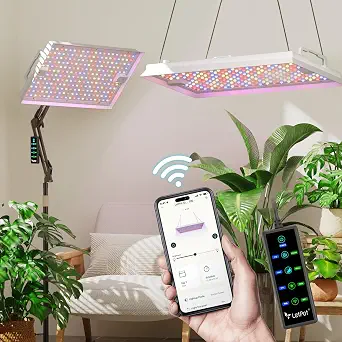 |
| Best Value The sweet spot between price and what you get | GLOWRIUM G8 Smart Full‑Spectrum LED Grow Light (Desktop, 32 LEDs) |  |
| Best Budget The cheapest option that still gets the job done reliably | Necgemlex NPB-A70-09W-Pro LED Smart Grow Light Bulbs (2-pack) |  |
| Highest Rated A top-rated pick with lots of positive feedback | GLOWRIUM Full-Spectrum Smart LED Grow Light (Freestanding) |  |
| Most Popular A crowd favorite that many people choose with confidence | GLOWRIUM Smart Full-Spectrum LED Grow Light (32-LED, Gooseneck, App Control) |  |
| Best Seller A high-volume bestseller chosen again and again | GLOWRIUM 48W Smart Full-Spectrum Floor Grow Light (Adjustable Height, App Control) |  |
Spider Farmer G1500 150W LED Grow Light (App Controlled)

| Light Source Type | LED |
|---|---|
| Wattage | 150 watts |
| Light Source Special Features | Dimmable, Smart Control |
| Voltage | 110 volts |
| Material Type | Aluminum |
The Spider Farmer G1500 is a compact 150W LED fixture built for full‑cycle indoor growing in a 2×2 to 2.3×2.3 foot footprint. It uses high‑density Bridgelux diodes and aluminum construction to deliver even canopy coverage and efficient light output (PPE listed at 2.85 umol/J). Setup is straightforward: hang or table‑mount the slim rectangular panel, set schedules and dim levels in the Spider Farmer app, or adjust brightness on the built‑in digital display. The light supports daisy‑chaining and can be integrated into larger arrays, which is handy if you scale beyond a single small tent. Practical benefits include a true full spectrum for seedlings through flower, low heat production thanks to efficient diodes and cooling, and a 5‑year coverage for long term use. Limitations are its fixed 2×2 focused coverage, so larger areas require additional units, and advanced growers wanting the absolute highest PPE or ultra‑wide commercial coverage may prefer larger models in the same series.
Best for: Growers who need a reliable, easy to manage light for a single 2×2 tent or small bench and prioritize consistent performance and low maintenance.
Less Ideal for: People outfitting larger grow rooms or commercial racks who need broader single‑unit coverage or maximum PPE per fixture.
- Compact 150W design suited to 2×2 grow spaces
- Full spectrum diodes support all growth stages
- App control plus on‑unit dimming and digital display for easy scheduling
- High LED density with efficient Bridgelux diodes for even canopy coverage
- Daisy‑chainable and scalable for multi‑light setups
- Coverage is optimized for small 2×2 areas so larger tents need more units
- Not the highest PPE available compared with larger, higher‑end fixtures
Verdict: A dependable, app‑controlled 150W full‑spectrum light purpose‑built to deliver even, low‑heat performance for 2×2 grow setups.
LETPOT GL-100 100W Smart Full-Spectrum LED Grow Light with App and Adjustable Stand

| Light Source Type | LED |
|---|---|
| Power Source | Corded Electric |
| Voltage | 120 volts |
| Light Output Maximum | 18000 lumens |
| Wattage | 100 watts |
The LETPOT GL-100 is a performance-focused smart grow light aimed at serious indoor gardeners who want app control and flexible mounting. It supplies a full-spectrum 100W LED output (advertised up to 120W max) with eight adjustable brightness levels and independent red, blue and white control so you can tailor spectrum and intensity for seedlings through mature plants. The magnetic controller and LetPot app let you schedule lighting from 0 to 24 hours and manage multiple units when daisy-chained, which simplifies running a small rack or multi-shelf setup. Build quality leans toward durable with an alloy steel stand that telescopes and folds, plus aluminum honeycomb heat dissipation to keep temps down during long runs. Real benefits are precise spectrum tuning, strong PPFD for faster growth, and scalable control for expanding rigs. Limitations to note are the single light source design and stated coverage of roughly 2×3 feet, so you may need multiple units for larger gardens, and some advanced growers may want more published PPFD maps or mounting alternatives.
Best for: Buyers who prioritize controlled, high-performance indoor growth and want smart scheduling and spectrum tuning to maximize plant vigor in small to medium setups.
Less Ideal for: Casual hobbyists who need a simple clip-on lamp or growers needing wide-area coverage from a single fixture without purchasing multiple units.
- Full-spectrum 100W LED with 8 brightness levels for spectrum and intensity control
- App and magnetic controller allow scheduling and independent control of color channels
- Daisy-chain support for managing up to 20 units from a single controller
- Adjustable, foldable stand and mounting options for hanging or freestanding setups
- Aluminum honeycomb heat dissipation and alloy steel construction for cooler, durable operation
- Manufacturer provides limited published PPFD charts and coverage specifics beyond a 2×3 ft claim
- Single integrated light source may require multiple units to evenly cover larger grow areas
Verdict: Choose this light if you want a smart, adjustable full-spectrum fixture that delivers strong, tunable performance and easy app-based control for small to medium indoor gardens.
GLOWRIUM G8 Smart Full‑Spectrum LED Grow Light (Desktop, 32 LEDs)

| Wattage | 10 watts |
|---|---|
| Light Source Type | LED |
| Number of Light Sources | 32 |
| Connectivity Protocol | Bluetooth |
| Mounting Type | Desktop |
The GLOWRIUM G8 is a beginner‑friendly smart grow light designed for desks and small plant stands. It combines 32 LEDs (4000K white plus 660 nm red) to deliver targeted PPFD for seedlings, succulents, and small potted plants and offers both a push‑button inline control and Bluetooth app control for scheduling and dimming. The flexible 360° gooseneck and tabletop base make placement simple and let you aim light precisely at a single plant or a small grouping. App features include custom plant profiles from a 1,000+ species database, watering reminders, and sun‑sync timing that can simulate natural light cycles, which reduces guesswork when optimizing light for different growth stages. Practical benefits are easy setup, precise brightness control (10‑level and stepless options), and usable light intensity at typical desk distances. Limitations are its small footprint and 10W output, which means it is best for individual plants or seedlings rather than larger arrays or canopy coverage, and it is not water resistant so it needs to stay away from wet conditions.
Best for: Someone who wants an easy, low‑effort smart lamp to optimize light for desk plants, seedlings, or a few succulents and values app control and preset plant profiles to simplify tuning.
Less Ideal for: Growers who need high output or wide canopy coverage for multiple mature plants should choose a larger, higher‑wattage fixture instead.
- Full‑spectrum LED mix with specifically included 660 nm red LEDs to support photosynthesis
- Bluetooth app plus manual push‑button control for schedules, dimming and plant profiles
- Flexible 360° gooseneck and compact tabletop base for precise placement
- Built‑in plant assistant with 1,000+ species presets and watering reminders
- 10W power and compact beam are suitable only for single plants or small groups
- Not water resistant so it must be kept away from damp or splash zones
Verdict: A compact, app‑controlled desktop grow light that simplifies lighting for single plants and seed starting with presets and precise dimming.
Necgemlex NPB-A70-09W-Pro LED Smart Grow Light Bulbs (2-pack)

| Wattage | 9 watts |
|---|---|
| Bulb Base | E26 |
| Color Temperature | 4500 Kelvin |
| White Brightness | 1037 lumens |
| Light Source Operating Life | 30000 hours |
These Necgemlex smart grow bulbs replace a standard E26 lamp with a full-spectrum LED designed for indoor plants. Each 9 W bulb produces about 1,037 lumens and offers three dimming modes (20%, 60%, 100%) to suit shade, germination, and flowering stages, plus a built-in daily timer that you set once and it repeats automatically. Control is via infrared remote for on/off, brightness selection, and an 2–22 hour timer option, and a sunlight-simulation mode slowly changes brightness through the day. Practical benefits include easy installation in existing fixtures, consistent scheduled runtimes without extra controllers, and a long rated life of 30,000 hours. Important limitations are the IR remote range and line-of-sight requirement, no app or Wi-Fi integration for remote access, and a CRI of 70 which is adequate for growth but not for color-critical tasks. For growers on a budget this package gives useful automation and spectrum control without needing separate fixtures or advanced controllers.
Best for: Buyers who want an affordable, easy-to-install solution that adds scheduled, full-spectrum light to small indoor setups without buying new fixtures or a smart-home hub.
Less Ideal for: Growers who need app control, networked scheduling across multiple lights, or professional-grade color accuracy for photo assessment should look at Wi-Fi or higher-CRI fixtures.
- Full-spectrum output suitable for all plant growth stages from seedling to flowering
- Built-in programmable timer that auto repeats daily after a single setup
- Three dimming levels let you match light intensity to plant needs
- Fits standard E26 sockets for plug-and-play installation in existing fixtures
- Long rated life of 30,000 hours reduces replacement frequency
- Infrared remote requires line-of-sight and offers no smartphone or voice control
- Color rendering index of 70 is modest compared with higher-CRI fixtures
Verdict: A budget-friendly, plug-and-play full-spectrum grow bulb pair with built-in timer and dimming that makes adding automated light to small indoor gardens simple and inexpensive.
GLOWRIUM Full-Spectrum Smart LED Grow Light (Freestanding)

| Power Source | Corded Electric |
|---|---|
| Wattage | 12 watts |
| Control Method | App, Push Button |
| Connectivity Protocol | Bluetooth |
| Mounting Type | Freestanding |
The GLOWRIUM smart grow light is a freestanding LED lamp designed to support seedlings through flowering with a full-spectrum output and stepless dimming. It is typically used beside houseplants or small indoor gardens where adjustable positioning and gentle diffuse light matter. Notable features include Bluetooth app control for scheduling and reminders, a 24V low-voltage power design, a 360° flexible gooseneck and enlarged lamp head for broader coverage, and an auto-timer with sunrise/sunset sync to create natural light cycles. In practice the lamp makes it easy to set consistent daily hours and tweak brightness for different growth stages, while the app’s care reminders and light measurement tools help users keep track of watering and light exposure. The lamp is built from aluminum with a frosted diffuser and claims long LED life, which supports dependable long-term use. Limitations are its single-light-source design and modest 12W power, so it is best for individual plants or small groupings rather than larger grow racks, and it is not water resistant so it must stay in dry indoor spaces.
Best for: Buyers who prioritize a dependable, easy-to-manage indoor grow light with smart scheduling and long-term reliability for one or a few houseplants.
Less Ideal for: Growers needing high-output lighting for multiple plants, dense seed trays, or humid environments should consider higher-wattage or water-resistant fixtures instead.
- Full-spectrum output with stepless dimming to match different plant growth stages
- App and push-button controls plus scheduling and sunrise/sunset sync for consistent automated light cycles
- Adjustable height and 360° gooseneck for precise positioning and wider coverage
- Low-voltage 24V design and aluminum construction for durable, safe operation
- Includes smart plant assistant features like light measurement and care reminders
- Single 12W light source limits effective coverage for larger plant groups
- Not water resistant so it cannot be used in wet or high-humidity setups
Verdict: A compact, reliable smart grow lamp that delivers automated full-spectrum lighting and app-based care tools for steady indoor plant growth.
GLOWRIUM Smart Full-Spectrum LED Grow Light (32-LED, Gooseneck, App Control)

| Light Source Type | LED |
|---|---|
| Power Source | Corded Electric |
| Light Source Special Features | APP Control, Automated Timing, Dimmable |
| Color Temperature | 3700 Kelvin |
| Number of Light Sources | 32 |
The GLOWRIUM Smart Grow Light is a desktop-style LED lamp that provides full-spectrum light (4000K plus 660nm red) using 32 LEDs and a flexible gooseneck for targeted coverage. It is typically used for desk plants, seedlings, and single potted houseplants where space is limited and precision light placement matters. Notable features include smartphone app control over schedules and brightness, a local inline controller, two-phase auto-timer with a Sun-Sync mode, and a Plant Assistant database that suggests PPFD and run times for many species. Practical benefits are easy hands-off scheduling, fine-grained dimming to match plant needs, and a stable metal base with 360-degree positioning so you can angle light to reduce shading. Limitations to consider are the modest 10 W power and lumen output, which suits single plants or small groups but will not replace larger fixtures for dense canopies or larger grow tents, and the gooseneck reach is best for close-range setups. The lamp is aluminum-built and offers reasonably high color rendering for natural-looking growth monitoring.
Best for: Buyers who want a compact, smart-controlled grow light to make plant care low-effort and data-driven for desk or countertop plants, valuing easy scheduling and app guidance.
Less Ideal for: People planning to light multiple mature plants, larger grow tents, or full racks should choose a higher-power fixture designed for broader coverage.
- App and inline controls plus two-phase auto-timer let you automate daily lighting and mimic daylight patterns
- Full-spectrum output including 660nm red LEDs supports all growth stages from seedlings to flowering
- Flexible gooseneck and 360° positioning provide precise light targeting for single pots and desk setups
- High color rendering index (CRI 90) and aluminum construction deliver accurate plant color and durable build
- 10 W power and 760 lumens limit effective coverage to single plants or small clusters rather than larger grow areas
- Short maximum height range restricts use for tall plants or multi-layer shelving without very close placement
Verdict: A user-friendly, app-controlled full-spectrum desk grow light that automates plant lighting and is ideal for single pots and small indoor setups.
GLOWRIUM 48W Smart Full-Spectrum Floor Grow Light (Adjustable Height, App Control)

| Wattage | 48 watts |
|---|---|
| Light Source Type | LED |
| Control Method | App, Push Button |
| Power Source | Corded Electric |
| Indoor Outdoor Usage | Indoor |
The GLOWRIUM 48W Smart Floor Grow Light is a freestanding LED lamp designed to give indoor plants reliable full-spectrum illumination across all growth stages. It is typically used beside a plant stand or cluster of pots; the telescoping pole and 360° flexible lamp head let you raise the light and aim it for seedlings through taller houseplants. Controls work from the built-in panel, a remote, or the app, which adds auto-timer schedules, sunrise/sunset sync and a plant-care assistant that logs light readings and reminders. Notable features include stepless dimming, a frosted diffuser for softer output, a low-voltage 24V system, and a claimed 50,000+ hour LED life. Practical benefits are easy placement without hanging hardware, precise light targeting for more efficient photosynthesis, and app-based convenience for less hands-on maintenance. Important limitations are that the connectivity uses a proprietary protocol so ecosystem integrations may be limited, it is not water resistant so it must stay dry, and the standing form factor requires floor space that may not suit very small rooms.
Best for: Buyers who want a low-maintenance, smart-lit solution for multiple indoor plants and value automated schedules and care reminders to reduce guesswork.
Less Ideal for: People who need a compact clip-on or hanging light for very tight spaces or who require waterproof fixtures for humid cabinets or near-sink locations.
- Full-spectrum LED output suitable for seedlings through flowering stages
- Adjustable height and 360° flexible head for targeted coverage
- App, remote, and panel controls with stepless dimming and timers
- Low-voltage 24V design and aluminum construction for safe, durable use
- Proprietary connectivity may limit compatibility with other smart-home platforms
- Not water resistant so unsuitable for damp locations
Verdict: A feature-rich, app-controlled floor grow light that makes reliable, low-effort plant care simple for cautious buyers who prioritize safety and automation.
Choosing the Right Smart Grow Light: Key Factors to Consider
Spectrum Tuning and Intensity
Plants react to both light intensity and spectrum. A light that lets you shift blue and red ratios or select full-spectrum white makes it easier to optimize for seedlings, vegetative growth, and flowering. Intensity control across the fixture helps you dial in distance and prevent stretching or light burn.
For mixed plantings or progressive growth stages, look for discrete modes or continuous dimming so you can reduce power for seedlings and raise it for mature plants without moving fixtures.
Energy Use and Output
Indoor growing runs continuously, so watts-per-day and PAR output per watt directly affect operating costs and plant performance. Higher efficiency fixtures deliver more usable photons for less electricity; that matters both for small apartment setups and larger multi-bay grows.
Check for published PAR or PPFD figures at typical hanging distances when possible, and prefer drivers rated for continuous duty rather than fixtures aimed at occasional decorative use.
Heat Dissipation and Clearance
Even efficient LEDs produce heat that can stress plants or require extra ventilation. Good heat dissipation slows component failure and keeps canopy temperatures reasonable. Passive sinks and well-vented housing reduce the need for noisy fans.
Consider how close lights sit above foliage: fixtures with poor thermal design may force you to hang higher to avoid heat stress, which reduces usable light intensity and coverage.
Mounting Flexibility and Coverage
Grow spaces vary from narrow shelves to tall cabinets and open indoor rooms. Adjustable hanging systems, included hangers or rails, and fixture shape determine how evenly light spreads. Wide panels often provide more uniform canopy coverage at lower heights, while compact bars can be easier to place between shelves.
Think about eventual scale. A modular or linkable system simplifies expanding later, and a fixture that can be angled or daisy-chained saves time during setup.
Controls, Automation, and Integration
Smart features matter when you want reliable day/night cycles, dimming schedules, or remote adjustments. Wi-Fi or Bluetooth control should be stable and allow practical scheduling, ramp-up timers, and preset spectra for stages. Integration with voice assistants or home automation can simplify multi-device setups.
Be cautious of apps that prioritize flashy lighting effects over useful horticultural controls. The goal is repeatable programs that match plant needs rather than entertainment lighting.
Build Durability and Serviceability
Grow lights are an ongoing investment, so durable housings, replaceable drivers, and stable connectors extend useful life. Fixtures intended for continuous grow cycles should use quality power supplies and corrosion-resistant materials if they will be used in humid environments.
Check for easy-to-replace parts or accessible warranty terms to avoid early replacement. A solidly built fixture also reduces the chance of electrical faults in indoor spaces.
Matching Light Choice to Plant Stage
Different plant stages benefit from different spectra and intensities. Seedlings and young cuttings usually prefer cooler, bluer light at lower intensity to encourage compact, sturdy stems. As plants move into vegetative growth, increasing both intensity and the proportion of red light supports leaf expansion and faster canopy development.
When flowers and fruits are the goal, shifting toward a warmer spectrum and maintaining higher PPFD levels supports bud formation and fruit set. A programmable smart fixture that stores profiles for each stage makes these transitions simple and repeatable.
- Seedlings: low intensity, higher blue ratio
- Vegetative: medium-high intensity, balanced spectrum
- Flowering/fruiting: higher intensity, increased red component
Setting Up for Small Indoor Spaces
In compact setups like windowsill racks or grow cabinets, fixture size and mounting options are the most important practical considerations. A slim profile that fits between shelves while offering adjustable output makes it possible to maintain good canopy uniformity without overcrowding.
Also pay attention to heat. In tight spaces you may need to run fixtures at reduced output or add ventilation to keep foliage temperatures stable. Smart scheduling that ramps light up over a short period can reduce thermal shocks and better mimic natural dawn and dusk.
- Use narrow panels or bars for shelf setups
- Prefer fixtures with lower clearance requirements
- Plan ventilation if multiple fixtures run in an enclosed cabinet
Integrating Lights with Timers and Sensors
Smart fixtures often provide built-in timers, but you can also integrate lights with separate sensors or home automation for advanced control. Light sensors and humidity sensors help maintain consistent microclimates, while external controllers can coordinate multiple fixtures for staggered cycles across growth areas.
When using automation, test schedules over several days to ensure repeatability. Avoid frequent mid-cycle changes to avoid stressing plants.
- Use ramped sunrise/sunset settings to reduce shock
- Coordinate light cycles with ventilation and irrigation
- Test sensor thresholds before deploying across many plants
Safety and Indoor Electrical Considerations
Indoor grow fixtures draw sustained power and often run near moisture. Prioritize lights with well-insulated connectors, grounded plugs, and power supplies rated for continuous operation. Keep power strips and controllers off the floor and away from watering zones.
If you plan to run several fixtures on one circuit, calculate total load and avoid overloading outlets. Good cable management and certified components reduce fire risk and keep your indoor growing space safe.
- Use ground-fault protection when humidity is high
- Avoid daisy-chaining power strips
- Secure cables to prevent snagging or water exposure
Common Troubleshooting Tips
If plants show stretching, either increase light intensity or lower the fixture closer to the canopy while watching for heat stress. Yellowing or burned leaf edges near the top often indicate light or heat stress rather than nutrient problems.
Connectivity problems with smart fixtures are usually solved by moving the controller closer, reducing Wi-Fi congestion, or using a local-only Bluetooth mode. Firmware updates can improve scheduling stability, so check the app or manufacturer support resources periodically.
- Stretching: raise intensity or lower fixture
- Leaf burn: check canopy temperature and lower output
- Connectivity: relocate router or use Bluetooth pairing
How We Chose the Best Smart Grow Light
We prioritized features that matter in everyday indoor gardening and excluded fixtures that were strictly hobby toys or industrial horticulture rigs. Selection began by screening lights for actual spectrum control and programmable schedules, not just fixed-color LEDs. We then filtered for reliable thermal design and safe mounting accessories suitable for apartments and small greenhouses. Usability in real garden conditions was central: Wi-Fi or Bluetooth controls had to provide stable scheduling and useful presets rather than gimmicky color effects. Key evaluation criteria included spectrum tuning and intensity control, energy efficiency and lumen or PAR output per watt, heat management and safe clearance requirements, mounting and coverage flexibility for common indoor setups, and software stability plus third-party integration. We excluded lights lacking clear output specs or with unrepairable power supplies. The final short list balances performance, safety, and practical control so gardeners can match a fixture to plants and available space.
FAQ
How high should I hang a smart grow light above seedlings?
Seedlings typically do best with the fixture lower than mature plants but not so close that heat or light burn occurs. Start with the manufacturer recommended distance or about 12 to 24 inches for panels, then adjust upward if you see heat stress or downward if stems are stretching.
Do I need Wi-Fi features to get good results?
Wi-Fi and app controls are convenient for remote scheduling and presets but not essential. Many plants respond well to simple timers and consistent cycles. Choose smart features for convenience and automation, not because they are required for healthy growth.
How many hours a day should indoor plants be under the light?
Daily light requirements depend on species and growth stage. Many herbs and leafy greens do well on 12 to 16 hours, while flowering plants often need 12 or fewer hours with a distinct dark period. Use species-specific guidance and avoid running lights 24/7 for most crops.
Will a smart grow light work in a small apartment without extra ventilation?
Yes, many efficient fixtures are designed for small spaces, but monitor canopy temperature and humidity. If heat builds up, reduce intensity, increase hanging distance, or add passive ventilation. Avoid fixtures with poor thermal designs in sealed spaces.
Can I chain several fixtures together on one controller?
Many smart systems support linking multiple fixtures, but capacity varies. Confirm that the controller and power setup are rated for the total number of fixtures and that schedules remain synchronized once linked.
Final Verdict
Prioritize fixtures that give you controllable spectrum, reliable scheduling, and efficient light output when choosing a smart grow light. Tradeoffs are common: very compact fixtures can save space but may require closer mounting or additional units for uniform coverage, while larger panels give even light but need more room and support. Decide first on the scale of your project and the plant stages you will run. From there, favor lights with stable controls, good thermal design, and clear output specifications so you can match a fixture to your indoor environment with confidence.
