

Note: This article contains affiliate links. If you click on these links and make a purchase, I may earn a small commission at no extra cost to you. This helps support my research and content. Read my full affiliate disclosure here.
Picking the right hydroponic fertilizer matters because vegetables rely entirely on the nutrient solution you provide. In hydroponic systems the wrong balance or form of nutrients can cause stunting, blossom problems, or uneven ripening. This guide focuses on fertilizers formulated for vegetables and explains the practical differences gardeners will notice in day-to-day use. We shortlisted seven top-rated hydroponic fertilizers that are appropriate for a range of vegetable systems from NFT channels to deep water culture. The selections were evaluated for nutrient balance, ease of use, and how they perform in real-world vegetable production. Read on to see which characteristics to prioritize and how each option fits specific growing situations.
Top Picks at a Glance
| Best Overall The best all-around choice for most situations | General Hydroponics FloraSeries 3-Part Nutrient System, 16 oz Each |  |
| Best Quality Built to a higher standard if you want something more solid | General Hydroponics Flora Series 3-Part Nutrient System (FloraMicro, FloraGro, FloraBloom) — 1 qt. bottles |  |
| Best Value The sweet spot between price and what you get | Ahopegarden 800ml A&B Hydroponic Nutrients Liquid Plant Food |  |
| Best Budget The cheapest option that still gets the job done reliably | Haligo A&B Hydroponic Nutrient Solution (800 ml total, 8-pack dosing bottles) |  |
| Highest Rated A top-rated pick with lots of positive feedback | General Hydroponics FloraMicro Liquid Nutrient, 1 Quart |  |
| Most Popular A crowd favorite that many people choose with confidence | TPS Nutrients Liquid Plant Food for AeroGarden and Hydroponics, 8 oz |  |
| Best Seller A high-volume bestseller chosen again and again | TPS Nutrients Liquid Plant Food for AeroGarden and Hydroponic Systems, 32 oz |  |
General Hydroponics FloraSeries 3-Part Nutrient System, 16 oz Each

| Item Form | Liquid |
|---|---|
| Specific Uses For Product | Hydroponics |
| Coverage | Full |
| Liquid Volume | 48 fluid ounces |
| Mixing Ratio | 2:1 |
The General Hydroponics FloraSeries is a classic 3-part liquid nutrient system that gives hydroponic growers precise control over feeding throughout vegetative and flowering stages. You mix FloraMicro into fresh water first, then add FloraGro and FloraBloom as needed to match growth phase and desired strength; the included mixing ratio and feedcharts help you dial in concentration. FloraMicro supplies nitrogen, calcium, and chelated micronutrients for general growth, FloraGro supports structural and leaf development, and FloraBloom boosts phosphorus and potassium for flowering and fruiting. In practice the system is flexible: use all three for a full program or adjust proportions to favor veg or bloom. The 16 oz bottles in this bundle are convenient for small to medium reservoirs, and the liquid form dissolves readily. Limitations are typical of concentrated multi-part feeds: you must follow order and measurements to avoid nutrient lockout and monitor pH and EC separately since the set does not include dosing hardware or testing tools. For growers who want recipe-level control, this remains a dependable, well-documented option.
Best for: Hydroponic growers who want flexible, recipe-style control of feeding across growth stages and who are comfortable measuring and adjusting nutrient concentrations.
Less Ideal for: Casual gardeners who prefer one-part fertilizers or turnkey fertigation systems with automated dosing and included testing equipment.
- Three-part formula lets you tailor nutrient ratios for veg and bloom stages.
- Liquid concentrates dissolve easily for reservoir-based hydroponic systems.
- Includes micronutrients and calcium to support balanced plant development.
- Comes with mixing ratio guidance and feedchart recommendations.
- Requires separate pH and EC monitoring and adjustment; no testing tools included.
- Smaller 16 oz bottles may need frequent refilling for larger systems.
Verdict: Buy this if you want a proven, adjustable three-part nutrient system that lets you fine-tune feeding for all hydroponic growth stages.
General Hydroponics Flora Series 3-Part Nutrient System (FloraMicro, FloraGro, FloraBloom) — 1 qt. bottles
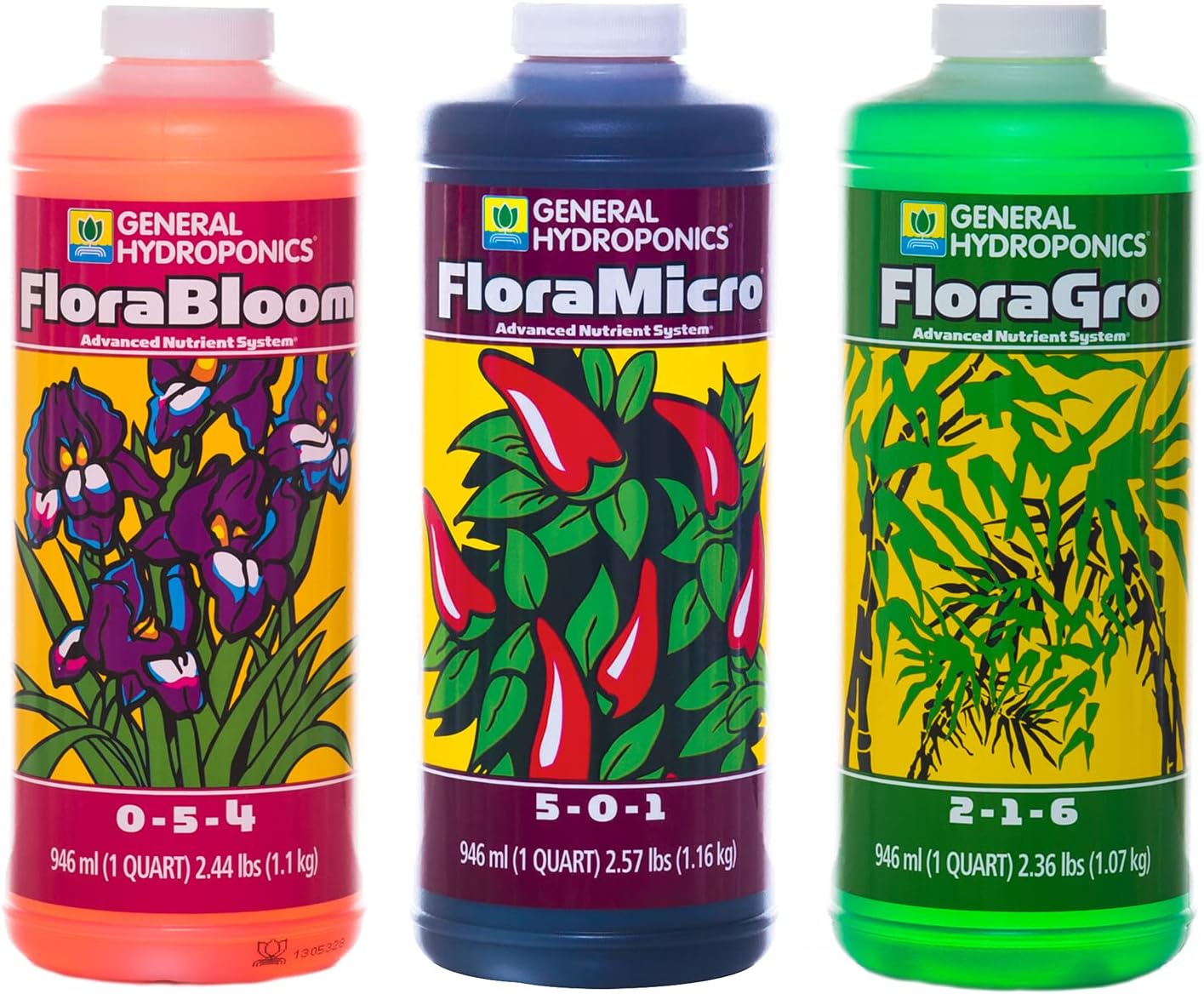
| Item Form | Liquid |
|---|---|
| Specific Uses For Product | Plant Growth, Seed Development, Foliar Feedings |
| Unit Count | 96 Fluid Ounces |
| Mixing Ratio | 2:1:6 |
The General Hydroponics Flora Series is a classic 3-part liquid nutrient system intended for growers who want precise control over feeding in hydroponic vegetable production. Users mix FloraMicro, FloraGro, and FloraBloom into the reservoir in varying ratios to match vegetative, flowering, or seedling stages; the label and mixing ratio (2:1:6) guide standard preparations. FloraMicro supplies nitrogen, calcium, and trace elements while FloraGro and FloraBloom shift NPK balance to favor structural growth or flowering and fruiting respectively. Practical benefits include flexible recipe-building for different crops and stages, concentrated quarts that last through many reservoir changes, and suitability for foliar feeding or specialized batches. Important limitations are that achieving optimal results requires attention to EC/pH and careful measuring since this is a concentrate rather than an automated solution, and phosphorus-containing components may be restricted in some local jurisdictions. This kit fits growers who want hands-on nutrient management and the ability to fine-tune feeds for higher yields of vegetables in hydro systems.
Best for: Growers who prioritize plant performance and yield and who are comfortable mixing and dialing nutrient recipes for hydroponic vegetables.
Less Ideal for: Casual hobbyists seeking a zero-setup, automated feed solution or gardeners who do not want to monitor EC and pH regularly.
- Three-part formula lets you tailor NPK balance for vegetative growth, flowering, and fruiting
- Includes micro and trace minerals needed for complete plant nutrition
- Concentrated quart bottles provide many reservoir doses for small to medium setups
- Label gives mixing guidance and the product is established and widely used
- Requires careful measuring and monitoring of EC and pH since it is a concentrate rather than a plug-and-play solution
- Contains phosphorus which may be regulated for outdoor runoff in some areas
Verdict: Choose the Flora Series when you want hands-on, performance-focused control of nutrient ratios to maximize hydroponic vegetable growth.
Ahopegarden 800ml A&B Hydroponic Nutrients Liquid Plant Food

| Item Form | Liquid |
|---|---|
| Specific Uses For Product | Hydroponic Nutrients, Plant Growth, Root Development, Seed Development |
| Target Species | Vegetables, Fruits, Flowers |
| Liquid Volume | 800 ml |
| Mixing Ratio | 1:1 (5ml A + 5ml B per 1L then use 1:200) |
This two-part Ahopegarden hydroponic nutrient comes as an 800 ml concentrate intended to feed plants through every growth stage in indoor hydroponic systems. You mix 5 ml of Solution A and 5 ml of Solution B into 1 L of water (a 1:200 working ratio) and dose that solution to your reservoir; the product separates incompatible minerals across two bottles to keep the formula stable and bioavailable. In practice it is easy to use for beginners thanks to clear directions and a marked cap for measuring, and the complete A&B formula means you do not need multiple specialty bottles for veg versus bloom phases. The concentrate should support many refill cycles, which helps stretch value for budget-minded growers. Limitations are typical of concentrated A&B systems: you must keep the two parts separate until mixing and follow the dosing precisely to avoid nutrient imbalance, and no N-P-K breakdown or micronutrient list is provided on the label for fine-tuning advanced nutrient programs.
Best for: Growers who want an affordable, all-in-one hydroponic nutrient that is easy to measure and stretches across multiple refill cycles for year-round indoor vegetables and herbs.
Less Ideal for: Advanced hobbyists who need exact N-P-K and micronutrient specifications or growers running specialized nutrient regimens will want a product with full analytical data.
- Large 800 ml concentrate provides enough solution for multiple grow cycles
- Two-part A&B formulation keeps incompatible minerals separate for stable potency
- Simple, marked cap and clear mixing instructions make it beginner-friendly
- Marketed as complete full-cycle feed suitable for vegetables, fruits, and flowers
- Label does not list a detailed N-P-K or full micronutrient breakdown for precision feeding
- Requires careful mixing of two parts and accurate dosing to avoid imbalance
Verdict: Ahopegarden's 800 ml A&B concentrate is a budget-friendly, easy-to-use complete feed that stretches across many hydroponic cycles for reliable full-cycle indoor growing.
Haligo A&B Hydroponic Nutrient Solution (800 ml total, 8-pack dosing bottles)

| Item Form | Liquid |
|---|---|
| Specific Uses For Product | Root Development |
| Target Species | Herb |
| Liquid Volume | 800 centiliters |
| Mixing Ratio | 1:1 |
This Haligo A&B hydroponic nutrient is a two-part liquid fertilizer intended for indoor hydroponic systems such as Aerogarden and similar countertop growers. You mix measured amounts of part A and part B into water (manufacturer recommends 5 ml of each per 1 L) and add the solution to your reservoir on a regular feeding schedule. The product ships as multiple small dosing bottles totaling 800 ml and includes a dispensing cup for accurate measuring. Its pH-balanced, fully water-soluble formulation is targeted at root development and herb growth, which helps plants absorb nutrients efficiently in soilless setups. The compact bottles and clear mixing ratio make it easy to dose consistently, useful for growers who track feedings and want predictable results. Important limitations are that it is designed as a general A&B formula rather than a crop-specific recipe, so heavy-feeding vegetables or large systems may need higher volumes or supplemental formulations, and safety precautions are required when handling concentrated liquid nutrients.
Best for: Buyers who run small to medium indoor hydroponic systems and value predictable, easy-to-measure feedings to keep herbs and small vegetables healthy.
Less Ideal for: Growers managing large commercial systems or specialty crops that require tailored nutrient regimens should consider higher-volume or crop-specific nutrient programs instead.
- Two-part A&B formula tailored for hydroponics for balanced nutrient delivery
- Clear mixing ratio and included dispensing cup for consistent, easy dosing
- pH-balanced and fully water-soluble for efficient nutrient uptake in soilless systems
- Packaged as multiple small bottles that make regular feedings convenient and reduce waste
- General-purpose formulation may not meet the higher nutrient demands of large or heavy-producing hydroponic crops
- Product labeling requires careful handling and safety precautions due to concentrated liquid ingredients
Verdict: A practical two-part, pH-balanced A&B nutrient that makes accurate, repeatable feedings easy for small indoor hydroponic setups.
General Hydroponics FloraMicro Liquid Nutrient, 1 Quart

| Item Form | Liquid |
|---|---|
| Specific Uses For Product | Hydroponics |
| Coverage | 1 Quart |
| Mixing Ratio | 5:0:1 |
| Target Species | Vegetables and other crop plants (vigorous growth, larger flowers, enhanced yields) |
FloraMicro supplies the micronutrients and a portion of the nitrogen and potassium that complete a three-part feeding program when mixed with FloraGro and FloraBloom. In practice you dose FloraMicro into your reservoir according to the recommended mixing ratio and adjust with the companion formulas to match vegetative or flowering stages. Notable features include its liquid form for fast dissolution, a 5-0-1 NPK contribution, and trace elements geared toward vigorous growth and better yields. For vegetable growers this means more consistent nutrient availability and easier tuning of profiles across stages. Important limitations are that FloraMicro is not a complete fertilizer by itself and must be used with the other Flora components to hit balanced NPK levels, and you will still need to monitor EC and pH separately. The product is straightforward to measure and integrates well into standard hydroponic routines, making it a practical choice for growers who want predictable, system-compatible nutrients rather than one-shot blends.
Best for: Vegetable growers who prioritize consistent, reliable nutrient control and prefer system-compatible components they can tune across growth stages.
Less Ideal for: Casual gardeners who want a single all-in-one fertilizer or beginners who prefer a no-monitoring, one-bottle feed approach.
- Designed as part of a three-part system so nutrient balance can be precisely adjusted
- Liquid formula dissolves quickly for reservoir dosing
- Provides micronutrients plus nitrogen and potassium to support vegetative growth
- Well suited to repeatable, staged feeding programs for vegetables
- Not a standalone complete fertilizer; requires FloraGro and FloraBloom to achieve full NPK balance
- Requires regular EC and pH monitoring to ensure proper uptake
Verdict: Buy this if you want a dependable, system-based micronutrient component that lets you precisely tune feeds for hydroponic vegetables.
TPS Nutrients Liquid Plant Food for AeroGarden and Hydroponics, 8 oz

| Item Form | Liquid |
|---|---|
| Specific Uses For Product | Plant Growth, Root Development |
| Target Species | Herb, Vegetable |
| Mixing Ratio | 5 mL (1 tsp) per quart of feedwater |
| Unit Count | 8 Fluid Ounces |
This 8 oz liquid plant food provides concentrated, reservoir-safe nutrition intended for AeroGarden and comparable hydroponic units. It is used by mixing the recommended 5 mL per quart of feedwater into the system reservoir on a regular feeding schedule to supply macro and micronutrients for herbs, greens, and other compact edible plants. Notable features include a liquid formulation that dissolves easily, a focus on root development, and explicit compatibility with indoor hydroponic gardens. In practice it simplifies feeding for small indoor crops because a measured teaspoon per quart is straightforward to dose and store. Important limitations are the small bottle size, which will require frequent repurchasing for larger or multiple units, and the need to follow dilution directions carefully to avoid overfeeding. Safety handling is necessary because the concentrate should be kept away from children and pets. For risk-averse growers, the product’s clear mixing ratio and hydroponic focus make predictable feeding simple, but you should track reservoir concentrations rather than guessing frequency or volume adjustments.
Best for: Buyers who want a simple, low-risk feeding routine for indoor green onions and other small edible hydroponic crops and prefer clear dosing instructions they can follow reliably.
Less Ideal for: Growers managing large hydroponic setups, outdoor beds, or those who need a detailed NPK profile for tailored nutrient programs should look for larger or fully specified concentrates.
- Designed specifically for AeroGarden and similar hydroponic systems for straightforward compatibility
- Liquid formula mixes easily for even nutrient distribution in the reservoir
- Clear mixing ratio (5 mL per quart) simplifies dosing and repeatable feeding
- Targets root development and steady growth for herbs and vegetables
- Small 8 oz bottle may not last long for multiple or larger units
- No full nutrient analysis or NPK breakdown provided on the product listing
Verdict: A compact, easy-to-dose liquid fertilizer that makes predictable feeding of indoor green onions simple and low risk.
TPS Nutrients Liquid Plant Food for AeroGarden and Hydroponic Systems, 32 oz

| Brand | TPS NUTRIENTS |
|---|---|
| Unit Count | 32 Fluid Ounces |
| Item Form | Liquid |
| Specific Uses For Product | Plant Growth, Root Development |
| Mixing Ratio | 5 mL per quart of feedwater |
This liquid plant food is designed specifically for AeroGarden and comparable indoor hydroponic setups, delivering a balanced nutrient mix in a ready-to-dilute liquid form. You mix the recommended 5 mL per quart of feedwater and add it to the system reservoir on your regular feeding schedule. Because it is reservoir-safe and made for hydroponic use, it dissolves easily, supports steady vegetative growth and root development, and is suitable for herbs, leafy greens, and other compact indoor plants. Practical benefits include a concentrated 32 oz bottle that lasts for many feedings and clear directions that simplify dosing for routine maintenance. Important limitations are that it is formulated for general growth rather than crop-specific bloom or fruiting boosts, and safe handling precautions are required since it is a concentrated chemical solution. For someone looking for an easy-to-use, hydroponic-specific nutrient to maintain healthy indoor plants, this product gives predictable, consistent results when used as directed.
Best for: Buyers who want a reliable, easy-to-use nutrient for indoor hydroponic herb and salad gardens and who prioritize predictable, low-maintenance feeding routines.
Less Ideal for: Gardeners focused on heavy fruiting or bloom enhancement who need crop-specific bloom or bloom-boosting formulations should look elsewhere.
- Formulated for AeroGarden and similar indoor hydroponic systems so it integrates into reservoir feeding routines
- Liquid concentrate mixes easily and uses a simple 5 mL per quart dosing guideline
- Supports steady vegetative growth and root development for herbs and leafy greens
- Large 32 oz bottle provides many feedings for small indoor gardens
- Designed as a general growth formula and not tailored for flowering or high-yield fruiting stages
- Contains concentrated chemicals so safe handling and storage are required
Verdict: A straightforward, hydroponic-specific liquid concentrate that delivers consistent, low-effort nutrition for indoor herbs and leafy greens.
Choosing the Right Hydroponic Fertilizer for Vegetables: Key Factors to Consider
N-P-K Balance and Crop Stage
Vegetables need different macronutrient ratios during vegetative growth versus flowering and fruiting. A fertilizer with a higher nitrogen ratio supports leafy crops like lettuce and spinach, while lower nitrogen and higher potassium suit fruiting vegetables such as tomatoes and peppers.
Using a fertilizer that allows you to adjust or switch between vegetative and bloom formulas helps you match plant demand through the season. Ignoring stage-appropriate N-P-K can cause excessive leaf growth at the expense of fruit set or the opposite where foliage is weak and yields suffer.
Micronutrient Profile
Micronutrients like iron, manganese, boron, zinc, copper, and molybdenum are required in small amounts but are critical for enzyme functions and nutrient uptake. Deficiencies often show as interveinal chlorosis, blossom drop, or poor fruit development.
Choose fertilizers with a clear guarantee of essential micronutrients or pair primary fertilizers with a compatible micronutrient supplement. Also consider chelated forms for iron in hard water to prevent rapid precipitation and make micronutrients more available to vegetable roots.
Solubility and Precipitation Risk
Hydroponic fertilizers must dissolve cleanly and remain in solution across expected water temperatures. Insoluble particulates or formulations that precipitate when mixed raise the risk of clogged emitters, blocked channels, and inconsistent nutrient delivery to roots.
Check for instructions about mixing order, water temperature, and whether the product is designed for high-concentration or low-volume systems. A formula that stays stable in your system type reduces maintenance time and prevents localized nutrient deficiencies.
pH and Electrical Conductivity Behavior
Nutrient availability in hydroponics is tightly linked to pH and solution EC/TDS. Some fertilizers have strong acid or alkaline properties that shift pH quickly, while others include buffering agents to reduce fluctuations.
Consider how a fertilizer affects your normal pH range and whether it makes maintaining target EC easier or harder. Matching fertilizer behavior to your monitoring routine and pH control method reduces corrective work and keeps vegetables absorbing nutrients efficiently.
Concentration, Dosing Accuracy, and Mixing Convenience
Concentrated formulas reduce storage volume but increase the risk of dosing errors. Liquid concentrates and dry soluble powders each have tradeoffs in measuring accuracy, shelf life, and convenience.
Look for clear mixing charts, compatibility with common measuring tools, and straightforward dilution instructions. Products that simplify dosing reduce mistakes, especially for hobbyists and small commercial growers managing many reservoirs.
Compatibility with System Type and Water Source
Different hydroponic systems-NFT, Ebb and Flow, Deep Water Culture, or aeroponics-have varying flow characteristics and susceptibility to clogging or biological issues. Water source quality also matters; hard water can interact with certain salts and reduce nutrient availability.
Select fertilizers tested or labeled for your system type and consider formulations that tolerate ranges of water hardness. If your water has high alkalinity or minerals, you may need products designed to minimize precipitation and maintain available nutrients for vegetables.
Matching Fertilizer Strategy to Vegetable Type
Leafy greens and herbs generally prefer a steady, nitrogen-forward feed to encourage tender foliage. Fruiting vegetables like tomatoes, peppers, and cucurbits need a transition toward higher potassium and balanced phosphorus once flowering begins. Planning a two-stage feeding strategy or using a feed schedule designed for vegetables helps avoid nutrient-stage mismatch.
For mixed plantings, choose a flexible fertilizer program that lets you tailor EC and pH per crop or use separate reservoirs for different groups. This approach minimizes tradeoffs when you are growing fast-growing salad greens next to slower fruiting plants.
- Use higher nitrogen early for leaf crops
- Increase potassium during flowering/fruiting
- Consider separate reservoirs for different crop groups
Mixing and Maintenance Best Practices
Always dissolve fertilizers in warm, clean water and add components in the recommended order to avoid precipitation. Measure EC and pH after mixing and adjust before adding plants to the reservoir.
Regular partial reservoir changes prevent buildup of unbalanced ions and reduce disease risk. Keep records of dosing amounts and water parameters so you can spot trends and correct problems early.
- Dissolve powders fully before combining concentrates
- Check EC and pH after every refill
- Schedule routine reservoir flushes
Managing Water Quality and Hardness
Tap water mineral content affects how fertilizers behave. Hard water can cause calcium or magnesium to precipitate with phosphate, reducing availability to plants. If you have hard water, choose formulas tolerant of higher mineral content or adjust the feed program to account for background ions.
Using a baseline water test helps you calculate target EC more accurately and decide whether partial softening or mineral adjustments are needed. Small tweaks to the recipe often fix issues without major system changes.
- Test source water for EC and alkalinity
- Adjust fertilizer recipe based on background minerals
- Consider targeted supplements rather than broad changes
Signs of Nutrient Problems in Vegetables
Vegetable nutrient issues often appear as leaf discoloration, stunted growth, blossom-end rot, or poor fruit set. Early symptoms help narrow whether macronutrients or micronutrients are lacking or if pH is locking out uptake.
Documenting symptoms and recent reservoir changes speeds diagnosis. Simple corrective actions include adjusting pH, topping up missing nutrients, or performing a partial reservoir replacement to rebalance the solution.
- Yellowing between veins often points to iron or manganese issues
- Leaf tip burn can indicate high EC or salt buildup
- Blossom-end rot is commonly linked to inconsistent calcium availability
Scaling Recipes for Small and Large Systems
Concentration and dosing scale differently for hobby buckets versus commercial reservoirs. Small growers benefit from clear, low-dose charts and simple measurements. Larger systems need robust measures to avoid cumulative errors and to keep consistency across multiple reservoirs.
Automation tools like proportional injectors reduce manual error but require formulations that stay stable when concentrated. Factor in mixing space, storage, and handling safety as you scale up your feeding program.
- Follow volume-based mixing charts for accuracy
- Consider automation compatibility for large setups
- Store concentrates safely and label mixtures clearly
How We Chose the Best Hydroponic Fertilizer for Vegetables
We focused on criteria that directly affect vegetable growth in hydroponic systems rather than marketing claims. Primary evaluation metrics included nutrient completeness and correct N-P-K ratios tailored to leafy greens and fruiting vegetables; solubility and stability so the solution remains uniform in common system types; and pH buffering or compatibility with pH control routines since vegetables are sensitive to dissolved ion availability. We also assessed ease of mixing and dosing accuracy to reduce nutrient errors during daily maintenance, and compatibility with common water sources and EC/TDS levels. Longevity in solution and tendency to precipitate under typical greenhouse temperatures were considered because clogging or nutrient lockup affects root health. Packaging and concentration were reviewed only for practicality in handling and measuring. We excluded products designed strictly for ornamentals, soil use only, or formulations lacking clear guaranteed analysis for hydroponic application. Any fertilizer that required supplemental unlisted micronutrients to be usable for vegetables was not included. The final list balances chemical completeness with real-world usability for gardeners growing vegetables without soil.
FAQ
How often should I change the nutrient reservoir for vegetables?
Usually change or refresh the reservoir every one to two weeks, depending on crop uptake and system size. Monitor EC and pH; large shifts or signs of imbalance mean an earlier change is needed.
Can I use the same fertilizer for lettuce and tomatoes?
You can use the same base fertilizer but adjust concentrations and N-P-K balance by stage. Lettuce benefits from higher nitrogen, while tomatoes need more potassium and steady calcium once they set fruit.
How do I prevent nutrient lockout caused by pH swings?
Keep pH within the recommended range for vegetables, typically in the slightly acidic range. Use a fertilizer compatible with your pH control method and check pH daily until you are confident in stability.
Do I need to add calcium and magnesium separately?
It depends on your water source and the fertilizer's guaranteed analysis. If your water is low in these minerals or you see related deficiency symptoms, add a compatible calcium-magnesium supplement.
Will a concentrated liquid save space compared with solids?
Concentrates save storage footprint but increase the consequences of dosing errors because small measuring mistakes lead to large nutrient swings. Choose a concentration that matches your measuring tools and handling comfort.
How important are chelated micronutrients in hydroponics?
Chelated micronutrients are often more stable and available, especially iron in alkaline or hard water. They reduce the risk of precipitation and make micronutrient uptake more reliable for vegetables.
Final Verdict
When choosing a hydroponic fertilizer for vegetables, prioritize complete macronutrient profiles, necessary micronutrients, and formulas that stay soluble and stable in your system and water. Balance dosing convenience with reservoir management practices so daily maintenance is predictable. Accept the tradeoffs between concentrated convenience and dosing risk, and focus on how the fertilizer interacts with pH and EC in your setup. With the right feed strategy and routine monitoring, you can maintain steady growth and consistent yields across leafy greens and fruiting vegetables.
