

Note: This article contains affiliate links. If you click on these links and make a purchase, I may earn a small commission at no extra cost to you. This helps support my research and content. Read my full affiliate disclosure here.
Spring fertilizer sets the tone for the entire growing season. The right lawn spring fertilizer encourages early green-up, supports root development, and can limit common spring weeds before they take hold. If you pick the wrong formulation or application style you may overfeed, burn grass, or waste time on treatments that do not suit your mower height or grass type. This guide shortlists seven top options suitable for common spring lawn needs and garden situations. We evaluated nutrient mix, release type, and application practicality so you can choose a product that fits your lawn size and maintenance routine. Read on for the criteria we used and practical notes to help you decide which fertilizer to try first.
Top Picks at a Glance
| Best Overall The best all-around choice for most situations | Scotts Turf Builder Lawn Food, 12.5 lb |  |
| Best Quality Built to a higher standard if you want something more solid | The Andersons Professional PGF Complete 16-4-8 Granular Lawn Fertilizer (covers 5,000 sq ft) |  |
| Best Value The sweet spot between price and what you get | GreenView Fairway Formula Lawn Fertilizer, 33 lb (covers 10,000 sq. ft.) |  |
| Best Budget The cheapest option that still gets the job done reliably | GreenView Lawn Food 22-0-4, 16 lb bag |  |
| Highest Rated A top-rated pick with lots of positive feedback | Scotts Green Max Lawn Food (46.67 lb) | 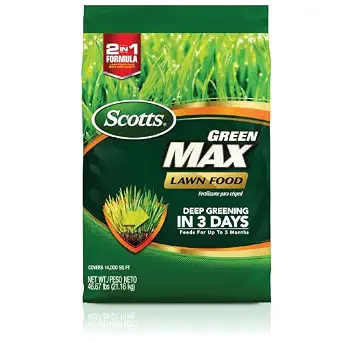 |
| Most Popular A crowd favorite that many people choose with confidence | Scotts Turf Builder Weed & Feed (42.87 lb) |  |
| Best Seller A high-volume bestseller chosen again and again | Scotts Green Max Lawn Food (16.67 lb) |  |
Scotts Turf Builder Lawn Food, 12.5 lb

| Item Form | Powder |
|---|---|
| Specific Uses For Product | Lawn |
| Coverage | 5,000 sq. ft. |
| Mixing Ratio | 32:0:4 |
Scotts Turf Builder Lawn Food is a general-purpose granular fertilizer formulated for use on any grass type to thicken turf and improve root strength. You spread it with a broadcast or drop spreader (Scotts provides recommended settings) and can apply it to wet or dry lawns in spring, summer, or fall. The formula is pesticide-free and emphasizes building deeper roots so the lawn better absorbs water and nutrients, which helps turf resist stress over the season. One 12.5 lb bag covers about 5,000 sq. ft., making it a simple option for small to medium yards or spot treatments. Practical benefits include clear application guidance, compatibility with common spreaders, and the option to water in for faster greening. Limitations are that this single bag covers a modest area compared with larger homeowner bags and it does not include weed control or insect protection, so you may need additional products for comprehensive lawn care.
Best for: Buyers who want a reliable, easy-to-apply granular fertilizer to strengthen and green a small to medium lawn and prefer products with widespread user approval and clear instructions.
Less Ideal for: Homeowners needing one-step weed or pest control, or those with large properties who want a single bag to cover many thousands of square feet.
- Works on all common grass types so one product fits mixed lawns
- Builds stronger, deeper roots to improve water and nutrient uptake
- Clear spreader settings and can be applied to wet or dry turf for flexibility
- Pesticide-free formula suitable when you only want fertilization
- Covers only about 5,000 sq. ft. per bag, requiring multiple bags for larger yards
- Does not include weed or insect control so additional products may be needed
Verdict: A reliable, easy-to-use granular lawn food that builds stronger roots and is a solid choice for feeding small to medium lawns.
The Andersons Professional PGF Complete 16-4-8 Granular Lawn Fertilizer (covers 5,000 sq ft)

| Item Form | Granules |
|---|---|
| Specific Uses For Product | Soil Conditioning |
| Target Species | lawn grasses |
| Unit Count | 288 Ounce |
| Mixing Ratio | 4-1-2 ratio |
This granular fertilizer is built to boost turf performance with a 16-4-8 N-P-K ratio that delivers both immediate and extended nitrogen release for up to eight weeks. It is typically applied with a broadcast spreader at the recommended rate on dry foliage, then lightly watered to activate the Humic DG technology that helps nutrients move into the root zone. Notable features include super-fine particles for even coverage, added iron and micronutrients for richer color, and a mix of quick and slow-release nitrogen for steady growth without frequent reapplication. Practical benefits for a performance-focused buyer are visibly greener turf, reduced application frequency, and improved soil conditioning from humic acids. Important limitations are that it is a granular product so precise spreader calibration and steady walking are required for uniform results, and it is not labeled for sale in California which restricts availability in that state.
Best for: Gardeners focused on high-performance, visibly greener lawns who want a single application product that delivers both immediate and extended feeding and supports soil health.
Less Ideal for: Small container gardeners or people who prefer liquid or organic-only fertilizer programs should consider other formats or formulations.
- Balanced 16-4-8 N-P-K with both quick- and slow-release nitrogen for immediate color and sustained feeding
- Super-fine particles designed for even distribution across the lawn
- Includes iron and multiple micronutrients to improve turf color and overall plant nutrition
- Humic DG additive to help move nutrients into the soil and support soil conditioning
- Requires correct spreader settings and consistent walking speed to avoid streaking
- Not available for sale in California
Verdict: Choose this fertilizer when you want a performance-focused granular formula that delivers quick color boost plus up to eight weeks of sustained feeding for greener grass.
GreenView Fairway Formula Lawn Fertilizer, 33 lb (covers 10,000 sq. ft.)

| Coverage | 10,000 sq. ft. |
|---|---|
| Item Form | Granules |
| Specific Uses For Product | Root Development, Seed Development, Soil Conditioning |
| Mixing Ratio | 27-0-5 |
GreenView Fairway Formula is a granular lawn fertilizer formulated to deliver steady nitrogen feeding without causing surge growth. It combines an immediate-release portion with a high proportion of slow-release nitrogen to feed turf for up to 12 weeks, making it suitable for routine spring or in-season applications when grass is actively growing. Typical use is broadcast application with a spreader for established lawns or raked into the seedbed for new lawns, and one bag claims coverage for about 10,000 sq ft. Notable features include a phosphate-free mix to reduce runoff concerns, a 27-0-5 N-P-K profile, and safety guidance to avoid hand spreading or applying before heavy rain. Practical benefits are longer intervals between applications, reduced risk of burning from controlled-release nutrients, and stronger, thicker turf and color. Limitations are that it is a straight nitrogen-focused formula (no weed control or broad-spectrum nutrient balance) and it requires careful spreading and watering to avoid off-target loss near hard surfaces or waterways.
Best for: Homeowners who want a practical, lower-maintenance fertilizing plan that prioritizes steady nitrogen feeding and fewer seasonal applications for medium to large lawns.
Less Ideal for: If you need simultaneous weed or crabgrass control, a combined fertilizer-plus-herbicide product would be a better choice; not for those who prefer a multi-nutrient or custom lawn program.
- Long-lasting feeding with up to 12 weeks of controlled-release nitrogen
- Covers up to 10,000 sq ft from a single 33 lb bag for fewer applications
- Phosphate-free formula reduces potential impact on waterways
- Suitable for all grass types and usable anytime turf is actively growing
- Does not include weed or crabgrass control
- Requires a spreader for even application and careful sweeping from hard surfaces
Verdict: Choose this fertilizer if you want a phosphate-free, high slow-release nitrogen formula that feeds lawns steadily for up to 12 weeks and reduces how often you need to apply.
GreenView Lawn Food 22-0-4, 16 lb bag

| NPK | 22-0-4 |
|---|---|
| Form | Granules |
| Coverage | 5,000 sq. ft. |
| Application | Broadcast or drop spreader |
GreenView Lawn Food is a granular, broadcast-applied lawn fertilizer designed to boost root development, speed spring green-up, and maintain deeper green color through an eight-week controlled-release formula. You apply it with a broadcast or drop spreader over up to 5,000 sq. ft., and the MESA controlled-release nitrogen delivers both immediate and slow-release nutrition so you get quicker green-up without a surge of excessive top growth. The zero-phosphate 22-0-4 blend focuses on nitrogen and potassium to improve drought resistance and nutrient uptake in established turf. Practical benefits for summer care include longer feeding intervals, better water retention from improved root vigor, and fewer repeat applications compared with quick-release products. Limitations are that it is not a starter fertilizer for new seed because it contains no phosphorus and it requires a spreader for even coverage; hand spreading is discouraged. Also the 16 lb bag suits small to medium lawns rather than large properties where multiple bags would be needed.
Best for: Homeowners who want a low-maintenance summer feed that reduces how often you need to reapply and prioritizes steady green-up and root health.
Less Ideal for: Those establishing new lawns from seed or managing large commercial turf areas who need phosphorus or high-coverage bulk quantities.
- Controlled-release MESA nitrogen gives up to 8 weeks of feeding for fewer applications
- Applicable with common broadcast or drop spreaders for even coverage
- Zero-phosphate formula aligns with lawn-use restrictions and protects waterways
- 22-0-4 NPK focuses on root development and drought resilience
- Not suitable as a phosphorus-containing starter fertilizer for new seed
- 16 lb bag covers about 5,000 sq. ft. so larger lawns will need multiple bags
Verdict: A convenient, controlled-release summer lawn food that keeps small to mid-size lawns greener longer with fewer applications.
Scotts Green Max Lawn Food (46.67 lb)

| Item Form | Granules |
|---|---|
| Target Species | Lawn Grass |
| Item Highlight | Lawn Fertilizer plus Iron Supplement, Covers 14,000 sq. ft. |
Scotts Green Max Lawn Food is a granular, dual-action fertilizer formulated to feed lawns and deliver fast greening thanks to a 5% iron supplement. It is applied with a broadcast or drop spreader following the recommended settings for even coverage, then lightly watered in for best results. The product is suitable for use in spring, summer, or fall and is advertised safe to re-enter immediately after application. A single 46.67 lb bag covers approximately 14,000 square feet, so it is practical for mid- to large-size yards and routine spring feeding. The manufacturer also guarantees it will not stain concrete or driveways when used as directed, which reduces application risk near hard surfaces. Limitations include that it is a general-purpose turf fertilizer rather than a tailored formula for specific grass species or soil deficiencies, and users should follow spreader settings carefully to avoid over-application.
Best for: Homeowners who want a reliable, easy-to-apply spring fertilizer that produces quick greening across medium to large lawns and prefer a product with clear spreader instructions.
Less Ideal for: Gardeners seeking a custom nutrient program for specific grass species, soil test-driven feeding, or small urban lawns where bulk packaging is unnecessary.
- Fast visible greening within about three days due to a 5% iron supplement
- Large 46.67 lb bag covers up to 14,000 sq. ft., reducing purchase frequency for bigger lawns
- Formulated as granules for easy application with common broadcast or drop spreaders
- Guaranteed not to stain concrete or driveways when used as directed
- General-purpose NPK formulation without soil-specific nutrient tailoring
- Requires careful spreader calibration to achieve correct application rates
Verdict: Pick this if you want a dependable, fast-greening granular lawn food that covers large areas and is simple to apply for spring feeding.
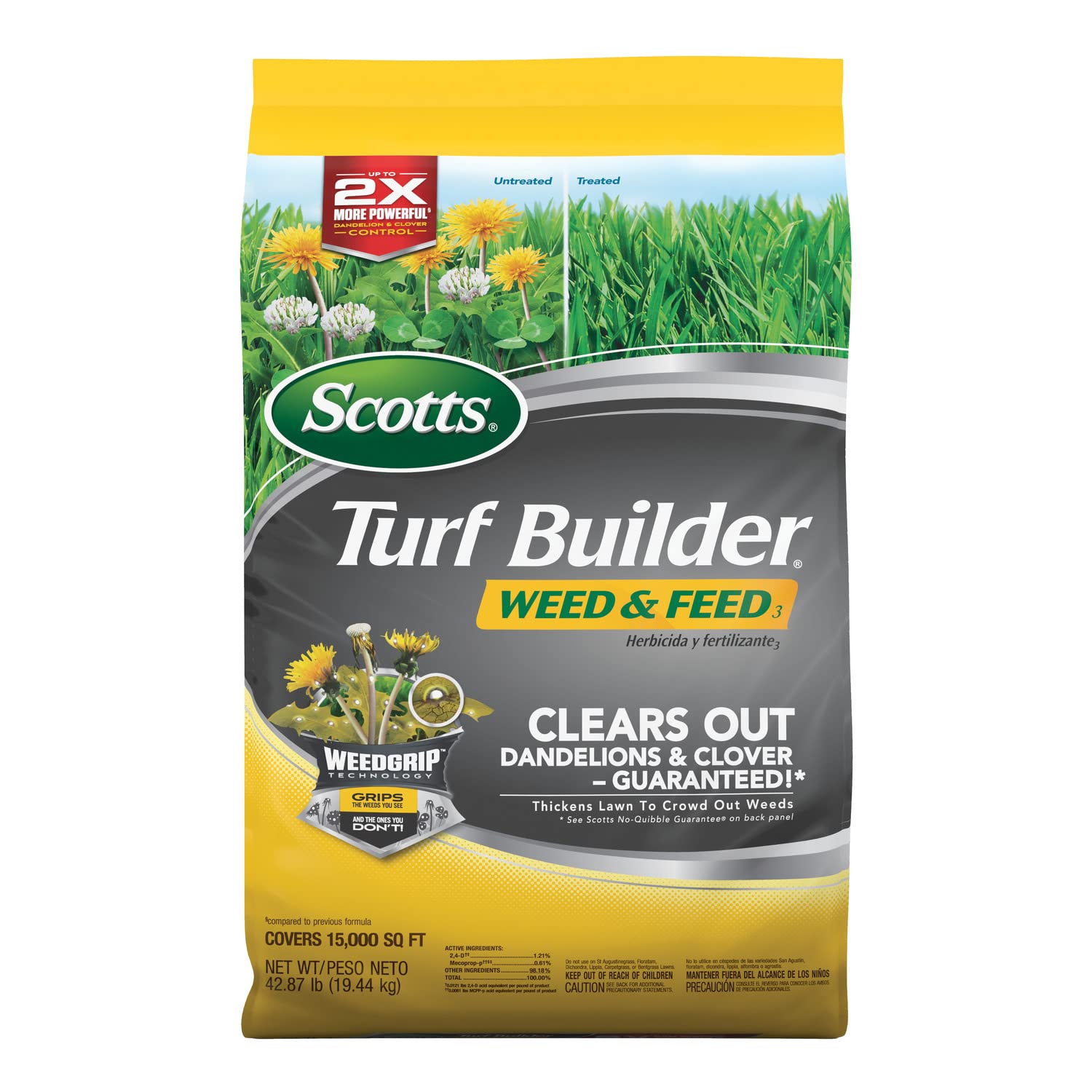
Scotts Turf Builder Weed & Feed (42.87 lb)
| Item Form | Granule |
|---|---|
| Coverage | 15000 square_feet |
| Active Ingredients | 24-D Mecoprop-p |
Scotts Turf Builder Weed & Feed is a granular lawn treatment that kills broadleaf weeds while feeding grass to encourage thicker turf. It is applied with a spreader when weeds are actively growing and temperatures are between 60°F and 90°F; the label recommends applying to a wet lawn so granules stick to weed leaves and waiting 24 hours before watering. The formula uses WeedGrip technology and lists active ingredients including 2,4-D and Mecoprop-p, and the 42.87 lb bag covers about 15,000 square feet. In practice this product is straightforward to broadcast across medium to large lawns and gives visible reduction of common weeds like dandelions and clover while supplying nutrients to help crowd out future weeds. Important limitations are application timing and grass restrictions: do not use on St. Augustinegrass, bentgrass, carpetgrass, dichondra, or lippia, and do not apply if rain is expected within 24 hours. Also keep people and pets off treated turf until dust settles. For homeowners who follow label directions, it is an efficient one-step option for late spring weed control and feeding.
Best for: Homeowners who want a single product to both reduce common broadleaf weeds and feed a cool- or warm-season lawn and who prefer a proven brand with clear label instructions and wide user adoption.
Less Ideal for: People with lawns made of excluded grass types or those needing immediate spot treatment for individual weeds should consider alternatives designed for those specific situations.
- Combines selective broadleaf weed control and fertilizer in one application
- Large bag covers up to 15,000 sq. ft., suitable for medium to large lawns
- WeedGrip technology helps granules adhere to weed leaves for better control
- Granular form is compatible with common broadcast or drop spreaders
- Not safe for several grass types including St. Augustine and bentgrass
- Requires specific temperature and moisture conditions for best results
Verdict: A convenient, proven one-step weed-and-feed for homeowners who want broadleaf weed control plus lawn feeding across large yards.
Scotts Green Max Lawn Food (16.67 lb)

| Item Form | Granules |
|---|---|
| Coverage | 5000 square feet |
| Specific Uses For Product | Lawn |
| Target Species | lawn grass |
Scotts Green Max Lawn Food is a granular, all-purpose lawn fertilizer formulated to deliver fast greening with a 2-in-1 feed plus 5% iron supplement. It is applied with a broadcast or drop spreader to any grass type and is recommended for routine spring, summer, or fall applications. Notable features include a guaranteed nonstaining formula when used as directed and settings provided for Scotts spreaders to help get an even application across the advertised 5,000 sq ft coverage. The iron content speeds visible greening in as little as three days and the granules are ready to water in for faster uptake. For a risk-averse homeowner growing fescue in spring, the product is straightforward to use and safe to re-enter the lawn immediately after application. Limitations are that proper spreader settings and sweeping up excess product are important to avoid runoff and that it is a general lawn food rather than a specialized product for nutrient-deficient soils, so a soil test is still useful for targeted corrections.
Best for: Homeowners who want a low-risk, easy-to-apply lawn food that produces quick green results on fescue lawns in spring and prefer established brand guidance for application.
Less Ideal for: Gardeners seeking a product to correct a specific nutrient imbalance or those who prefer liquid or organic-only fertilizing approaches.
- Includes 5% iron for faster, deeper greening visible in about three days
- Premeasured granular form covers up to 5,000 sq ft from one bag
- Manufacturer provides spreader settings to simplify even application
- Formulated not to stain concrete or driveways when used as directed
- Not a tailored corrective fertilizer for specific soil deficiencies
- Requires correct spreader settings and cleanup to prevent runoff
Verdict: A simple, fast-acting granular lawn food with added iron that reliably greens fescue lawns when applied with a spreader.
Choosing the Right Lawn Spring Fertilizer: Key Factors to Consider
Nutrient Formulation and Timing
Spring fertilizers vary in their nitrogen-to-phosphorus-to-potassium ratios and in whether nitrogen is fast-release or slow-release. A formulation with higher available nitrogen helps rapid green-up, but a mix that includes slow-release nitrogen reduces burn risk and supports steady growth over weeks. Match the NPK and release profile to your lawn's needs, recent soil test results, and whether you plan follow-up feeding later in the season.
Timing matters because soil temperature influences nutrient uptake. Apply when soil temperatures reach the recommended range for your grass type so the turf can actively use the nutrients rather than them washing away or remaining unused.
Release Mechanism and Longevity
Granular fertilizers often come as quick-release crystals, coated slow-release granules, or a blend. Liquids tend to show effects fastest but may require more frequent applications. Slow-release products give a steadier nutrient supply and reduce peak growth surges that demand extra mowing. Consider how often you want to fertilize and whether the product's longevity matches your maintenance schedule.
Also consider how the release mechanism interacts with rainfall and irrigation. Heavy rain shortly after application can move soluble nitrogen off the lawn, raising environmental concerns and reducing effectiveness. Slow-release or polymer-coated options help buffer that risk.
Compatibility With Weed Control Plans
Some spring fertilizers are paired with broadleaf herbicides or preemergent weed preventers. Combining weed control with feeding can save time, but it can also restrict timing or harm newly seeded areas. If you plan to seed or overseed in spring, avoid products containing herbicides that inhibit seedling establishment.
If you prefer separate treatments, choose a fertilizer whose application window lines up with the preemergent or postemergent herbicide schedule so treatments do not interfere with one another. Read label directions on tank-mixing and reapplication intervals.
Application Method and Coverage Accuracy
Granules are generally applied with broadcast or drop spreaders while liquids require a hose-end or pump sprayer. The method affects how evenly nutrients are distributed. Uneven application causes patchy growth or burning. Ensure the fertilizer's recommended spreader settings are available and that the granule size suits your equipment to avoid clogging.
For larger lawns, convenience and spreader calibration matter more. For small yards or irregular plots, liquid products or hand-spreadable granules with clear rate instructions may be easier to apply accurately.
Lawn Type and Local Climate
Cool-season grasses green up earlier in spring than warm-season types and have different nutrient needs. Choose a formulation and timing that align with your grass species and local climate patterns. For example, applying a high-nitrogen spring feed too early on warm-season lawns can be wasteful or damaging.
Regional rainfall, soil type, and typical spring temperatures also affect both product choice and timing. In heavy clay soils, slower nutrient release helps prevent runoff, while sandy soils may need split applications or slow-release options to maintain nutrition between irrigations.
Environmental and Safety Concerns
Fertilizer runoff and nutrient leaching are real concerns near waterways and paved surfaces. Look for formulations and application rates that minimize soluble nitrogen and phosphorus losses. Follow label guidance on buffer zones and avoid applying before heavy rains. Consider products labeled for reduced runoff or those that rely more on slow-release nitrogen.
Also assess user safety and storage: some fertilizers include herbicides or salts that require protective gear and secure storage away from children and pets. Proper handling reduces risk of accidental overapplication or environmental harm.
When to Apply Spring Fertilizer
Apply spring fertilizer when your lawn is actively coming out of dormancy and soil temperatures are consistently in the optimal range for your grass species. For cool-season lawns that typically green up earlier, this often means early to mid-spring; for warm-season grasses wait until soil warming indicates active root growth.
Avoid fertilizing immediately before heavy rain and give any fresh seed or sod time to establish if you plan overseeding. Timing the application for a period of moderate weather and normal irrigation will improve nutrient uptake and reduce waste.
- Check soil temperature rather than calendar date when possible
- Delay if significant rain is expected within 24 hours
- Do not apply herbicide-containing mixes if overseeding
Calibrating Your Spreader or Sprayer
Accurate application rate is critical. For broadcast spreaders, test a calibration run on a driveway to measure coverage per pass and adjust settings to match the product label. For drop spreaders, maintain consistent walking speed and overlap minimally to avoid double application.
When using liquids, measure water volume and nozzle output to reach the labeled rate per 1,000 square feet. Keep records so you can reproduce the same coverage next season.
- Always use the recommended spreader settings when provided
- Clean equipment after use to prevent cross-contamination
- Recalibrate if you change product granule size or sprayer tips
Safe Storage and Handling Practices
Store fertilizers in a dry, cool place out of reach of children and pets. Keep granular and liquid products in their original containers with the label intact so application rates and safety instructions remain available.
Wear gloves and eye protection when mixing or spreading, and avoid inhaling dust from dry formulations. Rinse equipment away from storm drains to prevent runoff.
- Keep fertilizer off paved surfaces and sweep up spills immediately
- Follow label instructions for protective equipment
- Store liquids upright and sealed to prevent leaks
Adjusting Rates for Lawn Condition
Lawns with thin or patchy turf may benefit from slightly higher nitrogen in spring, but it is better to correct chronic issues like compaction or poor soil fertility with targeted treatments based on a soil test. Overapplication can cause excessive top growth at the expense of root strength.
If your lawn shows signs of nutrient deficiency on a soil test, adjust rates to correct the imbalance rather than increasing blanket nitrogen. Compact, shaded, or drought-stressed areas may need different approaches than sunny, well-drained turf.
- Use soil test results to guide phosphorus and potassium adjustments
- Favor lower nitrogen rates where root development is the goal
- Split applications reduce burn risk on fragile turf
Environmental Best Practices
Minimize runoff by avoiding applications on slopes above waterways or right before heavy rains. Leave a buffer zone along streams and driveways and sweep any granules off pavement back onto turf.
Consider slow-release nitrogen sources and match application timing to periods of active uptake. These steps reduce nutrient loss from your lawn and lessen downstream impacts.
- Do not apply within buffer distances specified on the label
- Time irrigation to move nutrients into the soil without washing them away
- Prefer products with lower soluble phosphorus if local regulations restrict phosphorus use
How We Chose the Best Lawn Spring Fertilizer
We focused on practical, garden-focused filters that matter for spring lawn care. Primary evaluation criteria included nutrient formulation and NPK balance for spring green-up and root support, release type and longevity to reduce risk of burn and limit frequent reapplications, and weed-control compatibility for products that include herbicides or pair well with separate preemergent treatments. We also assessed application method and coverage consistency to match common spreader types and lawn sizes, plus granule size or liquid dilution clarity because those affect distribution and ease of use. Other editorial filters were environmental and safety considerations such as runoff risk, recommended timing relative to soil temperature, and turfgrass compatibility for cool- and warm-season grasses. We excluded products formulated exclusively for specialty turf like athletic fields or golf greens and any fertilizers intended only for overseeding or sod establishment. Our short list emphasizes broadly useful spring formulas that gardeners can apply reliably with consumer spreaders or sprayers.
FAQ
Can I apply spring fertilizer before overseeding?
It depends. Products that contain herbicides or strong preemergents can prevent grass seed from establishing. If you plan to overseed, choose a fertilizer labeled safe for new seed or delay herbicide-containing products until seedlings are established.
How soon after application will I see results?
Quick-release formulations can produce visible green-up in a week, while slow-release products work over several weeks. Weather and soil temperature heavily influence how fast turf responds.
Is a soil test necessary before spring feeding?
A soil test is recommended every few years to identify nutrient imbalances, especially phosphorus and potassium needs. For basic spring green-up, a balanced fertilizer is fine, but a test helps avoid unnecessary nutrient additions.
Will spring fertilizer increase mowing frequency?
Often yes. Fertilizers that spur rapid top growth will require more frequent mowing. If you want steady growth with fewer cuts, choose a slow-release option or apply a lower nitrogen rate.
Can I spread fertilizer in cool, wet conditions?
Applying during cool, wet conditions increases the risk of runoff and may reduce uptake. It is better to wait for drier weather or use slow-release products designed to withstand light rain.
How do I avoid burning my lawn with spring fertilizer?
Follow label rates precisely, calibrate your spreader, and avoid applying during drought stress. Slow-release formulations and splitting the total seasonal rate into smaller applications also reduce burn risk.
Final Verdict
Choose a spring fertilizer that matches your grass type, soil needs, and the timing you can reliably manage. Prioritize nutrient balance and a release mechanism that fits your schedule and local weather patterns. Remember that calibration, proper timing, and attention to environmental precautions matter as much as the product label. Ultimately, selecting the right spring fertilizer is about balancing faster green-up with long-term turf health. Focus on the factors in this guide to pick an option that delivers the results you want without unnecessary risk.
