

Note: This article contains affiliate links. If you click on these links and make a purchase, I may earn a small commission at no extra cost to you. This helps support my research and content. Read my full affiliate disclosure here.
Picking the right phosphorous-focused fertilizer makes a measurable difference in bloom set, root development, and transplant success. In many gardens a targeted phosphorous supplement corrects a soil shortfall and supports flowering and fruiting without adding unnecessary nitrogen. This guide highlights seven shortlisted Phos Fertilizers chosen for common garden situations, from container plants and raised beds to established fruit trees and vegetable rows. We evaluate each option on nutrient concentration, form, and how easy it is to apply in the garden so you can pick a solution that fits your soil, planting stage, and maintenance routine.
Top Picks at a Glance
| Best Overall The best all-around choice for most situations | Prevegenics Monopotassium Phosphate (MKP) Fertilizer 0-52-34, 5 lb |  |
| Best Quality Built to a higher standard if you want something more solid | Espoma Rock Phosphate Organic Fertilizer (7.25 lb) |  |
| Best Value The sweet spot between price and what you get | Espoma Triple Phosphate Fertilizer 0-45-0, 6.5 lb |  |
| Best Budget The cheapest option that still gets the job done reliably | OULLYY Triple Super Phosphate Fertilizer (1.9 lb) |  |
| Highest Rated A top-rated pick with lots of positive feedback | Supply Solutions 0-45-0 Triple Superphosphate Bloom Booster (5 lb) |  |
| Most Popular A crowd favorite that many people choose with confidence | Easy Peasy Triple Super Phosphate Fertilizer 0-46-0 (Granules) |  |
| Best Seller A high-volume bestseller chosen again and again | Farmer's Secret Fruit Tree Booster Liquid Fertilizer (32 oz) |  |
Prevegenics Monopotassium Phosphate (MKP) Fertilizer 0-52-34, 5 lb

| Item Form | Powder |
|---|---|
| Application Method | foliar spray or soil drench |
| Target Species | flowers, fruits, vegetables |
| Mixing Ratio | 1:128 |
This MKP 0-52-34 powder supplies a concentrated dose of phosphorus and potassium in a water-soluble form for foliar or soil applications. Mix at the recommended ratio and apply as a foliar spray or soil drench to encourage stronger roots, more abundant blooms, and improved fruit set. The zero-nitrogen formulation makes it useful at reproductive stages when you want to push flowering and fruiting without promoting leafy growth. Practical benefits include versatility across flowers, fruits, and vegetables and straightforward mixing for both small beds and larger plots. Because it is a powder you control dilution and frequency, which is handy for targeted feeding or correcting a phosphorus deficiency. Limitations are that it provides no nitrogen or micronutrients so it should be used alongside a balanced base fertilizer or soil amendment program, and care is needed to follow mixing instructions to avoid overapplication on sensitive plants.
Best for: Gardeners who prioritize boosting blooms and fruit set and want a concentrated P and K product to add to an existing feeding program.
Less Ideal for: Those looking for an all-in-one or starter fertilizer for general growth or for users who want micronutrient-balanced feeds without combining multiple products.
- High phosphorus and potassium concentrations (0-52-34) targeted at root development and bloom/fruit production
- Highly water soluble powder suitable for foliar spray or soil drench applications
- Zero nitrogen formula for use during reproductive stages when leafy growth is not desired
- Versatile for use on flowers, fruits, and vegetables
- Contains no nitrogen or micronutrients so it is not a complete fertilizer
- Requires careful mixing and application to avoid plant stress from concentrated dosing
Verdict: Use this concentrated MKP powder when you need to push flowering and fruit production without adding nitrogen.
Espoma Rock Phosphate Organic Fertilizer (7.25 lb)

| Item Form | Granules |
|---|---|
| Specific Uses For Product | Organic |
| Application Method | Pelletized |
| Target Species | Flowers |
| Liquid Volume | 7.25 liters |
Espoma Rock Phosphate is a pelletized organic source of phosphorus intended to correct phosphorus‑deficient soils and support bloom and root development. You apply it directly to the soil around established beds or before planting, following package directions; the pellet form reduces dust and makes broadcast or spot application easy. Because it is rock phosphate the nutrient release is slow and persistent, so it provides long‑term phosphorus without frequent reapplication. Notable features include an all‑natural phosphate source and pelletized granules for cleaner handling. Practical benefits are improved flowering and stronger root systems over time and minimal odor or mess during application. Important limitations are that it is not a fast‑acting soluble phosphate for correcting acute deficiencies and it works best in soils with biological activity that can gradually make the phosphate available to plants. For gardeners seeking quick green‑up or foliar correction this product will not substitute for a water‑soluble phosphorous feed.
Best for: Gardeners focused on long‑term performance who want an organic phosphorus source to improve flowering and root development over a season or longer.
Less Ideal for: Growers who need immediate, soluble phosphorus corrections or quick foliar responses should choose a water‑soluble phosphate product instead.
- Organic, naturally derived phosphorus source suitable for organic gardens
- Pelletized granules reduce dust and simplify broadcast or spot application
- Provides slow, long‑lasting phosphorus release that supports blooms and root growth
- Sized for garden use with enough product for multiple applications in small beds
- Slow‑release nature means it will not correct acute phosphorus deficiencies quickly
- Effectiveness depends on soil biological activity and may be limited in very alkaline or biologically inactive soils
Verdict: Choose this product when you want a low‑maintenance, organic phosphorus source that builds bloom and root strength over the long term.
Espoma Triple Phosphate Fertilizer 0-45-0, 6.5 lb

| Item Form | Granules |
|---|---|
| Specific Uses For Product | Growth |
| Application Method | Sprinkle on the soil |
| Target Species | Fruiting and flowering plants |
| Mixing Ratio | 0:45:0 |
Espoma Triple Phosphate is a straight phosphorus fertilizer (0-45-0) sold as granules for direct soil application. It is used by sprinkling the granules around the root zone of flowering plants, vegetables, trees and shrubs and then watering to move the nutrient into the soil. The high phosphate concentration makes it effective when you need a targeted boost for root establishment, bulb and bloom development, or to correct a phosphorus deficiency. Being 100% triple phosphate with no fillers means you get concentrated nutrient per application and predictable results. Practical limitations are that it supplies only phosphorus so you will need to pair it with a balanced NPK product or organic feed for overall plant nutrition, and local regulations may restrict phosphorus use because of runoff concerns. Handle with care to avoid skin or eye contact and follow label rates to prevent overapplication.
Best for: Gardeners focused on efficient, targeted corrections who want a concentrated phosphorus boost for roots, bulbs, or flowering without mixing liquids.
Less Ideal for: Those seeking an all-in-one fertilizer or organic growers who prefer multi-nutrient or slow-release organic formulas should look elsewhere.
- Very high phosphate concentration for fast, targeted root and bloom response
- Granular form for easy, no-mixing soil application
- Contains only triple phosphate so there are no inert fillers
- Suitable for a wide range of flowering plants, vegetables, trees and shrubs
- Provides phosphorus only and must be supplemented with nitrogen and potassium for balanced feeding
- Phosphorus runoff regulations in some areas limit where it can be applied
Verdict: Buy this when you need a simple, concentrated phosphorus boost to drive root development and flowering.
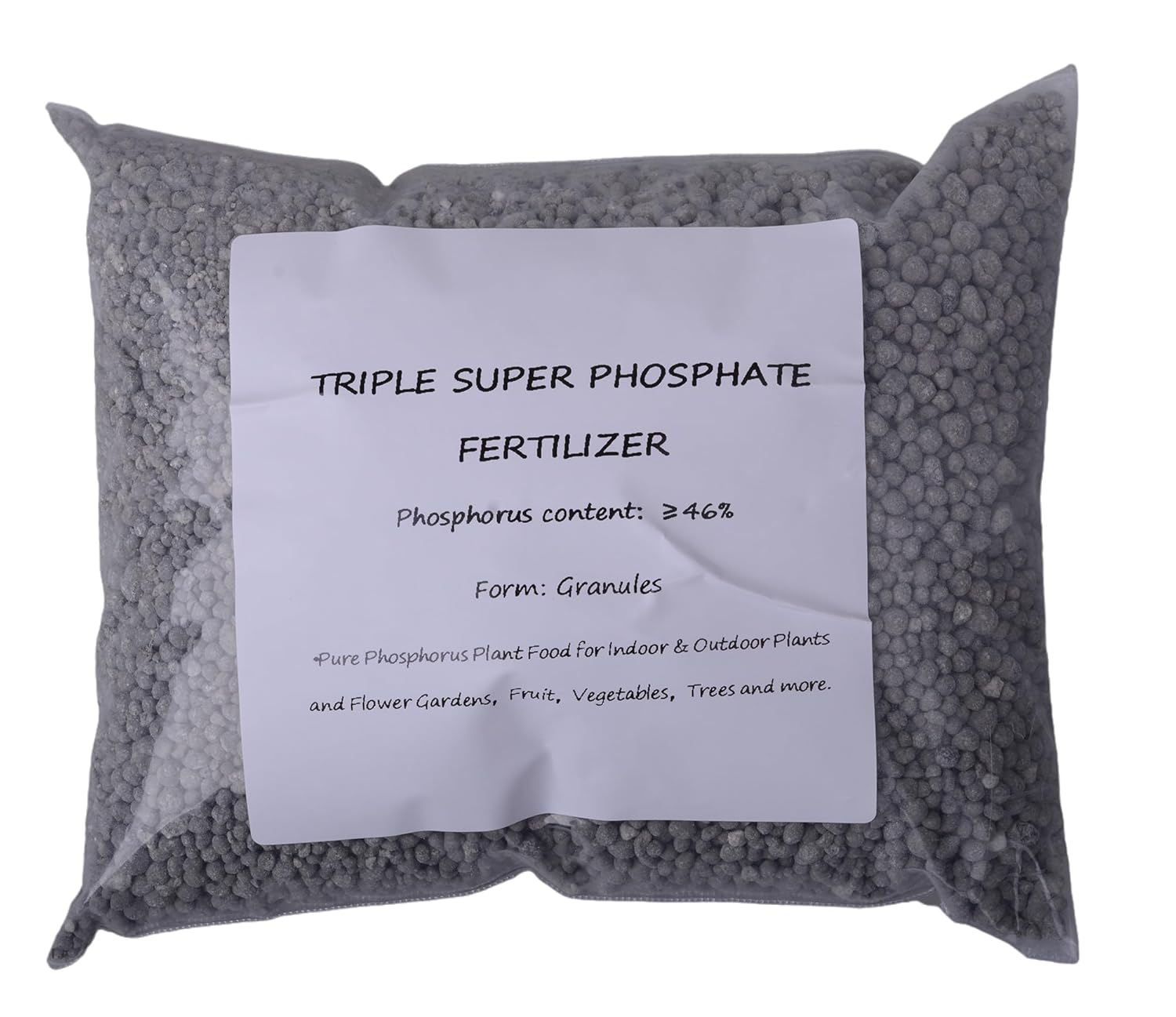
OULLYY Triple Super Phosphate Fertilizer (1.9 lb)
| Item Form | Granules |
|---|---|
| Specific Uses For Product | Plant Growth |
| Coverage | ½ lb.100 sq. ft. |
| Target Species | Flowers, Vegetables |
| Mixing Ratio | 0.5 lb/100 sq. ft. |
This granular triple super phosphate provides a high-phosphorus boost intended for flowers, vegetables, and general garden soil. It is applied to the top inch of soil at the manufacturer-recommended rate (0.5 lb per 100 sq. ft.) and watered in, with repeat applications every five to six weeks for continued bloom and fruit development. The product is simple to use for routine garden feeding and targets phosphorus-deficient gardens where stronger root development, flowering, and fruit set are the goals. As a single-nutrient source it works well when paired with a complete NPK fertilizer or organic amendment; it does not supply nitrogen or potassium so you should plan a balanced feeding program. The granular form is easy to measure and spread but requires careful placement to avoid overapplication in small beds. Overall it is a focused phosphorus supplement that fits into a planned fertilization schedule rather than functioning as an all-in-one plant food.
Best for: Gardeners on a budget who need a targeted phosphorus boost to improve blooms or fruit production and who plan to integrate it into a broader feeding routine.
Less Ideal for: People looking for an all-in-one or slow-release fertilizer or those who want an organic-certified product.
- High phosphorus concentration for improved flowering and fruit set
- Clear mixing and application ratio provided for easy dosing
- Granular form is easy to spread and incorporate into the topsoil
- Supplies only phosphorus so additional fertilizers are needed for balanced nutrition
- Not a slow-release formula so repeat applications are required
Verdict: A concentrated, easy-to-use phosphorus booster that delivers better blooms and fruit for gardeners who want an affordable targeted feed.
Supply Solutions 0-45-0 Triple Superphosphate Bloom Booster (5 lb)

| Item Form | Granules |
|---|---|
| Specific Uses For Product | Plant Growth, Root Development, Seed Development, Soil Conditioning |
| Mixing Ratio | 0-45-0 |
| Coverage | Full |
This granular 0-45-0 triple superphosphate is a targeted phosphorus booster aimed at improving root growth, bloom size, and fruit development. Gardeners typically use it as a starter or bloom feed for citrus, flowering shrubs, orchids, and transplanting—apparent uses include mixing with water for potted plants or broadcasting small amounts into garden beds and around tree root zones. The formula emphasizes phosphorus with added calcium to support cell strength and nutrient uptake, so you can expect sharper bud set and firmer fruit when applied according to directions. Practical benefits include straightforward dosing guidance for both indoor (tablespoons per gallon) and outdoor (cups per 100 sq ft) applications and compatibility with regular feeding schedules every 4 to 6 weeks during active growth. Important limitations are its narrow NPK profile that provides little to no nitrogen or potassium, so it should be used alongside a balanced fertilizer program rather than as an all-in-one feed, and safety precautions are needed when handling concentrated granules.
Best for: Citrus growers seeking a reliable, repeatable bloom and fruit booster who plan to integrate a phosphorus-specific feed into an established fertilization routine.
Less Ideal for: Beginners who want a single all-purpose fertilizer or gardeners looking for an everyday balanced NPK feed instead of a targeted supplement.
- Very high phosphorus concentration for strong bloom and fruit development
- Includes calcium to support cell strength and improve nutrient absorption
- Granular form is easy to measure and apply for both potted plants and garden beds
- Clear application rates for indoor and outdoor use
- Contains no appreciable nitrogen or potassium so it is not a complete fertilizer
- Requires careful handling and storage due to concentrated formulation
Verdict: Use this concentrated phosphorus booster when you want a dependable way to strengthen roots and increase bloom and fruit set on citrus as part of a broader fertilizing plan.
Easy Peasy Triple Super Phosphate Fertilizer 0-46-0 (Granules)

| Item Form | Granules |
|---|---|
| Specific Uses For Product | Lawns,Plant Food |
| Application Method | Work into the top six inches of the soil |
| Target Species | Cactus |
This triple super phosphate product supplies a concentrated source of phosphorus in a granular form for gardeners who want to boost bloom size and root development. It is typically worked into the top of the soil and applied every 6 to 8 weeks during the growing season to support flowering plants such as wisteria, fruit trees, and ornamentals. Notable features include a 0-46-0 analysis that provides one of the highest phosphate concentrations available and a slow-release granular form that reduces the risk of burning plant roots compared with liquid high-strength alternatives. Practical benefits are clearer: stronger root establishment, more prolific flowering when phosphorus is the limiting nutrient, and easy soil incorporation around established shrubs and vines. Important limitations are that it supplies phosphorus only, so nitrogen and potassium must be provided separately, and it will not correct other soil issues like pH or micronutrient deficiencies. Also, because it is high in phosphate it should be used according to soil test results to avoid excess buildup.
Best for: Gardeners focused on maximizing blooms and root strength for flowering vines and shrubs who will apply targeted phosphorus treatments as part of a broader feeding plan.
Less Ideal for: People seeking an all-in-one balanced fertilizer or a product to correct pH or micronutrient deficiencies should consider a different option.
- Very high phosphate concentration (0-46-0) for strong bloom and root promotion
- Granular slow-release form lowers burn risk and is easy to work into soil
- Recommended application interval (every 6–8 weeks) aligns with growing season needs
- Suitable for a wide range of flowering shrubs and vines that benefit from extra phosphorus
- Provides only phosphorus so other nutrients must be added separately
- Can contribute to phosphate buildup if used without soil test guidance
Verdict: Use this concentrated phosphate granule to push bigger blooms and stronger roots on wisteria and other flowering shrubs when phosphorus is the primary limiting nutrient.
Farmer's Secret Fruit Tree Booster Liquid Fertilizer (32 oz)

| Item Form | Liquid |
|---|---|
| Specific Uses For Product | Fruit Tree Care |
| Coverage | 1 teaspoon per gallon |
| Target Species | Apple, Banana, Peach |
| Unit Count | 32 Fluid Ounces |
This concentrated liquid fertilizer is formulated to strengthen roots and push fruit production for a wide range of fruit trees, including banana. It is mixed at 1 teaspoon per gallon and applied weekly as a soil drench around the drip line or as a foliar feed, which makes it easy to use with a watering can, sprayer, or irrigation system. The formula emphasizes higher phosphorus and includes macronutrients and trace minerals to support root expansion, disease resistance, and quicker nutrient uptake compared with granular products. One 32 oz bottle is highly concentrated so a small volume treats a full season for a mature tree, and the brand notes compatibility with young trees at higher per-feed rates. Practical limitations are that results depend on timing, tree age, and local conditions, and weekly applications may be more maintenance than slow-release granules. Also the label gives general guidance rather than crop-specific feeding charts for bananas, so growers wanting precise macronutrient ratios may prefer a product with an explicit NPK breakdown.
Best for: Growers focused on boosting fruit production and root development who are willing to follow a regular liquid feeding schedule and want quick nutrient availability for banana trees.
Less Ideal for: People who prefer low-maintenance, infrequent feeding or who need a fertilizer with an exact NPK label for tailored nutrient management.
- Highly concentrated formula stretches a 32 oz bottle across many feedings
- Phosphorus-rich blend aimed at improving root development and fruit set
- Usable as soil drench or foliar spray and compatible with irrigation systems
- Contains trace minerals in addition to NPK to support overall tree health
- No explicit NPK ratio listed on the provided specs for precise nutrient planning
- Requires weekly applications which can be more work than slow-release options
Verdict: A concentrated, phosphorus-forward liquid that gives banana growers a fast, professional-style boost to roots and fruit when used weekly.
Choosing the Right Phos Fertilizer: Key Factors to Consider
Phosphorus Concentration and NPK Balance
Phosphorus content determines how much product you must apply to reach target soil or tissue levels. Higher concentration products deliver more phosphorous per dose but require careful measurement to avoid localized over-application that can harm seedlings. Consider the complete NPK ratio since excess nitrogen or potassium can shift plant growth away from flowering or root development.
For gardeners growing edible crops, look for clear labeling of elemental P or available P2O5 so you can translate directions into actual nutrient amounts. Matching concentration to the scale of your garden reduces waste and simplifies scheduling for repeat applications.
Product Form and Application Method
Phos fertilizers come as water-soluble powders, granular amendments, liquid concentrates, and specialty gels. Each form affects how quickly phosphorus becomes available and how you apply it. Water-soluble and liquid forms are useful for quick corrections, foliar feeding, and greenhouse fertigation. Granular materials are better for slow-release needs and top-dressing beds.
Your preferred application method should align with plant type. Containers and hanging baskets benefit from soluble or liquid products, while in-ground beds and established trees often suit granules or incorporated amendments that provide longer-term supply.
Soil pH and Phosphorus Availability
Phosphorus availability is highly pH-dependent. In very acidic or alkaline soils, added phosphorous can bind to minerals and become unavailable to plants. Before applying a concentrated phosphorous product, test soil pH and correct extremes if needed so the fertilizer has the best chance of working.
If your soil has pH issues, choose products formulated for better availability in your pH range or pair fertilization with pH adjustments. Small, repeated applications are safer than one large dose when availability is uncertain.
Timing Relative to Plant Stage
Phosphorus is most valuable during root establishment, early vegetative growth, and the onset of flowering or fruit set. Applying a targeted phos fertilizer at transplant time or just before bloom helps plants allocate energy to roots and reproductive structures. Avoid heavy phosphorous applications late in the season when plants are entering dormancy.
Plan applications around transplanting and blooming windows. For container-grown seedlings, a lower-strength, soluble product fed more frequently prevents salt buildup while supporting roots.
Safety, Handling, and Environmental Considerations
Phosphorus can contribute to waterway pollution if it runs off into drainage systems. Choose formulations and application techniques that minimize runoff, such as incorporating granular products into soil and avoiding broadcast applications on slopes before heavy rain. Follow label safety directions to protect children, pets, and pollinators.
Consider packaging that limits dust and makes measuring easier. Products with clear dilution instructions reduce the risk of accidental over-application and environmental impact.
Interpreting Soil Test Results for Phosphorus
A soil test gives a practical picture of whether additional phosphorous is needed and how much. Labs report phosphorus in different units, so focus on the recommendation rather than trying to convert numbers without guidance. If a test indicates low available phosphorus, choose a product and scheduling approach that addresses immediate needs while keeping long-term buildup in mind.
For container gardeners, soil tests are still useful. Containers can show depletion faster than in-ground beds, and soluble phos products let you correct deficiencies quickly. For in-ground plantings, follow test-based application rates and favor methods that keep phosphorus near root zones to maximize uptake.
- Ask your lab what units they report and follow their recommended rates.
- For low phosphorus, prefer small, staged applications rather than a single heavy dose.
- Retest every one to three years to monitor changes after applications.
Application Techniques That Reduce Waste
Placement and timing matter more than total product in many cases. Banding fertilizer near the root zone at planting helps seedlings and transplants without broadcasting across the whole bed. When using liquids or soluble powders, apply after watering to reduce salt stress and improve movement into the root zone.
Avoid applying before heavy rain to reduce runoff risk. For slopes or sandy soils, incorporate granules into the soil rather than leaving them on the surface.
- Band or side-dress at planting for efficient uptake.
- Apply liquids after irrigation to carry nutrients into the root zone.
- Incorporate granular amendments in the planting hole for trees and shrubs.
Using Phos Fertilizer in Containers and Small Beds
Containers need careful dosing because salts build up faster than in open ground. Use water-soluble or liquid phos products at reduced concentrations and flush containers periodically to prevent accumulation. For established potted shrubs or vegetables, feed on a schedule that matches the crop's growth stage and avoid heavy single doses.
Small raised beds respond well to lighter, more frequent applications of soluble products, especially during bloom and fruit set. Choose products with clear dilution instructions and avoid mixes that raise nitrogen sharply unless you want immediate leafy growth.
- Reduce recommended dilution by half for tender seedlings and increase gradually.
- Flush containers with plain water once every few months if using concentrated feeds.
- Monitor plant response and adjust frequency rather than increasing dose size.
Environmental Best Practices
Phosphorus runoff contributes to algae growth in nearby water bodies. Minimize this risk by applying fertilizers close to plant roots, avoiding broadcast applications on bare soil, and scheduling applications for dry weather windows. Use buffer strips or cover cropping to trap any soil movement down slope.
Select products with minimal dust and clear handling instructions to reduce accidental spills. Store fertilizers in a dry, secure place and clean up any spills promptly to prevent unintended release into storm drains.
- Avoid applying before heavy rain or on frozen ground.
- Incorporate granular products to reduce surface runoff.
- Use vegetative buffers near waterways to catch sediment and nutrients.
Combining Phosphorus with Other Nutrient Practices
Phosphorus works in concert with nitrogen, potassium, and micronutrients. Test your soil and address major imbalances before treating phosphorus in isolation. Organic matter additions can improve phosphorus retention and root foraging, making moderate rates of phos fertilizer more effective over time.
If you use controlled-release or slow-release fertilizers, plan applications so phosphorus needs align with the release schedule. For crops with specific bloom or fruiting windows, use soluble products for short-term boosts and reserve granular or slow-release forms for maintenance.
- Add compost or well-rotted organic matter to improve nutrient retention.
- Match release schedules to crop nutrient demand.
- Avoid layering high-phosphorus products repeatedly in the same planting hole.
How We Chose the Best Phos Fertilizer
We focused on attributes that matter most when gardeners choose a phosphorous-focused fertilizer. Primary criteria included nutrient analysis and available phosphorous content so products deliver the intended P levels per application. We evaluated formulation and form because granules, water-soluble powders, and liquid concentrates behave differently in soil and in foliar or fertigation setups. Application flexibility was assessed by looking at recommended uses for containers, beds, and young transplants. Solubility and plant availability were important to ensure phosphorous becomes accessible to roots in a reasonable timeframe. Safety and handling considerations covered whether a product is safe around young plants, pets, and edible crops when used as directed. Packaging and dosing clarity were also reviewed since accurate measurement prevents over-application. We excluded products that were general all-purpose NPK blends without a clear phosphorous focus, experimental formulations with no use instructions, and any sources that rely solely on marketing claims rather than published nutrient analysis. The result is a list of products that meet practical garden needs and deliver measurable phosphorous where and when plants need it.
FAQ
How do I know if my soil needs a phos fertilizer?
A soil test is the most reliable way to determine phosphorus needs. Visible signs like poor bloom or weak root establishment can hint at deficiency, but those symptoms overlap with other problems, so testing avoids unnecessary applications.
Can I foliar-feed phosphorus for quicker results?
Foliar applications can supply small amounts of phosphorus quickly, but the element is not as mobile through leaves as nitrogen. Foliar feeding is useful as a short-term supplement, but soil applications are usually better for sustained root development.
Is it safe to use phos fertilizer on edible crops?
Yes, when you follow label directions and recommended rates. Choose formulations intended for edible plant use and observe pre-harvest intervals if listed. Avoid over-application to reduce the risk of residual buildup and environmental runoff.
How often should I apply a phosphorous-focused fertilizer?
Frequency depends on product form and plant needs. Soluble liquids may be fed every few weeks during active growth, while granular or slow-release products typically need only seasonal or annual reapplication. Base the schedule on soil tests and plant response.
Will adding phosphorus help a plant that is not flowering?
If the issue is phosphorus deficiency, targeted phosphorus can encourage bloom set. However lack of flowering can also result from excess nitrogen, inadequate light, or wrong timing, so diagnose the underlying cause before relying solely on phosphorus.
Can I mix phos fertilizer with other garden chemicals?
Compatibility varies by formulation. Water-soluble and liquid fertilizers are often mixed with compatible pesticides or micronutrients, but always follow label guidance and test a small batch first. Avoid mixing incompatible chemistries to prevent reduced effectiveness or plant damage.
Final Verdict
Choose a phos fertilizer based on measured need, plant stage, and how you plan to apply it. Prioritize products with clear nutrient analysis and dosing instructions so you can deliver the right amount of phosphorus without excess. Match the product form to your planting style: soluble options for quick corrections and containers, granular or slow-release for longer-term maintenance in beds and trees. With soil testing, careful placement, and attention to timing, you can strengthen roots and improve bloom without creating environmental risk.
