

Note: This article contains affiliate links. If you click on these links and make a purchase, I may earn a small commission at no extra cost to you. This helps support my research and content. Read my full affiliate disclosure here.
If fungal disease is stressing your garden, choosing the right organic fungicide for plants matters for plant health and long-term soil and beneficial insect balance. The wrong product can scorch foliage, harm pollinators, or leave residues that limit follow-up treatments. This guide shortlists the top five organic options suited to common home-garden situations and evaluates them on disease control and plant safety. We focus on practical application details, spectrum of control, and how each option fits into an integrated program. Read on to see which types of organic fungicides perform best for typical home, patio, and vegetable-garden problems and why they made the list.
Top Picks at a Glance
| Best Overall The best all-around choice for most situations | Bonide Captain Jack's Liquid Copper Fungicide Ready-to-Use, 32 oz |  |
| Best Quality Built to a higher standard if you want something more solid | Bonide Revitalize Biofungicide Concentrate, 16 oz |  |
| Best Value The sweet spot between price and what you get | Bonide Captain Jack Copper Fungicide 16 oz Concentrate |  |
| Most Popular A crowd favorite that many people choose with confidence | Bonide Captain Jack's Ready-to-Use Neem Oil Spray, 32 oz |  |
| Best Seller A high-volume bestseller chosen again and again | BioAdvanced Organics Neem Oil Spray, Ready-to-Use, 24 fl oz |  |
Bonide Captain Jack's Liquid Copper Fungicide Ready-to-Use, 32 oz

| Item Form | Spray |
|---|---|
| Unit Count | 32 Ounce |
| Active Ingredients | copper |
Bonide Captain Jack’s Liquid Copper Fungicide is a trigger-spray, ready-to-use copper treatment designed to control common fungal diseases such as black spot, powdery mildew, blight and peach leaf curl. It is applied by shaking and thoroughly spraying tops and undersides of leaves every 7 to 10 days or as needed, and the label allows application up to the day of harvest on listed edible plants. The product’s copper active ingredient makes it broadly effective against many foliar diseases and the convenient spray bottle removes the need to mix concentrates. Practical benefits include organic approval for many uses and clear directions for repeat treatments, which helps with consistent disease management. Important limitations are that it is a contact-style copper spray rather than a systemic cure, so thorough coverage and repeated applications are required for control, and care must be taken to follow label directions to avoid phytotoxicity on sensitive varieties.
Best for: Gardeners who prioritize established, proven solutions and want an organic-approved spray that controls common foliar diseases on roses and other plants with minimal setup.
Less Ideal for: Growers looking for a systemic fungicide or a single-application cure for long-term prevention should consider alternatives with systemic activity.
- Ready-to-use trigger spray for easy application without measuring or mixing
- Approved for organic gardening and label allows use up to day of harvest on listed edibles
- Effective copper active ingredient against a wide range of foliar fungal diseases including black spot
- Clear instructions for treatment interval make follow-up applications straightforward
- Contact-action copper requires thorough coverage and repeat sprays rather than a one-time systemic fix
- Potential for phytotoxicity on some sensitive plants if label directions are not followed
Verdict: A ready-to-use, organic-approved copper spray that provides reliable contact control of black spot and other foliar diseases when applied thoroughly and on schedule.
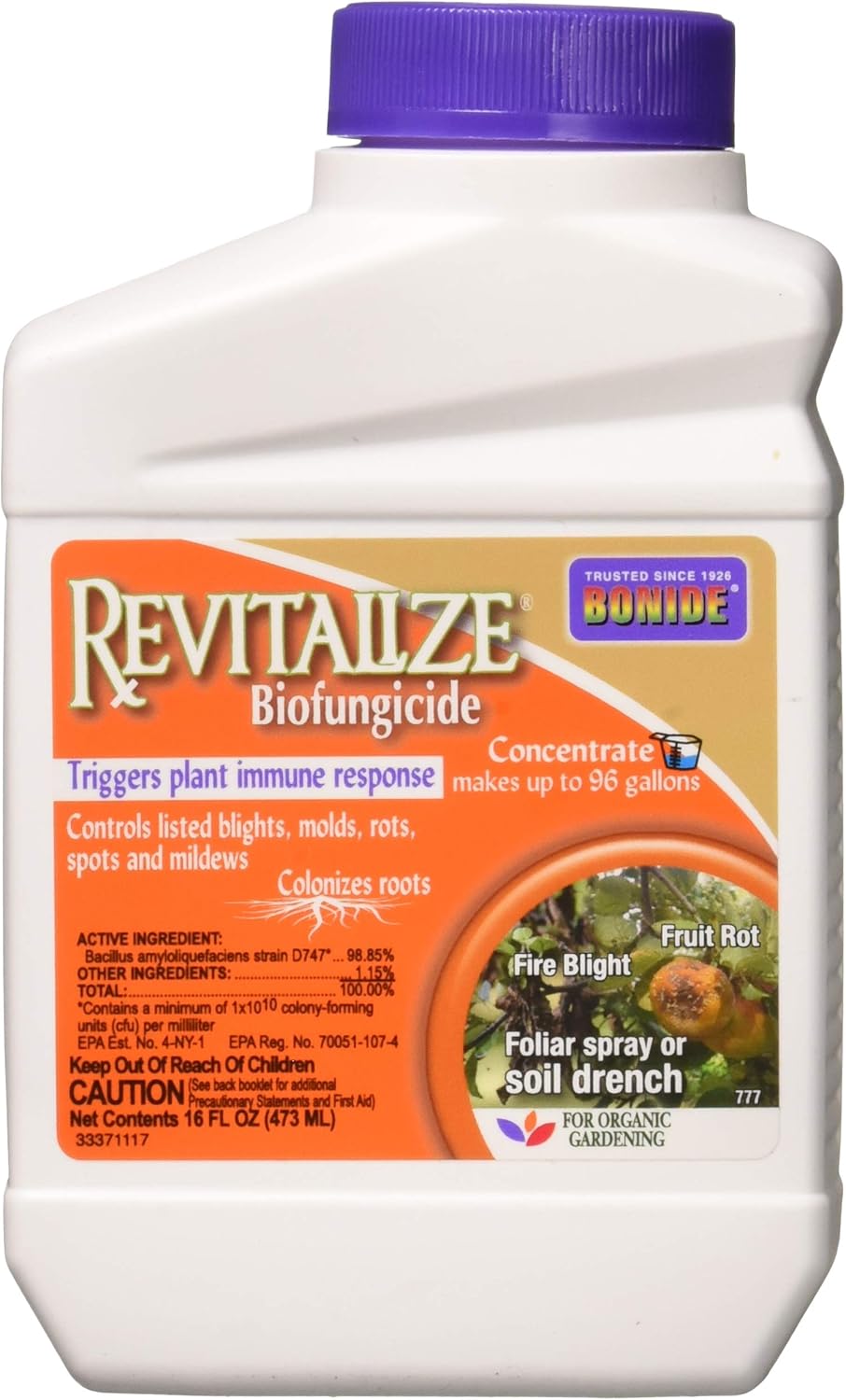
Bonide Revitalize Biofungicide Concentrate, 16 oz
| Unit Count | 16 Ounce |
|---|---|
| Item Form | Spray |
| Target Species | Disease |
| Included Components | Bonide Revitalize Bio Fungicide Concentrate, 16 oz |
Bonide Revitalize is a 16 oz concentrate that mixes with water to provide foliar spray or soil drench protection against many common fungal diseases. The active ingredient is a strain of Bacillus amyloliquefaciens, an approved biological control for organic gardening that helps induce plant defenses rather than relying on synthetic chemicals. You can use it on vegetables, fruits, nuts, ornamental trees, shrubs and houseplants and it can be applied up to the day of harvest when used as directed. A single bottle makes a large volume of spray, which is convenient for treating multiple plants or repeated applications across a growing season. Practical benefits include organic approval, flexibility of application methods, and top-to-bottom control for blights, mildews, spots and rots. Limitations are that results depend on correct mixing and timing and that biological controls often act more slowly than conventional fungicides, so they work best as part of a regular preventative program rather than as an instant cure for severe outbreaks.
Best for: Gardeners who prioritize organic, biologically based disease control and want a concentrated product they can use across vegetables, fruits and ornamentals as part of a preventative program.
Less Ideal for: Those needing a fast-acting, knockdown solution for an acute severe fungal outbreak or users unwilling to follow regular application schedules.
- Contains Bacillus amyloliquefaciens, an organic-approved biological active ingredient
- Versatile application as foliar spray or soil drench for many plant types
- Concentrated formula that mixes to make a large volume of spray
- Safe for use up to the day of harvest when label directions are followed
- Biological mode of action typically works slower than synthetic fungicides
- Effectiveness depends on proper mixing, coverage and application timing
Verdict: Choose this concentrate if you want an organic, bacteria-based fungicide to prevent and manage common plant diseases across edible and ornamental crops.
Bonide Captain Jack Copper Fungicide 16 oz Concentrate

| Unit Count | 16 Ounce |
|---|---|
| Item Form | Liquid |
| Target Species | Fungus |
| Active Ingredients | Copper Octanoate (Copper Soap) |
Bonide Captain Jack Copper Fungicide is a liquid concentrate designed to prevent and treat a broad range of fungal diseases on vegetables, fruits, ornamentals, and turf. Mixed with water per label directions, it is sprayed onto plant surfaces, including tops and undersides of leaves, and can be applied up to the day of harvest, which makes it practical for food crops like tomatoes. The active ingredient copper octanoate provides contact protection against powdery mildew, blight, black spot, rust, peach leaf curl and similar diseases. Application is straightforward and repeatable every 7 to 10 days as needed, and the product is cleared for use in organic gardening. Limitations to consider are that copper is a contact fungicide so it does not systemically move through the plant and works best as a preventative or early-treatment tool rather than curing severe systemic infections. Users should follow safety directions and avoid overuse to reduce copper buildup in soil.
Best for: Gardeners looking for a performance-focused, organic-approved fungicide to include in a preventative disease program for tomatoes and other edibles.
Less Ideal for: Growers seeking a systemic treatment for already advanced internal infections or those who prefer non-copper chemistries to avoid soil accumulation.
- Approved for organic gardening and can be used up to the day of harvest
- Controls a wide range of common diseases affecting tomatoes such as blight and powdery mildew
- Concentrated liquid formula mixes with water for spray application
- Repeatable 7–10 day application schedule makes preventative programs easy to maintain
- Acts as a contact fungicide and does not move systemically within the plant
- Repeated use can contribute to copper accumulation in soil if not managed
Verdict: Use this organic-approved copper concentrate when you want an effective, easy-to-apply preventative spray to protect tomatoes from common fungal diseases.
Bonide Captain Jack's Ready-to-Use Neem Oil Spray, 32 oz

| Item Form | Liquid |
|---|---|
| Target Species | Insects |
| Liquid Volume | 32 fluid ounces |
| Active Ingredients | Clarified Hydrophobic Extract of Neem Oil |
This ready-to-use neem oil spray is a multipurpose garden treatment that kills insects at all life stages while also serving as a miticide and preventative fungicide. Packaged in a 32-ounce trigger bottle, it is applied by shaking and thoroughly spraying plant surfaces, including leaf undersides, at the first sign of pests or disease and reapplying every 7 to 14 days as needed. The active ingredient is a clarified hydrophobic extract of neem oil, which is approved for organic gardening and labeled safe to use on vegetables up to the day of harvest. Practical benefits include broad pest coverage (aphids, whiteflies, spider mites and others), disease suppression such as powdery mildew, and convenience from a ready-to-use sprayer. Important limitations are that results are slower than synthetic contact insecticides and application timing matters to avoid leaf burn in full sun; repeated applications may be needed for heavy infestations. Follow label safety directions and keep the product away from children and pets.
Best for: Gardeners who want a single, organic-approved product to manage common vegetable garden pests and fungal problems and who prefer products with strong user feedback.
Less Ideal for: Growers needing rapid knockdown of severe infestations or commercial producers who require fast-acting, high-throughput treatments.
- Kills multiple pest stages including eggs, larvae and adults for more complete control.
- Also acts as a fungicide and miticide so one product covers pests and common fungal issues.
- Ready-to-use trigger bottle requires no mixing and is easy to apply to leaves and undersides.
- Approved for organic gardening and can be used on vegetables up to day of harvest.
- Slower-acting than many synthetic contact insecticides, so it may take several applications to see control.
- Must avoid spraying in peak sunlight to reduce risk of leaf burn.
Verdict: A convenient, organic-approved all-in-one neem spray that controls common vegetable garden pests and fungal issues with minimal fuss.
BioAdvanced Organics Neem Oil Spray, Ready-to-Use, 24 fl oz

| Unit Count | 24 Fluid Ounces |
|---|---|
| Item Form | Oil |
| Target Species | Spider |
| Specification Met | OMRI |
| Active Ingredients | Clarified Hydrophobic Extract of Neem Oil 0.9% |
This BioAdvanced Organics Neem Oil spray is a ready-to-use 3-in-1 treatment for home gardeners who need broad protection from both pests and common fungal diseases. The trigger bottle applies neem oil in a clarified hydrophobic extract formulation that kills eggs, larvae, and adults of listed insects such as aphids, whiteflies, and spider mites on contact while also helping prevent and control fungal problems like black spot, powdery mildew, and rust when used on a 7 to 14 day schedule. It is labeled for roses, flowers, vegetables, fruits and shrubs and can be used up to the day of harvest, making it suitable for edible gardens. Practical benefits include convenience of a pre-mixed spray, multi-target control in one treatment, and OMRI recognition for organic gardening. Limits to expect are that it is a contact-based product so full coverage is required for effectiveness and repeated applications are needed for prevention, and results can be slower than synthetic pesticides for heavy infestations. The bottle is best for small to medium gardens and spot treatments rather than large-scale applications.
Best for: Gardeners who want a single, organic-friendly spray to manage common insects and fungal issues on roses, ornamentals, and edible plants without mixing concentrates.
Less Ideal for: Those managing very large beds or commercial plantings who need high-volume coverage or fast knockdown from systemic synthetic products should consider concentrate or professional options.
- Ready-to-use trigger spray for easy application
- Combines insecticide, miticide, and fungicide action in one product
- Labeled for use on edible plants and permitted up to day of harvest
- OMRI listed formulation suitable for organic gardening
- Effectiveness depends on thorough coverage because it works primarily on contact
- Requires repeated applications on a regular schedule for disease prevention
Verdict: A convenient ready-to-use organic neem spray that gives home gardeners broad, multi-purpose protection against common insects and fungal diseases.
Choosing the Right Organic Fungicide for Plants: Key Factors to Consider
Spectrum of Pathogens Controlled
Different organic fungicides target different types of fungi and mildews. Some act broadly against a range of foliar diseases such as powdery mildew, downy mildew, and early blight, while others are effective only against specific pathogens. Knowing which pathogens commonly affect your plants helps you choose a fungicide that will actually reduce disease pressure.
Selecting a product with a wider spectrum can simplify treatment when multiple diseases appear at once, but broad-spectrum contact products may require more frequent reapplication. Conversely, more targeted options can be useful when a diagnosis is clear and you want to limit exposure to non-target organisms.
Plant Safety and Phytotoxicity
Organic does not always mean gentle on plant tissues. Some contact sprays can burn sensitive foliage if applied in hot sun or at too-strong a concentration. Different plant species and growth stages also vary in tolerance; seedlings and newly rooted transplants are usually more vulnerable.
Read and follow label dilution and timing guidance, avoid application during heat stress, and test-spray a single plant if you are unsure. Choosing a product with a proven low risk of phytotoxicity for the crops you grow reduces the chance of scorch or stunting.
Impact on Beneficial Insects and Soil Microbes
Many gardeners prioritize preserving pollinators and beneficial predatory insects. Some organic fungicides have minimal impact on above-ground beneficials when used as directed, while others can be harmful to bees or beneficial mites if sprayed during bloom or applied as dust.
Consider whether you will be treating flowering ornamentals or food crops in bloom, and opt for fungicides that have guidance for avoiding pollinator exposure. Also think about soil-applied or systemic options and how they might affect soil microbial communities; choose products labeled safe for soil health when root-associated microbes are a priority.
Application Method and Frequency
How a product is applied affects convenience and effectiveness. Contact sprays often require thorough coverage and repeat applications during wet weather, while systemic or translaminar products penetrate tissues and may provide longer residual protection.
Consider the size of the area you need to treat, whether you have sprayers already, and how often you can realistically reapply after rain. Ease of mixing, tank stability, and whether the product can be used through common sprayer types are practical points that influence daily garden use.
Residue, Preharvest, and Re-entry Intervals
If you grow edible crops, label directions for preharvest intervals and allowable use on food plants determine whether a fungicide fits your cropping plan. Some organic materials have zero or short preharvest intervals, while others require a wait before harvesting.
Also check re-entry intervals for personal safety and whether gloves or respirators are recommended. Lower-residue options can be applied closer to harvest or during active harvest periods with less disruption to garden routines.
Storage, Shelf Life, and Formulation Stability
Practical storage and how long a mixed spray remains effective matter for seasonal gardeners. Some concentrated formulations keep well for multiple seasons when stored properly, whereas others degrade faster or separate and require shaking.
Stability after dilution is also important if you mix only small amounts. Choose formulations with clear shelf-life guidance and stable emulsions or water-soluble powders if you store product between uses.
When to Use Contact Sprays Versus Systemic Options
Contact fungicides coat the plant surface and kill fungal spores on contact. They are generally best when you need rapid knockdown, when disease pressure is localized, or when you prefer minimal systemic uptake. Expect to reapply after heavy rain or new tissue growth because coverage is purely external.
- Contact sprays work well for quick suppression of powdery mildew and black spot on foliage.
- They require thorough coverage of both upper and lower leaf surfaces to be effective.
- Reapplication timing is critical during prolonged wet weather.
Integrating Fungicides Into Cultural Controls
Fungicides are most effective when combined with cultural practices that reduce disease pressure. Improving air circulation, pruning infected tissue, spacing plants properly, and avoiding overhead watering lower humidity around leaves and reduce the number of spray cycles needed. Use fungicides as one component of a plan rather than the sole solution.
- Water at the base of plants early in the day to let foliage dry.
- Remove heavily infected leaves promptly and dispose of them away from garden beds.
- Rotate crop families and practice good sanitation to limit recurring infections.
Safe Application Around Pollinators
To protect bees and other pollinators, avoid spraying during bloom or apply in the evening when pollinator activity is low. Some organic fungicides have low toxicity to pollinators but can still cause indirect harm if residues persist on floral surfaces. Read label guidance for bloom-time use and take extra care with flowering fruit trees and herb patches.
- Avoid spraying open flowers when bees are active.
- Target applications to foliage and stems rather than blossoms where possible.
- Use spot treatments rather than broad broadcasts when infestations are limited.
Using Fungicides on Edible Crops
Confirm that any product you use is labeled for edible crops and follow preharvest intervals to ensure safe harvests. Many organic options allow use up to harvest or have short waiting periods, but label instructions are the legal and safety standard. For salads and herbs harvested continuously, prefer low-residue products and consider withholding applications on blocks of plants meant for immediate harvest. Washing produce thoroughly reduces surface residues but does not substitute for label compliance.
- Check label for explicit edible-crop directions.
- Avoid treated areas for the recommended preharvest interval.
- Time applications to non-harvest windows when possible.
Managing Resistance and Treatment Rotation
Overreliance on a single mode of action can select for resistant pathogen strains. Even among organic fungicides, modes of action vary. Rotating products with different mechanisms or combining cultural tactics reduces selection pressure and prolongs efficacy. Document what you applied and when, and vary your approach annually or seasonally when disease pressure is persistent. If a product seems to lose effectiveness, reassess diagnosis and cultural conditions rather than simply increasing dose or frequency.
- Alternate modes of action across consecutive sprays.
- Avoid exceeding labeled rates in hopes of improved control.
- Pair chemical control with sanitation and resistant varieties when available.
How We Chose the Best Organic Fungicide for Plants
We prioritized products and formulations that are appropriate for home and small-scale garden use and that have documented efficacy against common fungal problems. Evaluation centered on measurable, gardener-relevant criteria: disease suppression across multiple pathogens, contact versus systemic action, crop and ornamental safety, ease of application and re-entry intervals, and compatibility with integrated pest management practices. We favored options with clear usage directions and label guidance for edible crops and pollinator safety. Exclusions included experimental compounds without established home-garden labeling, professional-only industrial formulations, and products lacking reputable efficacy data. We also excluded formulations with high reported rates of phytotoxicity when used at typical garden concentrations. The resulting shortlist emphasizes real-world reliability, safety for desirable insects, and straightforward application for home gardeners.
FAQ
Can I use organic fungicides on vegetables close to harvest?
Often yes, but it depends on the product. Many organic fungicides have short or zero preharvest intervals, but you must follow the label for each crop. When in doubt, allow the recommended wait time before harvesting.
Will organic fungicides harm bees and beneficial insects?
Some organic fungicides have low toxicity to pollinators when used correctly, but timing and method matter. Avoid spraying during bloom and use spot treatments to reduce exposure to beneficials.
How soon will I see results after applying an organic fungicide?
Results vary. Contact products can reduce visible spore loads quickly but may not reverse existing tissue damage. Systemic or translaminar materials may take several days to show reduced disease progression. Expect to follow label reapplication intervals for best control.
Can I mix different organic fungicides in the same spray tank?
Tank mixing is product-specific and depends on compatibility statements on labels. Some combinations are safe, while others cause phytotoxicity or reduced efficacy. Always perform a small jar test and follow label guidance.
How often should I reapply fungicide during wet weather?
Reapplication intervals are set on the label and often shorten under persistent wet conditions. Many contact products require treatment every 7 to 14 days or after heavy rainfall; check the label and adjust frequency accordingly.
Final Verdict
Prioritize the factors that match your garden situation: choose a broad-spectrum contact spray if quick suppression is needed and you can reapply after rain, or favor gentler systemic options when plant safety and longer residual control are more important. Protect pollinators by avoiding bloom sprays and pick products labeled for edible crops when treating vegetables. Balancing disease control, plant tolerance, and impact on beneficials will guide the right choice for most home gardeners. Use cultural controls first, then add appropriately labeled organic fungicides as part of an integrated program to manage disease while preserving garden health.
