

Note: This article contains affiliate links. If you click on these links and make a purchase, I may earn a small commission at no extra cost to you. This helps support my research and content. Read my full affiliate disclosure here.
If you regularly prune tall trees or large-diameter branches, a longest pruning saw can make reach and cutting power the priority. You want a saw that keeps you on the ground while still making clean, controlled cuts that protect tree health and reduce strain. This guide covers six shortlisted long-reach pruning saws suited to a range of backyard and orchard tasks. We focus on blade length, tooth geometry, handle ergonomics, and how each tool behaves in real gardening situations. Read on to understand the tradeoffs so you can pick a long pruning saw that matches the types of cuts and heights you face.
Top Picks at a Glance
| Best Quality Built to a higher standard if you want something more solid | Notch 18' Pole Saw Set with 15" Blade (40207) |  |
| Best Value The sweet spot between price and what you get | ZThrgran 30 ft Extendable Manual Pole Saw with Pruner Head and Carry Bag |  |
| Best Budget The cheapest option that still gets the job done reliably | BlumeTrec 11 ft Adjustable Manual Pole Saw with Alloy Steel Triangular Blade |  |
| Highest Rated A top-rated pick with lots of positive feedback | TONYINGO 3-in-1 Manual Pole Saw with Adjustable Fiberglass Handle |  |
| Most Popular A crowd favorite that many people choose with confidence | LETYANGER 7.3–27 ft Extendable Pole Saw and Pruner Kit |  |
| Best Seller A high-volume bestseller chosen again and again | SEESII 8-in-1 Cordless Pole Saw Combo (P6 Air) |  |
Notch 18' Pole Saw Set with 15" Blade (40207)

| Blade Length | 15 inches |
|---|---|
| Cut Capacity | Up to 8" |
| Blade Material | Alloy Steel |
| Handle Material | Fiberglass |
| Power Source | Manual |
This Notch pole saw set is a straightforward, professional-style tool for cutting high branches without a ladder. It ships with three 6-foot interlocking fiberglass poles that twist and lock together to reach about 18 feet, and a 15-inch chrome-plated blade with impulse-hardened, tri-edge teeth rated to cut branches up to roughly 8 inches thick. In use the light, commercial-grade fiberglass poles make it easy to hold and position the saw overhead while the serrated blade and hook help pull and pull-cut smaller limbs efficiently. Assembly is simple thanks to the twist-and-lock connectors and the blade is designed to stay sharp longer because of the hardened teeth and rust-resistant plating. Limitations are that it is manual so large-diameter limbs require more effort and control, and the hollow fiberglass poles should not be used near energized lines or left to retain moisture. For pruning tall deciduous trees and routine canopy cleanup it performs like a pro-grade extension saw, but it is not a substitute for powered saws when tackling very thick or dead wood.
Best for: Buyers who prioritize reliable cutting performance and professional-grade reach for overhead pruning and routine canopy maintenance and who prefer a durable manual tool over powered equipment.
Less Ideal for: People who need to cut large, very thick trunks regularly or who prefer powered, faster-cutting solutions for heavy commercial removal work.
- Extends to about 18 feet using three interlocking 6-foot fiberglass poles for high reach without ladders
- 15-inch chrome-plated blade with impulse-hardened, tri-edge teeth for durable, long-lasting cutting performance
- Serrated blade and hook design aid in pull-cutting and controlling branches
- Twist-and-lock pole connectors allow quick assembly and the option to use 1, 2, or 3 poles
- Manual operation requires significant physical effort on thick limbs compared with powered saws
- Poles are hollow and can retain moisture so they are not safe near energized lines
Verdict: A professional-grade manual pole saw that delivers long reach and a durable 15" impulse-hardened blade for reliable overhead pruning.
ZThrgran 30 ft Extendable Manual Pole Saw with Pruner Head and Carry Bag

| Power Source | hand powered |
|---|---|
| Other Special Features of the Product | Extendable, Lightweight, Non-Conductive, Detachable |
| Blade Material | Carbon Steel |
| Handle Material | Fiberglass |
| Included Components | 6 poles, saw head, pruner head, spare blade, carry bag |
This ZThrgran pole saw is a lightweight, six-section fiberglass system designed to reach tall limbs without a ladder. It assembles by hand with metal screw joints and accepts either the hooked saw head or the pruning shear head included in the kit. In practice you extend only the sections you need, lean the pole against the trunk to offload force, and use a pull-only sawing motion for safe cuts at height. The carbon steel saw blade is thin and sharp for efficient cutting and a spare blade is provided for longer use. Non-conductive fiberglass reduces electrical risk when working near lines, and the carry bag keeps the poles and heads together for transport. Expect some flex at full extension and the usual need to re-tighten the threaded joints after cuts; the pole is more stable than many 8–9 section designs but still requires care when fully extended. This set is a practical, ladder-free solution for pruning palms, pines, and common yard trees when paired with safe technique.
Best for: Buyers who want a practical, ladder-free pruning solution for routine home tree and shrub maintenance and who value a complete, portable kit that minimizes fatigue.
Less Ideal for: Not the best choice for professionals who need motorized power for very large limbs or for users who expect rigid, vibration-free performance at maximum reach.
- Reaches up to 30 ft with six detachable fiberglass sections for ladder-free trimming.
- Includes both saw head and pruning scissors plus a spare blade and carry bag for a complete kit.
- Fiberglass poles are non-conductive to lower electrical risk when used cautiously near lines.
- Carbon steel blade is thin and sharp for effective cutting and long service life.
- Fewer sections than many competitors reduces wobble and overall weight.
- Threaded metal joints require frequent hand re-tightening and can loosen with vibration.
- Some noticeable flex at full extension limits precise control on heavy limbs.
Verdict: A lightweight, six-section fiberglass pole saw kit that gives practical 30 ft reach and a complete set of heads for ladder-free home pruning.
BlumeTrec 11 ft Adjustable Manual Pole Saw with Alloy Steel Triangular Blade
| Power Source | Manual |
|---|---|
| Other Special Features of the Product | Adjustable Length, Anti-Slip Grip, Extendable, Lightweight |
| Blade Shape | Triangular |
| Blade Material | Alloy Steel |
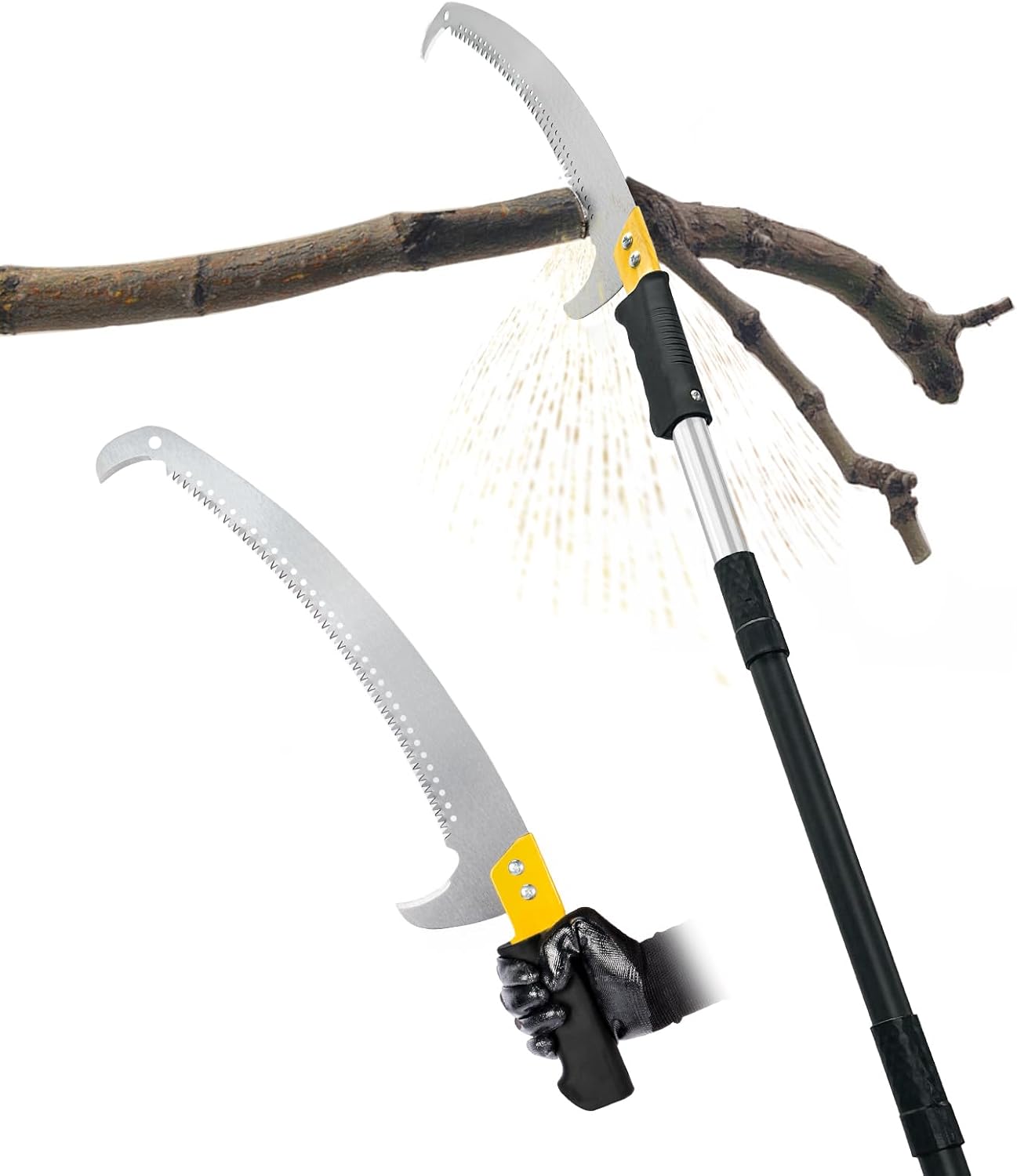
The BlumeTrec manual pole saw is a budget-friendly, extendable pruning tool designed for reaching and cutting higher branches from the ground. It ships as detachable pole sections that lock together to form an 11 foot reach, letting you shorten it for close work or assemble more sections for taller trees. The triangular alloy steel blade with double-sided barbs bites into wood for relatively quick, clean cuts without power, and the powder-coated steel poles resist rust. Practical features include an anti-slip grip for better control and an extra screw that secures the saw head to reduce loosening during use. Expect light weight and easy handling, which helps with longer sessions and makes it accessible to a wide range of users. The main limitations are that it is manual so cutting very thick limbs requires significant effort and the plastic handle and simple locking system do not feel as heavy duty as pro models. For routine pruning of small to medium branches where you want to avoid ladders, this provides straightforward performance at a low cost.
Best for: Homeowners looking for an inexpensive way to prune small to medium branches from the ground without using ladders and who prioritize low cost and easy storage.
Less Ideal for: People who need to cut large, hardwood limbs regularly or professional landscapers who require heavier duty, long-lasting commercial tools.
- Adjustable modular pole lets you configure reach for near or higher branches
- Alloy steel triangular blade with double-sided barbs for secure, efficient cuts
- Powder-coated steel poles reduce rust and increase durability
- Lightweight design and anti-slip grip reduce user fatigue during extended use
- Manual cutting requires significant effort on larger diameter limbs
- Plastic handle and basic locking hardware feel less robust than professional-grade poles
Verdict: A low-cost, easy-to-use extendable pole saw that lets homeowners prune higher branches from the ground without ladders.
TONYINGO 3-in-1 Manual Pole Saw with Adjustable Fiberglass Handle

| Power Source | Manual |
|---|---|
| Blade Material | Alloy Steel |
| Handle Material | Fiberglass |
| Included Components | Bag, Double-hook Saw, Fiberglass Pole, Gloves, Tree Pruner |
This TONYINGO pole saw is a practical long-reach pruning tool that extends by connecting multiple fiberglass sections to reach high limbs without a ladder. It is typically used from the ground to saw large branches with the double-hook saw head or to snip smaller twigs with the pulley-assisted pruner, and it also works as a hand saw for low branches. Notable features include a three-pulley cutting system that reduces effort when using the pruning head, a three-sided curved saw blade with fast chip removal to prevent binding, and aluminum joints that lock sections together. The lightweight fiberglass poles make the rig easier to hold at full extension and resist rust, while the included carry bag and gloves improve portability and storage. Important limitations are that it is a manual tool so very thick trunks require repeated effort and that long extended reach can amplify wobble if not braced, so careful handling is needed for precise cuts at maximum length.
Best for: Buyers who prioritize a dependable, nonpowered long-reach tool for routine tree maintenance and prefer a lightweight, low-maintenance solution they can use from the ground.
Less Ideal for: People who need a motorized solution for heavy commercial pruning or who frequently cut very large trunks should consider power pole saws or professional services instead.
- Adjustable reach via multiple fiberglass sections to trim high branches from the ground
- Two interchangeable heads: double-hook saw for larger limbs and pulley-assisted pruner for thinner branches
- Pulley system and sharp pruning scissors reduce cutting force for easier high cuts
- Three-sided curved saw blade with chip-removal slot reduces binding for smoother sawing
- Lightweight, rust-resistant fiberglass construction improves handling and storage
- Manual operation requires significant physical effort on very large or dense branches
- Extended length can feel wobbly and harder to control without practice
Verdict: A reliable, lightweight manual pole saw that reaches high branches and combines a saw and pulley-assisted pruner for versatile ground-level tree trimming.
LETYANGER 7.3–27 ft Extendable Pole Saw and Pruner Kit

| Power Source | Manual |
|---|---|
| Blade Material | Alloy Steel |
| Handle Material | Epoxy Resin |
| Number of Teeth | 10 |
| Unit Count | 7 Count |
This LETYANGER pole saw kit is a complete manual solution for trimming higher branches without a ladder. It assembles from seven interlocking epoxy resin poles with aluminum alloy joints to create reach from about 7.3 to 27 feet, and the kit includes a saw head, a pruner head with pulley, a spare saw in a sheath, and a carry bag. The alloy steel blade and hook make cutting and clearing small limbs straightforward, while the pruner with pulley helps reduce the effort required to cut crossing branches. In real use the system is best for routine pruning on yards and small landscape trees up to roughly 20 feet because the full 27 foot extension becomes heavy and harder to control. The included carry bag keeps parts organized and the spare blade is a practical backup if the saw binds. Expect to need reasonable upper-body strength and take care with balance at full extension, but for homeowners who prefer a nonpowered, serviceable tool this kit offers reach, useful accessories, and clear assembly.
Best for: Home gardeners who want maximum reach from a single nonpowered kit and prefer a complete set of poles and cutting heads for routine tree pruning without using a ladder.
Less Ideal for: People who need frequent, fast pruning on large trees or who want a lightweight one-handed tool for quick jobs should consider a powered pole saw or shorter single-piece poles instead.
- Extends to about 27 feet using seven interlocking poles for significant reach
- Includes both a saw head and a pruner head with pulley plus a spare saw and sheath
- Alloy steel blade and aluminum alloy joints for improved durability over basic carbon steel designs
- Carry bag keeps components organized for transport and storage
- At full 27 ft extension the assembly is heavy and can be difficult to control for many users
- Manual operation requires physical effort and is slower than powered alternatives
Verdict: Choose this kit if you want a complete, nonpowered pole saw system that gives very long reach and useful pruner accessories for steady at-home tree trimming.
SEESII 8-in-1 Cordless Pole Saw Combo (P6 Air)

| Power Source | Battery Powered |
|---|---|
| Horsepower | 600 watts |
| Chain Speed | 26/ft/s |
| Included Components | 2×4000mAh batteries; mini chainsaw; hedge trimmer; pruning shears; extension pole |
The SEESII P6 Air is a multihead cordless pole saw kit designed to replace several garden tools with one extendable system. It uses two 4000mAh batteries that the brand says can deliver long runtimes and powers a 6-inch chainsaw head capable of cutting branches up to about 6 inches thick. The kit includes a 12-inch hedge trimmer, grass shears, pruning head and an extendable pole with a rotating head so you can trim high branches and awkward angles without a ladder. Notable practical features are the automatic chain oiling and one-touch tensioning for the chainsaw plus a brushless pruner motor for better durability. For everyday use it streamlines hedge shaping, limb pruning and edge trimming while saving storage space compared with separate tools. Limitations to expect are the compact 6-inch chain which restricts it to small-to-medium branches and the overall weight when the pole is extended can become tiring during long overhead work despite the ergonomic grip.
Best for: Buyers who want one versatile long-handle system to handle routine tree pruning, hedge shaping and lawn edging without buying separate tools and without using ladders.
Less Ideal for: Arborists or users who need to cut large-diameter timber or who require a very lightweight handheld trimmer for frequent, extended overhead use.
- All-in-one kit replaces multiple tools and shares batteries to simplify storage and workflow
- Two 4000mAh batteries extend runtime for longer sessions without frequent recharges
- Extendable pole with 180° rotation and 4-position hedge head reaches high and awkward spots without a ladder
- Automatic chain oiling and one-touch chain tensioning reduce maintenance and downtime
- Brushless pruner motor offers stronger cutting performance and longer motor life
- 6-inch chainsaw bar limits cutting to small-to-medium branches and not large tree work
- Pole plus attachments add bulk and can feel heavy during prolonged overhead use
Verdict: If you want a single long-handle system that covers pruning, hedge trimming and edging with generous battery runtime, this SEESII 8-in-1 combo is a practical all-in-one choice.
Choosing the Right Longest Pruning Saw: Key Factors to Consider
Blade Length and Practical Reach
Longer blades increase the maximum branch diameter you can cut and reduce the need for ladders, but usable reach depends on both blade length and how comfortably you can position your body and arms. Consider how close you can safely get to the tree trunk or branch base; a very long blade may be harder to control at awkward angles.
A blade that is long but too flexible will bend under load and make precise cuts difficult. Look for blades that balance length with sufficient stiffness for the kinds of branches you plan to prune. For overhead work, think about how reach interacts with your vertical clearance and sightlines so you can make safe cuts while maintaining proper technique.
Tooth Geometry and Cut Quality
Tooth shape, size, and set determine whether the saw rips quickly or slices cleanly. Coarse, aggressively set teeth remove material fast and are useful on green or fibrous wood, but they can leave a rough wound. Finer tooth patterns produce smoother cuts that heal faster, which is preferable on ornamental trees and pruning where wound closure matters.
Also consider whether the teeth are filed for raking or slicing action; some long pruning saws use alternating teeth designed to clear chips on long pulls, which reduces clogging and makes long cuts more efficient. The tooth design should match the species you cut most often, whether softwood, hardwood, or mixed.
Handle Design and Control
A long pruning saw needs a handle that gives secure purchase and good control. Ergonomic grips reduce wrist and forearm fatigue when sawing at awkward angles or overhead. Look for handles shaped to prevent slipping and to keep blade alignment consistent with your forearm during long strokes.
Some handles include features like finger grooves, non-slip rubber, or a pronounced pommel to prevent the hand from sliding. If you frequently use the saw overhead, a handle that offers a good two-handed grip or compatibility with a removable pole should be considered even if you plan to use it as a handheld tool.
Weight, Balance, and Fatigue
Long blades increase torque and can make the tool feel heavy at the tip, which amplifies user fatigue and reduces cutting precision. A well-balanced saw distributes mass toward the handle so you can control the blade without excessive wrist strain. Lighter blades often reduce fatigue but can sacrifice stiffness.
Consider how long typical jobs last and whether you will be making many cuts in a session. For repetitive orchard or hedge work, prioritize a balance that keeps the blade stable while minimizing arm and shoulder strain. If you need the extra reach occasionally, a slightly heavier but stiffer blade may be acceptable; for frequent use, favor lighter, better-balanced designs.
Blade Material and Corrosion Resistance
Long pruning saw blades are exposed to sap, moisture, and outdoor storage, so material choice affects edge retention and longevity. High-carbon steels can hold a sharp edge and are easier to refile, but they may rust if not cleaned and oiled. Stainless alloys resist corrosion but sometimes need more frequent sharpening.
Consider whether you will be able to maintain the blade in the field. Blades with protective coatings or high-grade stainless compositions reduce maintenance and keep cutting performance consistent over seasons. Also look at how the blade is attached to the handle and whether the construction resists loosening and corrosion at the joint.
Scabbard, Transport, and Storage
A long pruning saw requires safe transport and storage to protect the teeth and prevent injury. A rigid scabbard or sheath guards the blade teeth and can be clipped to a belt or tool bag for easy access. Consider how compact the saw becomes in its sheath and whether it can be safely carried on a ladder or in a vehicle.
Also think about storage conditions; if you keep tools outdoors, rust-resistant materials and a protective sheath prolong life. Accessibility matters in workflows: a well-designed scabbard makes the saw quick to deploy and reduces the chance of accidental damage to other tools.
When a Longer Handheld Saw Is Better Than a Pole Saw
A long handheld pruning saw gives you more tactile feedback and cutting control than a pole-mounted unit. When branches are within comfortable reach and you can position your body safely, a handheld long saw lets you feel the blade bite and adjust stroke pressure to produce cleaner cuts.
Handheld long saws are also simpler to maintain and often lighter overall than pole saw setups. They work well for selective pruning, shaping, and situations where you need precise cuts close to the trunk without the bulk of a pole system.
- Better control for precise cuts and selective pruning
- Easier to sharpen and maintain than some pole saw attachments
- Lower setup complexity for quick jobs above shoulder height
Techniques for Safer Overhead Cutting
Position your feet for stable balance and avoid reaching so far that your shoulders are overloaded. Keep your body slightly to the side of the cut zone so falling debris is less likely to hit you. Always plan the cut so the branch falls safely away from you and not toward power lines or structures.
Use controlled strokes that let the teeth clear chips between pulls. If a cut is binding, ease pressure and reposition the blade rather than forcing it. Wearing eye protection, a hard hat, and gloves reduces injury risk from falling twigs and sharp tooth tips.
- Stand on solid ground or a stable ladder with a helper if needed
- Make relief cuts on larger branches to avoid bark tearing
- Cut in stages for very large branches instead of one long cut
Maintaining a Long Pruning Saw in the Garden
After use, remove sap and debris with a stiff brush and wipe the blade dry. Lightly oiling the blade before storage reduces rust and keeps the teeth in good condition. If teeth become dull, some long saw blades can be sharpened with a file, while others are best replaced when worn.
Inspect the handle and blade attachment regularly for looseness or corrosion. Replace or tighten fasteners as needed to maintain a secure connection. Proper maintenance extends the life of a long pruning saw and keeps cuts cleaner, which benefits plant health.
- Clean sap after each use and dry fully before storing
- Light oil layer prevents rust during outdoor storage
- Sharpen or replace blade when cutting becomes slow or ragged
Matching Saw Tooth Pattern to Tree Species
Different tree species and wood conditions respond better to specific tooth patterns. Coarser teeth excel on softwoods and very green wood because they remove material quickly; finer teeth are preferable for hardwoods and ornamental pruning where a smooth wound matters.
If you encounter a mix of species, choose a tooth pattern that offers compromise performance or consider carrying a spare blade with a different tooth profile. For abrasive or knotty wood, teeth with a stronger tooth face and backing resist chipping and maintain cutting speed.
- Coarse teeth for fast removal on soft, green wood
- Fine teeth for smooth cuts on hardwood and ornamental trees
- Reinforced tooth faces for knotty or abrasive species
Transport and On-Site Safety Tips
When moving between job sites or around the yard, keep the blade covered and point the saw down and away from your body. Secure the scabbard so it does not snag on branches or equipment. If you carry multiple tools, arrange them to avoid contact between blades.
On-site, keep bystanders and pets away from the cut zone. Clear the area beneath the branch before cutting and communicate with helpers about where debris will land. These simple precautions reduce the chance of accidents during pruning work.
- Always use a scabbard for transport
- Keep the cutting area clear of people and animals
- Store saws safely when not in use to prevent accidental injury
How We Chose the Best Longest Pruning Saw
We selected the six Longest Pruning Saws by focusing on practical dimensions and real-world gardening demands. Primary filters included blade length and usable cut capacity, because a long blade only helps if it can penetrate and control the target branch. We evaluated tooth geometry and set pattern for cut speed and smoothness, plus blade material and heat treatment for edge retention and corrosion resistance. Handle ergonomics and grip design were judged for comfort during extended use and for secure control when cutting overhead. We also considered saw weight and balance, since excessive length can amplify fatigue and reduce accuracy. Durability factors such as rivet and tang construction were part of the assessment to ensure the saws survive outdoor conditions. Excluded items were short pruning saws and pole-mounted saws that require separate poles; the list focuses on long-handed and extended-length handheld pruning saws. We prioritized tools that deliver predictable cuts in garden, orchard, and landscape situations rather than one-off specialty implements.
FAQ
How long should a pruning saw blade be for tall backyard trees?
Blade length depends on branch diameter and how far you need to reach. For most tall backyard trees, a blade between 12 and 20 inches handles many tasks. Extremely long blades are useful for large-diameter limbs but can be harder to control.
Can I sharpen a long pruning saw blade at home?
Often you can sharpen long pruning saw teeth with a suitable file, but the process depends on the tooth profile and steel hardness. Some blades are easier to refile than others; inspect the teeth and practice on a spare or seek professional sharpening for complex patterns.
Is a heavier long saw better for cutting big branches?
Heavier blades can offer more stiffness and assist through a cut, but they also increase fatigue and tip torque. Balance matters more than raw weight; a well-balanced saw with adequate stiffness usually outperforms a heavier, poorly balanced one for extended work.
Should I use a long handheld saw or a pole saw for high branches?
It depends on access and the type of cut. Use a long handheld saw when you can safely reach with good control and need precise cuts. Choose a pole saw when the branch is out of safe reach or when you need extra extension, keeping in mind pole saws have different maintenance and control tradeoffs.
How often should I clean and oil my pruning saw?
Clean sap and debris after each use and apply a light coat of oil before storing, especially if you store tools outdoors or in humid conditions. Regular cleaning prevents rust and keeps the blade cutting well over time.
Final Verdict
Choosing a longest pruning saw is a balance between reach and control. Prioritize a blade length that meets your maximum cut needs while maintaining stiffness and manageable balance. Pay close attention to tooth pattern, handle ergonomics, and material durability because those features determine cut quality and how comfortable the saw is during repeated overhead work. If you weigh reach against fatigue and maintenance requirements, you can pick a long pruning saw that keeps you safer and produces cleaner cuts season after season.
