

Note: This article contains affiliate links. If you click on these links and make a purchase, I may earn a small commission at no extra cost to you. This helps support my research and content. Read my full affiliate disclosure here.
If you prune trees, tall shrubs, or hedgerows, the right pole pruning saw changes how quickly and cleanly you finish jobs and how safe you feel while working aloft. A good pole pruning saw helps you reach high limbs without a ladder, makes cleaner cuts that heal faster, and reduces fatigue so you can work longer sessions around the yard. This guide covers seven shortlisted pole pruning saws that performed well for common home and small-acreage pruning tasks. We evaluate them on cut quality, reach and control, weight and balance, and durability so you can pick one matched to the plants and access challenges in your outdoor space.
Top Picks at a Glance
| Best Overall The best all-around choice for most situations | Supstable S5 Sky 2‑in‑1 Cordless Pole Saw and Mini Chainsaw with 16 ft Reach |  |
| Best Quality Built to a higher standard if you want something more solid | Corona TP 6870 RazorTOOTH 14-ft Dual-Compound Tree Pruner |  |
| Best Value The sweet spot between price and what you get | Walensee 14 ft 2-in-1 Pole Saw with Triple-Ground Tooth Blade |  |
| Best Budget The cheapest option that still gets the job done reliably | JAOTREL 7.5 ft Extension Pole Saw with Stainless Steel Blade |  |
| Highest Rated A top-rated pick with lots of positive feedback | Veebuyla 26ft Telescoping Manual Pole Saw with 24" Detachable Blade |  |
| Most Popular A crowd favorite that many people choose with confidence | SEESII P6 Plus 2-in-1 Cordless Pole Saw and Mini Chainsaw (6" Bar) |  |
| Best Seller A high-volume bestseller chosen again and again | BlumeTrec 14.5 ft Manual Pole Saw with Mn Steel Blade and Adjustable Sections |  |
Supstable S5 Sky 2‑in‑1 Cordless Pole Saw and Mini Chainsaw with 16 ft Reach

| Power Source | Battery Powered |
|---|---|
| Horsepower | 800 watts |
| Chain Speed | 30ft/s |
| Batteries Included | 2 × 4000mAh |
| Auto Lubrication | 30ml tank with window |
The Supstable S5 Sky combines a handheld 6-inch mini chainsaw with an extendable pole saw that reaches up to 16 feet, letting you trim high branches from the ground without a ladder. It uses a brushless motor and comes with two 4.0Ah batteries, which the manufacturer states provide extended runtime for larger yards and continuous work. Practical features include an automatic chain oiler with a transparent window, tool-free chain tensioning, and a 180 degree adjustable cutting head for angled cuts. The kit ships with an extra 8-inch bar, spare chain, gloves, goggles, and a charger so you have the consumables and safety gear to start working right away. For routine pruning, storm cleanup, and small firewood cutting the tool is convenient and reduces setup time compared with gas saws. Expect battery runtime and cutting power to limit very heavy cutting compared with full-size gas chainsaws, and the telescoping pole adds some leverage and balance challenges when fully extended. The unit is best for homeowners who want safer overhead trimming without climbing and who value the included accessories and maintenance conveniences.
Best for: Homeowners who want a safer way to prune tall branches and maintain trees without climbing or renting specialty equipment, and who prefer a ready-to-use cordless kit with batteries and safety accessories.
Less Ideal for: Arborists, professional landscapers, or anyone who regularly cuts large diameter hardwoods and needs continuous heavy-duty power from a gas or professional-grade electric saw.
- Two-in-one design lets you use it as a handheld mini chainsaw or a telescopic pole saw up to 16 feet
- Includes two 4.0Ah batteries for extended cordless runtime
- Automatic chain lubrication and transparent oil window reduce maintenance guesswork
- Tool-free chain tensioning and adjustable 180° cutting head simplify on-the-job adjustments
- Comes with extra bar, spare chain, gloves, goggles, and charger for immediate use
- Less cutting power and shorter continuous runtime than full-size gas chainsaws for very large or dense wood
- Long telescopic pole can feel unwieldy and harder to control when fully extended
Verdict: If you want a single cordless tool that replaces a small chainsaw and a pole saw for homeowner pruning, this complete kit delivers reach, convenient maintenance, and ready-to-use batteries and accessories.
Corona TP 6870 RazorTOOTH 14-ft Dual-Compound Tree Pruner

| Blade Material | Alloy Steel |
|---|---|
| Handle Material | Fiberglass |
| Blade Length | 13 inches |
| Number of Teeth | 6 |
| Cutting Capacity | Up to 1.25 inches |
The Corona TP 6870 is a professional-style telescoping pole pruner built for high-effort pruning tasks where cutting speed and reach matter. The fiberglass pole extends from about 7 to 14 feet and uses a twist-lock for quick length adjustment while a foam grip and powerglide rope pull give comfortable control when operating the heavy-duty die-cast zinc alloy pruning head. The chain-drive dual-compound pulley multiplies cutting force so the heat-treated alloy steel cutting blade and hooked head can slice through limbs up to 1.25 inches in diameter, and the 13-inch curved RazorTOOTH saw is impulse-hardened for faster, longer-lasting cuts on thicker wood. Practical benefits include faster sawing, reduced wrist effort when pulling, and reach for high or awkward branches without a ladder. Limitations to expect are the single cutting capacity (not for very large limbs), the need for physical rope pulling which can fatigue on long jobs, and a corded electric power source listed for the model that may be confusing for buyers who expect a purely manual pole pruner.
Best for: Buyers who prioritize cutting performance and reach for frequent or professional pruning jobs and want a robust tool that speeds through moderate-diameter branches without using a ladder.
Less Ideal for: Casual gardeners who rarely prune, those who need to cut large-diameter limbs, or users who prefer a purely battery-powered pole saw solution.
- Long reach with adjustable telescoping fiberglass pole for high branches
- Dual-compound chain-drive pulley that increases cutting power
- RazorTOOTH impulse-hardened saw blade cuts faster and stays sharp longer
- Comfortable 24-inch foam grip and powerglide rope for better control
- Rated cutting capacity limited to about 1.25 inches so not for very large limbs
- Operation requires repeated rope pulls which can tire users during extended jobs
- Corded electric listed as power source may indicate model variants or be confusing for manual-only buyers
Verdict: Choose this pruner when you need a high-reach, performance-focused pole tool that multiplies cutting power for fast, efficient pruning of moderate branches.
Walensee 14 ft 2-in-1 Pole Saw with Triple-Ground Tooth Blade

| Power Source | Corded Electric |
|---|---|
| Other Special Features of the Product | Adjustable Length |
| Number of Teeth | 6 |
| Blade Shape | Serrated |
| Blade Material | Alloy Steel |
This Walensee pole saw is a straightforward long-reach pruning tool that converts between a 14 foot extension pole and a detachable hand saw for lower work. It uses multiple stainless steel extension sections that screw together and lock with a reinforced screw, so you can build reach up to the advertised length without climbing a ladder. The triple-ground, serrated manganese/alloy steel blade with dual hooks is designed to bite in and pull cut wood cleanly, and the plastic, soft non-slip handle helps control the saw during longer cuts. Practical benefits include rust-resistant poles and a lightweight blade that make the tool easy to store and carry, plus the included wrench for assembly. Limitations are the manual cutting method and six-tooth blade which require more physical effort on thicker timber compared with powered saws, and the plastic handle and simple locking hardware are less robust than pro-grade gear. For basic annual pruning and occasional tall limb removal this offers good reach at a modest cost, but heavy frequent cutting will show its limits.
Best for: Homeowners and gardeners who need maximum reach for occasional tree pruning and prefer an affordable manual tool they can store easily.
Less Ideal for: Property owners or pros who do frequent heavy pruning or who need a powered saw for large-diameter limbs should consider sturdier or motorized alternatives.
- Extends up to 14 feet for high-branch access without a ladder
- Triple-ground serrated blade with dual hooks for cleaner, controlled cuts
- Stainless steel extension poles and rust-resistant finish for outdoor durability
- Detachable blade converts to a hand saw for versatile use
- Includes wrench for easy assembly and reinforced locking screw for stability
- Manual saw action requires significant physical effort on thick branches
- Handle and locking hardware are basic compared with professional tools
Verdict: If you want the longest manual reach for occasional tall-branch pruning on a budget, this 14 ft Walensee pole saw delivers useful reach and a sharp blade at a modest price.
JAOTREL 7.5 ft Extension Pole Saw with Stainless Steel Blade

| Brand | JAOTREL |
|---|---|
| Blade material | Manganese steel |
| Pole material | Stainless steel |
| Maximum length | 7.5 FT |
This manual pole saw is a budget-friendly tool for cutting small to medium tree branches from the ground. The kit ships as sectional stainless steel poles that screw together to reach about 7.5 feet, and the manganese-steel blade features three-sided sharp teeth and a double-barbed design for faster, cleaner cuts. It is typically used standing on the ground to trim limbs, prune hedges, and remove dead wood without climbing. Notable features include a rust-resistant pole and blade, an ergonomic soft-grip handle, and a compact option to use the saw by hand for low trimming. Practical benefits are straightforward assembly, portability, and a sharp blade that slices through typical yard branches efficiently. Important limitations are that the tool is manual so it requires physical effort on thicker limbs and the fixed blade head limits reach compared with motorized or articulating pole saws. For heavy-duty or professional tree work you would still need a powered saw or a longer telescoping model.
Best for: Buyers who want a low-cost, no-frills pole saw for occasional yard pruning and prefer simple, lightweight tools they can store easily.
Less Ideal for: Not a good choice for professional arborists or users who need to cut large hardwood limbs frequently or want a motorized solution.
- Extendable sectional pole lets you reach higher branches without a ladder
- Manganese-steel blade with multi-angle teeth for faster, cleaner cuts
- Rust-resistant stainless steel construction improves durability for outdoor use
- Soft non-slip grip for better control during sawing
- Manual operation requires significant effort on thicker or hardwood branches
- Fixed blade head does not articulate for awkward angles
Verdict: A simple, affordable extendable pole saw that lets homeowners prune small to medium branches safely from the ground.
Veebuyla 26ft Telescoping Manual Pole Saw with 24" Detachable Blade

| Power Source | HAND |
|---|---|
| Blade Material | Stainless Steel |
| Other Special Features of the Product | Hook-End Blade |
| Blade Shape | Serrated |
| Cutting Angle | 108 degrees |
This Veebuyla telescoping pole saw is a straightforward, reliability-oriented tool for homeowners who need to trim high branches without a ladder. The four-stage pole extends from a compact length up to 20 to 26 feet depending on configuration and uses flip-tab locks to hold sections in place; the head includes a 24 inch serrated stainless steel blade with a hook-end tip that grabs branches for one-motion cuts. The saw detaches to become a handheld pruning saw for lower pruning, brush work, or cutting small logs, and the threaded tip accepts common threaded attachments for other jobs. In practical use the non-slip grip and tempered stainless blade feel durable and make repetitive cuts predictable, while the tool’s manual power avoids the complexity of gas or battery models. Important limitations are that it is hand-powered, so large or very thick limbs require more effort, and the telescoping joints demand periodic checking to maintain secure locks. For regular maintenance of medium branches and seasonal pruning this pole saw is a dependable, low-maintenance choice.
Best for: Homeowners who prioritize a durable, low-maintenance tool for regular tree pruning and yard upkeep and who prefer a mechanical solution over powered equipment.
Less Ideal for: People who need to remove very large limbs frequently or who prefer motorized pruning for speed and less physical strain should consider powered pole saws instead.
- Telescoping four-stage pole gives extended reach for high branches
- 24" serrated stainless steel blade with hook-end speeds single-motion cuts
- Detachable saw head converts to a handheld pruning saw for versatility
- Threaded tip accepts common attachments for multi-tool use
- Non-slip grip and flip-tab locks improve handling and stability
- Manual operation requires physical effort on thicker limbs
- Telescoping locks need regular inspection to ensure secure extension
Verdict: A simple, versatile manual pole saw that delivers reliable reach and durable cutting performance for routine tree pruning.
SEESII P6 Plus 2-in-1 Cordless Pole Saw and Mini Chainsaw (6" Bar)

| Power Source | Battery Powered |
|---|---|
| Horsepower | 600 watts |
| Chain Speed | 26.2ft/s |
| Chain Length | 6 inches |
The SEESII P6 Plus is a 2-in-1 cordless tool that works as a handheld 6-inch mini chainsaw and quickly converts to an extension pole saw for trimming overhead branches. It is typically used for routine pruning, storm cleanup, and shaping small to medium trees without climbing. Notable features include a tool-free snap-and-lock pole attachment, a 120 degree adjustable cutting head for awkward angles, automatic chain oiling, and two 21V 2000mAh batteries that provide roughly 40 to 60 minutes of combined runtime. In practice the brush motor and 26.2 ft/s chain speed handle branches in the advertised 3/4 inch to 6 inch range cleanly, and the lightweight, ergonomic body helps reduce fatigue during extended sessions. Important limitations are that the kit is intended for residential pruning rather than heavy-duty felling and each battery run time is modest if you face many thick cuts. Buyers should also follow basic chainsaw safety and expect periodic chain maintenance despite the oiler system.
Best for: Homeowners and DIY gardeners who want a single, easy-to-use tool to handle routine pruning and reach low-to-mid height branches from the ground without using a ladder.
Less Ideal for: Professional arborists or anyone needing a high-capacity saw for frequent heavy felling or very large diameter trunks should look for a more powerful, commercial-grade option.
- 2-in-1 design converts quickly between handheld mini chainsaw and pole saw without tools
- 120° adjustable head improves access to awkward or overhead branches
- Automatic chain oiler reduces manual lubrication and wear
- Includes two batteries for immediate swap-and-go runtime
- Lightweight, ergonomic build reduces user fatigue during extended pruning
- Battery capacity (2×2000mAh) gives limited single-battery runtime for large jobs
- Designed for pruning and small branches rather than heavy tree felling
Verdict: An adaptable, homeowner-friendly cordless pole saw that turns a compact 6-inch chainsaw into a 10-foot reach pruning tool for most residential trimming tasks.
BlumeTrec 14.5 ft Manual Pole Saw with Mn Steel Blade and Adjustable Sections
| Power Source | Manual |
|---|---|
| Blade Material | Alloy Steel |
| Blade Length | 16.7 inches |
| Included Components | Wrench |
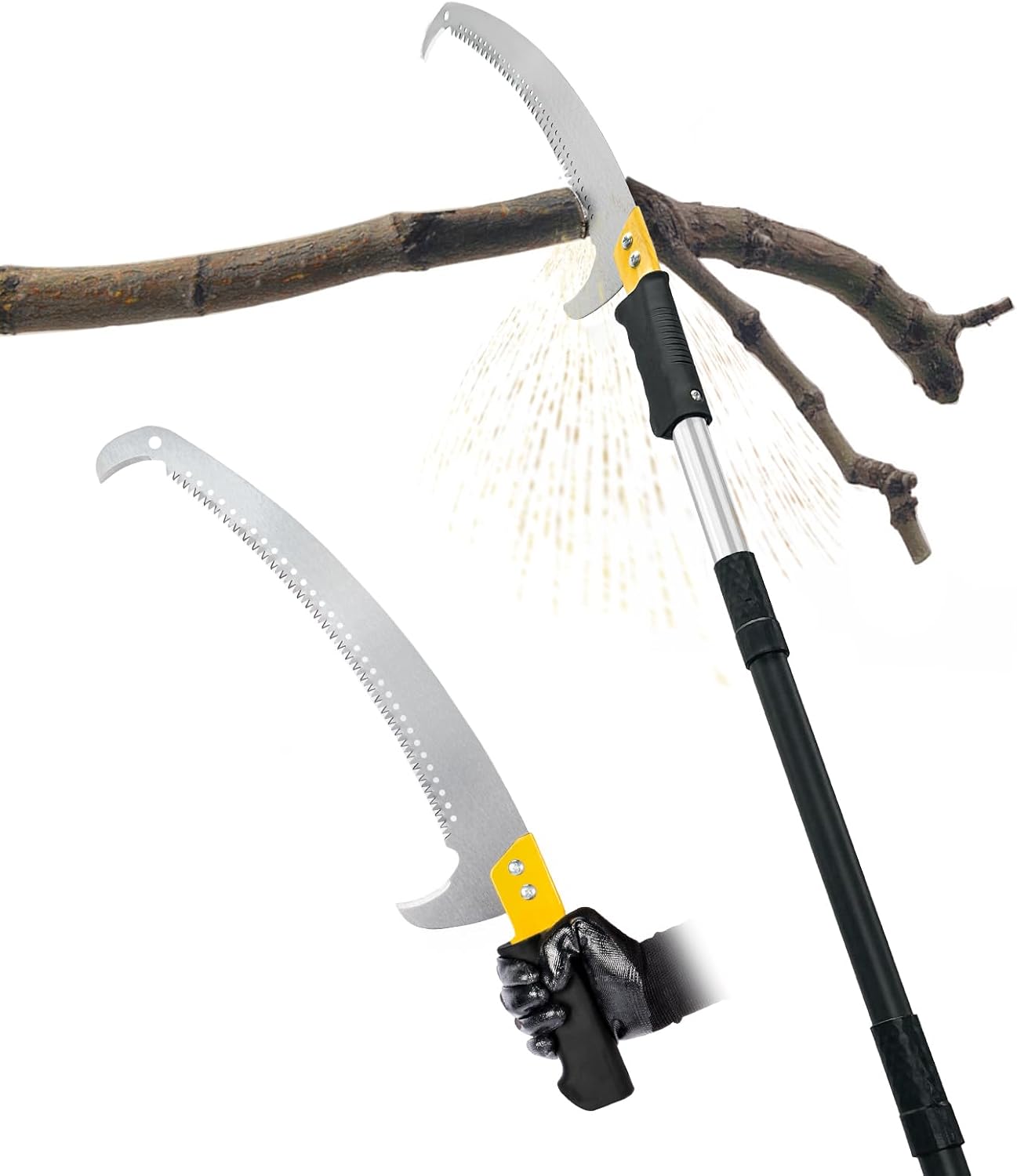
This BlumeTrec pole saw is a manual, multi-section pruning saw designed to let you trim high branches safely from the ground. The pole breaks down into sections so you can assemble it to three fixed lengths (8.5 ft, 11 ft, 14.5 ft) to match the task, and a manganese steel blade with a three-sided edge and double-sided barbs grips and slices branches for cleaner cuts. The stainless steel poles are powder-coated to resist rust and a tightening screw secures the saw head so it stays steady during use. In practice this is a basic, no-power tool that is quiet, low-maintenance, and lighter to carry than most motorized alternatives, making it easier for less experienced users to avoid ladders. Expect quicker work on small to medium branches but slower progress on very thick wood since it is manual. The plastic handle and anti-slip grip improve control but the modular pole means assembly time and storage space should be considered. Overall it is a straightforward, safety-minded option for everyday yard pruning when you want a simple, reliable tool rather than powered equipment.
Best for: Buyers who prioritize safety and simplicity and want to prune high branches from the ground without using power tools or climbing ladders; good for homeowners doing routine yard maintenance.
Less Ideal for: Professional arborists or anyone who needs to cut very large or numerous thick hardwood branches frequently should choose a powered pole saw or chainsaw instead.
- Adjustable multi-section pole offers three fixed reach lengths for flexible use.
- Mn steel blade with three-sided edge and barbs provides secure, clean cuts on small to medium branches.
- Powder-coated stainless poles resist rust for outdoor durability.
- Lightweight manual design reduces noise and maintenance compared with motorized saws.
- Anti-slip grip and extra screw to secure the saw head improve handling and safety.
- Manual cutting limits speed and effectiveness on very thick or hardwood branches.
- Plastic handle may feel less durable under heavy professional use.
Verdict: A simple, rust-resistant extendable manual pole saw that lets risk-conscious homeowners prune high branches from the ground without ladders.
Choosing the Right Pole Pruning Saw: Key Factors to Consider
Cut Quality & Tooth Pattern
How a saw's tooth shape and spacing perform on live versus dead wood matters because it affects healing and pruning success. Aggressive teeth remove material faster but can tear living tissue if not well shaped. A finer, bypass-style tooth pattern will make smoother cuts on green wood, reducing the risk of ragged wounds that invite disease.
Also consider whether the blade is impulse-hardened, coated to resist rust, or easy to sharpen in the field. Those features influence how often you need to resharpen and how tidy cuts stay season after season.
Reach Range and Adjustability
Reach is the primary reason to use a pole pruning saw. Check the usable working length rather than the collapsed length. A pole that telescopes in safe increments lets you dial in reach without overextending, and a secure locking system prevents slippage while cutting overhead.
Think about typical branch heights in your yard and whether you prefer a longer single pole or a modular system where sections can be added. Extra range adds versatility, but longer poles increase wind leverage and require better balance and more control.
Weight, Balance, and Ergonomics
A lightweight pole is easier to hold overhead, but weight distribution is often more important than absolute weight. A top-heavy pole with a long blade can tire your shoulders quickly, while a well-balanced setup keeps the center of mass nearer your hands and reduces wobble when making precise cuts.
Ergonomic grips, a comfortable shoulder strap, and the ability to change hand positions along the shaft matter for extended sessions. Consider how the saw feels raised to eye level and above; test or visualize the hand spacing you need for controlled sawing strokes.
Blade Attachment and Articulation
Some pole pruning saws have fixed heads, others pivot or fold for flush cuts and different approach angles. A pivoting head helps you position the blade behind awkward limbs and can make smoother flush cuts near the trunk. Folding blades are safer for storage but must lock securely during cutting.
Evaluate the head's locking mechanism and whether the articulation can be adjusted or fixed at multiple angles. Loose pivots or weak locks translate to vibration and reduced cutting accuracy when you are working high off the ground.
Durability and Corrosion Resistance
Outdoor tools see moisture, sap, and abrasion. Materials that resist corrosion and hardware that resists loosening extend the tool's life. Look for poles with anodized or painted finishes, stainless or high-carbon steel blades with protective coatings, and corrosion-resistant fasteners at joints and locks.
Durability also covers how the tool handles repeated impacts or tough cuts. Reinforced mounting points and replaceable blade systems are practical because they let you refresh the cutting edge without replacing the whole pole.
Maintenance and Serviceability
A straightforward maintenance routine keeps cutting performance consistent. Consider how easy it is to remove and reinstall replacement blades, whether sharpening is feasible with a common file, and if the manufacturer uses standard blade sizes that are widely available.
Also check access to spare parts for pivot pins, locking collars, and pole sections. Tools that require specialized parts or obscure fasteners can sit idle longer if something fails during a busy pruning season.
When To Use A Pole Pruning Saw
Pole pruning saws are best when branches are out of comfortable reach from the ground but still within the safe working range of a pole. They let you prune high limbs without climbing and are ideal for shaping trees, removing dead branches, and trimming tall hedges from the ground.
Many gardeners use pole saws for routine seasonal pruning, such as removing small-diameter deadwood and thinning canopy growth. They are not a substitute for an arborist on large-limb removals or when a safe rope-and-harness setup is required.
- Suitable for limbs typically up to 2 to 4 inches in diameter depending on blade type
- Good for pruning, shaping, and deadwood removal without a ladder
- Not recommended for major limb removal requiring professional rigging
Safe Cutting Technique And Body Positioning
Set a stable footing and keep your knees slightly bent. Plant your feet so you can rotate your torso while moving the pole rather than leaning or reaching. Move slowly to align the saw behind the branch and keep the blade at a comfortable angle to the cut rather than forcing it from an awkward wrist position.
Keep one hand near the base of the pole and the other several feet farther up to control the blade path. Watch for falling debris and plan an escape path. If you feel the saw bind, stop and assess the branch: sometimes a second relief cut closer to the trunk prevents tearing during the final pull.
- Wear eye protection and a hard hat when cutting overhead
- Keep bystanders well outside the drop zone
- Inspect the pole and blade locks before every cut
Maintaining Blade Sharpness In The Field
Carry a compact flat or round file and a small blade clamp or holder so you can realign and sharpen teeth after several heavy cuts. You do not need a full workshop to keep a pruning saw sharp; basic sharpening extends the effective life of the blade and reduces fatigue because teeth bite cleanly into wood.
After a session, clean sap and debris from the blade with a rag and a little solvent if needed, then apply a light coat of oil to prevent rust. Store the pole and blade in a dry space and check pivot hardware and locking collars periodically for tightness.
- Sharpen with a round file that matches tooth geometry
- Degrease sap and apply a thin oil film for corrosion protection
- Tighten pivot bolts and locking knobs after heavy use
Choosing Accessories And Storage Options
A padded shoulder strap or sling can make long pruning jobs manageable by carrying some weight off your arms. A blade cover is essential for safe transport and storage and protects the edge. If you expect frequent overhead work, invest in a small hand saw or folding pruning saw that fits a sheath for nearby low branches.
For compact storage, poles that collapse into shorter lengths fit in a garage or closet more easily. Consider where you will store the tool and whether you need a designated hook or rack to prevent accidental damage to the blade.
- Use a padded strap for long sessions to reduce arm fatigue
- Keep a blade sheath on the saw at all times when not cutting
- Store indoors to minimize corrosion and protect locking parts
How We Chose the Best Pole Pruning Saw
We focused on tools that suit home gardeners and small-acreage property owners who need reliable reach pruning without frequent professional maintenance. Our selection began with pole pruning saw designs that prioritize safe overhead cutting and end with options that are practical for repeated garden use. Evaluation criteria included cut quality and tooth geometry to assess how cleanly a saw severs live wood; reach and telescoping range so homeowners can access typical branch heights; weight, balance and ergonomics to gauge how easy the tool is to hold steady overhead; blade retention and hinge durability for models with folding or articulating heads; and maintenance needs such as sharpening ease and corrosion resistance. We also considered the compatibility of replacement blades and simple field repairs. We excluded heavy-duty professional arborist rigs, powered systems, and accessory-only attachments that require a separate pole. Choices were limited to handheld pole pruning saws or pole-mounted saws intended for non-commercial seasonal work. The result is a practical set of options that balance safety, cutting performance, and everyday usability for gardeners.
FAQ
What branch diameter can a pole pruning saw handle safely?
It depends on the blade length and tooth pattern. Most manual pole pruning saws are best for branches up to about 2 to 4 inches in diameter. Larger limbs often require a chainsaw or professional removal to cut safely and avoid tearing.
Is a pivoting head worth the extra cost?
A pivoting head can be very helpful for reaching awkward angles and making flush cuts close to the trunk. It may add a little weight and requires a reliable locking mechanism, so weigh the benefit of angle control against any increase in complexity.
How often should I sharpen the blade?
Sharpening frequency depends on use and wood type. For light home pruning, you may only need to sharpen annually; for heavy use or abrasive wood, sharpen after several major sessions. Keep a small file handy to maintain tooth profile between full sharpenings.
Can I use a pole pruning saw in wet weather?
You can use it, but wet conditions increase the risk of slipping and make falls more hazardous. Blade corrosion is also accelerated by moisture, so dry and oil the blade after use. Prefer to avoid overhead work during high winds or heavy rain.
How do I prevent sap buildup on the blade?
Wipe the blade with a solvent or soapy water after cutting, then dry thoroughly and apply a light coat of oil. For sticky sap, a citrus-based cleaner or denatured alcohol removes residues without harming most coatings.
Final Verdict
Prioritize a pole pruning saw that balances reach with control. Clean cutting teeth, secure head locking, and a pole with good balance are the most important attributes for safe, effective pruning. Expect tradeoffs: longer reach often means more weight and the need for better handling, while pivoting heads add versatility at the cost of some complexity. Choose the tool that matches the typical branch diameters and heights you face and one you can comfortably manipulate overhead for the duration of your pruning tasks. Focus on durability and serviceability so the saw remains sharp, safe, and ready season after season.
