

Note: This article contains affiliate links. If you click on these links and make a purchase, I may earn a small commission at no extra cost to you. This helps support my research and content. Read my full affiliate disclosure here.
A properly chosen rotor sprinkler head makes a big difference in how evenly a lawn is watered and how much water you waste. For home lawns and small yards, the right rotor can eliminate dry patches, reduce run time, and give you more consistent turf health with fewer adjustments. This guide shortlists six well-suited rotor sprinkler heads across common residential setups, and explains the practical tradeoffs gardeners face. We evaluated each option for coverage patterns, durability in outdoor conditions, and ease of service so you can pick a head that fits your watering zone and maintenance habits. Read on for the criteria we used and the specific situations each style of rotor fits best.
Top Picks at a Glance
| Best Overall The best all-around choice for most situations | Hunter PGP-ADJ 3/4" Rotor Sprinkler Head, 4" Pop-Up, 2-Pack |  |
| Best Quality Built to a higher standard if you want something more solid | Rain Bird 52SA Stainless Steel Gear-Drive Rotor Sprinkler (25–50 ft) |  |
| Best Value The sweet spot between price and what you get | Rain Bird 32SA Gear Drive Rotor Sprinkler (19–32 ft, 40°–360°) |  |
| Best Budget The cheapest option that still gets the job done reliably | Hunter PGP-ADJ 3/4" Gear-Drive Rotor Sprinkler Head (Adjustable 40°–360°, 4" Pop-Up) |  |
| Highest Rated A top-rated pick with lots of positive feedback | Rain Bird 42SA+ Gear-Driven Rotor Sprinkler Head (2-Pack) |  |
| Most Popular A crowd favorite that many people choose with confidence | Rain Bird 5000 Rotor Sprinkler Head 20-Pack with Rain Curtain Nozzles and Tool |  |
Hunter PGP-ADJ 3/4" Rotor Sprinkler Head, 4" Pop-Up, 2-Pack

| Maximum Pressure | 100 psi |
|---|---|
| Maximum Flow Rate | 3 gpm |
| Inlet Connection Size | 0.75 inches |
| Number of Packs | 2 |
The Hunter PGP-ADJ is a professional-grade gear-driven rotor sprinkler offered in a 2-pack for upgrading or installing in-ground irrigation. It provides an adjustable arc from 40° to 360° and a long throw of about 22 to 52 feet, making it suitable for medium to large turf areas. The unit uses a water-lubricated gear drive for quiet, smooth rotation and comes with a 4" pop-up body that clears grass while hidden when retracted. A preinstalled 3.0 GPM nozzle and standard 3/4" inlet make it a straightforward swap into most systems, and the included adjustment wrench simplifies setting arc and radius on site. Practical benefits include durable construction for frequent use, consistent coverage across wide areas, and fine-tuning to avoid overspray. Limitations are that the head is plastic rather than metal, which may be less impact-resistant in high-traffic or harsh conditions, and very small lawns may be overpowered by its long spray distance without changing to shorter-range nozzles sold separately.
Best for: Gardeners and property owners who prioritize reliable, professional-level irrigation performance for medium to large lawns and want adjustable, long-reach coverage they can fine-tune.
Less Ideal for: People with very small yards, container gardens, or situations needing impact-resistant metal heads should look at compact spray heads or more rugged alternatives.
- Adjustable arc 40°–360° lets you set part- or full-circle coverage.
- Long spray distance (22–52 ft) covers medium to large lawns with fewer heads.
- Gear-driven, water-lubricated mechanism runs quietly and promotes even coverage.
- Includes adjustment wrench for quick on-site arc and radius tuning.
- Standard 3/4" inlet and preinstalled 3.0 GPM nozzle make replacement simple.
- Plastic body may be less durable than metal in areas with heavy foot or mower traffic.
- Preinstalled nozzle favors longer distances so shorter-range lawns require purchasing different nozzles.
Verdict: Pick this rotor if you want professional, adjustable, long‑range coverage for medium to large lawns with quiet, gear‑driven operation.
Rain Bird 52SA Stainless Steel Gear-Drive Rotor Sprinkler (25–50 ft)

| Maximum Pressure | 70 psi |
|---|---|
| Maximum Flow Rate | 3 gpm |
| Inlet Connection Size | 0.75 inches |
| Material Type | Stainless Steel |
The Rain Bird 52SA is a contractor-grade gear-drive rotor built for dependable, long-range lawn irrigation. It delivers a 25 to 50 foot throw with a preinstalled 3.0 gpm nozzle and uses Rain Curtain nozzle technology to create large, wind-resistant droplets for more even coverage and less overspray. Top-of-head adjustments let you set arc (40° to 360°) and distance with a flat screwdriver while the quick check arc/fast-forward feature makes setup and troubleshooting simple while the head is running. The closed-case design, stainless-steel shaft, water-lubricated gears, and dual-action wiper seal protect internal parts from grit and creeping grasses, which helps the rotor run reliably in sandy or harsh soils. It pops up 4 inches to clear taller turf and has a 3/4" NPT female bottom inlet for contractor plumbing. Limitations are that it requires matching pressure and flow to reach the longest distances and replacement nozzles are sold separately if you need different flow rates or finer tuning for irregular lawns.
Best for: Buyers who prioritize a low-maintenance, long-lasting rotor for large lawns and want reliable, contractor-grade coverage without frequent servicing.
Less Ideal for: Homeowners with very low water pressure systems or those needing a compact spray head for small, densely planted beds should consider alternatives.
- Robust stainless-steel shaft and water-lubricated gear drive for long service life
- Rain Curtain nozzle produces large, wind-resistant droplets for uniform coverage
- Top-access arc and distance adjustments plus quick check feature speed installation and tuning
- Closed-case design and wiper seal protect internal components from debris and gritty water
- Requires sufficient system pressure and flow to achieve the full 25–50 ft throw and optimal uniformity
Verdict: Choose the 52SA when you need a dependable, long-range rotor built to withstand gritty soils and deliver consistent 25–50 foot coverage.
Rain Bird 32SA Gear Drive Rotor Sprinkler (19–32 ft, 40°–360°)
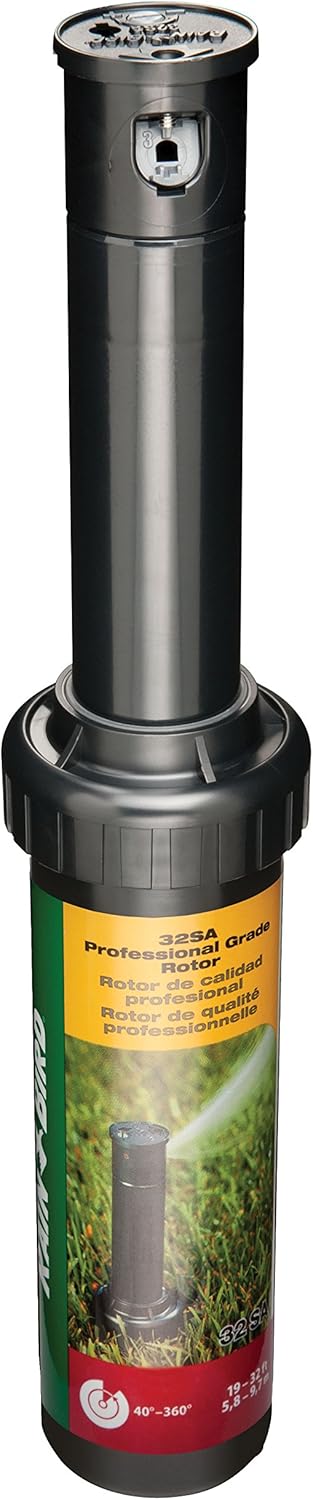
| Maximum Pressure | 70 psi |
|---|---|
| Maximum Flow Rate | 3 gpm |
| Inlet Connection Size | 0.5 inches |
| Pattern | 40° – 360° |
| Distance | 19' – 32' |
The Rain Bird 32SA is a water-lubricated gear-drive rotor designed for residential lawn irrigation where consistent coverage and low maintenance matter. It installs with a 1/2" female bottom inlet and pops up 4 inches to clear taller turf. Top-of-head adjustments let you set arc from 40° to 360° with a flat screwdriver and the quick-check feature lets you confirm the arc while the unit runs. The included 3.0 gpm Rain Curtain nozzle produces large, wind-resistant droplets and micro-ramps that reduce dry spots near the head and help improve uniformity across adjacent rotors. The closed-case body, wiper seal and removable filter screen protect internal parts from grit and creeping grasses so it tolerates tougher lawn conditions. Limitations to note are plastic construction and a single preinstalled nozzle size, so users needing stainless shafts or different flow presets will need other models or separate nozzles. For typical home lawns this head delivers reliable, low-effort watering and easier long-term upkeep than basic impact or spray heads.
Best for: Homeowners who want reliable, low-maintenance rotor coverage and prioritize even watering and ease of adjustment for typical lawns.
Less Ideal for: Commercial contractors or users who need stainless-steel shafts or factory multiple flow options for very large or high-wear installations.
- Simple top-adjustment for arc from 40° to 360° with quick-check while running
- Rain Curtain nozzle creates large, wind-resistant droplets for more uniform coverage
- Closed-case design, wiper seal and removable filter screen reduce debris-related failures
- Water-lubricated gear drive for durable, low-maintenance operation
- Plastic body and components rather than metal shaft for heavy-duty durability
- Comes with a single preinstalled nozzle size so flow/distance customization requires separate nozzles
Verdict: Choose the 32SA when you want an easy-to-adjust, durable rotor that delivers more uniform, wind-resistant coverage for a typical home lawn.
Hunter PGP-ADJ 3/4" Gear-Drive Rotor Sprinkler Head (Adjustable 40°–360°, 4" Pop-Up)

| Maximum Pressure | 100 psi |
|---|---|
| Maximum Flow Rate | 14.1 gpm |
| Inlet Connection Size | 0.75 inches |
The Hunter PGP-ADJ is a proven gear-drive rotor designed to provide even, long-range coverage for lawns and landscapes. It installs with a standard 3/4-inch female inlet and uses a 4-inch pop-up body to clear turf for consistent spray distribution. The head comes with a preinstalled 3.0 GPM nozzle and allows arc adjustment from 40° to 360°, so it can handle both part-circle and full-circle zones and reduce the number of heads needed per zone thanks to its 22 to 52 ft radius. Water-lubricated gears keep operation quiet and smooth while resisting clogging, and the nozzle trajectory options help with windy or sloped sites. It works across a wide pressure range (20 to 100 PSI) though it performs best in the 25 to 70 PSI recommended range. The main limitations are that long spray distances require adequate system pressure and occasional nozzle swaps if you need a different precipitation rate or lower flow for water-sensitive areas. For a basic, durable rotor this unit delivers reliable performance without complex features.
Best for: Homeowners or small-property stewards who want a durable, no-frills rotor that covers large areas efficiently and will last through seasons of regular lawn irrigation.
Less Ideal for: People with very low-pressure systems, micro-irrigation needs, or those who want smart features and adjustable low-flow nozzles included out of the box.
- Wide adjustable arc (40°–360°) suits both part-circle and full-circle zones
- Long spray radius (22–52 ft) reduces the number of heads needed per zone
- Gear-driven, water-lubricated mechanism provides smooth, quiet operation and resists clogging
- Standard 3/4" inlet and 4" pop-up height fit most residential systems for easy replacement
- Requires adequate system pressure for the full 52 ft radius to perform as specified
- Nozzles for different precipitation rates are sold separately if you need lower flow options
Verdict: Buy this if you want a proven, rugged rotor that delivers long, even coverage and simple compatibility with standard residential irrigation systems.
Rain Bird 42SA+ Gear-Driven Rotor Sprinkler Head (2-Pack)

| Maximum Pressure | 55 psi |
|---|---|
| Inlet Connection Size | 0.75 inches |
| Unit Count | 2 |
| Item Highlight | Adjustable 40 – 360 Degree Arc & 26 – 38 ft Radius |
The Rain Bird 42SA+ is a professional-style gear-driven rotor sprinkler head packaged as a two-pack for in-ground lawn irrigation. It delivers a 26 to 38 foot spray radius and lets you adjust arc from 40 to 360 degrees and distance from the top with a screwdriver, so you can tailor coverage to individual zones and avoid overspray. The Rain Curtain nozzles produce larger, wind-resistant droplets and micro ramps for better close-in coverage, which helps reduce dry spots and improves watering efficiency. The unit is built for durability with a closed-case design that resists debris, a water-lubricated gear drive, stainless steel retract spring, reinforced seals, and a 3/4-inch female bottom inlet rated to operate up to 55 psi. Practical benefits include consistent, even coverage across medium and large turf areas and reduced maintenance thanks to the protected internals and top-side adjustments. Limitations are that it is sized for larger zones and higher pressure systems, so small low-pressure setups or tiny lawns may be better served by smaller spray heads or different nozzle choices.
Best for: Homeowners who prioritize long-term reliability and consistent turf coverage across medium to large lawn zones and who maintain or supervise irrigation systems rather than wanting a purely plug-and-play consumer head.
Less Ideal for: Those with very small yards, low-pressure systems, or installers seeking the simplest, smallest spray heads for tiny turf areas should consider alternative heads.
- Adjustable 40–360 degree arc and top-adjustable distance for precise zone tuning
- Rain Curtain nozzles deliver wind-resistant droplets and improved close-in coverage
- Closed-case, gear-driven design resists sand and debris for long-term reliability
- Stainless steel retract spring and reinforced seals increase durability under regular use
- Designed for medium to large zones and requires adequate water pressure for full radius
Verdict: Buy this if you want a durable, professional-grade rotor head that delivers adjustable, reliable coverage for medium to large lawns.
Rain Bird 5000 Rotor Sprinkler Head 20-Pack with Rain Curtain Nozzles and Tool

| Maximum Pressure | 65 psi |
|---|---|
| Maximum Flow Rate | 50 gpm |
| Inlet Connection Size | 0.75 inches |
| Unit Count | 20 Count |
| Adjustable Arc | 40 – 360 Degree Arc |
The Rain Bird 5000 rotor 20-pack is a service-oriented bundle built for replacing or upgrading multiple lawn sprinkler heads at once. Each rotor is a 4-inch pop-up unit with a 3/4-inch female inlet, adjustable arc from 40 to 360 degrees, and a 25–50 foot spray radius, so you can tune coverage to match typical residential zones. The included Rain Curtain nozzles use larger, wind-resistant droplets and built-in micro ramps to reduce dry spots near the head, which improves uniformity and helps avoid overspray. Top adjustments with a flat screwdriver make arc and radius changes quick without pulling the head from the body. The rotors are designed with a closed-case gear drive, stainless steel retract spring, and reinforced seals to resist debris and extend service life. Because this listing is a 20-pack, it is convenient for reworking several zones at once, but it is bulk-focused and may be more than needed for a single repair or one-off replacement. These are plastic-bodied components, so installers who prefer all-metal parts may want a different model for high-abrasion or commercial sites.
Best for: Buyers who want a reliable, proven rotor solution for servicing multiple residential irrigation zones at once and who prioritize long-term, low-maintenance performance supported by positive user feedback.
Less Ideal for: Not a good fit for someone who only needs one or two replacement heads or who prefers commercial-grade metal-bodied rotors for heavy-duty installations.
- Large 20-pack simplifies replacing multiple heads in a yard or completing a full zone service at once
- Adjustable 40–360° arc and top-access radius adjustment speed up fine-tuning without digging
- Rain Curtain nozzles produce larger, wind-resistant droplets for more even coverage and reduced overspray
- Closed-case gear drive and stainless steel spring improve resistance to debris and increase longevity
- Plastic body construction may not satisfy users seeking metal-heavy commercial-grade components
- Pack size is excessive for single-head repairs or very small lawns
Verdict: Choose this 20-pack if you need a dependable, adjustable rotor bundle that delivers even, wind-resistant lawn coverage and simplifies servicing multiple irrigation zones.
Choosing the Right Rotor Sprinkler Head: Key Factors to Consider
Coverage Area and Throw Distance
Knowing the coverage radius and arc control of a rotor sprinkler head matters because it determines how many heads you need and whether they will properly overlap to avoid dry spots. Rotors are often chosen for medium to large arcs where a long throw reduces the number of heads required. If your lawn has narrow strips, trees, or hardscapes, choose a rotor with adjustable arc settings and nozzles covering shorter radii.
Incorrectly matching throw distance to zone size leads to misting, runoff, or missed edges. Account for the mature spray pattern rather than just the maximum radius, and plan for proper head spacing and overlap when laying out or retrofitting a zone.
Nozzle Options and Adjustability
The variety and interchangeability of nozzles affect how precisely you can tune water application. Multiple nozzle sizes let you adjust precipitation rates to match soil infiltration and slope, while different arc inserts allow you to shape the spray around pathways and plantings.
Rotors with easy-to-replace nozzles or a wide range of factory nozzles reduce the need for custom modifications on site. Consider whether the head accepts incremental arc adjustments and whether fine-tuning can be done without special tools so you can rebalance a system yourself between seasons.
Operating Pressure and Flow
Rotor performance depends heavily on available water pressure and the flow the zone supplies. Choose a head rated to operate well at your household pressure range; some rotors require higher pressure to achieve full radius, while others are designed for lower-pressure systems.
Flow per head influences how many heads you can run on a single valve without overtaxing the pump or municipal supply. Matching rotor flow rates to valve and pipe capacity prevents pressure drops that reduce uniformity and can cause uneven watering across a zone.
Weather Resistance and Materials
Exposure to sun, freezing temperatures, and abrasive particulates in water affects how long a rotor will function without leaks or broken components. Heads with UV-stable plastics, corrosion-resistant metals for internal parts, and durable seals will last longer in outdoor installations.
Consider how winterizing is performed and whether components tolerate being left in the ground or require removal. If your area has hard water, materials that resist mineral buildup will reduce maintenance and maintain spray patterns over time.
Serviceability and Replacement Parts
How easy a rotor is to service on site determines long-term ownership effort. Heads that allow simple access to nozzles, gears, and seals without digging or special tools keep maintenance time and costs down. The availability of common replacement nozzles and seals ensures you can quickly restore performance after wear or damage.
Also consider whether the head design allows partial disassembly in the field and whether common repairs are user-friendly for a homeowner. Heads that require full replacement for minor failures increase waste and recurring cost.
Budget and Long-Term Operating Cost
Initial cost is only part of the equation; long-term expense includes water use efficiency, maintenance frequency, and parts replacement. A rotor with better uniformity can reduce run time, lowering water bills. Conversely, a cheaper head that leaks or clogs may cost more over several seasons.
Think about the total lifecycle: choose heads whose expected durability and parts availability match how long you plan to keep your system and how much hands-on maintenance you are willing to perform.
Which Rotor Types Fit Different Lawn Shapes
Rotors come in several pattern styles and body sizes that suit particular layouts. Large-radius rotors work well across open, circular zones or broad expanses where fewer heads reduce installation complexity. Compact rotors are useful for narrow strips, small yards, or around tight planting beds where clearance is limited.
Consider the layout of sprinkler zones before selecting a rotor. Zones with irregular edges benefit from rotors that offer fine arc adjustment or modular nozzle inserts so you can tailor coverage without excessive overlap.
- Large-radius rotors reduce the number of heads in open turf.
- Compact rotors fit into tight beds and bordering strips.
- Adjustable arc rotors adapt to irregular landscape features.
Common Installation Tips for Reliable Performance
Set rotor elevation so the spray clears mulch and low plants but does not overshoot sidewalks. Proper height prevents early clogging and physical damage to the nozzle. Aim for heads to be level with the turf or slightly above for clean coverage.
Flushing lines before inserting rotors prevents grit from abrading internal gears and nozzles. Use thread tape on metal fittings and avoid overtightening to prevent stress on plastic risers. After installation, walk the zone to check overlap and adjust arcs to avoid gaps or excess spray onto hardscapes.
- Flush lateral lines before installation.
- Position heads for unobstructed spray paths.
- Test and adjust arcs during cooler parts of the day to avoid evaporation skewing impressions.
Maintenance Calendar to Keep Rotors Healthy
Create a seasonal maintenance routine that includes a spring startup check and a pre-winter inspection. In spring, inspect for damaged risers, confirm nozzle seating, and run each zone to verify coverage. Clean or replace nozzles showing irregular patterns.
Mid-season checks should look for leaks at the seal and evidence of mineral buildup. In colder climates, follow a winterizing procedure to drain or blow out irrigation lines to protect internal gear mechanisms and seals from freeze damage.
- Spring: inspect risers, test arcs, replace damaged nozzles.
- Mid-season: check for leaks and mineral deposits.
- Pre-winter: drain or blow out lines where applicable.
Matching Rotors to Water Budgets and Regulations
Local watering restrictions and water budgets make nozzle selection important. Lower precipitation rate nozzles extend run times but can be required in restricted districts. When water is limited, choose rotor setups that allow reduced flow with maintained uniformity.
Using rotors with multiple nozzle options helps you adjust application rate to meet local rules without reworking pipe or valve layouts. Pay attention to recommended run times for turf type and aim to water during cooler hours to reduce evaporation losses.
- Select nozzles to meet local precipitation limits.
- Adjust run times to native soil absorption rates.
- Prefer larger droplet patterns to minimize wind drift and evaporation.
Upgrading an Existing Spray System to Rotors
Replacing spray heads with rotors can improve efficiency on larger lawns, but it requires checking pipe capacity and valve sizing. Rotors typically use less water per unit area at long radii but demand different flow characteristics than sprays.
When retrofitting, evaluate whether the current valves and pipe diameters can supply the new rotor flows without pressure loss. You may need to reduce the number of heads per valve or stagger run times to maintain uniform pressure across zones.
- Compare current flow per zone to rotor flow needs.
- Plan head spacing to achieve recommended overlap.
- Test system after retrofit to confirm even coverage.
How We Chose the Best Rotor Sprinkler Head
We prioritized factors that matter when a rotor sprinkler head will be installed and maintained in a typical home lawn. Our evaluation focused on spray uniformity and adjustable range because those determine how well a rotor covers irregular zones and reduces dry edges. Durability and material resistance to UV and freezing conditions were included to predict service life in outdoor use. Flow and nozzle flexibility were assessed so heads can be tuned to match common residential irrigation pressure and water budgets. Ease of maintenance and the availability of replaceable nozzles or seals were considered to lower long-term labor and repair needs. We excluded specialty agricultural or large-scale commercial rotors that are not sized or priced for residential systems. We also filtered out products with poor user serviceability or limited nozzle options, since those limit adaptability in different yard layouts. The final shortlist reflects units that balance adjustability, build resilience, and predictable coverage for homeowners and landscapers working on small to medium lawns.
FAQ
How do I know what spray radius I need for my lawn?
Measure the longest uninterrupted stretch in a zone and the width you need to cover. Choose a rotor whose adjustable radius matches or slightly exceeds those dimensions so you can set proper overlap without overshooting hardscapes.
Can rotor sprinkler heads work with a low-pressure system?
Some rotors are designed for lower operating pressures, but many require higher pressure to reach full radius. Check the manufacturer pressure range and compare it to your measured household pressure to ensure the rotor will perform as expected.
How often should I clean or replace nozzles?
Inspect nozzles at the start of each season and again mid-season. Clean them when spray patterns become uneven or when mineral buildup is visible. Replace nozzles if cleaning does not restore a uniform spray or if they are cracked.
Will rotors handle windy conditions better than sprays?
Rotors typically produce larger droplets and longer throw, which reduces wind drift compared with fine-spray sprays. However, strong winds can still distort patterns, so watering during low-wind periods is advisable.
What maintenance protects rotors from freezing damage?
Before hard freezes, drain irrigation lines or use compressed air to blow out lateral lines so water does not freeze inside rotor bodies. Remove and store any components recommended by your local climate practices and inspect seals in spring for winter wear.
Final Verdict
Choose a rotor sprinkler head by matching its radius, nozzle options, and pressure range to your zone layout and water supply. Prioritize heads with easy serviceability and durable materials if you plan to keep the system long term. Expect tradeoffs between initial cost and savings from better uniformity and lower run times; focus on the dimensions that affect coverage and maintenance to make the most confident selection.
