

Note: This article contains affiliate links. If you click on these links and make a purchase, I may earn a small commission at no extra cost to you. This helps support my research and content. Read my full affiliate disclosure here.
If you want steady circulation, better oxygenation, and lower operating costs for a backyard pond, the right solar pond pump makes a big difference. Solar-powered units remove the need for a nearby electrical outlet and run quietly during daylight hours, but not all units perform the same in real garden conditions. This guide covers the top shortlisted solar pond pumps for small to medium ponds and water features. We evaluated models across real-world criteria such as measured flow and durability in outdoor conditions, and we explain which features matter for different pond sizes and setups. Read on for a practical look at what to expect from each top option and which pump type best suits your pond situation.
Top Picks at a Glance
| Best Overall The best all-around choice for most situations | My Natural Pond 100W Floating Solar Fountain Pump Kit |  |
| Best Quality Built to a higher standard if you want something more solid | My Natural Pond SP50 Submersible Solar Pond Pump Kit (50W) |  |
| Best Value The sweet spot between price and what you get | ECO-WORTHY 216 GPH Solar Water Fountain Pump Kit (13W) |  |
| Highest Rated A top-rated pick with lots of positive feedback | NFESOLAR 50W Solar Pond Filter Fountain – 580 GPH Submersible Pump with 3-Layer Filtration |  |
| Best Seller A high-volume bestseller chosen again and again | POPOSOAP 6.5W Solar Fountain Pump with 3000mAh Battery Backup for Bird Baths |  |
My Natural Pond 100W Floating Solar Fountain Pump Kit

| Power Source | Solar Powered |
|---|---|
| Maximum Lifting Height | 10 feet |
| Horsepower | 100 watts |
| Pumps up to | 1,300 Gallons Per Hour (GPH) |
This My Natural Pond kit is a complete floating solar fountain system built for larger ponds and water gardens. The floating pump mounts on the water so it follows changing levels and requires no permanent installation. Two 50W solar panels with stands and a long 32 ft cable let you position panels in full sun away from the pond, and three interchangeable nozzles plus a dome option deliver spray patterns from about 4 to 10 feet for both aeration and visual impact. In direct sun the pump moves up to 1,300 GPH and can lift water to 10 feet, making it useful for circulation in ponds at least 3 feet deep. There is no battery in the kit so it only runs in daylight or while the optional battery is attached, and performance drops in haze or cloudy conditions. Setup is straightforward and the included anchor and wiring make installation quick, but expect daytime-only operation unless you buy the separate battery pack for evening use.
Best for: Buyers who want a ready-to-run solar fountain that improves aeration and appearance in medium to large ponds and prefer a low-maintenance, non-permanent installation.
Less Ideal for: Not a good choice for pond owners who need reliable nighttime operation without purchasing an additional battery pack or those with consistently cloudy climates.
- Complete kit with two 50W solar panels and mounting stands for flexible panel placement
- Floating design adjusts to water level and avoids permanent mounts
- Multiple nozzle options for adjustable spray height and visual effects
- High daylight output up to 1,300 GPH and 10 ft lift for effective pond circulation
- No battery included so the pump only runs while panels receive sufficient sunlight
Verdict: A turnkey floating solar fountain kit that delivers strong daytime aeration and a selectable spray up to 10 feet for bigger ponds.
My Natural Pond SP50 Submersible Solar Pond Pump Kit (50W)

| Power Source | Solar Powered |
|---|---|
| Flow Rate | 14.96 gpm |
| Maximum Lifting Height | 9.86 feet |
| Horsepower | 50 watts |
| Included Components | Solar Panel |
The My Natural Pond SP50 is a solar-powered submersible pump kit built for moving a lot of water without wiring to mains power. It ships as a complete kit with the pump, two 25 W solar panels on stands, 16 feet of 1-inch hose and 16 feet of cable so you can place panels in sunny spots. In practical use it delivers a strong flow (advertised up to about 898 GPH) and a maximum lift near 10 feet, which makes it suitable for waterfalls, surface circulation, and feeding external filters on medium to large ponds. The pump uses a brushless design with a dry-run cutoff and a tool-free access panel for easier cleaning and lower routine maintenance. Because it runs directly from solar it needs good sunlight or very light cloud to reach peak flow and does not include an onboard battery, so flow drops significantly on overcast days or at dusk. The plastic construction and relatively large size mean it is not ideal for tiny decorative features, but for buyers prioritizing high daytime performance and minimal wiring this kit provides a powerful, largely maintenance-friendly solar circulation solution.
Best for: Buyers who need a high-output, off-grid pump to run waterfalls or circulate larger ponds during sunny hours and who prioritize strong daytime performance over 24-hour operation.
Less Ideal for: Gardeners who need continuous round-the-clock circulation or reliable evening operation without adding external batteries should consider battery-capable or mains-powered options.
- High daytime flow rate suitable for waterfalls and pond circulation
- Twin 25 W solar panels provide strong power without grid electricity
- Brushless pump with dry-run cutoff reduces maintenance and risk of burn-out
- Includes hose, panel stands, and 16 ft of cable for straightforward installation
- No included battery so performance falls on cloudy days and evening
- Plastic pump housing may show wear faster than metal alternatives
Verdict: If you want a powerful, low-maintenance solar kit to drive waterfalls or heavy daytime pond circulation, the SP50 delivers strong performance without grid power.
ECO-WORTHY 216 GPH Solar Water Fountain Pump Kit (13W)

| Power Source | DC |
|---|---|
| Maximum Lifting Height | 2.4 meters |
| Horsepower | 13 watts |
| Material Type | Polypropylene (PP) |
The ECO-WORTHY 216 GPH Solar Water Fountain Pump Kit is a plug-and-play solar pond pump intended to circulate water in small to medium outdoor fountains, birdbaths, and garden ponds. The kit combines a 13W brushless pump that can move up to 216 gallons per hour with an upgraded monocrystalline solar panel for improved conversion efficiency. It includes multiple fountain heads and an adjustable nozzle to change spray size, and the pump has built-in dry-run protection that automatically shuts off when water level is too low. In practice the pump runs well in direct sun and gives steady flow during bright days, but performance falls with cloud cover and it will not run at night unless paired with an external battery backup. The 16 ft cord allows flexible panel placement away from the pond edge. Expect routine cleaning to prevent debris clogs and modest maintenance to preserve the pump’s long service life. This is a straightforward, energy-free option for adding movement and sound to outdoor water features where sunlight is reliable.
Best for: Buyers who want a low-maintenance, grid-free way to add movement and sound to small or medium outdoor ponds and water features and who prioritize reliable daytime solar operation.
Less Ideal for: Those who need continuous 24/7 circulation, heavy-duty high-head pumping, or live in locations with limited sun exposure should consider pumps with battery backup or AC-powered alternatives.
- Solid peak flow for small to medium fountains at 216 GPH
- Monocrystalline solar panel for better sun-to-power efficiency
- Adjustable nozzle and multiple fountain heads for customizable spray
- Automatic dry-run protection prevents motor damage when water is low
- 16 ft cord provides flexible placement of the solar panel
- Depends on direct sunlight so flow weakens on cloudy days and it will not run at night without a separate battery
- Filter and pump can clog with debris so regular cleaning is required
Verdict: If you want a simple, solar-only pump that delivers solid daytime flow and built-in dry-run protection for small to medium ponds, this ECO-WORTHY kit is a practical choice.
NFESOLAR 50W Solar Pond Filter Fountain – 580 GPH Submersible Pump with 3-Layer Filtration

| Power Source | Solar Powered |
|---|---|
| Horsepower | 0.07 hp |
| Max Flow Rate | 580GPH |
| Filtration | 3-layer (pads, bio-balls, ceramic rings) |
This NFESOLAR kit combines a 50W solar panel, a 580 GPH submersible pump and a snap-on filter box to provide daytime circulation, aeration and multi-stage filtration without electricity. It is typically set up in a small to medium garden pond where the solar panel sits in full sun and the pump draws water through filter pads, bio-balls and ceramic rings before returning it via one of three fountain nozzles. Notable features include an all-in-one design for simple installation, tool-free access to the filter media for routine cleaning, and an adjustable diverter valve to prioritize fountain spray or straight filtration. In practice the system keeps water moving and improves clarity during sunny hours and reduces mechanical maintenance compared with separate pump-plus-filter setups. The main limitation is that the pump is direct solar driven so flow falls off in shade, cloudy weather and stops at night, making it unsuitable as a 24/7 electrically powered backup. Buyers should also plan seasonal maintenance for the plastic filter box and media to maintain performance.
Best for: Garden owners who want a low-maintenance, off-grid solution to keep pond water moving and clearer during sunny days and who prioritize equipment that runs reliably when exposed to direct sunlight.
Less Ideal for: People who need continuous 24-hour pumping or dependable performance through cloudy seasons should consider electrically powered or battery-backed systems instead.
- Integrated solar panel and pump deliver circulation and filtration without external power
- Three-layer filtration (pads, bio-balls, ceramic rings) captures debris and supports biological cleanup
- Snap-on filter box allows tool-free access for quick cleaning and media replacement
- Adjustable diverter and three spray patterns let you balance display and filtration needs
- Direct solar drive means performance drops in shade, cloudy weather and ceases at night
- Plastic components may require regular seasonal care to avoid wear in outdoor conditions
Verdict: Choose this all-in-one solar pond filter fountain if you want a straightforward, no-wires daytime filtration and fountain solution that runs reliably in full sun.
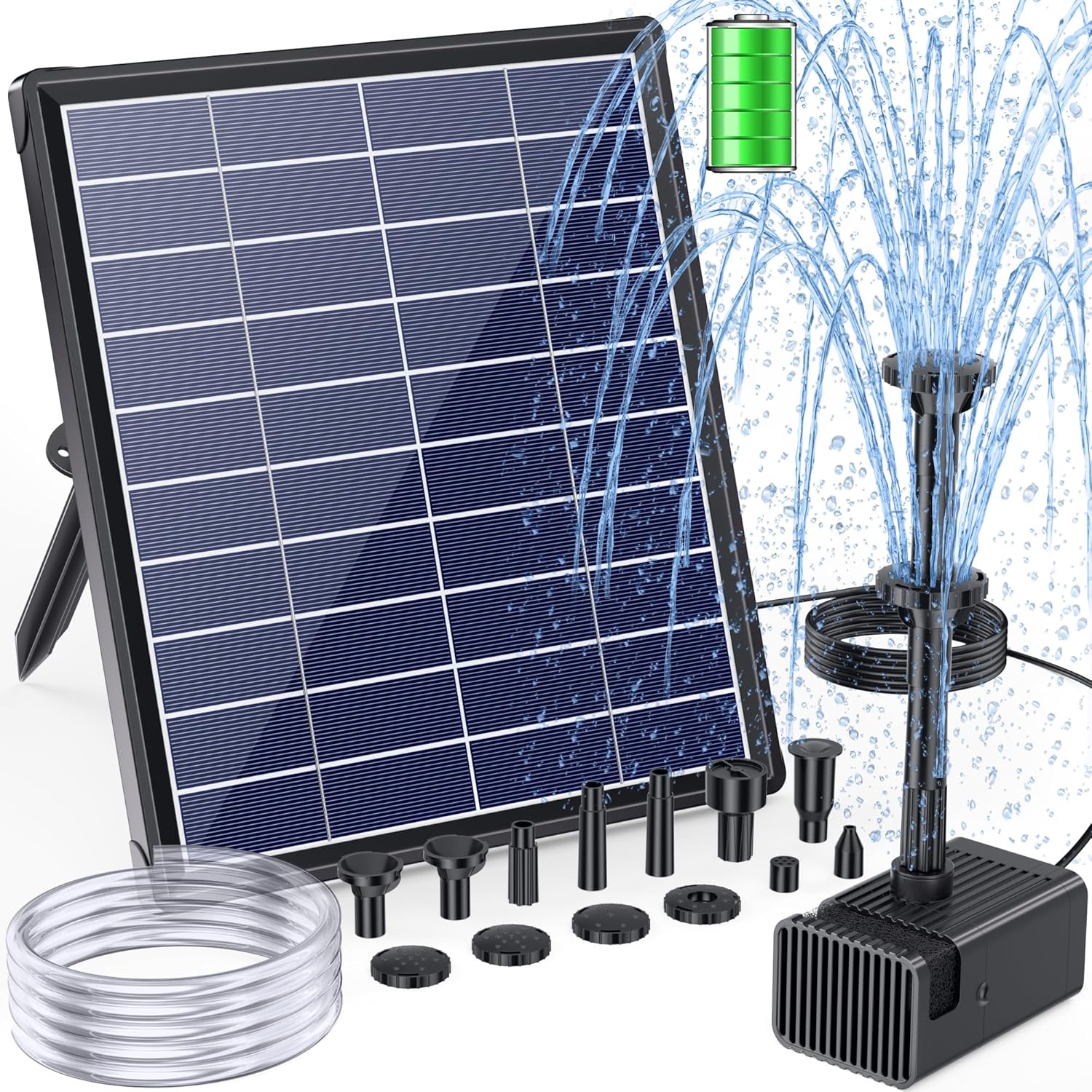
POPOSOAP 6.5W Solar Fountain Pump with 3000mAh Battery Backup for Bird Baths
| Power Source | Solar Powered |
|---|---|
| Flow Rate | 300 liters_per_day |
| Maximum Lifting Height | 65 inches |
| Voltage | 10 volts |
| Horsepower | 6.5 watts |
This POPOSOAP 6.5W solar fountain pump is built for steady daytime performance in bird baths and small backyard water features. The unit pairs a 6.5W solar panel with a 3000mAh rechargeable battery so it keeps running on cloudy days once charged, and the plug-and-play design makes installation simple: stake or mount the panel, float or submerge the pump and choose one of eight nozzles. Practical features include dry-run protection and an anti-clog filter to reduce maintenance and protect the motor, plus a 5 ft tubing for DIY setups or directing flow to a bubbler or small waterfall. The pump delivers up to about 300 liters per day and a maximum lift suited to shallow basins, so it produces a lively spray without emptying small baths. Expect quiet operation that attracts birds and wildlife. Limitations are that it does not operate at night and output depends on sun exposure, so taller or larger ponds will need a higher-capacity unit or wiring for stronger flow.
Best for: Gardeners who prioritize reliable daytime performance from a compact, low-maintenance solar pump for bird baths and small water features and who want a ready-to-install unit with flexible spray options.
Less Ideal for: People who need continuous nighttime operation or high flow for larger ponds should consider mains-powered or higher-wattage solar pumps instead.
- Built-in 3000mAh battery allows operation into cloudy periods after charging
- Dry-run protection and anti-clog filter help prevent pump damage and reduce maintenance
- Includes eight nozzle options and 5 ft tubing for flexible spray patterns and DIY features
- Easy plug-and-play installation with rotatable ground stake for the solar panel
- Does not operate at night despite the battery backup
- Flow and lift are limited by solar input, so performance drops in low sun or for larger ponds
Verdict: Choose this pump if you want a compact, easy-to-install solar fountain that delivers dependable daytime flow and low-maintenance protection for bird baths and small water features.
Choosing the Right Solar Pond Pump: Key Factors to Consider
Flow Rate and Head Height
Flow rate determines how much water the pump moves and directly affects circulation quality and fountain height. For ponds, you should consider both the pump's maximum flow in liters per hour or gallons per hour and how that flow falls off as head height increases.
A pump that lists a high maximum flow but drops quickly with a modest head may not deliver adequate circulation when installed under a fountain head or when pushing water up a stream run. Match the pump's flow curve to the vertical lift and length of tubing you plan to use. Failure to do so results in weak fountains, poor oxygenation, and increased debris buildup.
Solar Panel Output and Placement
Panel wattage and voltage determine how much energy the pump receives and how well it will operate under varying sunlight. Pay attention to the panel's rated output and the pump's voltage requirements so the system runs near its optimum during peak sun.
Placement matters more than raw wattage. Panels should face the sun with minimal shading and be mounted where morning and midday light reach them. Angle and orientation affect daily energy capture. In partially shaded yards you may prefer a larger panel or a pump that tolerates lower irradiance to maintain reliable flow through the day.
Weather Resistance and Construction
Pond pumps sit outdoors year-round and face UV, temperature swings, and moisture. Look for corrosion-resistant materials, secure cable glands, and panels rated for outdoor use. Plastic housings vary widely in UV stabilization and toughness, while metal components should be stainless or treated to avoid rust.
Durable construction extends service life and reduces the frequency of repairs or replacements. Consider how easily seals and gaskets can be inspected and replaced, since those are common wear points in pond equipment.
Clog Tolerance and Impeller Access
Ponds accumulate leaves, algae, and grit that can jam small impellers. Pumps designed with larger intake screens, removable pre-filters, or easily accessed impeller chambers reduce downtime and simplify maintenance.
Evaluate how easy it is to clean the intake, remove lodged debris, and replace the impeller if necessary. Models that require disassembling the entire unit for a simple clog are less practical for routine garden maintenance.
Compatibility with Fountain Heads and Tubing
Many gardeners use pond pumps to run decorative fountains and stream features. Ensure the pump's outlet fits common tubing sizes or that adapters are readily available. Some pumps include multiple nozzle sizes to produce different spray patterns.
Also consider the effect of added nozzle resistance on flow and head height. A pump that can handle moderate nozzle backpressure without stalling will give you more options for fountain effects and water feature design.
Sizing Your Pump to Pond Volume
Estimate your pond volume to choose a pump that turns over the water at an appropriate rate. For wildlife-friendly ornamental ponds, aim for a turnover that supports gentle circulation rather than aggressive rates that disturb plants and fish. For ponds with fish, higher turnover helps oxygenation and clarity, but balance this with the pump's daylight-only operation.
If you have a run or waterfall, calculate the head height and friction losses from tubing. Short runs with low head require much less pumping power than tall fountains. Matching pump capacity to these real-world factors prevents underperforming installations.
- Calculate volume in gallons or liters for accurate flow matching
- Factor in tubing length, fittings, and vertical lift when planning
- Over-spec a little for heavy plant or debris loads, but not excessively
Installation Tips for Reliable Performance
Position the solar panel where it receives the most consistent sun through the day and secure it against wind. Panels perform poorly with even partial shade from trees or structures. Use adjustable mounts if you want to change tilt seasonally for better capture.
Place the pump where it can draw cleaner water when possible, such as near a skimmer or slightly elevated on a platform to reduce intake of bottom silt. Use pre-filters or baskets to minimize clogging from leaves and string algae.
- Keep cable runs short and protected from pinch points
- Use flexible tubing designed for outdoor use to avoid kinks
- Check and clean intake screens weekly during peak leaf drop seasons
Winter Care and Off-Season Storage
In colder climates remove and store pumps that are not rated for freezing conditions. Freeze-thaw cycles damage seals and can crack housings. Store pumps dry and protected indoors if you remove them from the pond.
If you leave a pump installed, ensure it sits where ice formation is least likely to crush components, and consider a small de-icer for critical spots. Solar panels can remain mounted but should be cleaned and checked for secure fastenings before winter storms.
- Drain and dry pumps before storage to avoid freeze damage
- Label cords and fittings for quick reinstallation in spring
- Inspect seals and replace worn gaskets during offseason service
Energy Alternatives and Hybrid Options
Some gardeners combine solar pumps with battery backup or wired AC sources to provide continuous circulation after dusk or during low-sun periods. A hybrid approach reduces stress on aquatic life when sunlight is inconsistent.
Consider whether a small battery or controller that stores daytime energy is worthwhile for your pond. Batteries add complexity and maintenance but can smooth out flow on cloudy days and extend run time for critical features like a waterfall.
- Battery backups require charge controllers and proper ventilation
- Hybrid setups need planning for charging cycles and replacement costs
- Controllers that allow panel and battery management improve reliability
Common Installation Mistakes to Avoid
Avoid mounting the solar panel where it will be shaded during key daylight hours. Shading reduces flow dramatically and creates unpredictable performance. Also avoid placing the pump on silty bottoms where it will continuously draw debris.
Do not assume nominal flow ratings apply at your feature height. Always check the flow curve or expect reduced fountain heights once piping and heads are attached. Secure all fittings and use hose clamps where appropriate to prevent leaks and loss of pressure.
- Do not undersize tubing; restrictively small hoses cut flow
- Avoid hidden inlets that are hard to access for cleaning
- Regularly inspect seals and connections, especially after storms
How We Chose the Best Solar Pond Pump
We prioritized attributes gardeners actually experience when installing and maintaining solar pond pumps. Key evaluation points included reliable daytime flow and pump output across varying sunlight, the robustness of materials and weather resistance, impeller design and clog tolerance, ease of installation and common maintenance tasks, and compatibility with common pond fittings and fountain heads. We also checked mounting and panel placement options for realistic garden layouts and how simple it is to route tubing and secure wiring. Exclusions: units that require constant AC backup, make unverified waterproof claims, or lack clear specifications for flow at head height were excluded. We favored pumps with documented flow curves or manufacturer data that align with typical pond sizes. The result is a list that emphasizes dependable circulation, straightforward maintenance, and weatherproof construction that hold up in outdoor pond environments.
FAQ
Can a solar pond pump run continuously through the day?
Often yes. Most solar pond pumps run whenever they receive sufficient sunlight, so they operate throughout the day in direct sun. Performance will dip on cloudy days and during early morning and late afternoon when irradiance is lower.
Will a solar pump work for a waterfall or tall fountain?
It depends on the pump's flow curve and the total head height. Pumps that handle greater head and have robust panel wattage can run small waterfalls or modest fountains. Calculate the vertical lift and friction loss to know if a specific pump will meet your design.
How often do I need to clean a solar pond pump?
Usually weekly to monthly depending on debris load and plant matter. Ponds with heavy leaf fall or algae require more frequent checks. Pumps with easy-access impellers will reduce the time spent on maintenance.
Are batteries necessary with solar pond pumps?
Not always. Batteries provide run time after dark and during cloudy periods but add complexity and maintenance. If you only need daytime circulation and the site gets reliable sun, a direct-drive solar pump may be sufficient.
Can the solar panel be mounted away from the pond?
Yes. Panels can be placed where they get the best sun and wired to the pump, within manufacturer-recommended cable length limits. Longer cable runs can introduce voltage drop, so keep cables reasonably short and use weatherproof connections.
What maintenance should I do before winter?
In cold climates remove pumps that are not frost-rated, drain and dry them, and store them indoors. Clean and inspect panels and replace any worn seals so the unit is ready for reliable operation in spring.
Final Verdict
Choose a solar pond pump by matching its daytime flow and head capabilities to your pond volume and any decorative features you want to run. Prioritize panels placed in full sun and pumps with good clog tolerance and weatherproof construction for lower maintenance. For many gardeners the right balance is a pump that provides consistent daytime circulation, is simple to access for cleaning, and has installation options that fit the pond layout. Weigh tradeoffs between raw flow, head capability, and ease of upkeep to pick a pump that meets your pond's needs with minimal hassle.
