

Note: This article contains affiliate links. If you click on these links and make a purchase, I may earn a small commission at no extra cost to you. This helps support my research and content. Read my full affiliate disclosure here.
A properly matched pond pump keeps water moving, powers filters and waterfalls, and helps maintain oxygen levels essential for plants and fish. Pick the wrong size or style and you get low flow, stressed wildlife, or higher running costs. This guide narrows the field to seven top pond pumps suited for typical garden ponds, patios with small water features, and backyard koi setups. We shortlisted pumps based on steady flow performance, energy use, quiet operation, and build durability. Below you will find the shortlisted options and a clear explanation of the criteria used so you can pick a pump that fits your pond size and installation constraints.
Top Picks at a Glance
| Best Overall The best all-around choice for most situations | Alpine Corporation PAL5200 Submersible Pond Pump (5200 GPH) |  |
| Best Quality Built to a higher standard if you want something more solid | Aquascape AquaSurge Asynchronous Pond Pump (2,000–5,284 GPH) |  |
| Best Value The sweet spot between price and what you get | GROWNEER 550GPH Submersible Water Pump (30W) |  |
| Best Budget The cheapest option that still gets the job done reliably | PULACO 160 GPH Submersible Water Pump with Tubing |  |
| Highest Rated A top-rated pick with lots of positive feedback | OYO WATER PG850 850 GPH Adjustable Flow Submersible Pond Pump |  |
| Most Popular A crowd favorite that many people choose with confidence | AQUASTRONG 1 HP Submersible Utility/Sump Pump |  |
Alpine Corporation PAL5200 Submersible Pond Pump (5200 GPH)

| Power Source | Corded Electric |
|---|---|
| Flow Rate | 5200 gpm |
| Maximum Lifting Height | 25 feet |
| Voltage | 120 volts |
| Horsepower | 426 watts |
The Alpine PAL5200 is a heavy-duty submersible pump built to move a lot of water reliably in backyard ponds, waterfalls, and large fountains. It delivers up to 5200 gallons per hour using a 426-watt motor, so it can power strong circulation and support filtration and aeration on medium to large water features. The pump accepts vertical or horizontal installation, comes with multi-angle outlet adapters for directing flow, and has a long 33-foot power cord for flexible placement. Its ceramic shaft and oil-free design aim to reduce wear and clog-related problems, and the housing materials are intended to resist outdoor corrosion. You will notice robust performance and relatively quiet operation compared with similarly powerful models, but the unit is substantial and needs appropriate mounting or a stable base to avoid vibration. It is best suited to owners who need sustained high flow rather than ultra-compact or ultra-quiet setups. Routine debris management and occasional inspection will keep it running efficiently.
Best for: Gardeners and pond owners who want reliable, high-volume circulation for medium to large water features and prioritize steady filtration and visible water movement.
Less Ideal for: Those with very small ponds, indoor fountains, or buyers seeking the smallest, lowest-power quiet pumps should consider more compact low-flow models instead.
- High flow rate of 5200 GPH supports strong circulation for larger ponds and waterfalls
- 426-watt motor provides consistent power while remaining relatively quiet in operation
- Multi-angle outlet adapters and long 33-foot cord allow flexible placement and flow direction
- Ceramic impeller shaft and oil-free magnetic motor design reduce wear and clog issues
- Physically substantial unit may require a stable mounting surface to prevent vibration
- Higher power draw compared with small pumps makes it less suitable for tiny or low-flow ponds
Verdict: Choose the PAL5200 when you need dependable, high-volume water circulation to keep larger ponds and waterfalls well filtered and visually dynamic.
Aquascape AquaSurge Asynchronous Pond Pump (2,000–5,284 GPH)

| Manufacturer | Aquascape |
|---|---|
| Date First Available | February 18, 2023 |
| Customer Reviews | 4.6 out of 5 (205) |
The Aquascape AquaSurge is a performance-focused asynchronous pump built to move large volumes of water for ponds, pondless waterfalls, and skimmer-filter systems. Its wide flow range lets you size the pump for heavy circulation or powerful waterfall drops, and asynchronous motor design typically means robust continuous duty and good reliability under load. You would install it inline with plumbing or inside a pump vault or skimmer where it can be plumbed to a waterfall spillway or filtration system. Notable features include the high maximum GPH rating and compatibility with typical pond plumbing arrangements. Practical benefits are strong circulation to keep water clear, the capacity to run sizable waterfalls, and fewer pump changes for larger systems. Important limitations are that the unit is physically substantial and intended for larger features so it is not the best choice for very small backyard ponds, and proper installation requires matching it to your pond head height and plumbing to achieve the published flow rates.
Best for: Buyers building or upgrading medium to large ponds or pondless waterfalls who prioritize strong, continuous flow and long-run reliability from a purpose-built pump.
Less Ideal for: Owners of small container ponds, tabletop fountains, or those wanting a compact, plug-and-play decorative pump should look at lower-flow, simpler units instead.
- High maximum flow up to 5,284 GPH suitable for large ponds and waterfalls
- Asynchronous motor design for continuous-duty performance and reliability
- Works with skimmer filters and pondless waterfall plumbing
- Manufacturer brand with pond-specific product support and ecosystem
- Overkill for small ponds or simple fountain features
- Requires correct matching of head height and plumbing to reach rated flow
Verdict: Choose the AquaSurge if you need a robust, high-flow pump that reliably drives large ponds or dramatic waterfalls.
GROWNEER 550GPH Submersible Water Pump (30W)

| Power Source | ac |
|---|---|
| Flow Rate | 33 liters per minute |
| Maximum Lifting Height | 7.2 feet |
| Voltage | 110 volts |
| Horsepower | 30 watts |
The GROWNEER 550GPH is a small, versatile submersible pump aimed at circulating water in aquaria, small ponds, fountains, and hydroponic setups. It uses a 30W motor to deliver up to about 550 gallons per hour and includes a flow-control knob so you can dial the output to the feature you are running. Three threaded nozzles are supplied for different tubing sizes and spray patterns, and four suction cups make vertical or horizontal mounting straightforward. Practical touches include a nearly 6 foot power cord and guidance on avoiding debris and freezing. Expect reliable water movement and decent lift for modest pond features, but note this is a plastic-bodied, cold-water pump intended for clean water only and not rated for high-temperature liquids. Regular cleaning is required to prevent noise and flow loss from clogging, and its compact size limits use to small to medium installations rather than large landscape ponds.
Best for: Buyers who need an affordable, compact pump to power a small pond feature, fountain, or hydroponic system and prefer a unit they can tune and maintain themselves.
Less Ideal for: Not a good choice for large garden ponds, heavily silty or debris-filled water, or users who want a maintenance-free, heavy-duty metal pump.
- Adjustable flow control for matching output to fountains or filters
- Includes three threaded nozzles to fit different tubing and spray needs
- Decent maximum lift of 7.2 feet suitable for small pond features
- Compact and easy to mount with four suction cups and a long power cord
- Made of plastic and intended for clean, cold water only so not ideal for heavy debris or hot liquids
- Requires regular disassembly and cleaning to prevent clogging and noise
Verdict: If you want an adjustable, budget-friendly pump to circulate water and run small pond fountains, this compact 30W unit delivers practical performance and easy installation.
PULACO 160 GPH Submersible Water Pump with Tubing
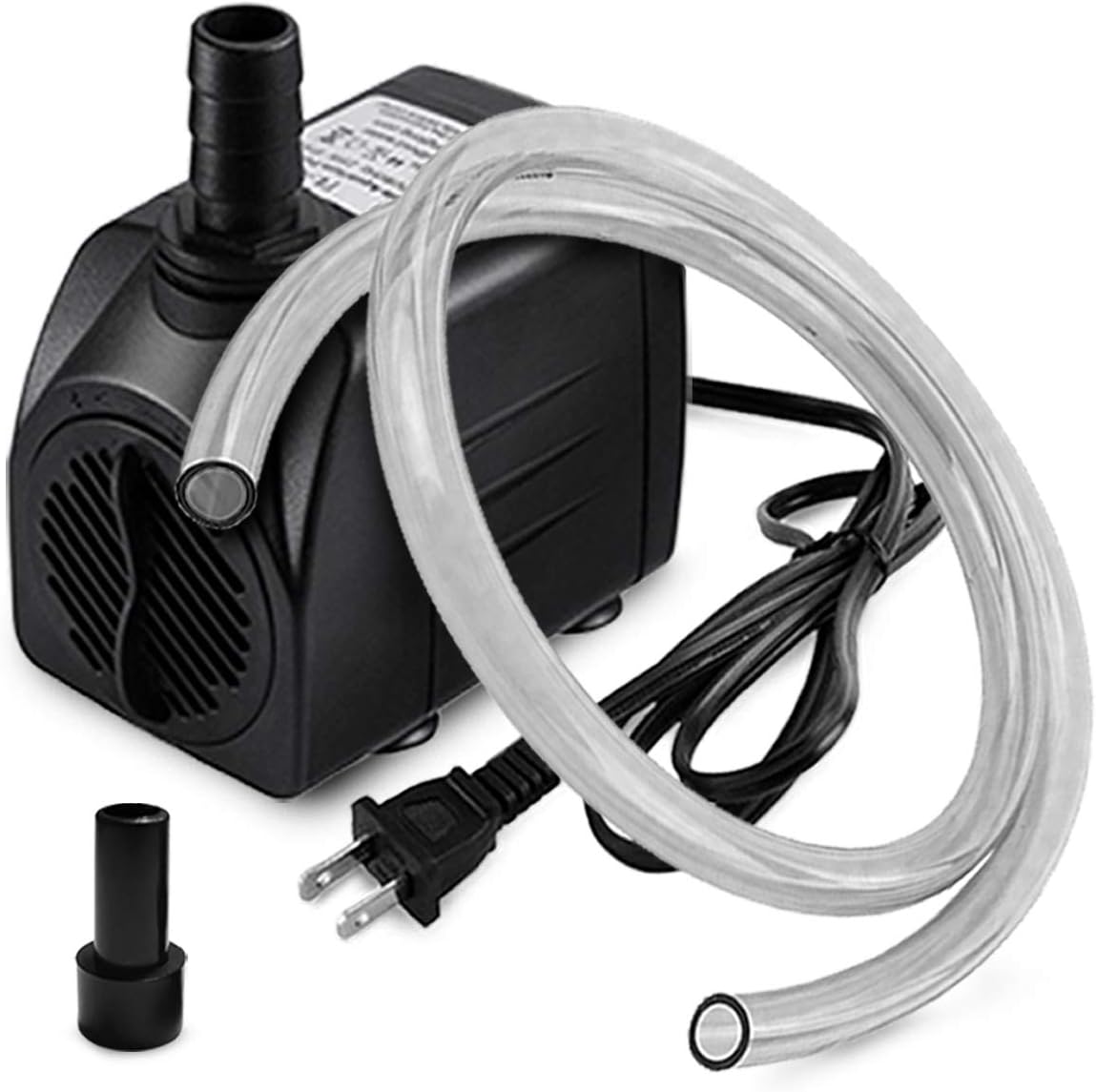
| Flow Rate | 160 GPH (600 L/H) |
|---|---|
| Maximum Lifting Height | 4 feet |
| Power | 10 Watt |
| Power Source | ac (120 volts) |
The PULACO 160 GPH submersible pump is a small, budget-friendly unit meant to circulate water in aquariums, tabletop fountains, and small ponds or garden features. It is designed to run fully submerged and includes a US plug and a 3.3 ft length of silicone tubing for basic hookups. Notable features are a claimed 160 GPH maximum flow, an adjustable flow valve for fine tuning output, a stainless steel shaft and copper-wound motor for corrosion resistance, and a relatively long power cord for flexible placement. In practice the 160 GPH rating is the open-flow maximum and flow will drop when plumbing or lift is added, so expect lower real-world output at the pump’s 4 ft lift limit. The pump is straightforward to disassemble for cleaning which helps with debris-prone garden use, but it does require regular maintenance to avoid clogs. It is mechanically simple and quiet for small outdoor fountains, though it is not large enough for medium to large ponds or heavy filtration tasks.
Best for: Buyers who need an inexpensive, easy-to-install pump for small water features or aquariums and prioritize quiet, low-power circulation over high flow.
Less Ideal for: People planning to move large volumes of water, run heavy filters, or service medium and large ponds should choose a higher-capacity pump instead.
- Compact submersible design works inside small tanks, fountains, and garden features
- Adjustable flow valve lets you dial output to the feature without extra fittings
- Stainless steel shaft and copper motor improve corrosion resistance and durability
- Easy to disassemble and clean to clear debris or salt buildup
- 160 GPH is an open-flow figure and real output will be lower when tubing or lift is added
- Not powerful enough for medium or large ponds or heavy filtration tasks
Verdict: A low-cost, compact submersible pump that delivers quiet, adjustable flow for small ponds and garden water features.
OYO WATER PG850 850 GPH Adjustable Flow Submersible Pond Pump

| Power Source | Corded Electric |
|---|---|
| Flow Rate | 14.16 gpm |
| Maximum Lifting Height | 8.2 feet |
| Voltage | 120 volts_of_alternating_current |
| Horsepower | 46 watts |
The OYO WATER PG850 is a compact, 46W submersible pump built to provide steady, reliable circulation for small ponds, fountains, and water features. It delivers up to 850 GPH at the outlet with an adjustable dial that scales flow from about 300 to 850 GPH and a maximum lift of 8.2 feet, so you can tune a gentle ripple or a modest waterfall. The unit includes a snap-on pre-filter cage and filter bag that protect fish and trap debris, plus two spout adapters and hose clamps for common tubing sizes. Its oil-free magnetic motor and ceramic shaft are sealed for quieter operation and reduced maintenance, and the 20.3 foot cord gives flexibility on placement. Practical benefits include easy tool-free installation, multiple mounting options (submerged or placed on land), and a run-time expectation the brand cites for long service life. Limitations are its power ceiling and lift height, which make it best for small to medium features rather than large high-head installations, and the 1-year manufacturer warranty is modest compared with some heavy-duty models.
Best for: Buyers who prioritize a dependable, low-maintenance pump for small to medium garden ponds or fountains and want simple, quiet circulation they can adjust without tools.
Less Ideal for: Owners planning large koi ponds, long high-head runs, or heavy-duty continuous high-flow applications should consider more powerful, commercial-grade pumps.
- Adjustable flow dial (approx. 300–850 GPH) lets you fine-tune water movement for different features
- Protective pre-filter cage and filter bag keep small fish safe and reduce debris intake
- Oil-free magnetic motor with ceramic shaft for quieter, low-maintenance operation
- Includes common adapters, hose clamps, suction bases, and a 20.3 ft power cord for flexible placement
- Maximum lift of 8.2 feet and 46W power limit its use for larger ponds or high-head waterfalls
- Manufacturer warranty period is only one year
Verdict: A quiet, adjustable, and easy-to-service submersible pump built for reliable everyday circulation in small to medium water features.
AQUASTRONG 1 HP Submersible Utility/Sump Pump

| Flow Rate | 75 gpm |
|---|---|
| Maximum Lifting Height | 30 feet |
| Horsepower | 1 hp |
| Power Source | AC |
| Material Type | Thermoplastic |
This AQUASTRONG 1 HP submersible pump is built for heavy-duty water removal tasks such as draining ponds, pools, basement water, and garden water features. It delivers up to 4500 GPH (75 GPM) at shallow lift and can push water vertically as high as 30 feet, which makes short transfers and filling elevated outlets practical. The reinforced thermoplastic casing and mechanical seal improve corrosion resistance and reduce the chance of leaks, while the bottom-suction design handles small solids down to 1/5 inch so it will clear fine debris without constant clogging. Installation is straightforward with the supplied adapters for common hose sizes and a 10 ft UL power cord for flexible placement. It lacks an automatic float switch, so it must be monitored or paired with an external controller for unattended sump work. For buyers focused on reliability, the pump’s durable motor protection and commonly reported positive feedback provide strong social proof, but expect manual operation for many applications.
Best for: Buyers who want a proven, high-capacity submersible pump for pond draining, pool emptying, or emergency water removal and who value durability and positive user feedback when choosing gear.
Less Ideal for: Users who need fully automatic unattended sump control or very fine debris filtration should consider pumps with integrated float switches or specialized filters.
- High flow capacity up to 4500 GPH (75 GPM) for fast draining
- 30 foot maximum vertical lift suitable for elevated discharge
- Reinforced thermoplastic housing and mechanical seal resist corrosion and leakage
- Bottom-suction design handles solids up to 1/5 inch to reduce clogging
- Includes multiple hose adapters and a 10 ft UL power cord for easy installation
- No built-in float switch for automatic on/off operation
Verdict: AQUASTRONG's 1 HP submersible pump is a reliable, high-flow choice for quickly draining ponds and other water features when you want a sturdy, well-reviewed unit.
Choosing the Right Pond Pump: Key Factors to Consider
Matching Pump Size to Pond Volume and Head Height
Selecting the right pump size starts with pond volume and desired turnover rate. For general pond health aim for a full turnover every 1 to 2 hours for fish-heavy ponds and every 2 to 4 hours for mostly planted ornamental ponds. Multiply the pond volume by the target turnover interval to estimate the required gallons per hour.
Head height matters because pumps deliver less flow as you push water higher or through long tubing. Check the pump's flow curve to see expected output at your installation head. Add allowances for fittings, filters, and the vertical lift from water surface to highest outlet. A pump that looks adequate on paper can underperform if head is not accounted for, so size conservatively for realistic plumbing losses.
Energy Use and Operating Cost
Pond pumps often run 24/7, so energy consumption is a major ongoing cost. Compare watts consumed at the operating point you expect rather than just the maximum rating. A pump that delivers the required flow at lower wattage will save money over months and years.
Look for pumps with efficient motor designs or multiple speed settings that let you dial back flow overnight or when circulation needs are lower. Consider the tradeoff between a slightly larger, more efficient pump and a smaller, less efficient one that might run harder or shorter life.
Noise Levels and Vibration Control
A loud pump or one that transmits vibration into rocks or decking can be a constant nuisance. Noise arises from motor mechanics, impeller interaction with debris, and vibration transfer through hard mounts.
Choose pumps with smooth-running motors and rubber isolators or soft mounting options. Consider locating the pump on a soft pad, in a sound-dampening box, or in a separate sump to reduce audible noise at seating areas. Remember that as pumps age or become partially clogged they can get noisier, so ease of maintenance helps keep noise down.
Debris Handling and Pre-Filter Needs
Outdoor ponds collect leaves, algae strands, and other debris that can clog impellers and shorten pump life. Pumps with integrated pre-filters, large-clearance impellers, or vortex-style housings handle debris better and reduce maintenance frequency.
Even with a capable pump, plan for a pre-filter or skimmer if your pond gets heavy leaf fall. Consider how easily the pump can be removed for cleaning and whether replacement parts like impellers and seals are accessible. Designs that tolerate intermittent partial blockage without stalling are especially useful in busy garden settings.
Material Durability and Weather Resistance
Pumps operate in wet, sometimes freezing or very hot conditions. Corrosion-resistant housings, sealed motors, and durable shaft materials extend operational life. Plastic housings can resist corrosion but must be UV-stable; metal housings should be stainless or treated for outdoor use.
Check the expected duty rating for continuous operation. Weather exposure, pond chemistry, and seasonal freeze-thaw cycles all influence longevity, so choose materials and seals designed for outdoor ponds rather than indoor-only fountain pumps.
Installation Flexibility and Serviceability
Practical installation features reduce headaches. Look for pumps with multiple outlet sizes, simple cable routing, and compact footprints that fit sumps or caverns. Easy access to impellers, tool-free disassembly, and availability of spare parts make routine service faster.
Consider whether the pump can be installed inline, submerged, or in a separate chamber, and whether fittings are standard sizes. Flexible installation options let you adapt the pump to existing plumbing and future upgrades without full replacement.
Sizing Examples and Quick Calculations
Calculate pond volume in gallons by measuring length, width, and average depth, then using standard formulas for rectangular or irregular shapes. For round ponds use the appropriate geometric formula. Once you have volume, choose a pump with a rated flow that meets your target turnover rate after factoring in head loss.
Use the pump's flow curve to find the actual delivered gallons per hour at your total head height. Subtract estimated losses for tubing length, elbows, and filter resistance. If you plan a waterfall or stream, add that elevation to your head calculation so the pump can sustain both circulation and decorative features.
- Estimate pond volume first, then target turnover rate.
- Read the pump flow curve for realistic output at head height.
- Account for tubing, fittings, and filter resistance when sizing.
Noise Mitigation Tactics for Near-Patio Ponds
If the pond sits near seating or a bedroom window, plan installation to reduce transmitted sound. Mount the pump on rubber feet or a foam pad to decouple vibration. Enclosing the pump in a ventilated, sound-absorbing box or using a separate buried chamber can cut audible motor hum significantly.
Regular maintenance limits noise from debris hitting the impeller. Check mounting points and tighten loose fasteners, and replace worn isolators to prevent new vibration paths.
- Use vibration isolators and soft mounts.
- Place pump away from direct contact with hard structures.
- Perform routine cleaning to avoid impeller noise.
Integrating Pumps with Filters and UV Clarifiers
Pumps are often paired with mechanical and biological filters and sometimes UV clarifiers. Ensure the pump delivers enough flow through the filter at the expected head. Oversizing a pump can overwhelm some filter media; undersizing reduces filtration efficiency. Check manufacturer recommendations for compatible flow ranges.
When adding a UV clarifier include its pressure drop in your head calculations. Some gardeners position the pump before the filter for better debris handling, while others route water through a skimmer first. Think through the planned plumbing sequence to avoid unexpected flow reductions.
- Match pump flow to the filter's rated range.
- Account for UV or additional devices in head loss.
- Plan plumbing sequence for debris control and service access.
Seasonal Care and Winter Considerations
In cold climates consider whether the pump will run year-round or be removed and stored for winter. Continuous-duty, freeze-rated pumps are useful when you need circulation to keep an opening in ice for gas exchange. If you remove the pump, choose an installation that allows easy extraction and safe winter storage.
For warm-season care, inspect seals and housings for UV degradation. Replace worn O-rings before they fail. Seasonal maintenance reduces the chance of sudden pump failure when pond organisms are most vulnerable.
- Decide on year-round operation or seasonal removal before installation.
- Select freeze-rated designs for winter circulation needs.
- Follow a seasonal maintenance checklist to extend life.
DIY Installation Tips for Small and Medium Ponds
Keep runs short and minimize turns in tubing to reduce head loss. Use rigid pipe for longer runs when possible to avoid collapse and reduce friction. Secure fittings with appropriate clamps and check for leaks before burying lines.
Test flow before finalizing landscaping. Run the pump with planned filtration and outlets in place so you can adjust pump position, hose size, or add a valve to fine-tune flow. Label electrical connections and use a GFCI-protected circuit for safety.
- Minimize tubing length and elbow count.
- Use appropriately sized pipe and fittings for long runs.
- Test the system under real conditions before finishing the site.
How We Chose the Best Pond Pump
We evaluated pumps on criteria that matter in real ponds: steady flow delivery under load, power consumption relative to output, noise level at typical operating distances, and long-term robustness against debris and continuous running. Flow performance was judged by rated flow at head height and reliability of that flow under partial blockage. Energy efficiency compared watts consumed against gallons per hour delivered at realistic head heights. Quiet operation focused on both motor design and mounting needs to reduce vibration transmission to liners and stonework. Durability covered housing materials, shaft and bearing design, and ease of routine maintenance. We excluded specialty units intended only for large municipal or industrial water features and tiny tabletop fountains that cannot handle pond debris or continuous duty. Also omitted were pumps lacking clear performance specs or construction details that matter for outdoor use. The final list favors pumps with clear flow curves, efficient motor designs, accessible service parts, and designs that handle common pond debris without frequent failure.
FAQ
How do I know what flow rate my pond needs?
Estimate pond volume and choose a pump that provides a full turnover in the target interval for your use. Fish-heavy ponds usually need faster turnover than planted-only ponds. Always adjust the pump's rated flow using the flow curve at your total head height.
Can I run a pond pump continuously?
Many pond pumps are designed for continuous duty, but check the pump's duty rating. Continuous operation helps oxygenation and filtration, but you should monitor energy use and perform regular maintenance to prevent failure from debris or wear.
Should I use a submersible or inline pump?
Submersible pumps are compact and quiet when properly mounted and are common for small to medium ponds. Inline pumps sit outside the water and can be easier to service and cool, which may suit larger installations. Your choice depends on access, noise tolerance, and space for a separate pump chamber.
How often should I service the pump?
Service frequency depends on debris load and season. Inspect and clean pre-filters and impellers every few weeks during heavy leaf fall or algae bloom and at least monthly in active seasons. More frequent checks prevent clogs and extend pump life.
Will a larger pump keep my water clearer?
Higher flow can improve filtration efficiency but can also stress filter systems and disturb plants. Balance flow with filter capacity and the needs of fish and plants. Using adjustable flow or multiple circuits often yields better clarity than simply upsizing the pump.
What electrical protections should I use?
Use a properly rated GFCI-protected circuit and weatherproof connections for outdoor pumps. Ensure cables are routed to avoid standing water and that any outdoor junctions are in sealed enclosures to reduce shock and corrosion risk.
Final Verdict
Pick a pond pump by balancing required flow at real head height with energy use and debris-handling ability. Prioritize a pump that meets your pond's turnover needs while running quietly and offering durable seals and service access. Expect tradeoffs between raw flow, efficiency, and noise, so choose the combination that fits your pond layout and maintenance plans. With the evaluation criteria in mind, you can select a pump that keeps water moving reliably, supports filtration and decorative features, and lasts through seasonal cycles without frequent intervention.
