

Note: This article contains affiliate links. If you click on these links and make a purchase, I may earn a small commission at no extra cost to you. This helps support my research and content. Read my full affiliate disclosure here.
If you manage a compact yard, a robotic lawn mower can save time while keeping grass consistently trimmed. The right unit for a small lawn balances compact size, efficient navigation, and battery runtime so the mower finishes frequent short cycles without getting stuck or leaving stripes. This guide covers seven shortlisted robotic lawn mowers chosen for small-lawn use and explains the real-world tradeoffs you should expect. We evaluate machines on navigation, battery endurance, cutting quality, and maintenance needs to help you pick the most practical option for your backyard. Read on for the factors that matter and how each type behaves in everyday garden conditions.
Top Picks at a Glance
| Best Overall The best all-around choice for most situations | ANTHBOT M5 Robotic Lawn Mower with Garage and RTK Positioning |  |
| Best Quality Built to a higher standard if you want something more solid | ECOVACS GOAT O1000 LiDAR PRO Robotic Lawn Mower |  |
| Best Value The sweet spot between price and what you get | RoboUP Raccoon 2 SE Robot Lawn Mower (Wire-Free, for up to 0.15 Acre) |  |
| Best Budget The cheapest option that still gets the job done reliably | KraftSense 20V Brushless Robotic Lawn Mower (7.9" Deck) |  |
| Highest Rated A top-rated pick with lots of positive feedback | LEBOSBO V3 AI Vision Robotic Lawn Mower (1600 sq ft) |  |
| Most Popular A crowd favorite that many people choose with confidence | Segway Navimow i105N Robot Lawn Mower (wire-free, RTK+Vision) |  |
| Best Seller A high-volume bestseller chosen again and again | ECOVACS GOAT O1000 RTK Robotic Lawn Mower |  |
ANTHBOT M5 Robotic Lawn Mower with Garage and RTK Positioning

| Power Source | Battery Powered |
|---|---|
| Operation Mode | Automatic |
| Minimum Adjustable Cutting Height | 3 centimeters |
| Cutting width | 7.9 inches |
The ANTHBOT M5 is a self-contained robotic mower designed for small-to-medium yards that need reliable slope performance. It combines dual AI cameras with RTK positioning so it builds virtual maps in the app and navigates without perimeter wire; the included RTK reference station improves positional accuracy for repeatable paths. Typical use is hands-off: set up the charging base and garage, let the mower map the lawn via the app, create work zones and no-go areas, then let it run automatically and self-charge when needed. Notable features include multi-zone management for up to 20 areas, adjustable cutting height down to about 3 cm, a five-blade mulching disc for fine clippings, and an ability to climb grades up to 45 percent. Practical benefits are precise navigation on steep terrain, quiet operation under 58 dB, and obstacle recognition from the dual 150° HDR cameras. Important limitations are that the M5 is aimed at smaller yards (around 0.12–0.15 acre recommended) and uses plastic bodywork, so very large properties or buyers seeking industrial‑grade durability should consider larger models.
Best for: Buyers who need a budget-conscious, automated mower capable of confidently handling steep residential slopes and who prioritize easy app setup and hands-off maintenance.
Less Ideal for: Homeowners with large acreages or those who need industrial-grade, heavy‑duty construction should look at higher-capacity commercial models.
- Wire-free mapping with dual AI vision and RTK improves positioning on slopes and complex layouts
- App control with multi-zone management and customizable no-go zones for tailored scheduling
- Handles steep terrain up to 45% gradient, suitable for most residential slopes
- Adjustable cutting height and five-blade mulching system for fine, even cuts
- Quiet operation under 58 dB and self-charging for mostly hands-off maintenance
- Recommended for relatively small lawns (approx 0.12–0.15 acre) so not ideal for large properties
- Plastic construction may not match the long-term durability of heavier commercial units
Verdict: If you want an affordable, app-driven robot mower that reliably handles steep residential slopes, the ANTHBOT M5 delivers precise, low‑noise mowing for small to mid-size yards.
ECOVACS GOAT O1000 LiDAR PRO Robotic Lawn Mower

| Power Source | Battery Powered |
|---|---|
| Operation Mode | Automatic |
| Maximum Adjustable Cutting Height | 3.6 inches |
| Minimum Adjustable Cutting Height | 1.2 inches |
| Cutting width | 8.66 inches |
The ECOVACS GOAT O1000 LiDAR PRO is a compact, wire-free robotic mower built to map and mow small yards with precision. It uses a HoloScope 360° dual-LiDAR system and AI vision to build an accurate map of your lawn and identify obstacles, which lets it mow reliably under trees, near fences, and in shaded areas where GPS-based models struggle. The mower includes an integrated TruEdge trimmer so it can cut right up to driveways, sidewalks, and beds, reducing follow-up trimming. App control lets you set schedules, create zones, and mark no-go areas for tailored coverage. Practical benefits for performance-minded owners include very close navigation accuracy, narrow-body access for tight corridors, and automated edge trimming to save time. Expect some setup and occasional mapping tweaks for complex corners or raised edges, and trimming mode is louder than normal mowing. The mower’s 8.66-inch cutting width and adjustable cut height make it best suited to smaller lawns rather than large properties where wider decks and longer runtimes would be preferable.
Best for: For owners of small, performance-focused lawns who want precise, low-touch mowing and close-to-edge trimming without trenching perimeter wire; ideal when navigation accuracy and compact footprint matter most.
Less Ideal for: Not a good fit for large acreage or homeowners who need a wider cutting path and longer continuous runtime; those who prefer the lowest noise operation may find trimming mode intrusive.
- Wire-free dual-LiDAR mapping for accurate position and navigation in shaded or complex yards
- Built-in edge trimmer for true edge-to-edge cutting and reduced manual trimming
- AI 3D obstacle detection to identify and avoid toys, furniture, pets, and small wildlife
- Narrow body that fits through tight paths and narrow lawn corridors
- App-driven zone, schedule, and no-go area customization for precise control
- Smaller 8.66-inch cutting width limits efficiency on larger lawns
- Edge trimming and trimmer module can be louder and may need occasional manual adjustments
Verdict: Choose the GOAT O1000 LiDAR PRO if you want wire-free, high-precision mowing and built-in edge trimming tailored to small, complex yards.
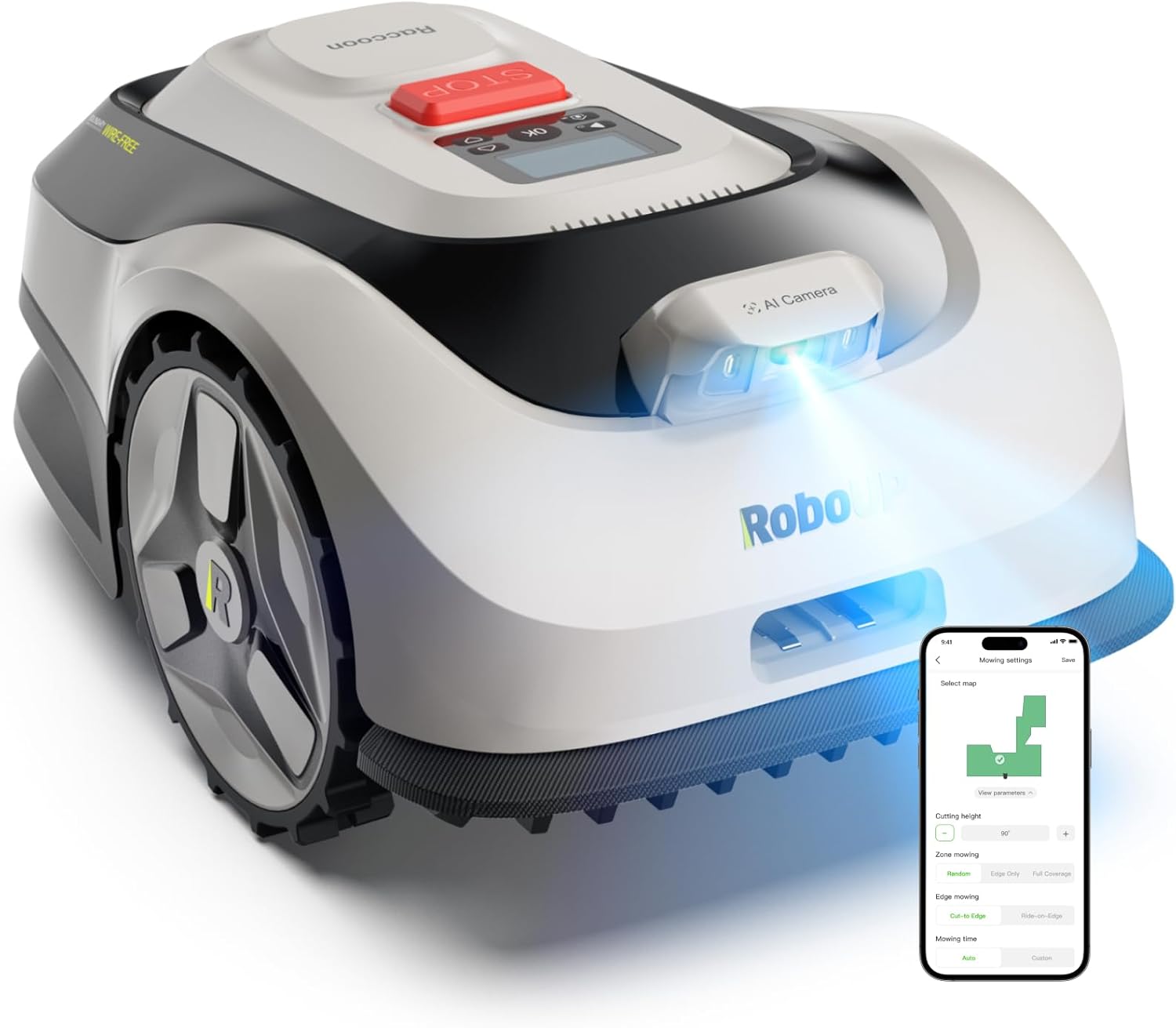
RoboUP Raccoon 2 SE Robot Lawn Mower (Wire-Free, for up to 0.15 Acre)
| Power Source | Battery Powered |
|---|---|
| Operation Mode | Automatic |
| Maximum Adjustable Cutting Height | 3.15 inches |
| Minimum Adjustable Cutting Height | 1.18 inches |
| Number of Positions | 5 |
The Raccoon 2 SE is a wire‑free robot mower built for small yards and straightforward layouts. It auto‑maps your lawn and can start with a single button press or be managed via app, offering scheduled mowing, multi‑zone support and electric height adjustment for a cleaner, more consistent cut. The mower uses AI vision and bumper sensors to avoid people, pets and common obstacles, handles slopes up to 36 percent, and will climb modest obstacles and navigate narrow passages. A 5Ah battery delivers long runtime and fast 70‑minute recharge cycles while the unit automatically returns to its dock when the battery is low or rain is detected. Practical benefits include quiet operation, OTA updates, and safety features such as lift and tilt detection and IPX6 water protection. Limitations to consider are the small coverage area limited to about 0.15 acre, the relatively narrow 7.9‑inch cutting width which increases run time on larger lawns, and the expectation that clearly defined boundaries or optional stakes are needed for optimal guidance on open edges.
Best for: Buyers who want a budget‑minded, low‑effort upgrade from push mowers for a small, well‑defined yard and value simple setup, quiet operation and app scheduling.
Less Ideal for: Owners of larger, irregular or heavily landscaped properties who need wider cutting decks, higher coverage area, or advanced RTK navigation for complex boundaries.
- Wire‑free auto mapping and one‑touch start for quick setup on simple lawns
- AI vision plus bumper sensors for obstacle avoidance and safe operation
- Long runtime from a 5Ah battery with 70‑minute fast recharge
- Handles steep slopes up to 36 percent and can climb small obstacles
- App control, scheduling and OTA updates for ongoing improvements
- Designed for small lawns only with a maximum recommended area of about 0.15 acre
- Narrow 7.9‑inch cutting width increases time needed on larger or complex yards
- May require optional boundary stakes for reliable edge control in open areas
Verdict: A practical, feature‑focused robotic mower for small yards that minimizes setup and hands‑on mowing while delivering quiet, app‑controlled performance.
KraftSense 20V Brushless Robotic Lawn Mower (7.9" Deck)

| Power Source | Battery Powered |
|---|---|
| Operation Mode | Automatic |
| Maximum Adjustable Cutting Height | 2.4 inches |
| Minimum Adjustable Cutting Height | 0.7 inches |
| Item Highlight | 1/8 acre Coverage, 22° Max Slope, 2.4G Wi-Fi & Bluetooth |
The KraftSense 20V Brushless Robotic Lawn Mower is an entry-level autonomous mower built for small lawns up to about 1/8 acre. It uses a brushless 20V motor for efficient cutting and lower maintenance, and connects over 2.4 GHz Wi-Fi or Bluetooth so you can schedule runs, set zones, and receive OTA firmware updates through the app. Practical features include a 7.9-inch cutting deck with adjustable heights from about 0.7 to 2.4 inches, IPX4 weather resistance for light rain, and hill capability up to 22 degrees which helps on modest slopes. Its compact, relatively quiet operation makes it easy to store and leaves less disturbance while mowing. Expect simple daily mowing performance on mostly flat, obstacle-light lawns; however the narrow deck and small coverage area mean longer run times on bigger yards and less efficiency around many tight obstacles or complex layouts. Build materials are mostly plastic, so handle rough terrain and impacts with care.
Best for: Homeowners with small yards who want a low-cost, low-effort mower that can be scheduled and monitored from a phone and who prioritize simplicity over high capacity.
Less Ideal for: People with large properties, highly complex lawns with many obstacles, or those who need heavy-duty, long-run commercial performance.
- Brushless 20V motor for efficient cutting and lower maintenance
- Wi-Fi and Bluetooth app control with OTA firmware updates
- IPX4 weather resistance lets it operate in light rain
- Capable of handling slopes up to 22 degrees
- Small 7.9-inch deck and 1/8 acre coverage make it slow on larger lawns
- Plastic construction may be less durable on very rough terrain
Verdict: A budget-friendly robotic mower for small yards that offers app scheduling, brushless motor efficiency, and basic weatherproofing for low-maintenance lawn care.
LEBOSBO V3 AI Vision Robotic Lawn Mower (1600 sq ft)

| Power Source | Battery Powered |
|---|---|
| Operation Mode | Automatic |
| Maximum Adjustable Cutting Height | 2.4 inches |
| Minimum Adjustable Cutting Height | 0.8 inches |
| Cutting width | 6.3 inches |
The LEBOSBO V3 is a plug-and-play robotic mower aimed at homeowners with small lawns who want reliable, low-effort grass maintenance. It uses AI vision to identify lawn edges and obstacles so you can skip perimeter wire installation, and the included 32 ft magnetic strip lets you create no-mow zones quickly. You control scheduling and modes through a smartphone app, and the mower operates quietly while cutting between 0.8 and 2.4 inches with a 6.3-inch cutting width. Practical benefits include reduced manual mowing, easy setup for nontechnical users, and the ability to protect flower beds or play areas with magnetic strips. Limitations to expect are a random mowing pattern that can take longer to fully cover complex layouts and a recommendation to manually trim very tall grass before use since the mower may treat dense, tall patches as obstacles. For routine maintenance on a small, mostly flat yard this model offers dependable convenience, but it is less suited to larger lawns or highly irregular terrain.
Best for: Homeowners who prioritize a dependable, low-maintenance solution for a small, mostly flat lawn and want a simple setup with app control rather than complex wiring.
Less Ideal for: Owners of large properties, highly irregular yards, or lawns with frequent tall or dense grass who need faster systematic coverage or heavy-duty cutting power.
- AI vision navigation removes need for perimeter wires for most yards
- Includes 32 ft magnetic strip to quickly define no-mow zones
- Smartphone app lets you schedule and monitor mowing remotely
- Low-noise operation suitable for daytime or evening use
- Random mowing pattern may require more time to fully cover complex lawns
- May struggle with grass taller than about 2.6 inches and requires pre-cutting taller growth
Verdict: Choose the V3 if you want a quiet, easy-to-install robotic mower that reliably maintains small lawns without perimeter wires.
Segway Navimow i105N Robot Lawn Mower (wire-free, RTK+Vision)

| Power Source | Battery Powered |
|---|---|
| Operation Mode | Automatic |
| Cutting width | 7.1 inches |
| Maximum Adjustable Cutting Height | 2 inches |
| Number of Positions | 5 |
The Navimow i105N is a wire-free robotic mower designed for small lawns up to one eighth of an acre. It creates an AI-assisted map via a smartphone app, then autonomously follows planned mowing patterns and returns to its charging base when needed. Key features include EFLS 2.0 with RTK+Vision for centimeter-level positioning in low-satellite conditions, a 140° camera that recognizes many common obstacles, multi-zone scheduling for up to 12 areas, OTA software updates, and selectable edge-mowing modes for a cleaner border. In practice the no-wire setup cuts installation time and makes it easier to reconfigure zones, while the vision system reduces collisions with toys, garden furniture, and small features. It is relatively quiet at the reported 58 dB(A) and includes spare blades and an installation kit. Important limitations are the small 7.1-inch cutting width and the maximum cutting height range, so it works best for regular maintenance rather than heavy overgrown lawns, and advanced positioning features are most useful where GNSS signal is weak but add system complexity. Overall the i105N suits owners who want low-touch, reliable mowing for compact, regularly maintained yards.
Best for: Buyers who want a low-maintenance, fuss-free robot mower for a small, regularly maintained yard and prioritize reliable navigation and safety over aggressive cutting power.
Less Ideal for: Large properties, very overgrown lawns, or owners who need wide cutting swaths for faster work should consider larger commercial-style mowers instead.
- Wire-free, app-guided mapping simplifies setup and zone management
- RTK+Vision positioning improves navigation under trees and in narrow areas
- Camera-based obstacle detection identifies many common objects to reduce collisions
- Multiple-zone scheduling and OTA updates allow flexible remote control and improvements
- Includes charging station, GNSS antenna kit and spare blades for out-of-the-box use
- Designed for small lawns only with a narrow 7.1-inch cutting width
- Not optimized for heavy overgrowth or infrequent deep cuts due to limited cutting width and height range
Verdict: Choose the Navimow i105N if you want a simple wire-free robot mower with RTK-enhanced navigation and strong obstacle avoidance for a small, regularly maintained lawn.
ECOVACS GOAT O1000 RTK Robotic Lawn Mower

| Power Source | Battery Powered |
|---|---|
| Operation Mode | Automatic |
| Maximum Adjustable Cutting Height | 3.2 inches |
| Minimum Adjustable Cutting Height | 1.2 inches |
| Number of Positions | 11 |
The ECOVACS GOAT O1000 RTK is a self‑navigating robotic lawn mower designed to maintain small to mid‑sized yards without perimeter wires. It scans and builds an editable map of your lawn, then follows efficient U‑shaped mowing patterns and a TruEdge routine to deliver consistent edge‑to‑edge cuts. The mower is battery powered and controlled through a smartphone app where you can set no‑go zones, adjust cutting height and speed, and schedule runs for different areas. Notable features include RTK positioning for accurate boundary recognition, AIVI 3D obstacle avoidance that detects pets and small objects, and an IPX6 waterproof rating for wet conditions. Practical benefits are low hands‑on time once the map is established, fewer missed spots near edges, and the ability to tailor behavior by zone. Important limitations are its modest 8.66-inch cutting width which means longer run times on larger properties, and a slimmer, lightweight plastic body that may be less durable under frequent heavy use compared with heavy commercial mowers.
Best for: Homeowners who want a low‑hands‑on, worry‑reducing mower for a modestly sized yard and value safety features and accurate mapping over bulky commercial power.
Less Ideal for: Those with large properties, commercial mowing needs, or buyers who need a wider cutting path and a heavy industrial build should look at larger, more rugged machines.
- RTK and automated mapping remove the need to install perimeter wire
- 3D AIVI obstacle avoidance reduces collisions with pets and garden objects
- App control with editable maps and zone customization simplifies scheduling and settings
- IPX6 waterproofing lets it operate reliably in wet weather
- Narrow 8.66-inch cutting width increases run time on larger lawns
- Plastic construction and consumer weight suggest lighter-duty build compared with heavy commercial units
Verdict: If you want a low‑maintenance, perimeter‑wire‑free mower with strong obstacle detection and precise mapping for a small to mid‑sized yard, the GOAT O1000 RTK is a practical choice.
Choosing the Right Robotic Lawn Mower for Small Lawns: Key Factors to Consider
Navigation and Obstacle Handling
How a robotic mower finds its way around lawn features is crucial on a small property. Tight gardens have more fences, flower beds, furniture, and narrow corridors where a mower can become wedged. Look for units that use a mix of bump sensors, ultrasonic or lidar sensing, or intelligent mapping algorithms to detect and avoid obstacles rather than relying only on simple random patterns.
Good navigation reduces the need for human intervention, prevents drag on batteries caused by repeated retries, and protects plants and hardscaping. For small lawns, the mower should replan routes quickly and back out of tight spots without manual rescue.
Battery Capacity and Recharge Behavior
Small lawns usually require shorter individual run times but more frequent cycles. Battery capacity and how the mower manages recharges determine whether it can complete a scheduled session or needs multiple trips to the base. Consider both nominal runtime and the recharge time because a long recharge can interrupt regular maintenance windows.
Also check whether the mower returns to the base automatically when battery falls below a threshold and whether it resumes unfinished work later. Efficient power management is especially important if you want the mower to run overnight or while you are away.
Cutting System and Width
Cut quality depends on blade type, cutting height range, and cutting width. On a small lawn with narrow passes, a wider cutting deck can be harder to maneuver but covers more area per pass. Many robotic mowers use rotary blades or small pivoting blades that mulch clippings finely, which is desirable for leaving a tidy finish and returning nutrients to the soil.
Adjustable cutting heights let you adapt to seasonal growth and grass type. For small lawns, prioritize a cutting system that balances compact footprint with the ability to make clean, repeated passes without scalping or leaving striping.
Edge Performance and Boundary Setup
Edges define the appearance of a small lawn. Some mowers follow a perimeter wire closely to produce clean edges, while others use perimeter mapping or edge-running modes that require less hardware. Consider how much physical edge trimming you will still need to do by hand and whether the mower can handle narrow strips between beds and paths.
Boundary setup time and complexity matter on small properties. If you prefer minimal installation, look for systems with easy-to-lay wire, wireless boundary options, or learning modes that map the lawn with fewer adjustments.
Durability and Weather Resistance
Robotic mowers spend most of their life outdoors, exposed to sun, rain, and debris. Robust housing, corrosion-resistant components, and proper sealing against moisture extend lifetime and reduce downtime. For small lawns that need year-round appearance, reliable IP-rated protection and the ability to tolerate occasional wet grass are helpful.
Also consider how the mower handles terrain changes like small slopes, uneven ground, or compacted soil. A durable drive system and well-protected electronics minimize maintenance and surprise failures.
Maintenance Effort and Serviceability
Even automated tools require upkeep. Blade changes, cleaning clogged intakes, winter storage, and routine checks should be simple and safe. On small lawns where the mower runs often, blades will dull or wear faster and may need frequent replacement. Choose designs that allow quick blade swaps, easy access to the charging contacts, and straightforward firmware updates.
Lower maintenance burden means the mower actually saves you time. Also evaluate the availability of replacement blades and simple diagnostics so you can troubleshoot common issues without professional help.
When a Robotic Mower Makes Sense for Compact Yards
Robotic mowers excel when you want frequent short trims rather than occasional long mowing sessions. On small lawns they smooth out growth, reduce clumping from irregular schedules, and keep a consistent height without bulky equipment storage.
They are particularly useful if access to the yard is limited, if you want to avoid moving a heavy push mower frequently, or if you need a low-noise solution for early morning or evening runs. Consider whether the extra setup time for boundaries is acceptable compared with the daily convenience.
- Ideal for lawns that are too small to justify large ride-on equipment
- Keeps grass uniformly short with minimal daily attention
- Reduces physical effort and saves shed space
Installation and Setup Tips for Small Lawns
Planning the perimeter layout carefully saves time later. For wired systems, lay the boundary wire slightly inside plant beds and hardscape to avoid accidental clipping. Use pegs or shallow burying so mowing and lawn care activities do not disturb the line.
Test the mower in a single-zone run before expanding schedules. Many issues come from initial placement of the charging base or poor cable routing through narrow gates. Keep an eye on ramp and passage clearances to ensure the mower can navigate typical garden furniture and gates.
- Place the charging base on level ground with good access
- Avoid tight funnels where the mower must make abrupt turns
- Label and map tricky spots so you can refine settings quickly
Managing Slopes, Strips, and Lawn Transitions
Small lawns often include steep little berms, narrow strips, or abrupt transitions to paths. Check the mower's slope rating and observe how it handles short steep runs. A unit with better traction and smaller drive wheels will often perform better in short steep sections than a model optimized for open expanses.
For narrow strips, you may need to run the mower in multiple orientations or trim edges by hand. Some mowers offer special edge modes or boundary following to reduce manual work, but on very narrow passages you should expect occasional touchups.
- Confirm slope capability for any sections over a few degrees
- Expect manual edging on very narrow or heavily landscaped borders
- Use companion trimming or a small cordless trimmer for final detail
Noise, Schedule Planning, and Neighbor Considerations
One advantage of robotic mowers on small properties is low operational noise. You can schedule runs during early morning or evening without causing major disturbance, but check local noise guidelines and neighbor preferences before running at odd hours.
Plan mowing windows to match grass growth patterns. Short, frequent passes are gentler on turf and reduce clippings. Use staggered schedules if the mower needs time to recharge between cycles so the lawn still receives consistent coverage.
- Prefer low-noise models if you have nearby neighbors
- Stagger cycles to avoid repeated daytime activity
- Avoid mowing wet grass to reduce noise and prevent clumping
Seasonal Care and Winter Storage for Small-lawn Setups
Even with a robotic mower, seasonal tasks remain. Store the unit in a dry place during long winter freezes or heavy snow periods if you want to preserve batteries and electronics. Before storage, clean debris from wheels and blades and charge the battery to the manufacturer-recommended level.
In shoulder seasons, reduce mowing frequency and adjust cutting height to help grass recover. A small lawn benefits from occasional manual inspections to correct low spots, thatch buildup, or invasive weeds that a mower cannot address alone.
- Perform a pre-winter deep clean and store in a dry area
- Adjust cut height for slow growth seasons
- Inspect and replace blades more often if the mower runs daily
How We Chose the Best Robotic Lawn Mower for Small Lawns
We focused on attributes that matter for small lawns where tight turns, limited run time, and frequent cycles are common. Key evaluation criteria included navigation and obstacle handling to avoid getting trapped around beds and furniture; battery capacity and recharge time to ensure complete cycles without long gaps; cutting system and mower-width efficiency to deliver even results on narrow strips and small patches; lawn-edge and boundary performance for clean edges near borders and paths; build durability and weather resistance since small lawns often need year-round convenience; and maintenance effort so busy homeowners spend minimal time on blade changes and cleaning. We filtered out models designed exclusively for large estates or those requiring extensive perimeter wiring complexity that makes setup impractical for small yards. We excluded units without documented safety or anti-theft features. The shortlisted products all met minimum runtime and navigation standards, and they represent different approaches gardeners use on compact properties, from simple return-to-base cycles to smarter mapping systems.
FAQ
Will a robotic mower handle narrow passages and gates?
Often it depends on the mower's navigation method and physical width. Many compact units can traverse narrow gates but may need boundary adjustments or temporary guide wires. Very tight passages may still require occasional manual assistance.
How often will the blades need replacing on a small lawn?
Usually blades last longer on smaller lawns because total cutting hours are lower, but frequent short cycles can still dull edges. Expect to inspect blades monthly during high-use seasons and replace or sharpen as needed to maintain cut quality.
Can the mower work in light rain or wet grass?
Many robotic mowers tolerate light moisture, but wet grass reduces traction and can clump, which harms cut quality. It often depends on weather sealing and the model's tolerance; avoid heavy rain and let turf dry when possible for best results.
How much setup is required for boundary wiring?
Setup ranges from minimal to moderate depending on the system. Wired perimeters take some initial planning and effort but are reliable. Some models offer wireless or simplified learning modes that reduce installation time for small lawns.
Will a robotic mower replace the need for edging and manual trimming?
Robotic mowers reduce overall edging but rarely eliminate the need entirely. Most units produce tidy results but struggle with exact edge definition against walls or very narrow borders, so occasional manual touchups are common.
Are robotic mowers secure from theft on a small property?
Security varies. Many units include PIN locks, alarms, and GPS tracking options. For small yards with easy access, consider activation locks and secure base placement to reduce theft risk.
Final Verdict
For small lawns, prioritize navigation, efficient battery behavior, and simple boundary setup over maximum cutting width or heavy-duty features. Decide whether you value a virtually hands-off schedule with intelligent mapping or a simpler compact unit that runs reliably with minimal setup. Keep in mind tradeoffs between edge precision and ease of installation; some manual touchups are normal even with a robotic mower. Choose based on how much maintenance you want to offload and the physical constraints of your yard. Focusing on the decision factors above will help you pick a reliable, low-noise mower that keeps a small lawn consistently neat with minimal effort.
