

Note: This article contains affiliate links. If you click on these links and make a purchase, I may earn a small commission at no extra cost to you. This helps support my research and content. Read my full affiliate disclosure here.
Fruit flies breed quickly in a kitchen environment and a well-chosen trap can stop an infestation before it spreads to other rooms. You need a solution that attracts and contains adult flies, is safe near food prep areas, and is simple to maintain. This guide shortlists seven of the most effective fruit fly traps for kitchen use and evaluates them against attractant strength, containment, and maintenance needs. Read on to understand how different trap styles behave on a countertop, near a sink, or in a pantry and which features matter most for fast, low-mess control.
Top Picks at a Glance
| Best Overall The best all-around choice for most situations | TERRO Fruit Fly Trap 6-Pack with 270-Day Lure Supply |  |
| Best Quality Built to a higher standard if you want something more solid | ZEVO Compact Flying Insect Trap with 3 Refill Cartridges |  |
| Best Value The sweet spot between price and what you get | Safer Home Indoor Plug-In Fly Trap, 2-Pack (with 2 Glue Cards) |  |
| Best Budget The cheapest option that still gets the job done reliably | Dwcom 40‑Pack Yellow Sticky Fungus Gnat and Fruit Fly Traps |  |
| Highest Rated A top-rated pick with lots of positive feedback | ELEGENZO DIY Fruit Fly Trap Kit with Reusable Escape-Proof Trap and Sticky Sheets |  |
| Most Popular A crowd favorite that many people choose with confidence | TERRO Fruit Fly Trap 4-Pack (180-Day Lure Supply) |  |
| Best Seller A high-volume bestseller chosen again and again | ZEVO Flying Insect Trap Starter Kit (Plug-In Base + Refill) |  |
TERRO Fruit Fly Trap 6-Pack with 270-Day Lure Supply

| Unit Count | 6 Count |
|---|---|
| Material Type | Plastic |
| Target Species | Fly |
| Power Source | manual |
The TERRO Fruit Fly Trap 6-pack is a practical, ready-to-use solution for kitchen fruit fly problems. Each apple-shaped trap contains a food-based liquid lure that attracts adult fruit flies through funnel openings where they cannot escape. Traps are meant to be placed near fruit bowls, trash cans, sinks, and other likely breeding sites and the built-in window makes it easy to monitor catches and remaining lure. Each trap is rated to last up to 45 days and the kit includes enough lure for about 270 days of protection, so you can deploy multiple traps around the kitchen without frequent replacement. The non-staining liquid and discreet design let you keep traps near food prep areas without obvious mess. Limitations to note are that these traps target adult flies and work best when combined with sanitation and removal of breeding sources, and the traps are single-use when lure runs out. For a buyer who wants low-effort, long-duration control across a typical household kitchen, this pack offers straightforward, broadly effective coverage.
Best for: Home cooks or householders who want a low-effort, long-lasting way to reduce fruit fly numbers in a typical kitchen without frequent maintenance.
Less Ideal for: People needing immediate removal of larvae or infestations rooted in hard-to-clean drains or compost systems should consider integrated sanitation or specialized treatments instead.
- Ready-to-use traps require no mixing or setup
- Built-in window for easy monitoring of catches and lure level
- Each trap lasts up to 45 days with a total lure supply for 270 days
- Attractive apple-shaped design that blends into kitchen fruit displays
- Targets adult fruit flies only and does not remove breeding sites
- Traps become single-use once the lure is depleted
Verdict: A convenient six-pack of ready-to-use, discreet traps that gives low-effort, long-duration control of adult fruit flies in the kitchen.
ZEVO Compact Flying Insect Trap with 3 Refill Cartridges

| Target Species | Fly, Fruit Fly, Gnat |
|---|---|
| Power Source | Electric |
| Unit Count | 4 Count |
| Material Type | Plastic |
The ZEVO Compact Flying Insect Trap is a plug-in indoor unit that attracts fruit flies, gnats, and house flies with blue and UV light and holds them on disposable adhesive cartridges so you can remove and replace refills without touching the insects. Typical use is to place the unit near problem areas such as fruit bowls, trash cans, or houseplants and leave it powered continuously for around-the-clock catch. Notable features include a no-mess adhesive cartridge with a tab for easy disposal, a compact profile for tight spaces, and a quiet, spray-free operation that avoids chemical odors and zapping sounds. In practice it provides consistent passive control for small flying pests and is family-friendly when used as directed. Limitations are that it is designed for indoor spot control of small flies rather than large infestations, and effectiveness depends on correct placement and periodic cartridge replacement roughly every six weeks. The unit requires an outlet and ongoing refill purchases to maintain performance.
Best for: Buyers who want a discreet, low-maintenance indoor solution for everyday small flying pests and prefer nonchemical, quiet options with easy cleanup.
Less Ideal for: People needing fast knockdown for heavy infestations or outdoor/large-area pest control should consider more powerful or whole-home treatments.
- Chemical-free, quiet operation suitable for homes with children or pets
- No-mess disposable adhesive cartridges with tab for easy removal
- Compact plug-in design fits tight indoor spaces near problem sources
- Blue and UV light provides continuous attraction day and night
- Not intended for large infestations or outdoor use
- Requires regular purchase and replacement of proprietary refills
Verdict: Choose this compact plug-in trap if you want a discreet, chemical-free way to reduce fruit flies and gnats in indoor problem spots with minimal fuss.
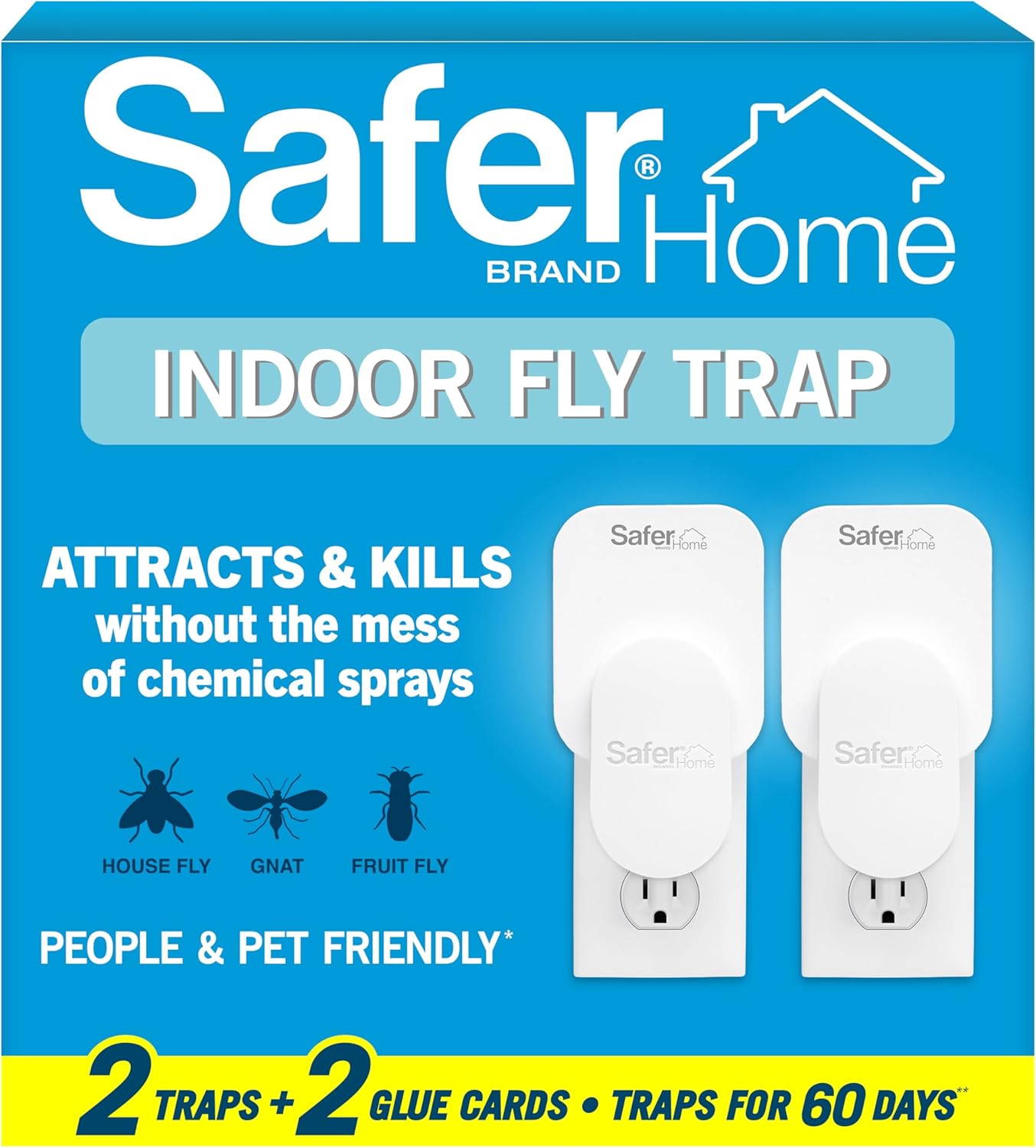
Safer Home Indoor Plug-In Fly Trap, 2-Pack (with 2 Glue Cards)
| Target Species | Fly |
|---|---|
| Power Source | ac |
| Unit Count | 4 Count |
| Material Type | Glue, Plastic |
The Safer Home Indoor Plug-In Fly Trap is a simple, low-effort solution for reducing flying insects around the house. You plug each compact unit into a standard outlet, insert a StickyTech glue card, and the UV-LED light attracts flies, fruit flies, moths, and gnats onto the adhesive where they stay until you replace the card. The rotating plug and small profile make it easy to position near kitchens, houseplants, pet areas, or entryways without standing out. Each glue card is rated up to 30 days of use and the two-device pack covers about 800 sq ft, so it can protect multiple rooms or provide backup while cards are swapped. Because it does not use chemical insecticides, it is a practical choice for households with children or pets when used as directed. Limitations to expect are routine maintenance to replace full cards and reduced effectiveness in very large or heavily infested spaces where multiple units or additional pest measures may be necessary.
Best for: Homeowners who want a low-maintenance, non-chemical way to reduce flying insects around living spaces and prefer discreet, plug-and-play devices that blend with décor.
Less Ideal for: People needing immediate control for large-scale infestations or those who require cordless placement far from outlets should consider higher-capacity or alternative solutions.
- Chemical-free operation using UV-LED light and glue cards, safer around children and pets when used as directed
- Plug-in rotating design fits any standard outlet and is easy to position discreetly
- StickyTech glue cards last up to 30 days and are designed to catch more insects than generic cards
- Two devices in the pack provide coverage for up to 800 sq ft for multi-room protection
- Requires regular replacement of glue cards and disposal of trapped insects
- Effectiveness drops in very large rooms or extremely heavy infestations without additional units
- Needs power outlet access which limits placement options
Verdict: A practical, family-friendly plug-in trap that delivers chemical-free, around-the-clock control of common indoor flying pests for typical homeowner needs.
Dwcom 40‑Pack Yellow Sticky Fungus Gnat and Fruit Fly Traps

| Unit Count | 40 Count |
|---|---|
| Target Species | fungus gnats, whiteflies, thrips, fruit flies, midges, mosquitoes |
| Material Type | Plastic |
| Power Source | Manual |
These yellow sticky traps are a low‑tech, low‑cost way to reduce fungus gnats and small flying pests around potted plants and kitchen areas. Each thin plastic card is coated on both sides with a strong, waterproof adhesive and a peel‑off protective film; the cards can be stuck into potting soil or hung near problem areas. The bright yellow color attracts tiny pests like fungus gnats, whiteflies and fruit flies, and the UV‑resistant glue is intended to hold up outdoors and in humid conditions. Because the pack contains 40 pieces in simple shapes, it is easy to distribute them across many plants or replace saturated traps quickly. Limitations are that they only attract flying insects that respond to color, so they will not address soil larvae or larger flies, and traps require periodic replacement once fully covered. Also keep traps out of reach of children and pets due to the sticky surface. For routine, budget‑focused gnat control around houseplants and kitchen fruit, these traps offer a simple, odorless option.
Best for: Buyers who want an inexpensive, no‑mess way to reduce visible fungus gnats and fruit flies on many potted plants or around the kitchen without using pesticides.
Less Ideal for: Gardeners seeking a comprehensive infestation solution that targets larvae or heavy infestations should choose systemic or soil treatments instead.
- Large 40‑piece pack provides coverage for many plants or repeated replacement
- Non‑toxic and odorless so safe for indoor use when positioned away from children and pets
- Double‑sided, waterproof adhesive that is UV resistant for outdoor durability
- Bright yellow color effectively attracts small flying pests like gnats and fruit flies
- Only captures flying adults attracted to color and does not eliminate larvae in soil
- Sticky surface can be messy and must be kept away from hands, pets, and children
Verdict: A high‑value bulk pack of non‑toxic yellow sticky cards that gives budget buyers an easy, odorless way to catch adult fungus gnats and fruit flies across many plants.
ELEGENZO DIY Fruit Fly Trap Kit with Reusable Escape-Proof Trap and Sticky Sheets

| Brand | ELEGENZO |
|---|---|
| Unit Count | 1 Count |
| UPC | 810228386998 |
| Manufacturer | ELEGENZO |
This ELEGENZO kit is built to make indoor fruit fly control simple and tidy. The system pairs a small reusable escape-proof trap and a dedicated bait cup with ten adhesive sheets so flies are caught either by entering the bait or landing on the sticky surface. You supply a common kitchen bait such as apple cider vinegar, red wine, or sweet tea, which keeps the method transparent and lets you change recipes as needed. The kit is intended for countertop or pantry placement and eliminates the need for open bowls or improvised containers, reducing mess. Notable features include the dual-capture design that increases chances of catching both attracted and hovering flies and the reusable components that cut down waste. Limitations to note are that you must refresh bait and replace sticky sheets periodically and the trap is sized for localized indoor use rather than large infestations or outdoors. For a reliability-focused buyer this kit is convenient, low-maintenance, and predictable when traps are maintained on a schedule.
Best for: Buyers who prioritize a dependable, low-mess indoor solution for spot control of fruit flies and who will maintain bait and sheets on a regular schedule.
Less Ideal for: People dealing with large-scale infestations, outdoor fruit fly problems, or those seeking an entirely maintenance-free, long-term extermination method.
- Dual-capture design combines bait cup and adhesive sheets to catch flies that enter or hover
- Reusable escape-proof trap reduces spills and repeated makeshift setups
- Includes bait cup and simple bait recipes so you can use common household ingredients
- Compact, tidy kit designed for kitchen counters and pantries
- Sticky sheets and bait require regular replacement and refresh to stay effective
- Not intended for large heavy infestations or outdoor use
Verdict: A compact, reusable dual-capture kit that gives reliable indoor spot control when bait and sticky sheets are refreshed regularly.
TERRO Fruit Fly Trap 4-Pack (180-Day Lure Supply)

| Unit Count | 4 Count |
|---|---|
| Target Species | Fly |
| Power Source | manual |
| Material Type | Plastic |
The TERRO Fruit Fly Trap is a simple, low-effort solution for indoor fruit fly problems. Each apple-shaped trap comes prefilled with a non-staining liquid bait that draws adult fruit flies through funnel-shaped entry holes where they cannot escape. Typical use is to place traps near likely breeding spots such as fruit bowls, sinks, garbage areas, or countertops; visible results are often noticeable within days. Notable features include a discreet apple design that blends into a kitchen, a built-in window to monitor captures and lure level, and a long-lasting bait that the manufacturer states provides up to 45 days per unit for a 180-day supply across the four traps. Practical benefits are that they require no mixing or electricity, are mess-free, and can be positioned wherever flies congregate. Limitations are that these traps target adult flies rather than larvae in hidden breeding sites, so effective control depends on locating and removing sources of breeding, and heavy infestations may require multiple placements or repeated cycles to fully suppress populations.
Best for: Homeowners who want a low-effort, visible indoor solution to reduce fruit fly activity and prefer straightforward products with an established track record.
Less Ideal for: People dealing with severe multi-room infestations or commercial food-preparation settings that need professional-grade or large-scale pest control methods.
- Ready-to-use liquid lure attracts and traps adult fruit flies without mixing or setup
- Designed to blend into kitchens with apple-shaped appearance and a monitoring window
- Long-lasting bait advertised to provide up to 45 days of protection per trap
- Mess-free, manual operation with no chemicals to spray or power required
- Only captures adult flies and will not eliminate larvae hidden in drains or trash
- Effectiveness depends on placing traps near breeding sites so some trial placement may be needed
Verdict: An easy, no-fuss indoor trap kit that offers visible, long-lasting control of adult fruit flies for homeowners seeking a simple preventive solution.
ZEVO Flying Insect Trap Starter Kit (Plug-In Base + Refill)

| Target Species | Fly, Fruit Fly, Gnat |
|---|---|
| Power Source | Electric |
| Unit Count | 2 Count |
| Material Type | Plastic |
The ZEVO Flying Insect Trap is a compact plug-in unit designed for continuous indoor use to reduce small flying pests around kitchens, bathrooms, and indoor plants. It uses blue and UV light to lure flies and gnats into a disposable adhesive cartridge so insects are captured quietly and out of sight on the wall-facing glue pad. Setup is simple — plug the base in, slide in a cartridge, and position the device near likely insect sources such as fruit bowls, trash, or potted plants. Notable features include a no-mess removal tab, a blinking reminder to check the cartridge about every six weeks, and a chemical-free, odor-free design that is safe for occupied rooms when used as directed. Practical benefits are low ongoing noise, no zapping or sprays, and discreet continuous protection. Limitations are that it targets small flying insects rather than larger pests, requires regular cartridge replacement, and is intended for indoor coverage so multiple units may be needed for larger rooms.
Best for: Buyers who want a low-risk, everyday indoor solution to reduce fruit flies, gnats, and house flies without chemicals or loud zappers and who prefer a discreet, continuous trap in kitchens and living areas.
Less Ideal for: People needing fast knockdown of larger flies, mosquitoes, or broad multi-room coverage from a single device should consider more powerful or different-style solutions.
- Chemical-free, odor-free capture using blue and UV light
- No-mess disposable adhesive cartridge with removal tab
- Quiet continuous operation suitable for occupied rooms
- Easy plug-in setup and a blinking reminder for cartridge checks
- Designed for small flying insects only and not effective on larger pests
- Requires periodic purchase and replacement of adhesive cartridges
Verdict: A convenient, low-risk plug-in trap that provides quiet, chemical-free day-and-night control of small indoor flying pests.
Choosing the Right Fruit Fly Trap for Kitchen: Key Factors to Consider
Attractant Type and Strength
How a trap lures fruit flies determines how quickly it reduces adult numbers. Some traps use fermenting fruit or vinegar-based baits that mimic rotting food, which can be very effective in a kitchen where food odors are present. Other designs rely on non-toxic chemical attractants formulated to be more consistent across temperatures. Consider whether you prefer a simple, refillable bait you make yourself or a preloaded attractant that lasts longer between changes.
Attractant strength also interacts with placement. Stronger baits can pull flies from a larger area, so a single trap may suffice for an open-plan kitchen. Weaker or homemade baits work best when placed close to known breeding sites like the sink trap, trash, or fruit bowl.
Containment Design
A trap's ability to keep flies inside and prevent escape affects both effectiveness and cleanliness. Funnels and one-way entry ports let flies enter but make exit difficult, while sealed-chamber designs hold captured insects away from the kitchen environment. Some traps have removable inner cups that can be discarded or cleaned; others require manual rinsing.
Look for designs that minimize spills and splatter when you move or empty the trap. A trap with a secure lid or a pour-out spout reduces the chance of contact with bait during disposal and keeps odors contained between cleanings.
Ease of Cleaning and Maintenance
Regular emptying and sanitation keep a trap working and prevent it from becoming an additional odor source. Traps with simple disassembly, smooth surfaces, and dishwasher-safe parts are faster to maintain. If a trap uses disposable bait pods, factor in how easy replacements are to install and whether residue builds up on parts that touch food surfaces.
Kitchens demand frequent cleaning, so choose a trap that fits your cleaning habits. Hard-to-reach crevices collect grime and can reduce attractant performance over time, while modular designs let you deep-clean only the parts that need it.
Placement and Footprint
Where you can put a trap determines how effective it will be and how much it interferes with kitchen tasks. Compact traps that sit on a counter or tuck under a cabinet are handy near sinks and fruit bowls. Larger traps often have greater bait capacity but may take up valuable workspace.
Consider stability as well. A lightweight trap can be knocked over, spilling bait and reducing performance. Look for low-profile or weighted bases if you have pets, children, or busy counters.
Safety Near Food and People
Because traps are used in food-prep zones, materials and bait safety matter. Non-toxic, food-safe plastics and baits that are not volatile are preferable. Avoid traps that release strong fumes or rely on hazardous chemicals in a kitchen setting.
Also consider the risk to pets and children. A child-safe lid or out-of-reach placement prevents accidental contact with bait. Traps that trap insects away from open food reduce the chance of contamination.
Refill Interval and Runtime
How often you need to replenish bait or clean a trap affects long-term convenience. Some traps use disposable cartridges that last weeks, while others require daily topping of a homemade bait. Longer runtime reduces maintenance but may be less flexible if attractant strength wanes over time.
Think about seasonal changes too. In warmer months fruit fly activity rises and you may need to refresh bait more often. Choose a trap whose refill schedule matches how much time you want to spend on upkeep.
Where to Place a Trap in the Kitchen
Placement is the single biggest practical factor in whether a trap performs. Put traps near likely breeding or feeding sites such as fruit bowls, the sink area, beneath dish drains, or next to the compost container. These locations intercept adult flies before they spread into living spaces.
Avoid placing traps directly next to open food or on high-traffic counters where they can be knocked over. If you have multiple hotspots, one trap per zone is often more effective than one trap in the center of a room.
- Near ripening fruit but not on the same surface as food prepped for immediate use
- Close to sinks and drains where fermenting residue accumulates
- By the indoor compost or trash can with a secure floor placement
Homemade Baits Versus Commercial Refills
Homemade baits like apple cider vinegar mixed with a drop of dish soap are cheap and effective in many situations. They are easy to mix and adjust based on how attractive they are in your kitchen. However, they need more frequent replacement and can leave sticky residue when emptied.
Commercial refills and preloaded attractants offer consistent performance and less frequent maintenance. They can be more convenient for busy households but require you to stock replacement cartridges. Evaluate whether convenience or DIY control fits your routine.
- DIY bait: low cost, frequent replacement, may be messier
- Commercial refill: consistent lure strength, less frequent changes
Managing Odor and Aesthetic Impact
Because kitchen traps sit near food prep, you may be sensitive to lingering smells. Look for traps that contain odors inside a sealed chamber or have carbon-filtered vents. Transparent containers let you see when the trap is full but may also display trapped insects, which some homeowners dislike.
Consider a compact, discreet design if the trap will be in plain sight. Some traps blend with countertop accessories and reduce visual impact while still functioning effectively.
- Sealed designs reduce odor escape
- Opaque containers hide captured insects
- Low-profile models minimize visual clutter
Combining Traps With Sanitation
Traps are most effective when used alongside basic sanitation. Regularly clear overripe fruit, rinse food scraps from drains, and keep compost containers sealed to reduce breeding sites. Traps accelerate control of adult flies but will not solve an infestation if breeding sources remain unchecked.
Inspect common problem areas periodically and move traps as needed. When you eliminate the source and use traps to catch adults, populations decline faster and require fewer maintenance cycles.
- Clean drains and disposal areas weekly
- Seal or refrigerate ripe fruit
- Empty indoor compost frequently
Seasonal and Situational Adjustments
Fruit fly pressure changes through the year and with household habits. Warmer months and increased fruit consumption raise activity, so plan for more frequent bait refreshes or additional traps during those times. When entertaining or cooking more frequently, move traps out of the way but keep them near likely hotspots.
If you live in a small apartment, a single well-placed trap often suffices. In larger kitchens or open-plan layouts, distribute traps across zones to prevent migration.
- Add extra traps during warm months
- Adjust bait strength if activity spikes
- Spread traps across zones in open layouts
How We Chose the Best Fruit Fly Trap for Kitchen
We evaluated options based on characteristics that matter in real kitchens. Attractant effectiveness measured how reliably a trap draws adult fruit flies under typical kitchen conditions such as ripening fruit, drains, and compost bins. Containment and seal quality looked at how well flies are kept inside without escape or mess, which is important near food prep areas. Ease of cleaning and refill assessed how quickly a trap can be emptied, scrubbed, or refilled without contaminating counters. Safety and materials covered non-toxic bait options, food-safe plastics, and the absence of volatile chemicals that would affect kitchen air. Usability factors included size, stability on a counter, and whether the trap design interferes with routine kitchen tasks. We excluded outdoor-only devices, sticky traps intended for walls, and industrial insect control equipment unsuitable for domestic kitchens. The final shortlist contains traps that balance strong attraction with secure containment and low maintenance for everyday kitchen use.
FAQ
How long does a trap take to work in a kitchen?
Most traps start catching adult fruit flies within 24 to 48 hours if properly placed near breeding sites. Population reduction takes longer because traps do not affect eggs and larvae already in drains or compost.
Are homemade vinegar traps safe to use near food?
Yes. Vinegar-based baits are non-toxic and safe around food when the trap is contained and not spilled. Clean the area after emptying a trap to remove residue and avoid attracting more flies.
Can I use a trap to completely eliminate an infestation?
Traps help reduce adult numbers quickly but are most effective when combined with sanitation that removes breeding sites. Eliminating eggs and larvae in drains and compost is necessary for full control.
How often should I replace bait or clean the trap?
Replacement frequency depends on attractant type and activity levels. Homemade baits typically need changing every few days, while commercial refills can last several weeks. Clean the trap whenever you notice residue buildup or a drop in capture rates.
Is a sealed trap better than a sticky trap for kitchen use?
Sealed traps that contain bait and captured flies are generally more hygienic and better suited for kitchens than sticky traps, which can collect dust and may adhere to non-target items. The best choice depends on your tolerance for visible catches and ease of disposal.
Can traps harm pets or children?
Most kitchen fruit fly traps use non-toxic baits and are safe around pets and children when placed out of reach. Choose designs with secure lids to prevent accidental contact and avoid leaving traps in areas where they can be tipped over.
Final Verdict
Prioritize traps that balance strong attraction with secure containment and easy maintenance for kitchen use. Placement and sanitation are as important as the trap itself: a well-placed, regularly emptied trap near sinks, fruit bowls, or compost will cut adult populations quickly. Tradeoffs include bait longevity versus refill convenience and visible catches versus odor containment. Choose the style that fits your cleaning habits and kitchen layout to gain fast, low-mess control.
