

Note: This article contains affiliate links. If you click on these links and make a purchase, I may earn a small commission at no extra cost to you. This helps support my research and content. Read my full affiliate disclosure here.
Roses are prone to recurring fungal problems that can defoliate bushes, reduce blooms, and weaken plants over a season. Choosing the right systemic fungicide for roses matters because these products move inside tissue to protect new growth and reduce repeat sprays in an active garden. This guide covers six shortlisted systemic options that perform well across common rose diseases and various garden settings. We evaluate residual activity, plant safety, and ease of application to help you pick a product that fits your maintenance schedule and risk tolerance. Read on for practical notes on use, timing, and safety before the product list.
Top Picks at a Glance
| Best Overall The best all-around choice for most situations | Bonide Rose Rx Systemic Drench Concentrate, 32 oz |  |
| Best Quality Built to a higher standard if you want something more solid | VivaGrow Reliant Systemic Fungicide, 32 oz |  |
| Best Value The sweet spot between price and what you get | BioAdvanced All‑in‑One Rose & Flower Care Concentrate, 32 oz |  |
| Best Budget The cheapest option that still gets the job done reliably | Bonide Infuse Systemic Disease Control Concentrate, 16 oz |  |
| Highest Rated A top-rated pick with lots of positive feedback | Monterey Fungi-Max Systemic Fungicide, 16 oz (with Measuring Spoon) |  |
| Best Seller A high-volume bestseller chosen again and again | BioAdvanced All-in-One Rose & Flower Care Granules, 64 oz |  |
Bonide Rose Rx Systemic Drench Concentrate, 32 oz
| Unit Count | 32 Ounce |
|---|---|
| Included Components | Bonide Rose Rx Systemic Drench Concentrate, 32 oz |
| Target Species | Insects |
| Liquid Volume | 32 fluid ounces |
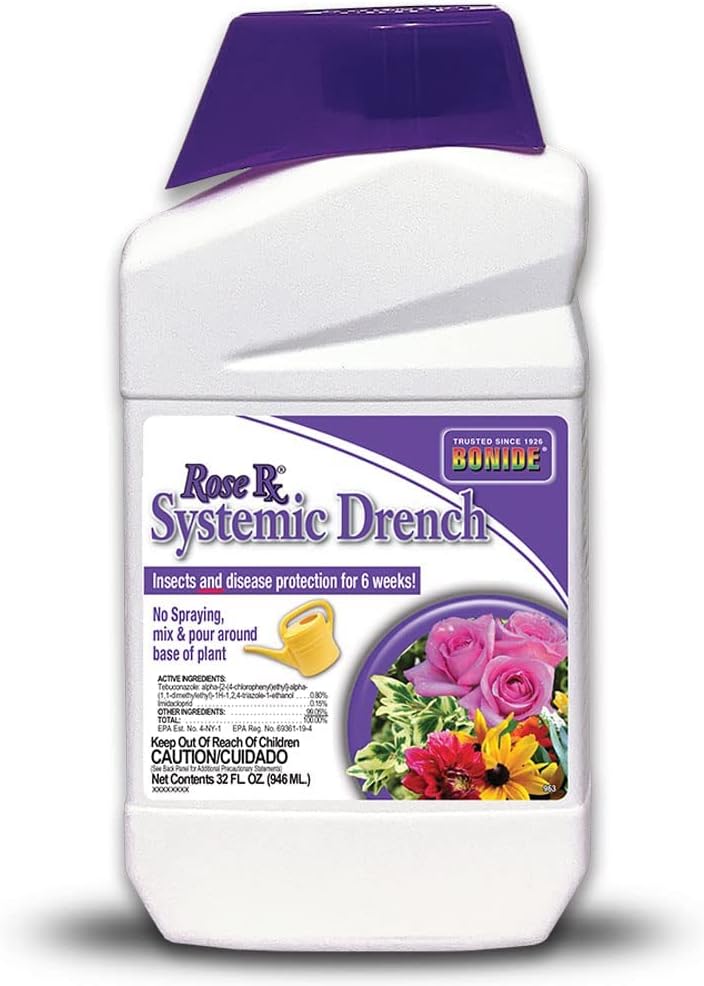
Bonide Rose Rx Systemic Drench is a concentrated soil drench designed to protect roses, flowering shrubs and mixed flowerbeds from both insects and diseases. You mix the concentrate with water and pour it at the base of plants rather than spraying, which makes application simple and reduces drift onto blooms and foliage. The systemic action moves through the plant to target pests such as aphids and Japanese beetles and common foliar diseases like black spot and powdery mildew. One quart treats up to about 16 roses and repeat applications every six weeks give season-long protection when used as directed. The no-spray format is convenient for gardeners who prefer minimal spray exposure, but because the product can harm bees and other pollinators you must avoid applying while pollinators are active. Also, this product is formulated for insect and disease control together rather than specialized, high-strength fungicide-only control for severe fungal outbreaks.
Best for: Gardeners who want a simple, low-effort option to protect roses and mixed ornamentals from both insects and routine fungal issues and who prioritize convenience over targeted spray programs.
Less Ideal for: Organic gardeners seeking pollinator-safe treatments and people dealing with severe or resistant fungal outbreaks who need a dedicated high-strength fungicide.
- Systemic drench delivers multi-week protection to the whole plant after a single application
- Dual-action formula controls both common insects and fungal diseases so you treat pests and disease with one product
- No-spray application is easy to mix and pour at the plant base, reducing mess and drift
- Covers multiple plant types including roses, azaleas, camellias and flowerbeds, making it versatile for mixed borders
- Not selective for pollinators so must not be applied while bees are active
- Not marketed as a specialized fungicide for severe or resistant fungal problems
Verdict: Use this pour-on systemic drench when you want simple, multi-week protection for roses and ornamentals against common insects and diseases without spraying.
VivaGrow Reliant Systemic Fungicide, 32 oz

| Item Form | Liquid |
|---|---|
| Special Features | organic |
VivaGrow Reliant is a concentrated systemic fungicide sold as a liquid concentrate that you dilute and apply as a foliar spray or soil drench. It is quickly absorbed through leaves and roots and moves through the plant to provide both curative action on existing infections and protective activity on new growth. The label lists control for common rose problems such as downy mildew, leaf spots, blights, scabs and root rots, making it suited to disease-prone beds. Because it activates the plant's natural defenses, you can expect broader protection than with many contact sprays and fewer reapplications when used correctly. It is EPA-approved as a biorational product and described as having minimal environmental impact, but you should follow label precautions and rates carefully since it is a concentrated professional-style formulation. Reliant is best used by gardeners who want proactive, season-long disease control for roses and are comfortable mixing and applying concentrated products.
Best for: Gardeners focused on reliable disease control for roses who prioritize effectiveness and are comfortable handling concentrated, professional-style treatments.
Less Ideal for: Casual gardeners who prefer ready-to-use products or those unwilling to follow label mixing and safety instructions should consider simpler alternatives.
- Systemic action distributes through foliage and roots for curative and protective control
- Controls a broad list of pathogens relevant to roses including downy mildew, leaf spots and root rots
- Concentrated formula mixes with water for foliar spray or drench applications to suit different situations
- Approved by the EPA Biopesticide Division and described as having minimal environmental impact
- Concentrated product requires careful measuring and mixing to avoid overapplication
- Not a ready-to-use spray so it adds preparation time compared with consumer spray bottles
Verdict: Buy this if you want a concentrated, systemic fungicide that provides curative and protective disease control for roses when applied correctly.
BioAdvanced All‑in‑One Rose & Flower Care Concentrate, 32 oz

| Item Form | Liquid |
|---|---|
| Liquid Volume | 32 fluid ounces |
| Active Ingredients | Imidacloprid, Tebuconazole |
| Target Species | Insects |
This BioAdvanced All‑in‑One Rose & Flower Care is a concentrated liquid designed to simplify rose care by combining fertilizer, insect control, and fungicide in a single pour‑in application. You mix the concentrate with water and apply to soil around roses and other flowering shrubs; the systemic formula is taken up through roots so it is rainproof and protects plants for up to six weeks. Notable features are its dual active ingredients, imidacloprid for insect control and tebuconazole for disease suppression, and a formulation targeted at common rose problems such as aphids and black spot. In practice it helps reduce visible fungal symptoms while also feeding plants to encourage stronger roots and better blooms, which is useful when you want broad protection without multiple products. Important limitations are that the product contains systemic insecticide (so follow label safety and pollinator guidance) and it is not approved for sale in several states, so check local restrictions before purchase.
Best for: Gardeners who want a simple, low‑fuss approach to maintain healthy roses and reduce both fungal disease and insect problems without juggling multiple products.
Less Ideal for: Organic growers who avoid synthetic systemic insecticides or anyone who needs a product cleared for use in states where this formulation is restricted.
- Three functions in one bottle: fertilizer, insect control, and fungicide for simpler care routines.
- Systemic, rainproof action that protects plants for up to six weeks after application.
- Targets common rose pests and diseases including aphids and black spot.
- Concentrate form allows multiple treatments per bottle compared with ready‑to‑use sprays.
- Contains a systemic insecticide that requires careful use around pollinators and according to label restrictions.
- Not sold in certain states, so availability and legality vary by location.
Verdict: A convenient 3‑in‑1 concentrate that treats black spot and other rose diseases while feeding plants, ideal for gardeners who want broad, low‑effort protection.
Bonide Infuse Systemic Disease Control Concentrate, 16 oz

| Item Form | Spray |
|---|---|
| Target Species | Disease |
| Liquid Volume | 16 fluid ounces |
Bonide Infuse is a propiconazole-based systemic concentrate designed to prevent and treat common fungal diseases on lawns and ornamentals, including roses. You mix 1 to 2 tablespoons per gallon of water in a sprayer and coat plants or turf; the systemic action helps move the active ingredient through the plant for longer protection and it becomes rainproof after application. The concentrate format stretches a little product across many applications and the label lists control for over 30 diseases such as powdery mildew, rust, leaf spot and blight that commonly afflict roses. Practical benefits include broad-spectrum coverage, up to four weeks of residual control, and the ability to treat large areas from a single bottle. Limitations are that it is a chemical fungicide so you must follow label safety instructions, it requires mixing and sprayer equipment, and timing is important since best results come when applied at the first signs of disease.
Best for: Gardeners who want an affordable, concentrated systemic fungicide to treat and prevent common fungal problems on roses and other ornamentals and who are comfortable mixing product and using a sprayer.
Less Ideal for: Those who prefer organic or contact-only treatments, or gardeners unwilling to handle concentrated chemicals and follow label safety instructions.
- Systemic propiconazole formula that moves through plant tissue for longer protection
- Controls over 30 listed diseases relevant to roses such as powdery mildew and leaf spot
- Concentrated bottle mixes to treat large areas, making it economical per treatment
- Provides up to four weeks of residual control when used as directed
- Requires dilution and a sprayer which adds prep and equipment needs
- Chemical formulation requires careful adherence to label safety and use restrictions
Verdict: A concentrated, economical systemic fungicide that delivers broad, long-lasting control of the fungal diseases that commonly threaten roses.
Monterey Fungi-Max Systemic Fungicide, 16 oz (with Measuring Spoon)
| Item Form | Liquid |
|---|---|
| Application Method | Spray |
| Coverage | Wide range of plants and plant types |
| Target Species | Flowers, Vegetables, Trees, Lawn Grass |
| Liquid Volume | 16 fluid ounces |
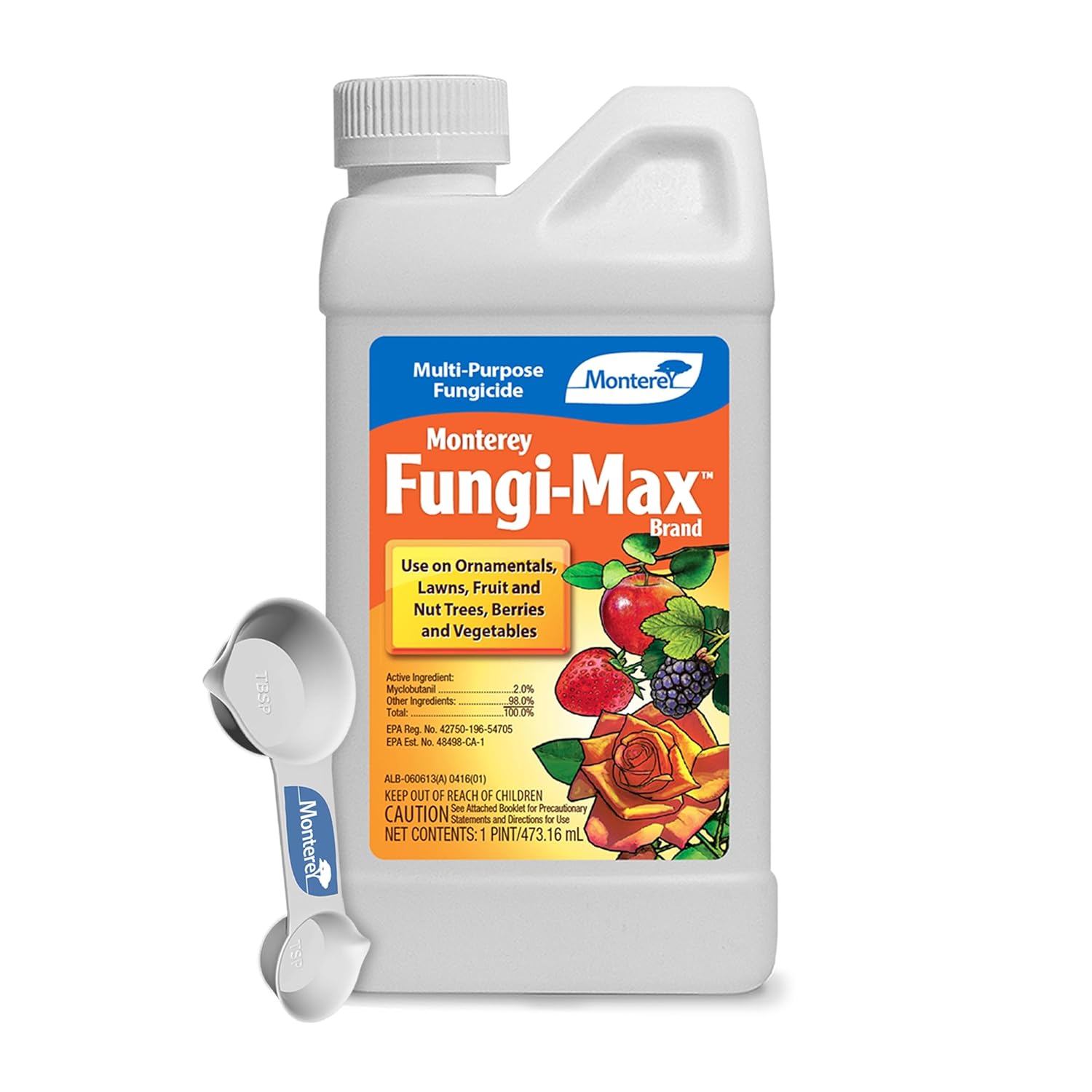
Monterey Fungi-Max is a concentrated liquid fungicide that you dilute and apply with a sprayer to prevent and control many common plant diseases. It is used outdoors on flowers, shrubs, trees, lawns and edible plants including vegetables and fruiting trees; for tomato growers it is intended to control leaf spots, blights and powdery mildew when applied at the first sign of disease. The product’s systemic action means it is absorbed and provides residual protection for up to two weeks, which reduces how often you need to spray during an outbreak. A measuring spoon is included to help with mixing and the spray application method works with standard pump or backpack sprayers. Important limitations are that it must be mixed and applied correctly according to the label and it is not listed as organic, so it may not suit organic-certified operations; also coverage on large plantings requires multiple bottles. For gardeners who want a reliable, easy-to-use fungicide to protect tomatoes and other outdoor plants, Fungi-Max delivers predictable, short-term disease control when applied promptly.
Best for: Gardeners who prioritize reliable, fast-acting disease control for outdoor tomato beds and mixed orchards and who want a product that gives measurable residual protection between applications.
Less Ideal for: Growers who require organic-certified products or those managing very large commercial tomato plantings where bulk coverage and cost per acre are primary concerns.
- Systemic action provides plant uptake and up to two weeks of protection per application.
- Broad labeled coverage for many plant types including vegetables and fruit trees.
- Liquid concentrate mixes for use with standard spray equipment for even coverage.
- Includes a measuring spoon to simplify accurate dilution amounts.
- Not listed as organic so unsuitable for certified organic production.
- One bottle may not cover large tomato plantings without repeated purchases.
Verdict: For home tomato growers seeking dependable, systemic disease control that reduces spray frequency, Monterey Fungi-Max is a practical, easy-to-use choice.
BioAdvanced All-in-One Rose & Flower Care Granules, 64 oz

| Unit Count | 64 Ounce |
|---|---|
| Item Form | Granules |
| Target Species | Insects |
| Specification Met | EPA |
BioAdvanced All-in-One Rose & Flower Care is a granular, three-in-one product that combines fertilizer, insect control, and fungicide into a single application for roses and other flowering shrubs. You apply the granules around the base of the plant, pulling back mulch first, and the systemic formula is taken up by roots so no spraying is required and protection remains effective through rain for up to six weeks. Notable features include a balanced N-P-K analysis and active ingredients (acephate and tebuconazole) that target common pests like aphids and leafhoppers while reducing fungal issues such as black spot and powdery mildew. For a gardener seeking convenience, this simplifies routine rose care by reducing separate feeding and spray steps and helps maintain stronger roots and better blooms. The main limitations are that it contains conventional active ingredients that some gardeners may wish to avoid and it is formulated for listed pests and diseases rather than every possible problem, so you should follow label directions and local regulations when using it.
Best for: Gardeners who want a straightforward, low-effort way to feed roses and reduce common insect and fungal problems with a single seasonal application.
Less Ideal for: People who prioritize organic or all-natural products or who need treatments for pests or diseases not listed on the label.
- Combines fertilizer, insect control, and disease control in one granular application
- Systemic, rainproof formula provides protection for up to six weeks
- Easy to apply around the plant base with no spraying required
- Targets common rose pests and diseases, helping improve blooms and plant health
- Contains conventional pesticides and fungicides that may not suit organic gardeners
- Protection covers only listed pests and diseases and requires correct placement and timing
Verdict: Choose this product when you want a convenient single-product solution to feed roses and provide multiweek, rainproof insect and disease protection.
Choosing the Right Systemic Fungicide for Roses: Key Factors to Consider
Residual Activity and Reapplication Interval
Residual activity determines how long a systemic fungicide continues to protect new growth after application. Longer residuals reduce how often you need to reapply during the growing season, which is important for labor and for reducing the number of chemical events on ornamental roses.
Consider seasonal disease pressure and rainfall patterns. In wet springs you may need products with longer residuals or expect more frequent reapplication. Also check label guidance for maximum seasonal use to avoid overapplication and prevent resistance build-up.
Spectrum of Disease Control
Different systemic fungicides control different fungal pathogens. Some are formulated primarily for black spot and anthracnose, while others also suppress powdery mildew, rust, or botrytis. Choose a product whose labeled target list matches the common diseases in your area and the problems your roses have shown.
If multiple diseases occur in one season, either rotate systemic modes of action or combine systemic control with targeted cultural practices to reduce reliance on any single active ingredient.
Plant Safety and Phytotoxicity
Not all systemic fungicides are equally safe on all rose varieties or under all environmental conditions. Phytotoxicity risk can increase with high temperatures, overly rapid translocation in stressed plants, or mixing incompatible tank partners.
Check label warnings for sensitive cultivars, maximum concentration, and temperature restrictions. Test any new product on a small area or single plant before treating a full bed, especially when roses are under drought or transplant stress.
Application Method and Timing
Systemic fungicides can come as concentrates for dilution, ready-to-use sprays, or granular forms for soil uptake. Spray applications treat foliage and stems directly while soil drenches rely on root uptake and movement. Choose a method that fits your routine and plant staging.
Timing matters: apply preventatively or at first signs of disease aggression according to label timing. Some systemic actives work best when given before heavy disease onset, while others have curative effects if applied early in an infection cycle.
Resistance Management
Systemic fungicides often have single-site modes of action, which increases the risk of pathogens developing resistance. Effective programs rotate fungicide classes, alternate modes of action, and incorporate nonchemical practices like improving air circulation and removing infected leaves.
Follow label limits on seasonal applications, avoid consecutive sprays of the same active ingredient, and use tank mixes or alternation strategies recommended by extension resources to prolong product effectiveness.
Label Directions and Garden Compatibility
Clear label instructions are essential for safe and effective home-garden use. Labels should specify rates for ornamental roses, reentry intervals, personal protective equipment, and any restrictions for pollinator-attractive blooms.
Also check compatibility with nearby plantings and whether a product can be used on roses in containers versus in-ground beds. Reliable labels make it easier to apply correctly and to stay within local regulations.
When to Use a Systemic Versus a Contact Fungicide
Systemic fungicides move into plant tissue and can protect new leaves that emerge after application, while contact fungicides remain on surfaces and protect only the treated tissue. Use systemic products when you need internal protection for new growth or when disease has already established and you need curative activity.
Contact products still play an important role, especially in heavy rain or when immediate barrier protection is needed. Many gardeners combine a systemic schedule with occasional contact sprays during high-pressure periods to broaden protection and reduce resistance risk.
- Systemic benefits include internal protection and some curative action on early infections.
- Contact sprays are useful after heavy wash-off or for rapid spot treatment.
- Alternate modes of action over the season to avoid resistance.
Application Tips for Strong Uptake and Coverage
For foliar-applied systemics, ensure thorough coverage of undersides of leaves and the crown area where new shoots emerge. Apply during cooler parts of the day to reduce evaporation and stress, and avoid applications when plants are drought-stressed or when temperatures exceed label limits.
For soil drenches, water plants well beforehand unless the label specifies otherwise, and apply to moist soil to aid root uptake. Follow volume recommendations so active ingredients move to the root zone without runoff.
- Spray in early morning or late afternoon for best uptake.
- Avoid spraying during direct midday sun or when temperatures are extreme.
- Do not mix with incompatible products; check label tank-mix guidance.
Integrating Cultural Controls with Chemical Programs
Chemical control is most effective when combined with cultural practices that lower disease pressure. Prune for air circulation, space plants to reduce humidity, remove and dispose of heavily infected leaves, and maintain balanced fertility to avoid soft, disease-prone growth.
Good sanitation lowers the inoculum load and can lengthen the effective life of systemic fungicides, reducing the number of interventions needed across the season.
- Regularly remove fallen leaves and spent blooms to reduce fungal reservoirs.
- Improve airflow with judicious pruning and correct spacing.
- Avoid excessive nitrogen late in the season to reduce tender flushes susceptible to infection.
Safe Handling and Pollinator Considerations
Follow label personal protective equipment recommendations during mixing and application. Keep bees and beneficials in mind: some systemic products can be translocated into nectar or pollen depending on the active ingredient and timing.
Apply during periods of low pollinator activity, avoid spraying open blooms if label restrictions apply, and observe reentry intervals to protect household members and pets.
- Wear gloves, long sleeves, and eye protection when handling concentrates.
- Do not apply to blooming roses unless the label explicitly allows it.
- Respect reentry intervals and keep pets away from treated areas until safe.
Common Mistakes to Avoid
Common errors include applying systemics only once and assuming season-long control, exceeding label rates in hopes of extra protection, and failing to rotate modes of action. These practices can harm plants, increase resistance risk, and offer a false sense of security.
Another frequent mistake is neglecting to adjust schedules when weather changes. Heavy rain, extreme heat, or drought can all reduce effectiveness or increase phytotoxicity risks. Read and follow label instructions for timing and environmental limitations.
- Do not overapply; follow label seasonal maximums.
- Avoid tank mixes unless label compatibility is confirmed.
- Adapt application frequency to weather and disease pressure.
How We Chose the Best Systemic Fungicide for Roses
Our shortlist focused on systemic fungicides that are appropriate for roses and that provide reliable control against common fungal diseases in ornamental roses. We prioritized products with demonstrable systemic activity so active ingredients move within leaf and stem tissue to protect new growth. Key evaluation dimensions were residual length, spectrum of disease control, phytotoxicity risk to roses, and application flexibility for home garden use. We also considered label clarity and directions to ensure homeowners can match rates and timing to disease pressure. Exclusions: we excluded contact-only protectants, products labeled only for commercial or non-ornamental use, and formulations with unclear home-garden directions. We did not include broad general-purpose fungicides without systemic claims. The final picks balance season-long protection, safety for established roses, and options that suit both preventative and curative programs.
FAQ
How often should I apply a systemic fungicide to roses?
Application frequency depends on the product's labeled reapplication interval and disease pressure. Often systemics are applied every 7 to 21 days under moderate pressure, but you should follow the specific label and shorten intervals only as allowed and necessary.
Can systemic fungicides be used on roses in containers?
Many systemic products have directions for container-grown ornamentals, but uptake dynamics differ due to smaller root volumes. Use lower volumes and follow label rates for containers to avoid overconcentration and root damage.
Will systemic fungicides prevent all fungal problems on roses?
Systemics reduce and sometimes cure certain infections, but they are not a universal solution. Their effectiveness depends on the active ingredient and the pathogen involved, so combine them with cultural practices and rotate modes of action for broader control.
Are systemic fungicides safe to use when roses are in bloom?
Safety during bloom depends on the product. Some labels prohibit application to open flowers because of pollinator risks or potential residue in nectar. Check the label for bloom restrictions and avoid spraying during peak pollinator activity.
How do I avoid creating resistant fungal strains?
Avoid repeated consecutive uses of the same mode of action, adhere to label limits, and integrate nonchemical measures. Rotate between fungicide classes and use contact protectants when recommended to reduce selection pressure on pathogens.
Final Verdict
Picking the right systemic fungicide for roses means balancing residual length, the diseases you need to control, and the safety profile for your plants and garden visitors. Prioritize products with clear label instructions for roses, plan rotations to limit resistance, and pair chemical control with cultural practices like pruning and sanitation. With the right schedule and attention to timing and application method, systemic fungicides can be an effective part of a holistic rose care program.
